First order hyperbolic approach for Anisotropic Diffusion equation
Pith reviewed 2026-05-24 14:52 UTC · model grok-4.3
The pith
A first-order hyperbolic reformulation of anisotropic diffusion allows construction of fifth-order schemes whose accuracy stays uniform regardless of anisotropy strength.
A machine-rendered reading of the paper's core claim, the machinery that carries it, and where it could break.
Core claim
Reformulating anisotropic diffusion as a first-order hyperbolic system and introducing an optimal length scale makes construction of a uniformly fifth-order accurate scheme independent of the anisotropy ratio straightforward, while weighted compact schemes compute gradients to matching order.
What carries the argument
First-order hyperbolic system reformulation combined with an optimal length scale that decouples scheme accuracy from anisotropy strength.
If this is right
- Gradients are obtained at fifth-order accuracy at the same time as the solution variable.
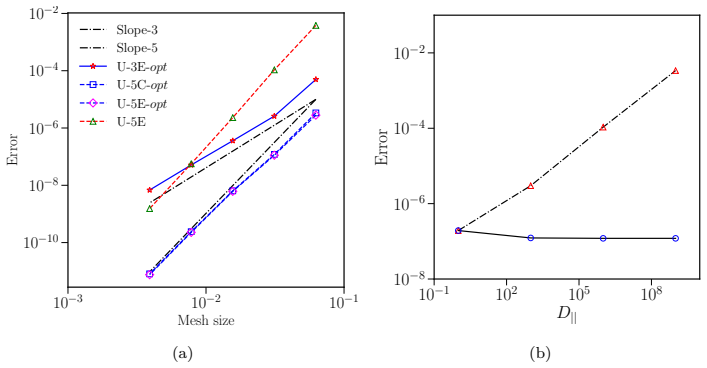
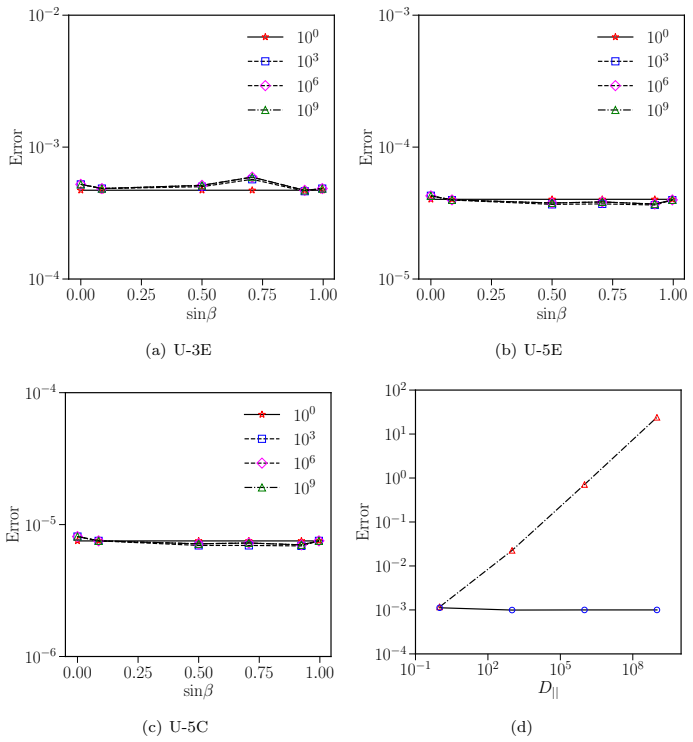
- The observed order stays five even when the anisotropy ratio becomes arbitrarily large.
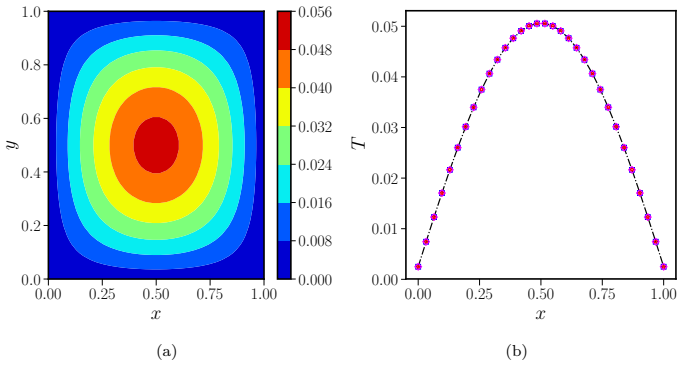
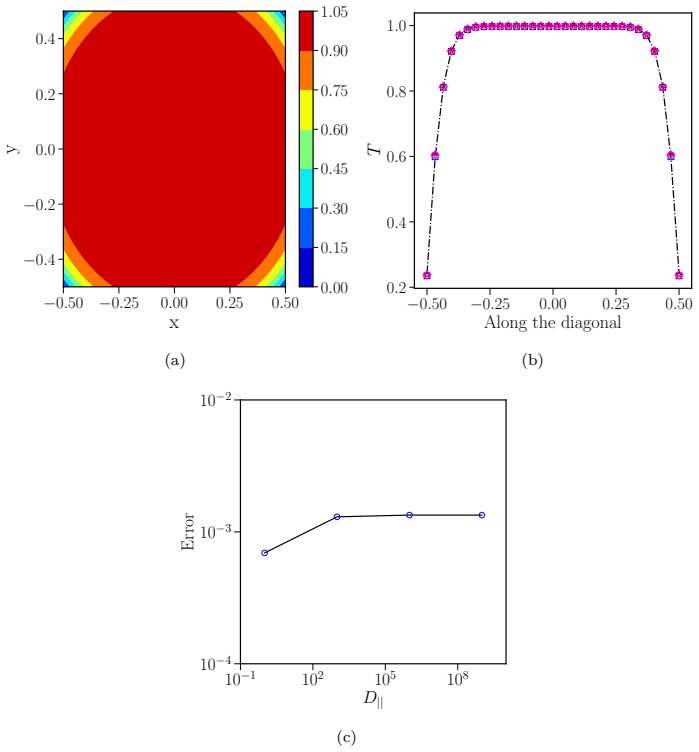
- The same length-scale choice improves accuracy on the magnetized-electron test case.
- The reformulation is expected to apply directly to other linear and nonlinear anisotropic diffusion problems.
Where Pith is reading between the lines
- The same length-scale selection may remove order reduction in other diffusion problems dominated by strong directional bias.
- Extending the length-scale choice to time-dependent or nonlinear coefficients would test whether uniformity persists beyond the linear steady case.
- Application to three-dimensional unstructured meshes would check whether the uniformity property survives loss of grid alignment.
Load-bearing premise
An optimal length scale can be identified such that the resulting scheme order remains exactly fifth regardless of the anisotropy ratio.
What would settle it
A sequence of grid-convergence studies in which the observed order of accuracy falls below five as the anisotropy ratio is increased while keeping the same length scale.
Figures

read the original abstract
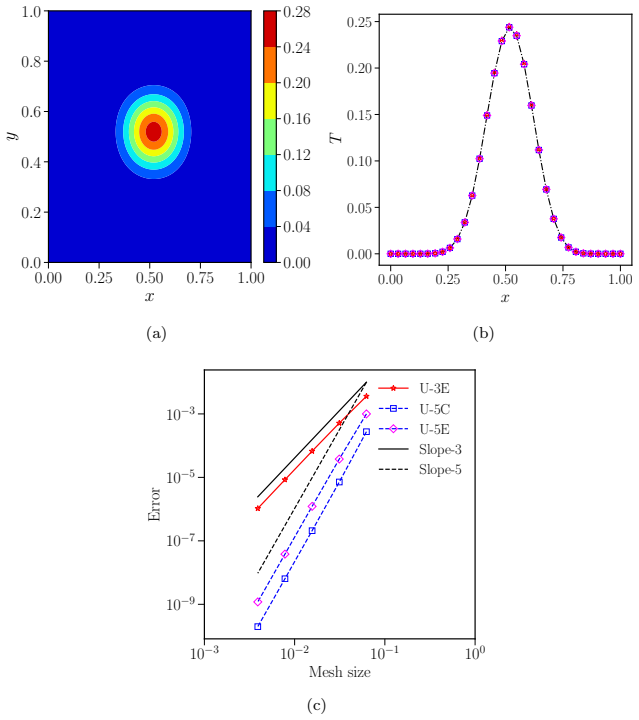
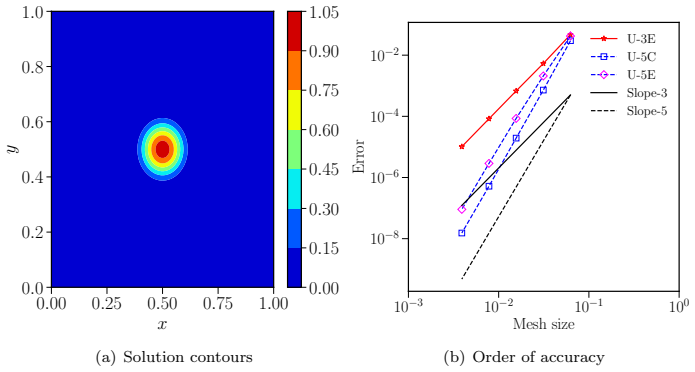
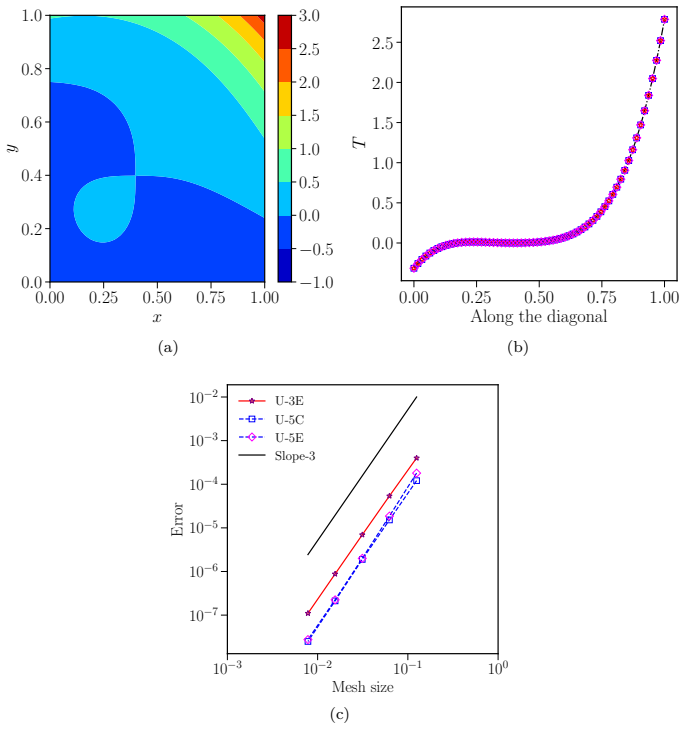
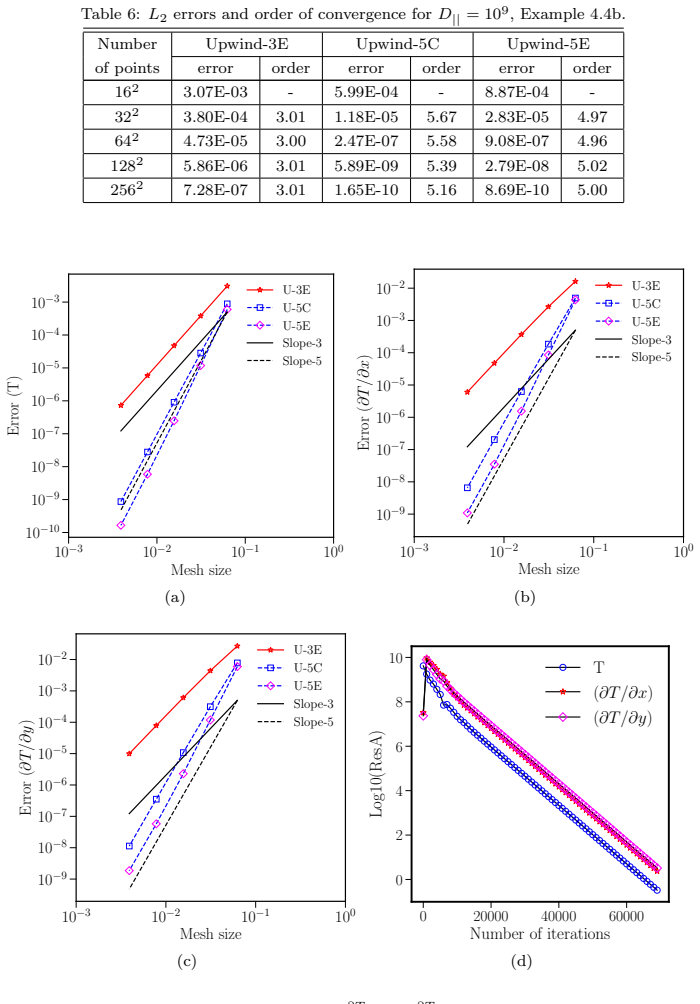
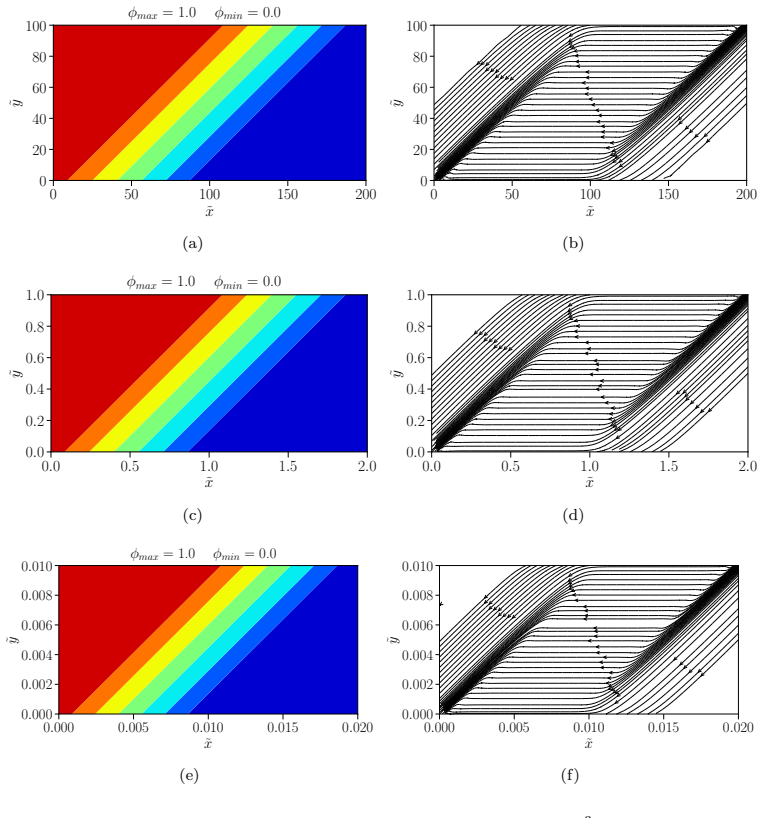
In this paper, we present a high order finite difference solver for anisotropic diffusion problems based on the first-order hyperbolic system method. In particular, we demonstrate that the construction of a uniformly accurate fifth-order scheme that is independent of the degree of anisotropy is made straightforward by the hyperbolic method with an optimal length scale. We demonstrate that the gradients are computed simultaneously to the same order of accuracy as that of the solution variable by using weight compact finite difference schemes. Furthermore, the approach is extended to improve further the simulation of the magnetized electrons test case previously discussed in Refs.[J. Comput. Phys., 284 (2015) 59-69 and 374 (2018) 1120-1151]. Numerical results indicate that these schemes are capable of delivering high accuracy and the proposed approach is expected to allow the hyperbolic method to be successfully applied to a wide variety of linear and nonlinear problems with anisotropic diffusion.
Editorial analysis
A structured set of objections, weighed in public.
Referee Report
Summary. The manuscript presents a first-order hyperbolic reformulation of the anisotropic diffusion equation solved via high-order finite difference methods. It claims that an optimal length scale makes construction of a uniformly fifth-order accurate scheme straightforward and independent of the anisotropy ratio; gradients are obtained simultaneously to the same order via compact schemes; the method is extended to the magnetized electrons test case from prior literature; and numerical results confirm high accuracy with the proposed approach applicable to linear and nonlinear anisotropic problems.
Significance. If the central claim of anisotropy-independent fifth-order accuracy holds via a single fixed length-scale choice that does not implicitly encode the diffusion-tensor eigenvalues, the work would offer a structurally robust high-order method for anisotropic diffusion, simplifying reliable simulations in plasma physics and materials modeling where anisotropy ratios vary widely.
major comments (2)
- [Abstract] Abstract: the claim that a uniformly accurate fifth-order scheme 'independent of the degree of anisotropy' is 'made straightforward' by the hyperbolic method with an optimal length scale is load-bearing for the paper's contribution, yet the abstract supplies no derivation or explicit optimality condition showing that this length scale can be chosen independently of the anisotropy ratio (e.g., without reference to the eigenvalues of the diffusion tensor) while keeping the truncation error O(h^5) for arbitrary ratios.
- [Numerical results] Numerical results section (as referenced in the abstract): the assertion that 'numerical results indicate ... uniform fifth-order behavior' is presented without tabulated convergence rates or error norms for a sequence of anisotropy ratios (e.g., 1 to 10^6) under a single fixed length-scale choice; this leaves open whether observed uniformity is structural or an artifact of per-ratio calibration.
minor comments (2)
- [Abstract] The abstract cites two prior JCP papers on the magnetized electrons test case but does not state what concrete improvements (accuracy, stability, or implementation) the new hyperbolic scheme provides over those references.
- Notation for the hyperbolic relaxation parameter (length scale) and the compact finite-difference weights should be introduced with explicit definitions before the numerical examples.
Simulated Author's Rebuttal
We thank the referee for the thoughtful review and for highlighting the need to strengthen the presentation of our central claims on anisotropy-independent accuracy. We address each major comment below and will revise the manuscript to incorporate additional details and data where appropriate.
read point-by-point responses
-
Referee: [Abstract] Abstract: the claim that a uniformly accurate fifth-order scheme 'independent of the degree of anisotropy' is 'made straightforward' by the hyperbolic method with an optimal length scale is load-bearing for the paper's contribution, yet the abstract supplies no derivation or explicit optimality condition showing that this length scale can be chosen independently of the anisotropy ratio (e.g., without reference to the eigenvalues of the diffusion tensor) while keeping the truncation error O(h^5) for arbitrary ratios.
Authors: The optimality condition for the length scale is derived in Section 3 of the manuscript via truncation error analysis of the hyperbolic relaxation system; the resulting length scale depends only on the mesh spacing and the scheme's order, with no explicit dependence on the eigenvalues of the diffusion tensor. This ensures the O(h^5) error bound holds uniformly. While the abstract is necessarily concise, we agree it should reference this independence more explicitly and will revise it to include a brief statement of the optimality condition. revision: yes
-
Referee: [Numerical results] Numerical results section (as referenced in the abstract): the assertion that 'numerical results indicate ... uniform fifth-order behavior' is presented without tabulated convergence rates or error norms for a sequence of anisotropy ratios (e.g., 1 to 10^6) under a single fixed length-scale choice; this leaves open whether observed uniformity is structural or an artifact of per-ratio calibration.
Authors: The numerical experiments in the manuscript employ a single fixed length scale (determined from the analysis in Section 3) across all tested anisotropy ratios. To make the uniformity explicit and rule out any per-ratio calibration, we will add tabulated L2 error norms and observed convergence rates for anisotropy ratios from 1 to 10^6 in the revised numerical results section. revision: yes
Circularity Check
No circularity: hyperbolic reformulation and optimal length scale presented as independent construction.
full rationale
The abstract and reader's summary describe a first-order hyperbolic system reformulation that enables a fifth-order scheme whose accuracy is claimed independent of anisotropy via an optimal length scale. No quoted equations or self-citations in the available text reduce the uniformity claim to a fitted parameter or prior self-result by construction. The length-scale choice is asserted to make the construction straightforward, but without exhibited reduction (e.g., scale selected from the same data it is used to predict), the derivation remains self-contained against external benchmarks. This is the expected honest non-finding for a methods paper whose central claim is a reformulation technique rather than a tautological fit.
Axiom & Free-Parameter Ledger
free parameters (1)
- optimal length scale
axioms (1)
- domain assumption Reformulation of the anisotropic diffusion equation into a first-order hyperbolic system preserves the original problem properties
Reference graph
Works this paper leans on
-
[1]
Braginskii, Transport processes in a plasma, Reviews of plasma physics 1 (1965)
S. Braginskii, Transport processes in a plasma, Reviews of plasma physics 1 (1965)
work page 1965
- [2]
-
[3]
P. J. Basser, D. K. Jones, Diffusion-tensor mri: theory, experimental design and data analysis–a technical review, NMR in Biomedicine: An International Journal Devoted to the Development and Application of Magnetic Resonance In Vivo 15 (7-8) (2002) 456–467
work page 2002
-
[4]
R. Marchand, M. Dumberry, Carre: a quasi-orthogonal mesh generator for 2d edge plasma mod- elling, Computer Physics Communications 96 (2-3) (1996) 232–246
work page 1996
-
[5]
L. Degtyarev, S. Y. Medvedev, Methods for numerical simulation of ideal mhd stability of axisym- metric plasmas, Computer Physics Communications 43 (1) (1986) 29–56
work page 1986
-
[6]
S. G¨ unter, Q. Yu, J. Kr¨ uger, K. Lackner, Modelling of heat transport in magnetised plasmas using non-aligned coordinates, Journal of Computational Physics 209 (1) (2005) 354 – 370
work page 2005
-
[7]
C. Sovinec, A. Glasser, T. Gianakon, D. Barnes, R. Nebel, S. Kruger, D. Schnack, S. Plimpton, A. Tarditi, M. Chu, et al., Nonlinear magnetohydrodynamics simulation using high-order finite elements, Journal of Computational Physics 195 (1) (2004) 355–386
work page 2004
- [8]
- [9]
-
[10]
A. Mentrelli, C. Negulescu, Asymptotic-preserving scheme for highly anisotropic non-linear diffusion equations, Journal of Computational Physics 231 (24) (2012) 8229–8245
work page 2012
-
[11]
L. Chac´ on, D. Del-Castillo-Negrete, C. D. Hauck, An asymptotic-preserving semi-Lagrangian al- gorithm for the time-dependent anisotropic heat transport equation, Journal of Computational Physics 272 (2014) 719–746. doi:10.1016/j.jcp.2014.04.049
- [12]
- [13]
- [14]
-
[15]
Nishikawa, A first-order system approach for diffusion equation
H. Nishikawa, A first-order system approach for diffusion equation. I: Second-order residual- distribution schemes, Journal of Computational Physics 227 (1) (2007) 315–352
work page 2007
-
[16]
Nishikawa, First-, second-, and third-order finite-volume schemes for diffusion, J
H. Nishikawa, First-, second-, and third-order finite-volume schemes for diffusion, J. Comput. Phys. 256 (2014) 791–805
work page 2014
-
[17]
Nishikawa, First, second, and third order finite-volume schemes for Navier-Stokes equations, in: Proc
H. Nishikawa, First, second, and third order finite-volume schemes for Navier-Stokes equations, in: Proc. of 7th AIAA Theoretical Fluid Mechanics Conference, AIAA Aviation and Aeronautics Forum and Exposition 2014, AIAA Paper 2014-2091, Atlanta, GA, 2014
work page 2014
-
[18]
Y. Nakashima, N. Watanabe, H. Nishikawa, Hyperbolic Navier-Stokes solver for three-dimensional flows, in: 54th AIAA Aerospace Sciences Meeting, AIAA Paper 2016-1101, San Diego, CA, 2016
work page 2016
-
[19]
A. Mazaheri, M. Ricchiuto, H. Nishikawa, A first-order hyperbolic system approach for dispersion, J. Comput. Phys. 321 (2016) 593–605
work page 2016
-
[20]
H. Baty, H. Nishikawa, Hyperbolic method for magnetic reconnection process in steady state mag- netohydrodynamics, Mon. Not. R. Astron. Soc. 459 (2016) 624–637
work page 2016
-
[21]
R. A. Watson, W. Trojak, P. G. Tucker, A simple flux reconstruction approach to solving a poisson equation to find wall distances for turbulence modelling, in: AIAA 2018 Fluid Dynamics Conference, AIAA Paper 2018-4261, Atlanta, Georgia, 2018
work page 2018
-
[22]
J. Lou, X. Liu, H. Luo, H. Nishikawa, Reconstructed discontinuous galerkin methods for hyperbolic diffusion equations on unstructured grids, in: 55th AIAA Aerospace Sciences Meeting, AIAA Paper, Vol. 310, 2017
work page 2017
-
[23]
J. Lou, X. Liu, H. Luo, H. Nishikawa, Reconstructed discontinuous galerkin methods for hyperbolic diffusion equations on unstructured grids, Communications in Computational Physics 25 (5) (2019). doi:10.4208/cicp.oa-2017-0186
-
[24]
A. S. Chamarthi, K. Komurasaki, R. Kawashima, High-order upwind and non-oscillatory approach for steady state diffusion, advection–diffusion and application to magnetized electrons, Journal of Computational Physics 374 (2018) 1120–1151
work page 2018
-
[25]
H. Nishikawa, Y. Nakashima, Dimensional scaling and numerical similarity in hyperbolic method for diffusion, Journal of Computational Physics 355 (2018) 121–143
work page 2018
-
[26]
J. Lou, L. Li, H. Luo, H. Nishikawa, Explicit hyperbolic reconstructed discontinuous Galerkin methods for time-dependent problems, in: AIAA 2018 Fluid Dynamics Conference, AIAA Paper 2018-4270, Atlanta, Georgia, 2018
work page 2018
-
[27]
H. Nishikawa, Y. Nakashima, Dimensional scaling and numerical similarity in hyperbolic method for diffusion, J. Comput. Phys. 355 (2018) 121–143
work page 2018
-
[28]
Y. Liu, H. Nishikawa, Third-order inviscid and second-order hyperbolic Navier-Stokes solvers for three-dimensional unsteady inviscid and viscous flows, in: 55th AIAA Aerospace Sciences Meeting, AIAA Paper 2017-0738, Grapevine, Texas, 2017
work page 2017
-
[29]
H. Nishikawa, New-generation hyperbolic Navier-Stokes schemes: O(1/h) speed-up and accurate viscous/heat fluxes, in: Proc. of 20th AIAA Computational Fluid Dynamics Conference, AIAA Paper 2011-3043, Honolulu, Hawaii, 2011
work page 2011
-
[30]
Nishikawa, On hyperbolic method for diffusion with discontinuous coefficients, J
H. Nishikawa, On hyperbolic method for diffusion with discontinuous coefficients, J. Comput. Phys. 367 (2018) 102–108
work page 2018
-
[31]
J. Lou, L. Li, H. Luo, H. Nishikawa, First-order hyperbolic system based reconstructed discontinuous Galerkin methods for nonlinear diffusion equations on unstructured grids, in: 56th AIAA Aerospace Sciences Meeting, AIAA Paper 2018-2094, Kissimmee, Florida, 2018
work page 2018
-
[32]
L. Li, J. Lou, H. Luo, H. Nishikawa, A new formulation of hyperbolic Navier-Stokes solver based on finite volume method on arbitrary grids, in: AIAA 2018 Fluid Dynamics Conference, AIAA Paper 2018-4160, Atlanta, Georgia, 2018
work page 2018
-
[33]
H. Nishikawa, First-, second-, and third-order finite-volume schemes for diffusion, Journal of Com- putational Physics 256 (2014) 791–805
work page 2014
-
[34]
X. Deng, H. Zhang, Developing High-Order Weighted Compact Nonlinear Schemes, Journal of Computational Physics 165 (1) (2000) 22–44
work page 2000
-
[35]
T. Nonomura, K. Fujii, Robust explicit formulation of weighted compact nonlinear scheme, Com- puters and Fluids 85 (2013) 8–18
work page 2013
-
[36]
S. K. Lele, Compact finite difference schemes with spectral-like resolution, Journal of computational physics 103 (1) (1992) 16–42
work page 1992
-
[37]
S. Nagarajan, S. K. Lele, J. H. Ferziger, A robust high-order compact method for large eddy simulation, Journal of Computational Physics 191 (2) (2003) 392–419
work page 2003
-
[38]
B. J. Boersma, A 6th order staggered compact finite difference method for the incompressible Navier-Stokes and scalar transport equations, Journal of Computational Physics 230 (12) (2011) 4940–4954. 31 URL http://dx.doi.org/10.1016/j.jcp.2011.03.014
-
[39]
G.-S. Jiang, C.-W. Shu, Efficient Implementation of Weighted ENO Schemes, Journal of Compu- tational Physics 126 (126) (1995) 202–228
work page 1995
-
[40]
X. Deng, Y. Jiang, M. Mao, H. Liu, S. Li, G. Tu, A family of hybrid cell-edge and cell-node dissipative compact schemes satisfying geometric conservation law, Computers & Fluids 116 (2015) 29–45
work page 2015
-
[41]
V. Titarev, E. Toro, Finite-volume weno schemes for three-dimensional conservation laws, Journal of Computational Physics 201 (1) (2004) 238 – 260
work page 2004
-
[42]
T. Nonomura, S. Morizawa, H. Terashima, S. Obayashi, K. Fujii, Numerical (error) issues on com- pressible multicomponent flows using a high-order differencing scheme: Weighted compact nonlinear scheme, Journal of Computational Physics 231 (8) (2012) 3181–3210
work page 2012
-
[43]
M. L. Wong, S. K. Lele, High-order localized dissipation weighted compact nonlinear scheme for shock- and interface-capturing in compressible flows, Vol. 339, Elsevier Inc., 2017. doi:10.1016/j. jcp.2017.03.008
work page doi:10.1016/j 2017
-
[44]
H. Nishikawa, P. Roe, Y. Suzuki, B. van Leer, A general theory of local preconditioning and its application to 2d ideal mhd equations, in: 16th AIAA Computational Fluid Dynamics Conference, p. 3704
- [45]
- [46]
-
[47]
R. Kawashima, K. Komurasaki, T. Sch¨ onherr, A hyperbolic-equation system approach for magne- tized electron fluids in quasi-neutral plasmas, Journal of Computational Physics 284 (2015) 59 – 69
work page 2015
- [48]
-
[49]
S. Tan, C. W. Shu, A high order moving boundary treatment for compressible inviscid flows, Journal of Computational Physics 230 (15) (2011) 6023–6036
work page 2011
-
[50]
R. Kawashima, K. Komurasaki, T. Sch¨ onherr, A flux-splitting method for hyperbolic-equation system of magnetized electron fluids in quasi-neutral plasmas, Journal of Computational Physics 310 (2016) 202–212
work page 2016
-
[51]
T. Nonomura, N. Iizuka, K. Fujii, Freestream and vortex preservation properties of high-order WENO and WCNS on curvilinear grids, Computers and Fluids 39 (2) (2010) 197–214. doi:10. 1016/j.compfluid.2009.08.005
work page 2010
-
[52]
H. T. Huynh, A flux reconstruction approach to high-order schemes including discontinuous galerkin methods, in: 18th AIAA Computational Fluid Dynamics Conference, 2007, p. 4079
work page 2007
- [53]
discussion (0)
Sign in with ORCID, Apple, or X to comment. Anyone can read and Pith papers without signing in.