REVIEW 3 major objections 6 minor 2 cited by
SF-Net: Structured Feature Network for Continuous Sign Language Recognition
T0 review · 3 major / 6 minor · reviewed 2026-08-14 · deepseek-v4-flash
Pith's one-line read SF-Net recognizes continuous sign language end-to-end without alignment labels, reporting 3.8% word error on CSL and 36.1% on RWTH-PHOENIX-Weather-2014, beating prior sequence-level-supervised systems on both.
desk verdict A plausible architecture with a genuinely useful self-distillation regularizer, but the 'outperforms on both datasets' claim is only supported on PHOENIX; the CSL comparison is uncontrolled. read the letter →
The pith
A machine-rendered reading of the paper's core claim, the machinery that carries it, and where it could break.
The reading
What carries the argument
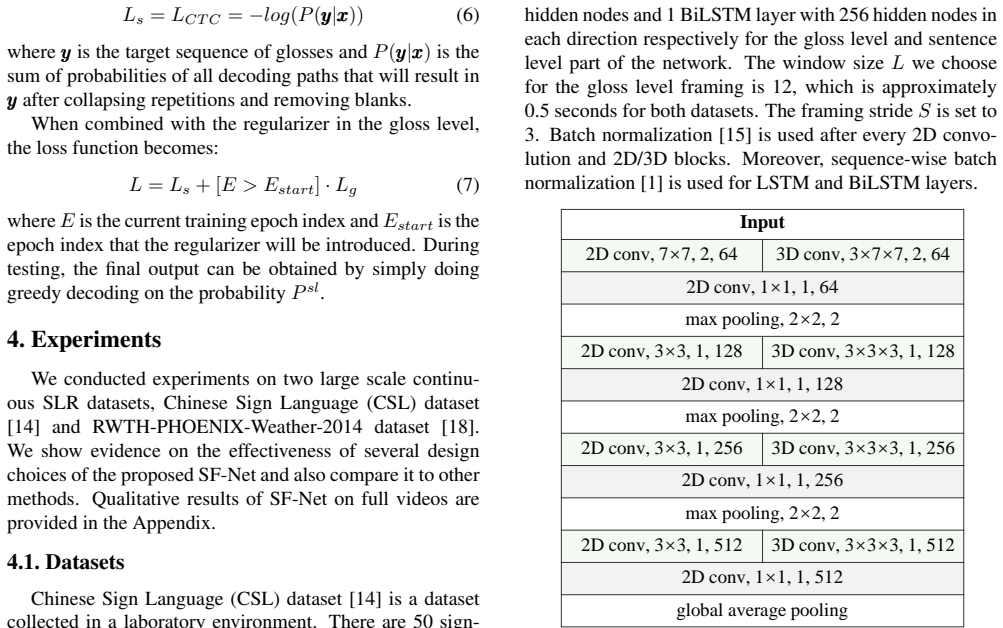
The central object is SF-Net's three-level feature hierarchy. In the frame level, paired 2D and 3D convolutions are merged by element-wise summation, letting the 3D branch act as a residual temporal feature extractor for fast, small motions. In the gloss level, a framing operation divides the frame-level sequence into overlapping meta-frames (window size L=12 frames, stride S=3), and an LSTM summarizes each meta-frame's temporal ordering into a single vector, which is what lets alignment be inferred per gloss rather than per frame. In the sentence level, a BiLSTM re-encodes the meta-frame sequence with context, and a Connectionist Temporal Classification (CTC) loss performs alignment-free sequence training. A Kullback-Leibler divergence regularizer pulls the gloss-level probability distribution toward the sentence-level distribution after an early training stage, which the paper treats as a guard against overfitting on rich-vocabulary data.
What would settle it
Measure ground-truth gloss durations on the CSL and PHOENIX datasets: if a substantial share of glosses are shorter than roughly 250 ms or longer than roughly 1 second, the fixed-window framing assumption fails. A more direct test is to train SF-Net with window sizes 6 and 18 on signers grouped by signing speed and check whether errors rise sharply for fast signers at L=12.
Extended reading notes
Core claim
The paper's central claim is that structuring feature extraction along the three semantic levels of signing—frame, gloss, and sentence—lets a single end-to-end network learn both the visual features and the temporal alignment of a continuous signing stream. Frame-level 2D/3D convolution blocks capture static gestures plus fast small motions; a framing step groups every 12 consecutive frames, about 500 milliseconds, into a meta-frame; an LSTM compresses each meta-frame into a gloss-level feature; a BiLSTM re-encodes the meta-frame sequence with context; and a connectionist temporal classification loss trains the whole system without per-frame alignment. The paper argues that this hierarchy is what produces the reported gains, and supports the argument with ablations: removing the gloss-level framing and LSTM raises word error rate substantially on both datasets, and removing the 3D branch adds about 3.5 points of classification error on word-level CSL. The strongest reported configuration reaches 3.8% word error on CSL and 36.1% on the RWTH-PHOENIX-Weather-2014 test set, with a ResNet-18 variant at 34.9%, each beating the best previous sentence-level-supervised baseline.
Load-bearing premise
The load-bearing premise is that most sign language glosses take about 500 ms, so a fixed 12-frame window captures a complete sign; if signing speed varies, the meta-frame summaries lose their meaning and CTC alignment degrades.
Editorial extensions
If this is right
- SF-Net's reported results beat all compared sentence-level-supervised baselines on both benchmarks: 3.8% versus 11.0% for SubUNet on CSL, and 36.1% versus 36.7% for Align-iOpt on the PHOENIX test set.
- Because inference is greedy decoding of CTC posterior probabilities, a deployed system needs no HMM, no external language model, and no frame-level labels or pre-training; the word-level-initialized variant only speeds training.
- The ablation evidence says the framing-plus-LSTM gloss level is the main source of improvement; without it, WER rises from 4.7% to 11.9% on CSL and from 40.8% to 46.7% on PHOENIX.
- The gloss-level KL regularizer improves PHOENIX WER from 40.8% to about 38% when introduced around epoch 15–25, but has little effect on the smaller-vocabulary CSL dataset, suggesting the benefit scales with vocabulary richness.
Reading between the lines
- A testable extension the paper leaves implicit is duration-conditioned evaluation: if per-gloss duration distributions vary across signers, a static window of 12 frames will hurt fast or slow signers, and measuring WER as a function of gloss duration would localize this failure.
- The same three-level recipe—short-range motion features, windowed temporal summaries, then sequence-level alignment—could transfer to other unsegmented gesture or action recognition tasks where units have fairly stable durations.
- The KL regularizer's dataset-dependent effect suggests it functions as a sentence-pattern prior; testing it on another large-vocabulary weakly supervised sequence task would show whether the effect generalizes.
Editorial analysis
A structured set of objections, weighed in public.
Referee Report
Summary. The paper presents SF-Net, an end-to-end continuous sign language recognition architecture organized into three levels: frame-level 2D/3D convolutional blocks, gloss-level framing plus LSTM, and sentence-level BiLSTM with CTC. A KL regularizer distills sentence-level predictions into gloss-level features. Experiments on CSL and RWTH-PHOENIX-Weather-2014 report WERs of 3.8% and 36.1% (34.9% with a ResNet-18 backbone), with ablations showing gains from each component. The authors claim state-of-the-art performance among sequence-level-supervised methods on both datasets.
Significance. The architecture is clearly described, and the main components are individually ablated in a well-organized way. The PHOENIX experiments use the official split, and the best PHOENIX result (36.1%, or 34.9% with ResNet-18) improves on the strongest prior sequence-level method (Align-iOpt, 36.7%). However, the CSL comparison is not controlled, and the paper's from-scratch claim on PHOENIX is contradicted by its own table. The central claim of outperforming prior methods on both datasets is therefore not established as written, although the underlying method remains plausible and the PHOENIX contribution is solid.
major comments (3)
- [Section 4.1, Section 4.4, Table 4] The CSL comparison cannot support the claim that SF-Net outperforms prior methods. The authors state in Section 4.1 that CSL has no official split and that they created a 20,000/5,000 split with disjoint signers. Section 4.4 states that most baseline numbers were collected from original papers and only SubUNet was retrained. Baselines such as LS-HAN (17.3%) and HAN (20.7%) were therefore evaluated on train/test partitions chosen by their original authors, which may differ in size, sampling, and signer disjointness. The reported 3.8% could reflect an easier split rather than architectural superiority; at minimum, the comparison is not controlled. This directly affects the abstract and Section 1 claim of outperforming previous methods on "both datasets."
- [Section 4.4, Table 5] The statement that "SF-Net has achieved the best performance among these methods on both datasets, even when training from scratch" is not supported by Table 5. The from-scratch variant obtains 38.1% WER on the PHOENIX test set, which is worse than Align-iOpt's 36.7%. Only the pretrained SF-Net (36.1%) and the ResNet-18 variant (34.9%) beat Align-iOpt. Moreover, the headline SF-Net result uses initialization from word-level CSL training, so the abstract's claim of training "without the help of other models or pre-training" should be reconciled with the fact that the best PHOENIX number comes from a pretrained model.
- [Section 4.4, Table 5] The set of methods compared on PHOENIX is not consistently "sequence level supervision based" as claimed. Deep Hand [19] and Deep Sign [20] are hybrid CNN-HMM systems that use alignment information from an HMM rather than only sentence-level supervision, and therefore do not satisfy the same weak-supervision condition used to justify excluding [21]. This makes the fair-comparison statement in Section 4.4 inaccurate, even though the comparison with Align-iOpt remains relevant.
minor comments (6)
- [Abstract and Section 1] There are grammatical issues such as "effectively learn" and "while many among them contain similar gestures" that should be corrected.
- [Section 3.2, Equation (4)] Equation (4) should be written as F = floor((T-L)/S)+1; the current typesetting lacks grouping parentheses and is ambiguous.
- [Section 4.2] The phrases "central cropped" and "random cropped" should be "center-cropped" and "randomly cropped."
- [Appendix A.1, Table S1] The header "No frame Window Size" is confusing; "No framing" would be clearer.
- [Appendix A.2] The text refers to "the proposed SR-Net"; this appears to be a typo for "SF-Net."
- [Figure 6 and surrounding text] The caption says "12 frames of 3 samples downsampled from 24 frames," while the text mentions "24 predictions (only show 12 due to page limit) compared to 5 predictions." The relationship between the displayed frames and the prediction counts should be clarified.
Circularity Check
No significant circularity: SF-Net's architecture and training objectives are derived independently, and the reported comparisons are external validity concerns rather than reductions to the paper's own inputs.
full rationale
The paper's central contribution is an architectural derivation: frame-level 2D/3D convolutional blocks, a gloss-level framing plus LSTM layer, a sentence-level BiLSTM with CTC loss, and a KL-divergence regularizer. None of these components is defined in terms of the reported WER numbers. The framing window size L=12 is presented as an empirical choice based on observed gloss duration and validated by the window-size ablation in Table S1; the regularizer start epoch Estart is tuned on validation and shown in Table 3. These are experimental inputs, not predictions derived from the target results. The gloss-level regularizer uses the network's own sentence-level probability distribution as a soft target (Eq. 5), but this is a self-distillation consistency objective, not an injection of the test labels or of the final WER; the evaluation is performed by greedy decoding against held-out transcripts. Comparisons in Tables 4 and 5 are against numbers reported in other papers; the absence of an official CSL split and the possibility that baselines were evaluated under different train/test partitions is a real comparability threat for the CSL claim, but it is a matter of experimental control and external validity, not circularity. There is no load-bearing self-citation chain: the only cited prior work (e.g., MiCT, ResNet, CTC) is external, and no uniqueness theorem or author-imported constraint forces the architecture. Therefore, the derivation does not reduce to its inputs by construction, and the circularity score is 0.
Assumptions & free parameters
free parameters (6)
- framing window size L =
12
- framing stride S =
3
- LSTM hidden nodes (gloss level) =
512
- BiLSTM hidden nodes per direction (sentence level) =
256
- regularizer start epoch Estart =
15 or 25 (PHOENIX)
- initial learning rate and schedule =
1e-4, halved halfway
assumptions (5)
- standard math CTC loss is appropriate for weakly supervised sequence alignment.
- domain assumption 2D/3D convolution blocks with element-wise summation improve gradient flow and capture fast motions.
- domain assumption Sign language glosses have a roughly consistent duration around 500 ms, so fixed-window framing is valid.
- domain assumption A KL regularizer between gloss-level and sentence-level distributions improves generalization without external supervision.
- standard math BiLSTM context encoding improves alignment for CTC decoding.
Cite this review
Pith. "Pith review of SF-Net: Structured Feature Network for Continuous Sign Language Recognition." pith.science (2026). https://pith.science/paper/PCQF4XCX
@misc{pith2026190801341,
  author       = {Pith},
  title        = {Pith review of: SF-Net: Structured Feature Network for Continuous Sign Language Recognition},
  year         = {2026},
  howpublished = {\url{https://pith.science/paper/PCQF4XCX}},
  note         = {Machine review of arXiv:1908.01341}
}
read the original abstract
Continuous sign language recognition (SLR) aims to translate a signing sequence into a sentence. It is very challenging as sign language is rich in vocabulary, while many among them contain similar gestures and motions. Moreover, it is weakly supervised as the alignment of signing glosses is not available. In this paper, we propose Structured Feature Network (SF-Net) to address these challenges by effectively learn multiple levels of semantic information in the data. The proposed SF-Net extracts features in a structured manner and gradually encodes information at the frame level, the gloss level and the sentence level into the feature representation. The proposed SF-Net can be trained end-to-end without the help of other models or pre-training. We tested the proposed SF-Net on two large scale public SLR datasets collected from different continuous SLR scenarios. Results show that the proposed SF-Net clearly outperforms previous sequence level supervision based methods in terms of both accuracy and adaptability.
Figures


Figures from the paper (3 more)


Forward citations
Cited by 2 Pith papers
-
Bridging the Gap Between Semantics and Reconstruction:Unifying Sign Language Translation and Production
A single model with a semantic/reconstruction-split sign tokenizer performs both sign-to-text translation and text-to-sign production, improving production motion accuracy while keeping pose-based translation competitive.
-
Sign Language Question Answering: A New Task, Benchmark, and Baseline for Sign Language Understanding
Sign Language QA benchmarks are introduced from PHOENIX14T and CSL-Daily via template-generated questions, and a question-conditioned baseline outperforms video-language and cascaded baselines.
Reference graph
Works this paper leans on
- [19]
- [20]
- [21]
-
[1]
D. Amodei, S. Ananthanarayanan, R. Anubhai, J. Bai, E. Battenberg, C. Case, J. Casper, B. Catanzaro, Q. Cheng, G. Chen, et al. Deep speech 2: End-to-end speech recogni- tion in english and mandarin. InProceedings of International Conference on Machine Learning, pages 173–182, 2016
work page 2016
-
[2]
D. Bahdanau, K. Cho, and Y . Bengio. Neural machine translation by jointly learning to align and translate. arXiv preprint arXiv:1409.0473, 2014
arXiv 2014
-
[3]
N. C. Camgoz, S. Hadfield, O. Koller, and R. Bowden. Sub- unets: End-to-end hand shape and continuous sign language recognition. In Proceedings of IEEE International Confer- ence on Computer Vision, pages 3075–3084, 2017
work page 2017
-
[4]
Y . Chen, S. Wang, W. Zhang, and Q. Huang. Less is more: Picking informative frames for video captioning. In Pro- ceedings of European Conference on Computer Vision, pages 358–373, 2018
work page 2018
-
[5]
C.-C. Chiu, T. N. Sainath, Y . Wu, R. Prabhavalkar, P. Nguyen, Z. Chen, A. Kannan, R. J. Weiss, K. Rao, E. Gonina, et al. State-of-the-art speech recognition with sequence-to-sequence models. In Proceedings of IEEE In- ternational Conference on Acoustics, Speech and Signal Pro- cessing, pages 4774–4778, 2018
work page 2018
Show all 39 references
-
[6]
Cihan Camgoz, S
N. Cihan Camgoz, S. Hadfield, O. Koller, H. Ney, and R. Bowden. Neural sign language translation. In Proceed- ings of the IEEE Conference on Computer Vision and Pattern Recognition, pages 7784–7793, 2018
2018
-
[7]
R. Cui, H. Liu, and C. Zhang. Recurrent convolutional neu- ral networks for continuous sign language recognition by staged optimization. In Proceedings of IEEE Conference on Computer Vision and Pattern Recognition , pages 7361– 7369, 2017
2017
-
[8]
Doetsch, A
P. Doetsch, A. Zeyer, and H. Ney. Bidirectional decoder networks for attention-based end-to-end offline handwriting recognition. In Proceedings of IEEE International Confer- ence on Frontiers in Handwriting Recognition , pages 361– 366, 2016
2016
-
[9]
Feichtenhofer, H
C. Feichtenhofer, H. Fan, J. Malik, and K. He. Slow- fast networks for video recognition. arXiv preprint arXiv:1812.03982, 2018
2018 arXiv
-
[10]
Graves, S
A. Graves, S. Fern ´andez, F. Gomez, and J. Schmidhu- ber. Connectionist temporal classification: Labelling unseg- mented sequence data with recurrent neural networks. In Proceedings of International Conference on Machine learn- ing, pages 369–376, 2006
2006
-
[11]
D. Guo, W. Zhou, H. Li, and M. Wang. Online early-late fu- sion based on adaptive hmm for sign language recognition. ACM Transactions on Multimedia Computing, Communica- tions, and Applications, 14(1):8, 2018
2018
-
[12]
D. Guo, W. Zhou, M. Wang, and H. Li. Sign language recognition based on adaptive hmms with data augmentation. In Proceedings of IEEE International Conference on Image Processing, pages 2876–2880, 2016
2016
-
[13]
K. He, X. Zhang, S. Ren, and J. Sun. Deep residual learn- ing for image recognition. In Proceedings of the IEEE Con- ference on Computer Vision and Pattern Recognition, pages 770–778, 2016
2016
-
[14]
Huang, W
J. Huang, W. Zhou, Q. Zhang, H. Li, and W. Li. Video-based sign language recognition without temporal segmentation. In AAAI Conference on Artificial Intelligence, 2018
2018
-
[15]
Ioffe and C
S. Ioffe and C. Szegedy. Batch normalization: Accelerating deep network training by reducing internal covariate shift. arXiv preprint arXiv:1502.03167, 2015
2015 arXiv
-
[16]
S. Ji, W. Xu, M. Yang, and K. Yu. 3d convolutional neural networks for human action recognition. IEEE Transactions on Pattern Analysis and Machine Intelligence , 35(1):221– 231, 2013
2013
-
[17]
D. P. Kingma and J. Ba. Adam: A method for stochastic optimization. In International Conference on Learning Rep- resentations, 2015
2015
-
[18]
Koller, J
O. Koller, J. Forster, and H. Ney. Continuous sign language recognition: Towards large vocabulary statistical recognition systems handling multiple signers. Computer Vision and Im- age Understanding, 141:108–125, 2015
2015
-
[22]
LeCun, Y
Y . LeCun, Y . Bengio, and G. Hinton. Deep learning.Nature, 521(7553):436–444, 2015
2015
-
[23]
T. Liu, W. Zhou, and H. Li. Sign language recognition with long short-term memory. In Proceedings of IEEE Interna- tional Conference on Image Processing , pages 2871–2875, 2016
2016
-
[24]
Luong, H
M.-T. Luong, H. Pham, and C. D. Manning. Effective approaches to attention-based neural machine translation. arXiv preprint arXiv:1508.04025, 2015
2015 arXiv
-
[25]
Molchanov, S
P. Molchanov, S. Gupta, K. Kim, and J. Kautz. Hand ges- ture recognition with 3d convolutional neural networks. In IEEE Conference on Computer Vision and Pattern Recogni- tion Workshops, pages 1–7, 2015
2015
-
[26]
S. C. Ong and S. Ranganath. Automatic sign language anal- ysis: A survey and the future beyond lexical meaning. IEEE Transactions on Pattern Analysis and Machine Intelligence, (6):873–891, 2005
2005
-
[27]
Y . Pan, T. Mei, T. Yao, H. Li, and Y . Rui. Jointly modeling embedding and translation to bridge video and language. In Proceedings of IEEE Conference on Computer Vision and Pattern Recognition, pages 4594–4602, 2016
2016
-
[28]
J. Pu, W. Zhou, and H. Li. Iterative alignment network for continuous sign language recognition. In Proceedings of the IEEE Conference on Computer Vision and Pattern Recogni- tion, pages 4165–4174, 2019
2019
-
[29]
S. S. Rautaray and A. Agrawal. Vision based hand gesture recognition for human computer interaction: A survey. Arti- ficial Intelligence Review, 43(1):1–54, 2015
2015
-
[30]
Sutskever, O
I. Sutskever, O. Vinyals, and Q. V . Le. Sequence to sequence learning with neural networks. In Advances in Neural Infor- mation Processing Systems, pages 3104–3112, 2014. 9
2014
-
[31]
D. Tran, H. Wang, L. Torresani, J. Ray, Y . LeCun, and M. Paluri. A closer look at spatiotemporal convolutions for action recognition. In Proceedings of IEEE Conference on Computer Vision and Pattern Recognition , pages 6450– 6459, 2018
2018
-
[32]
Venugopalan, M
S. Venugopalan, M. Rohrbach, J. Donahue, R. Mooney, T. Darrell, and K. Saenko. Sequence to sequence-video to text. In Proceedings of IEEE International Conference on Computer Vision, pages 4534–4542, 2015
2015
-
[33]
Venugopalan, H
S. Venugopalan, H. Xu, J. Donahue, M. Rohrbach, R. Mooney, and K. Saenko. Translating videos to natural lan- guage using deep recurrent neural networks. arXiv preprint arXiv:1412.4729, 2014
2014 arXiv
-
[34]
V oigtlaender, P
P. V oigtlaender, P. Doetsch, and H. Ney. Handwriting recog- nition with large multidimensional long short-term memory recurrent neural networks. In Proceedings of IEEE Interna- tional Conference on Frontiers in Handwriting Recognition, pages 228–233, 2016
2016
-
[35]
B. Wang, L. Ma, W. Zhang, and W. Liu. Reconstruction network for video captioning. In Proceedings of IEEE Con- ference on Computer Vision and Pattern Recognition, pages 7622–7631, 2018
2018
-
[36]
W. Yang, J. Tao, and Z. Ye. Continuous sign language recognition using level building based on fast hidden markov model. Pattern Recognition Letters, 78:28–35, 2016
2016
-
[37]
L. Yao, A. Torabi, K. Cho, N. Ballas, C. Pal, H. Larochelle, and A. Courville. Describing videos by exploiting temporal structure. In Proceedings of IEEE International Conference on Computer Vision, pages 4507–4515, 2015
2015
-
[38]
Zhang, W
J. Zhang, W. Zhou, and H. Li. A threshold-based hmm-dtw approach for continuous sign language recognition. In Pro- ceedings of International Conference on Internet Multimedia Computing and Service, page 237, 2014
2014
-
[39]
Y . Zhou, X. Sun, Z.-J. Zha, and W. Zeng. Mict: Mixed 3d/2d convolutional tube for human action recognition. InProceed- ings of IEEE Conference on Computer Vision and Pattern Recognition, pages 449–458, 2018. A. Appendix A.1. Framing Window Size We conducted a set of experimen...
2018
Reviewed August 14, 2026 · model on record in the stance chip above.
Discussion (0). Continue with ORCID to comment.