REVIEW 5 minor 4 cited by
Search for dark matter particles produced in association with a Higgs boson in proton-proton collisions at $\sqrt{s} =$ 13 TeV
T0 review · 0 major / 5 minor · reviewed 2026-08-14 · deepseek-v4-flash
Pith's one-line read A search for dark matter produced with a Higgs boson in five decay channels finds no excess and sets new 95% CL limits on two simplified mediator models.
desk verdict A solid, honestly-reported null search: first mono-Higgs in WW/ZZ plus a five-channel combination, with no serious flaw beyond a benchmark caveat the authors themselves flag. read the letter →
The pith
A machine-rendered reading of the paper's core claim, the machinery that carries it, and where it could break.
The reading
What carries the argument
The central object is the mono-Higgs signature: a Higgs boson recoiling against a pair of invisible dark matter particles, inferred experimentally as a reconstructed Higgs candidate accompanied by large missing transverse momentum. Two simplified benchmark models carry the interpretation: the Z'-2HDM, where a Z' boson decays to a Higgs boson and a pseudoscalar mediator that decays to dark matter, and the baryonic Z' model, where a Z' mediator radiates a Higgs boson before decaying to dark matter. The analysis machinery combines per-channel discriminants—dijet and diphoton invariant masses, tau-pair transverse mass, a boosted decision tree for WW, and four-lepton mass plus missing momentum for ZZ—into a single profile-likelihood fit across all five channels.
What would settle it
Run the same five-channel combination on an independent dataset of comparable size: if the observed number of events in the high-missing-transverse-momentum signal regions exceeds the background-only prediction by a 5-sigma fluctuation consistent with a Z'->Higgs-plus-dark-matter hypothesis, the no-excess claim would be refuted. A specific place to look is the h->bb invariant-mass sidebands combined with the high-pTmiss tail, where a resonant signal would create a localized excess.
Extended reading notes
Core claim
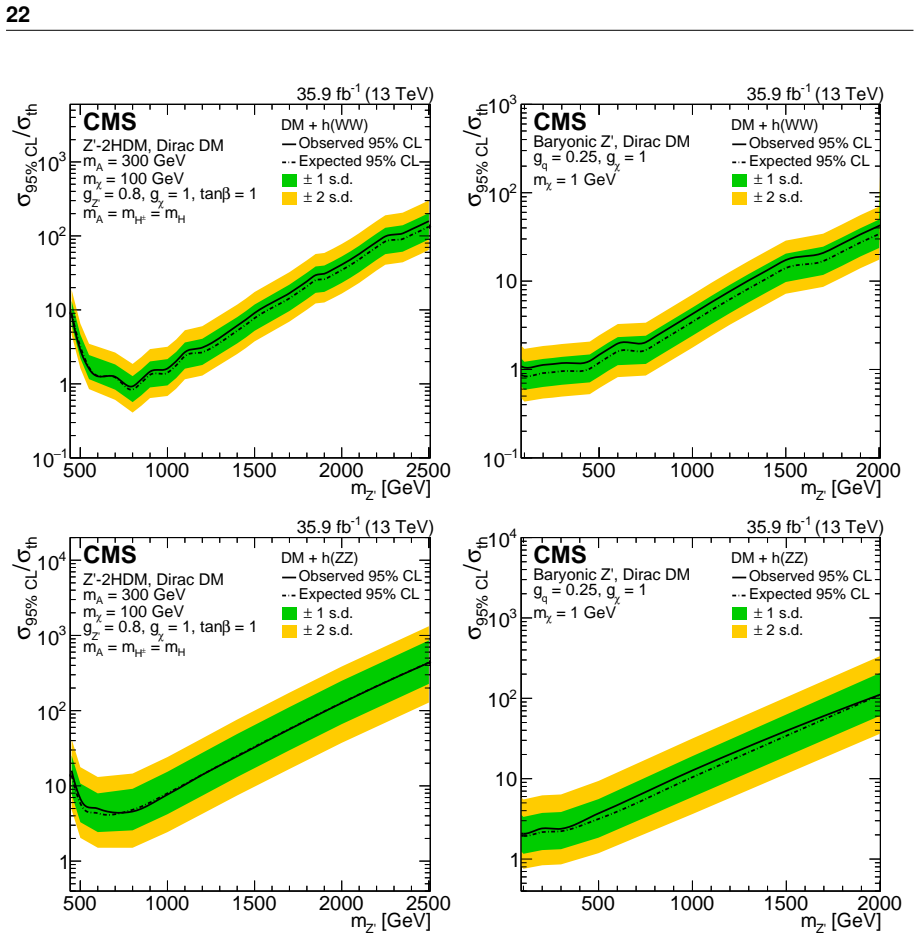
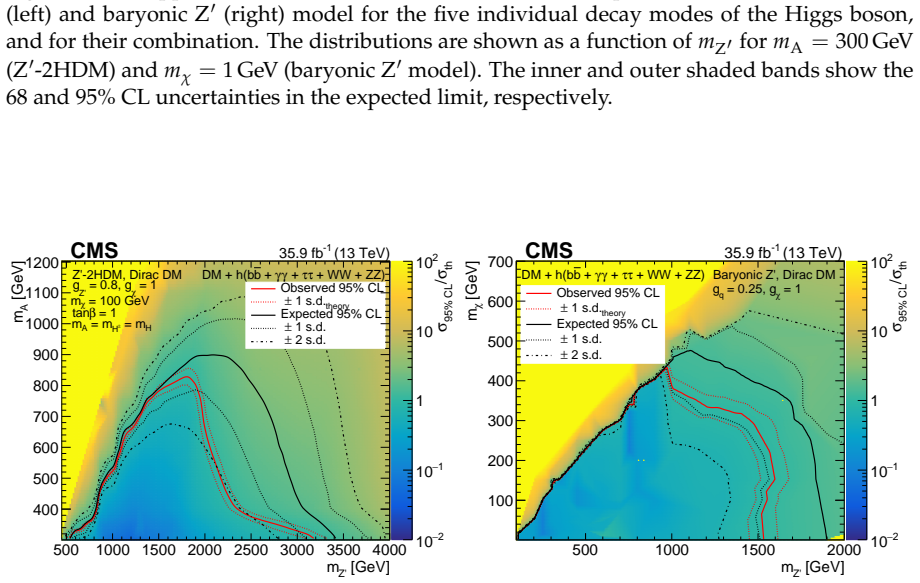
The authors establish that, in 35.9 inverse femtobarns of 13 TeV collision data, events containing a Higgs boson candidate plus large missing transverse momentum are consistent with standard model expectations. In the Z'-2HDM benchmark, the combined analysis excludes Z' mediator masses from roughly 500 to 3200 GeV for a pseudoscalar mass of 300 GeV; in the baryonic Z' model it excludes Z' masses from 100 to 1600 GeV for a dark matter mass of 1 GeV. These limits are interpreted as a spin-independent dark-matter-nucleon cross-section bound that is more stringent than direct-detection limits for dark matter masses between 1 and 5 GeV. The new WW and ZZ channels, while individually less sensitive, add coverage in kinematically distinct regions and are combined with the previously published bb, gamma-gamma, and tau-tau channels.
Load-bearing premise
The limits assume that the simulated signal acceptance and background predictions, together with the control-region transfer factors used to normalize data, are unbiased within the quoted systematic uncertainties; in the new WW and ZZ channels this rests on data-driven nonprompt-lepton background estimates that carry uncertainties of 30% and 36-43% respectively.
Editorial extensions
If this is right
- If the limits are correct, dark matter particles lighter than about 5 GeV with spin-independent scattering cross sections above roughly 10^-40 cm^2 are excluded by collider data alone.
- The h->WW and h->ZZ channels, newly exploited here, provide a route to probe mono-Higgs signals with soft missing-transverse-momentum spectra where the bb channel is less sensitive.
- The five-channel combination demonstrates a reusable statistical strategy for Higgs-associated dark matter searches that can be applied to future datasets with higher luminosity.
- For the chosen benchmark parameters, the excluded Z' mass ranges overlap with regions probed by dijet resonance searches, so the two search strategies jointly constrain the model parameter space.
Reading between the lines
- Editorial inference: the large uncertainties in the data-driven nonprompt-lepton background estimates in the WW and ZZ channels (about 30% and 36-43%, respectively) mean these new channels currently add more breadth than raw precision; with more data or better background control they could become substantially more powerful.
- Editorial inference: the same combined-analysis framework could be adapted to other invisible-Higgs topologies, such as Higgs production with a Z boson decaying invisibly, by exchanging the signal model while keeping the per-channel discriminants and likelihood structure.
- Editorial inference: a natural testable extension is to rerun this analysis on the full Run 2 dataset (about 140 inverse femtobarns), which would roughly double the sensitivity to the mediator masses and sharpen the low-mass dark matter exclusion.
Editorial analysis
A structured set of objections, weighed in public.
Referee Report
Summary. This paper reports a CMS search for dark matter produced in association with a Higgs boson (mono-Higgs) using 35.9 fb^-1 of 13 TeV proton-proton collisions. The analysis covers five Higgs decay channels (bb, gamma gamma, tau tau, WW, and ZZ); the WW and ZZ channels are new to this search, and the five channels are statistically combined. The central result is a null observation: data agree with the SM background expectation in all channels and in the combination, and 95% CL upper limits are set on the Z'-2HDM and baryonic Z' simplified models, including an interpretation as a spin-independent DM-nucleon scattering cross section. The paper claims the first mono-Higgs search in the WW and ZZ final states and the first five-channel mono-Higgs combination.
Significance. The result, if correct, is a valid upper-limit measurement with a modest but real extension of the mono-Higgs program: the WW and ZZ channels are new, and the five-channel combination improves coverage at low and high mZ'. I was unable to find a load-bearing technical flaw. The analysis uses standard CMS object reconstruction, data-driven control regions for the dominant backgrounds, and a detailed systematic budget; the observed yields agree with the expected background within uncertainties. The paper is also commendable for explicitly stating in Section 1 that the Z'-2HDM benchmark points within sensitivity reach are already excluded by dijet searches; this limits the phenomenological priority of the Z'-2HDM limits but does not make the null result or the derived limits incorrect. The large nonprompt-lepton uncertainties in the new WW and ZZ channels (30% and 36-43%, Tables 3 and 4) are real but not decisive: the skeptic's stress-test concern does not land, because those channels contribute only a small fraction of the combined expected signal and background, and the combination is dominated by h->bb.
minor comments (5)
- [Section 8, text before Tables 6 and 7] The text says the baryonic Z' signal benchmark is normalized to mZ' = 500 GeV and mchi = 1000 GeV, but Table 6, Table 7, and all the figures and limits in the paper use mchi = 1 GeV for this benchmark; this is an obvious typo and should be corrected.
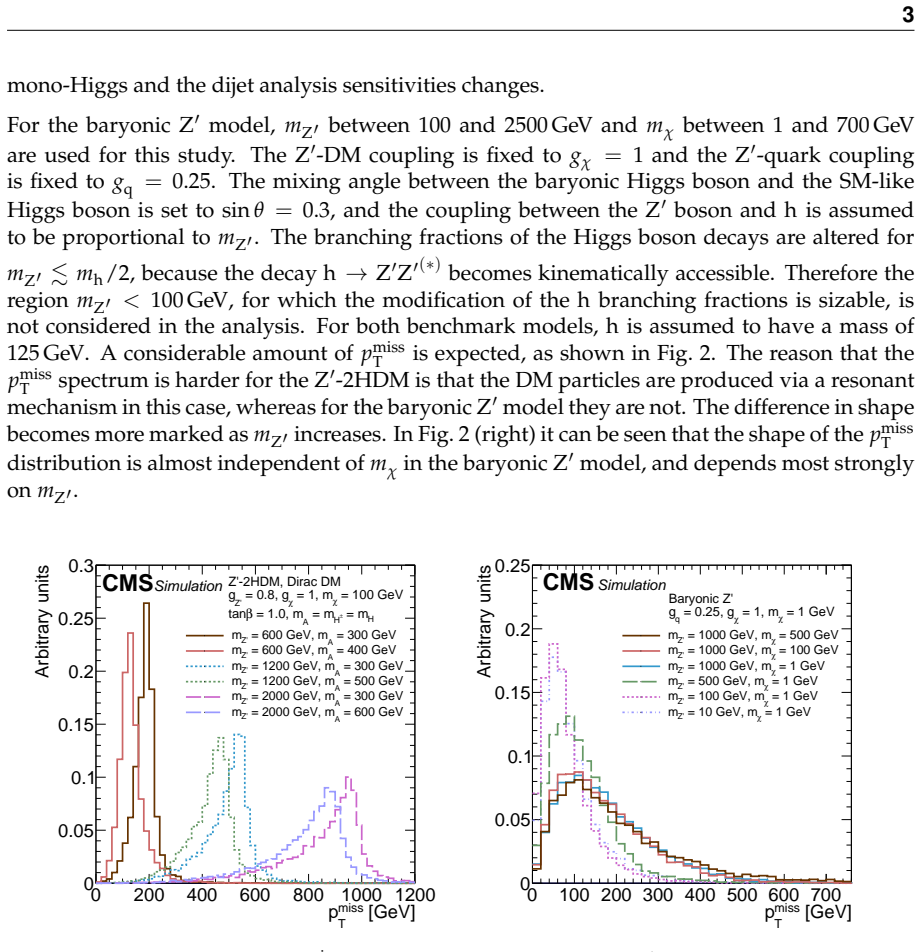
- [Figure 2 caption] The axis labels and legend entries in Fig. 2 are garbled in the manuscript (for example, entries like ' = 300 GeV A = 600 GeV, mZ'm = 400 GeV' should read something like 'mA = 300 GeV, mZ' = 400 GeV'); please restore the full parameter notation and verify every legend entry.
- [Section 1 and Section 9] The caveat that the chosen Z'-2HDM benchmark has mZ' values within sensitivity reach already excluded by dijet searches is stated clearly in the introduction; I recommend repeating this caveat in the summary section so that the final conclusions do not overstate the reach of the Z'-2HDM limits.
- [Section 5.4.1] The description of the BDT training is ambiguous: the sentence 'simulated signal samples with mA = 300 GeV (mchi = 1 GeV) with various values of mZ' have been used for training' could mean either a single training sample per model or an ensemble of samples; please clarify which signal points enter the training and whether the same BDT is applied to all scan points.
- [Section 8.1, Tables 6 and 7] The observed yields in the WW and ZZ channels are close to the predicted backgrounds (11,172 vs. 11,030 and 112 vs. 117.8, respectively); a sentence reporting the local p-value or significance of the largest deviation would make the 'no significant excess' statement more quantitative.
Circularity Check
No significant circularity: the limit extraction is a direct data fit against external benchmark signal models, with backgrounds from simulation and data control regions.
full rationale
I walked the claimed derivation chain from event selection through background estimation, signal extraction, and limit setting, and found no step where a prediction reduces by construction to a fitted input or to a self-citation that is itself load-bearing. The signal hypotheses are the ATLAS-CMS Dark Matter Forum benchmark models (Z'-2HDM and baryonic Z'), with parameters fixed externally to this analysis; no signal parameter is fitted to data to produce a predicted signal. The h->bb, h->gamma-gamma, and h->tau-tau channels are taken from previously published CMS analyses (Refs. [30-32]); those are independent published results with their own data and fits, not assumptions whose validity is imported from this paper. In the new h->WW and h->ZZ channels, backgrounds are estimated from simulation with normalizations constrained by dedicated control regions included in the likelihood fit, and the nonprompt-lepton background is determined from data with explicitly quoted 30% and 36-43% uncertainties (Sections 5.4.1, 5.5.1, Tables 3-4); this is a conventional data-driven background estimate, not a fitted quantity being renamed as a prediction. The conversion to a spin-independent DM-nucleon cross section uses the standard analytic formula of Ref. [37], Eq. (1), and is an external mapping rather than a circular definition. The paper itself honestly flags that the Z'-2HDM benchmark masses within sensitivity reach are already excluded by dijet searches, and the m_chi text inconsistency in Section 8 is a typographical error that does not affect the analysis. I therefore find no circular step, and the appropriate score is 0.
Assumptions & free parameters
free parameters (5)
- Z'-2HDM DM mass mChi =
100 GeV (fixed benchmark)
- Z'-2HDM couplings and tanBeta =
gChi=1, gZ'=0.8, tanBeta=1 (tanBeta varied 0.4 to 10 in interpretation)
- Baryonic Z' couplings and mixing =
gChi=1, gq=0.25, sinTheta=0.3
- Z'-2HDM scan masses mA and mZ' =
mA 300-1000 GeV, mZ' 450-4000 GeV
- Baryonic Z' scan masses mZ' and mChi =
mZ' 100-2500 GeV, mChi 1-700 GeV
assumptions (5)
- domain assumption Standard model background predictions from Monte Carlo generators and their normalizations are accurate within quoted uncertainties.
- domain assumption The GEANT4 detector simulation accurately models the CMS response.
- domain assumption The two simplified models, Z'-2HDM and baryonic Z', are valid benchmarks for interpreting the search.
- domain assumption The five channels are statistically independent with zero signal-region overlap and negligible control-region overlap.
- domain assumption Control regions transfer to the signal region without unmodeled bias.
Cite this review
Pith. "Pith review of Search for dark matter particles produced in association with a Higgs boson in proton-proton collisions at $\sqrt{s} =$ 13 TeV." pith.science (2026). https://pith.science/paper/COOCKDEV
@misc{pith2026190801713,
  author       = {Pith},
  title        = {Pith review of: Search for dark matter particles produced in association with a Higgs boson in proton-proton collisions at $\sqrts =$ 13 TeV},
  year         = {2026},
  howpublished = {\url{https://pith.science/paper/COOCKDEV}},
  note         = {Machine review of arXiv:1908.01713}
}
abstract
A search for dark matter (DM) particles is performed using events with a Higgs boson candidate and large missing transverse momentum. The analysis is based on proton-proton collision data at a center-of-mass energy of 13 TeV collected by the CMS experiment at the LHC in 2016, corresponding to an integrated luminosity of 35.9 fb$^{-1}$. The search is performed in five Higgs boson decay channels: h $\to \mathrm{b\bar{b}}$, $\gamma\gamma$, $\tau^{+}\tau^{-}$, W$^{+}$W$^{-}$, and ZZ. The results from the individual channels are combined to maximize the sensitivity of the analysis. No significant excess over the expected standard model background is observed in any of the five channels or in their combination. Limits are set on DM production in the context of two simplified models. The results are also interpreted in terms of a spin-independent DM-nucleon scattering cross section and compared to those from direct-detection DM experiments. This is the first search for DM particles produced in association with a Higgs boson decaying to a pair of W or Z bosons, and the first statistical combination based on five Higgs boson decay channels.
Figures


Figures from the paper (8 more)





Forward citations
Cited by 4 Pith papers
-
Search for resonant production of lepton-enriched semivisible jets in proton-proton collisions at $\sqrt{s}$ = 13 TeV
A CMS search with 138 fb^-1 of 13 TeV data finds no lepton-enriched semivisible jet resonance and excludes Z' masses up to 4.7 TeV (SVJ l) and 1.8-3.5 TeV (SVJ tau) at 95% CL.
-
Search for dark matter production in association with bottom quarks and a lepton pair in proton-proton collisions at $\sqrt{s}$ = 13 TeV
First dedicated CMS search for bb + dilepton + missing transverse momentum in the 2HDM+a model finds no signal and sets 95% CL cross-section limits of 10^-2 to 10^-3 pb for mH = 400-2000 GeV.
-
Unveiling the inert Triplet desert region with a pNGB Dark Matter and its Gravitational Wave signatures
A two-component dark matter model combining an inert scalar triplet with a pseudo-Goldstone singlet revives the sub-TeV triplet desert region and predicts gravitational waves detectable by LISA, BBO, and DECIGO.
-
Prospecting bipartite Dark Matter through Gravitational Waves
A two-component dark matter model with an inert triplet scalar and a singlet fermion can explain the relic abundance while producing a strong electroweak phase transition and gravitational wave signals detectable by L...
Reference graph
Works this paper leans on
-
[1]
Direct detection of dark matter
R. J. Gaitskell, “Direct detection of dark matter”, Ann. Rev. Nucl. Part. Sci. 54 (2004) 315, doi:10.1146/annurev.nucl.54.070103.181244
arXiv 2004
-
[2]
Existence and nature of dark matter in the universe
V . Trimble, “Existence and nature of dark matter in the universe”, Ann. Rev. Astron. Astrophys. 25 (1987) 425, doi:10.1146/annurev.aa.25.090187.002233
arXiv 1987
-
[3]
Dark Matter searches with astroparticle data
T. A. Porter, R. P . Johnson, and P . W. Graham, “Dark Matter searches with astroparticle data”, Ann. Rev. Astron. Astrophys. 49 (2011) 155, doi:10.1146/annurev-astro-081710-102528 , arXiv:1104.2836
arXiv 2011
-
[4]
Particle dark matter: evidence, candidates and constraints
G. Bertone, D. Hooper, and J. Silk, “Particle dark matter: evidence, candidates and constraints”, Phys. Rept. 405 (2005) 279, doi:10.1016/j.physrep.2004.08.031, arXiv:hep-ph/0404175
arXiv 2005
-
[5]
Planck 2018 results. I. Overview and the cosmological legacy of Planck
Planck Collaboration, “Planck 2018 results. I. Overview and the cosmological legacy of Planck”, (2018). arXiv:1807.06205
arXiv 2018
-
[6]
Dark matter candidates from particle physics and methods of detection
J. L. Feng, “Dark matter candidates from particle physics and methods of detection”, Ann. Rev. Astron. Astrophys. 48 (2010) 495, doi:10.1146/annurev-astro-082708-101659 , arXiv:1003.0904
arXiv 2010
-
[7]
On the relic, cosmic abundance of stable weakly interacting massive particles
R. J. Scherrer and M. S. Turner, “On the relic, cosmic abundance of stable weakly interacting massive particles”, Phys. Rev. D 33 (1986) 1585, doi:10.1103/PhysRevD.33.1585. [Erratum: doi:10.1103/PhysRevD.34.3263]
-
[8]
Cosmological constraints on the properties of weakly interacting massive particles
G. Steigman and M. S. Turner, “Cosmological constraints on the properties of weakly interacting massive particles”, Nucl. Phys. B 253 (1985) 375, doi:10.1016/0550-3213(85)90537-1. References 27
Show all 102 references
-
[9]
Maverick dark matter at colliders
M. Beltran et al., “Maverick dark matter at colliders”, JHEP 09 (2010) 037, doi:10.1007/JHEP09(2010)037, arXiv:1002.4137
2010 arXiv
-
[10]
Search for dark matter and other new phenomena in events with an energetic jet and large missing transverse momentum using the ATLAS detector
ATLAS Collaboration, “Search for dark matter and other new phenomena in events with an energetic jet and large missing transverse momentum using the ATLAS detector”, JHEP 01 (2018) 126, doi:10.1007/JHEP01(2018)126, arXiv:1711.03301
2018 arXiv
-
[11]
Search for new physics in final states with an energetic jet or a hadronically decaying W or Z boson and transverse momentum imbalance at√s = 13 TeV
CMS Collaboration, “Search for new physics in final states with an energetic jet or a hadronically decaying W or Z boson and transverse momentum imbalance at√s = 13 TeV”, Phys. Rev. D 97 (2018) 092005, doi:10.1103/PhysRevD.97.092005, arXiv:1712.02345
2018 arXiv
-
[12]
Search for dark matter produced in association with bottom or top quarks in√s = 13 TeV pp collisions with the ATLAS detector
ATLAS Collaboration, “Search for dark matter produced in association with bottom or top quarks in√s = 13 TeV pp collisions with the ATLAS detector”, Eur. Phys. J. C 78 (2018) 18, doi:10.1140/epjc/s10052-017-5486-1 , arXiv:1710.11412
2018 arXiv
-
[13]
Search for dark matter in events with energetic, hadronically decaying top quarks and missing transverse momentum at√s = 13 TeV
CMS Collaboration, “Search for dark matter in events with energetic, hadronically decaying top quarks and missing transverse momentum at√s = 13 TeV”, JHEP 06 (2018) 027, doi:10.1007/JHEP06(2018)027, arXiv:1801.08427
2018 arXiv
-
[14]
Search for dark matter at√s = 13 TeV in final states containing an energetic photon and large missing transverse momentum with the ATLAS detector
ATLAS Collaboration, “Search for dark matter at√s = 13 TeV in final states containing an energetic photon and large missing transverse momentum with the ATLAS detector”, Eur. Phys. J. C 77 (2017) 393, doi:10.1140/epjc/s10052-017-4965-8 , arXiv:1704.03848
2017 arXiv
-
[15]
Search for new physics in the monophoton final state in proton-proton collisions at√s = 13 TeV
CMS Collaboration, “Search for new physics in the monophoton final state in proton-proton collisions at√s = 13 TeV”, JHEP 10 (2017) 073, doi:10.1007/JHEP10(2017)073, arXiv:1706.03794
2017 arXiv
-
[16]
Search for an invisibly decaying Higgs boson or dark matter candidates produced in association with a Z boson in pp collisions at√s = 13 TeV with the ATLAS detector
ATLAS Collaboration, “Search for an invisibly decaying Higgs boson or dark matter candidates produced in association with a Z boson in pp collisions at√s = 13 TeV with the ATLAS detector”, Phys. Lett. B 776 (2018) 318, doi:10.1016/j.physletb.2017.11.049, arXiv:1708.09624
2018 arXiv
-
[17]
Search for new physics in events with a leptonically decaying Z boson and a large transverse momentum imbalance in proton-proton collisions at√s = 13 TeV
CMS Collaboration, “Search for new physics in events with a leptonically decaying Z boson and a large transverse momentum imbalance in proton-proton collisions at√s = 13 TeV”, Eur. Phys. J. C 78 (2018) 291, doi:10.1140/epjc/s10052-018-5740-1 , arXiv:1711.00431
2018 arXiv
-
[18]
Search for dark matter in events with a hadronically decaying vector boson and missing transverse momentum in pp collisions at√s = 13 TeV with the ATLAS detector
ATLAS Collaboration, “Search for dark matter in events with a hadronically decaying vector boson and missing transverse momentum in pp collisions at√s = 13 TeV with the ATLAS detector”, JHEP 10 (2018) 180, doi:10.1007/JHEP10(2018)180, arXiv:1807.11471
2018 arXiv
-
[19]
Observation of a new particle in the search for the standard model Higgs boson with the ATLAS detector at the LHC
ATLAS Collaboration, “Observation of a new particle in the search for the standard model Higgs boson with the ATLAS detector at the LHC”, Phys. Lett. B 716 (2012) 1, doi:10.1016/j.physletb.2012.08.020, arXiv:1207.7214
2012 arXiv
-
[20]
Observation of a new boson at a mass of 125 GeV with the CMS experiment at the LHC
CMS Collaboration, “Observation of a new boson at a mass of 125 GeV with the CMS experiment at the LHC”, Phys. Lett. B 716 (2012) 30, doi:10.1016/j.physletb.2012.08.021, arXiv:1207.7235
2012 arXiv
-
[21]
Observation of a new boson with mass near 125 GeV in pp collisions at√s = 7 and 8 TeV
CMS Collaboration, “Observation of a new boson with mass near 125 GeV in pp collisions at√s = 7 and 8 TeV”, JHEP 06 (2013) 081, doi:10.1007/JHEP06(2013)081, arXiv:1303.4571. 28
2013 arXiv
-
[22]
Mono-Higgs-boson: a new collider probe of dark matter
L. Carpenter et al., “Mono-Higgs-boson: a new collider probe of dark matter”, Phys. Rev. D 89 (2014) 075017, doi:10.1103/PhysRevD.89.075017, arXiv:1312.2592
2014 arXiv
-
[23]
Looking through the pseudoscalar portal into dark matter: novel mono-Higgs and mono-Z signatures at the LHC
J. M. No, “Looking through the pseudoscalar portal into dark matter: novel mono-Higgs and mono-Z signatures at the LHC”, Phys. Rev. D 93 (2016) 031701, doi:10.1103/PhysRevD.93.031701, arXiv:1509.01110
2016 arXiv
-
[24]
Search for dark matter in events with missing transverse momentum and a higgs boson decaying to two photons in pp collisions at√s = 8 TeV with the ATLAS detector
ATLAS Collaboration, “Search for dark matter in events with missing transverse momentum and a higgs boson decaying to two photons in pp collisions at√s = 8 TeV with the ATLAS detector”, Phys. Rev. Lett. 115 (2015) 131801, doi:10.1103/PhysRevLett.115.131801, arXiv:1506.01081
2015 arXiv
-
[25]
Search for dark matter produced in association with a Higgs boson decaying to two bottom quarks in pp collisions at√s = 8 TeV with the ATLAS detector
ATLAS Collaboration, “Search for dark matter produced in association with a Higgs boson decaying to two bottom quarks in pp collisions at√s = 8 TeV with the ATLAS detector”, Phys. Rev. D 93 (2016) 072007, doi:10.1103/PhysRevD.93.072007, arXiv:1510.06218
2016 arXiv
-
[26]
Search for dark matter in association with a Higgs boson decaying to b-quarks in pp collisions at√s = 13 TeV with the ATLAS detector
ATLAS Collaboration, “Search for dark matter in association with a Higgs boson decaying to b-quarks in pp collisions at√s = 13 TeV with the ATLAS detector”, Phys. Lett. B 765 (2017) 11, doi:10.1016/j.physletb.2016.11.035, arXiv:1609.04572
2017 arXiv
-
[27]
Search for associated production of dark matter with a Higgs boson decaying to bb or γγ at√s = 13 TeV
CMS Collaboration, “Search for associated production of dark matter with a Higgs boson decaying to bb or γγ at√s = 13 TeV”, JHEP 10 (2017) 180, doi:10.1007/JHEP10(2017)180, arXiv:1703.05236
2017 arXiv
-
[28]
Search for dark matter in association with a Higgs boson decaying to two photons at√s = 13 TeV with the ATLAS detector
ATLAS Collaboration, “Search for dark matter in association with a Higgs boson decaying to two photons at√s = 13 TeV with the ATLAS detector”, Phys. Rev. D 96 (2017) 112004, doi:10.1103/PhysRevD.96.112004, arXiv:1706.03948
2017 arXiv
-
[29]
Search for dark matter produced in association with a Higgs boson decaying to b¯b using 36 fb−1 of pp collisions at√s = 13 TeV with the ATLAS detector
ATLAS Collaboration, “Search for dark matter produced in association with a Higgs boson decaying to b¯b using 36 fb−1 of pp collisions at√s = 13 TeV with the ATLAS detector”, Phys. Rev. Lett. 119 (2017) 181804, doi:10.1103/PhysRevLett.119.181804, arXiv:1707.01302
2017 arXiv
-
[30]
Search for heavy resonances decaying into a vector boson and a Higgs boson in final states with charged leptons, neutrinos and b quarks at√s = 13 TeV
CMS Collaboration, “Search for heavy resonances decaying into a vector boson and a Higgs boson in final states with charged leptons, neutrinos and b quarks at√s = 13 TeV”, JHEP 11 (2018) 172, doi:10.1007/JHEP11(2018)172, arXiv:1807.02826
2018 arXiv
-
[31]
Search for dark matter produced in association with a Higgs boson decaying to a pair of bottom quarks in proton-proton collisions at√s = 13 TeV
CMS Collaboration, “Search for dark matter produced in association with a Higgs boson decaying to a pair of bottom quarks in proton-proton collisions at√s = 13 TeV”, Eur. Phys. J. C 79 (2019) 280, doi:10.1140/epjc/s10052-019-6730-7 , arXiv:1811.06562
2019 arXiv
-
[32]
Search for dark matter produced in association with a Higgs boson decaying to γγ or τ+τ− at√s = 13 TeV
CMS Collaboration, “Search for dark matter produced in association with a Higgs boson decaying to γγ or τ+τ− at√s = 13 TeV”, JHEP 09 (2018) 046, doi:10.1007/JHEP09(2018)046, arXiv:1806.04771
2018 arXiv
-
[33]
Dark matter benchmark models for early LHC Run-2 searches: report of the ATLAS/CMS Dark Matter Forum
D. Abercrombie et al., “Dark matter benchmark models for early LHC Run-2 searches: report of the ATLAS/CMS Dark Matter Forum”, (2015). arXiv:1507.00966
2015 arXiv
-
[34]
Theory and phenomenology of two-Higgs-doublet models
G. C. Branco et al., “Theory and phenomenology of two-Higgs-doublet models”, Phys. Rept. 516 (2012) 1, doi:10.1016/j.physrep.2012.02.002, arXiv:1106.0034. References 29
2012 arXiv
-
[35]
Searching for signs of the second Higgs doublet
N. Craig, J. Galloway, and S. Thomas, “Searching for signs of the second Higgs doublet”, (2013). arXiv:1305.2424
2013 arXiv
-
[36]
Mono-Higgs detection of dark matter at the LHC
A. Berlin, T. Lin, and L.-T. Wang, “Mono-Higgs detection of dark matter at the LHC”, JHEP 06 (2014) 078, doi:10.1007/JHEP06(2014)078, arXiv:1402.7074
2014 arXiv
-
[37]
Recommendations on presenting LHC searches for missing transverse energy signals using simplified s-channel models of dark matter
A. Boveia et al., “Recommendations on presenting LHC searches for missing transverse energy signals using simplified s-channel models of dark matter”, (2016). arXiv:1603.04156
2016 arXiv
-
[38]
Search for new phenomena in dijet events using 37 fb−1 of pp collision data collected at√s =13 TeV with the ATLAS detector
ATLAS Collaboration, “Search for new phenomena in dijet events using 37 fb−1 of pp collision data collected at√s =13 TeV with the ATLAS detector”, Phys. Rev. D 96 (2017) 052004, doi:10.1103/PhysRevD.96.052004, arXiv:1703.09127
2017 arXiv
-
[39]
Search for low mass vector resonances decaying into quark-antiquark pairs in proton-proton collisions at√s = 13 TeV
CMS Collaboration, “Search for low mass vector resonances decaying into quark-antiquark pairs in proton-proton collisions at√s = 13 TeV”, JHEP 01 (2018) 097, doi:10.1007/JHEP01(2018)097, arXiv:1710.00159
2018 arXiv
-
[40]
Search for low-mass dijet resonances using trigger-level jets with the ATLAS detector in pp collisions at√s = 13 TeV
ATLAS Collaboration, “Search for low-mass dijet resonances using trigger-level jets with the ATLAS detector in pp collisions at√s = 13 TeV”, Phys. Rev. Lett. 121 (2018) 081801, doi:10.1103/PhysRevLett.121.081801, arXiv:1804.03496
2018 arXiv
-
[41]
Search for narrow and broad dijet resonances in proton-proton collisions at√s = 13 TeV and constraints on dark matter mediators and other new particles
CMS Collaboration, “Search for narrow and broad dijet resonances in proton-proton collisions at√s = 13 TeV and constraints on dark matter mediators and other new particles”, JHEP 08 (2018) 130, doi:10.1007/JHEP08(2018)130, arXiv:1806.00843
2018 arXiv
-
[42]
Measurements of properties of the Higgs boson decaying into the four-lepton final state in pp collisions at√s = 13 TeV
CMS Collaboration, “Measurements of properties of the Higgs boson decaying into the four-lepton final state in pp collisions at√s = 13 TeV”, JHEP 11 (2017) 047, doi:10.1007/JHEP11(2017)047, arXiv:1706.09936
2017 arXiv
-
[43]
The CMS trigger system
CMS Collaboration, “The CMS trigger system”, JINST 12 (2017) P01020, doi:10.1088/1748-0221/12/01/P01020, arXiv:1609.02366
2017 arXiv
-
[44]
The CMS experiment at the CERN LHC
CMS Collaboration, “The CMS experiment at the CERN LHC”, JINST 3 (2008) S08004, doi:10.1088/1748-0221/3/08/S08004
2008 doi
-
[45]
Measurement of the inelastic proton-proton cross section at√s = 13 TeV
CMS Collaboration, “Measurement of the inelastic proton-proton cross section at√s = 13 TeV”, JHEP 07 (2018) 161, doi:10.1007/JHEP07(2018)161, arXiv:1802.02613
2018 arXiv
-
[46]
MadGraph 5: going beyond
J. Alwall et al., “MadGraph 5: going beyond”, JHEP 06 (2011) 128, doi:10.1007/JHEP06(2011)128, arXiv:1106.0522
2011 arXiv
-
[47]
The automated computation of tree-level and next-to-leading order differential cross sections, and their matching to parton shower simulations
J. Alwall et al., “The automated computation of tree-level and next-to-leading order differential cross sections, and their matching to parton shower simulations”, JHEP 07 (2014) 079, doi:10.1007/JHEP07(2014)079, arXiv:1405.0301
2014 arXiv
-
[48]
An introduction to PYTHIA 8.2
T. Sj ¨ostrand et al., “An introduction to PYTHIA 8.2”, Comput. Phys. Commun. 191 (2015) 159, doi:10.1016/j.cpc.2015.01.024, arXiv:1410.3012
2015 arXiv
-
[49]
A new method for combining NLO QCD with shower Monte Carlo algorithms
P . Nason, “A new method for combining NLO QCD with shower Monte Carlo algorithms”, JHEP 11 (2004) 040, doi:10.1088/1126-6708/2004/11/040, arXiv:hep-ph/0409146. 30
2004 arXiv
-
[50]
Matching NLO QCD computations with parton shower simulations: the POWHEG method
S. Frixione, P . Nason, and C. Oleari, “Matching NLO QCD computations with parton shower simulations: the POWHEG method”, JHEP 11 (2007) 070, doi:10.1088/1126-6708/2007/11/070, arXiv:0709.2092
2007 arXiv
-
[51]
A general framework for implementing NLO calculations in shower Monte Carlo programs: the POWHEG BOX
S. Alioli, P . Nason, C. Oleari, and E. Re, “A general framework for implementing NLO calculations in shower Monte Carlo programs: the POWHEG BOX”, JHEP 06 (2010) 043, doi:10.1007/JHEP06(2010)043, arXiv:1002.2581
2010 arXiv
-
[52]
W+W−, WZ and ZZ production in the POWHEG BOX
T. Melia, P . Nason, R. R¨ontsch, and G. Zanderighi, “W+W−, WZ and ZZ production in the POWHEG BOX”, JHEP 11 (2011) 078, doi:10.1007/JHEP11(2011)078, arXiv:1107.5051
2011 arXiv
-
[53]
Electroweak gauge boson production at hadron colliders through O(α2 s )
K. Melnikov and F. Petriello, “Electroweak gauge boson production at hadron colliders through O(α2 s )”, Phys. Rev. D 74 (2006) 114017, doi:10.1103/PhysRevD.74.114017, arXiv:hep-ph/0609070
2006 arXiv
-
[54]
Vector boson pair production at the LHC
J. M. Campbell, R. K. Ellis, and C. Williams, “Vector boson pair production at the LHC”, JHEP 07 (2011) 018, doi:10.1007/JHEP07(2011)018, arXiv:1105.0020
2011 arXiv
-
[55]
A multi-threaded version of MCFM
J. M. Campbell, R. K. Ellis, and W. T. Giele, “A multi-threaded version of MCFM”, Eur. Phys. J. C 75 (2015) 246, doi:10.1140/epjc/s10052-015-3461-2 , arXiv:1503.06182
2015 arXiv
-
[56]
Transverse momentum resummation effects in W+W− measurements
P . Meade, H. Ramani, and M. Zeng, “Transverse momentum resummation effects in W+W− measurements”, Phys. Rev. D 90 (2014) 114006, doi:10.1103/PhysRevD.90.114006, arXiv:1407.4481
2014 arXiv
-
[57]
Explanation of the WW excess at the LHC by jet-veto resummation
P . Jaiswal and T. Okui, “Explanation of the WW excess at the LHC by jet-veto resummation”, Phys. Rev. D 90 (2014) 073009, doi:10.1103/PhysRevD.90.073009, arXiv:1407.4537
2014 arXiv
-
[58]
QCD corrections to W+W− production through gluon fusion
F. Caola, K. Melnikov, R. R ¨ontsch, and L. Tancredi, “QCD corrections to W+W− production through gluon fusion”, Phys. Lett. B 754 (2016) 275, doi:10.1016/j.physletb.2016.01.046, arXiv:1511.08617
2016 arXiv
-
[59]
Measurement of the t ¯t production cross section in the eµ channel in proton-proton collisions at√s = 7 and 8 TeV
CMS Collaboration, “Measurement of the t ¯t production cross section in the eµ channel in proton-proton collisions at√s = 7 and 8 TeV”, JHEP 08 (2016) 029, doi:10.1007/JHEP08(2016)029, arXiv:1603.02303
2016 arXiv
-
[60]
NLO vector-boson production matched with shower in POWHEG
S. Alioli, P . Nason, C. Oleari, and E. Re, “NLO vector-boson production matched with shower in POWHEG”, JHEP 07 (2008) 060, doi:10.1088/1126-6708/2008/07/060, arXiv:0805.4802
2008 arXiv
-
[61]
Higgs production via gluon fusion in the POWHEG approach in the SM and in the MSSM
E. Bagnaschi, G. Degrassi, P . Slavich, and A. Vicini, “Higgs production via gluon fusion in the POWHEG approach in the SM and in the MSSM”, JHEP 02 (2012) 088, doi:10.1007/JHEP02(2012)088, arXiv:1111.2854
2012 arXiv
-
[62]
NLO Higgs boson production via vector-boson fusion matched with shower in POWHEG
P . Nason and C. Oleari, “NLO Higgs boson production via vector-boson fusion matched with shower in POWHEG”, JHEP 02 (2010) 037, doi:10.1007/JHEP02(2010)037, arXiv:0911.5299
2010 arXiv
-
[63]
Higgs boson production in association with top quarks in the POWHEG BOX
H. B. Hartanto, B. Jager, L. Reina, and D. Wackeroth, “Higgs boson production in association with top quarks in the POWHEG BOX”, Phys. Rev. D 91 (2015) 094003, doi:10.1103/PhysRevD.91.094003, arXiv:1501.04498. References 31
2015 arXiv
-
[64]
HW±/HZ + 0 and 1 jet at NLO with the POWHEG BOX interfaced to GoSam and their merging within MiNLO
G. Luisoni, P . Nason, C. Oleari, and F. Tramontano, “HW±/HZ + 0 and 1 jet at NLO with the POWHEG BOX interfaced to GoSam and their merging within MiNLO”, JHEP 10 (2013) 083, doi:10.1007/JHEP10(2013)083, arXiv:1306.2542
2013 arXiv
-
[65]
Spin determination of single-produced resonances at hadron colliders
Y. Gao et al., “Spin determination of single-produced resonances at hadron colliders”, Phys. Rev. D 81 (2010) 075022, doi:10.1103/PhysRevD.81.075022, arXiv:1001.3396. [Erratum: doi:10.1103/PhysRevD.81.079905]
2010 arXiv
-
[66]
On the spin and parity of a single-produced resonance at the LHC
S. Bolognesi et al., “On the spin and parity of a single-produced resonance at the LHC”, Phys. Rev. D 86 (2012) 095031, doi:10.1103/PhysRevD.86.095031, arXiv:1208.4018
2012 arXiv
-
[67]
Handbook of LHC Higgs cross sections: 4. deciphering the nature of the Higgs sector
LHC Higgs Cross Section Working Group, “Handbook of LHC Higgs cross sections: 4. deciphering the nature of the Higgs sector”, CERN (2016) doi:10.23731/CYRM-2017-002, arXiv:1610.07922
2016 arXiv
-
[68]
Parton distributions for the LHC Run II
NNPDF Collaboration, “Parton distributions for the LHC Run II”, JHEP 04 (2015) 040, doi:10.1007/JHEP04(2015)040, arXiv:1410.8849
2015 arXiv
-
[69]
Event generator tunes obtained from underlying event and multiparton scattering measurements
CMS Collaboration, “Event generator tunes obtained from underlying event and multiparton scattering measurements”, Eur. Phys. J. C 76 (2016) 155, doi:10.1140/epjc/s10052-016-3988-x , arXiv:1512.00815
2016 arXiv
-
[70]
GEANT 4—a simulation toolkit
GEANT4 Collaboration, “ GEANT 4—a simulation toolkit”, Nucl. Instrum. Meth. A 506 (2003) 250, doi:10.1016/S0168-9002(03)01368-8
2003 doi
-
[71]
Particle-flow reconstruction and global event description with the CMS detector
CMS Collaboration, “Particle-flow reconstruction and global event description with the CMS detector”, JINST 12 (2017) P10003, doi:10.1088/1748-0221/12/10/P10003, arXiv:1706.04965
2017 arXiv
-
[72]
Performance of electron reconstruction and selection with the CMS detector in proton-proton collisions at√s = 8 TeV
CMS Collaboration, “Performance of electron reconstruction and selection with the CMS detector in proton-proton collisions at√s = 8 TeV”, JINST 10 (2015) P06005, doi:10.1088/1748-0221/10/06/P06005, arXiv:1502.02701
2015 arXiv
-
[73]
Dispelling the n3 myth for the kT jet-finder
M. Cacciari and G. P . Salam, “Dispelling the n3 myth for the kT jet-finder”, Phys. Lett. B 641 (2006) 57, doi:10.1016/j.physletb.2006.08.037, arXiv:hep-ph/0512210
2006 arXiv
-
[74]
FastJet user manual
M. Cacciari, G. P . Salam, and G. Soyez, “FastJet user manual”, Eur. Phys. J. C 72 (2012) 1896, doi:10.1140/epjc/s10052-012-1896-2 , arXiv:1111.6097
2012 arXiv
-
[75]
Pileup subtraction using jet areas
M. Cacciari and G. P . Salam, “Pileup subtraction using jet areas”, Phys. Lett. B 659 (2008) 119, doi:10.1016/j.physletb.2007.09.077, arXiv:0707.1378
2008 arXiv
-
[76]
Jet energy scale and resolution in the CMS experiment in pp collisions at 8 TeV
CMS Collaboration, “Jet energy scale and resolution in the CMS experiment in pp collisions at 8 TeV”, JINST 12 (2017) 02014, doi:10.1088/1748-0221/12/02/P02014, arXiv:1607.03663
2017 arXiv
-
[77]
Jet performance in pp collisions at√s = 7 TeV
CMS Collaboration, “Jet performance in pp collisions at√s = 7 TeV”, CMS Physics Analysis Summary CMS-PAS-JME-10-003, 2010
2010
-
[78]
Hadronization corrections to jet cross-sections in deep inelastic scattering
M. Wobisch and T. Wengler, “Hadronization corrections to jet cross-sections in deep inelastic scattering”, (1998). arXiv:hep-ph/9907280. 32
1998 arXiv
-
[79]
A Cambridge-Aachen (C-A) based jet algorithm for boosted top-jet tagging
CMS Collaboration, “A Cambridge-Aachen (C-A) based jet algorithm for boosted top-jet tagging”, CMS Physics Analysis Summary CMS-PAS-JME-09-001, 2009
2009
-
[80]
Pileup per particle identification
D. Berteloni, P . Harris, M. Low, and N. Tran, “Pileup per particle identification”, JHEP 59 (2014) 059, doi:10.1007/JHEP10(2014)059, arXiv:1407.6013
2014 arXiv
-
[81]
Soft Drop
A. J. Larkoski, S. Marzani, G. Soyez, and J. Thaler, “Soft Drop”, JHEP 05 (2014) 146, doi:10.1007/JHEP05(2014)146, arXiv:1402.2657
2014 arXiv
-
[82]
Identification of heavy-flavour jets with the CMS detector in pp collisions at 13 TeV
CMS Collaboration, “Identification of heavy-flavour jets with the CMS detector in pp collisions at 13 TeV”, JINST 13 (2018) P05011, doi:10.1088/1748-0221/13/05/P05011, arXiv:1712.07158
2018 arXiv
-
[83]
Performance of reconstruction and identification of τ leptons decaying to hadrons and ντ in pp collisions at√s = 13 TeV
CMS Collaboration, “Performance of reconstruction and identification of τ leptons decaying to hadrons and ντ in pp collisions at√s = 13 TeV”, JINST 13 (2018) P10005, doi:10.1088/1748-0221/13/10/P10005, arXiv:1809.02816
2018 arXiv
-
[84]
Performance of missing transverse momentum reconstruction in proton-proton collisions at√s = 13 TeV using the CMS detector
CMS Collaboration, “Performance of missing transverse momentum reconstruction in proton-proton collisions at√s = 13 TeV using the CMS detector”, JINST 14 (2019), no. 07, P07004, doi:10.1088/1748-0221/14/07/P07004, arXiv:1903.06078
2019 arXiv
-
[85]
Measurements of properties of the Higgs boson decaying to a W boson pair in pp collisions at√s = 13 TeV
CMS Collaboration, “Measurements of properties of the Higgs boson decaying to a W boson pair in pp collisions at√s = 13 TeV”, Phys. Lett. B 791 (2019) 96, doi:10.1016/j.physletb.2018.12.073, arXiv:1806.05246
2019 arXiv
-
[86]
Review of particle physics
Particle Data Group Collaboration, “Review of particle physics”, Phys. Rev. D 98 (2018) 030001, doi:10.1103/PhysRevD.98.030001
2018 doi
-
[87]
Measurement of Higgs boson production and properties in the WW decay channel with leptonic final states
CMS Collaboration, “Measurement of Higgs boson production and properties in the WW decay channel with leptonic final states”, JHEP 01 (2014) 096, doi:10.1007/JHEP01(2014)096, arXiv:1312.1129
2014 arXiv
-
[88]
Measurements of differential cross sections of top quark pair production as a function of kinematic event variables in proton-proton collisions at√s = 13 TeV
CMS Collaboration, “Measurements of differential cross sections of top quark pair production as a function of kinematic event variables in proton-proton collisions at√s = 13 TeV”, JHEP 06 (2018) 002, doi:10.1007/JHEP06(2018)002, arXiv:1803.03991
2018 arXiv
-
[89]
Higgs CAT
G. Passarino, “Higgs CAT”, Eur. Phys. J. C 74 (2014) 2866, doi:10.1140/epjc/s10052-014-2866-7 , arXiv:1312.2397
2014 arXiv
-
[90]
Electroweak and QCD corrections to top-pair hadroproduction in association with heavy bosons
S. Frixione et al., “Electroweak and QCD corrections to top-pair hadroproduction in association with heavy bosons”, JHEP 06 (2015) 184, doi:10.1007/JHEP06(2015)184, arXiv:1504.03446
2015 arXiv
-
[91]
CMS luminosity measurements for the 2016 data taking period
CMS Collaboration, “CMS luminosity measurements for the 2016 data taking period”, CMS Physics Analysis Summary CMS-PAS-LUM-17-001, 2017
2016
-
[92]
PDF4LHC recommendations for LHC Run II
J. Butterworth et al., “PDF4LHC recommendations for LHC Run II”, J. Phys. G 43 (2016) 023001, doi:10.1088/0954-3899/43/2/023001, arXiv:1510.03865
2016 arXiv
-
[93]
Asymptotic formulae for likelihood-based tests of new physics
G. Cowan, K. Cranmer, E. Gross, and O. Vitells, “Asymptotic formulae for likelihood-based tests of new physics”, Eur. Phys. J. C 71 (2011) 1554, doi:10.1140/epjc/s10052-011-1554-0 , arXiv:1007.1727. [Erratum: doi:10.1140/epjc/s10052-013-2501-z . References 33
2011 arXiv
-
[94]
Confidence level computation for combining searches with small statistics
T. Junk, “Confidence level computation for combining searches with small statistics”, Nucl. Instrum. Meth. A 434 (1999) 435, doi:10.1016/S0168-9002(99)00498-2, arXiv:hep-ex/9902006
1999 arXiv
-
[95]
Presentation of search results: the CL s technique
A. L. Read, “Presentation of search results: the CL s technique”, J. Phys. G 28 (2002) 2693, doi:10.1088/0954-3899/28/10/313
2002 doi
-
[96]
Procedure for the LHC Higgs boson search combination in Summer 2011
ATLAS and CMS Collaborations, and the LHC Higgs Combination Group, “Procedure for the LHC Higgs boson search combination in Summer 2011”, Technical Report CMS-NOTE-2011-005, ATL-PHYS-PUB-2011-11, 2011
2011
-
[97]
Results on light dark matter particles with a low-threshold CRESST-II detector
CRESST-II Collaboration, “Results on light dark matter particles with a low-threshold CRESST-II detector”, Eur. Phys. J. C 76 (2016) 25, doi:10.1140/epjc/s10052-016-3877-3 , arXiv:1509.01515
2016 arXiv
-
[98]
New results from the search for low-mass weakly interacting massive particles with the CDMS low ionization threshold experiment
SuperCDMS Collaboration, “New results from the search for low-mass weakly interacting massive particles with the CDMS low ionization threshold experiment”, Phys. Rev. Lett. 116 (2016) 071301, doi:10.1103/PhysRevLett.116.071301, arXiv:1509.02448
2016 arXiv
-
[99]
Dark matter results from 54-ton-day exposure of PandaX-II experiment
PandaX-II Collaboration, “Dark matter results from 54-ton-day exposure of PandaX-II experiment”, Phys. Rev. Lett. 119 (2017) 181302, doi:10.1103/PhysRevLett.119.181302, arXiv:1708.06917
2017 arXiv
-
[100]
Results from a search for dark matter in the complete LUX exposure
LUX Collaboration, “Results from a search for dark matter in the complete LUX exposure”, Phys. Rev. Lett. 118 (2017) 021303, doi:10.1103/PhysRevLett.118.021303, arXiv:1608.07648
2017 arXiv
-
[101]
First dark matter search results from the XENON1T experiment
XENON Collaboration, “First dark matter search results from the XENON1T experiment”, Phys. Rev. Lett. 119 (2017) 181301, doi:10.1103/PhysRevLett.119.181301, arXiv:1705.06655
2017 arXiv
-
[102]
Limits on light weakly interacting massive particles from the first 102.8 kg× day data of the CDEX-10 experiment
CDEX Collaboration, “Limits on light weakly interacting massive particles from the first 102.8 kg× day data of the CDEX-10 experiment”, Phys. Rev. Lett. 120 (2018) 241301, doi:10.1103/PhysRevLett.120.241301, arXiv:1802.09016. 34 35 A The CMS Collaboration Yerevan Physics Instit...
2018 arXiv
Reviewed August 14, 2026 · model on record in the stance chip above.
Discussion (0). Continue with ORCID to comment.