REVIEW 4 major objections 5 minor 51 references
SqueezeNAS: Fast neural architecture search for faster semantic segmentation
T0 review · 4 major / 5 minor · reviewed 2026-08-14 · deepseek-v4-flash
Pith's one-line read The paper shows that proxyless, hardware-aware neural architecture search, optimizing measured latency on the target GPU, produces semantic segmentation networks that are faster and more accurate than their MAC-optimized counterparts.
desk verdict Solid engineering recipe for hardware-aware NAS on segmentation, but the headline SOTA claims are selection-set artifacts: the held-out test set flips the MobileNetV3 comparison. read the letter →
The pith
A machine-rendered reading of the paper's core claim, the machinery that carries it, and where it could break.
The reading
What carries the argument
The load-bearing mechanism is a stochastic supernetwork—a single model in which each layer holds all 13 candidate blocks and a softmax over architecture parameters $\theta$ controls which path is sampled—optimized end-to-end with the Gumbel-Softmax relaxation. The resource-aware loss $$L_E(\$\theta$)=\sum_j \sum_i p(i,j|\theta_i) C(i,j)$$ makes the search objective a weighted sum of lookup-table costs $C(i,j)$, where the table is filled either with MAC counts or with wall-clock latencies measured on the target GPU for each candidate block. That additivity is what lets a single forward pass of the supernetwork estimate both the architecture distribution and its resource cost, and an early-stopping rule removes candidate blocks whose selection probability drops below 0.5%, roughly halving search time.
What would settle it
Run the 200 candidate architectures from a completed SqueezeNAS search through the per-block lookup table, sum the predicted latencies, and compare against actual end-to-end latency on the same GPU: if the summed estimates misorder the actual latencies by more than the observed accuracy differences, the additive cost model in Equation 3 is not the reason the search succeeds. Equivalently, permuting the block order of a found network while keeping the multiset of blocks fixed should leave measured latency nearly unchanged if per-block costs are truly independent.
Extended reading notes
Core claim
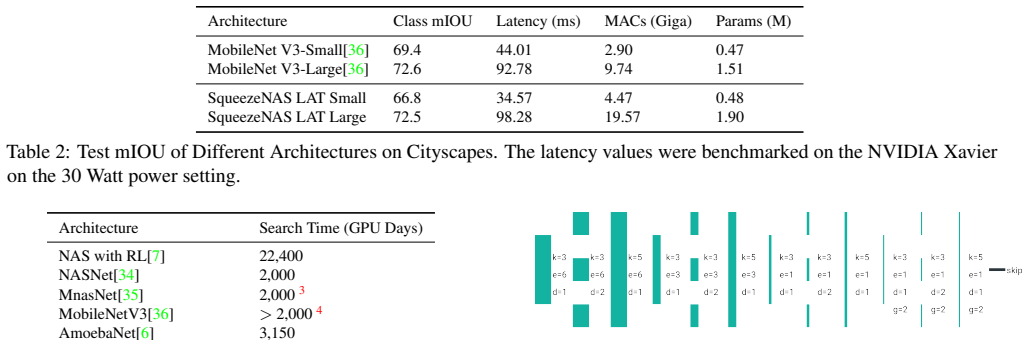
On its own terms, the central discovery is that when a supernetwork is searched directly on semantic segmentation with a latency lookup table for the target GPU, the optimizer finds encoders that dominate their MAC-optimized siblings: SqueezeNAS-LAT Small reaches 68.02% validation class mIOU in 34.57 ms versus 66.76% in 46.01 ms for the MAC-small network, and SqueezeNAS-LAT Large reaches 73.62% in 98.28 ms versus 72.40% in 102.90 ms. The paper reads this as evidence that measured per-block latency, not operation count, should guide NAS, because the found networks deliberately skip low-arithmetic-intensity blocks and concentrate computation late in the network, more than doubling MACs while reducing wall-clock time. It further claims this is the first proxyless hardware-aware NAS targeted at dense semantic segmentation, and that the same playbook should replace classification-transfer for other dense prediction tasks.
Load-bearing premise
The paper's ranking of architectures collapses if the latency of a full network is not the sum of independently measured per-block latencies—that is, if block order, kernel fusion, or data reuse materially changes total inference time on the Xavier.
Editorial extensions
If this is right
- Optimizing measured latency instead of MACs produced networks that are 1.2–1.3% more accurate while running 4–35% faster, so MAC counts are a poor proxy for speed on GPU-class embedded hardware.
- Because the cost entries form a lookup table, the same search procedure can be pointed at a new platform by re-measuring per-block latencies, and the optimal encoder changes with the hardware.
- The found architectures share a structural signature—aggressive early downsampling, heavy use of dilated convolutions late, and compute pushed to later low-resolution blocks—so task-specific search on segmentation discovers different encoders than classification-transfer would suggest.
- Search remains practical: each SqueezeNAS search took 7–15 GPU-days, in contrast to thousands of GPU-days for earlier NAS methods, making this playbook usable on dense vision tasks.
Reading between the lines
- The paper does not report end-to-end predicted-versus-measured latency correlation for full architectures; if block interactions such as kernel fusion or memory reuse are sizable, the additive lookup-table model in Equation 3 would need to be replaced with pair-wise or order-dependent costs.
- The same machinery is trivially extensible to energy, memory bandwidth, or multi-platform average latency by changing the contents of $C$; testing those objectives is a natural follow-up the paper motivates but does not run.
- The broader thesis implied by the paper is that any dense prediction task with a fixed deployment platform—depth estimation, panoptic segmentation, detection—should get its own proxyless search rather than reuse a classification backbone.
Signed reviews
Editorial analysis
A structured set of objections, weighed in public.
Referee Report
Summary. This paper presents SqueezeNAS, a proxyless hardware-aware neural architecture search method for semantic segmentation. The authors search over encoders built from Inverted Residual blocks directly on the Cityscapes dataset, using a Gumbel-Softmax parameterized supernetwork and a resource-aware loss that can optimize either MAC count or measured latency on an NVIDIA Xavier. Three search spaces (Small, Large, XLarge) are explored, producing MAC-optimized and latency-optimized models. The paper reports that the latency-optimized SqueezeNAS networks achieve higher validation mIOU at lower or comparable latency than the MAC-optimized counterparts, and claims an improved latency-accuracy tradeoff over MobileNetV3 semantic segmentation networks, with search times of 7–15 GPU days. The final sections analyze the discovered architectures and argue that latency-aware search shifts computation toward high arithmetic-intensity stages.
Significance. If the results hold, the paper makes a useful contribution: it is one of the first demonstrations of a proxyless hardware-aware NAS applied directly to dense semantic segmentation, and it provides a concrete case where optimizing measured latency outperforms optimizing MACs. The search cost of under 15 GPU days is genuinely low compared with RL- and evolution-based NAS, and the architectural analysis of where latency-optimized networks place their compute is informative. The paper also does a service by benchmarking on a specific embedded GPU rather than relying on FLOPS or MACs as a proxy. The central limitation is that the headline comparisons to MobileNetV3 rest on validation-selected numbers without error bars, and the held-out test set reverses the main Large-network comparison; the relative claim that latency search beats MAC search is more robust and is not affected by that reversal.
major comments (4)
- [§5.3.1, Table 1, Table 2, Abstract] The headline validation mIOU numbers in Table 1 and the abstract are not unbiased estimates of generalization. Section 5.3.1 states that 200 discrete architectures are sampled from the optimal distribution, scored on the Cityscapes validation set, and one architecture is selected from the estimated Pareto frontier before retraining. Validation mIOU is therefore a selection-set statistic. The held-out test results in Table 2 show the comparison to MobileNetV3 reversing: SqueezeNAS-LAT-Large drops to 72.5 test mIOU, below MobileNetV3-Large's 72.6, while taking 98.28 ms versus 92.78 ms, and SqueezeNAS-LAT-Small is 66.8 versus 69.4, a 2.6-point gap rather than the 0.26-point gap claimed in Section 5.4. The abstract's claim that the approach advances the state of the art for latency-optimized networks is therefore not supported by the unbiased test set. Please report test mIOU as the headline comparison, temper the state-of-the-art claim, or provide a selection-bias-corrected estimate.
- [Tables 1–2, §5.4] No repeated runs or error bars are reported for any of the central comparisons. The final architectures are the result of a stochastic search followed by retraining, and the claimed advantages over MobileNetV3 are small (0.26 points on validation for Small, 1.2 points for Large). Without variance estimates over search seeds or retraining seeds, it is impossible to tell whether these differences are within noise. Please retrain each selected architecture multiple times, and ideally repeat the search, and report mean and standard deviation for validation and test mIOU, as well as for the latency measurements on the Xavier.
- [§5.1, Table 1] The MobileNetV3 latency values are obtained from an open-source re-implementation rather than from the official MobileNetV3 release, and the paper does not specify which implementation, framework, or precision was used. Because the central comparison is latency-accuracy on the Xavier, the baseline must be measured in the same software stack (same framework, same cuDNN version, same power mode, same batch size) as the SqueezeNAS models; otherwise the claimed speed advantage may be an artifact of implementation quality. Please provide the exact code and commit used, or rerun the official MobileNetV3 segmentation models under identical conditions.
- [§4.3, Eq. (3)] The resource-aware loss assumes the total network cost is the sum of independently measured per-block costs, with no dependence on block order, kernel fusion, or neighboring block shapes. On a GPU with cuDNN, fused operations and memory reuse can make actual end-to-end latency deviate from the sum of isolated block latencies. This does not undermine the paper's relative claim that latency search beats MAC search, since both objectives use the same independence assumption, but the absolute latency predictions from the lookup table should be validated against the measured latencies of the final architectures; reporting the correlation between predicted and measured latency would strengthen the search-objective claim.
minor comments (5)
- [§5, first paragraph] The paper contains a typo, 'NVIDIA Xaiver' for 'NVIDIA Xavier'; please correct it.
- [§5.4, MobileNetV3 comparison] The sentence 'SqueezeNAS-LAT-Large achieves over 1.2% higher accuracy with less than 6% higher latency' should be moved to a test-set comparison or explicitly marked as a validation-set observation, since the test-set comparison has the opposite sign.
- [Figures 5 and 6] Figures 5 and 6 plot validation mIOU against MACs and latency; the caption should state explicitly that the MobileNetV3 points are also validation mIOU from the open-source re-implementation, not official test numbers.
- [§4.1 and §5.3.1] Several reproducibility details are missing: the Gumbel-Softmax temperature schedule, the value of the tradeoff weight alpha, the early stopping threshold, and the number of supernetwork training iterations. Please add these to the implementation section.
- [Table 3] The search time table mixes reported and approximated values (e.g., MnasNet and MobileNetV3 are approximated from TPUv2 hours); please mark each row with the source of the number, and state whether SqueezeNAS search times include the retraining of the selected architecture.
Circularity Check
Mild selection circularity: the reported headline mIOU is a validation-set-selected statistic, while the core latency-NAS derivation is otherwise independent.
-
fitted input called prediction
[Section 5.3.1 (Architecture Search) and Table 1; cf. Section 5.4]
"After we finish optimizing the supernetwork, we sample 200 discrete architectures from the optimal architecture distribution. We estimate the performance of each architecture by running inference on the Cityscapes fine validation dataset using the architecture path within the supernetwork as shown in Figure 4. After validating the 200 architectures, we choose one from this estimated pareto-optimal frontier and retrain the singular architecture."
The final architecture is selected by ranking 200 sampled architectures on the Cityscapes validation set, and then Table 1 and the abstract report that same validation mIOU (68.02, 73.62, 75.19) as the headline result. Validation mIOU is therefore a selection-set statistic, not an unbiased evaluation of a pre-specified architecture: the reported accuracy is essentially the selection objective read back. The test-set reversal in Table 2 (SqueezeNAS-LAT-Large 72.5 vs MobileNetV3-Large 72.6) is the expected consequence. The paper itself notes 'a small gap in our validation and test accuracies,' but the headline SOTA comparison is still based on the selection set.
full rationale
The core contribution—proxyless, hardware-aware NAS for semantic segmentation—is self-contained: Eq. (1)-(3) define a loss with a measured per-block latency lookup table, and the final networks are compared against external Cityscapes test data and published baselines. I find no load-bearing self-citation: the only author-overlap reference ([31]) is cited for using Gumbel-Softmax, not for the paper's main claims, and no uniqueness theorem is imported. The one circular element is statistical rather than derivational: Section 5.3.1 selects the final architecture using the Cityscapes validation set, and Table 1 and the abstract report that same validation mIOU as the headline accuracy. This makes the headline SOTA claim partially self-referential, although it does not undermine the relative latency-vs-MAC search comparison. Overall, the central derivation is independent, so the circularity score is low.
Assumptions & free parameters
free parameters (5)
- Alpha loss tradeoff weight =
not reported
- Macro-architecture templates =
hand-designed Small/Large/XLarge (Appendix C)
- Candidate block set =
12 block types plus skip (Appendix B)
- Gumbel-Softmax temperature schedule =
annealed 5.0 to 1.0
- Early stopping threshold =
0.5% selection probability
assumptions (6)
- domain assumption Latency of a full network is the sum of independently measured per-block latencies and does not depend on block order or co-optimized weights.
- domain assumption Architecture parameters optimized jointly with shared supernetwork weights (Gumbel-Softmax path selection) predict the relative performance of individually retrained networks.
- domain assumption Cityscapes validation set scores of 200 sampled architectures are a reliable ranking signal for final retrained test performance.
- domain assumption Pretraining on ImageNet classification and COCO segmentation transfers to Cityscapes semantic segmentation and is fair across compared models.
- standard math The Gumbel-Softmax relaxation is a differentiable approximation of categorical sampling with gradients useful for architecture search.
- domain assumption Measured latency on the NVIDIA Xavier at 30 W with cuDNN 7.3.1 and batch size 1 is representative of real-time inference performance.
Cite this review
Pith. "Pith review of SqueezeNAS: Fast neural architecture search for faster semantic segmentation." pith.science (2026). https://pith.science/paper/EADKWN6L
@misc{pith2026190801748,
  author       = {Pith},
  title        = {Pith review of: SqueezeNAS: Fast neural architecture search for faster semantic segmentation},
  year         = {2026},
  howpublished = {\url{https://pith.science/paper/EADKWN6L}},
  note         = {Machine review of arXiv:1908.01748}
}
read the original abstract
For real time applications utilizing Deep Neural Networks (DNNs), it is critical that the models achieve high-accuracy on the target task and low-latency inference on the target computing platform. While Neural Architecture Search (NAS) has been effectively used to develop low-latency networks for image classification, there has been relatively little effort to use NAS to optimize DNN architectures for other vision tasks. In this work, we present what we believe to be the first proxyless hardware-aware search targeted for dense semantic segmentation. With this approach, we advance the state-of-the-art accuracy for latency-optimized networks on the Cityscapes semantic segmentation dataset. Our latency-optimized small SqueezeNAS network achieves 68.02% validation class mIOU with less than 35 ms inference times on the NVIDIA AGX Xavier. Our latency-optimized large SqueezeNAS network achieves 73.62% class mIOU with less than 100 ms inference times. We demonstrate that significant performance gains are possible by utilizing NAS to find networks optimized for both the specific task and inference hardware. We also present detailed analysis comparing our networks to recent state-of-the-art architectures.
Figures


Figures from the paper (5 more)




Reference graph
Works this paper leans on
-
[1]
Imagenet: A large-scale hierarchical image database,
J. Deng, W. Dong, R. Socher, L.-J. Li, K. Li, and L. Fei-Fei, “Imagenet: A large-scale hierarchical image database,” inCVPR, 2009, pp. 248–255. 1
work page 2009
-
[2]
Learning multiple layers of features from tiny images,
A. Krizhevsky, “Learning multiple layers of features from tiny images,” Tech. Rep., 2009. 1
work page 2009
-
[3]
SqueezeNet: AlexNet- level accuracy with 50x fewer parameters and <0.5mb model size,
F. N. Iandola, S. Han, M. W. Moskewicz, K. Ashraf, W. J. Dally, and K. Keutzer, “SqueezeNet: AlexNet- level accuracy with 50x fewer parameters and <0.5mb model size,” CoRR, vol. abs/1602.07360, 2016. [Online]. Available: http://arxiv.org/abs/1602.07360 1, 2
arXiv 2016
-
[4]
Very deep convo- lutional networks for large-scale image recognition,
K. Simonyan and A. Zisserman, “Very deep convo- lutional networks for large-scale image recognition,” CoRR, vol. abs/1409.1556, 2014. 1, 2
arXiv 2014
-
[5]
The unreasonable effectiveness of deep fea- tures as a perceptual metric,
R. Zhang, P. Isola, A. A. Efros, E. Shechtman, and O. Wang, “The unreasonable effectiveness of deep fea- tures as a perceptual metric,” inCVPR, 2018. 1
work page 2018
-
[6]
Reg- ularized evolution for image classifier architecture search,
E. Real, A. Aggarwal, Y . Huang, and Q. V . Le, “Reg- ularized evolution for image classifier architecture search,” in AAAI Conference on Artificial Intelligence,
-
[7]
Neural architecture search with reinforcement learning,
B. Zoph and Q. V . Le, “Neural architecture search with reinforcement learning,” inInternational Conference on Learning Representations, 2017. 1, 7
work page 2017
-
[8]
DARTS: Differentiable architecture search,
H. Liu, K. Simonyan, and Y . Yang, “DARTS: Differentiable architecture search,” in International Conference on Learning Representations , 2019. [Online]. Available: https://openreview.net/forum?id= S1eYHoC5FX 1, 2, 3, 7
work page 2019
Show all 51 references
-
[9]
Fbnet: Hardware-aware efficient convnet design via differ- entiable neural architecture search,
B. Wu, X. Dai, P. Zhang, Y . Wang, F. Sun, Y . Wu, Y . Tian, P. Vajda, Y . Jia, and K. Keutzer, “Fbnet: Hardware-aware efficient convnet design via differ- entiable neural architecture search,” inProceedings of the IEEE Conference on Computer Vision and Pattern Recognition, 201...
2019
-
[10]
EmBench: Quantifying performance variations of deep neural networks across modern com- modity devices,
M. Almeida, S. Laskaridis, I. Leontiadis, S. I. Venieris, and N. D. Lane, “EmBench: Quantifying performance variations of deep neural networks across modern com- modity devices,” inInternational Workshop on Embed- ded and Mobile Deep Learning (EMDL), 2019. 1
2019
-
[11]
The cityscapes dataset for semantic urban scene understanding,
M. Cordts, M. Omran, S. Ramos, T. Rehfeld, M. En- zweiler, R. Benenson, U. Franke, S. Roth, and B. Schiele, “The cityscapes dataset for semantic urban scene understanding,” in Proc. of the IEEE Conference on Computer Vision and Pattern Recognition (CVPR),
-
[12]
Jetson AGX Xavier developer kit,
NVIDIA, “Jetson AGX Xavier developer kit,” 2018. [Online]. Available: https://developer.nvidia.com/ embedded/jetson-agx-xavier-developer-kit 2
2018
-
[13]
Scene parsing through ade20k dataset,
B. Zhou, H. Zhao, X. Puig, S. Fidler, A. Barriuso, and A. Torralba, “Scene parsing through ade20k dataset,” in Proceedings of the IEEE Conference on Computer Vision and Pattern Recognition, 2017. 2
2017
-
[14]
Indoor segmentation and support inference from rgbd images,
P. K. Nathan Silberman, Derek Hoiem and R. Fergus, “Indoor segmentation and support inference from rgbd images,” inECCV, 2012. 2
2012
-
[15]
The pascal visual object classes (voc) challenge,
M. Everingham, L. Van Gool, C. K. I. Williams, J. Winn, and A. Zisserman, “The pascal visual object classes (voc) challenge,”International Journal of Com- puter Vision, vol. 88, no. 2, pp. 303–338, Jun. 2010. 2
2010
-
[16]
Im- agenet classification with deep convolutional neural networks,
A. Krizhevsky, I. Sutskever, and G. E. Hinton, “Im- agenet classification with deep convolutional neural networks,” inAdvances in Neural Information Process- ing Systems 25, F. Pereira, C. J. C. Burges, L. Bottou, and K. Q. Weinberger, Eds. Curran Associates, Inc., 2012, pp. 10...
2012
-
[17]
Fully convolutional networks for semantic segmentation,
E. Shelhamer, J. Long, and T. Darrell, “Fully convolutional networks for semantic segmentation,” IEEE Trans. Pattern Anal. Mach. Intell. , vol. 39, no. 4, pp. 640–651, Apr. 2017. [Online]. Available: https://doi.org/10.1109/TPAMI.2016.2572683 2
2017
-
[18]
DeepLab: Semantic image segmentation with deep convolutional nets, atrous convolution, and fully connected CRFs,
L. Chen, G. Papandreou, I. Kokkinos, K. Murphy, and A. L. Yuille, “DeepLab: Semantic image segmentation with deep convolutional nets, atrous convolution, and fully connected CRFs,” CoRR, vol. abs/1606.00915, 2016. [Online]. Available: http://arxiv.org/abs/1606.00915 2
2016 arXiv
-
[19]
Rethinking atrous convolution for semantic image segmentation,
L. Chen, G. Papandreou, F. Schroff, and H. Adam, “Rethinking atrous convolution for semantic image segmentation,” CoRR, vol. abs/1706.05587, 2017. [Online]. Available: http://arxiv.org/abs/1706.05587 2, 3, 8, 14
2017 arXiv
-
[20]
Encoder-decoder with atrous separable con- volution for semantic image segmentation,
L.-C. Chen, Y . Zhu, G. Papandreou, F. Schroff, and H. Adam, “Encoder-decoder with atrous separable con- volution for semantic image segmentation,” inProceed- ings of the European conference on computer vision (ECCV), 2018, pp. 801–818. 2, 3, 5, 6
2018
-
[21]
Visualizing and understand- ing convolutional networks,
M. Zeiler and R. Fergus, “Visualizing and understand- ing convolutional networks,” inECCV, 2014, pp. 818–
2014
-
[22]
Deep residual learning for image recognition,
K. He, X. Zhang, S. Ren, and J. Sun, “Deep residual learning for image recognition,” in CVPR, 2016, pp. 770–778. 2, 5 9
2016
-
[23]
MobileNets: Efficient convolutional neural net- works for mobile vision applications,
A. G. Howard, M. Zhu, B. Chen, D. Kalenichenko, W. Wang, T. Weyand, M. Andreetto, and H. Adam, “MobileNets: Efficient convolutional neural net- works for mobile vision applications,” CoRR, vol. abs/1704.04861, 2017. [Online]. Available: http://arxiv.org/abs/1704.04861 2
2017 arXiv
-
[24]
Shufflenet: An extremely efficient convolutional neural network for mobile devices,
X. Zhang, X. Zhou, M. Lin, and J. Sun, “Shufflenet: An extremely efficient convolutional neural network for mobile devices,” inProceedings of the IEEE Con- ference on Computer Vision and Pattern Recognition, 2018, pp. 6848–6856. 2
2018
-
[25]
Search- ing for efficient multi-scale architectures for dense im- age prediction,
L.-C. Chen, M. Collins, Y . Zhu, G. Papandreou, B. Zoph, F. Schroff, H. Adam, and J. Shlens, “Search- ing for efficient multi-scale architectures for dense im- age prediction,” in Advances in Neural Information Processing Systems, 2018, pp. 8699–8710. 2, 3
2018
-
[26]
Nas-fpn: Learn- ing scalable feature pyramid architecture for object detection,
G. Ghiasi, T.-Y . Lin, and Q. V . Le, “Nas-fpn: Learn- ing scalable feature pyramid architecture for object detection,” inProceedings of the IEEE Conference on Computer Vision and Pattern Recognition, 2019, pp. 7036–7045. 2, 3
2019
-
[27]
Focal loss for dense object detection,
T.-Y . Lin, P. Goyal, R. Girshick, K. He, and P. Dollár, “Focal loss for dense object detection,” inCVPR, 2017, pp. 2980–2988. 2
2017
-
[28]
Faster r-cnn: Towards real-time object detection with region pro- posal networks,
S. Ren, K. He, R. Girshick, and J. Sun, “Faster r-cnn: Towards real-time object detection with region pro- posal networks,” in Advances in Neural Information Processing Systems, C. Cortes, N. D. Lawrence, D. D. Lee, M. Sugiyama, and R. Garnett, Eds., 2015, pp. 91–99. 2
2015
-
[29]
SNAS: stochastic neural architecture search,
S. Xie, H. Zheng, C. Liu, and L. Lin, “SNAS: stochastic neural architecture search,” in International Conference on Learning Representations , 2019. [Online]. Available: https://openreview.net/forum?id= rylqooRqK7 2, 3
2019
-
[30]
ProxylessNAS: Direct neural architecture search on target task and hardware,
H. Cai, L. Zhu, and S. Han, “ProxylessNAS: Direct neural architecture search on target task and hardware,” in International Conference on Learning Representations, 2019. [Online]. Available: https://openreview.net/forum?id=HylVB3AqYm 2, 3
2019
-
[31]
Bayesian meta-network architecture learning,
A. Shaw, B. Dai, W. Liu, and L. Song, “Bayesian meta-network architecture learning,” CoRR, vol. abs/1812.09584, 2018. [Online]. Available: http: //arxiv.org/abs/1812.09584 2, 3
2018 arXiv
-
[32]
Efficient neural architecture search via parameters sharing,
H. Pham, M. Guan, B. Zoph, Q. Le, and J. Dean, “Efficient neural architecture search via parameters sharing,” in International Conference on Machine Learning, 2018, pp. 4095–4104. [Online]. Available: http://proceedings.mlr.press/v80/pham18a.html 2, 3
2018
-
[33]
Progressive neural architecture search,
C. Liu, B. Zoph, M. Neumann, J. Shlens, W. Hua, L.-J. Li, L. Fei-Fei, A. Yuille, J. Huang, and K. Murphy, “Progressive neural architecture search,” in Proceed- ings of the European Conference on Computer Vision (ECCV), 2018, pp. 19–34. 2, 3
2018
-
[34]
Learn- ing transferable architectures for scalable image recog- nition,
B. Zoph, V . Vasudevan, J. Shlens, and Q. V . Le, “Learn- ing transferable architectures for scalable image recog- nition,” inThe IEEE Conference on Computer Vision and Pattern Recognition (CVPR), 2018. 2, 7
2018
-
[35]
Mnasnet: Platform-aware neural architecture search for mobile,
M. Tan, B. Chen, R. Pang, V . Vasudevan, M. Sandler, A. Howard, and Q. V . Le, “Mnasnet: Platform-aware neural architecture search for mobile,” inProceedings of the IEEE Conference on Computer Vision and Pat- tern Recognition, 2019, pp. 2820–2828. 2, 7
2019
-
[36]
Searching for MobileNetV3,
A. Howard, M. Sandler, G. Chu, L.-C. Chen, B. Chen, M. Tan, W. Wang, Y . Zhu, R. Pang, V . Vasudevan, Q. V . Le, and H. Adam, “Searching for MobileNetV3,” arXiv:1905.02244, 2019. 2, 3, 5, 6, 7, 8, 13
1905 arXiv
-
[37]
Ef- ficient architecture search by network transformation,
H. Cai, T. Chen, W. Zhang, Y . Yu, and J. Wang, “Ef- ficient architecture search by network transformation,” in AAAI Conference on Artificial Intelligence, 2018. 3
2018
-
[38]
Auto-deeplab: Hierar- chical neural architecture search for semantic image segmentation,
C. Liu, L.-C. Chen, F. Schroff, H. Adam, W. Hua, A. L. Yuille, and L. Fei-Fei, “Auto-deeplab: Hierar- chical neural architecture search for semantic image segmentation,” inProceedings of the IEEE Conference on Computer Vision and Pattern Recognition, 2019, pp. 82–92. 3
2019
-
[39]
Categorical reparame- terization with gumbel-softmax,
E. Jang, S. Gu, and B. Poole, “Categorical reparame- terization with gumbel-softmax,” in International Con- ference on Learning Representations, 2017. 3, 4
2017
-
[40]
MobileNetV2: Inverted residuals and linear bottlenecks,
M. B. Sandler, A. G. Howard, M. Zhu, A. Zhmoginov, and L.-C. Chen, “MobileNetV2: Inverted residuals and linear bottlenecks,” 2018, pp. 4510–4520. 3, 6, 7
2018
-
[41]
Concentrated-comprehensive convolutions for lightweight semantic segmentation,
H. Park, Y . Yoo, G. Seo, D. Han, S. Yun, and N. Kwak, “Concentrated-comprehensive convolutions for lightweight semantic segmentation,” CoRR, vol. abs/1812.04920, 2018. [Online]. Available: http://arxiv.org/abs/1812.04920 6
2018 arXiv
-
[42]
Efficient dense modules of asymmetric convolution for real-time semantic segmentation,
S. Lo, H. Hang, S. Chan, and J. Lin, “Efficient dense modules of asymmetric convolution for real-time semantic segmentation,”CoRR, vol. abs/1809.06323,
-
[43]
Microsoft COCO: Common objects in context,
T. Lin, M. Maire, S. J. Belongie, L. D. Bourdev, R. B. Girshick, J. Hays, P. Perona, D. Ramanan, P. Dollár, and C. L. Zitnick, “Microsoft COCO: Common objects in context,” inECCV, 2014. 5
2014
-
[44]
Megdet: A large mini-batch object detector,
C. Peng, T. Xiao, Z. Li, Y . Jiang, X. Zhang, K. Jia, G. Yu, and J. Sun, “Megdet: A large mini-batch object detector,” inThe IEEE Conference on Computer Vision and Pattern Recognition (CVPR), June 2018. 6
2018
-
[45]
Batch normalization: Ac- celerating deep network training by reducing internal covariate shift,
S. Ioffe and C. Szegedy, “Batch normalization: Ac- celerating deep network training by reducing internal covariate shift,” in International Conference on Ma- chine Learning, 2015, pp. 448–456. 6
2015
-
[46]
Squeeze-and-excitation networks,
J. Hu, L. Shen, and G. Sun, “Squeeze-and-excitation networks,” inProceedings of the IEEE conference on computer vision and pattern recognition , 2018, pp. 7132–7141. 7
2018
-
[47]
Searching for activation functions,
P. Ramachandran, B. Zoph, and Q. V . Le, “Searching for activation functions,”CoRR, vol. abs/1710.05941,
-
[48]
Pyramid scene parsing network,
H. Zhao, J. Shi, X. Qi, X. Wang, and J. Jia, “Pyramid scene parsing network,” in Proceedings of the IEEE conference on computer vision and pattern recognition, 2017, pp. 2881–2890. 8
2017
-
[49]
Roofline: An insightful visual performance model for floating- point programs and multicore architectures,
S. Williams, A. Waterman, and D. Patterson, “Roofline: An insightful visual performance model for floating- point programs and multicore architectures,” Lawrence Berkeley National Lab.(LBNL), Berkeley, CA (United States), Tech. Rep., 2009. 8 11 Appendix A. XLarge Networks Visual...
2009
-
[2017]
Available: http://arxiv.org/abs/1710
[Online]. Available: http://arxiv.org/abs/1710. 05941 7
-
[2018]
Available: http://arxiv.org/abs/1809
[Online]. Available: http://arxiv.org/abs/1809. 06323 6 10
Reviewed August 14, 2026 · model on record in the stance chip above.
Discussion (0). Continue with ORCID to comment.