REVIEW 2 major objections 3 minor 39 references
Magnetic structure and excitations of the topological semimetal YbMnBi$_2$
T0 review · 2 major / 3 minor · reviewed 2026-08-14 · deepseek-v4-flash
Pith's one-line read Neutron diffraction shows YbMnBi2's Mn moments stay within 3° of the c-axis, ruling out the time-reversal-breaking route to bulk Weyl nodes.
desk verdict Solid neutron-scattering study with a careful magnetic structure determination, but the 'excluded in the bulk' conclusion overreaches the data. read the letter →
The pith
A machine-rendered reading of the paper's core claim, the machinery that carries it, and where it could break.
The reading
What carries the argument
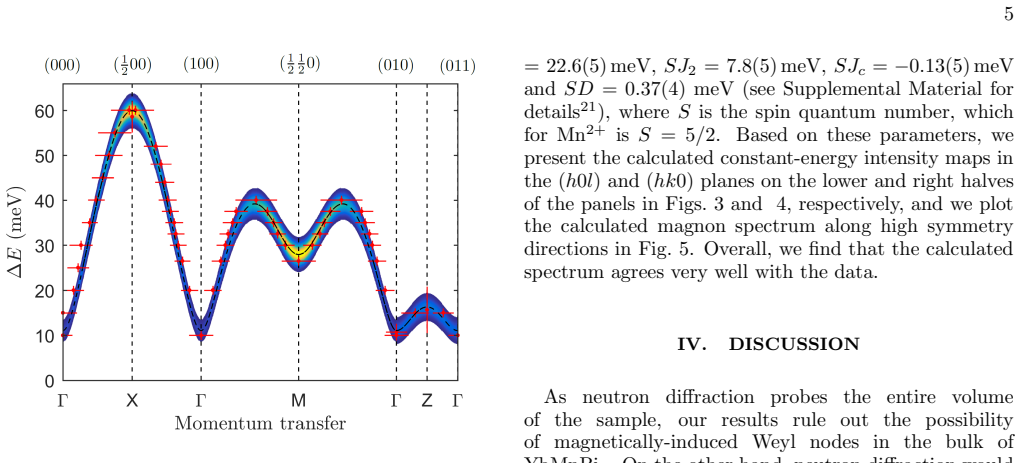
The load-bearing probe is elastic neutron diffraction of the (00l) family of nuclear reflections, relying on the fact that magnetic neutron scattering is sensitive only to the component of the ordered moment perpendicular to the scattering vector Q, so reflections with Q parallel to the c-axis isolate any in-plane ferromagnetic component that would accompany canting. The authors measure the temperature dependence of the weak (001) and (002) peaks and compare the data with calculated intensities for tilt angles of 0°, 5°, and 10°, obtaining via a chi-square analysis a 95% upper bound of 3° on the tilt. For the dynamics, the central object is a linear spin-wave model built from the Hamiltonian H = sum_{i,j} J_{ij} S_i · S_j − D (S_i^z)^2, including in-plane nearest and next-nearest exchange J1 and J2 and c-axis exchange Jc; fitting it to constant-energy neutron maps reproduces the measured dispersion and yields exchange parameters statistically identical to those of CaMnBi2. This combination—a calibrated canting bound from elastic diffraction and a parameter-matched spin-wave spectrum—carries the argument.
What would settle it
A first-principles calculation of the band structure for canting angles between 0° and 3° would settle the matter: if Weyl nodes survive at 1°, the 3° bound is insufficient; if they require the full 10°, the paper's conclusion stands.
Extended reading notes
Core claim
The central claim is that the Mn sublattice of YbMnBi2 is a collinear C-type antiferromagnet below TN = 290 K, with moments along the c-axis within 3° at 95% confidence, and that this eliminates the time-reversal-symmetry-breaking route to Weyl nodes in the bulk. The evidence is the absence of any magnetic contribution to the weak (00l) nuclear Bragg peaks, which would acquire intensity from an in-plane ferromagnetic component if the moments tilted. The paper also reports the full magnon dispersion up to about 60 meV and shows that a linear spin-wave model with nearest-neighbor J1, next-nearest-neighbor J2, and c-axis Jc exchanges plus a single-ion easy-axis anisotropy D reproduces it; the fitted exchange constants are the same as in CaMnBi2 within error. No anomalous features attributable to Weyl fermions appear in the spin dynamics. The conclusion on the bulk electronic state follows only together with the prior theoretical result that about 10° of canting is needed for the Weyl mechanism.
Load-bearing premise
The exclusion of bulk Weyl nodes depends on the prior theoretical result that creating Weyl points by time-reversal-symmetry breaking in this material requires the Mn moments to cant about 10° away from the c-axis; if that threshold were actually below the 3° experimental bound, the neutron data would not rule out the mechanism.
Editorial extensions
If this is right
- Bulk YbMnBi2 should be classified with the Dirac semimetals rather than as a magnetically induced Weyl semimetal, so proposals that rely on bulk Weyl fermions from spin canting need revision.
- Any Weyl physics in YbMnBi2 must reside at the surface or arise from a different mechanism, and surface-sensitive probes could search for a roughly 10° canting in the top layers.
- The near-identical Mn exchange parameters in YbMnBi2 and CaMnBi2 imply that the Yb 4f electrons do not enhance coupling between the Mn moments and the Bi-square-net carriers, so tuning the A-site rare earth to a magnetic ion such as Eu is a more promising route to strong magneto-topological coupling.
- The magnon spectrum's crossover to two-dimensional behavior above about 30 meV and its 60 meV maximum provide a benchmark for future studies of the wider 112 pnictide family.
Reading between the lines
- The same (00l)-reflection strategy could be applied to other proposed magnetic Weyl or Dirac candidates, such as EuMnBi2 or SrMnBi2, to place comparable upper bounds on moment canting.
- If surface canting is confirmed, YbMnBi2 would become a test case for a bulk-Dirac/surface-Weyl dichotomy, with distinct transport signatures expected from surface Fermi arcs.
- Since the fitted J values are identical to CaMnBi2, a systematic study across the AMnPn2 family could use magnon spectra to map how exchange changes with A-site magnetism and pnictide mass, potentially predicting where topological crossings survive.
- The paper's bound is statistical (95% confidence on a 3° tilt); higher-statistics measurements on larger crystals could push the bound toward 1°, sharpening the test of the theoretical canting requirement.
Editorial analysis
A structured set of objections, weighed in public.
Referee Report
Summary. The paper reports elastic and inelastic neutron scattering measurements on single-crystal YbMnBi2. The elastic data confirm C-type antiferromagnetic order of the Mn sublattice below TN = 290 K and constrain the ordered moments to lie within 3 degrees of the c-axis at 95% confidence, based on the intensity of the (001) and (002) reflections. The inelastic data map the magnon dispersion, which is well reproduced by a linear spin-wave model with in-plane J1, J2, c-axis Jc, and single-ion anisotropy D. The fitted parameters are nearly identical to those of CaMnBi2, with the anisotropy about half that of YbMnBi2. The authors conclude that the absence of a ~10 degree canting rules out the time-reversal-symmetry-breaking mechanism for Weyl nodes in the bulk, and propose that the bulk is a Dirac semimetal.
Significance. If the central claim held, this would be a valuable negative result for the candidate Weyl semimetal YbMnBi2. The diffraction analysis is careful: the (001) intensity comparison against calculated curves for tilt angles, with a chi-squared goodness-of-fit yielding a 95% confidence bound of 3 degrees, is a sound and reproducible procedure. The spin-wave model fit to the measured dispersion is convincing, and the comparison with CaMnBi2 provides a useful benchmark. These experimental contributions are solid and will be of interest to the community. However, the central interpretive claim about excluding the time-reversal-symmetry-breaking Weyl mechanism in the bulk is logically stronger than the data support, as detailed in the major comments.
major comments (2)
- [Sec. III.A and Abstract] The conclusion that the time-reversal-symmetry-breaking mechanism for Weyl nodes is excluded in the bulk is not logically supported. The paper states in Sec. III.A that 'a 10 degree canting of Mn moments away from the c-axis, as required to create the Weyl nodes, can be excluded,' and the abstract asserts that creation of Weyl nodes by this mechanism 'can be excluded in the bulk.' The 10 degree requirement is taken from Ref. 10, but the paper does not establish that canting angles smaller than 3 degrees cannot create Weyl nodes. On symmetry grounds, any nonzero uniform in-plane ferromagnetic component—no matter how small—breaks the protecting antiunitary symmetry and can split a Dirac crossing into Weyl nodes; the canting magnitude only affects the separation of the nodes in momentum space, not their existence. Since the neutron data allow a canting up to 3 degrees, a 2 degree canting is fully consistent with the measurement and could still produce Weyl nodes. The data therefore exclude the specific ~10 degree canting prediction of Ref. 10, but they do not logically exclude the TRS-breaking mechanism in the bulk. The Discussion acknowledges the surface-canting caveat but not this small-bulk-canting caveat. The authors should either soften the conclusion to 'no canting of the size predicted by Ref. 10' or add a theoretical argument demonstrating a lower threshold for the existence of Weyl nodes above 3 degrees.
- [Sec. V (Conclusion)] The statement 'we demonstrate that bulk YbMnBi2 is a Dirac semimetal rather than a host for the WSM state' is an overreach relative to the neutron diffraction data. The measurements constrain the magnetic structure; they do not directly probe the electronic band structure. The conclusion that the bulk is a Dirac semimetal depends on the (unproven) assumption that the absence of a canting above 3 degrees implies the absence of Weyl nodes, and additionally requires that the band crossings present in the paramagnetic or non-magnetic state survive as gapless Dirac points in the ordered state. The neutron data alone cannot rule out a gapped trivial semimetal or other possibilities. This statement should be revised to reflect the actual scope of the evidence, for example by saying the data are consistent with a Dirac semimetal rather than demonstrating it.
minor comments (3)
- [Introduction] There is a typo: 'could play be expected to play some role' should read 'could be expected to play some role.'
- [Reference 21] Reference 21 appears malformed: it begins 'm. m. see supplemental material at...' and should be corrected to a standard citation format.
- [Sec. III.A] The phrase 'the (100) peak, which is otherwise forbidden in the P4/nmm space group' is imprecise; the (100) reflection is not forbidden by the space group extinction rules but has zero nuclear structure factor for the specific atomic positions. The wording could be clarified.
Circularity Check
No significant circularity: the canting bound is measured directly, and the Weyl-exclusion argument depends on an external theory premise rather than on a fitted parameter or self-citation.
full rationale
I find no circular step. The central magnetic-structure result—collinear Mn moments along c to within 3°—is obtained by comparing the temperature dependence of the (001)/(002) nuclear peaks with the calculated magnetic intensity expected from a ferromagnetic in-plane component; the calculation uses the measured (100) magnetic intensity and standard neutron-scattering geometry, so the bound is a direct experimental constraint rather than a quantity defined by the conclusion. The exclusion of the TRS-breaking Weyl mechanism is conditional on the external premise, stated in the Introduction as 'In Ref. 10, it was argued that creation of Weyl points by TRS breaking in YbMnBi2 requires a ∼10° canting,' and the paper does not hide that conditionality: it explicitly leaves open surface canting in the Discussion and Conclusion. That premise is an external theory input and is not equivalent to, or fitted from, the neutron data; if the threshold were wrong the conclusion would weaken, but that is a correctness concern, not circularity. The only author-overlapping citation, Ref. 18 (CaMnBi2 spin waves), is used as a benchmark for the magnon parameters, not as an input to the magnetic-structure or Weyl-exclusion claims. The spin-wave parameters are fitted to the observed dispersion and then compared, but they are not renamed as predictions or fed back into the canting conclusion. Therefore the derivation chain is self-contained with respect to its own inputs.
Assumptions & free parameters
free parameters (4)
- SJ1 (in-plane nearest-neighbor exchange) =
22.6(5) meV
- SJ2 (in-plane next-nearest-neighbor exchange) =
7.8(5) meV
- SJc (c-axis nearest-neighbor exchange) =
-0.13(5) meV
- SD (single-ion anisotropy) =
0.37(4) meV
assumptions (6)
- domain assumption Linear spin-wave theory as implemented in SpinW accurately describes the magnon spectrum of YbMnBi2 at the measured energies.
- domain assumption The effective spin Hamiltonian includes only first and second nearest neighbors in the ab plane (J1, J2), nearest neighbors along c (Jc), and a single-ion anisotropy D.
- domain assumption The Mn2+ spin is S=5/2.
- domain assumption The gradual increase of the (001) and (002) peak intensities with decreasing temperature is entirely due to the Debye-Waller factor.
- domain assumption The magnetic form factor of Mn2+ and the observed (100) magnetic peak intensity correctly calibrate the expected magnetic intensity of the (001) reflection for a given tilt angle.
- domain assumption A canting of about 10 degrees is required to create Weyl nodes by the time-reversal-symmetry-breaking mechanism, as argued in Ref. 10.
Cite this review
Pith. "Pith review of Magnetic structure and excitations of the topological semimetal YbMnBi$_2$." pith.science (2026). https://pith.science/paper/DUU5MEIL
@misc{pith2026190804872,
  author       = {Pith},
  title        = {Pith review of: Magnetic structure and excitations of the topological semimetal YbMnBi$_2$},
  year         = {2026},
  howpublished = {\url{https://pith.science/paper/DUU5MEIL}},
  note         = {Machine review of arXiv:1908.04872}
}
abstract
We investigated the magnetic structure and dynamics of YbMnBi$_2$, with elastic and inelastic neutron scattering, to shed light on the topological nature of the charge carriers in the antiferromagnetic phase. We confirm C-type antiferromagnetic ordering of the Mn spins below $T_{\rm N} = 290$ K, and determine that the spins point along the $c$-axis to within about $3^\circ$. The observed magnon spectrum can be described very well by the same effective spin Hamiltonian as was used previously to model the magnon spectrum of CaMnBi$_2$. Our results show conclusively that the creation of Weyl nodes in YbMnBi$_2$ by the time-reversal-symmetry breaking mechanism can be excluded in the bulk.
Figures


Figures from the paper (1 more)
Reference graph
Works this paper leans on
-
[1]
author author A. A. \ Burkov ,\ 10.1038/nmat4788 journal journal Nat. Mat. \ volume 15 ,\ pages 1145 ( year 2016 ) NoStop
doi:10.1038/nmat4788 2016
-
[2]
author author N. P. \ Armitage , author E. J. \ Mele , \ and\ author A. Vishwanath ,\ 10.1103/RevModPhys.90.015001 journal journal Rev. Mod. Phys. \ volume 90 ,\ pages 015001 ( year 2018 ) NoStop
-
[3]
author author J. G. \ Rau , author E. K.-H. \ Lee , \ and\ author H.-Y. \ Kee ,\ 10.1146/annurev-conmatphys-031115-011319 journal journal Ann. Rev. Con. Mat. Phys. \ volume 7 ,\ pages 195 ( year 2016 ) NoStop
-
[4]
author author D. Pesin \ and\ author L. Balents ,\ 10.1038/nphys1606 journal journal Nat. Phys. \ volume 6 ,\ pages 376 ( year 2010 ) NoStop
-
[5]
author author M. Z. \ Hasan \ and\ author C. L. \ Kane ,\ 10.1103/RevModPhys.82.3045 journal journal Rev. Mod. Phys. \ volume 82 ,\ pages 3045 ( year 2010 ) NoStop
-
[6]
author author B. Q. \ Lv , author H. M. \ Weng , author B. B. \ Fu , author X. P. \ Wang , author H. Miao , author J. Ma , author P. Richard , author X. C. \ Huang , author L. X. \ Zhao , author G. F. \ Chen , author Z. Fang , author X. Dai , author T. Qian , \ and\ author H. Ding ,\ 10.1103/PhysRevX.5.031013 journal journal Phys. Rev. X \ volume 5 ,\ pag...
-
[7]
author author S.-M. \ Huang , author S.-Y. \ Xu , author I. Belopolski , author C.-C. \ Lee , author G. Chang , author B. Wang , author N. Alidoust , author G. Bian , author M. Neupane , author C. Zhang , author S. Jia , author A. Bansil , author H. Lin , \ and\ author M. Z. \ Hasan ,\ 10.1038/ncomms8373 journal journal Nat. Comms. \ volume 6 ,\ pages 737...
-
[8]
author author S.-Y. \ Xu , author I. Belopolski , author N. Alidoust , author M. Neupane , author G. Bian , author C. Zhang , author R. Sankar , author G. Chang , author Z. Yuan , author C.-C. \ Lee , author S.-M. \ Huang , author H. Zheng , author J. Ma , author D. S. \ Sanchez , author B. Wang , author A. Bansil , author F. Chou , author P. P. \ Shibaye...
Show all 39 references
-
[9]
author author L. X. \ Yang , author Z. K. \ Liu , author Y. Sun , author H. Peng , author H. F. \ Yang , author T. Zhang , author B. Zhou , author Y. Zhang , author Y. F. \ Guo , author M. Rahn , author D. Prabhakaran , author Z. Hussain , author S.-K. \ Mo , author C. Felser ...
-
[10]
Borisenko , author D
author author S. Borisenko , author D. Evtushinsky , author Q. Gibson , author A. Yaresko , author K. Koepernik , author T. Kim , author M. Ali , author J. van den Brink , author M. Hoesch , author A. Fedorov , author E. Haubold , author Y. Kushnirenko , author I. Soldatov , a...
-
[11]
Chaudhuri , author B
author author D. Chaudhuri , author B. Cheng , author A. Yaresko , author Q. D. \ Gibson , author R. J. \ Cava , \ and\ author N. P. \ Armitage ,\ 10.1103/PhysRevB.96.075151 journal journal Phys. Rev. B \ volume 96 ,\ pages 075151 ( year 2017 ) NoStop
-
[12]
Chinotti , author A
author author M. Chinotti , author A. Pal , author W. J. \ Ren , author C. Petrovic , \ and\ author L. Degiorgi ,\ 10.1103/PhysRevB.94.245101 journal journal Phys. Rev. B \ volume 94 ,\ pages 245101 ( year 2016 ) NoStop
2016 doi
-
[13]
Klemenz , author S
author author S. Klemenz , author S. Lei , \ and\ author L. M. \ Schoop ,\ 10.1146/annurev-matsci-070218-010114 journal journal Annu. Rev. Mater. Res. \ volume 49 ,\ pages 185 ( year 2019 ) NoStop
2019 doi
-
[14]
Wang , author I
author author A. Wang , author I. Zaliznyak , author W. Ren , author L. Wu , author D. Graf , author V. O. \ Garlea , author J. B. \ Warren , author E. Bozin , author Y. Zhu , \ and\ author C. Petrovic ,\ 10.1103/PhysRevB.94.165161 journal journal Phys. Rev. B \ volume 94 ,\ p...
-
[15]
author author J. Y. \ Liu , author J. Hu , author D. Graf , author T. Zou , author M. Zhu , author Y. Shi , author S. Che , author S. M. A. \ Radmanesh , author C. N. \ Lau , author L. Spinu , author H. B. \ Cao , author X. Ke , \ and\ author Z. Q. \ Mao ,\ 10.1038/s41467-017-...
-
[16]
Pal , author M
author author A. Pal , author M. Chinotti , author L. Degiorgi , author W. Ren , \ and\ author C. Petrovic ,\ https://doi.org/10.1016/j.physb.2017.09.079 journal journal Physica B \ volume 536 ,\ pages 64 ( year 2018 ) NoStop
2017 doi
-
[17]
author author I. A. \ Zaliznyak , author A. T. \ Savici , author V. O. \ Garlea , author B. Winn , author U. Filges , author J. Schneeloch , author J. M. \ Tranquada , author G. Gu , author A. Wang , \ and\ author C. Petrovic ,\ http://stacks.iop.org/1742-6596/862/i=1/a=012030...
2017
-
[18]
author author M. C. \ Rahn , author A. J. \ Princep , author A. Piovano , author J. Kulda , author Y. F. \ Guo , author Y. G. \ Shi , \ and\ author A. T. \ Boothroyd ,\ 10.1103/PhysRevB.95.134405 journal journal Phys. Rev. B \ volume 95 ,\ pages 134405 ( year 2017 ) NoStop
-
[19]
Hiess , author M
author author A. Hiess , author M. Jiménez-Ruiz , author P. Courtois , author R. Currat , author J. Kulda , \ and\ author F. Bermejo ,\ https://doi.org/10.1016/j.physb.2006.05.370 journal journal Physica B \ volume 385-386 ,\ pages 1077 ( year 2006 ) NoStop
2006 doi
-
[20]
Kempa , author B
author author M. Kempa , author B. Janousova , author J. Saroun , author P. Flores , author M. Boehm , author F. Demmel , \ and\ author J. Kulda ,\ https://doi.org/10.1016/j.physb.2006.05.371 journal journal Physica B \ volume 385-386 ,\ pages 1080 ( year 2006 ) NoStop
2006 doi
-
[21]
author author m. m. \ see supplemental material at http://link.aps.org/supplemental/10.1103/PhysRevB.00. 000000 for laboratory x-ray diffraction patterns \ and\ author data analysis methods ,\ @noop NoStop
-
[22]
author author Y. F. \ Guo , author A. J. \ Princep , author X. Zhang , author P. Manuel , author D. Khalyavin , author I. I. \ Mazin , author Y. G. \ Shi , \ and\ author A. T. \ Boothroyd ,\ 10.1103/PhysRevB.90.075120 journal journal Phys. Rev. B \ volume 90 ,\ pages 075120 ( ...
-
[23]
Li , author K
author author L. Li , author K. Wang , author D. Graf , author L. Wang , author A. Wang , \ and\ author C. Petrovic ,\ 10.1103/PhysRevB.93.115141 journal journal Phys. Rev. B \ volume 93 ,\ pages 115141 ( year 2016 ) NoStop
2016 doi
-
[24]
\ Wang , author Q.-H
author author Y.-Y. \ Wang , author Q.-H. \ Yu , \ and\ author T.-L. \ Xia ,\ http://stacks.iop.org/1674-1056/25/i=10/a=107503 journal journal Chin. Phys. B \ volume 25 ,\ pages 107503 ( year 2016 b ) NoStop
2016
-
[25]
author author G. L. \ Squires ,\ 10.1017/CBO9781139107808 title Introduction to the Theory of Thermal Neutron Scattering ,\ edition 3rd \ ed.\ ( publisher Cambridge University Press ,\ year 2012 ) NoStop
2012 doi
-
[26]
author author J. Y. \ Liu , author J. Hu , author Q. Zhang , author D. Graf , author H. B. \ Cao , author S. M. A. \ Radmanesh , author D. J. \ Adams , author Y. L. \ Zhu , author G. Cheng , author X. Liu , author W. A. \ Phelan , author J. Wei , author M. Jaime , author F. Ba...
-
[27]
@citealpnum Liu2017b are interchanged with respect to those defined in the present work
note Note that the a and c axis in Ref. @citealpnum Liu2017b are interchanged with respect to those defined in the present work. SrMnBi _2 suffers from an off stoichiometry and is better described by Sr _ 1-y Mn _ 1-z Sb _2 (y, z < 0.1) . Stop
-
[28]
Toth \ and\ author B
author author S. Toth \ and\ author B. Lake ,\ http://stacks.iop.org/0953-8984/27/i=16/a=166002 journal journal J. Phys.: Condens. Matter \ volume 27 ,\ pages 166002 ( year 2015 ) NoStop
2015
-
[29]
Feng , author Z
author author Y. Feng , author Z. Wang , author C. Chen , author Y. Shi , author Z. Xie , author H. Yi , author A. Liang , author S. He , author J. He , author Y. Peng , author X. Liu , author Y. Liu , author L. Zhao , author G. Liu , author X. Dong , author J. Zhang , author ...
-
[30]
Wang , author D
author author K. Wang , author D. Graf , author L. Wang , author H. Lei , author S. W. \ Tozer , \ and\ author C. Petrovic ,\ 10.1103/PhysRevB.85.041101 journal journal Phys. Rev. B \ volume 85 ,\ pages 041101(R) ( year 2012 ) NoStop
2012 doi
-
[31]
Zhang , author C
author author A. Zhang , author C. Liu , author C. Yi , author G. Zhao , author T.-l. \ Xia , author J. Ji , author Y. Shi , author R. Yu , author X. Wang , author C. Chen , \ and\ author Q. Zhang ,\ 10.1038/ncomms13833 journal journal Nat. Comms. \ volume 7 ,\ pages 13833 ( y...
-
[33]
Masuda , author H
author author H. Masuda , author H. Sakai , author M. Tokunaga , author Y. Yamasaki , author A. Miyake , author J. Shiogai , author S. Nakamura , author S. Awaji , author A. Tsukazaki , author H. Nakao , author Y. Murakami , author T.-h. \ Arima , author Y. Tokura , \ and\ aut...
2016
-
[34]
Masuda , author H
author author H. Masuda , author H. Sakai , author M. Tokunaga , author M. Ochi , author H. Takahashi , author K. Akiba , author A. Miyake , author K. Kuroki , author Y. Tokura , \ and\ author S. Ishiwata ,\ 10.1103/PhysRevB.98.161108 journal journal Phys. Rev. B \ volume 98 ,...
-
[35]
\ Wang , author S
author author Y.-Y. \ Wang , author S. Xu , author L.-L. \ Sun , \ and\ author T.-L. \ Xia ,\ 10.1103/PhysRevMaterials.2.021201 journal journal Phys. Rev. Mater. \ volume 2 ,\ pages 021201 ( year 2018 ) NoStop
2018 doi
-
[36]
Kealhofer , author S
author author R. Kealhofer , author S. Jang , author S. M. \ Griffin , author C. John , author K. A. \ Benavides , author S. Doyle , author T. Helm , author P. J. W. \ Moll , author J. B. \ Neaton , author J. Y. \ Chan , author J. D. \ Denlinger , \ and\ author J. G. \ Analyti...
-
[37]
author author J. Y. \ Liu , author J. Hu , author H. Cao , author Y. Zhu , author A. Chuang , author D. Graf , author D. J. \ Adams , author S. M. A. \ Radmanesh , author L. Spinu , author I. Chiorescu , \ and\ author Z. Q. \ Mao ,\ 10.1038/srep30525 journal journal Sci. Rep. ...
-
[38]
Ouladdiaf , author J
author author B. Ouladdiaf , author J. Archer , author G. McIntyre , author A. Hewat , author D. Brau , \ and\ author S. York ,\ 10.1016/j.physb.2006.05.337 journal journal Physica B \ volume 385-386 ,\ pages 1052 ( year 2006 ) NoStop
2006 doi
-
[39]
author author A. T. \ Boothroyd , author A. Ivanov , author H. Jacobsen , author A. Piovano , \ and\ author J.-R. \ Soh ,\ 10.5291/ILL-DATA.5-41-975 \ ( year 2018 ),\ 10.5291/ILL-DATA.5-41-975 NoStop
2018 doi
-
[40]
author author A. F. \ May , author M. A. \ McGuire , \ and\ author B. C. \ Sales ,\ 10.1103/PhysRevB.90.075109 journal journal Phys. Rev. B \ volume 90 ,\ pages 075109 ( year 2014 b ) NoStop
2014 doi
Reviewed August 14, 2026 · model on record in the stance chip above.
Discussion (0). Continue with ORCID to comment.