REVIEW 4 major objections 7 minor 40 references
How Sequence-to-Sequence Models Perceive Language Styles?
T0 review · 4 major / 7 minor · reviewed 2026-08-14 · deepseek-v4-flash
Pith's one-line read A corpus's language style is the covariance matrix of its semantic vectors, and that matrix alone drives training-free style transfer.
desk verdict Style-as-covariance for text is a clean, testable idea, but the paper's own experiments never verify the near-lossless encoder it depends on, leaving Conjecture 1 under-tested. read the letter →
The pith
A machine-rendered reading of the paper's core claim, the machinery that carries it, and where it could break.
The reading
What carries the argument
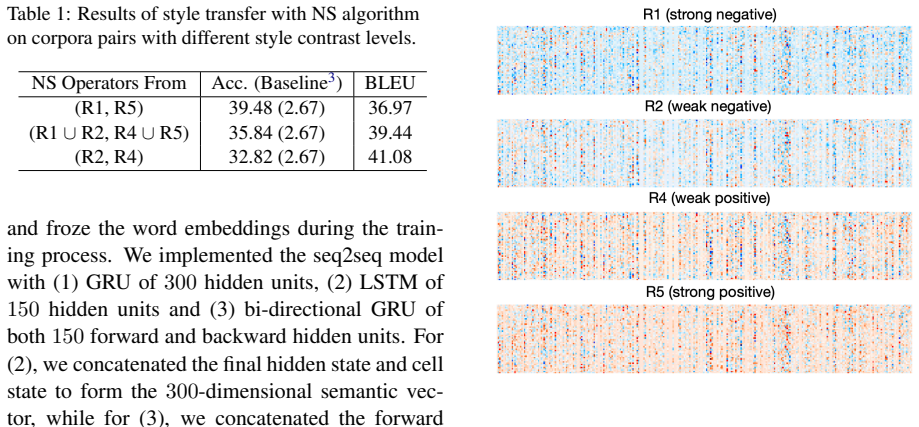
The central object is the style matrix $S_{\mathcal{X}}$, the covariance matrix of the centered semantic vectors produced by a seq2seq encoder. Its eigendecomposition $S_{\mathcal{X}}=P_{\mathcal{X}}\Lambda_{\mathcal{X}}P_{\mathcal{X}}^{\top}$ yields the two transfer operators: neutralization $N_{\mathcal{X}}(Z)=P_{\mathcal{X}}\Lambda_{\mathcal{X}}^{-1/2}P_{\mathcal{X}}^{\top}(Z-\bar{z}_{\mathcal{X}})$, which decorrelates the semantic dimensions, and stylization $S_{\mathcal{Y}}(Z)=P_{\mathcal{Y}}\Lambda_{\mathcal{Y}}^{1/2}P_{\mathcal{Y}}^{\top}Z+\bar{z}_{\mathcal{Y}}$, which re-correlates them in the target pattern. Because the decoder is assumed nearly lossless, the composed operation $y=D(S_{\mathcal{Y}}N_{\mathcal{X}}E(x))$ turns one style into another without learning any new parameters. The style matrix does the explanatory work: the paper's figures and intensity experiments are all evidence that its eigenvectors and eigenvalues track style attributes.
What would settle it
Measure token-level reconstruction accuracy of the pretrained autoencoder on held-out sentences; if reconstruction is far from exact, the near-lossless premise fails and the style-transfer outputs cannot be credited to covariance alignment.
Extended reading notes
Core claim
The paper's central claim is Conjecture 1: a corpus's style is encoded in the covariance matrix of its semantic vectors, $S_{\mathcal{X}}=\frac{1}{N-1}\hat{Z}_{\mathcal{X}}\hat{Z}_{\mathcal{X}}^{\top}$. To make this concrete, the paper trains a sequence-to-sequence autoencoder without attention, so that all information must pass through the final encoder state $z=E(x)$, and the decoder must reconstruct the sentence from $z$ alone. The style matrix is then the covariance of these centered vectors. The paper shows experimentally that eigenvectors of style matrices separate by sentiment polarity and intensity, and that attitude and tense can be transferred independently from the same matrix. From the eigendecomposition of the style matrix it derives the Neutralization-Stylization operators: neutralizing removes the source covariance by ZCA whitening, and stylization imposes the target covariance by coloring; the transformed vector is decoded directly. The paper reports that this learning-free recipe performs comparably to learned baselines on Yelp and Amazon, and it extends to out-of-domain sentences, where operators built on one annotated corpus restyle inputs from another.
Load-bearing premise
The load-bearing premise is that the encoder and decoder are nearly lossless, so any linearly transformed semantic vector still decodes into grammatical text; the paper does not directly measure reconstruction accuracy.
Editorial extensions
If this is right
- Unpaired style transfer becomes a few matrix operations: a pretrained autoencoder plus neutralization and stylization operators, with no adversarial training.
- Style intensity and multiple style attributes can be controlled from one matrix, since covariance encodes them jointly.
- Operators prepared from one domain can be applied to out-of-domain sentences, so a corpus labeled for a single attribute can control that attribute elsewhere.
- Transfer quality should rise with style contrast, which the paper observes when comparing rating pairs with different intensity gaps.
- Two corpora whose semantic vectors have identical covariance should be indistinguishable in style, making style a second-order property of semantic space.
Reading between the lines
- A natural extension is to test whether higher-order cumulants of semantic vectors carry finer style attributes such as formality or irony, since the paper leaves higher-order statistics for future work.
- The near-losslessness premise suggests a practical diagnostic for any autoencoder-based style transfer: report reconstruction quality separately, because poor reconstruction would break the decoding of transformed vectors before any style conclusion can be drawn.
- The same covariance-alignment recipe could be applied to other learned representation spaces, giving a unified second-order view of style across text and images, although the paper does not make that claim.
- Out-of-domain success suggests style matrices transfer more readily than content representations, which could be tested by swapping encoders across domains and checking whether the same operators still work.
Signed reviews
Editorial analysis
A structured set of objections, weighed in public.
Referee Report
Summary. The paper proposes that language style, as perceived by seq2seq models, is encoded in the covariance matrix of semantic vectors, which it calls the style matrix. Semantic vectors are defined as outputs of a seq2seq autoencoder trained with reconstruction loss and without attention. The paper defines the style matrix as the covariance of these vectors, introduces a learning-free Neutralization-Stylization (NS) algorithm that transfers style by whitening source vectors and coloring with target covariance, and augments the autoencoder with a classifier on vec(zz^T) to obtain competitive transfer results. Experiments on Yelp and Amazon cover sentiment and tense transfer, including a newly proposed out-of-domain setting. The central contribution is Conjecture 1 (style equals covariance) plus the NS operator framework.
Significance. If validated, the style-matrix conjecture would offer a simple, interpretable, and parameter-light account of style in neural text generation, with a plug-and-play transfer method and a new challenging task. The connection to Gram-matrix style transfer in vision is intellectually appealing, and the linear algebra of the NS operators is correct. The paper also provides qualitative visualizations and a code link. However, the current evidence falls short of substantiating the 'innate encoding' claim: the main quantitative results rely on a classifier trained on the same second-order statistic that defines the style matrix, and the near-lossless autoencoder assumption is never tested. The underlying idea is worth pursuing, but the manuscript requires substantial additional evidence before the central conjecture can be considered supported.
major comments (4)
- [Section 2.1-2.2, Eq. (1)-(4)] The definition of semantic vectors requires the decoder to satisfy D∘E ≈ I_X, yet no reconstruction loss, reconstruction accuracy, or identity-transfer BLEU is reported for any of the three architectures. This is load-bearing because Conjecture 1 concerns the covariance of semantic vectors; if the encoder is not nearly lossless, the covariance is computed on arbitrary hidden states. Moreover, because attention is intentionally removed (§2.2), long or rare sentences may be poorly reconstructed. Please report reconstruction quality on the validation set, including length-bucketed results, and also BLEU for D(E(x)) versus x and for D(S_Y N_X E(x)) versus x.
- [Section 3.2, Eq. (9), and Table 2] The competitive results in Table 2 are produced by an encoder trained with a classifier C(z)=σ(w^T vec(zz^T)) on the same second-order statistic that defines the style matrix. This makes the covariance's style content a fitted consequence of the training objective, so Table 2 cannot serve as independent evidence for 'innate' style encoding. Please provide an ablation with the reconstruction-only encoder on the same benchmark, and ideally compare with a classifier on first-order features (w^T z) to show that second-order statistics are specifically needed.
- [Table 2 and Fig. 3] The drop rate used to prepare the (N,S) operators is not stated for any row of Table 2. Fig. 3 shows a strong trade-off between Acc and BLEU as the drop rate varies from 0 to 0.9, so the reported numbers are not reproducible without this information. State the exact drop rate (or rates) used, or report the full operating curve and a principled selection rule.
- [Section 4.4, Table 4] For out-of-domain transfer, the decoder receives transformed vectors S_Y N_X E(x) that lie outside the distribution it was trained on, yet no quantitative measure of decoding reliability for such vectors is provided. The samples in Table 4 exhibit content loss (e.g., 'expensive' is dropped in the Amazon positive example), which is consistent with decoding failure rather than clean stylization. Please report identity-transfer BLEU for the transformed vectors (e.g., with target style set to source style) and, if possible, a measure of content preservation for out-of-domain inputs.
minor comments (7)
- [Abstract and Section 1] The contribution is described as 'explain for the first time' although the central claim is presented as a conjecture; I suggest softening the wording to match the epistemic status.
- [Section 3 heading] The heading reads 'Neuralization-Stylization' but should be 'Neutralization-Stylization'.
- [Section 2.1] There is a typo: 'vecotrs' should be 'vectors'.
- [Section 5 heading] The heading 'Unparalled Text Style Transfer' should be 'Unpaired Text Style Transfer'.
- [Table 1 caption] The baseline value (2.67) is not defined; please clarify whether it is the classifier error rate on original validation sentences and why it is identical across rows.
- [Appendix A.2] The text refers to 'Section 4.3.1', which does not exist; the intended reference is likely Section 4.2.
- [Code link] The code is provided as a short URL (bit.ly/2QgEUNE); a persistent identifier (e.g., a DOI or long-lived archive) would be more appropriate for reproducibility.
Circularity Check
Table 2's main transfer results are partly fitted: the encoder is trained with a classifier on vec(zz^T), the same second-order statistic that defines the style matrix; unsupervised experiments give only partial independent support.
-
fitted input called prediction
[Section 3.2, Eq. 9; Section 4.3, Table 2]
"we propose to train the encoder E of the seq2seq model in a semi-supervised way by adding a nonlinear binary classifier C : Rd → {0, 1} on the semantic space, which provides supervision signal simultaneously with the original unsupervised reconstruction process. Formally, given semantic vector z, we define the classifier as C(z) = σ(w^T vec(zz^T))"
C is a linear function of the outer product zz^T; its corpus average is the second-order statistic used to define the style matrix (Eq. 1). Training E so that C predicts the human-defined style label therefore directly shapes the covariance of the semantic vectors to be style-discriminative. The same covariance is then used to build the NS operators whose transfer accuracy is reported in Table 2. Thus the high Acc./BLEU numbers are partly a check of the objective E was optimized to satisfy, not independent confirmation that covariance 'innately' encodes style. The reconstruction-only experiments in §4.2 (Fig. 1, Tables 1 and 3) provide some independent support, so the circularity is partial rather than total.
full rationale
Conjecture 1 is an empirical claim and is tested in §4.2 with a reconstruction-only seq2seq model, so it is not circular by definition. However, the flagship benchmark results (Table 2) come from the semi-supervised variant in §3.2, where the encoder is explicitly trained with a classifier on vec(zz^T) — the same second-order statistic that defines the style matrix (Eq. 1). This makes the main transfer results partly fitted. Separately, the paper requires D∘E ≈ I_X but never reports reconstruction loss or accuracy, and never tests decoding of the transformed vectors used in Eq. 8; this is a substantial unverified premise and a correctness risk, but it is not itself a circular step. No load-bearing self-citation chains or imported uniqueness theorems appear. Overall, partial circularity: the central claim retains independent content from the unsupervised experiments, but the advertised competitive performance reduces in part to the training objective.
Assumptions & free parameters
free parameters (3)
- Drop rate for operator preparation =
unreported (varied 0 to 0.9)
- Classifier weight w (Eq. 9) =
R^(d^2), d=300, trained
- Loss weight ratio (reconstruction:classification) =
10:1
assumptions (5)
- domain assumption The seq2seq autoencoder achieves near-lossless reconstruction (D◦E ≈ I_X) for every corpus used.
- ad hoc to paper The covariance matrix of semantic vectors is a sufficient statistic for the style attribute.
- domain assumption Linear whitening and coloring in the semantic space preserves content while changing style.
- standard math Eigenvalue decomposition of the style matrix is valid and stable.
- domain assumption A single encoder trained on X∪Y produces comparable semantic spaces across corpora.
Cite this review
Pith. "Pith review of How Sequence-to-Sequence Models Perceive Language Styles?." pith.science (2026). https://pith.science/paper/XM3RL3MW
@misc{pith2026190805947,
  author       = {Pith},
  title        = {Pith review of: How Sequence-to-Sequence Models Perceive Language Styles?},
  year         = {2026},
  howpublished = {\url{https://pith.science/paper/XM3RL3MW}},
  note         = {Machine review of arXiv:1908.05947}
}
read the original abstract
Style is ubiquitous in our daily language uses, while what is language style to learning machines? In this paper, by exploiting the second-order statistics of semantic vectors of different corpora, we present a novel perspective on this question via style matrix, i.e. the covariance matrix of semantic vectors, and explain for the first time how Sequence-to-Sequence models encode style information innately in its semantic vectors. As an application, we devise a learning-free text style transfer algorithm, which explicitly constructs a pair of transfer operators from the style matrices for style transfer. Moreover, our algorithm is also observed to be flexible enough to transfer out-of-domain sentences. Extensive experimental evidence justifies the informativeness of style matrix and the competitive performance of our proposed style transfer algorithm with the state-of-the-art methods.
Figures


Reference graph
Works this paper leans on
-
[1]
Dzmitry Bahdanau, Kyunghyun Cho, and Yoshua Bengio. 2014. Neural machine translation by jointly learning to align and translate. arXiv preprint arXiv:1409.0473
arXiv 2014
-
[2]
Allan Bell. 1984. Language style as audience design. Language in society, 13(2):145--204
work page 1984
-
[3]
Anthony J Bell and Terrence J Sejnowski. 1997. Edges are the'independent components' of natural scenes. In Advances in neural information processing systems, pages 831--837
work page 1997
-
[4]
Samy Bengio, Oriol Vinyals, Navdeep Jaitly, and Noam Shazeer. 2015. Scheduled sampling for sequence prediction with recurrent neural networks. In Advances in Neural Information Processing Systems, pages 1171--1179
2015
-
[5]
Dongdong Chen, Lu Yuan, Jing Liao, Nenghai Yu, and Gang Hua. 2017. Stylebank: An explicit representation for neural image style transfer. In Proceedings of the IEEE Conference on Computer Vision and Pattern Recognition, pages 1897--1906
work page 2017
-
[6]
Liqun Chen, Shuyang Dai, Chenyang Tao, Haichao Zhang, Zhe Gan, Dinghan Shen, Yizhe Zhang, Guoyin Wang, Ruiyi Zhang, and Lawrence Carin. 2018. Adversarial text generation via feature-mover's distance. In Advances in Neural Information Processing Systems, pages 4666--4677
work page 2018
-
[7]
Kyunghyun Cho, Bart Van Merri \"e nboer, Caglar Gulcehre, Dzmitry Bahdanau, Fethi Bougares, Holger Schwenk, and Yoshua Bengio. 2014. Learning phrase representations using rnn encoder-decoder for statistical machine translation. arXiv preprint arXiv:1406.1078
arXiv 2014
-
[8]
Alexis Conneau, Douwe Kiela, Holger Schwenk, Loic Barrault, and Antoine Bordes. 2017. Supervised learning of universal sentence representations from natural language inference data. arXiv preprint arXiv:1705.02364
arXiv 2017
Show all 40 references
-
[9]
Nikolas Coupland. 2007. Style: Language variation and identity. Cambridge University Press
2007
-
[10]
Zhenxin Fu, Xiaoye Tan, Nanyun Peng, Dongyan Zhao, and Rui Yan. 2018. Style transfer in text: Exploration and evaluation. In Thirty-Second AAAI Conference on Artificial Intelligence
2018
-
[11]
Leon Gatys, Alexander S Ecker, and Matthias Bethge. 2015. Texture synthesis using convolutional neural networks. In Advances in neural information processing systems, pages 262--270
2015
-
[12]
Leon A Gatys, Alexander S Ecker, and Matthias Bethge. 2016. Image style transfer using convolutional neural networks. In Proceedings of the IEEE conference on computer vision and pattern recognition, pages 2414--2423
2016
-
[13]
Ruining He and Julian McAuley. 2016. Ups and downs: Modeling the visual evolution of fashion trends with one-class collaborative filtering. In proceedings of the 25th international conference on world wide web, pages 507--517. International World Wide Web Conferences Steering ...
2016
-
[14]
Sepp Hochreiter and J \"u rgen Schmidhuber. 1997. Long short-term memory. Neural computation, 9(8):1735--1780
1997
-
[15]
M Hossain. 2016. Whitening and coloring transforms for multivariate gaussian random variables. Project Rhea
2016
-
[16]
Zhiting Hu, Zichao Yang, Xiaodan Liang, Ruslan Salakhutdinov, and Eric P Xing. 2017. Toward controlled generation of text. In Proceedings of the 34th International Conference on Machine Learning-Volume 70, pages 1587--1596. JMLR. org
2017
-
[17]
Justin Johnson, Alexandre Alahi, and Li Fei-Fei. 2016. Perceptual losses for real-time style transfer and super-resolution. In European conference on computer vision, pages 694--711. Springer
2016
-
[18]
Dan Jurafsky. 2000. Speech & language processing. Pearson Education India
2000
-
[19]
Yoon Kim. 2014. Convolutional neural networks for sentence classification. arXiv preprint arXiv:1408.5882
2014 arXiv
-
[20]
Diederik P Kingma and Jimmy Ba. 2014. Adam: A method for stochastic optimization. arXiv preprint arXiv:1412.6980
2014 arXiv
-
[21]
Diederik P Kingma and Max Welling. 2013. Auto-encoding variational bayes. arXiv preprint arXiv:1312.6114
2013 arXiv
-
[22]
Ryan Kiros, Yukun Zhu, Ruslan R Salakhutdinov, Richard Zemel, Raquel Urtasun, Antonio Torralba, and Sanja Fidler. 2015. Skip-thought vectors. In Advances in neural information processing systems, pages 3294--3302
2015
-
[23]
Quoc Le and Tomas Mikolov. 2014. Distributed representations of sentences and documents. In International conference on machine learning, pages 1188--1196
2014
-
[24]
Yann LeCun, Yoshua Bengio, and Geoffrey Hinton. 2015. Deep learning. nature, 521(7553):436
2015
-
[25]
Jiwei Li, Minh-Thang Luong, and Dan Jurafsky. 2015. A hierarchical neural autoencoder for paragraphs and documents. arXiv preprint arXiv:1506.01057
2015 arXiv
-
[26]
Juncen Li, Robin Jia, He He, and Percy Liang. 2018. Delete, retrieve, generate: A simple approach to sentiment and style transfer. arXiv preprint arXiv:1804.06437
2018 arXiv
-
[27]
Yanghao Li, Naiyan Wang, Jiaying Liu, and Xiaodi Hou. 2017. Demystifying neural style transfer. arXiv preprint arXiv:1701.01036
2017 arXiv
-
[28]
Minh-Thang Luong, Hieu Pham, and Christopher D Manning. 2015. Effective approaches to attention-based neural machine translation. arXiv preprint arXiv:1508.04025
2015 arXiv
-
[29]
Carl D Meyer. 2000. Matrix analysis and applied linear algebra, volume 71. Siam
2000
-
[30]
Tomas Mikolov, Ilya Sutskever, Kai Chen, Greg S Corrado, and Jeff Dean. 2013. Distributed representations of words and phrases and their compositionality. In Advances in neural information processing systems, pages 3111--3119
2013
-
[31]
Matteo Pagliardini, Prakhar Gupta, and Martin Jaggi. 2017. Unsupervised learning of sentence embeddings using compositional n-gram features. arXiv preprint arXiv:1703.02507
2017 arXiv
-
[32]
Kishore Papineni, Salim Roukos, Todd Ward, and Wei-Jing Zhu. 2002. Bleu: a method for automatic evaluation of machine translation. In Proceedings of the 40th annual meeting on association for computational linguistics, pages 311--318. Association for Computational Linguistics
2002
-
[33]
Anita Ramm, Sharid Lo \'a iciga, Annemarie Friedrich, and Alexander Fraser. 2017. Annotating tense, mood and voice for english, french and german. Proceedings of ACL 2017, System Demonstrations, pages 1--6
2017
-
[34]
Brian Ray. 2014. Style: An Introduction to History, Theory, Research, and Pedagogy. Parlor Press
2014
-
[35]
David E Rumelhart, Geoffrey E Hinton, and Ronald J Williams. 1985. Learning internal representations by error propagation. Technical report, California Univ San Diego La Jolla Inst for Cognitive Science
1985
-
[36]
Tianxiao Shen, Tao Lei, Regina Barzilay, and Tommi Jaakkola. 2017. Style transfer from non-parallel text by cross-alignment. In Advances in neural information processing systems, pages 6830--6841
2017
-
[37]
Ilya Sutskever, Oriol Vinyals, and Quoc V Le. 2014. Sequence to sequence learning with neural networks. In Advances in neural information processing systems, pages 3104--3112
2014
-
[38]
Dmitry Ulyanov, Vadim Lebedev, Andrea Vedaldi, and Victor S Lempitsky. 2016. Texture networks: Feed-forward synthesis of textures and stylized images. In ICML, volume 1, page 4
2016
-
[39]
Dmitry Ulyanov, Andrea Vedaldi, and Victor Lempitsky. 2017. Improved texture networks: Maximizing quality and diversity in feed-forward stylization and texture synthesis. In Proceedings of the IEEE Conference on Computer Vision and Pattern Recognition, pages 6924--6932
2017
-
[40]
Jingjing Xu, Xu Sun, Qi Zeng, Xuancheng Ren, Xiaodong Zhang, Houfeng Wang, and Wenjie Li. 2018. Unpaired sentiment-to-sentiment translation: A cycled reinforcement learning approach. arXiv preprint arXiv:1805.05181
2018 arXiv
Reviewed August 14, 2026 · model on record in the stance chip above.
Discussion (0). Continue with ORCID to comment.