REVIEW 60 references
The arithmetic geometry of AdS$_2$ and its continuum limit
T0 review · reviewed 2026-08-14 · deepseek-v4-flash
Pith's one-line read The finite modular geometry AdS2[Z_N] recovers smooth AdS2 spacetime in a correlated double limit built from k-Fibonacci sequences.
desk verdict A genuinely new construction for the modular AdS2 program, but the central continuum-limit claim is asserted rather than proven and needs a rigorous convergence statement. read the letter →
The pith
A machine-rendered reading of the paper's core claim, the machinery that carries it, and where it could break.
The reading
What carries the argument
The load-bearing construction is the two-cutoff family AdS$_2^M[\mathbb{Z}_N]=\{(k,l,m)\in\mathbb{Z}_N^3: k^2+l^2-m^2\equiv M^2\pmod N\}$, together with the constraint $M^2\equiv 1\pmod N$ that links it back to the original AdS$_2[\mathbb{Z}_N]$. $M$ sets the ultraviolet lattice spacing $a=R_{\mathrm{AdS}_2}/M$ in the ambient Minkowski space; $N$ sets the infrared periodic box side $L=Na$, so $N/M=L/R_{\mathrm{AdS}_2}=\gamma$ is the box aspect ratio relative to the AdS radius. The explicit limit sequences come from the $k$-Fibonacci recurrence $g_{n+1}=kg_n+g_{n-1}$, $g_0=0$, $g_1=1$. The matrix identity $A(k)^n$ with entries $g_{n-1},g_n,g_n,g_{n+1}$ and determinant $(-1)^n$ yields, for odd $n=2l+1$, $g_{2l+1}^2=1+g_{2l}g_{2l+2}$, hence $g_{2l+1}^2\equiv 1\pmod{g_{2l+2}}$; and the ratio $g_{2l+2}/g_{2l+1}$ tends to the $k$-silver ratio $\rho_+(k)=(k+\sqrt{k^2+4})/2$. Taking $l\to\infty$ fixes $\gamma=\rho_+(k)$ and removes the ultraviolet cutoff; taking $k\to\infty$ sends $\gamma\to\infty$ and removes the infrared cutoff, keeping $R_{\mathrm{AdS}_2}$ fixed. The ambient-space topology of Minkowski space is the arena in which the convergence is meant to hold.
What would settle it
For fixed $k$, take the sequence $(M_l,N_l)=(g_{2l+1},g_{2l+2})$ and reduce the integral points of the radius-$M_l$ hyperboloid modulo $N_l$, then scale by $1/M_l$ into the torus of side $\gamma=N_l/M_l$. Compute the covering radius of these points inside the folded continuum hyperboloid $\{X_0^2+X_1^2-X_2^2\equiv 1\pmod{\gamma}\}$: the largest Euclidean distance from any point of that folded surface to the nearest reduced point. The claimed continuum limit in the ambient topology holds only if this radius tends to $0$ as $l\to\infty$; a direct numerical evaluation for a few values of $k$ would settle the issue.
Extended reading notes
Core claim
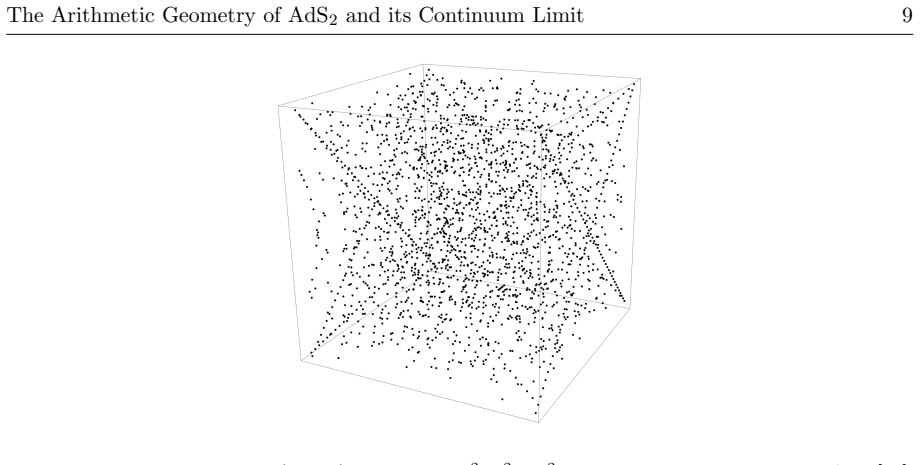
The paper's central discovery is that the finite modular geometry AdS$_2[\mathbb{Z}_N]$, defined as the solution set of $x_0^2+x_1^2-x_2^2\equiv 1\pmod N$, can be embedded in a two-parameter family AdS$_2^M[\mathbb{Z}_N]$, defined by $x_0^2+x_1^2-x_2^2\equiv M^2\pmod N$ and representing the integral points of the radius-$M$ hyperboloid reduced modulo $N$. The consistency condition $M^2\equiv 1\pmod N$ identifies AdS$_2^M[\mathbb{Z}_N]$ with AdS$_2[\mathbb{Z}_N]$, while $M$ and $N$ play the roles of ultraviolet and infrared cutoffs: $a=R_{\mathrm{AdS}_2}/M$ is the lattice spacing and $L=Na$ is the side of the periodic box in the ambient $(2+1)$-dimensional Minkowski space. The continuum limit is then constructed in two reverse steps. First, for any fixed $k$, the $k$-Fibonacci pairs $(M_l,N_l)=(g_{2l+1},g_{2l+2})$ satisfy $M_l^2\equiv 1\pmod{N_l}$, and the ratio $N_l/M_l$ tends to the finite value $\rho_+(k)=(k+\sqrt{k^2+4})/2$; letting $l\to\infty$ removes the ultraviolet cutoff and yields the continuous, toroidally compactified AdS$_2$, folded infinitely many times inside the torus. Second, since $\rho_+(k)\to\infty$ as $k\to\infty$, letting $k\to\infty$ removes the infrared cutoff and unfolds the torus, recovering the standard non-compact AdS$_2$ with fixed, arbitrary radius $R_{\mathrm{AdS}_2}$. The authors state that the same two-step method applies directly to higher-dimensional AdS spacetimes.
Load-bearing premise
The argument assumes, rather than proves, that as $M$ and $N$ go to infinity along the chosen Fibonacci sequences the finite sets of reduced points become dense in, and hence converge to, the continuously folded hyperboloid inside the periodic box, in the ordinary topology of the surrounding Minkowski space.
Editorial extensions
If this is right
- The discrete AdS$_2[\mathbb{Z}_N]$ model passes the basic consistency test: its continuum limit is the smooth, non-compact AdS$_2$ spacetime rather than some other scale-dependent limiting geometry.
- The finiteness of the black hole entropy Hilbert space is built into the model at every finite $N$, and the continuous AdS$_2$ near-horizon geometry emerges only after the ultraviolet and infrared cutoffs are removed in the correlated $k$-Fibonacci double limit.
- For each fixed $k$, the construction provides infinitely many explicit UV/IR pairs $(M_l,N_l)$ realizing the continuum limit with aspect ratio $\rho_+(k)$; this yields a countable family of toroidally compactified intermediate geometries.
- The two-step prescription---discretize in the ambient Minkowski space, compactify periodically, then remove cutoffs in reverse order---is claimed to extend directly to higher-dimensional AdS spacetimes using the corresponding arithmetic isometry groups.
Reading between the lines
- A natural next step the paper does not take is to quantify the rate of convergence: for the Fibonacci pairs one could compute the covering radius of the reduced lattice points inside the folded continuum hyperboloid and ask whether it decays like $O(1/M)$; such a bound would upgrade the ambient-topology statement to a metric statement.
- The authors mention the profinite limit but do not develop it; interpreting the sequence AdS$_2^M[\mathbb{Z}_N]$ as a profinite object suggests that the real AdS$_2$ continuum could be recovered as a quotient or specialization of the profinite AdS$_2[\hat{\mathbb{Z}}]$, with the Haar measure on the profinite integers inducing a natural measure on the limit.
- If the continuum limit is made rigorous, the same correlated double limit could be used to define the bulk dual of the boundary theory on $\mathbb{P}^1[\mathbb{Z}_N]$ directly from finite-dimensional quantum mechanics, offering a constructive route to AdS$_2$/CFT$_1$ that avoids introducing a continuum boundary theory first.
Editorial analysis
A structured set of objections, weighed in public.
Circularity Check
The continuum limit is built into the construction: AdS2^M[Z_N] is defined from lattice points of the continuum AdS2, so the limit returns the input equation.
-
self definitional
[Sec. 1.2 (outline) and Sec. 3.1–3.2, Eq. (3.4)]
"In order to show this we reconstruct this geometry from AdS 2, in two steps: 1. The first step involves the discretization of AdS 2, using an appropriate spacetime lattice in the ambient (2 + 1)-dimensional, Minkowski, spacetime. ... The set of these images satisfy the equations k2 +l2−m2≡M 2 modN. (3.4) The set of points satisfying this condition will be called AdS M 2 [ZN]."
AdS^M_2[Z_N] is defined by Eq. (3.4) as the mod-N image of AdS^M_2[Z], whose points lie by definition on the continuum hyperboloid: k^2+l^2−m^2=M^2, and after the rescaling x=a(k,l,m) with a=R/M this is exactly x0^2+x1^2−x2^2=R^2. Thus the continuum target is an input of the construction, not an emergent output. In the correlated limit, dividing Eq. (3.4) by M^2 with N/M→γ and a=R/M gives x0^2+x1^2−x2^2=R^2(1+tN/M^2)→R^2, the defining equation of AdS2 used in Sec. 2.1. The k-Fibonacci pairs are explicit and non-fitted, but the claimed recovery of the continuum is the reversal of the discretization and toroidal compactification that were themselves built from the continuum AdS2.
full rationale
The paper contains substantial independent arithmetic work: the point-count recursion, the ruling/chart structure for primes mod 4, the light-cone parametrizations, and the construction of explicit (M_n,N_n) pairs with M^2≡1 modN are genuine results that are not fitted or circular. The circularity is concentrated in the central continuum-limit claim. AdS^M_2[Z_N] is introduced (Sec. 3.1–3.2) as the mod-N image of the integral points of the continuum AdS2 hyperboloid, and the paper says it 'reconstructs' the finite geometry from AdS2 and then reverses the process. Consequently, the scaling limit reproduces the defining equation of AdS2 by construction rather than by an independent emergence argument. The k-Fibonacci sequences provide valid, non-fitted pairs and give nontrivial limiting ratios, but they parameterize a definitional embedding; the asserted convergence of the finite sets is not proven with an explicit topology or metric, which is a correctness gap rather than a separate circular step. Because the central claim reduces by construction while peripheral results are independent, the score is 6.
Assumptions & free parameters
assumptions (5)
- domain assumption Spacetime at Planck scale is fundamentally discrete and finite, and continuous geometry emerges as an infrared limit.
- domain assumption The finite geometry AdS2[Z_N] models the near-horizon region of extremal black holes and supports a holographic correspondence with the projective line P^1[Z_N].
- domain assumption The continuum limit is defined via convergence in the topology of the ambient (2+1)-dimensional Minkowski space, with lattice spacing a=R/M.
- domain assumption The number of solutions to x0^2+x1^2-x2^2 ≡ 1 mod p^r equals the size of the coset PSL(2,Z_{p^r})/PSO(1,1,Z_{p^r}).
- standard math Standard results from number theory: Chinese remainder theorem, Gauss circle problem asymptotics, and properties of Fibonacci and k-Fibonacci sequences.
invented entities (1)
-
AdS^M_2[Z_N] finite geometries
Cite this review
Pith. "Pith review of The arithmetic geometry of AdS$_2$ and its continuum limit." pith.science (2026). https://pith.science/paper/Z25M5CI7
@misc{pith2026190806641,
  author       = {Pith},
  title        = {Pith review of: The arithmetic geometry of AdS$_2$ and its continuum limit},
  year         = {2026},
  howpublished = {\url{https://pith.science/paper/Z25M5CI7}},
  note         = {Machine review of arXiv:1908.06641}
}
abstract
According to the 't Hooft-Susskind holography, the black hole entropy,$S_\mathrm{BH}$, is carried by the chaotic microscopic degrees of freedom, which live in the near horizon region and have a Hilbert space of states of finite dimension $d=\exp(S_\mathrm{BH})$. In previous work we have proposed that the near horizon geometry, when the microscopic degrees of freedom can be resolved, can be described by the AdS$_2[\mathbb{Z}_N]$ discrete, finite and random geometry, where $N\propto S_\mathrm{BH}$. It has been constructed by purely arithmetic and group theoretical methods in order to explain, in a direct way, the finiteness of the entropy, $S_\mathrm{BH}$. What has been left as an open problem is how the smooth AdS$_2$ geometry can be recovered, in the limit when $N\to\infty$. In the present article we solve this problem, by showing that the discrete and finite AdS$_2[\mathbb{Z}_N]$ geometry can be embedded in a family of finite geometries, AdS$_2^M[\mathbb{Z}_N]$, where $M$ is another integer. This family can be constructed by an appropriate toroidal compactification and discretization of the ambient $(2+1)$-dimensional Minkowski space-time. In this construction $N$ and $M$ can be understood as "infrared" and "ultraviolet" cutoffs respectively. The above construction enables us to obtain the continuum limit of the AdS$_2^M[\mathbb{Z}_N]$ discrete and finite geometry, by taking both $N$ and $M$ to infinity in a specific correlated way, following a reverse process: Firstly, by recovering the continuous, toroidally compactified, AdS$_2[\mathbb{Z}_N]$ geometry by removing the ultraviolet cutoff; secondly, by removing the infrared cutoff in a specific decompactification limit, while keeping the radius of AdS$_2$ finite. It is in this way that we recover the standard non-compact AdS$_2$ continuum space-time. This method can be applied directly to higher-dimensional AdS spacetimes.
Figures


Figures from the paper (4 more)


Reference graph
Works this paper leans on
-
[1]
Almheiri A., Dong X., Harlow D., Bulk locality and quantum error correction in AdS/CFT, J. High Energy Phys. 2015 (2015), no. 4, 163, 34 pages, arXiv:1411.7041
arXiv 2015
-
[2]
Almheiri A., Marolf D., Polchinski J., Sully J., Black holes: complementarity or firewalls?, J. High Energy Phys. 2013 (2013), no. 2, 062, 20 pages, arXiv:1207.3123
arXiv 2013
-
[3]
Benjamin, Inc., New York – Amsterdam, 1968
Arnol’d V.I., Avez A., Ergodic problems of classical mechanics, The Mathematical Physics Monograph Series , W.A. Benjamin, Inc., New York – Amsterdam, 1968
work page 1968
-
[4]
Athanasiu G.G., Floratos E.G., Coherent states in finite quantum mechanics, Nuclear Phys. B 425 (1994), 343–364
work page 1994
-
[5]
Athanasiu G.G., Floratos E.G., Nicolis S., Fast quantum maps, J. Phys. A: Math. Gen. 31 (1998), L655– L662, arXiv:math-ph/9805012
work page Pith review arXiv 1998
-
[6]
Modular discretization of the AdS2/CFT1 Holography
Axenides M., Floratos E., Nicolis S., Modular discretization of the AdS 2/CFT1 holography, J. High Energy Phys. 2014 (2014), no. 2, 109, 31 pages, arXiv:1306.5670
work page Pith review arXiv 2014
-
[7]
Axenides M., Floratos E., Nicolis S., Chaotic information processing by extremal black holes, Internat. J. Modern Phys. D 24 (2015), 1542012, 7 pages, arXiv:1504.00483
work page Pith review arXiv 2015
-
[8]
Axenides M., Floratos E., Nicolis S., The quantum cat map on the modular discretization of extremal black hole horizons, Eur. Phys. J. C 78 (2018), 412, 15 pages, arXiv:1608.07845
work page Pith review arXiv 2018
Show all 60 references
-
[9]
Banks T., Holographic space-time and quantum information, Front. Phys. 8 (2020), 111, 10 pages, arXiv:2001.08205
2020 arXiv
-
[10]
Bao N., Carroll S.M., Singh A., The Hilbert space of quantum gravity is locally finite-dimensional, Inter- nat. J. Modern Phys. D 26 (2017), 1743013, 5 pages, arXiv:1704.00066
2017 arXiv
-
[11]
Baragar A., Lattice points on hyperboloids of one sheet, New York J. Math. 20 (2014), 1253–1268
2014
-
[12]
Bengtsson I., Anti-de Sitter space, http://3dhouse.se/ingemar/Kurs.pdf
-
[13]
Bousso R., Black hole entropy and the Bekenstein bound, in Jacob Bekenstein, The Conservative Revolu- tionary, World Scientific, 2019, 139–158, arXiv:1810.01880
2019 arXiv
-
[14]
Bressoud D., Wagon S., A course in computational number theory, Key College Publishing, Emeryville, CA, 2000
2000
-
[15]
B 557 (1999), 165–180, arXiv:hep-th/9902040
Cadoni M., Mignemi S., Asymptotic symmetries of AdS 2 and conformal group in d = 1, Nuclear Phys. B 557 (1999), 165–180, arXiv:hep-th/9902040. The Arithmetic Geometry of AdS 2 and its Continuum Limit 21
1999 arXiv
-
[16]
Carlip S., The small-scale structure of spacetime, in Foundations of Space and Time, Cambridge University Press, Cambridge, 2012, 69–84, arXiv:1009.1136
2012 arXiv
-
[17]
Carlip S., Mosna R.A., Pitelli J.P.M., Vacuum fluctuations and the small scale structure of spacetime, Phys. Rev. Lett. 107 (2011), 021303, 4 pages, arXiv:1103.5993
2011 arXiv
-
[18]
Arnold, in Fourth Colloquium on Mathematics and Computer Science Algorithms, Trees, Combinatorics and Probabilities, Discrete Math
Cesaratto E., Plagne A., Vall´ ee B., On the non-randomness of modular arithmetic progressions: a solution to a problem by V.I. Arnold, in Fourth Colloquium on Mathematics and Computer Science Algorithms, Trees, Combinatorics and Probabilities, Discrete Math. Theor. Comput. Sc...
2006
-
[19]
Coxeter H.S.M., Discrete groups generated by reflections, Ann. of Math. 35 (1934), 588–621
1934
-
[20]
Duke W., Rudnick Z., Sarnak P., Density of integer points on affine homogeneous varieties, Duke Math. J. 71 (1993), 143–179
1993
-
[21]
Dyson F.J., Falk H., Period of a discrete cat mapping, Amer. Math. Monthly 99 (1992), 603–614
1992
-
[22]
Algebra 322 (2009), 1295–1339, arXiv:0805.3018
Feingold A.J., Kleinschmidt A., Nicolai H., Hyperbolic Weyl groups and the four normed division algebras, J. Algebra 322 (2009), 1295–1339, arXiv:0805.3018
2009 arXiv
-
[23]
Floratos E.G., The Heisenberg–Weyl group on the ZN × ZN discretized torus membrane, Phys. Lett. B 228 (1989), 335–340
1989
-
[24]
Gibbons G.W., Anti-de-Sitter spacetime and its uses, in Mathematical and Quantum Aspects of Relativity and Cosmology (Pythagoreon, 1998), Lecture Notes in Phys. , Vol. 537, Springer, Berlin, 2000, 102–142, arXiv:1110.1206
1998 arXiv
-
[25]
Giddings S.B., Black holes, quantum information, and unitary evolution, Phys. Rev. D 85 (2012), 124063, 17 pages, arXiv:1201.1037
2012 arXiv
-
[26]
Gubser S.S., A p-adic version of AdS/CFT, Adv. Theor. Math. Phys. 21 (2017), 1655–1678, arXiv:1705.00373
2017 arXiv
-
[27]
B 144 (1978), 349–362
Hawking S.W., Spacetime foam, Nuclear Phys. B 144 (1978), 349–362
1978
-
[28]
Hawking S.W., Information loss in black holes, Phys. Rev. D 72 (2005), 084013, 4 pages, arXiv:hep- th/0507171
2005
-
[29]
Horadam A.F., A generalized Fibonacci sequence, Amer. Math. Monthly 68 (1961), 455–459
1961
-
[30]
High Energy Phys
Jefferson R.A., Myers R.C., Circuit complexity in quantum field theory, J. High Energy Phys. 2017 (2017), no. 10, 107, 81 pages, arXiv:1707.08570
2017 arXiv
-
[31]
Kac V.G., Infinite-dimensional Lie algebras, 3rd ed., Cambridge University Press, Cambridge, 1990
1990
-
[32]
2, Seminumerical algorithms, 2nd ed., Addison-Wesley Publishing Co., Reading, Mass., 1981
Knuth D.E., The art of computer programming, Vol. 2, Seminumerical algorithms, 2nd ed., Addison-Wesley Publishing Co., Reading, Mass., 1981
1981
-
[33]
Kontorovich A.V., The hyperbolic lattice point count in infinite volume with applications to sieves, Duke Math. J. 149 (2009), 1–36, arXiv:0712.1391
2009 arXiv
-
[34]
Lenstra H., Profinite groups, 2003, available at http://websites.math.leidenuniv.nl/algebra/ Lenstra-Profinite.pdf
2003
-
[35]
Lenstra H., Profinite Fibonacci numbers, Nieuw Arch. Wiskd. 6 (2005), 297–300
2005
-
[36]
Lenstra H., Profinite number theory, Eur. Math. Soc. Newsl. 100 (2016), 14–18
2016
-
[37]
Lowry-Duda D., On some variants of the Gauss circle problem, arXiv:1704.02376
-
[38]
Ma C.-T., Lattice AdS geometry and continuum limit, Internat. J. Modern Phys. A 35 (2020), 2050079, 12 pages, arXiv:1807.08871
2020 arXiv
-
[39]
Maldacena J., Black holes and quantum information, Nature Rev. Phys. 2 (2020), 123–125
2020
-
[40]
Maldacena J., Susskind L., Cool horizons for entangled black holes, Fortschr. Phys. 61 (2013), 781–811, arXiv:1306.0533
2013 arXiv
-
[41]
Naik V., Order formulas for symplectic groups, https://groupprops.subwiki.org/wiki/Order_formulas_ for_symplectic_groups
-
[42]
Oh H., Shah N.A., Limits of translates of divergent geodesics and integral points on one-sheeted hyperboloids, Israel J. Math. 199 (2014), 915–931, arXiv:1104.4988
2014 arXiv
-
[43]
High Energy Phys
Papadodimas K., Raju S., An infalling observer in AdS/CFT, J. High Energy Phys. 2013 (2013), no. 10, 212, 73 pages, arXiv:1211.6767. 22 M. Axenides, E. Floratos and S. Nicolis
2013 arXiv
-
[44]
Patricot C., A group theoretical approach to causal structures and positive energy on space-times, arXiv:hep- th/0403040
-
[45]
Modern Opt
Preskill J., Quantum information and physics: some future directions, J. Modern Opt. 47 (2000), 127–137, arXiv:quant-ph/9904022
2000 arXiv
-
[46]
Rawnsley J., On the universal covering group of the real symplectic group, J. Geom. Phys. 62 (2012), 2044–2058
2012
-
[47]
Schild A., Discrete space-time and integral Lorentz transformations, Phys. Rev. 73 (1948), 414–415
1948
-
[48]
Schild A., Discrete space-time and integral Lorentz transformations, Canad. J. Math. 1 (1949), 29–47
1949
-
[49]
High Energy Phys
Sen A., Arithmetic of quantum entropy function, J. High Energy Phys. 2009 (2009), no. 8, 068, 22 pages, arXiv:0903.1477
2009 arXiv
-
[50]
Sen A., Quantum entropy function from AdS 2/CFT1 correspondence, Internat. J. Modern Phys. A 24 (2009), 4225–4244, arXiv:0809.3304
2009 arXiv
-
[51]
Tables Aids Comput
Shanks D., A sieve method for factoring numbers of the form n2 + 1, Math. Tables Aids Comput. 13 (1959), 78–86
1959
-
[52]
Srednicki M., Chaos and quantum thermalization, Phys. Rev. E 50 (1994), 888–901, arXiv:cond- mat/9403051
1994
-
[53]
Susskind L., Dear qubitzers, GR = QM, arXiv:1708.03040
-
[54]
Susskind L., Black holes and complexity classes, arXiv:1802.02175
-
[55]
Susskind L., Three lectures on complexity and black holes, arXiv:1810.11563
-
[56]
’t Hooft G., How quantization of gravity leads to a discrete space-time, J. Phys. Conf. Ser. 701 (2016), 012014, 14 pages
2016
-
[57]
Tan L., The group of rational points on the unit circle, Math. Mag. 69 (1996), 163–171
1996
-
[58]
High Energy Phys
Verlinde E., On the origin of gravity and the laws of Newton, J. High Energy Phys. 2011 (2011), no. 4, 029, 27 pages, arXiv:1001.0785
2011 arXiv
-
[59]
Vinberg E.B., Discrete groups generated by reflections in Lobaˇ cevski˘ ı spaces, Math. USSR Sb. 1 (1967), 429–444
1967
-
[60]
Witten E., Quantum gravity in de Sitter space, in Strings, 2001 (Mumbai), Clay Math. Proc. , Vol. 1, Amer. Math. Soc., Providence, RI, 2002, 351–365, arXiv:hep-th/0106109
2001 arXiv
Reviewed August 14, 2026 · model on record in the stance chip above.
Discussion (0). Continue with ORCID to comment.