REVIEW 3 major objections 7 minor 2 cited by
The Optical Afterglow of GW170817: An Off-axis Structured Jet and Deep Constraints on a Globular Cluster Origin
T0 review · 3 major / 7 minor · reviewed 2026-08-14 · deepseek-v4-flash
Pith's one-line read Deep HST imaging of GW170817 shows its optical afterglow is an off-axis structured jet, and the same image rules out a globular-cluster birthplace.
desk verdict A careful template-based revision of the GW170817 optical afterglow with a strong new globular cluster limit, but the 584-day template may carry a small residual that biases the late-time slope. read the letter →
The pith
A machine-rendered reading of the paper's core claim, the machinery that carries it, and where it could break.
The reading
What carries the argument
The central object is the deep HST/F606W observation at about 584 days post-merger, which contains no source at the afterglow position to 3-$\sigma$ confidence ($m_{\rm F606W} > 28.2$ mag, $< 0.019\,\mu$Jy). Subtracting this template from nine earlier epochs with image-subtraction software produces uniform photometry of the afterglow, and the same template underlies the globular-cluster luminosity limit. The paper's interpretation leans on two comparison sets: the structured-jet and quasi-spherical outflow light curves used to discriminate jet geometry, and the globular cluster luminosity/mass function of the host galaxy NGC4993 used to convert the non-detection into a mass limit.
What would settle it
A detection of a point source at the afterglow position in deeper or independent imaging of the 584-day epoch (above about 0.019 $\mu$Jy) would invalidate the template and require re-measuring the whole light curve; a globular cluster more massive than about $1.3\times10^4\,M_\odot$ found at that position would contradict the claimed limit.
Extended reading notes
Core claim
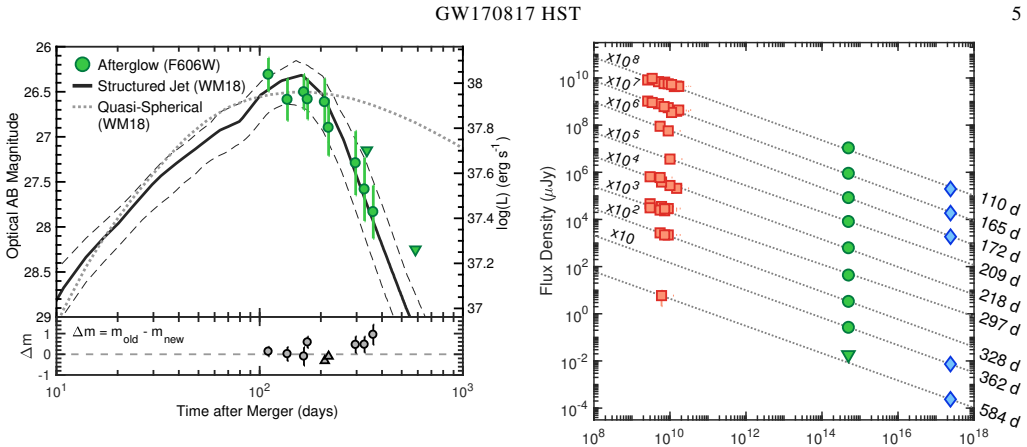
Using a deep HST/F606W observation at about 584 days as a subtraction template, the paper derives a revised optical light curve of GW170817 spanning about 110 to 362 days. The light curve reaches a peak and then declines steeply, with post-peak slope $\alpha_2 = -2.20 \pm 0.25$ and a break near 200–240 days, matching the structured-jet model favored by radio and X-ray data while over-predicting quasi-spherical outflow models by 1.5 to 4 times. Across nine epochs, the broad-band spectrum from radio through optical to X-ray is fit by a single power law with weighted-average spectral index $\langle \beta \rangle = -0.583 \pm 0.013$, implying an electron index $p = 2.166 \pm 0.026$ and no synchrotron break frequencies crossing the observed bands out to about 584 days. Extrapolating the post-peak decline to short-GRB luminosities gives jet-break times of about 0.7 to 4 days, consistent with the observed breaks in that population. The 584-day non-detection, with limit $m_{\rm F606W} > 28.2$ mag (flux density $< 0.019\,\mu$Jy), excludes any underlying globular cluster with mass $\lesssim 1.3\times 10^4\,M_\odot$, about 4$\sigma$ below the peak of the NGC4993 cluster mass function.
Load-bearing premise
The 584-day image used as the subtraction template is assumed to contain no residual light at the afterglow position; if a faint source is present there, every flux measurement in the light curve would be systematically biased.
Editorial extensions
If this is right
- If correct, the optical data independently confirm that GW170817's afterglow is an off-axis structured jet, ruling out a quasi-spherical outflow as the source of the late-time emission.
- The constant spectral index to about 584 days means radio, optical, and X-ray observations can be combined into a single synchrotron spectrum over that time, simplifying broadband modeling of neutron-star merger afterglows.
- The match between the extrapolated decline and short-GRB jet breaks implies that short GRBs and GW170817 share similar jet energy, opening angle, and circum-merger density, with viewing angle as the main difference.
- The globular-cluster limit rules out an in-situ globular-cluster formation and merger channel for GW170817, and shows that similarly deep imaging of future nearby mergers can test this channel directly.
Reading between the lines
- Because the template non-detection is only at 3-sigma, a residual source just below the limit would systematically reduce the measured flux at every epoch; deeper later-time imaging of GW170817 could test whether the light curve needs revision.
- The same template-subtraction strategy could be applied to archival observations of other nearby mergers or off-axis candidates after a deep late-time image becomes available, potentially revising published afterglow photometry.
- If the short-GRB connection holds, it predicts that future gravitational-wave-discovered mergers seen off-axis will show optical post-peak slopes approaching about -2.2 and jet breaks near 0.7-4 days, independent of the observer's viewing angle.
- The cluster mass limit does not exclude the possibility that the progenitor binary was dynamically ejected from a globular cluster before merging; associating future mergers with a specific parent cluster would require deeper imaging and kinematic information.
Signed reviews
Editorial analysis
A structured set of objections, weighed in public.
Referee Report
Summary. The paper presents revised HST/F606W photometry of the GW170817 afterglow at 110–362 days, obtained by subtracting a deep 584-day template from archival and new images, plus a deep limit at 584 days. The authors report a broken power-law light curve with pre-break slope α1 = −0.4 ± 0.2 and post-break slope α2 = −2.20 ± 0.25, a constant broad-band spectral index ⟨β⟩ = −0.583 ± 0.013 from radio to X-ray, and use these to argue that the emission is from a relativistic structured jet viewed off-axis, that an extrapolation of the post-peak decline connects to short GRB jet breaks, and that the 584-day non-detection rules out a globular cluster more massive than ∼1.3 × 10^4 M☉ at the merger site.
Significance. If correct, the paper provides the first complete optical afterglow light curve for GW170817 obtained with a consistent template subtraction, strengthens the off-axis structured jet interpretation with optical data, and places the deepest direct limit on a globular cluster progenitor for a neutron star merger. The photometric pipeline is careful in several respects: it uses injection tests, tests multiple median-filter sizes, aligns images to sub-pixel precision, and reports uncertainties. The spectral analysis uses uniform X-ray reductions and gives acceptable chi-square values. The globular cluster limit is a valuable direct constraint, and the authors appropriately note that they cannot exclude cluster ejection. However, the central photometric result rests on an assumption about the 584-day template that is not secured by the quoted 3σ limit; this requires a correction before the conclusions can be taken at face value.
major comments (3)
- [§3.2–3.3, Table 1] The use of the 584-day observation as a zero-flux template is the most load-bearing assumption, and the 3σ limit m_F606W > 28.2 (0.019 μJy) does not justify it. If the afterglow continues with the fitted post-peak slope α2 = −2.20 from the observed 362-day flux of 0.027 ± 0.007 μJy, the self-consistent constant residual in the template is r ≈ 0.027/[(584/362)^2.20 − 1] ≈ 0.014 μJy, which is below the quoted limit. HOTPANTS subtracts this residual from every earlier epoch. Removing a constant r from the 297- and 362-day points steepens the apparent 297–362 day decline from α ≈ −1.8 to the observed ≈ −2.46, i.e., the template bias alone can shift α2 by an amount comparable to its quoted uncertainty. The reported uncertainties and the structured-jet versus quasi-spherical comparison therefore omit a systematic that is not excluded by the data. Please either include the template residual as a free parameter with a prior set by the 584-day limit, or explicitly demonstrate that adding a 0.014 μJy constant to all epochs leaves the model comparison and α2 unchanged.
- [§4.1, Figure 2] The broken power-law fit is quoted as α1 = −0.4 ± 0.2, α2 = −2.20 ± 0.25 with a break at 200–240 days, but the fitting procedure is not described: it is unclear whether the 336.8-day upper limit is included, how the break smoothness is parameterized, and what the covariance between α1, α2, and t_b is. Because α2 is used both to infer p = 2.20 ± 0.25 and to extrapolate to short GRBs, provide the fit details, the likelihood surface, and a version of Figure 2 with the best-fit curve and confidence band.
- [§4.2, Figure 5] The short GRB comparison is qualitative: a single deterministic extrapolation with α = −2.17 is said to intersect the short GRB population at 0.7–4 days, and this is compared by eye with observed jet breaks at 0.4–3.5 days. The extrapolation should include the uncertainty on α2 and the distance/luminosity uncertainty, and the consistency should be quantified, for example by computing the likelihood of the observed jet-break times under the predicted distribution. The conclusion that the primary difference is viewing angle is plausible but currently rests on a visual overlap.
minor comments (7)
- [Table 1, Figure 1] The 336.83-day entry is listed as a 3σ upper limit, but the caption of Figure 1 states that the afterglow is detected at ≥3σ in all residual images; please reconcile this inconsistency.
- [Figure 2] The definition of the 'top 5% of models' shown in Figure 2 is not given in the text; specify what quantity defines the top 5%.
- [Table 2] Per-epoch χ² values for the SED fits are only quoted as a range (χν² ≈ 0.6–1.3); include the values and degrees of freedom in Table 2 so the reader can assess the fits.
- [Abstract and §5] The abstract says the light curve spans ≈110–362 days, while Section 5 says ≈110–584 days; clarify that the later value includes the 584-day upper limit.
- [§3.4 and §4.1] The paper relies on 'Hajela et al. (in prep.)' for the uniform X-ray reduction and a 6 GHz radio point at 585 days; if possible, provide a public data release or an accepted reference, because these data are central to the spectral-index claim.
- [§3.3, Table 1] Typographical issues: 'performe' in §3.3 and 'correspond Corr' in the Table 1 note should be corrected.
- [§4.1] The factor of 1.5–4 by which quasi-spherical models over-predict the optical flux is presented without a quantitative model-comparison statistic; please state how it is derived.
Circularity Check
No significant circularity: the optical light curve, SED fits, and globular-cluster limit are measured against external data and published models, not derived from the claims they support.
full rationale
The paper's central products are new HST/F606W photometry obtained by subtracting a 584-day observation as a template, broad-band SED power-law fits using independent radio/X-ray data, a comparison to published structured-jet and quasi-spherical models (Wu & MacFadyen 2018), and a globular-cluster mass limit compared to the external Lee et al. (2018) GCLF. None of these steps defines the target quantity in terms of itself. The 584-day template is an empirical 3-sigma limit (m_F606W > 28.2), and although a residual source at that position could bias late-time photometry, that is a systematic-uncertainty concern rather than a definitional circularity; the limit is an input measurement, not derived from the afterglow fluxes it is used to measure. The short-GRB comparison is explicitly conditional ('If GW170817 and cosmological short GRBs share the same values for their explosion properties...'), and the matching of the extrapolated slope to observed jet-break times is an external consistency check, not a fitted parameter renamed as a prediction. Self-citations such as Wu & MacFadyen (2018), Kathirgamaraju et al. (2019), and Hajela et al. (in prep.) are prior published models and a uniform X-ray analysis; they do not assume the paper's optical conclusion, and no uniqueness theorem or ansatz is imported from them as a substitute for evidence. The analysis is therefore self-contained against external benchmarks, and no circular step can be exhibited from the text.
Assumptions & free parameters
free parameters (4)
- post-peak temporal slope alpha2 =
-2.20 +/- 0.25
- pre-break temporal slope alpha1 =
-0.4 +/- 0.2
- jet break time t_b =
approximately 200 to 240 days
- broad-band spectral index beta =
weighted average -0.583 +/- 0.013
assumptions (4)
- domain assumption The afterglow is synchrotron emission from a relativistic outflow, with the standard relations p = 1 - 2 beta and post-jet-break decay F_nu ~ t^-p.
- domain assumption The Wu and MacFadyen (2018) structured jet and quasi-spherical outflow models correctly describe the radio and X-ray evolution to about 260 days.
- domain assumption The globular cluster luminosity function of NGC4993 from Lee et al. (2018) is Gaussian with mean m_F606W = 25.45 and width 0.69 mag, and a mass-to-light ratio of about 2 solar masses per solar luminosity applies.
- domain assumption At the 584-day template epoch, any source at the afterglow position is below the 3 sigma limit, so the template contains no residual afterglow flux.
Cite this review
Pith. "Pith review of The Optical Afterglow of GW170817: An Off-axis Structured Jet and Deep Constraints on a Globular Cluster Origin." pith.science (2026). https://pith.science/paper/LNJ452RD
@misc{pith2026190808046,
  author       = {Pith},
  title        = {Pith review of: The Optical Afterglow of GW170817: An Off-axis Structured Jet and Deep Constraints on a Globular Cluster Origin},
  year         = {2026},
  howpublished = {\url{https://pith.science/paper/LNJ452RD}},
  note         = {Machine review of arXiv:1908.08046}
}
abstract
We present a revised and complete optical afterglow light curve of the binary neutron star merger GW170817, enabled by deep Hubble Space Telescope (HST) F606W observations at $\approx\!584$ days post-merger, which provide a robust optical template. The light curve spans $\approx 110-362$ days, and is fully consistent with emission from a relativistic structured jet viewed off-axis, as previously indicated by radio and X-ray data. Combined with contemporaneous radio and X-ray observations, we find no spectral evolution, with a weighted average spectral index of $\langle \beta \rangle = -0.583 \pm 0.013$, demonstrating that no synchrotron break frequencies evolve between the radio and X-ray bands over these timescales. We find that an extrapolation of the post-peak temporal slope of GW170817 to the luminosities of cosmological short GRBs matches their observed jet break times, suggesting that their explosion properties are similar, and that the primary difference in GW170817 is viewing angle. Additionally, we place a deep limit on the luminosity and mass of an underlying globular cluster of $L \lesssim 6.7 \times 10^{3}\,L_{\odot}$, or $M \lesssim 1.3 \times 10^{4}\,M_{\odot}$, at least 4 standard deviations below the peak of the globular cluster mass function of the host galaxy, NGC4993. This limit provides a direct and strong constraint that GW170817 did not form and merge in a globular cluster. As highlighted here, HST (and soon JWST) enables critical observations of the optical emission from neutron star merger jets and outflows.
Figures


Figures from the paper (2 more)


Forward citations
Cited by 2 Pith papers
-
From Multimessenger Inference to Simulations: A Ranked Ensemble of Finite-Temperature Equations of State
The paper constructs a 12-member ensemble of finite-temperature neutron star equations of state that spans the posterior from multimessenger and nuclear-physics constraints and releases simulation-ready tables.
-
Gamma-ray bursts: what do we know today that we did not know 10 years ago?
A review of the past decade of gamma-ray burst research, highlighting structured jets, GR-MHD simulations, TeV detections, and the contested idea that many GRBs have moderate Lorentz factors.
Reference graph
Works this paper leans on
-
[1]
D., et al
Alexander, K. D., et al. 2018, ApJL, 863, L18
2018
-
[2]
1990, Nature, 346, 42
Wolszczan, A. 1990, Nature, 346, 42
1990
-
[3]
2017, PASA, 34, e069
Andreoni, I., et al. 2017, PASA, 34, e069
2017
- [4]
- [5]
-
[6]
Bae, Y .-B., Kim, C., & Lee, H. M. 2014, MNRAS, 440, 2714
work page 2014
-
[7]
2017, MNRAS, 464, 2174
Baumgardt, H. 2017, MNRAS, 464, 2174
2017
-
[8]
Becker, A. 2015, HOTPANTS: High Order Transform of PSF ANd Template Subtraction, Astrophysics Source Code Library
work page 2015
Show all 83 references
-
[9]
L., Larson, D., Weiland, J
Bennett, C. L., Larson, D., Weiland, J. L., & Hinshaw, G. 2014, ApJ, 794, 135
2014
-
[10]
2014, ARA&A, 52, 43
Berger, E. 2014, ARA&A, 52, 43
2014
-
[11]
1996, A&AS, 117, 393
Bertin, E., & Arnouts, S. 1996, A&AS, 117, 393
1996
-
[12]
K., et al
Blanchard, P. K., et al. 2017, ApJL, 848, L22
2017
-
[13]
Bohlin, R. C. 2016, AJ, 152, 60
2016
-
[14]
P., & Strader, J
Brodie, J. P., & Strader, J. 2006, ARA&A, 44, 193
2006
-
[15]
N., et al
Burrows, D. N., et al. 2006, ApJ, 653, 468
2006
-
[16]
2018, ApJL, 854, L31
Cantiello, M., et al. 2018, ApJL, 854, L31
2018
-
[17]
C., et al
Chambers, K. C., et al. 2016, ArXiv e-prints
2016
-
[18]
2017, ApJL, 848, L19
Chornock, R., et al. 2017, ApJL, 848, L19
2017
-
[19]
A., et al
Coulter, D. A., et al. 2017, Science, 358, 1556
2017
-
[20]
S., et al
Cowperthwaite, P. S., et al. 2017, ApJL, 848, L17 D’Avanzo, P., et al. 2018, A&A, 613, L1
2017
-
[21]
E., & Mack, J
Deustua, S. E., & Mack, J. 2017, Comparing the ACS/WFC and WFC3/UVIS Calibration and Photometry, Technical report Díaz, M. C., et al. 2017, ApJL, 848, L29
2017
-
[22]
2018, ApJL, 858, L15
Dobie, D., et al. 2018, ApJL, 858, L15
2018
-
[23]
R., et al
Drout, M. R., et al. 2017, Science, 358, 1570
2017
-
[24]
2017, ApJL, 848, L23
Fong, W., et al. 2017, ApJL, 848, L23
2017
-
[25]
Fong, W., Berger, E., Margutti, R., & Zauderer, B. A. 2015, ApJ, 815, 102
2015
-
[26]
2012, ApJ, 756, 189
Fong, W., et al. 2012, ApJ, 756, 189
2012
-
[27]
2014, ApJ, 780, 118
Fong, W., et al. 2014, ApJ, 780, 118
2014
-
[28]
B., et al
Fox, D. B., et al. 2005, Nature, 437, 845
2005
-
[29]
2019, Science, 363, 968
Ghirlanda, G., et al. 2019, Science, 363, 968
2019
-
[30]
Gonzaga, S. e. 2012, The DrizzlePac Handbook
2012
-
[31]
2002, ApJ, 568, 820
Granot, J., & Sari, R. 2002, ApJ, 568, 820
2002
-
[32]
2006, Nature Physics, 2, 116
Grindlay, J., Portegies Zwart, S., & McMillan, S. 2006, Nature Physics, 2, 116
2006
-
[33]
Fregeau, J. M. 2008, MNRAS, 386, 553
2008
-
[34]
M., et al
Kasliwal, M. M., et al. 2017, Science, 358, 1559
2017
-
[35]
2018, MNRAS, 473, L121
Kathirgamaraju, A., Barniol Duran, R., & Giannios, D. 2018, MNRAS, 473, L121
2018
-
[36]
2019, MNRAS, 484, L98
Duran, R. 2019, MNRAS, 484, L98
2019
- [37]
-
[38]
Cantiello, M., Ciolfi, R., Giacomazzo, B., & Workman, J. C. 2018, PhRvL, 120, 241103
2018
-
[39]
G., Kang, J., & Im, M
Lee, M. G., Kang, J., & Im, M. 2018, ApJL, 859, L6
2018
-
[40]
H., Ramirez-Ruiz, E., & van de Ven, G
Lee, W. H., Ramirez-Ruiz, E., & van de Ven, G. 2010, ApJ, 720, 953
2010
-
[41]
J., et al
Levan, A. J., et al. 2017, ApJL, 848, L28
2017
-
[42]
Lin, E.-T., Yu, H.-F., & Kong, A. K. H. 2019, Journal of High Energy Astrophysics, 21, 1
2019
-
[43]
M., et al
Lipunov, V . M., et al. 2017, ApJL, 850, L1
2017
-
[44]
D., et al
Lyman, J. D., et al. 2018, Nature Astronomy, 2, 751
2018
-
[45]
D., et al
Lyman, J. D., et al. 2017, MNRAS, 467, 1795
2017
-
[46]
2018, ApJL, 856, L18
Margutti, R., et al. 2018, ApJL, 856, L18
2018
-
[47]
D., et al
Metzger, B. D., et al. 2010, MNRAS, 406, 2650
2010
-
[48]
2017, ApJL, 848, L18
Nicholl, M., et al. 2017, ApJL, 848, L18
2017
-
[49]
J., Haggard, D., & Evans, P
Nynka, M., Ruan, J. J., Haggard, D., & Evans, P. A. 2018, ApJL, 862, L19
2018
-
[50]
2017, ApJL, 849, L34
Palmese, A., et al. 2017, ApJL, 849, L34
2017
-
[51]
C., et al
Pan, Y . C., et al. 2017, ApJL, 848, L30
2017
-
[52]
Y ., Ho, L
Peng, C. Y ., Ho, L. C., Impey, C. D., & Rix, H. W. 2007, in Bulletin of the American Astronomical Society, V ol. 39, American Astronomical Society Meeting Abstracts, 804
2007
-
[53]
2017, Nature, 551, 67
Pian, E., et al. 2017, Nature, 551, 67
2017
-
[54]
2019, MNRAS, 483, 1912
Piro, L., et al. 2019, MNRAS, 483, 1912
2019
-
[55]
C., & Grossan, B
Pooley, D., Kumar, P., Wheeler, J. C., & Grossan, B. 2018, ApJL, 859, L23
2018
-
[56]
2003, ApJL, 591, L131 GW170817 HST 11 Portegies Zwart, S
Pooley, D., et al. 2003, ApJL, 591, L131 GW170817 HST 11 Portegies Zwart, S. F., McMillan, S. L. W., & Gieles, M. 2010, ARA&A, 48, 431
2003
-
[57]
2017, Astronomy & Astrophysics (Caucasus), 1, 8
Pozanenko, A., et al. 2017, Astronomy & Astrophysics (Caucasus), 1, 8
2017
-
[58]
Rhoads, J. E. 1999, ApJ, 525, 737
1999
-
[59]
J., Nynka, M., Haggard, D., Kalogera, V ., & Evans, P
Ruan, J. J., Nynka, M., Haggard, D., Kalogera, V ., & Evans, P. 2018, ApJL, 853, L4 Salafia, O. S., Ghirlanda, G., Ascenzi, S., & Ghisellini, G. 2019, A&A, 628, A18
2018
-
[60]
Sari, R., Piran, T., & Halpern, J. P. 1999, ApJL, 519, L17
1999
-
[61]
1998, ApJL, 497, L17 Schlafly, E
Sari, R., Piran, T., & Narayan, R. 1998, ApJL, 497, L17 Schlafly, E. F., & Finkbeiner, D. P. 2011, ApJ, 737, 103
1998
-
[62]
2005, PASP, 117, 1049
Sirianni, M., et al. 2005, PASP, 117, 1049
2005
-
[63]
J., et al
Smartt, S. J., et al. 2017, Nature, 551, 75
2017
-
[64]
2017, ApJL, 848, L16
Soares-Santos, M., et al. 2017, ApJL, 848, L16
2017
-
[65]
M., et al
Soderberg, A. M., et al. 2006, ApJ, 650, 261
2006
-
[66]
P., Spitler, L., & Beasley, M
Strader, J., Brodie, J. P., Spitler, L., & Beasley, M. A. 2006, AJ, 132, 2333
2006
-
[67]
H., Larsen, S., Brodie, J
Strader, J., Smith, G. H., Larsen, S., Brodie, J. P., & Huchra, J. P. 2009, AJ, 138, 547
2009
-
[68]
R., et al
Tanvir, N. R., et al. 2017, ApJL, 848, L27
2017
-
[69]
M., et al
Tauris, T. M., et al. 2017, ApJ, 846, 170
2017
-
[70]
1986, in Proc
Tody, D. 1986, in Proc. SPIE, V ol. 627, Instrumentation in astronomy VI, ed. D. L. Crawford, 733
1986
-
[71]
1993, in Astronomical Society of the Pacific Conference
Tody, D. 1993, in Astronomical Society of the Pacific Conference
1993
-
[72]
2019, arXiv e-prints, arXiv:1905.01290
Troja, E., et al. 2019, arXiv e-prints, arXiv:1905.01290
2019 arXiv
-
[73]
2017, Nature, 551, 71
Troja, E., et al. 2017, Nature, 551, 71
2017
-
[74]
2016, ApJ, 827, 102
Troja, E., et al. 2016, ApJ, 827, 102
2016
-
[75]
2018c, arXiv e-prints, arXiv:1808.06617
Troja, E., et al. 2018c, arXiv e-prints, arXiv:1808.06617
-
[76]
2017, PASJ, 69, 101
Utsumi, Y ., et al. 2017, PASJ, 69, 101
2017
-
[77]
2017, ApJL, 848, L24 van Eerten, H
Valenti, S., et al. 2017, ApJL, 848, L24 van Eerten, H. J., & MacFadyen, A. I. 2012, ApJ, 751, 155
2017
-
[78]
A., et al
Villar, V . A., et al. 2017, ApJL, 851, L21
2017
-
[79]
Willmer, C. N. A. 2018, ApJS, 236, 47
2018
-
[80]
2010, ApJ, 721, 1689
Wong, T.-W., Willems, B., & Kalogera, V . 2010, ApJ, 721, 1689
2010
-
[81]
2018, ApJ, 869, 55
Wu, Y ., & MacFadyen, A. 2018, ApJ, 869, 55
2018
-
[82]
2019, arXiv e-prints, arXiv:1905.02665
Wu, Y ., & MacFadyen, A. 2019, arXiv e-prints, arXiv:1905.02665
2019 arXiv
-
[83]
2018, ApJL, 865, L2
Zrake, J., Xie, X., & MacFadyen, A. 2018, ApJL, 865, L2
2018
Reviewed August 14, 2026 · model on record in the stance chip above.
Discussion (0). Continue with ORCID to comment.