REVIEW 3 major objections 5 minor 68 references
Bias to CMB lensing from lensed foregrounds
T0 review · 3 major / 5 minor · reviewed 2026-08-14 · deepseek-v4-flash
Pith's one-line read The paper shows that extragalactic foregrounds in CMB temperature maps are lensed by the same large-scale structure that lenses the CMB, so standard lensing reconstructions pick up a correlated foreground-lensing signal that biases them…
desk verdict A genuinely new, carefully quantified systematic in CMB lensing, with a real order-unity uncertainty that the authors openly admit; worth refereeing, but the headline percent-level numbers should be read as estimates, not predictions. read the letter →
The pith
A machine-rendered reading of the paper's core claim, the machinery that carries it, and where it could break.
The reading
What carries the argument
The load-bearing object is the response function $R_L^f$, the ratio of a quadratic estimator's response to foreground lensing, built from the foreground power spectrum $C_\ell^f$, to its response to CMB lensing, built from $C_\ell^{\rm CMB}$. Multiplying this response by the correlation $C_L^{\kappa_f\kappa_{\rm CMB}}$ between foreground and CMB convergence gives the bias to the auto-spectrum, and by $C_L^{g\kappa_f}$ gives the bias in cross-correlation with galaxies. The foreground lensing convergence is defined through an effective kernel $W^{\kappa_f}(\chi,L)$, constructed from the redshift distribution of the foreground power spectrum $\mathrm{d}C_f/\mathrm{d}\chi_S$, evaluated at $\ell=3000$ in this paper. A secondary bias term, given by a four-dimensional integral, cancels exactly in the limit $L,L_0\ll\ell$ and dominates at high lensing multipoles.
What would settle it
Build a realistic foreground map split into redshift slices, lens each slice by its own convergence field correlated with the CMB convergence, add it to a lensed CMB map, apply the quadratic, shear, and magnification estimators, and compare the measured bias with this paper's single-effective-convergence prediction; a mismatch larger than the simulation error would falsify that approximation.
Extended reading notes
Core claim
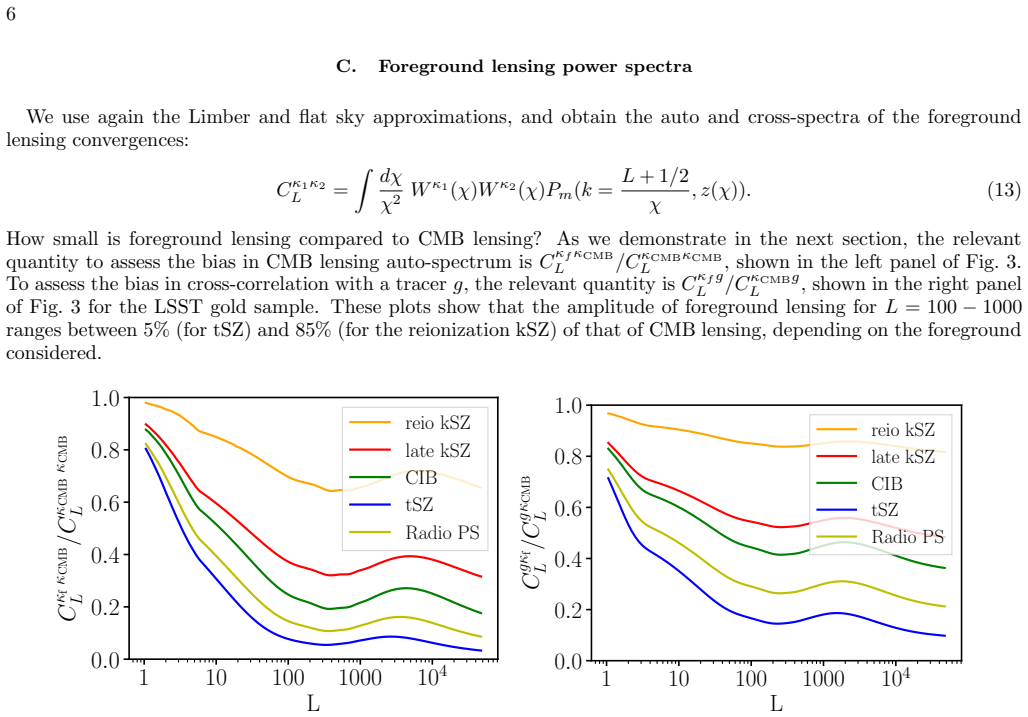
The central claim is that CMB lensing quadratic estimators applied to a temperature map containing lensed extragalactic foregrounds reconstruct a weighted sum of CMB lensing and foreground lensing, and that the correlation between the two convergences converts this response into a bias. The paper computes this lensed foreground bias for the standard quadratic estimator, the shear estimator, and the magnification estimator, finding percent-level biases for a single-frequency 143 GHz stage-III experiment. The foreground lensing convergence itself is 5% to 85% as large as the CMB lensing convergence depending on the component, but the estimators' response to foreground lensing is only about a percent, which sets the bias size. In the CMB lensing auto-spectrum the bias is comparable to the statistical uncertainty, while in cross-correlation with a deep galaxy sample it exceeds the statistical error and is thus highly significant. The bias formulas include primary, secondary, and four-point terms; the secondary term cancels at low lensing multipoles and dominates at multipoles of a few thousand.
Load-bearing premise
The calculation assumes each foreground component is lensed as a whole by a single effective convergence field built from its adopted redshift distribution, and it assumes those foreground redshift distributions and power spectra are accurate; if they are not, the percent-level bias estimate changes.
Editorial extensions
If this is right
- For a stage-III single-frequency temperature experiment, the lensed foreground bias must be included in the error budget because it is comparable to the statistical uncertainty on the CMB lensing auto-spectrum.
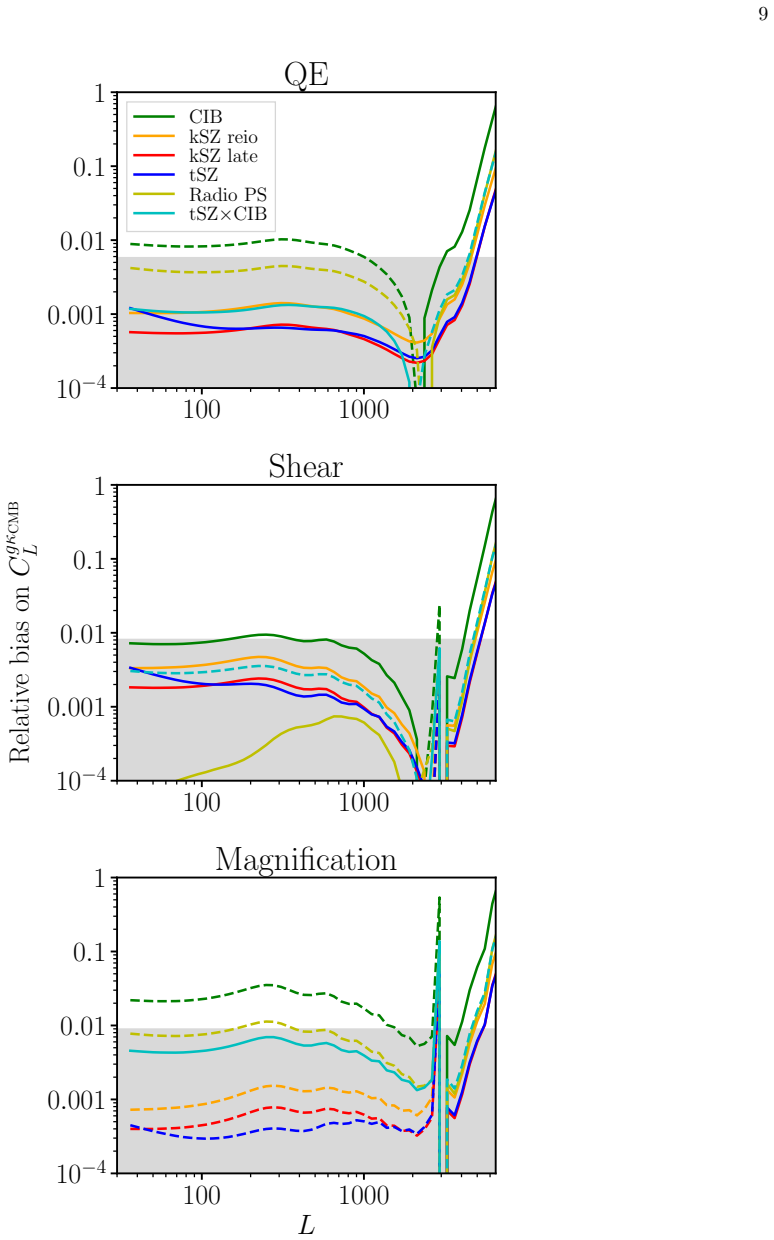
- In cross-correlation with a deep galaxy sample, the bias is larger than the statistical error, so ignoring it would produce a biased measurement of the galaxy-CMB lensing correlation.
- The shear and magnification estimators have opposite-sign responses to foreground lensing, so comparing them provides a null test for the presence of lensed foreground bias.
- Mitigation methods that rely on foreground non-Gaussianity, such as standard bias hardening or the shear estimator alone, do not remove this bias; reducing the foreground level in the map, scale cuts, or the lensed-foreground bias-hardened estimators are needed.
- At lensing multipoles of a few thousand the secondary bias dominates, so small-scale lensing measurements from temperature need special treatment.
Reading between the lines
- The bias depends directly on foreground redshift distributions, so measuring those distributions, for example by cross-correlating foreground maps with galaxy positions, could turn the predicted bias into a correctable template; the paper's statement that a 10% theory error is acceptable sets the required calibration.
- The single-effective-convergence approximation could be checked with redshift-sliced foreground mocks; if slice-by-slice lensing matters, the bias formulas would need the full $\mathrm{d}C_f/\mathrm{d}\chi_S$ integral rather than a single $\ell=3000$ evaluation.
- The same correlated-lensing logic should also bias CMB lensing cross-correlations with the foreground fields themselves, such as CIB or tSZ tracers, since those tracers share the foreground lensing convergence and would enter through the same response formulas.
- The opposite signs of the shear and magnification responses suggest an internal consistency test on real data: the difference of the two estimators should flip sign where lensed foregrounds dominate, independently of any assumed foreground model.
Editorial analysis
A structured set of objections, weighed in public.
Referee Report
Summary. This paper quantifies a new systematic for CMB lensing reconstruction: the lensing of extragalactic foregrounds by the same large-scale structure that lenses the CMB. The authors derive analytic expressions for the response of the standard quadratic, shear, and magnification estimators to foreground lensing (Eq. 14), the resulting primary, secondary, and 4-point biases in the lensing auto-spectrum (Eqs. 19-22), and the cross-correlation bias (Eq. 17). Using foreground power spectra and redshift distributions from the literature, a Simons Observatory-like single-frequency 143 GHz configuration, and the LSST gold sample, they find percent-level biases comparable to the statistical errors in the auto-spectrum and larger than the expected cross-correlation errors. They validate the analytic expressions against 8060-map Gaussian simulations, provide a public code repository, and propose bias-hardening estimators.
Significance. If the amplitude estimate is reliable, this is an important first quantification of a systematic that has been noted but not computed, and it is directly relevant to AdvACT, SPT-3G, Simons Observatory, and CMB-S4. The analytic derivation is careful, the exact cancellation of the secondary bias at low L is a clean result, and the extensive simulation cross-checks plus public code are clear strengths. The main limitation is that the bias amplitude inherits the uncertainty in the approximate effective foreground source distribution, which the paper itself flags as needing quantification; consequently the quantitative headline is not yet fully robust.
major comments (3)
- [Sec. III B (Eq. 11) and Sec. V] The exact effective foreground source distribution Wf(χS,L) defined in Eq. (11) is estimator-weighted and L-dependent, but the numerical results replace it with Wf ∝ dCf(ℓ=3000)/dχS, dropping the F/N_L weighting and all L dependence. Since the bias in Eq. (19) is linear in the resulting C^{κf κCMB}_L, an order-unity error in the effective source redshift distribution would change the percent-level claim and the 'highly significant' LSST cross-correlation conclusion. The paper itself states in Sec. V that quantifying the uncertainty in the foreground source distributions is needed, but no such quantification is provided. Please evaluate Eq. (11) exactly for representative L values, or propagate explicit uncertainties from the adopted source models, and report how the bias changes.
- [Sec. IV and Sec. V] The single-convergence approximation, where each foreground map is lensed as a whole by one convergence field κf, is stated in Sec. IV and in the Conclusions to be 'sufficient' and believed to be comparable to the redshift-distribution uncertainty, but no test is given. Because each redshift slice of a foreground is lensed by a different convergence, and because the estimator weights in Eq. (11) depend on the source distribution, this assumption directly affects the same C^{κf κCMB}_L that sets the headline amplitude. Please test the approximation, for example by splitting a foreground into two or more redshift slices and recomputing the bias.
- [App. B and Figs. 4, 6] The simulation validation uses foreground convergence maps κf generated from the same approximate Wf used in the analytic calculation (App. B, Eqs. B1-B3). The agreement between simulation and analytic curves therefore validates the algebra of the response and bias formulae, but it does not validate the Wf approximation itself. The paper should make this explicit and, more importantly, the approximate input should be tested against exact or observationally calibrated source distributions.
minor comments (5)
- [Sec. III B] The sentence 'For the CMB S3 experiment we consider, and assuming lmax T = 3500, most of the CMB lensing signal-to-noise comes from temperature multipoles ℓ ~ 3000' is given without support; a quantitative statement of the signal-to-noise contribution would strengthen the justification for evaluating dCf/dχ at ℓ=3000.
- [App. C (Eq. C10)] The second line of Eq. (C10) contains an undefined weight w'_{L,ℓ}; the primary-bias term should presumably involve (Σ_ℓ w_{L,ℓ} R^f_{L,ℓ})(Σ_ℓ w_{L,ℓ}) or simply (Σ_ℓ w_{L,ℓ} R^f_{L,ℓ}) since the estimator has unit CMB response. Please clarify or correct.
- [Figs. 5 and 6 captions] The grey shaded areas are described as 'statistical uncertainty on the amplitude' with fsky and Lmax,κ specified; stating clearly whether this includes cosmic variance of the CMB lensing field and of the tracer, and how the bandpower errors are combined, would help the reader.
- [Abstract and Sec. V] The term 'lensed foreground bias-hardening' is used in the abstract and in Sec. V; the hyphenation makes it read as if 'lensed foreground' modifies 'bias-hardening'. Consider rewording as 'hardening against the lensed foreground bias'.
- [Sec. V] The statement 'This bias is thus marginally significant in auto-correlation, and highly significant in cross-correlation' would benefit from repeating the quantitative numbers (e.g., percent-level bias versus 0.6% cross-correlation uncertainty and 1% auto-spectrum uncertainty) so that the conclusion does not depend on the figures alone.
Circularity Check
No significant circularity: the lensed-foreground bias is computed from independent foreground spectra and source distributions, with internal simulation checks; the overlap with Schaan, Ferraro, Spergel (2018) is not load-bearing.
full rationale
The paper's central derivation is not circular. The lensed-foreground bias is computed from (i) foreground power spectra and redshift distributions taken from independent literature (Dunkley et al. 2013 for the spectra; the CIB halo model, Hill & Pajer tSZ model, Shaw et al. kSZ model, and NVSS-based radio source distributions), (ii) the standard quadratic estimator response formalism, whose analytic evaluation is checked against 8060 first-order lensing simulations in App. B, and (iii) the nonlinear matter power spectrum. No parameter is fitted to the target bias. The only overlapping-author citation, Schaan, Ferraro, and Spergel (2018), supplies the response and effective-kernel formalism, but the present paper independently computes the analytic integrals and validates them with simulations (Eqs. B1-B3 and Figs. 4, 6-8), so the citation is not load-bearing in the circularity sense. The approximation Wf ∝ dCf/dχ at ℓ=3000 and the single-lens-plane simplification are acknowledged accuracy limitations (Secs. III B, IV, V), not circular reductions: the predicted bias does not reduce to its input foreground spectra by construction. The paper's own statements that the foreground source distributions are uncertain and that the bias should be treated as a reasonable value rather than exact further support reading this as an uncertainty caveat, not a circular step.
Assumptions & free parameters
assumptions (5)
- standard math Born approximation and a single source plane for CMB lensing.
- standard math Limber and flat-sky approximations for power spectra.
- domain assumption Effective foreground source distribution Wf(chiS,L) is approximated as proportional to dCf(l=3000)/dchiS, ignoring L-dependence.
- domain assumption Each foreground map is lensed by a single convergence field kappa_f.
- domain assumption Foreground power spectra and redshift distributions from the literature are sufficiently accurate.
Cite this review
Pith. "Pith review of Bias to CMB lensing from lensed foregrounds." pith.science (2026). https://pith.science/paper/HAP7ZXTW
@misc{pith2026190808057,
  author       = {Pith},
  title        = {Pith review of: Bias to CMB lensing from lensed foregrounds},
  year         = {2026},
  howpublished = {\url{https://pith.science/paper/HAP7ZXTW}},
  note         = {Machine review of arXiv:1908.08057}
}
read the original abstract
Extragalactic foregrounds are known to constitute a limiting systematic in temperature-based CMB lensing with AdvACT, SPT-3G, Simons Observatory and CMB S4. Furthermore, since these foregrounds are emitted at cosmological distances, they are also themselves lensed. The correlation between this foreground lensing and CMB lensing causes an additional bias in CMB lensing estimators. In this paper, we quantify for the first time this "lensed foreground bias" for the standard CMB lensing quadratic estimator, the CMB shear and the CMB magnification estimators, in the case of Simons Observatory and in the absence of multi-frequency component separation. This percent-level bias is highly significant in cross-correlation of CMB lensing with LSST galaxies, and comparable to the statistical uncertainty in CMB lensing auto-spectrum. We discuss various mitigation strategies, and show that "lensed foreground bias-hardening" methods can reduce this bias at some cost in signal-to-noise. The code used to generate our theory curves is publicly available at https://github.com/EmmanuelSchaan/LensedForegroundBias .
Figures


Figures from the paper (5 more)



Reference graph
Works this paper leans on
-
[1]
K. M. Smith, O. Zahn, and O. Dor´ e, Phys. Rev. D 76, 043510 (2007), 0705.3980
arXiv 2007
-
[2]
C. M. Hirata, S. Ho, N. Padmanabhan, U. Seljak, and N. A. Bahcall, Phys. Rev. D 78, 043520 (2008), 0801.0644
arXiv 2008
-
[3]
S. Das, B. D. Sherwin, P. Aguirre, J. W. Appel, J. R. Bond, C. S. Carvalho, M. J. Devlin, J. Dunkley, R. D¨ unner, T. Essinger-Hileman, et al., Physical Review Letters 107, 021301 (2011), 1103.2124
arXiv 2011
-
[4]
S. Das, T. Louis, M. R. Nolta, G. E. Addison, E. S. Battistelli, J. R. Bond, E. Calabrese, D. Crichton, M. J. Devlin, S. Dicker, et al., J. Cosmology Astropart. Phys. 4, 014 (2014), 1301.1037
arXiv 2014
-
[5]
Evidence of Lensing of the Cosmic Microwave Background by Dark Matter Halos
M. Madhavacheril, N. Sehgal, R. Allison, N. Battaglia, J. R. Bond, E. Calabrese, J. Caliguiri, K. Coughlin, D. Crichton, R. Datta, et al., Physical Review Letters 114, 151302 (2015), 1411.7999
work page Pith review arXiv 2015
-
[6]
A. van Engelen, B. D. Sherwin, N. Sehgal, G. E. Addison, R. Allison, N. Battaglia, F. de Bernardis, J. R. Bond, E. Cal- abrese, K. Coughlin, et al., ApJ 808, 7 (2015), 1412.0626
arXiv 2015
-
[7]
B. D. Sherwin, A. van Engelen, N. Sehgal, M. Madhavacheril, G. E. Addison, S. Aiola, R. Allison, N. Battaglia, D. T. Becker, J. A. Beall, et al., Phys. Rev. D 95, 123529 (2017), 1611.09753
arXiv 2017
-
[8]
The Atacama Cosmology Telescope: measuring radio galaxy bias through cross-correlation with lensing
R. Allison, S. N. Lindsay, B. D. Sherwin, F. de Bernardis, J. R. Bond, E. Calabrese, M. J. Devlin, J. Dunkley, P. Gallardo, S. Henderson, et al., MNRAS 451, 849 (2015), 1502.06456
work page Pith review arXiv 2015
Show all 68 references
-
[9]
van Engelen, R
A. van Engelen, R. Keisler, O. Zahn, K. A. Aird, B. A. Benson, L. E. Bleem, J. E. Carlstrom, C. L. Chang, H. M. Cho, T. M. Crawford, et al., ApJ 756, 142 (2012), 1202.0546
2012 arXiv
-
[10]
Hanson, S
D. Hanson, S. Hoover, A. Crites, P. A. R. Ade, K. A. Aird, J. E. Austermann, J. A. Beall, A. N. Bender, B. A. Benson, and L. E. Bleem, Phys. Rev. Lett. 111, 141301 (2013), 1307.5830
2013 arXiv
-
[11]
E. J. Baxter, R. Keisler, S. Dodelson, K. A. Aird, S. W. Allen, M. L. N. Ashby, M. Bautz, M. Bayliss, B. A. Benson, L. E. Bleem, et al., ApJ 806, 247 (2015), 1412.7521
2015 arXiv
-
[12]
K. T. Story, D. Hanson, P. A. R. Ade, K. A. Aird, J. E. Austermann, J. A. Beall, A. N. Bender, B. A. Benson, L. E. Bleem, J. E. Carlstrom, et al., ApJ 810, 50 (2015), 1412.4760
2015 arXiv
-
[13]
Omori, R
Y. Omori, R. Chown, G. Simard, K. T. Story, K. Aylor, E. J. Baxter, B. A. Benson, L. E. Bleem, J. E. Carlstrom, C. L. Chang, et al., ApJ 849, 124 (2017), 1705.00743
2017 arXiv
-
[14]
P. A. R. Ade, Y. Akiba, A. E. Anthony, K. Arnold, M. Atlas, D. Barron, D. Boettger, J. Borrill, S. Chapman, Y. Chinone, et al., Physical Review Letters 113, 021301 (2014), 1312.6646
2014 arXiv
-
[15]
Namikawa, Y
T. Namikawa, Y. Chinone, H. Miyatake, M. Oguri, R. Takahashi, A. Kusaka, N. Katayama, S. Adachi, M. Aguilar, H. Aihara, et al., arXiv e-prints (2019), 1904.02116
2019 arXiv
-
[16]
Aguilar Faundez, K
M. Aguilar Faundez, K. Arnold, C. Baccigalupi, D. Barron, D. Beck, F. Bianchini, D. Boettger, J. Borrill, J. Carron, K. Cheung, et al., arXiv e-prints (2019), 1903.07046
2019 arXiv
-
[17]
Planck Collaboration, P. A. R. Ade, N. Aghanim, C. Armitage-Caplan, M. Arnaud, M. Ashdown, F. Atrio-Barandela, J. Aumont, C. Baccigalupi, A. J. Banday, et al., A&A 571, A17 (2014), 1303.5077
2014 arXiv
-
[18]
Planck Collaboration, P. A. R. Ade, N. Aghanim, M. Arnaud, M. Ashdown, J. Aumont, C. Baccigalupi, A. J. Banday, R. B. Barreiro, J. G. Bartlett, et al., ArXiv e-prints (2015), 1502.01591
2015 arXiv
-
[19]
Aghanim, Y
Planck Collaboration, N. Aghanim, Y. Akrami, M. Ashdown, J. Aumont, C. Baccigalupi, M. Ballardini, A. J. Banday, R. B. Barreiro, N. Bartolo, et al., arXiv e-prints (2018), 1807.06210
2018 arXiv
-
[20]
Keck Array, BICEP2 Collaborations, :, P
T. Keck Array, BICEP2 Collaborations, :, P. A. R. Ade, Z. Ahmed, R. W. Aikin, K. D. Alexander, D. Barkats, S. J. Benton, C. A. Bischoff, et al., ArXiv e-prints (2016), 1606.01968
2016 arXiv
-
[21]
Manzotti, K
A. Manzotti, K. T. Story, W. L. K. Wu, J. E. Austermann, J. A. Beall, A. N. Bender, B. A. Benson, L. E. Bleem, J. J. Bock, and J. E. Carlstrom, ApJ 846, 45 (2017), 1701.04396
2017 arXiv
-
[22]
Carron, A
J. Carron, A. Lewis, and A. Challinor, Journal of Cosmology and Astro-Particle Physics 2017, 035 (2017), 1701.01712
2017 arXiv
- [23]
-
[24]
S. W. Henderson, R. Allison, J. Austermann, T. Baildon, N. Battaglia, J. A. Beall, D. Becker, F. De Bernardis, J. R. Bond, E. Calabrese, et al., Journal of Low Temperature Physics 184, 772 (2016), 1510.02809
2016 arXiv
-
[25]
B. A. Benson, P. A. R. Ade, Z. Ahmed, S. W. Allen, K. Arnold, J. E. Austermann, A. N. Bender, L. E. Bleem, J. E. Carlstrom, C. L. Chang, et al., in Millimeter, Submillimeter, and Far-Infrared Detectors and Instrumentation for Astron- omy VII (2014), vol. 9153 of Society of Pho...
2014 arXiv
-
[26]
Suzuki, P
A. Suzuki, P. Ade, Y. Akiba, C. Aleman, K. Arnold, C. Baccigalupi, B. Barch, D. Barron, A. Bender, D. Boettger, et al., Journal of Low Temperature Physics 184, 805 (2016), 1512.07299
2016 arXiv
-
[27]
P. Ade, J. Aguirre, Z. Ahmed, S. Aiola, A. Ali, D. Alonso, M. A. Alvarez, K. Arnold, P. Ashton, J. Austermann, et al., Journal of Cosmology and Astro-Particle Physics 2019, 056 (2019), 1808.07445
2019 arXiv
-
[28]
K. N. Abazajian, P. Adshead, Z. Ahmed, S. W. Allen, D. Alonso, K. S. Arnold, C. Baccigalupi, J. G. Bartlett, N. Battaglia, 14 B. A. Benson, et al., arXiv e-prints arXiv:1610.02743 (2016), 1610.02743
2016 arXiv
-
[29]
S. J. Osborne, D. Hanson, and O. Dor´ e, Journal of Cosmology and Astro-Particle Physics 2014, 024 (2014), 1310.7547
2014 arXiv
-
[30]
van Engelen, S
A. van Engelen, S. Bhattacharya, N. Sehgal, G. P. Holder, O. Zahn, and D. Nagai, ApJ 786, 13 (2014), 1310.7023
2014 arXiv
-
[31]
Raghunathan, S
S. Raghunathan, S. Patil, E. J. Baxter, F. Bianchini, L. E. Bleem, T. M. Crawford, G. P. Holder, A. r. Manzotti, and C. L. Reichardt, Journal of Cosmology and Astro-Particle Physics 2017, 030 (2017), 1705.00411
2017 arXiv
- [32]
- [33]
-
[34]
Raghunathan, S
S. Raghunathan, S. Patil, E. Baxter, B. A. Benson, L. E. Bleem, T. L. Chou, T. M. Crawford, G. P. Holder, T. McClintock, and C. L. Reichardt, ApJ 872, 170 (2019), 1810.10998
2019 arXiv
-
[35]
M. S. Madhavacheril and J. C. Hill, arXiv e-prints arXiv:1802.08230 (2018), 1802.08230
2018 arXiv
-
[36]
Raghunathan, G
S. Raghunathan, G. P. Holder, J. G. Bartlett, S. Patil, C. L. Reichardt, and N. Whitehorn, arXiv e-prints arXiv:1904.13392 (2019), 1904.13392
2019 arXiv
- [37]
- [38]
-
[39]
Bucher, C
M. Bucher, C. S. Carvalho, K. Moodley, and M. Remazeilles, Phys. Rev. D 85, 043016 (2012), 1004.3285
2012 arXiv
-
[40]
Prince, K
H. Prince, K. Moodley, J. Ridl, and M. Bucher, Journal of Cosmology and Astro-Particle Physics 2018, 034 (2018), 1709.02227
2018 arXiv
-
[41]
Cooray, New Astronomy 9, 173 (2004), astro-ph/0309301
A. Cooray, New Astronomy 9, 173 (2004), astro-ph/0309301
2004 arXiv
-
[42]
Schaan, S
E. Schaan, S. Ferraro, and D. N. Spergel, Phys. Rev. D 97, 123539 (2018), 1802.05706
2018 arXiv
- [43]
-
[44]
A. J. Mead, J. A. Peacock, C. Heymans, S. Joudaki, and A. F. Heavens, MNRAS 454, 1958 (2015), 1505.07833
2015 arXiv
-
[45]
D. Blas, J. Lesgourgues, and T. Tram, Journal of Cosmology and Astro-Particle Physics 2011, 034 (2011), 1104.2933
2011 arXiv
- [46]
-
[47]
Foreman, P
S. Foreman, P. D. Meerburg, A. van Engelen, and J. Meyers, Journal of Cosmology and Astro-Particle Physics 2018, 046 (2018), 1803.04975
2018 arXiv
- [48]
-
[49]
Zaldarriaga and U
M. Zaldarriaga and U. Seljak, Phys. Rev. D 59, 123507 (1999), astro-ph/9810257
1999 arXiv
-
[50]
Pen, New Astronomy 9, 417 (2004), astro-ph/0305387
U.-L. Pen, New Astronomy 9, 417 (2004), astro-ph/0305387
2004 arXiv
- [51]
-
[52]
Dunkley, E
J. Dunkley, E. Calabrese, J. Sievers, G. E. Addison, N. Battaglia, E. S. Battistelli, J. R. Bond, S. Das, M. J. Devlin, R. D¨ unner, et al., Journal of Cosmology and Astro-Particle Physics2013, 025 (2013), 1301.0776
2013 arXiv
-
[53]
LSST Science Collaboration, P. A. Abell, J. Allison, S. F. Anderson, J. R. Andrew, J. R. P. Angel, L. Armus, D. Arnett, S. J. Asztalos, T. S. Axelrod, et al., arXiv e-prints arXiv:0912.0201 (2009), 0912.0201
2009 arXiv
-
[54]
P´ enin, O
A. P´ enin, O. Dor´ e, G. Lagache, and M. B´ ethermin, A&A537, A137 (2012), 1110.0395
2012 arXiv
-
[55]
B´ ethermin, E
M. B´ ethermin, E. Daddi, G. Magdis, M. T. Sargent, Y. Hezaveh, D. Elbaz, D. Le Borgne, J. Mullaney, M. Pannella, V. Buat, et al., ApJ 757, L23 (2012), 1208.6512
2012 arXiv
-
[56]
B´ ethermin, L
M. B´ ethermin, L. Wang, O. Dor´ e, G. Lagache, M. Sargent, E. Daddi, M. Cousin, and H. Aussel, A&A 557, A66 (2013), 1304.3936
2013 arXiv
-
[57]
J. C. Hill and E. Pajer, Phys. Rev. D 88, 063526 (2013), 1303.4726
2013 arXiv
-
[58]
L. D. Shaw, D. H. Rudd, and D. Nagai, ApJ 756, 15 (2012), 1109.0553
2012 arXiv
-
[59]
Aghanim, Y
Planck Collaboration, N. Aghanim, Y. Akrami, M. Ashdown, J. Aumont, C. Baccigalupi, M. Ballardini, A. J. Banday, R. B. Barreiro, N. Bartolo, et al., arXiv e-prints arXiv:1807.06209 (2018), 1807.06209
2018 arXiv
-
[60]
de Zotti, M
G. de Zotti, M. Massardi, M. Negrello, and J. Wall, A&A Rev. 18, 1 (2010), 0908.1896
2010 arXiv
-
[61]
M. H. Brookes, P. N. Best, J. A. Peacock, H. J. A. R¨ ottgering, and J. S. Dunlop, MNRAS 385, 1297 (2008), 0802.1158
2008 arXiv
- [62]
-
[63]
Anderes and J
E. Anderes and J. Guinness, arXiv e-prints arXiv:1603.03496 (2016), 1603.03496. Appendix A: Derivation of the secondary bias to CMB lensing from lensed foregrounds We consider the auto-spectrum of QL [T +f,T +f], where T now represents the lensed CMB and f the lensed foregroun...
2016 arXiv
-
[64]
(14) by using the Fast Fourier Transform (FFT)
Analytical evaluation methods For the bias in CMB lensing cross-correlation, and for the primary and secondary biases to CMB lensing, we evaluate the responseRf L from Eq. (14) by using the Fast Fourier Transform (FFT). Indeed, each integral is a sum of products and convolutio...
-
[65]
These calculations build upon the LensQuEst module4
Simulations In addition to the analytical calculations describe above, we also evaluate the foreground lensing responses, primary and secondary biases using simulated maps of the CMB, foregrounds and their lensing convergences. These calculations build upon the LensQuEst modul...
-
[66]
Standard quadratic estimator The standard quadratic estimator of [46] is simply the minimum variance unbiased linear combination of these estimators. Indeed, we look for weights wL,𝓁 satisfying: ∑ 𝓁 wL,𝓁 = 1 (unit response to CMB lensing) ∑ 𝓁 w2 L,𝓁σ2 L,𝓁 is minima...
-
[67]
Here we would like the combined estimator to have zero response to κf L
Nulling the response to foreground lensing In the presence of a lensed foreground, the estimator ˆκL,𝓁 acquires a biasRf L,𝓁κf L, whereRf L,𝓁 = f f 𝓁,L−𝓁 f CMB 𝓁,L−𝓁 . Here we would like the combined estimator to have zero response to κf L. We thus look for lensing weights wL,...
-
[68]
This would make sure that we are not subtracting a ∼ 1% foreground lensing bias at a large cost in signal-to-noise
Minimizing the total variance from noise plus lensed foreground bias An alternative approach is thus not to require the response to foreground lensing to be exactly zero, but instead to minimize the total variance of the lensing estimator, including the additional variance due...
Reviewed August 14, 2026 · model on record in the stance chip above.
Discussion (0). Continue with ORCID to comment.