REVIEW 2 major objections 4 minor 1 cited by
Lyapunov growth in quantum spin chains
T0 review · 2 major / 4 minor · reviewed 2026-08-14 · deepseek-v4-flash
Pith's one-line read This paper claims that raising the local spin in a mixed-field Ising chain opens an exponential Lyapunov window whose infinite-spin rate matches the classical Poisson-bracket exponent.
desk verdict Qualitative exponential window and classical analogue are real; the quantitative match is plausible but rests on a post-selected power-law extrapolation, so treat the abstract's agreement claim as provisional. read the letter →
The pith
A machine-rendered reading of the paper's core claim, the machinery that carries it, and where it could break.
The reading
What carries the argument
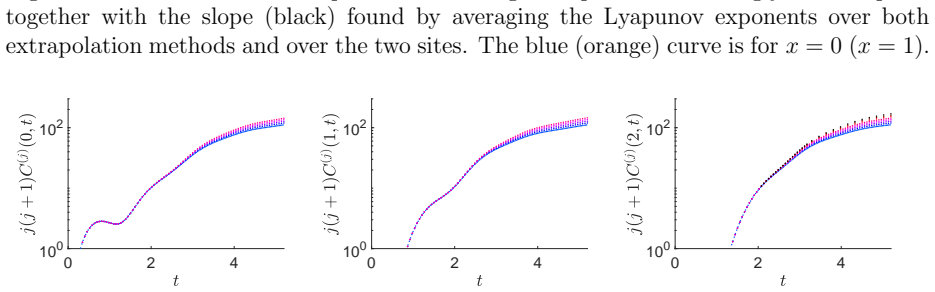
The machinery is the correspondence between the rescaled commutator squared and a Poisson-bracket squared in the classical limit: $\lim_{j\to\infty} j(j+1)C^{(j)}(x,t)=C^{(\mathrm{cl})}(x,t)=\langle |\{S_z^{(1)}(t),S_z^{(1+x)}(0)\}|^2\rangle$. The finite-$j$ phase space is a fuzzy sphere, a sphere whose coordinates are non-commuting spin operators, which smooths to a classical $S^2$ as $j\to\infty$; the Poisson bracket is taken on the product of these spheres. The rescaling by $j(j+1)$ is what opens the window: the commutator squared starts suppressed by $1/(j(j+1))$ and the exponential growth can proceed for roughly $\Delta t_{\exp}\sim(2\lambda_L)^{-1}\log j(j+1)$ before the bounded observable saturates. On the classical side, the bracket is evaluated numerically by Monte Carlo sampling of initial angles on the spheres and finite-difference perturbation of one angle, and the Lyapunov exponent is read from a linear fit to the semi-log growth of the averaged squared bracket.
What would settle it
Compute the commutator squared at $j=90$ to $120$ in the two-site chain at $(h_x,h_z)=(-1.05,0.5)$: if the extracted rates follow the exponential extrapolation and approach $\lambda_L^\infty\simeq0.70$, or if changing the lower fit boundary from $j(j+1)C=9$ to $4$ or $16$ shifts the slope at $j=61$ by more than the quoted uncertainty, the claimed match with the classical value $0.752\pm0.013$ fails.
Extended reading notes
Core claim
The central claim is that in the higher-spin mixed-field Ising chain the rescaled commutator squared $j(j+1)C^{(j)}(x,t)$, where $C^{(j)}(x,t)=\langle |[S_z^{(1)}(t),S_z^{(1+x)}(0)]|^2\rangle_{\beta=0}$, develops a genuine exponential-growth window for sufficiently large spin $j$, with a rate $\lambda_L^{(j)}$ that saturates to a finite value $\lambda_L^\infty$ as $j\to\infty$. At the strongly chaotic point $(h_x,h_z)=(-1.05,0.5)$ the paper reports $\lambda_{L,\mathrm{pow}}^\infty=0.722\pm0.019$ from a power-law extrapolation and $\lambda_L^{\mathrm{classical}}=0.752\pm0.013$ from the classical analysis, while the exponential extrapolation gives $0.700\pm0.016$; only the power-law form is consistent with the classical value. The paper also finds that the integrable line $h_z=0$ of the spin-1/2 model is no longer integrable at higher spin, and that the exponential window lasts roughly $(2\lambda_L)^{-1}\log j(j+1)$, so the dimension of the local Hilbert space supplies the small parameter that spatial separation failed to provide.
Load-bearing premise
The whole matching argument rests on the assumption that the straight stretch seen in the semi-log plot at the largest spin is genuine exponential growth, not a crossover artifact, and that the power-law extrapolation, rather than the exponential one, gives the correct infinite-spin limit.
Editorial extensions
If this is right
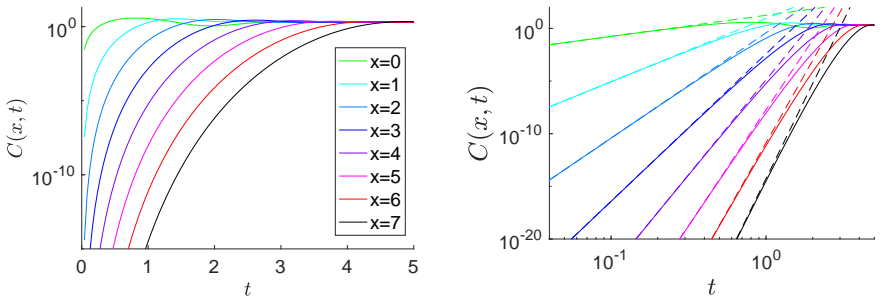
- For spin-1/2, no amount of spatial separation opens an exponential window; the commutator squared goes from early Baker-Campbell-Hausdorff power-law growth directly into diffusive saturation.
- For spins $j\gtrsim 10$, the exponential window lasts roughly $\frac{1}{2\lambda_L}\log j(j+1)$, so the local Hilbert-space dimension, not the operator separation, is the parameter that controls the scrambling window.
- The infinite-spin limit of the quantum rate matches the classical Poisson-bracket rate in the chaotic region, with the power-law extrapolation consistent with the classical value while the exponential extrapolation misses it.
- Moving toward integrable parameter lines, the extracted Lyapunov exponent decreases and eventually vanishes, correlating the spectral-statistics measure of chaos with the dynamical measure.
- The exponential growth breaks down before saturation at a scale that survives the classical limit, so the near-saturation behavior is a separate regime from the Lyapunov regime.
Reading between the lines
- If the L=2 matching persists in longer chains, the exponential window is a genuine finite-spin echo of classical chaos rather than a few-site artifact; a tensor-network or MPO simulation at $L=4$-$6$, $j\approx20$-$30$ could test whether the extracted rate shifts with chain length.
- The exponent extracted here is a generalized Lyapunov exponent, an average over phase space of the squared Poisson bracket, rather than the standard time-averaged Lyapunov exponent; comparing it with tangent-space Lyapunov spectra for the same classical chain would quantify the difference.
- The disappearance of the $h_z=0$ integrable line at higher spin suggests integrability of the spin-1/2 model is fine-tuned to the local Hilbert-space dimension; a systematic spectral-statistics scan at fixed $j$ could reveal whether any integrable surfaces survive.
- The breakdown of exponential growth before saturation, at a scale that survives the classical limit, points to a separate Ehrenfest-type scale; measuring the operator wavefront shape in longer chains at moderate $j$ would separate this scale from the diffusive front studied at spin-1/2.
Signed reviews
Editorial analysis
A structured set of objections, weighed in public.
Referee Report
Summary. The paper studies the mixed-field Ising chain with spin-j representations at each site, asking whether the commutator squared develops a window of exponential growth as j is increased toward the classical limit. It reports that at the strongly chaotic point (h_x,h_z)=(-1.05,0.5), the quantity j(j+1)C^(j)(x,t) indeed develops an intermediate-time exponential regime whose duration grows with j, and it extracts a quantum Lyapunov exponent lambda^(j)_L for each j. A classical analogue C^(cl)(x,t), defined as the infinite-spin limit of j(j+1)C^(j)(x,t) and computed from the classical equations of motion via a Monte Carlo average over initial conditions, is used to extract a classical Lyapunov exponent. The central quantitative claim is that the infinite-spin extrapolation of the quantum exponent agrees with the classical exponent in the chaotic region; Table 1 reports lambda^inf_L,pow = 0.722 +/- 0.019 and lambda^inf_L,exp = 0.701 +/- 0.016 at site 1, against lambda_classical_L = 0.752 +/- 0.013. The paper is explicit about the numerical ambiguities and about the restriction to very short chains, and it discusses why the extracted quantity is a generalized rather than standard Lyapunov exponent.
Significance. If the quantitative matching holds, the paper provides a concrete demonstration of a classical-quantum Lyapunov correspondence for a many-body lattice model, with an explicit classical analogue of the commutator squared and a physically motivated scaling window of order (1/2) log j(j+1). The qualitative result that sufficiently large local spin opens an exponential window is well supported by the data, and the paper is honest about the fit ambiguities and the L=2 limitation. A notable strength is that the classical exponent is computed independently from the classical equations of motion, Eqs. (3.16)-(3.17), rather than inferred from the quantum lambda^(j); the comparison is therefore not circular by construction. The main weakness is that the quantitative matching between the infinite-spin quantum extrapolation and the classical exponent is sensitive to the choice of extrapolant, and the paper's preference for the power-law form is justified only after the fact by its agreement with the classical value.
major comments (2)
- [Table 1 and Eqs. (4.11)-(4.12), with discussion in Sec. 5.2] The central quantitative claim depends on which extrapolating function is used for lambda^(j)_L. Table 1 reports at site 1 lambda^inf_L,exp = 0.701 +/- 0.016 for the exponential extrapolant (4.11) and lambda^inf_L,pow = 0.722 +/- 0.019 for the power-law extrapolant (4.12), against lambda_classical_L = 0.752 +/- 0.013. Only the power-law form overlaps the classical value; the exponential form is approximately 2.5 sigma away and is close to simply using the highest-spin value lambda^(61)_L = 0.697 +/- 0.015. The paper states in Sec. 5.1 that the power-law approach 'provides a better estimate than the exponential extrapolation', but this is an a posteriori judgment based on agreement with the target, not a derived scaling or an independent selection principle. Unless a theoretical or independent numerical criterion is supplied for the j-dependence of lambda^(j)_L, or the comparison is framed as a range spanning both extrapolants, the claimed agreement with the classical exponent is not established. This issue is load-bearing because the abstract's claim that the two exponents 'agree' rests on this choice.
- [Sec. 4.2.2 and Fig. 10] The identification of the 'exponential regime' is based on only 3-4 e-foldings at the highest spin j=61, in an L=2 chain, and the fitting window is fixed by data-dependent thresholds: the initial time is set where j(j+1)C^(j)(x,t)=9, and the final time is set by the 1% deviation time of the two highest spins. With this short a window, a crossover between the early BCH power-law growth and the near-saturation behavior could plausibly masquerade as a linear region on a semi-log plot. The variance over the 25 time intervals captures only the sensitivity to the chosen cuts, not the possibility that the apparent linear regime is itself a crossover artifact. I ask for an additional diagnostic, for example a test of whether the local logarithmic slope is constant over the fitted window for several j values, or a collapse of j(j+1)C^(j) data at different j, to support the claim that a genuine exponential regime has been isolated.
minor comments (4)
- [Sec. 4.1] The statement that the L=3 chain shows Poisson statistics at every parameter value 'probably due to a residual symmetry that we were not immediately able to identify' is an unverified assumption. Since Fig. 14 is later used to argue that the fluctuations seen in L=2 are edge effects, the unresolved symmetry issue should be presented more prominently as a limitation of the spectral-statistics-based definition of chaos for this chain.
- [Sec. 2.2.2] The text refers to 'Figure 2.2' twice when describing the semi-log and log-log plots; these references should be corrected to the actual figure numbers (presumably Figures 2 and 3) to avoid confusion.
- [Sec. 4.2.2 and Fig. 11] The claim that both the exponential form (4.11) and the power-law form (4.12) 'provide a good fit' while the logarithmic form (4.13) 'was not found to provide a good fit' is supported only visually. Reporting a goodness-of-fit statistic such as reduced chi-squared for each fit would make the selection of extrapolants quantitative and would strengthen the paper.
- [Sec. 5.1] The classical extraction procedure is described as varying the endpoints of the fitting region and computing the mean and standard deviation, but the number of endpoint choices and the range over which they are varied are not specified. A brief quantitative description would improve reproducibility.
Circularity Check
Mild post-selected extrapolant choice; no construction-level circularity.
-
fitted input called prediction
[Sec. 5.1 (quoted after Eq. (5.1)); Table 1; Sec. 4.2.2 Eqs. (4.11)-(4.12)]
"We find that the errorbars of the classical exponent and the power law extrapolation overlap, which suggests that the power law approach provides a better estimate than the exponential extrapolation."
The paper's central classical-quantum matching claim is reported using the power-law infinite-spin extrapolant lambda^inf_L,pow. Both Eq. (4.11) (exponential) and Eq. (4.12) (power law) are described as good fits to the same lambda^(j)_L data, yet Table 1 shows only the power-law extrapolant overlaps the classical value (0.752 +/- 0.013), while the exponential extrapolant gives 0.701 +/- 0.016 and does not overlap. The quoted sentence shows that the power-law form is labelled the 'better estimate' because its error bars overlap the independently computed classical exponent, i.e. the extrapolant used for the comparison is selected after seeing the target.
full rationale
The classical Lyapunov exponent is computed independently from the classical equations of motion (3.16)-(3.17) via Monte Carlo averaging, and is not derived from the quantum lambda^(j) data. The definition C^(cl) = lim j(j+1) C^(j) (Eq. 3.19) is a correspondence-principle limit, not a fit to the target. The quantum exponential-growth window and the extracted lambda^(j)_L come from explicit time evolution of the commutator squared. The only concerning element is the choice of extrapolant: the power-law form is favored in the final comparison because it overlaps the classical exponent, whereas the exponential form, which is equally consistent with the finite-j data, does not. This post-selection weakens the claim as an independent confirmation, but it is not a construction-level circularity; no self-citation is load-bearing, and no equation reduces to its own input. Accordingly, the paper is largely self-contained with a mild post-hoc element.
Assumptions & free parameters
free parameters (2)
- Extrapolation parameters (lambda_infinity, a1, a2) in Eqs. (4.11) and (4.12) =
lambda_infinity_exp ~ 0.70, lambda_infinity_pow ~ 0.72; a1 and a2 not reported
- Exponential-regime fit window (t_i, t_f) in section 4.2.2 =
t_i where j(j+1)C = 9; t_f at 1 percent deviation between the two highest spins
assumptions (4)
- domain assumption Correspondence principle: as j goes to infinity, -i sqrt(j(j+1)) [.,.] becomes the Poisson bracket and the rescaled Hamiltonian (3.1)/(3.4) gives finite classical equations of motion.
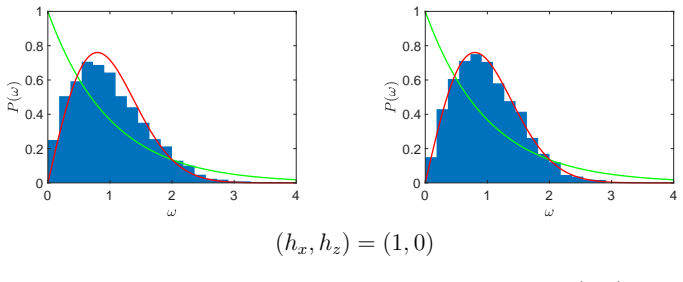
- domain assumption Wigner-Dyson level-spacing statistics define quantum chaos, and classical chaos is assumed to correspond via the BGS conjecture.
- domain assumption The infinite-temperature classical average is the uniform (Haar) measure on the product of spheres, Eq. (5.1).
- ad hoc to paper The L=3 chain's Poisson statistics are due to an unidentified residual symmetry.
Cite this review
Pith. "Pith review of Lyapunov growth in quantum spin chains." pith.science (2026). https://pith.science/paper/ZZBZTINL
@misc{pith2026190808059,
  author       = {Pith},
  title        = {Pith review of: Lyapunov growth in quantum spin chains},
  year         = {2026},
  howpublished = {\url{https://pith.science/paper/ZZBZTINL}},
  note         = {Machine review of arXiv:1908.08059}
}
read the original abstract
The Ising spin chain with longitudinal and transverse magnetic fields is often used in studies of quantum chaos, displaying both chaotic and integrable regions in its parameter space. However, even at a strongly chaotic point this model does not exhibit Lyapunov growth of the commutator squared of spin operators, as this observable saturates before exponential growth can manifest itself (even in situations where a spatial suppression factor makes the initial commutator small). We extend this model from the spin 1/2 Ising model to higher spins, demonstrate numerically that a window of exponential growth opens up for sufficiently large spin, and extract a quantity which corresponds to a notion of a Lyapunov exponent. In the classical infinite-spin limit, we identify and compute the appropriate classical analogue of the commutator squared, and show that the corresponding exponent agrees with the infinite-spin limit extracted from the quantum spin chain.
Figures


Figures from the paper (14 more)




Forward citations
Cited by 1 Pith paper
-
Quantum chaos and pole skipping in two-dimensional conformal perturbation theory
A deformed 2D CFT's stress-tensor pole-skipping point shifts at O(lambda^2); at h=1/2 the shift matches the holographic butterfly velocity.
Reference graph
Works this paper leans on
- [1]
-
[2]
Bohigas, M
O. Bohigas, M. J. Giannoni, and C. Schmit, Characterization of Chaotic Quantum Spectra and Universality of Level Fluctuation Laws, Phys. Rev. Lett. 52, 1 (1984)
1984
-
[3]
M. V. Berry, and M. Tabor, Level clustering in the regular spectrum, Proc. Roy. Soc. A 356, 1686 (1977) . 30
work page 1977
-
[4]
L. D’Alessio, Y. Kafri, A. Polkovnikov, and M. Rigol, From quantum chaos and eigenstate thermalization to statistical mechanics and thermodynamics, Adv. Phys. 65, 239 (2016), arXiv:1509.06411 [cond-mat.stat-mech]
arXiv 2016
-
[5]
A. I. Larkin and Y. N. Ovchinnikov, Quasiclassical method in the theory of superconductivity, JETP 28, 1200 (1969)
work page 1969
-
[6]
A. Almheiri, D. Marolf, J. Polchinski, D. Stanford, and J. Sully, An Apologia for Firewalls, JHEP 09, 018, arXiv:1304.6483 [hep-th]
-
[7]
S. H. Shenker and D. Stanford, Black holes and the butterfly effect, JHEP 03, 067, arXiv:1306.0622 [hep-th]
-
[8]
S. H. Shenker and D. Stanford, Multiple Shocks, JHEP 12, 046, arXiv:1312.3296 [hep-th]
Show all 30 references
-
[9]
Kitaev, Hidden correlations in the hawking radiation and thermal noise, talk given at Fundamental Physics Prize Symposium, Nov
A. Kitaev, Hidden correlations in the hawking radiation and thermal noise, talk given at Fundamental Physics Prize Symposium, Nov. 10, 2014
2014
-
[10]
Maldacena, S
J. Maldacena, S. H. Shenker, and D. Stanford, A bound on chaos, JHEP 08, 106, arXiv:1503.01409 [hep-th]
-
[11]
Arseni Goussev, R. A. Jalabert, H. M. Pastawski, and D. Wisniacki, Loschmidt echo, Scholarpedia 7(8):11687 (2012)
2012
-
[12]
T. A. Elsayed , and B. V. Fine, Sensitivity to small perturbations in systems of large quantum spins, Phys. Scr. 2015, 014011, arXiv:1409.4763 [cond-mat.stat-mech]
2015 arXiv
-
[13]
M. C. Ba˜ nuls, J. I. Cirac, and M. B. Hastings, Strong and weak thermalization of infinite nonintegrable quantum systems, Phys. Rev. Lett. 106, 050405 (2011), 1007.3957 [quant-ph]
2011 arXiv
-
[14]
D. A. Roberts, D. Stanford, and L. Susskind, Localized shocks, JHEP 03, 051, arXiv:1409.8180 [hep-th]
-
[15]
Kukuljan, S
I. Kukuljan, S. Grozdanov, and T. Prosen, Weak Quantum Chaos, Phys. Rev. B96, 060301(R) (2017), arXiv:1701.09147 [cond-mat.stat-mech]
2017 arXiv
-
[16]
Khemani, D
V. Khemani, D. A. Huse, and A. Nahum, Velocity-dependent Lyapunov exponents in many-body quantum, semiclassical, and classical chaos, Phys. Rev. B98, 144304 (2018), arXiv:1803.05902 [cond-mat.stat-mech]
2018 arXiv
-
[17]
Xu and B
S. Xu and B. Swingle, Locality, Quantum Fluctuations, and Scrambling, (2018a), arXiv:1805.05376 [cond-mat.str-el]
2018 arXiv
-
[18]
E. B. Rozenbaum, S. Ganeshan, and V. Galitski, Lyapunov Exponent and Out-of-Time-Ordered Correlator’s Growth Rate in a Chaotic System, Phys. Rev. Lett. 118, 086801 (2017), arXiv:1609.01707 [cond-mat.dis-nn] . 31
2017 arXiv
-
[19]
Sachdev, Quantum Phase Transitions , 2nd ed
S. Sachdev, Quantum Phase Transitions , 2nd ed. (Cambridge University Press, 2011)
2011
-
[20]
Evnin and W
O. Evnin and W. Piensuk, Quantum resonant systems, integrable and chaotic, J. Phys. A52, 025102 (2019), arXiv:1808.09173 [math-ph]
2019 arXiv
-
[21]
Hosur, X.-L
P. Hosur, X.-L. Qi, D. A. Roberts, and B. Yoshida, Chaos in quantum channels, JHEP 02, 004, arXiv:1511.04021 [hep-th]
-
[22]
B. V. Fine, T. A. Elsayed, C. M. Kropf, and A. S. de Wijn, Absence of exponential sensitivity to small perturbations in nonintegrable systems of spins 1/2, Phys. Rev. E 89, 012923 , arXiv:1305.2817 [cond-mat.stat-mech]
-
[23]
Lin and O
C.-J. Lin and O. I. Motrunich, Out-of-time-ordered correlators in a quantum Ising chain, Phys. Rev. B97, 144304 (2018), arXiv:1801.01636 [cond-mat.stat-mech]
2018 arXiv
-
[24]
Xu and B
S. Xu and B. Swingle, Accessing scrambling using matrix product operators, arXiv:1802.00801 [quant-ph]
-
[25]
Frahm and H
H. Frahm and H. Mikeska, On the dynamics of a quantum system which is classically chaotic, Zeitschrift f¨ ur Physik B Condensed Matter60, 117 (1985)
1985
-
[26]
Madore, The fuzzy sphere, Classical and Quantum Gravity 9, 69 (1992)
J. Madore, The fuzzy sphere, Classical and Quantum Gravity 9, 69 (1992)
1992
-
[27]
Schuckert and M
A. Schuckert and M. Knap, Many-body chaos near a thermal phase transition, SciPost Phys. 7, 022 (2019), arXiv:1905.00904 [cond-mat.stat-mech]
2019 arXiv
-
[28]
Fujisaka, Statistical dynamics generated by fluctuations of local Lyapunov exponents, Prog
H. Fujisaka, Statistical dynamics generated by fluctuations of local Lyapunov exponents, Prog. Theor. Phys. 70, 5, 1264-1275 (1983)
1983
-
[29]
Benzi, G
R. Benzi, G. Paladin, G. Parisi, and A. Vulpiani, Characterisation of intermittency in chaotic systems, J. Phys. A: Math. Gen. 18, 2157 (1985)
1985
-
[30]
Huang, F
Y. Huang, F. G. S. L. Brand˜ ao, and Y.-L. Zhang, Finite-size scaling of out-of-time-ordered correlators at late times, Phys. Rev. Lett. 123, 010601 (2019), arXiv:1705.07597 [quant-ph] . 32
2019 arXiv
Reviewed August 14, 2026 · model on record in the stance chip above.
Discussion (0). Continue with ORCID to comment.