REVIEW 3 major objections 6 minor 1 cited by
Global-Local Temporal Representations For Video Person Re-Identification
T0 review · 3 major / 6 minor · reviewed 2026-08-14 · deepseek-v4-flash
Pith's one-line read The paper claims that a video-based person re-identification system can reach state-of-the-art rank-1 accuracy by combining a dilated temporal pyramid convolution for local motion cues with a temporal self-attention module for global…
desk verdict Sound empirical work with a clean two-part temporal aggregation module; the only load-bearing flaw is a rank-1-only SOTA claim that doesn't survive mAP on two benchmarks. read the letter →
The pith
A machine-rendered reading of the paper's core claim, the machinery that carries it, and where it could break.
The reading
What carries the argument
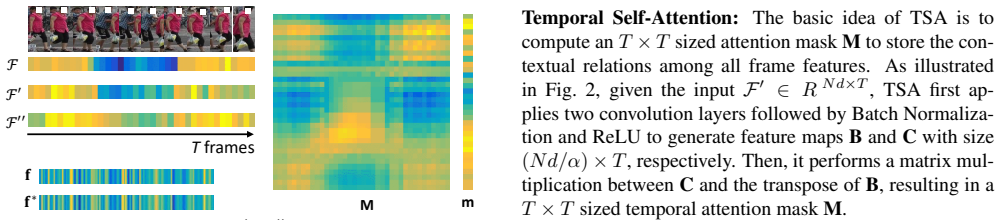
The load-bearing object is the aggregation subnetwork that turns a sequence of $d$-dimensional frame features into the GLTR vector. It contains two named modules. DTP runs $N=3$ parallel dilated temporal convolutions with dilation rates $1,2,4$ along the frame index, so each output frame mixes a growing window of neighbors without increasing parameters or downsampling; this encodes short-term motion and appearance cues. TSA projects the DTP output through two convolution layers, multiplies one projection by the transpose of the other to form a $T\times T$ attention mask, and re-weights the feature sequence with a residual connection whose final convolution is zero-initialized; this lets distant, non-adjacent frames vote on each other and suppresses occluded frames. Average pooling over the updated sequence produces the fixed-length GLTR. The machinery's work is to fuse two complementary temporal scales so the final representation is both discriminative, through local motion, and robust, through global context.
What would settle it
Run the standard MARS and DukeMTMC-VideoReID evaluations with mean average precision as the primary metric. On both datasets the paper's own tables show the competing STA method reporting higher mAP than GLTR (80.80 vs 78.47 on MARS; 94.90 vs 93.74 on Duke), so under a mAP-primary protocol the claim that GLTR beats current state of the art fails. A reader can settle the question by reproducing both models under identical backbone, loss, and evaluation settings.
Extended reading notes
Core claim
The paper's central claim is that the right video representation for person re-identification must jointly encode local temporal cues, such as the motion pattern and speed visible across adjacent frames, and global temporal cues, such as the relations among distant frames that reveal occlusions and noises. It constructs GLTR by applying Dilated Temporal Pyramid (DTP) convolution followed by Temporal Self-Attention (TSA) to a sequence of frame features, then average-pooling the updated features. The paper reports that this representation reaches rank-1 accuracy of 87.02% on MARS without re-ranking, outperforming recent systems that use body-part cues, recurrent networks, or 3D convolutions, and that it is consistently competitive on PRID, iLIDS-VID, DukeMTMC-VideoReID, and the newly collected LS-VID dataset.
Load-bearing premise
The whole "better than state-of-the-art" case rests on the choice of rank-1 accuracy as the headline metric; if a reader weighs mean average precision equally, the competitor STA still leads on MARS and DukeMTMC-VideoReID.
Editorial extensions
If this is right
- A video re-identification system can get competitive or state-of-the-art rank-1 accuracy without body-part supervision, optical flow, or a recurrent or 3D-convolutional head, using only frame features plus the two modules.
- Because the aggregation subnetwork is backbone-agnostic, stronger image-based re-identification features can be plugged in directly and should further improve GLTR.
- The attention mask provides an explicit mechanism for occlusion robustness, so tracklets with noisy or partially occluded frames are down-weighted during pooling rather than corrupting the video descriptor.
- On longer and more varied sequences such as LS-VID, the gain over recurrent and 3D models is several rank-1 points, suggesting the local-plus-global design scales with sequence length and dataset difficulty.
Reading between the lines
- Editorial inference: the state-of-the-art claim is metric-dependent, since the paper's own tables show the competing STA method with higher mAP on MARS (80.80 vs 78.47) and on DukeMTMC-VideoReID (94.90 vs 93.74).
- Editorial inference: the same two-module recipe could transfer to other video understanding tasks where short-range motion and long-range context matter, because the aggregation subnetwork does not depend on re-identification-specific losses or part models.
- Editorial inference: the learned attention weights could be reused as a frame-quality or occlusion score to filter training samples or to explain why a match succeeded, which the paper visualizes in its occlusion example.
- Editorial inference: a natural test is to vary inference-time sequence length; because the $T\times T$ attention mask has constant cost per pair of frames, the method should be especially favorable when sequences grow.
Signed reviews
Editorial analysis
A structured set of objections, weighed in public.
Referee Report
Summary. The paper proposes a Global-Local Temporal Representation (GLTR) for video person re-identification, formed by a Dilated Temporal Pyramid (DTP) convolution to capture short-term local temporal cues and a Temporal Self-Attention (TSA) model to capture long-term global relations across inconsecutive frames. The two modules are applied to frame-level features extracted from a ResNet50 backbone and aggregated by average pooling. The method is evaluated on four standard video ReID benchmarks (PRID, iLIDS-VID, MARS, DukeMTMC-VideoReID) and on a newly introduced large-scale dataset (LS-VID), with systematic ablations showing that each component improves over the baseline and their combination is generally best. The paper claims state-of-the-art rank-1 accuracy on MARS (87.02%) without re-ranking and reports competitive results on the other datasets.
Significance. The paper's contribution is an architecture that jointly models local and global temporal cues in a simple, single-stream CNN, and it provides a thorough empirical study across five datasets, including a new large-scale dataset (LS-VID). The ablation study is a strength: it isolates the contribution of DTP and TSA, compares DTP with alternative local temporal modeling strategies, and reports consistent gains over the average-pooling baseline. If the claims hold, the method is a practical, efficient alternative to more complex RNN or 3D-CNN designs. However, the headline claim of 'better than current state-of-the-art' is not fully substantiated because the comparison with STA shows that STA achieves higher mAP on MARS and DukeMTMC-VideoReID, and the reported rank-1 margins are small and without variance analysis.
major comments (3)
- [Section 3.2, Eq. (5)] The definition of dilated temporal convolution is inconsistent with the text. Eq. (5) computes f^{(r)}_t as the sum over i=1..w of f[t+r·i] × W[i], which yields a one-sided (causal) sampling of future frames. However, the text states that with r=2, w=3, 'each output feature corresponds to a temporal range of five adjacent frames,' which implies a centered kernel with offsets t−r, t, t+r. The formula as written would cover frames t+2, t+4, t+6, not a symmetric five-frame neighborhood. This inconsistency affects the reproducibility of the core DTP module and must be corrected, either by revising the equation to use centered offsets or by aligning the text with the actual implementation.
- [Abstract, Introduction, Tables 5 and 7] The unqualified claim 'better than current state-of-the-art' in the abstract and introduction is not supported by the paper's own tables. On MARS (Table 5), GLTR achieves rank-1 87.02% vs STA's 86.30%, but mAP is 78.47% vs STA's 80.80%. On DukeMTMC-VideoReID (Table 7), GLTR achieves rank-1 96.29% vs STA's 96.20%, but mAP is 93.74% vs STA's 94.90%. Thus, if mAP is taken as an equal or primary metric, GLTR is not superior to STA on either dataset. The claim should be qualified explicitly (e.g., 'state-of-the-art rank-1 accuracy') or the comparison should be presented in a metric-neutral way.
- [Tables 5 and 7] The rank-1 improvements over STA are small (0.72 percentage points on MARS and 0.09 percentage points on DukeMTMC-VideoReID), and the paper reports no repeated trials, error bars, or significance tests for these datasets. For PRID and iLIDS-VID, the authors average over 10 random splits, showing awareness of run-to-run variance, but no such variance is reported for MARS or Duke. The measured rank-1 edges may be within normal variation, and the paper should either provide variance estimates or temper the claim of superiority from these small margins.
minor comments (6)
- [Abstract] The phrase 'state-of-the art' is missing a hyphen; it should be 'state-of-the-art'.
- [Section 3.3] The text contains a duplicated word: 'generalize self-attention to to capture' should be 'generalize self-attention to capture'.
- [Figure 7 caption] The caption contains typographical errors: 'first tow' and 'second tow' should be 'first two' and 'second two'.
- [Section 4.4] The sentence 'We repeat PBR [39] and DRSA [22] by referring to their implantations on MARS' uses 'implantations'; it should be 'implementations'.
- [Section 3.3, Eq. (7)] The text describes a T×T attention mask M but does not mention the softmax normalization that is shown in Figure 2. Please specify the normalization step explicitly in the equation or following text.
- [Section 4.1, LS-VID] The paper does not state whether LS-VID will be released publicly. Given that the dataset is a claimed contribution, a statement about its availability (or a URL) is needed for reproducibility.
Circularity Check
No significant circularity: GLTR's components are evaluated empirically against external baselines, and no prediction reduces to a fitted input.
full rationale
The paper makes an empirical claim: the GLTR architecture (DTP + TSA) improves video person ReID accuracy over published baselines. There is no derivation chain in which an output quantity is defined in terms of an input quantity, no fitted parameter is renamed as a prediction, and no load-bearing assumption is justified solely by a self-citation. DTP is constructed by generalizing dilated spatial convolution (DeepLab, DenseASPP) to the temporal dimension, and TSA is constructed by applying standard self-attention to frame features; both are external, independently known building blocks. The ablation study in Table 2 and Fig. 6 measures each component against the ResNet50 average-pooling baseline, and the final configuration (N=3, alpha=2) is selected from validation experiments, which is ordinary model selection rather than circularity. The paper cites the authors' own prior M3D [19] only as a comparison baseline in Tables 4-6; those numbers are external results being compared, not premises used to justify GLTR. The abstract's 'better than current state-of-the-art' claim is metric-dependent (GLTR trails STA in mAP on MARS and Duke), but metric selection is a correctness/interpretation concern, not circular reasoning. No circular step can be exhibited from the paper's equations or citations.
Assumptions & free parameters
free parameters (3)
- Number of DTP branches N =
3
- TSA channel compression factor alpha =
2
- Number of sampled frames per training epoch =
16
assumptions (3)
- domain assumption The CMC and mAP evaluation metrics correctly measure re-identification performance and are computed consistently across compared methods.
- domain assumption The ResNet50 backbone pretrained on ImageNet produces frame features that retain sufficient discriminative spatial information for temporal aggregation to help.
- domain assumption The newly collected LS-VID dataset has accurate detection, tracking, and identity labeling such that evaluation on it is meaningful.
invented entities (1)
-
LS-VID dataset
Cite this review
Pith. "Pith review of Global-Local Temporal Representations For Video Person Re-Identification." pith.science (2026). https://pith.science/paper/KKUINOQH
@misc{pith2026190810049,
  author       = {Pith},
  title        = {Pith review of: Global-Local Temporal Representations For Video Person Re-Identification},
  year         = {2026},
  howpublished = {\url{https://pith.science/paper/KKUINOQH}},
  note         = {Machine review of arXiv:1908.10049}
}
read the original abstract
This paper proposes the Global-Local Temporal Representation (GLTR) to exploit the multi-scale temporal cues in video sequences for video person Re-Identification (ReID). GLTR is constructed by first modeling the short-term temporal cues among adjacent frames, then capturing the long-term relations among inconsecutive frames. Specifically, the short-term temporal cues are modeled by parallel dilated convolutions with different temporal dilation rates to represent the motion and appearance of pedestrian. The long-term relations are captured by a temporal self-attention model to alleviate the occlusions and noises in video sequences. The short and long-term temporal cues are aggregated as the final GLTR by a simple single-stream CNN. GLTR shows substantial superiority to existing features learned with body part cues or metric learning on four widely-used video ReID datasets. For instance, it achieves Rank-1 Accuracy of 87.02% on MARS dataset without re-ranking, better than current state-of-the art.
Figures


Figures from the paper (3 more)



Forward citations
Cited by 1 Pith paper
-
Causality and "In-the-Wild" Video-Based Person Re-ID: A Survey
A survey of causal reasoning for video person re-identification that reviews DIR-ReID, identity-shuffle GANs, and causal transformers, but contains unverified performance claims.
Reference graph
Works this paper leans on
-
[1]
Self Attention Grid for Person Re-Identification
Jean-Paul Ainam, Ke Qin, and Guisong Liu. Self at- tention grid for person re-identification. arXiv preprint arXiv:1809.08556, 2018
work page Pith review arXiv 2018
-
[2]
Quo vadis, action recognition? a new model and the kinetics dataset
Joao Carreira and Andrew Zisserman. Quo vadis, action recognition? a new model and the kinetics dataset. In CVPR, 2017
2017
-
[3]
Dapeng Chen, Hongsheng Li, Tong Xiao, Shuai Yi, and Xi- aogang Wang. Video person re-identification with compet- itive snippet-similarity aggregation and co-attentive snippet embedding. In CVPR, 2018
work page 2018
-
[4]
Liang-Chieh Chen, George Papandreou, Iasonas Kokkinos, Kevin Murphy, and Alan L Yuille. Deeplab: Semantic im- age segmentation with deep convolutional nets, atrous con- volution, and fully connected crfs. IEEE Trans. PAMI , 40(4):834–848, 2017
work page 2017
-
[5]
A two stream siamese convolutional neural network for person re-identification
Dahjung Chung, Khalid Tahboub, and Edward J Delp. A two stream siamese convolutional neural network for person re-identification. In ICCV, 2017
work page 2017
-
[6]
Afshin Dehghan, Shayan Modiri Assari, and Mubarak Shah. Gmmcp tracker: Globally optimal generalized maximum multi clique problem for multiple object tracking. In CVPR, 2015
work page 2015
-
[7]
Spatiotemporal multiplier networks for video action recog- nition
Christoph Feichtenhofer, Axel Pinz, and Richard P Wildes. Spatiotemporal multiplier networks for video action recog- nition. In CVPR, 2017
work page 2017
-
[8]
Convolutional two-stream network fusion for video action recognition
Christoph Feichtenhofer, Axel Pinz, and Andrew Zisserman. Convolutional two-stream network fusion for video action recognition. In CVPR, 2016
work page 2016
Show all 59 references
-
[9]
Object detection with discriminatively trained part-based models
Pedro F Felzenszwalb, Ross B Girshick, David McAllester, and Deva Ramanan. Object detection with discriminatively trained part-based models. IEEE Trans. PAMI, 32(9), 2010
2010
-
[10]
Dual attention network for scene segmentation
Jun Fu, Jing Liu, Haijie Tian, Yong Li, Yongjun Bao, Zhiwei Fang, and Hanqing Lu. Dual attention network for scene segmentation. In CVPR, 2019
2019
-
[11]
Sta: Spatial-temporal attention for large-scale video- based person re-identification
Yang Fu, Xiaoyang Wang, Yunchao Wei, and Thomas Huang. Sta: Spatial-temporal attention for large-scale video- based person re-identification. In AAAI. 2019
2019
-
[12]
Deep residual learning for image recognition
Kaiming He, Xiangyu Zhang, Shaoqing Ren, and Jian Sun. Deep residual learning for image recognition. In CVPR, 2016
2016
-
[13]
In de- fense of the triplet loss for person re-identification
Alexander Hermans, Lucas Beyer, and Bastian Leibe. In de- fense of the triplet loss for person re-identification. arXiv preprint arXiv:1703.07737, 2017
2017 arXiv
-
[14]
Person re-identification by descriptive and discrim- inative classification
Martin Hirzer, Csaba Beleznai, Peter M Roth, and Horst Bischof. Person re-identification by descriptive and discrim- inative classification. In SCIA, 2011
2011
-
[15]
Ccnet: Criss- cross attention for semantic segmentation
Zilong Huang, Xinggang Wang, Lichao Huang, Chang Huang, Yunchao Wei, and Wenyu Liu. Ccnet: Criss- cross attention for semantic segmentation. arXiv preprint arXiv:1811.11721, 2018
2018 arXiv
-
[16]
Self-attention learning for person re-identification
Minyue Jiang, Yuan Yuan, and Qi Wang. Self-attention learning for person re-identification. In BMVC, 2018
2018
-
[17]
Imagenet classification with deep convolutional neural net- works
Alex Krizhevsky, Ilya Sutskever, and Geoffrey E Hinton. Imagenet classification with deep convolutional neural net- works. In NIPS, 2012
2012
-
[18]
Learning deep context-aware features over body and latent parts for person re-identification
Dangwei Li, Xiaotang Chen, Zhang Zhang, and Kaiqi Huang. Learning deep context-aware features over body and latent parts for person re-identification. In CVPR, 2017
2017
-
[19]
Multi- scale 3d convolution network for video based person re- identification
Jianing Li, Shiliang Zhang, and Tiejun Huang. Multi- scale 3d convolution network for video based person re- identification. In AAAI, 2019
2019
-
[20]
Pose-guided representation learning for person re- identification
Jianing Li, Shiliang Zhang, Qi Tian, Meng Wang, and Wen Gao. Pose-guided representation learning for person re- identification. IEEE Trans. PAMI, 2019
2019
-
[21]
Unsupervised person re-identification by deep learning tracklet association
Minxian Li, Xiatian Zhu, and Shaogang Gong. Unsupervised person re-identification by deep learning tracklet association. In ECCV, 2018
2018
-
[22]
Diversity regularized spatiotemporal attention for video- based person re-identification
Shuang Li, Slawomir Bak, Peter Carr, and Xiaogang Wang. Diversity regularized spatiotemporal attention for video- based person re-identification. In CVPR, 2018
2018
-
[23]
Deep- reid: Deep filter pairing neural network for person re- identification
Wei Li, Rui Zhao, Tong Xiao, and Xiaogang Wang. Deep- reid: Deep filter pairing neural network for person re- identification. In CVPR, 2014
2014
-
[24]
Harmonious at- tention network for person re-identification
Wei Li, Xiatian Zhu, and Shaogang Gong. Harmonious at- tention network for person re-identification. In CVPR, 2018
2018
-
[25]
Video-based person re-identification by deep fea- ture guided pooling
Youjiao Li, Li Zhuo, Jiafeng Li, Jing Zhang, Xi Liang, and Qi Tian. Video-based person re-identification by deep fea- ture guided pooling. In CVPR Workshops, 2017
2017
-
[26]
Video-based person re-identification with accumulative motion context
Hao Liu, Zequn Jie, Karlekar Jayashree, Meibin Qi, Jian- guo Jiang, Shuicheng Yan, and Jiashi Feng. Video-based person re-identification with accumulative motion context. IEEE Trans. CSVT, 28(10):2788–2802, 2017
2017
-
[27]
Dense 3d-convolutional neural network for person re-identification in videos
Jiawei Liu, Zheng-Jun Zha, Xuejin Chen, Zilei Wang, and Yongdong Zhang. Dense 3d-convolutional neural network for person re-identification in videos. ACM Trans. on TOMM, 15(1s):8, 2019
2019
-
[28]
Qual- ity aware network for set to set recognition
Yu Liu, Junjie Yan, Wanli Ouyang, and Wanli Ouyang. Qual- ity aware network for set to set recognition. In CVPR, 2017
2017
-
[29]
Spatial and temporal mutual promotion for video-based person re-identification
Yiheng Liu, Zhenxun Yuan, Wengang Zhou, and Houqiang Li. Spatial and temporal mutual promotion for video-based person re-identification. In AAAI, 2019
2019
-
[30]
Recurrent convolutional network for video- based person re-identification
Niall McLaughlin, Jesus Martinez del Rincon, Paul Miller, and Paul Miller. Recurrent convolutional network for video- based person re-identification. In CVPR, 2016
2016
-
[31]
Local fisher discriminant analysis for pedestrian re-identification
Sateesh Pedagadi, James Orwell, Sergio Velastin, and Boghos Boghossian. Local fisher discriminant analysis for pedestrian re-identification. In CVPR, 2013
2013
-
[32]
Learning spatio- temporal representation with pseudo-3d residual networks
Zhaofan Qiu, Ting Yao, and Tao Mei. Learning spatio- temporal representation with pseudo-3d residual networks. In ICCV, 2017
2017
-
[33]
Faster r-cnn: Towards real-time object detection with region proposal networks
Shaoqing Ren, Kaiming He, Ross Girshick, and Jian Sun. Faster r-cnn: Towards real-time object detection with region proposal networks. In NIPS, 2015
2015
-
[34]
Performance measures and a data set for multi-target, multi-camera tracking
Ergys Ristani, Francesco Solera, Roger Zou, Rita Cucchiara, and Carlo Tomasi. Performance measures and a data set for multi-target, multi-camera tracking. In ECCV, 2016
2016
-
[35]
Dual attention matching network for context-aware feature sequence based person re-identification
Jianlou Si, Honggang Zhang, Chun-Guang Li, Jason Kuen, Xiangfei Kong, Alex C Kot, and Gang Wang. Dual attention matching network for context-aware feature sequence based person re-identification. In CVPR, 2018
2018
-
[36]
Two-stream con- volutional networks for action recognition in videos
Karen Simonyan and Andrew Zisserman. Two-stream con- volutional networks for action recognition in videos. In NIPS, 2014
2014
-
[37]
Mask-guided contrastive attention model for person re-identification
Chunfeng Song, Yan Huang, Wanli Ouyang, and Liang Wang. Mask-guided contrastive attention model for person re-identification. In CVPR, 2018
2018
-
[38]
Pose-driven deep convolutional model for per- son re-identification
Chi Su, Jianing Li, Shiliang Zhang, Junliang Xing, Wen Gao, and Qi Tian. Pose-driven deep convolutional model for per- son re-identification. In ICCV, 2017
2017
-
[39]
Part-aligned bilinear representations for per- son re-identification
Yumin Suh, Jingdong Wang, Siyu Tang, Tao Mei, and Ky- oung Mu Lee. Part-aligned bilinear representations for per- son re-identification. In ECCV, 2018
2018
-
[40]
Rethinking the inception ar- chitecture for computer vision
Christian Szegedy, Vincent Vanhoucke, Sergey Ioffe, Jon Shlens, and Zbigniew Wojna. Rethinking the inception ar- chitecture for computer vision. In CVPR, 2016
2016
-
[41]
Learning spatiotemporal features with 3d convolutional networks
Du Tran, Lubomir Bourdev, Rob Fergus, Lorenzo Torresani, and Manohar Paluri. Learning spatiotemporal features with 3d convolutional networks. In ICCV, 2015
2015
-
[42]
Non-local neural networks
Xiaolong Wang, Ross Girshick, Abhinav Gupta, and Kaim- ing He. Non-local neural networks. In CVPR, 2018
2018
-
[43]
Person re-identification: System design and evaluation overview
Xiaogang Wang and Rui Zhao. Person re-identification: System design and evaluation overview. In Person Re- Identification, pages 351–370. Springer, 2014
2014
-
[44]
Person transfer gan to bridge domain gap for person re- identification
Longhui Wei, Shiliang Zhang, Wen Gao, and Qi Tian. Person transfer gan to bridge domain gap for person re- identification. In CVPR, 2018
2018
-
[45]
Glad: global-local-alignment descriptor for pedestrian retrieval
Longhui Wei, Shiliang Zhang, Hantao Yao, Wen Gao, and Qi Tian. Glad: global-local-alignment descriptor for pedestrian retrieval. In ACM MM, 2017
2017
-
[46]
Deep recurrent convolutional networks for video-based person re-identification: An end-to-end ap- proach
Lin Wu, Chunhua Shen, Anton van den Hengel, and An- ton van den Hengel. Deep recurrent convolutional networks for video-based person re-identification: An end-to-end ap- proach. arXiv preprint arXiv:1606.01609, 2016
2016 arXiv
-
[47]
Exploit the unknown gradually: One-shot video-based person re-identification by stepwise learning
Yu Wu, Yutian Lin, Xuanyi Dong, Yan Yan, Wanli Ouyang, and Yi Yang. Exploit the unknown gradually: One-shot video-based person re-identification by stepwise learning. In CVPR, 2018
2018
-
[48]
Temporal-enhanced convolutional network for person re- identification
Yang Wu, Jie Qiu, Jun Takamatsu, and Tsukasa Ogasawara. Temporal-enhanced convolutional network for person re- identification. In AAAI, 2018
2018
-
[49]
Person re-identification using kernel-based metric learning methods
Fei Xiong, Mengran Gou, Octavia Camps, and Mario Sz- naier. Person re-identification using kernel-based metric learning methods. In ECCV. 2014
2014
-
[50]
Person re-identification via recurrent feature aggregation
Yichao Yan, Bingbing Ni, Zhichao Song, Chao Ma, Yan Yan, and Xiaokang Yang. Person re-identification via recurrent feature aggregation. In ECCV, 2016
2016
-
[51]
Denseaspp for semantic segmentation in street scenes
Maoke Yang, Kun Yu, Chi Zhang, Zhiwei Li, and Kuiyuan Yang. Denseaspp for semantic segmentation in street scenes. In CVPR, 2018
2018
-
[52]
Multi-scale context aggregation by dilated convolutions
Fisher Yu and Vladlen Koltun. Multi-scale context aggregation by dilated convolutions. arXiv preprint arXiv:1511.07122, 2015
2015 arXiv
-
[53]
Ocnet: Object context net- work for scene parsing
Yuhui Yuan and Jingdong Wang. Ocnet: Object context net- work for scene parsing. arXiv preprint arXiv:1809.00916 , 2018
2018 arXiv
-
[54]
Pyramid scene parsing network
Hengshuang Zhao, Jianping Shi, Xiaojuan Qi, Xiaogang Wang, and Jiaya Jia. Pyramid scene parsing network. In CVPR, 2017
2017
-
[55]
Deeply-learned part-aligned representations for person re- identification
Liming Zhao, Xi Li, Yueting Zhuang, and Jingdong Wang. Deeply-learned part-aligned representations for person re- identification. In ICCV, 2017
2017
-
[56]
Mars: A video benchmark for large-scale person re-identification
Liang Zheng, Zhi Bie, Yifan Sun, Jingdong Wang, Chi Su, Shengjin Wang, and Qi Tian. Mars: A video benchmark for large-scale person re-identification. In ECCV, 2016
2016
-
[57]
Scalable person re-identification: A benchmark
Liang Zheng, Liyue Shen, Lu Tian, Shengjin Wang, Jing- dong Wang, and Qi Tian. Scalable person re-identification: A benchmark. In ICCV, 2015
2015
-
[58]
Re- ranking person re-identification with k-reciprocal encoding
Zhun Zhong, Liang Zheng, Donglin Cao, and Shaozi Li. Re- ranking person re-identification with k-reciprocal encoding. In CVPR, 2017
2017
-
[59]
See the forest for the trees: Joint spatial and tem- poral recurrent neural networks for video-based person re- identification
Zhen Zhou, Yan Huang, Wei Wang, Liang Wang, and Tie- niu Tan. See the forest for the trees: Joint spatial and tem- poral recurrent neural networks for video-based person re- identification. In CVPR, 2017
2017
Reviewed August 14, 2026 · model on record in the stance chip above.
Discussion (0). Continue with ORCID to comment.