REVIEW 3 major objections 5 minor 5 cited by
Progress in the CTEQ-TEA NNLO global QCD analysis
T0 review · 3 major / 5 minor · reviewed 2026-08-14 · deepseek-v4-flash
Pith's one-line read The CT18 global analysis claims that an x-dependent factorization scale reproduces the HERA-data improvement attributed to low-x resummation.
desk verdict CT18 is a solid public PDF update, but the x-dependent scale improvement is fitted on the same HERA data it is then used to describe. read the letter →
The pith
A machine-rendered reading of the paper's core claim, the machinery that carries it, and where it could break.
The reading
What carries the argument
The central mechanism is the $x$-dependent factorization scale $\mu^2_{F,x}=0.82\,(Q^2+0.3\,\mathrm{GeV}^2/x^{0.3})$, used in place of the conventional $\mu_F^2=Q^2$ when evaluating NNLO DIS cross sections. It is intended as a fixed-order proxy for enhanced low-$x$ logarithms; the paper reports that it lowers $\chi^2$ for the HERA I+II inclusive data by more than 50 units in the stated region, matching the improvement attributed to resummation. The supporting apparatus is the Hessian global-fit machinery: fast grid interfaces (APPLgrid and fastNLO) for cross sections, the PDFSense and ePump programs for deciding which data sets constrain the fit, Lagrange Multiplier scans for PDF constraints, and flexible Bernstein-polynomial parametrizations tested over more than 90 functional forms.
What would settle it
Take the tuned scale $\mu^2_{F,x}$ with its published coefficients and apply it, without refitting, to independent low-x DIS data not included in the CT18 fit, such as future EIC structure-function measurements; if the out-of-sample improvement is not comparable to the reported >50-unit gain on HERA, the scale is absorbing fit noise rather than the low-x logarithms it is claimed to reproduce.
Extended reading notes
Core claim
The paper claims that the CT18 family of NNLO parton distribution functions, fitted to 3681 data points with $\chi^2/N_{\mathrm{pt}}=1.17$ in the default set, supersede CT14 and CT14HERA2 for LHC phenomenology. Its central physics result is that an $x$-dependent factorization scale in fixed-order NNLO deep-inelastic scattering reproduces the HERA-data improvement previously attributed to low-$x$ resummation, a reduction of more than 50 units of $\chi^2$ in the kinematic region $Q>2$ GeV and $x>10^{-5}$, while also moving the small-$x$ gluon and sea quarks. Because the high-precision ATLAS $W/Z$ measurements cannot be accommodated together with the rest of the world data, four PDF families (CT18, CT18A, CT18X, CT18Z) are presented; the spread among them is the paper's estimate of the present ambiguity in NNLO PDFs.
Load-bearing premise
The x-dependent scale's coefficients are chosen to minimize chi-squared on the HERA data that are then quoted as the improvement, so the small-x physics claim rests on that scale being a genuine theoretical proxy for resummation rather than a flexible fit.
Editorial extensions
If this is right
- The default CT18 set becomes the reference NNLO PDF ensemble for LHC calculations, replacing CT14 and CT14HERA2, with Hessian error sets for uncertainty propagation.
- If the tuned scale is equivalent to low-x resummation for inclusive DIS, fixed-order NNLO calculations can be used in kinematic regions where explicit resummation was previously thought necessary.
- The four CT18 families quantify the range of NNLO PDF behavior consistent with current data; using only the default set would understate the ambiguity revealed by the ATLAS W/Z tension.
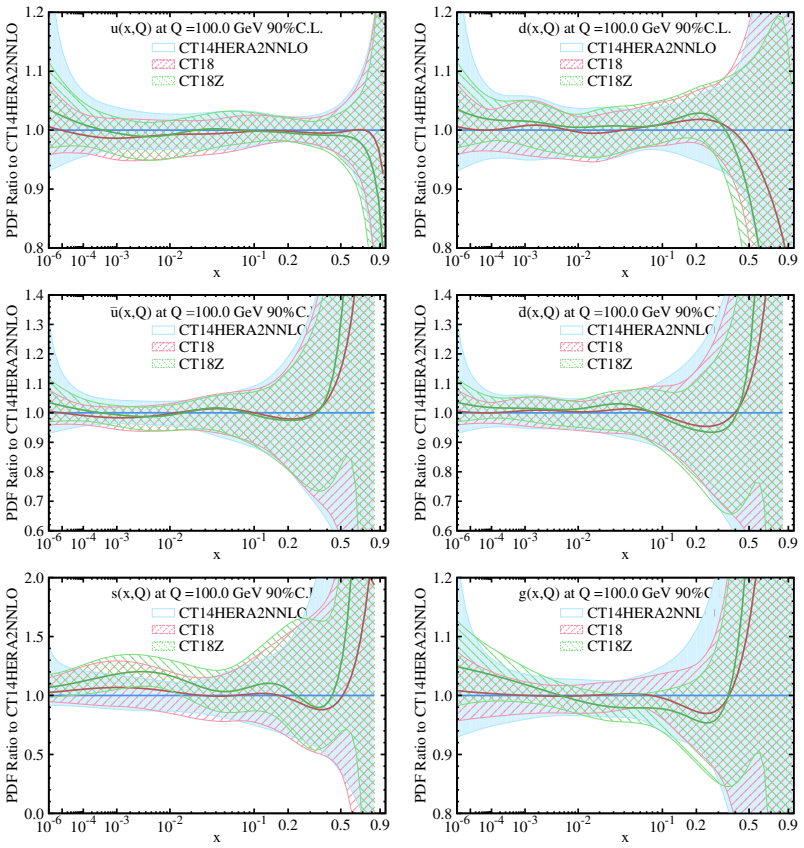
- CT18Z, the variant that includes the ATLAS W/Z data, removes CDHSW, adopts a saturation-inspired DIS scale, and reduces the NNLO gluon-fusion Higgs cross section by about 1% relative to CT14 and CT18.
- The new parametrization, with an SU(3)-symmetric strange sea at x->0 and a d/u ratio free at x->1, changes strange-quark and high-x d-quark predictions relevant to W-mass and new-physics analyses.
Reading between the lines
- Beyond the paper, the central claim is directly testable out of sample: take the fixed coefficients of $\mu^2_{F,x}$ and apply them to low-x DIS data not used in the fit; the paper reports no such held-out test.
- The claimed equivalence with resummation is demonstrated only for inclusive HERA data; a natural extension would be to check charm and bottom structure functions or transverse-momentum distributions, where resummation and a scale change can diverge.
- If the tuned scale is instead a phenomenological knob, then the spread across CT18, A, X, and Z would be the honest statement of current small-x uncertainty, and future precision data would be needed to break the degeneracy between scale choice and resummation.
Signed reviews
Editorial analysis
A structured set of objections, weighed in public.
Referee Report
Summary. The manuscript presents the CTEQ-TEA collaboration's new CT18 global QCD analysis at NNLO, which is offered as the successor to CT14. Four PDF families are released (CT18, CT18A, CT18X, CT18Z), based on a global fit to 3681 data points for the default set with chi^2/Npt = 1.17 at NNLO. The paper describes the inclusion of new LHC data on jets, W/Z, Drell-Yan, and top-quark pair production, along with methodological advances (PDFSense, ePump, parallelized fitting). A central feature is an x-dependent factorization scale mu_F,x^2 = 0.82(Q^2 + 0.3 GeV^2 / x^0.3) used for DIS, which is reported to reduce the HERA I+II chi^2 by more than 50 units relative to the conventional scale mu_F^2 = Q^2, an improvement described as comparable to the inclusion of low-x resummation. The paper also compares PDF luminosities at the 13 TeV LHC with other groups and presents Lagrange Multiplier scans for the gluon and strangeness PDFs.
Significance. If the CT18 analysis is sound, it represents a valuable update to a widely used PDF set, incorporating a large body of new LHC data and improved fitting methodology. The public availability of the PDF grids and the careful comparisons with other groups are clear strengths. The x-dependent scale observation is intriguing: if it were shown to be a theoretically legitimate proxy for low-x resummation, it would be an important result for small-x phenomenology. However, the evidence presented in the manuscript does not currently establish that claim, because the scale's coefficients are tuned on the same HERA data used to demonstrate the chi^2 improvement. The four-family spread is also presented as a way to explore PDF uncertainty, but the selection of the alternative variants is driven by post-hoc data choices, so this spread is not a calibrated uncertainty band. These issues do not undermine the basic existence of the CT18 fit, but they do affect the strength of the paper's central 'progress' claims.
major comments (3)
- [Sec. II, 'Combined HERA I+II DIS data and an x-dependent factorization scale'] The paper states that the numerical coefficients in mu_F,x^2 = 0.82(Q^2 + 0.3 GeV^2 / x^0.3) are 'chosen to minimize chi^2 for the HERA DIS data', and then uses the same HERA I+II data to report a chi^2 reduction of more than 50 units. This is an in-sample, fitted improvement, not an out-of-sample validation. The comparison with the resummed fits of Refs. [15,16] is therefore a comparison of two tuned descriptions of the same data, and it does not by itself establish that the x-dependent scale is a legitimate proxy for low-x resummation. I request either an out-of-sample test (for example, fitting the scale parameters to a subset of the data and evaluating on a held-out subset, or checking consistency against independent low-x data sets not used in the tuning) or an explicit reframing of this result as an exploratory observation that does not carry the weight of a validation of resummation mimicry.
- [Sec. I and Sec. II, data set selection (ATLAS 7 TeV W/Z, CDHSW)] The decision to exclude the ATLAS 7 TeV W/Z data from the default CT18 fit and include it only in CT18Z, and to remove CDHSW in CT18Z, is made after examining the tension indicators (the SE distribution in Fig. 8). Such post-hoc choices mean that the spread among CT18, CT18A, CT18X, and CT18Z is not a systematically defined PDF uncertainty band. The quoted chi^2/Npt values are conditional on these decisions. If the four families are intended to 'explore the full range of PDF behavior consistent with the available hadronic data', the manuscript should either specify selection criteria that are defined before inspecting the data or clearly label the family spread as a sensitivity study rather than an uncertainty envelope. As written, the claim is too strong for the presented methodology.
- [General (Sections I and II)] Several details that are essential for independently assessing the CT18 determination are deferred to an upcoming publication: the complete list of fitted data sets with their kinematic cuts and treatment of correlated systematic uncertainties, the explicit functional forms of the PDF parametrizations (beyond the mention of Bernstein polynomials), the precise definition of chi^2 including normalization penalties, and the exact source of the '0.5% uncorrelated error'. For a paper that proposes CT18 as a replacement for CT14, these are load-bearing for reproducibility. If this is intended as a preliminary proceedings contribution, that status should be stated clearly and the full record should be made permanently accessible, for example in a public repository, so that the CT18 result can be independently validated rather than resting on the upcoming publication.
minor comments (5)
- [Sec. II, 'Advancements in fitting methodology'] The phrase 'multi-prone effort' should be 'multi-pronged effort'.
- [Throughout] The typesetting of chi^2 as 'χ2' is inconsistent; the exponential form 'χ²' would be clearer.
- [Sec. II, Fig. 7 caption] The sentence 'The right Fig. 7 shows the χ2/Npt values' should be 'The right panel of Fig. 7 shows...' for clarity.
- [Sec. II, x-dependent scale equation] The formula for mu_F,x is given in the text without an equation number; adding a numbered equation would aid referencing in the discussion.
- [Sec. I, description of CT18Z variants] The phrase 'take charm pole mass to be 1.4 GeV, instead of the nominal value of 1.3 GeV' could be made more precise by stating whether this is the pole mass in the MS-bar scheme or a specific threshold parameter; a brief definition would avoid ambiguity.
Circularity Check
The x-dependent factorization scale is tuned on the HERA DIS data it is then claimed to improve, so the resummation-mimicry result is in-sample rather than a prediction.
-
fitted input called prediction
[Section II (Combined HERA I+II DIS data and an x-dependent factorization scale), text defining µ2F,x = 0.82 (Q2 + 0.3 GeV2/x0.3)]
"In our analysis, we observe that, by evaluating the DIS cross sections at NNLO with an x-dependent factorization scale, such as a tuned scale µ2F,x = 0.82 (Q2 + 0.3 GeV2/x0.3), instead of the conventional choice µ2F = Q2, we achieve a comparable quality of improvement in the description of the HERA DIS data set by the fixed-order NNLO theoretical prediction as the inclusion of the low-x resummation in [15, 16]."
The same section states that 'the numerical coefficients in µ2F,x are chosen to minimize χ2 for the HERA DIS data.' Reporting a >50-unit χ2(HERA I+II) improvement for the very dataset used to tune those coefficients is an in-sample description of the minimized objective, not an independent validation. Consequently, the claim that the x-dependent scale mimics low-x resummation is not established: the comparison with resummed fits of Refs. [15,16] compares a tuned fixed-order scale against resummation, rather than testing a prediction. The small-x gluon and sea-quark changes in the CT18X/Z variants inherit this in-sample character insofar as they are cited as evidence of progress.
full rationale
The core CT18 global analysis is a standard Hessian PDF fit: parton distributions are parameterized and then adjusted to reproduce 3681 data points, which is parameter estimation rather than circular reasoning. The one genuinely circular element is the treatment of the x-dependent factorization scale in Section II. The coefficients 0.82 and 0.3 in µ2F,x are explicitly chosen to minimize χ2 for the HERA DIS data, and the same HERA DIS data are then quoted as showing a large χ2 improvement when this scale is used. That makes the 'comparable quality of improvement ... as the inclusion of the low-x resummation' claim an in-sample fitted result, not a prediction or independent confirmation. The paper itself is transparent about the tuning, but the load-bearing comparison to resummation rests on that tuned scale, so the resummation-mimicry claim partially reduces to its own input. No other circular step was found: the selection of new LHC data via PDFSense/ePump, the Lagrange-multiplier scans, and the comparisons of PDF luminosities are all data-driven analyses that do not presuppose their conclusions. Self-citations to CT14 and CT14HERA2 are normal references to the group's own previous fits, and they are not used to forbid alternatives or to import an unverified uniqueness theorem.
Assumptions & free parameters
free parameters (3)
- x-dependent scale coefficients =
0.82, 0.3 GeV^2, 0.3
- Charm pole mass =
1.3 GeV nominal; 1.4 GeV in CT18Z
- PDF parametrization parameters =
not listed in this report
assumptions (4)
- domain assumption Perturbative QCD factorization at NNLO holds for all fitted processes.
- domain assumption The Hessian method approximates PDF uncertainties as Gaussian around a global minimum.
- ad hoc to paper SU(3) symmetry of the sea quark PDFs is assumed as x approaches 0.
- ad hoc to paper Tensions between ATLAS W/Z data and DIS data are attributed to incomplete theory rather than an unknown systematic.
Cite this review
Pith. "Pith review of Progress in the CTEQ-TEA NNLO global QCD analysis." pith.science (2026). https://pith.science/paper/4ZEDTC7Y
@misc{pith2026190811394,
  author       = {Pith},
  title        = {Pith review of: Progress in the CTEQ-TEA NNLO global QCD analysis},
  year         = {2026},
  howpublished = {\url{https://pith.science/paper/4ZEDTC7Y}},
  note         = {Machine review of arXiv:1908.11394}
}
abstract
We present the new CTEQ-TEA global analysis of quantum chromodynamics (QCD). In this analysis, parton distribution functions (PDFs) of the nucleon are determined within the Hessian method at the next-to-next-to-leading order (NNLO) in perturbative QCD, based on the most recent measurements from the Large Hadron Collider (LHC) and a variety of world collider data. Because of difficulties in fitting both the ATLAS 7 and 8 TeV $W$ and $Z$ vector boson production cross section data, we present four families of (N)NLO CTEQ-TEA PDFs, named CT18, A, X and Z PDFs, respectively. We study the impact of the CT18 family of PDFs on the theoretical predictions of standard candle cross sections at the LHC.
Figures


Figures from the paper (5 more)


Forward citations
Cited by 5 Pith papers
-
Measurement of differential $t$-channel single top (anti)quark production cross-sections at 13 TeV with the ATLAS detector
First separate differential tq and tbarq t-channel single-top cross-sections at 13 TeV, using the full ATLAS Run 2 sample, agree with NLO/NNLO QCD and set −0.12 < C_Qq^{3,1}/Λ² < 0.12 TeV⁻² at 95% CL.
-
Impact of relativistic corrections to high-pT prompt-psi(2S) production at hadron colliders
Relativistic O(v^2) corrections to color-singlet fragmentation functions, especially for gluons, bring leading-power NRQCD predictions for prompt psi(2S) at high pT into agreement with LHC data without color-octet mat...
-
Transverse single-spin asymmetries in $\gamma$SIDIS as a direct probe of quark-gluon-quark longitudinal momentum structure
The transverse spin asymmetry for isolated-photon SIDIS at EIC energies is estimated to reach 10% or more in specific kinematics, offering a path to constrain the quark-gluon-quark correlators F_FT(x,x') and G_FT(x,x'...
-
Energy-Energy Correlator for jet production in $pp$ and $pA$ collisions
A TMD-inspired non-perturbative model plus leading-logarithm perturbative evolution describes the full angular energy-energy correlator in pp and pA jet production and attributes the observed pA suppression to medium-...
-
Parton Distribution Functions and their Generalizations
A textbook-style introduction to the definitions, QCD properties, experimental access, and current phenomenological status of PDFs and their generalizations.
Reference graph
Works this paper leans on
-
[1]
“CT18, A, X, Z PDF website,” https://hep.pa.msu.edu/cteq/public/ct18.html
-
[2]
S. Dulat, T.-J. Hou, J. Gao, M. Guzzi, J. Huston, P. Nadolsky, J. Pumplin, C. Schmidt, D. Stump, and C. P. Yuan, Phys. Rev. D93, 033006 (2016), arXiv:1506.07443 [hep-ph]
arXiv 2016
-
[3]
T.-J. Hou, S. Dulat, J. Gao, M. Guzzi, J. Huston, P. Nadolsky, J. Pumplin, C. Schmidt, D. Stump, and C. P. Yuan, Phys. Rev. D95, 034003 (2017), arXiv:1609.07968 [hep-ph]
arXiv 2017
- [4]
-
[5]
A. Gehrmann-De Ridder, T. Gehrmann, E. W. N. Glover, A. Huss, and T. A. Morgan, Phys. Rev. Lett. 117, 022001 (2016), arXiv:1507.02850 [hep-ph]
arXiv 2016
-
[6]
M. Aaboud et al. (ATLAS), Eur. Phys. J. C77, 367 (2017), arXiv:1612.03016 [hep-ex]
arXiv 2017
- [7]
-
[8]
FastNLO tables for NNLO top-quark pair differential distributions,
M. Czakon, D. Heymes, and A. Mitov, “FastNLO tables for NNLO top-quark pair differential distributions,” (2017), arXiv:1704.08551 [hep-ph]
arXiv 2017
Show all 24 references
-
[9]
Wobisch, D
M. Wobisch, D. Britzger, T. Kluge, K. Rabbertz, and F. Stober (fastNLO), (2011), arXiv:1109.1310 [hep-ph]
2011 arXiv
-
[10]
Chatrchyan et al
S. Chatrchyan et al. (CMS), Phys. Rev. D90, 072006 (2014), arXiv:1406.0324 [hep-ex]
2014 arXiv
-
[11]
Khachatryan et al
V. Khachatryan et al. (CMS), JHEP 03, 156 (2017), arXiv:1609.05331 [hep-ex]
2017 arXiv
-
[12]
Aad et al
G. Aad et al. (ATLAS), Eur. Phys. J. C76, 291 (2016), arXiv:1512.02192 [hep-ex]
2016 arXiv
-
[13]
Abramowicz et al
H. Abramowicz et al. (H1, ZEUS), Eur. Phys. J. C75, 580 (2015), arXiv:1506.06042 [hep-ex]
2015 arXiv
-
[14]
F. D. Aaron et al. (H1, ZEUS), JHEP 01, 109 (2010), arXiv:0911.0884 [hep-ex]
2010 arXiv
-
[15]
R. D. Ball, V. Bertone, M. Bonvini, S. Marzani, J. Rojo, and L. Rottoli, Eur. Phys. J. C78, 321 (2018), arXiv:1710.05935 [hep-ph]
2018 arXiv
-
[16]
Abdolmaleki et al
H. Abdolmaleki et al. (xFitter Developers’ Team), Eur. Phys. J. C78, 621 (2018), arXiv:1802.00064 [hep-ph]
2018 arXiv
-
[17]
Caola, S
F. Caola, S. Forte, and J. Rojo, Phys. Lett. B686, 127 (2010), arXiv:0910.3143 [hep-ph]
2010 arXiv
-
[18]
F. D. Aaron et al. (H1), Eur. Phys. J. C71, 1579 (2011), arXiv:1012.4355 [hep-ex]
2011 arXiv
-
[19]
Kovarik, P
K. Kovarik, P. M. Nadolsky, and D. E. Soper, (2019), arXiv:1905.06957 [hep-ph]
2019 arXiv
-
[20]
H.-L. Lai, M. Guzzi, J. Huston, Z. Li, P. M. Nadolsky, J. Pumplin, and C. P. Yuan, Phys. Rev. D82, 074024 (2010), arXiv:1007.2241 [hep-ph]
2010 arXiv
- [21]
-
[22]
B.-T. Wang, T. J. Hobbs, S. Doyle, J. Gao, T.-J. Hou, P. M. Nadolsky, and F. I. Olness, Phys. Rev. D98, 094030 (2018), arXiv:1803.02777 [hep-ph]
2018 arXiv
-
[23]
Schmidt, J
C. Schmidt, J. Pumplin, C. P. Yuan, and P. Yuan, Phys. Rev. D98, 094005 (2018), arXiv:1806.07950 [hep-ph]
2018 arXiv
-
[24]
Kluge, K
T. Kluge, K. Rabbertz, and M. Wobisch, in Proceedings, DIS 2006, Tsukuba, Japan, April 2006 (2006) pp. 483–486, arXiv:hep-ph/0609285 [hep-ph]. 11
2006 arXiv
Reviewed August 14, 2026 · model on record in the stance chip above.
Discussion (0). Continue with ORCID to comment.