REVIEW 5 major objections 7 minor 43 references
Learning self-triggered controllers with Gaussian processes
T0 review · 5 major / 7 minor · reviewed 2026-08-14 · deepseek-v4-flash
Pith's one-line read Gaussian-process reinforcement learning jointly learns an unknown nonlinear plant and a self-triggered controller, stabilizing an inverted pendulum while cutting transmissions by 73 percent.
desk verdict A genuinely novel combination of GP regression and value iteration for self-triggered control, honestly limited by no stability guarantees and thin empirical evidence—worth peer review. read the letter →
The pith
A machine-rendered reading of the paper's core claim, the machinery that carries it, and where it could break.
The reading
What carries the argument
The load-bearing object is the Gaussian-process model $\hat f(x,u)\sim\mathcal{N}(\mu(x,u),\Sigma(x,u))$ of the unknown transition dynamics: a nonparametric probabilistic regression model whose mean $\mu$ and variance $\Sigma$ come from training data. Two approximation devices carry the computation: moment matching, which replaces the multi-step predictive distribution of the state under a constant control by a Gaussian with the same mean and covariance, and radial-basis-function approximations of the optimal cost and policies, which let the value iteration update $D(x,u,m)=\mathbb{E}[C_1(x_m)+\gamma C_2(m')+\hat J^*(x_m)]$ be evaluated in closed form. The self-triggered policy is a pair $(\hat\pi^*_{\mathrm{inp}},\hat\pi^*_{\mathrm{com}})$ mapping each state to a control input and an inter-communication time $m\in\{1,\dots,M\}$. Algorithm 2 alternates $\varepsilon$-greedy data collection with Algorithm 1's approximate value iteration, so the Gaussian-process model and the policies are learned jointly.
What would settle it
Take the inverted-pendulum example but collect training data only from a small box around the origin during exploration; if Algorithm 2 then outputs a policy that, from the initial state $[1.0,\,0.2]^\top$, chooses a wait $m>1$ at a state where the true dynamics leave the trained region and the state fails to converge, the stabilizing claim would be refuted. The same test can be run on any nonlinear plant by comparing the Gaussian-process-prescribed pair $(u,m)$ against the true successor state at each transmission.
Extended reading notes
Core claim
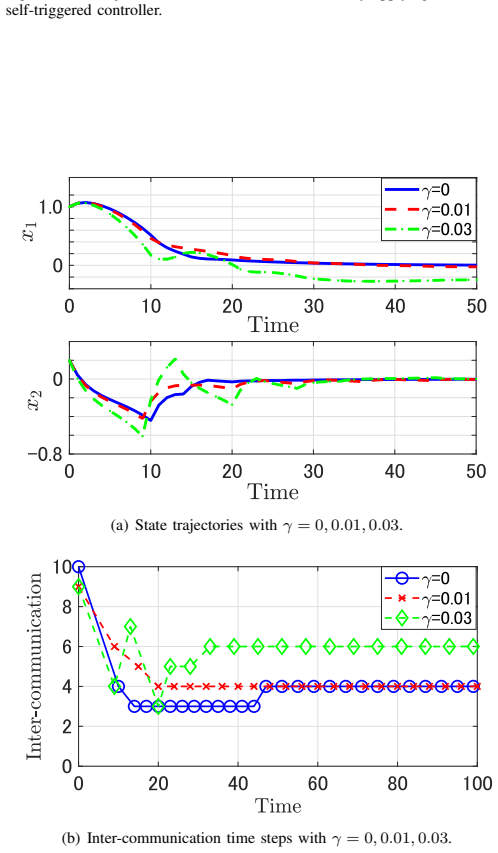
The paper claims that self-triggered control can be learned from data rather than designed from a known model: at each transmission, the controller chooses both a control input $u$ and a waiting time $m \in \{1,\dots,M\}$, and both policies are obtained by approximate value iteration on a Bellman equation whose transition model is a Gaussian-process regression of the unknown map $x_{k+1}=f(x_k,u_k)$. The Gaussian process's predictive distribution is propagated $m$ steps ahead under a constant input using moment matching, so the expected stage and communication costs become Gaussian integrals and can be evaluated in closed form. An outer reinforcement loop alternates $\varepsilon$-greedy exploration, which collects one-step transition data for the Gaussian process, with value-iteration updates, so the plant model, the control policy, and the communication policy improve together. In the inverted-pendulum simulation, the resulting self-triggered controller stabilizes the state toward the origin and, with $M=10$, communicates 27 times over 100 steps instead of 100; the paper states explicitly that closed-loop stability is not proven and that no error bound between the Gaussian-process model and the true dynamics is available.
Load-bearing premise
Everything hinges on the learned Gaussian-process model being accurate at the states the closed loop actually visits, because every policy decision is computed from that model; the paper gives no error bound between the Gaussian-process model and the true dynamics, and its own Remark 3 concedes that stabilization cannot be guaranteed as a result.
Editorial extensions
If this is right
- Controllers for unknown nonlinear plants can be synthesized without a first-principles model: the same loop that collects data learns both the plant and the communication schedule.
- Raising the maximum allowed wait $M$ or the communication weight $\gamma$ trades convergence speed for fewer transmissions, giving a tunable operating point.
- Communication reduction occurs even at $\gamma=0$, because stage costs accrue only at communication instants; the mechanism does not depend on an explicit communication penalty.
- The approach extends to general nonlinear systems, not just linear or input-affine ones, since the Gaussian process learns $f$ nonparametrically and the policy search is grid- and basis-function-based.
- The learning loop is data-efficient in the inverted-pendulum example, reaching a stabilizing policy within about 10 episodes.
Reading between the lines
- One extension left implicit is to use the Gaussian process's predictive variance $\Sigma(x,u)$ as a safety margin: shorten the waiting time $m$ where variance is large and lengthen it where the model is confident, since the paper already computes exactly the quantities this would require.
- A convergence guarantee would likely need a uniform error bound on the Gaussian-process posterior over the visited region; absent such a bound, a testable route is to restrict exploration to a region where the posterior variance is provably small and check whether stabilization survives.
- The same joint-learning loop could be applied to event-triggered control by learning a state-error threshold instead of an ahead-of-time wait $m$, using the Gaussian process to evaluate expected costs; this is a neighboring problem the paper does not address.
Signed reviews
Editorial analysis
A structured set of objections, weighed in public.
Referee Report
Summary. The paper proposes a reinforcement-learning framework, called Algorithm 2, for jointly learning an unknown nonlinear plant model via Gaussian process regression and synthesizing self-triggered control and communication policies for networked control systems. The control problem is an infinite-horizon optimal control problem whose stage cost penalizes both state deviation and communication, and the paper derives the associated Bellman equation. Since the value iteration cannot be solved exactly, the authors approximate the multi-step predictive state distribution by Gaussian moment matching (Section IV), approximate the value function and policies by exponential radial basis functions on a finite grid (Section V), and then iterate these approximations in Algorithm 1. The method is demonstrated on a simulated inverted pendulum, where the reported results show stabilization and a reduction in the number of communication instants compared with periodic communication.
Significance. If the proposed method works as claimed, it would be a useful contribution to model-based reinforcement learning for event-triggered and self-triggered control, since it addresses the practically important case of unknown dynamics and learns communication policies from scratch. The paper is transparent about its limitations: Remark 3 explicitly states that no error bound between the GP model and the true dynamics is available and that closed-loop stability is not guaranteed, and Section VIII lists stability and convergence as future work. The detailed closed-form moment-matching formulas in Section IV and the explicit problem formulation are valuable reference material. However, the central claim of stabilizing the true plant and achieving communication reduction rests on a single simulated inverted-pendulum example with one seed, no code, and no statistical repetition, so the empirical part is currently too thin to fully support the paper's stated contribution.
major comments (5)
- [Section V (Algorithm 1) and Remark 3] Algorithm 1, line 6, computes D(x,u,m) entirely from the GP predictive distribution p(x_m|x,u) approximated by moment matching in Section IV; Remark 3 explicitly concedes there is no error bound between the GP model and the true dynamics and that stabilization of the true plant is not guaranteed. Because every Bellman update and both output policies inherit this surrogate model, the paper's central claim that Algorithm 2 stabilizes the unknown plant is not supported by the theoretical part. The authors should either provide a model-accuracy condition that the learning loop enforces or restrict the claims to stabilizing the GP model and provide substantially stronger empirical evidence for the true plant.
- [Section VI (Algorithm 2)] Algorithm 2, lines 11-23, contains a control-flow error: the for loop over l closes at line 20, before the state transition k_{l+1} <- k_l + m_l and the data collection in lines 21-28, so as written an episode performs exactly one communication step instead of Nmax steps. This makes the core implementation algorithm non-executable as printed and must be corrected.
- [Section VII] Section VII reports one inverted-pendulum example: Fig. 3(a) shows one trajectory for each episode, Fig. 4 does not specify the number or distribution of initial states, and no code, seeds, or repeated trials are provided. The claims of robustness and of learning within 10 episodes are therefore not statistically supported; at minimum the authors should report multiple seeds with mean and quantile trajectories and make the simulation code available.
- [Section IV and Algorithm 1] Section IV approximates the multi-step predictive distribution by a Gaussian via (23)-(27), and Section V iterates this approximation inside value iteration; no bound or convergence statement is given for the moment-matching error, and Algorithm 1 (line 14) assumes the approximate value iteration converges to the optimal cost. The convergence claim is stated only as a future-work item in Section VIII, so the quality of the resulting policy relative to (15) is unquantified. Please either prove convergence of the approximate iteration under the Gaussian approximation or state explicitly that the algorithm is heuristic and assess sensitivity empirically.
- [Section V (eqs. 29-31) and Algorithm 1 line 14] Algorithm 1, line 14, says the hyperparameters are updated using the new training data (32) but never specifies the fitting procedure for the RBF weights in (29)-(31), so the value iteration update is not reproducible. In addition, the rounding in (31) is not clipped to N_{1:M}, so π*_com(x) can in principle return values larger than M or undefined for negative arguments; the projection onto [1,M] should be stated.
minor comments (7)
- [Equation (39)] The expression for δ_{J,n} is missing the exponent -1/2 on the determinant; compare the analogous expression in (38).
- [Section VII, Fig. 5] The Fig. 5 caption lists γ = 0, 0.01, 0.03 while the text of Section VII says γ = 0.01, 0.02, 0.03; please align these values.
- [Figure 4] The axis labels of Fig. 4 are garbled in the provided manuscript and should be corrected.
- [References] Reference [22] appears to have a malformed author list ('M. N. Z. L. Hewing, A. Liniger'); it should be corrected.
- [Algorithm 2, lines 24-27] Algorithm 2 uses set notation X <- {X ∪ ...} for what are arrays of training inputs; use concatenation to avoid ambiguity.
- [Section II] The kernel vector k_* is defined with argument x in (5) but later used as k_*,i(~x) with the augmented input; the notation should be unified.
- [Equation (36)] The display near Eq. (36) omits the integration variable dx_m in the integral; this is harmless but should be corrected.
Circularity Check
No significant circularity: the policy synthesis is a self-contained model-based value iteration on a GP surrogate, and the simulation validates against the true plant dynamics.
full rationale
The paper's derivation chain is self-contained and does not reduce to its own inputs. The GP regression (Eqs. 9–14) produces a predictive model of the unknown dynamics; Section IV uses moment matching to approximate the multi-step predictive distributions under constant control; and Algorithm 1 runs an approximate value iteration whose Bellman backup (Eqs. 33–35) is computed from that GP predictive distribution. This is a standard model-based RL setup, not a circular one: the learned GP is a surrogate model used inside the optimization, and the empirical evaluation in Section VII runs the resulting policies against the true simulated inverted-pendulum dynamics (40)–(41), which are not the GP model. The paper's own Remark 3 concedes that no error bound is available between the GP model and the true dynamics and that closed-loop stabilization is therefore not guaranteed; this is an explicit correctness/stability limitation, not a circular reduction. The communication-reduction effect noted in Remark 1 follows from the definition of the cost in Eq. (15), which sums stage costs only at communication instants and penalizes larger inter-communication times via C2(m) = M − m; this is the optimization objective being designed, not a fitted parameter later relabeled as a prediction. The self-citations ([10]–[14] by the first author) are contextual related-work references and are not load-bearing for the derivation. No quoted equation or algorithmic step is equivalent by construction to another step, and no prediction is statistically forced by a fitted input.
Assumptions & free parameters
free parameters (8)
- GP kernel hyperparameters {alpha_i, lambda_i, sigma_epsilon} =
not reported
- RBF widths sigma_J, sigma_u, sigma_c =
not reported
- RBF weights {w_J,n, w_u,n, w_c,n} =
learned in Algorithm 1
- Communication weight gamma =
0 (main), 0.01, 0.02, 0.03 (variants)
- Maximum inter-communication time M =
10
- State/input grid interval =
0.3
- Exploration probability epsilon =
not reported
- Number of episodes N_epi =
10
assumptions (8)
- domain assumption The unknown transition dynamics f is modeled as independent GPs per output dimension with squared exponential kernel (2).
- domain assumption The equilibrium point is known and is the origin: 0 = f(0,0).
- domain assumption The communication network is ideal with no packet dropouts or delays.
- domain assumption The stage cost C1 is polynomial or exponential so that Gaussian integrals are analytic.
- ad hoc to paper Multi-step predictive distributions are approximated as Gaussian via moment matching (Section IV).
- ad hoc to paper The cost-to-go and policies are approximated by exponential RBFs on a finite grid (29)-(31).
- ad hoc to paper The approximate value iteration converges to the optimal solution.
- ad hoc to paper The learned GP model is sufficiently accurate for the derived policies to stabilize the true plant.
Cite this review
Pith. "Pith review of Learning self-triggered controllers with Gaussian processes." pith.science (2026). https://pith.science/paper/XGRHVPR2
@misc{pith2026190900178,
  author       = {Pith},
  title        = {Pith review of: Learning self-triggered controllers with Gaussian processes},
  year         = {2026},
  howpublished = {\url{https://pith.science/paper/XGRHVPR2}},
  note         = {Machine review of arXiv:1909.00178}
}
read the original abstract
This paper investigates the design of self-triggered controllers for networked control systems (NCSs), where the dynamics of the plant is \textit{unknown} apriori. To deal with the unknown transition dynamics, we employ the Gaussian process (GP) regression in order to learn the dynamics of the plant. To design the self-triggered controller, we formulate an optimal control problem, such that the optimal control and communication policies can be jointly designed based on the GP model of the plant. Moreover, we provide an overall implementation algorithm that jointly learns the dynamics of the plant and the self-triggered controller based on a reinforcement learning framework. Finally, a numerical simulation illustrates the effectiveness of the proposed approach.
Figures


Figures from the paper (2 more)

Reference graph
Works this paper leans on
-
[1]
A survey of recent results in networked control systems,
J. P. Hespanha, P. Naghshtabrizi, and Y . Xu, “A survey of recent results in networked control systems,” Proceedings of the IEEE , vol. 95, no. 1, pp. 138–162, 2007
work page 2007
-
[2]
An introduction to event-triggered and self-triggered control,
W. P. M. H. Heemels, K. H. Johansson, and P. Tabuada, “An introduction to event-triggered and self-triggered control,” in Proceedings of the 51st IEEE Conference on Decision and Control (IEEE CDC) , 2012, pp. 3270–3285
work page 2012
-
[3]
A survey on recent advances in event-triggered communication and control,
C. Peng and F. Li, “A survey on recent advances in event-triggered communication and control,” Information Sciences , vol. 457, pp. 113– 125, 2018
work page 2018
-
[4]
Self-triggered feedback control systems with finite L2 gain stability,
X. Wang and M. D. Lemmon, “Self-triggered feedback control systems with finite L2 gain stability,” IEEE Transactions on Automatic Control , vol. 54, no. 3, pp. 452–467, 2009
work page 2009
-
[5]
Output-based event- triggered control with guaranteed L∞ gain and decentralized event- triggering,
M. C. F. Donkers and W. P. M. H. Heemels, “Output-based event- triggered control with guaranteed L∞ gain and decentralized event- triggering,” IEEE Transactions on Automatic Control , vol. 57, no. 6, pp. 1362–1376, 2011
work page 2011
-
[6]
An iss self-triggered implemen- tation of linear controllers,
M. Mazo Jr., A. Anta, and P. Tabuada, “An iss self-triggered implemen- tation of linear controllers,” Automatica, vol. 46, no. 8, pp. 1310–1314, 2010
work page 2010
-
[7]
V . S. Dolk, D. P. Borgers, and W. P. M. H. Heemels, “Output-based and decentralized dynamic event-triggered control with guaranteed Lp- gain performance and zeno-freeness,” IEEE Transactions on Automatic Control, vol. 62, no. 1, pp. 34–49, 2016
work page 2016
-
[8]
Periodic event- triggered control for linear systems,
W. P. M. H. Heemels, M. C. F. Donkers, and A. R. Teel, “Periodic event- triggered control for linear systems,” IEEE Transactions on Automatic Control, vol. 58, no. 4, pp. 847–861, 2013
2013
Show all 43 references
-
[9]
Event- triggered control for discrete time systems,
A. Eqtami, D. V . Dimarogonas, and K. J. Kyriakopoulos, “Event- triggered control for discrete time systems,” in Proceedings of American Control Conference (ACC) , 2010, pp. 4719–4724
2010
-
[10]
Self-triggered model predictive control for nonlinear input-affine dynamical systems via adaptive control samples selection,
K. Hashimoto, S. Adachi, and D. V . Dimarogonas, “Self-triggered model predictive control for nonlinear input-affine dynamical systems via adaptive control samples selection,”IEEE Transactions on Automatic Control, vol. 62, no. 1, pp. 177–189, 2017
2017
-
[11]
Energy-aware networked control systems under temporal logic specifications,
——, “Energy-aware networked control systems under temporal logic specifications,” in Proceedings of the 57th IEEE Conference on Decision and Control (IEEE CDC) , 2018
2018
-
[12]
Event-triggered intermittent sampling for nonlinear model pre- dictive control,
——, “Event-triggered intermittent sampling for nonlinear model pre- dictive control,” Automatica, vol. 81, pp. 148–155, 2017
2017
-
[13]
Synthesizing communication plans for reachability and safety specifications,
K. Hashimoto and D. V . Dimarogonas, “Synthesizing communication plans for reachability and safety specifications,” IEEE Transactions on Automatic Control, vol. 65, no. 2, pp. 561–576, 2020
2020
-
[14]
Resource-aware networked control systems under temporal logic specifications,
——, “Resource-aware networked control systems under temporal logic specifications,” Discrete Event Dynamic Systems , vol. 29, pp. 473–499, 2019
2019
-
[15]
Event-triggered op- timal tracking control of nonlinear systems,
K. G. Vamvoudakis, A. Mojoodi, and H. Ferraz, “Event-triggered op- timal tracking control of nonlinear systems,” The International Journal of Robust and Nonlinear Control , vol. 27, no. 4, pp. 598–619, 2017
2017
-
[16]
Optimal triggering of networked control systems,
A. Heydari, “Optimal triggering of networked control systems,” IEEE Transactions on Neural Networks and Learning Systems , vol. 29, no. 7, pp. 3011–3021, 2018
2018
-
[17]
Robust event-triggered model predictive control for cyber-physical systems under denial-of-service attacks,
Y . C. Sun and G. H. Yang, “Robust event-triggered model predictive control for cyber-physical systems under denial-of-service attacks,” The International Journal of Robust and Nonlinear Control , vol. 29, no. 14, pp. 4797–4811, 2019
2019
-
[18]
Optimal self-triggering for nonlinear systems via approximate dynamic programming,
D. Tolic, R. Fierro, and S. Ferrari, “Optimal self-triggering for nonlinear systems via approximate dynamic programming,” in Proceedings of 2012 IEEE International Conference on Control Applications , 2012, pp. 879–884
2012
-
[19]
Co-design of event trigger and feedback policy in robust model predictive control,
C. Liu, H. Li, Y . Shi, and D. Xu, “Co-design of event trigger and feedback policy in robust model predictive control,” IEEE Transactions on Automatic Control , 2019(to appear)
2019
-
[20]
Aperiodic robust model predictive control for constrained continuous-time nonlinear systems: An event- triggered approach,
C. Liu, J. Gao, H. Li, and D. Xu, “Aperiodic robust model predictive control for constrained continuous-time nonlinear systems: An event- triggered approach,” IEEE Transactions on Cybernetics , vol. 4, no. 5, pp. 1397–1405, 2018
2018
-
[21]
Stable gaussian process based tracking control of euler-lagrange systems,
T. Beckers, D. Kulic, and S. Hirche, “Stable gaussian process based tracking control of euler-lagrange systems,” Automatica, vol. 103, pp. 390–397, 2019
2019
-
[22]
Cautious nmpc with gaussian process dynamics for autonomous miniature race cars,
M. N. Z. L. Hewing, A. Liniger, “Cautious nmpc with gaussian process dynamics for autonomous miniature race cars,” in Proceedings of 2018 European Control Conference (ECC 2018) , 2018
2018
-
[23]
Learning and control using gaussian processes: towards bridging machine learning and controls for physical systems,
A. Jain, T. X. Nghiem, M. Morari, and R. Mangharam, “Learning and control using gaussian processes: towards bridging machine learning and controls for physical systems,” in Proceedings of the 9th ACM/IEEE International Conference on Cyber-Physical Systems (ICCPS 2018) , 2018
2018
-
[24]
Gaussian process-based predictive control for periodic error correction,
E. D. Klenske, M. N. Zeilinger, B. Scholkopf, and P. Hennig, “Gaussian process-based predictive control for periodic error correction,” IEEE Transactions on Control Systems Technology , vol. 24, no. 1, pp. 390– 397, 2019
2019
-
[25]
C. F. Rasmussen and C. K. I. Williams, Gaussian Processes for Machine Learning, The MIT Press, 2006
2006
-
[26]
An uncertainty-based control lyapunov approach for control-affine systems modeled by gaussian process,
J. Umlauft, L. Pohler, and S. Hirche, “An uncertainty-based control lyapunov approach for control-affine systems modeled by gaussian process,” IEEE Control Systems Letters , vol. 2, no. 3, pp. 483–488, 2018
2018
-
[27]
Gaussian process model predictive control,
J. Kocijan, R. M. Smith, C. E., and A. Girard, “Gaussian process model predictive control,” in Proceedings of the 2004 American Control Conference, 2004
2004
-
[28]
Scenario-based optimal control for gaussian process state space models,
J. Umlauft, T. Beckers, and S. Hirche, “Scenario-based optimal control for gaussian process state space models,” in Proceedings of 2018 European Control Conference (ECC 2018) , 2018
2018
-
[29]
Stochastic data-driven model predictive control using gaussian processes,
E. Bradford, L. Imsland, D. Zhang, and E. A. R. Chanona, “Stochastic data-driven model predictive control using gaussian processes,” in arxiv, available online at https://arxiv.org/pdf/1908.01786.pdf
1908 arXiv
-
[30]
Gaussian processes for data-efficient learning in robotics and control,
M. P. Deisenroth, D. Fox, and C. E. Rasmussen, “Gaussian processes for data-efficient learning in robotics and control,” IEEE Transactions on Pattern Analysis and Machine Intelligence , vol. 37, no. 2, pp. 408–423, 2013
2013
-
[31]
Gaussian process dynamic programming,
M. P. Deisenroth, C. E. Rasmussen, and J. Peters, “Gaussian process dynamic programming,” Neurocomputing, vol. 72, no. 7–9, pp. 1508– 1524, 2009
2009
-
[32]
Deep reinforcement learning for event-triggered control,
D. Baumann, J.-J. Zhu, G. Martius, and S. Trimpe, “Deep reinforcement learning for event-triggered control,” in Proceedings of 57th IEEE Conference on Decision and Control (IEEE CDC) , 2018, pp. 943–950
2018
-
[33]
A simple event-based pid controller,
K. E. ˚Arzen, “A simple event-based pid controller,” in Proceedings of 14th IF AC World Congress, 1999
1999
-
[34]
Event- triggered pulse control with model learning (if necessary),
D. Baumann, F. Solowjow, K. H. Johansson, and S. Trimpe, “Event- triggered pulse control with model learning (if necessary),” in Proceed- ings of 2019 American Control Conference (ACC 2019) , 2019, pp. 792– 797
2019
-
[35]
Hierarchical event-triggered learning for cyclically excited systems with application to wireless sensor networks,
J. Beuchert, F. Solowjow, J. Raisch, S. Trinpe, and T. Seel, “Hierarchical event-triggered learning for cyclically excited systems with application to wireless sensor networks,”IEEE Control Systems Letters, vol. 4, no. 1, pp. 103–108, 2019
2019
-
[36]
Model-free event-triggered control algorithm for continuous-time linear systems with optimal performance,
K. G. Vamvoudakis and H. Ferraz, “Model-free event-triggered control algorithm for continuous-time linear systems with optimal performance,” Automatica, vol. 87, pp. 412–420, 2018
2018
-
[37]
Event-triggered reinforcement learning approach for unknown nonlinear continuous- time system,
X. Zhong, Z. Ni, H. He, X. Xu, and D. Zhao, “Event-triggered reinforcement learning approach for unknown nonlinear continuous- time system,” in Proceedings of 2014 International Joint Conference on Neural Networks , 2014. 10
2014
-
[38]
Adaptive critic designs for event-triggered robust control of nonlinear systems with unknown dynamics,
X. Yang and H. He, “Adaptive critic designs for event-triggered robust control of nonlinear systems with unknown dynamics,” IEEE Transac- tions on Cybernetics , vol. 49, no. 6, pp. 2255–2267, 2019
2019
-
[39]
Dynamic intermittent Q-learning-based model-free suboptimal co-design of L2- stabilization,
Y . Yang, K. G. Vamvoudakis, H. Ferraz, and H. Modares, “Dynamic intermittent Q-learning-based model-free suboptimal co-design of L2- stabilization,” The International Journal of Robust and Nonlinear Con- trol, vol. 29, no. 9, pp. 2673–2694, 2019
2019
-
[40]
Dynamic intermittent Q-learning for systems with reduced bandwidth,
——, “Dynamic intermittent Q-learning for systems with reduced bandwidth,” in Proceedings of 2018 IEEE Conference on Decision and Control (IEEE CDC) , 2018, pp. 924–931
2018
-
[41]
Dynamic intermittent feedback design for H∞ containment control on a directed graph,
Y . Yang, H. Modares, K. G. Vamvoudakis, Y . Yin, and D. C. Wunsch, “Dynamic intermittent feedback design for H∞ containment control on a directed graph,” IEEE Transactions on Cybernetics , 2019
2019
-
[42]
Safe intermittent reinforcement learning for nonlinear sys- tems,
Y . Yang, K. G. Vamvoudakis, H. Modares, W. He, Y . Yin, and D. C. Wunsch, “Safe intermittent reinforcement learning for nonlinear sys- tems,” inProceedings of 2018 IEEE Conference on Decision and Control (IEEE CDC) , 2019
2018
-
[43]
D. P. Bertsekas, Dynamic Programming and Optimal Control , Athena Scientific, Belmont, MA, 1996. (a) State trajectories by implementing Algorithm 2 with M = 10. (b) Corresponding inter-communication time steps ( Episode = 10 ). (c) State trajectories by implementing Algorithm 2...
1996
Reviewed August 14, 2026 · model on record in the stance chip above.
Discussion (0). Continue with ORCID to comment.