REVIEW 3 major objections 5 minor 10 references
Search for Dark Matter decay signals in the Galactic Halo with the MAGIC telescopes
T0 review · 3 major / 5 minor · reviewed 2026-08-14 · deepseek-v4-flash
Pith's one-line read Pairwise subtraction of matched MAGIC observations of the Galactic halo excludes dark-matter decay to bottom-quark pairs with lifetime below about $10^{26}$ s at a mass of 100 TeV.
desk verdict A genuinely new same-night ON/OFF pair method for Galactic Halo dark matter decay searches gives an impressively competitive limit, but the diffuse-foreground cancellation is asserted rather than demonstrated. read the letter →
The pith
A machine-rendered reading of the paper's core claim, the machinery that carries it, and where it could break.
The reading
What carries the argument
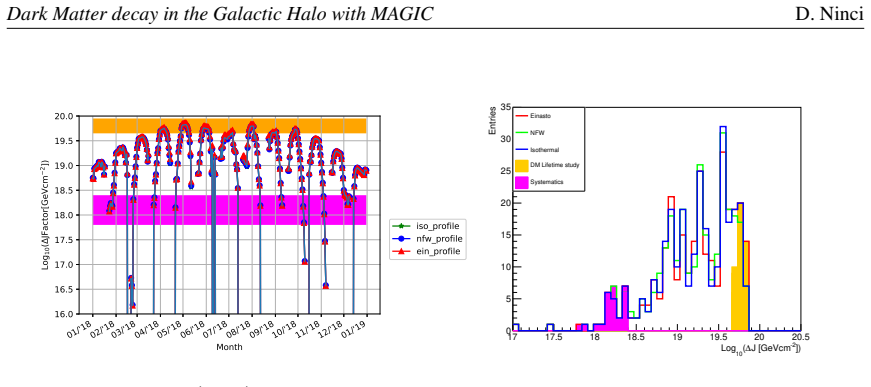
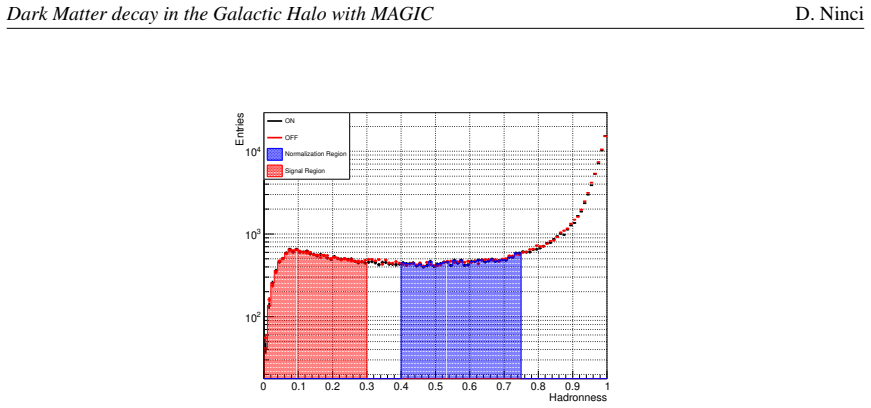
The load-bearing element is the matched ON/OFF pair: each ON observation at low Galactic longitude (high expected dark-matter flux) is paired with an OFF observation at higher longitude during the same night, following the same azimuth and zenith path, with both fields satisfying $|b|>10^\circ$. The normalization factor $\kappa$ between ON and OFF is derived from high-hadronness events outside the signal region, and the residual $R=2(N_{\rm ON}-N_{\rm OFF}/\kappa)/(N_{\rm ON}+N_{\rm OFF}/\kappa)$ is the test statistic whose width, measured on a low-$\Delta J$ control sample, defines the systematic uncertainty. The signal term is proportional to $\Delta J(\phi_1,\phi_2)$, the difference in J-factors, which is nearly model-independent for decay at $\phi>10^\circ$ across NFW, Einasto, and isothermal profiles.
What would settle it
Compute the expected residual $\Delta R_{\rm Gal-\gamma}$ between the selected ON and OFF fields using a standard model of interstellar gas and cosmic-ray distributions; if the predicted diffuse background difference is comparable to or larger than the 4.8% systematic uncertainty or the observed residual, then the derived lifetime limits would be biased.
Extended reading notes
Core claim
MAGIC's pairwise ON-OFF observation strategy for the Galactic halo can make the residual event rate between two sky positions depend only on the dark-matter decay contribution, $\Delta R(\phi_1,\phi_2) = R_{\rm DM}(\phi_1)-R_{\rm DM}(\phi_2)$, once isotropic backgrounds are removed and the anisotropic Galactic gamma-ray background is assumed negligible. With 10 hours of observations selected for large $\Delta J$, the analysis yields a 95% CL lower limit on the $\mathrm{b}\bar{\mathrm{b}}$ decay lifetime of $10^{26}$ s at 100 TeV, and limits as constraining as the 200-hour Perseus cluster observation for masses up to 10 TeV. The paper also reports an energy-independent systematic uncertainty of $\sigma_{\rm syst}=4.8\pm1.0\%$ in the background-estimation procedure.
Load-bearing premise
The method assumes that the Galactic diffuse gamma-ray background is effectively the same in the ON and OFF fields, so that its difference is negligible compared with the dark-matter decay signal; the paper does not quantify this with a foreground emission model or template map.
Editorial extensions
If this is right
- Ten hours of Galactic-halo observation with MAGIC exclude $\mathrm{b}\bar{\mathrm{b}}$ dark-matter decay lifetimes below about $10^{26}$ s at 100 TeV at 95% confidence.
- The pairwise subtraction method reaches the same sensitivity as a 200-hour Perseus cluster campaign for masses up to 10 TeV, using 5% of the observation time.
- Extending the data set to 40 hours is projected to improve the lifetime constraints by at least a factor of two.
- The method, including its measured 4.8% systematic uncertainty, transfers naturally to future wide-field Cherenkov observatories.
- Because the decay J-factor is nearly identical for cusped and cored halo profiles at $\phi>10^\circ$, the limits are robust against the Milky Way halo modelling uncertainty.
Reading between the lines
- The same pairwise cancellation could be adapted to dark-matter annihilation, where the J-factor contrast between matched fields is stronger, though the brighter astrophysical foregrounds at small angular separation would need a quantitative foreground model.
- The claim that the residual Galactic diffuse gamma-ray emission is negligible could be tested directly by measuring the ON-OFF residual as a function of interstellar gas column density in the selected fields; a correlation would indicate a foreground bias in the lifetime limit.
- Comparable pairwise analyses by other instruments using different pointings could combine with MAGIC's limit to push the lifetime bound beyond $10^{26}$ s without requiring the full observation time of a deep cluster survey.
Editorial analysis
A structured set of objections, weighed in public.
Referee Report
Summary. This manuscript reports a search for gamma-ray signals from dark-matter (DM) decay in the Milky Way halo using 20 hours of MAGIC observations taken in 2018. The method compares same-night ON/OFF pointings at different angular distances from the Galactic Center, with matched azimuth and zenith paths, and assumes that all non-DM diffuse components cancel in the ON-OFF difference. Ten hours with the lowest ΔJ are used to measure the systematic uncertainty σ_syst = 4.8%, and the remaining 10 hours with the highest ΔJ are used in a binned likelihood to set 95% CL lower limits on the DM lifetime for the b bbar channel; the strongest limit is τ_DM > 10^26 s at m_DM = 100 TeV, which the authors compare with a 200-hour Perseus observation.
Significance. If the result holds, the paper demonstrates that a dedicated matched-pair ON-OFF strategy can produce TeV-scale DM decay limits competitive with much longer exposures, and the methodology is of clear interest for future instruments such as CTA. The strengths of the paper include the careful matched azimuth/zenith data-taking, the cross-check of the systematic uncertainty against archival data, and the explicit demonstration that the J-factor is nearly model-independent in the selected sky region. The result is not a detection, and its main risk is statistical and systematic rather than the central limit itself; however, the foreground-cancellation assumption is load-bearing and is not quantitatively supported.
major comments (3)
- [Sec. 2, equation for R(l,b)] The central reduction ΔR(φ1,φ2) = R_DM(φ1) − R_DM(φ2) rests on the claim that R_Gal−γ(l1,b1) − R_Gal−γ(l2,b2) is negligible because the Galactic diffuse emission is 'mildly anisotropic' for |b| > 10°. This is asserted rather than demonstrated. Since the ON positions are closer to the Galactic Center than the OFF positions, the Galactic diffuse gradient is expected to correlate with ΔJ, so the residual could be of either sign and comparable to the DM signal. Please quantify this residual using a Galactic diffuse foreground model or Fermi-LAT template maps for the specific high-ΔJ pairs used in Sec. 4, and show that it is small compared to CΔJ. If a negative residual is possible, the derived lifetime limit could be artificially strong.
- [Sec. 3, systematic uncertainty] The σ_syst = 4.8% used in the likelihood is measured on control samples with ΔJ_syst ≈ 4% of the search average and on archival pairs with ΔJ ≈ 0. These configurations do not reproduce the spatial foreground difference of the search pairs; they constrain the stability of the ON/OFF acceptance but not the residual Galactic diffuse anisotropy term in the equation for ΔR. The likelihood in Eq. (4.1) propagates σ_syst only into the κ uncertainty, so the final limit contains no contribution from the foreground-cancellation assumption. A quantitative bound on that residual is required before the reported limit can be considered robust.
- [Sec. 4, Eq. (4.1)] The likelihood includes a term J(ΔJ|ΔJ_obs, σ_ΔJ) but sets σ_ΔJ = 0. The paper argues that the J-factor is robust because three halo profiles agree in the region of interest; nevertheless, the Milky Way halo parameters are not infinitely well known, and the choice σ_ΔJ = 0 should be justified with a quantitative estimate of the residual spread among models or a statement of which halo-parameter uncertainties were considered. As written, the limit omits any uncertainty in the astrophysical factor.
minor comments (5)
- [Abstract and Sec. 4] The lifetime limit is rendered as '10^26 s' in the abstract but as '1026 s' in the body text; please fix the typesetting of the superscript.
- [Fig. 2] The right panel of Fig. 2 is discussed in terms of orange and magenta histograms, but the figure caption does not identify which histogram corresponds to which selection; the caption should be self-contained.
- [Sec. 3] The definition of R is given as an inline formula; please define it in a numbered equation and clarify that it is expressed as a percentage, and state how the quoted uncertainty on σ_tot was derived from the sample variance with the given number of nights.
- [Sec. 4] The notation τ_LL_DM is used without definition; please define it as the lower-limit lifetime or explain the subscript 'LL'.
- [References] Reference [7] to the 3FHL catalog lacks volume and page information, and [10] should include the full collaboration name; please complete the bibliographic entries.
Circularity Check
No significant circularity: the DM lifetime limit is derived from observed ON/OFF counts through a standard likelihood, with no parameter fitted to the DM signal itself.
full rationale
The paper's derivation chain is self-contained: the observed rate is decomposed into isotropic components, Galactic diffuse emission, and DM decay, and the ON-OFF subtraction cancels all isotropic terms by construction. The surviving signal is written as C*DeltaJ, where DeltaJ is computed from standard DM density profiles and C is the inverse lifetime times the spectrum. The lifetime is then constrained by a Poisson likelihood on the observed ON and OFF event counts, so the central limit is not a renamed input or a fitted quantity. The systematic uncertainty sigma_syst is measured on separate low-DeltaJ and archival near-zero-DeltaJ control data and enters only as a nuisance parameter widening the kappa normalization uncertainty; it is not tuned to produce the DM result. The only notable self-citation is the likelihood method of reference [8], which is a published, external, parameter-free analysis framework and does not by itself impose the lifetime bound. The weakest step is the assumption that the residual Galactic diffuse anisotropy cancels in the high-DeltaJ pairs, justified by the statement that phi_Gal-gamma is 'mildly anisotropic' for |b| > 10 deg; this is an unquantified modeling assumption that could bias the limit, but it is a scientific risk, not a circular reduction of the prediction to its inputs. External comparisons with the MAGIC Perseus limit and Fermi-LAT halo limits further show that the result is benchmarked independently. Accordingly, the appropriate circularity score is 0.
Assumptions & free parameters
free parameters (3)
- per-night ON/OFF normalization factor kappa_i =
night-dependent; not quoted
- systematic uncertainty sigma_syst =
4.8% +/- 1.0%
- analysis cuts: energy threshold and theta^2 cut =
E > 60 GeV, theta^2 < 1.44 deg^2
assumptions (5)
- standard math Dark matter decay flux formula dphi/dE = (1/(4*pi*m_DM*tau_DM)) * dN/dE * J(phi,DeltaOmega) for beta=1.
- domain assumption Milky Way halo density profiles (NFW, Einasto, isothermal) from refs [3] and [5] determine the J-factors.
- ad hoc to paper All non-DM diffuse components cancel in the ON-OFF difference, and residual Galactic diffuse anisotropy Delta R_Gal-gamma is negligible for |b|>10.
- domain assumption Same-night, same-azimuth, same-zenith observations plus the hadronness normalization region keep the relative ON/OFF acceptance constant up to a measured residual sigma_syst.
- ad hoc to paper Delta-J uncertainty is set to zero and sigma_syst is energy independent.
Cite this review
Pith. "Pith review of Search for Dark Matter decay signals in the Galactic Halo with the MAGIC telescopes." pith.science (2026). https://pith.science/paper/54HVXRSH
@misc{pith2026190900222,
  author       = {Pith},
  title        = {Pith review of: Search for Dark Matter decay signals in the Galactic Halo with the MAGIC telescopes},
  year         = {2026},
  howpublished = {\url{https://pith.science/paper/54HVXRSH}},
  note         = {Machine review of arXiv:1909.00222}
}
abstract
MAGIC is a system of two Cherenkov telescopes located in the Canary island of La Palma. A key part of MAGIC Fundamental Physics program is the search for indirect signals of Dark Matter (DM) from different sources. In the Milky Way, DM forms an almost spherically symmetric halo, with a density peaked towards the center of the Galaxy and decreasing toward the outer region. We search for DM decay signals from the Galactic Halo, with a special methodology developed for this work. Our strategy is to compare pairs of observations performed at different angular distances from the Galactic Center, selected in such a way that all the diffuse components cancel out, except for those coming from the DM. In order to keep the systematic uncertainty of this novel background estimation method down to a minimum, the observation pairs have been acquired during the same nights and follow exactly the same azimuth and zenith paths. We collected 20 hours of data during 2018. Using half of them to determine the systematic uncertainty in the background estimation of our analysis, we obtain a value of 4.8\% with no dependence on energy. Accounting for this systematic uncertainty in the likelihood analysis based on the 10 remaining hours of data collected so far, we present the limit to TeV DM particle with a lifetime of $10^{26}$ s in the $\mathrm{b\bar{b}}$ decay channel.
Figures

Figures from the paper (3 more)


Reference graph
Works this paper leans on
-
[1]
Bergstrom, Dark Matter Evidence, Particle Physics Candidates and Detection Methods , Annalen Phys
L. Bergstrom, Dark Matter Evidence, Particle Physics Candidates and Detection Methods , Annalen Phys. 524 (2012) 479-496, [arXiv:1205.4882]
arXiv 2012
-
[2]
J. K. Gaskins, A review of indirect searches for particle dark matter , Contemp. phys. 57 (2016) 496-525 [arXiv:1604.00014]
arXiv 2016
-
[3]
F. Nesti and P. Salucci, The Dark Matter halo of the Milky Way, AD2013 , JCAP 1307 (2013) 016, [arXiv:1304.5127]
arXiv 2013
-
[4]
H. Abdalla, Search for Dark Matter Annihilations towards the Inner Galactic Halo from 10 Years of Observations with H.E.S.S., Phys. Rev. Lett. 117 (2016) 111301, [arXiv:1607.08142],
arXiv 2016
-
[5]
Detecting Gamma-Ray Anisotropies from Decaying Dark Matter: Prospects for Fermi LAT
A. Ibarra et al., Detecting Gamma-Ray Anisotropies from Decaying Dark Matter: Prospects for Fermi LAT , Phys.Rev.D81:023529,2010, [arXiv:0909.3514],
work page Pith review arXiv 2010
-
[6]
J. Albert et al., Implementation of the Random F orest Method for the Imaging Atmospheric Cherenkov Telescope MAGIC, Nucl.Instrum.Meth.A588:424-432,2008, [arXiv:0709.3719],
arXiv 2008
-
[7]
The Fermi-LAT coll., 3FHL: The Third Catalog of Hard Fermi-LAT Sources, ApJS 2017, [arXiv:1702.00664],
arXiv 2017
-
[8]
Optimized analysis method for indirect dark matter searches with Imaging Air Cherenkov Telescopes
J. Aleksic, J. Rico, M. Martinez, Optimized analysis method for indirect dark matter searches with Imaging Air Cherenkov Telescopes, JCAP 1210 (2012) 032, [arXiv:1209.5589],
work page Pith review arXiv 2012
Show all 10 references
-
[9]
Acciari et al., Constraining Dark Matter lifetime with a deep gamma-ray survey of the Perseus Galaxy Cluster with MAGIC, Phys
V . Acciari et al., Constraining Dark Matter lifetime with a deep gamma-ray survey of the Perseus Galaxy Cluster with MAGIC, Phys. Dark Universe, 22 (2018) 38, [arXiv:1806.11063],
2018
-
[10]
Ackermann, Constraints on the Galactic Halo Dark Matter from Fermi-LAT diffuse measurements, Astrophys.J
M. Ackermann, Constraints on the Galactic Halo Dark Matter from Fermi-LAT diffuse measurements, Astrophys.J. 761 (2012) 91, [arXiv:1205.6474]. 7
2012 arXiv
Reviewed August 14, 2026 · model on record in the stance chip above.
Discussion (0). Continue with ORCID to comment.