REVIEW 3 major objections 5 minor 97 references
Scalable Reinforcement-Learning-Based Neural Architecture Search for Cancer Deep Learning Research
T0 review · 3 major / 5 minor · reviewed 2026-08-14 · deepseek-v4-flash
Pith's one-line read A reinforcement-learning agent that generates neural-network architectures from a search space of custom nodes finds drug-response and gene-expression models that match or beat hand-built baselines while using up to 800x fewer trainable…
desk verdict Solid HPC-scale RL-NAS engineering for cancer tabular data, but the accuracy claim is overreach given a noisy low-fidelity reward and selection on the validation set. read the letter →
The pith
A machine-rendered reading of the paper's core claim, the machinery that carries it, and where it could break.
The reading
What carries the argument
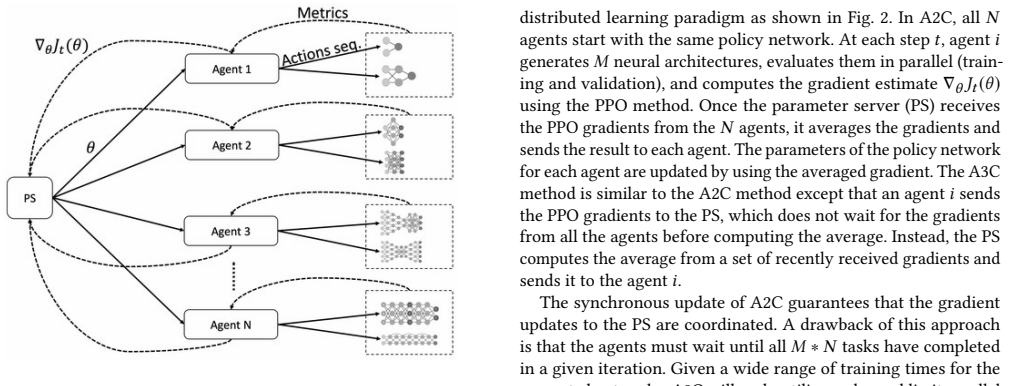
The machinery is the graph-based search space joined to a PPO-clipped actor-critic agent. A search space is a directed acyclic graph of cells, each cell containing blocks of nodes; a variable node is a placeholder whose choices are operations such as Dense(100, relu), Dropout(0.1), or a skip connection. Two node types encode the cancer-specific structure: constant nodes fix an operation (for example, adding the dose value at each block in Uno), and mirror nodes reuse the same submodel for both drug descriptors in Combo, enforcing weight sharing. The agent chooses the sequence of node operations, receives a reward equal to validation R2 or accuracy after one training epoch, and updates the shared policy with the PPO clipped surrogate objective. A3C runs many agents asynchronously against a parameter server, accepting stale gradients in exchange for keeping compute nodes busy.
What would settle it
Sample, say, 200 architectures from the Combo search space, compute both the cheap reward (one epoch, 10% of training data, 10-minute timeout) and the full post-training R2 for each, and measure the rank correlation between the two; if the correlation is weak, or if the top 50 by cheap reward perform no better when fully trained than 50 random architectures, the claimed advantage comes from the fidelity shortcut rather than from the search strategy.
Extended reading notes
Core claim
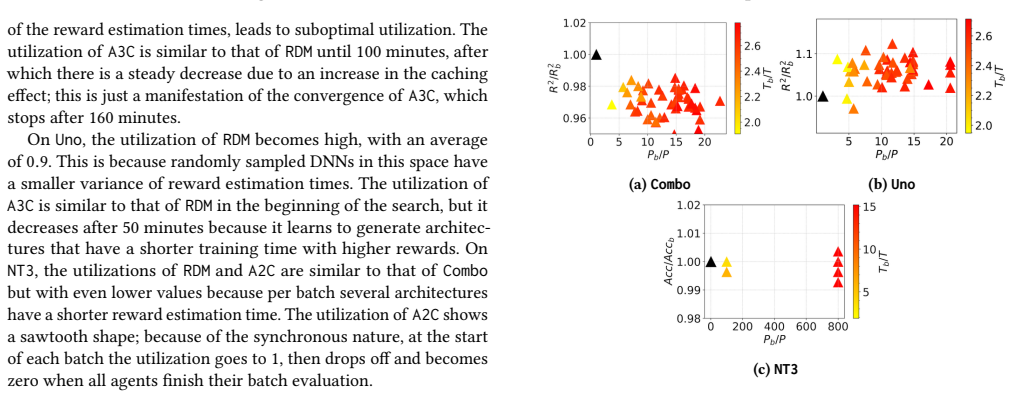
The central discovery is that the asynchronous advantage actor-critic variant (A3C), which tolerates stale gradient updates in exchange for higher node utilization, finds better architectures faster than its synchronous counterpart or random search on all three benchmarks. The search is organized around a directed-acyclic-graph search space with multiple input cells, variable nodes whose options are layer operations, constant nodes that fix operations such as adding the dose input at every block, and mirror nodes that force the two drug-descriptor branches in Combo to share weights. After ranking generated architectures by a cheap one-epoch reward (on 10% of the Combo training data, with a 10-minute timeout), the top 50 are retrained fully; the best ones reach Combo R2 0.930 versus 0.926 with 7.3x fewer parameters, Uno R2 0.729 versus 0.649 with 11.5x fewer parameters, and NT3 accuracy 0.989 versus 0.986 with about 800x fewer parameters. The paper presents these numbers as support for replacing manual model design with automated search on high-performance computing systems.
Load-bearing premise
The pipeline assumes the cheap one-epoch, often partial-data reward ranks architectures the same way full post-training would, even though the paper records the same NT3 architecture scoring 1.0 from one seed and 0.4 from another.
Editorial extensions
If this is right
- Cancer researchers can replace weeks of manual network design with a roughly six-hour automated search, since the paper demonstrates the full pipeline on leadership-class supercomputing resources.
- The large parameter reductions imply cheaper retraining, hyperparameter tuning, and scaling to larger datasets, because training time scales with parameter count.
- Asynchronous A3C is the preferred scalable variant of RL-based NAS: it reaches higher rewards in less wall-clock time than synchronous A2C or random search and keeps node utilization higher.
- The custom search-space building blocks (multiple input cells, constant nodes, mirror nodes) provide a reusable template for defining NAS spaces over other multi-modal tabular data.
- The fidelity experiments show that the cheap reward is not neutral: changing the fraction of training data used to estimate rewards changes which architectures the agent favors, trading accuracy for training speed as the data fraction grows.
Reading between the lines
- A reader could infer that the manual baselines are heavily overparameterized for these small tabular datasets; if so, similarly large parameter reductions may appear when the same search is applied to other genomics or drug-response problems without further search-space engineering.
- The noisy reward signal (one NT3 architecture scored 1.0 and 0.4 under different random seeds) suggests the top-50 selection would be more reliable if each candidate's cheap reward were averaged over several seeds before ranking.
- The fidelity results imply an implicit accuracy-versus-speed tradeoff: with 10% data the agent maximizes accuracy, while with 40% data the timeout forces it to favor fast-to-train architectures. A testable extension would make that tradeoff explicit in the reward function.
- Because the search space is defined as a graph of cells and nodes, the same code and search strategy could be applied to other scientific tabular benchmarks by swapping cell definitions; that experiment would separate the value of the RL search from the value of the cancer-specific prior knowledge encoded in the search space.
Signed reviews
Editorial analysis
A structured set of objections, weighed in public.
Referee Report
Summary. The paper presents a reinforcement-learning-based neural architecture search (NAS) framework for deep learning models on three cancer-related benchmarks (Combo, Uno, NT3) from the CANDLE project. The search space is customized with multiple input layers, variable/constant/mirror nodes, and skip connections to capture cancer-data-specific structure. The authors scale asynchronous advantage actor-critic (A3C) and synchronous A2C with proximal policy optimization on up to 1,024 Intel Knights Landing nodes, compare against random search, and show that A3C achieves higher reward trajectories and better utilization. For the final claim, the top-50 architectures from each search are post-trained and compared with manually designed networks on accuracy, trainable parameter count, and training time; the paper reports that A3C finds networks with substantially fewer parameters and shorter training time, and with accuracy similar to or higher than the manual baselines.
Significance. If the central accuracy claim held as stated, this would be a valuable demonstration of scalable RL-based NAS on nonimage, nontext cancer data, an application area where NAS has been little explored. The paper's strengths include the open-source DeepHyper-based implementation, the careful system-level scalability study up to 1,024 nodes, the comparison of A3C with A2C and random search under controlled settings, and the domain-motivated search space primitives such as MirrorNode and ConstantNode. The parameter and training-time reductions are credible because they are deterministic properties of the discovered architectures. However, the accuracy half of the headline claim is not yet supported with the evidence presented, due to single-run post-training metrics and selection on the same validation set used for reward estimation.
major comments (3)
- [Section 5.2, Table 1, Figs. 7-8] The accuracy comparisons are based on a single post-training run per architecture, with no error bars or standard deviations reported. Table 1 reports one R2 or ACC value for each A3C-best architecture, and Figs. 7 and 8 plot individual ratio points without uncertainty. Given that Section 5.1 itself reports the same NT3 architecture receiving rewards of 1.0 and 0.4 under different random initializations during reward estimation, the final post-training metrics are also expected to be seed-sensitive. The claim 'accuracy similar to or higher than those of manually designed architectures' therefore requires multiple post-training repetitions with mean and variance reported, and evaluation on a held-out test split not used for either reward estimation or top-50 selection.
- [Section 3.3 and Section 5.4] The selection of the top-50 architectures is based on a low-fidelity reward: one training epoch, a 10-minute timeout, and only 10% of the training data for Combo. Section 5.4 shows that changing the training-data fraction changes what architectures the agent learns to generate, so the low-fidelity reward is not a neutral proxy for the post-training objective. The paper does not validate the load-bearing assumption that one-epoch reward ranks architectures in the same order as 20-epoch full-data post-training. To support the central claim, the authors should directly measure rank preservation, for example by computing the correlation between reward estimates and post-training R2/ACC on a random sample of architectures, or by using a multi-fidelity schedule that confirms early rankings with higher-fidelity evaluations.
- [Section 5.5] The randomness analysis in Section 5.5 quantifies only the variation of the A3C search trajectory (reward quantiles over time across 10 replications). It does not quantify the variance of the final post-training metrics for the selected architectures, which is the quantity that matters for Table 1. The conclusion that 'randomness does not have a significant impact on the search trajectory' cannot be extended to the accuracy of the best reported architectures without replicating the full selection-plus-post-training pipeline across multiple seeds and reporting the resulting distribution of R2 and ACC values.
minor comments (5)
- [Section 5.6] There is a typo in the first sentence: 'OOn Uno' should read 'On Uno.'
- [Section 5.2] The text says NT3 training time speedup is 'up to 20x', but Table 1 reports the NT3 A3C-best training time as 16.65 s versus 247.63 s, which is about 14.8x; these numbers should be reconciled.
- [Section 6] In the 'Open source software' paragraph, 'scalabiltiy' is a typo for 'scalability.'
- [Table 1] The row labeled 'A3C-best' does not indicate which search-space configuration (small or large) or which node count (256, 512, or 1,024) produced each architecture; providing this provenance would aid reproducibility.
- [Section 5.5] Figure 13 reports 10%, 50%, and 90% quantiles computed from only 10 replications; this is a small sample for quantile estimation, and the paper does not state the random seeds or the initialization scheme used, so the reader cannot assess the stability of the displayed bands.
Circularity Check
No significant circularity: the reported architectures are empirical search outcomes on an independently defined space, not consequences of the paper's inputs by construction.
full rationale
The paper's central claim is an empirical comparison between architectures discovered by A3C and the CANDLE manual baselines. The search space is described independently of the results, and the manual architectures are simply reachable points within that space; the reported post-training accuracy, parameter counts, and training times are measured outputs of a concrete search-and-evaluation procedure, not quantities derived from the reward function or from the search-space definition. The low-fidelity reward used during search (one epoch, 10% of Combo training data, and a 10-minute timeout) is an acknowledged limitation and the paper itself reports substantial reward noise in Section 5.1, but that is an evaluation-reliability concern rather than a circular step. Likewise, selecting the top 50 architectures on the same validation metric later used for comparison creates a selection-bias risk, but it does not make the accuracy result true by definition: a random-search baseline on the same space performs worse (Section 5.1), and the parameter and training-time reductions are intrinsic properties of the returned architectures. The only self-citations are to DeepHyper and Balsam as software infrastructure, and no load-bearing mathematical claim is imported from them. No equation or fitted parameter is renamed as a prediction, and no prior result by the same authors is invoked to force the choice of search strategy or search space. Therefore no specific circular reduction can be exhibited, and the paper is best assessed as self-contained for the purpose of this analysis.
Assumptions & free parameters
free parameters (6)
- reward_estimation_epochs =
1
- reward_estimation_timeout_seconds =
600
- combo_reward_data_fraction =
0.1
- top_k_post_trained =
50
- PPO_policy_hyperparameters =
epochs=4, clip=0.2, learning_rate=0.001, LSTM units=32
- post_training_epochs =
20
assumptions (5)
- domain assumption Validation accuracy from low-fidelity training (one epoch, partial data, timeout) is a useful proxy for selecting architectures that will perform well after full training.
- domain assumption The manually designed CANDLE DNNs are appropriate expert baselines, and the stated design effort of days to weeks is representative.
- ad hoc to paper The custom search spaces, including MLP_Node, MirrorNode, ConstantNode, and Connect skip operations, cover the relevant architecture family for these cancer data sets.
- domain assumption A3C and PPO updates learn to generate better architectures than random search, and the observed improvements are due to learning rather than chance.
- standard math Standard deep learning and RL background: Adam optimization, validation set generalization, Keras/TensorFlow correctness, and policy-gradient convergence.
Cite this review
Pith. "Pith review of Scalable Reinforcement-Learning-Based Neural Architecture Search for Cancer Deep Learning Research." pith.science (2026). https://pith.science/paper/GOOPZRY3
@misc{pith2026190900311,
  author       = {Pith},
  title        = {Pith review of: Scalable Reinforcement-Learning-Based Neural Architecture Search for Cancer Deep Learning Research},
  year         = {2026},
  howpublished = {\url{https://pith.science/paper/GOOPZRY3}},
  note         = {Machine review of arXiv:1909.00311}
}
read the original abstract
Cancer is a complex disease, the understanding and treatment of which are being aided through increases in the volume of collected data and in the scale of deployed computing power. Consequently, there is a growing need for the development of data-driven and, in particular, deep learning methods for various tasks such as cancer diagnosis, detection, prognosis, and prediction. Despite recent successes, however, designing high-performing deep learning models for nonimage and nontext cancer data is a time-consuming, trial-and-error, manual task that requires both cancer domain and deep learning expertise. To that end, we develop a reinforcement-learning-based neural architecture search to automate deep-learning-based predictive model development for a class of representative cancer data. We develop custom building blocks that allow domain experts to incorporate the cancer-data-specific characteristics. We show that our approach discovers deep neural network architectures that have significantly fewer trainable parameters, shorter training time, and accuracy similar to or higher than those of manually designed architectures. We study and demonstrate the scalability of our approach on up to 1,024 Intel Knights Landing nodes of the Theta supercomputer at the Argonne Leadership Computing Facility.
Figures


Figures from the paper (9 more)




Reference graph
Works this paper leans on
-
[1]
[n. d.]. AutoML Workshops. https://www.ml4aad.org/automl/
-
[2]
[n. d.]. CANDLE Exascale Computing Program Application. https://github.com/ ECP-CANDLE/Benchmarks
-
[3]
[n. d.]. Combo Benchmark. https://github.com/ECP-CANDLE/Benchmarks/ tree/master/Pilot1/Combo
-
[4]
[n. d.]. An End-to-End AutoML Solution for Tabular Data at KaggleDays. https: //ai.googleblog.com/2019/05/an-end-to-end-automl-solution-for.html
2019
-
[5]
[n. d.]. Exascale Deep Learning and Simulation Enabled Precision Medicine for Cancer. https://candle.cels.anl.gov
-
[6]
[n. d.]. Literature on Neural Architecture Search. https://www.ml4aad.org/ automl/literature-on-neural-architecture-search/
-
[7]
[n. d.]. Neural Network Intelligence. https://github.com/Microsoft/nni
-
[8]
[n. d.]. NT3 Benchmark. https://github.com/ECP-CANDLE/Benchmarks/tree/ master/Pilot1/NT3
Show all 97 references
-
[9]
[n. d.]. Uno Benchmark. https://github.com/ECP-CANDLE/Benchmarks/tree/ master/Pilot1/Uno
-
[10]
[n. d.]. World Health Organization: Cancer key facts. https://www.who.int/ news-room/fact-sheets/detail/cancer
-
[11]
Martín Abadi, Paul Barham, Jianmin Chen, Zhifeng Chen, Andy Davis, Jeffrey Dean, Matthieu Devin, Sanjay Ghemawat, Geoffrey Irving, Michael Isard, et al
-
[12]
Anubhav Ashok, Nicholas Rhinehart, Fares Beainy, and Kris M Kitani. 2017. N2n learning: Network to network compression via policy gradient reinforcement learning. arXiv preprint 1709.06030 (2017)
2017 arXiv
-
[13]
Bowen Baker, Otkrist Gupta, Nikhil Naik, and Ramesh Raskar. 2016. Design- ing neural network architectures using reinforcement learning. arXiv preprint 1611.02167 (2016)
2016 arXiv
-
[14]
Balaprakash, R
P. Balaprakash, R. Egele, M. Salim, V. Vishwanath, and S. M. Wild. 2018. Deep- Hyper: Scalable automated machine learning package. https://github.com/ deephyper/deephyper
2018
-
[15]
Prasanna Balaprakash, Michael Salim, Thomas Uram, Venkat Vishwanath, and Stefan Wild. 2018. DeepHyper: Asynchronous Hyperparameter Search for Deep Neural Networks. In HiPC 2018: 25th edition of the IEEE International Conference on High Performance Computing, Data, and Analytics
2018
-
[16]
Irwan Bello, Barret Zoph, Vijay Vasudevan, and Quoc V Le. 2017. Neural opti- mizer search with reinforcement learning. In Proceedings of the 34th International Conference on Machine Learning , Vol. 70. JMLR. org, 459–468
2017
-
[17]
Ben-Nun and T
T. Ben-Nun and T. Hoefler. 2018. Demystifying Parallel and Distributed Deep Learning: An In-Depth Concurrency Analysis. CoRR abs/1802.09941 (Feb. 2018)
2018 arXiv
-
[18]
Gabriel Bender, Pieter-Jan Kindermans, Barret Zoph, Vijay Vasudevan, and Quoc Le. 2018. Understanding and simplifying one-shot architecture search. In Inter- national Conference on Machine Learning . 549–558
2018
-
[19]
Gabriel Bender, Pieter-Jan Kindermans, Barret Zoph, Vijay Vasudevan, and Quoc Le. 2018. Understanding and Simplifying One-Shot Architecture Search. In Proceedings of the 35th International Conference on Machine Learning (Proceedings of Machine Learning Research) , Jennifer Dy ...
2018
-
[20]
James Bergstra and Yoshua Bengio. 2012. Random search for hyper-parameter optimization. Journal of Machine Learning Research 13, Feb (2012), 281–305
2012
-
[21]
James Bergstra, Dan Yamins, and David D Cox. 2013. Hyperopt: A Python library for optimizing the hyperparameters of machine learning algorithms. In Proceedings of the 12th Python in Science Conference . 13–20
2013
-
[22]
James Bergstra, Daniel Yamins, and David Daniel Cox. 2013. Making a science of model search: Hperparameter optimization in hundreds of dimensions for vision architectures. (2013)
2013
-
[23]
Greg Brockman, Vicki Cheung, Ludwig Pettersson, Jonas Schneider, John Schulman, Jie Tang, and Wojciech Zaremba. 2016. OpenAI Gym. arXiv:arXiv:1606.01540
2016 arXiv
-
[24]
Michael M Bronstein, Joan Bruna, Yann LeCun, Arthur Szlam, and Pierre Van- dergheynst. 2017. Geometric deep learning: Going beyond euclidean data. IEEE Signal Processing Magazine 34, 4 (2017), 18–42
2017
-
[25]
Yukang Chen, Qian Zhang, Chang Huang, Lisen Mu, Gaofeng Meng, and Xing- gang Wang. 2018. Reinforced Evolutionary Neural Architecture Search. arXiv preprint 1808.00193 (2018)
2018 arXiv
-
[26]
François Chollet et al. 2017. Keras (2015)
2015
-
[27]
Patryk Chrabaszcz, Ilya Loshchilov, and Frank Hutter. 2017. A downsampled variant of ImageNet as an alternative to the CIFAR datasets. arXiv preprint 1707.08819 (2017)
2017 arXiv
-
[28]
Xiangxiang Chu, Bo Zhang, Hailong Ma, Ruijun Xu, Jixiang Li, and Qingyuan Li
-
[29]
Prafulla Dhariwal, Christopher Hesse, Oleg Klimov, Alex Nichol, Matthias Plap- pert, Alec Radford, John Schulman, Szymon Sidor, Yuhuai Wu, and Peter Zhokhov
-
[30]
Georgi Dikov, Patrick van der Smagt, and Justin Bayer. 2019. Bayesian Learning of Neural Network Architectures. arXiv preprint 1901.04436 (2019)
2019 arXiv
-
[31]
Jesse R Dixon, Jie Xu, Vishnu Dileep, Ye Zhan, Fan Song, Victoria T Le, Galip Gürkan Yardımcı, Abhijit Chakraborty, Darrin V Bann, Yanli Wang, et al
-
[32]
Thomas Elsken, Jan Hendrik Metzen, and Frank Hutter. 2018. Neural architecture search: A survey. arXiv preprint 1808.05377 (2018)
2018 arXiv
-
[33]
Manuel Fernández-Delgado, Eva Cernadas, Senén Barro, and Dinani Amorim
-
[34]
Dario Floreano, Peter Dürr, and Claudio Mattiussi. 2008. Neuroevolution: From architectures to learning. Evolutionary Intelligence 1, 1 (2008), 47–62
2008
-
[35]
Ivo Grondman, Lucian Busoniu, Gabriel AD Lopes, and Robert Babuska. 2012. A survey of actor-critic reinforcement learning: SStandard and natural policy gradients. IEEE Transactions on Systems, Man, and Cybernetics, Part C (Applications and Reviews) 42, 6 (2012), 1291–1307
2012
-
[36]
Minghao Guo, Zhao Zhong, Wei Wu, Dahua Lin, and Junjie Yan. 2018. IRLAS: In- verse Reinforcement Learning for Architecture Search. arXiv preprint 1812.05285 (2018)
2018 arXiv
-
[37]
Hutter, L
F. Hutter, L. Kotthoff, and J. Vanschoren (Eds.). 2019.Automated Machine Learning: Methods, Systems, Challenges. Springer International Publishing
2019
-
[38]
Max Jaderberg, Valentin Dalibard, Simon Osindero, Wojciech M Czarnecki, Jeff Donahue, Ali Razavi, Oriol Vinyals, Tim Green, Iain Dunning, Karen Simonyan, et al. 2017. Population Based Training of Neural Networks. arXiv preprint 1711.09846 (2017)
2017 arXiv
-
[39]
Haifeng Jin, Qingquan Song, and Xia Hu. 2018. Efficient neural architecture search with network morphism. arXiv preprint 1806.10282 (2018)
2018 arXiv
-
[40]
Purushotham Kamath, Abhishek Singh, and Debo Dutta. [n. d.]. AMLA: An AutoML frAmework for Neural Network Design. ([n. d.])
-
[41]
Kirthevasan Kandasamy, Willie Neiswanger, Jeff Schneider, Barnabas Poczos, and Eric P Xing. 2018. Neural architecture search with Bayesian optimisation and optimal transport. In Advances in Neural Information Processing Systems . 2020–2029
2018
-
[42]
Klein, S
A. Klein, S. Falkner, N. Mansur, and F. Hutter. 2017. RoBO: A flexible and ro- bust Bayesian Optimization framework in Python. In NeurIPS 2017 Bayesian Optimization Workshop
2017
-
[43]
Aaron Klein, Stefan Falkner, Jost Tobias Springenberg, and Frank Hutter. 2016. Learning curve prediction with Bayesian neural networks. (2016). 12
2016
-
[44]
Lisha Li, Kevin Jamieson, Giulia DeSalvo, Afshin Rostamizadeh, and Ameet Talwalkar. 2016. Hyperband: Bandit-based configuration evaluation for hyperpa- rameter optimization. (2016)
2016
-
[45]
Liam Li and Ameet Talwalkar. 2019. Random Search and Reproducibility for Neural Architecture Search. arXiv preprint 1902.07638 (2019)
2019 arXiv
-
[46]
Jason Liang, Elliot Meyerson, Babak Hodjat, Dan Fink, Karl Mutch, and Risto Miikkulainen. 2019. Evolutionary Neural AutoML for Deep Learning. arXiv preprint 1902.06827 (2019)
2019 arXiv
-
[47]
Jason Liang, Elliot Meyerson, and Risto Miikkulainen. 2018. Evolutionary ar- chitecture search for deep multitask networks. In Proceedings of the Genetic and Evolutionary Computation Conference. ACM, 466–473
2018
-
[48]
Shaoping Ling, Zheng Hu, Zuyu Yang, Fang Yang, Yawei Li, Pei Lin, Ke Chen, Lili Dong, Lihua Cao, Yong Tao, et al. 2015. Extremely high genetic diversity in a single tumor points to prevalence of non-Darwinian cell evolution. Proceedings of the National Academy of Sciences 112,...
2015
-
[49]
Chenxi Liu, Barret Zoph, Jonathon Shlens, Wei Hua, Li-Jia Li, Li Fei-Fei, Alan Yuille, Jonathan Huang, and Kevin Murphy. 2017. Progressive neural architecture search. arXiv preprint 1712.00559 (2017)
2017 arXiv
-
[50]
Pablo Ribalta Lorenzo and Jakub Nalepa. 2018. Memetic evolution of deep neural networks. In Proceedings of the Genetic and Evolutionary Computation Conference . ACM, 505–512
2018
-
[51]
Pablo Ribalta Lorenzo, Jakub Nalepa, Luciano Sanchez Ramos, and José Ranilla Pastor. 2017. Hyper-parameter selection in deep neural networks using paral- lel particle swarm optimization. In Proceedings of the Genetic and Evolutionary Computation Conference Companion. ACM, 1864–1871
2017
-
[52]
Minh-Thang Luong, Hieu Pham, and Christopher D Manning. 2015. Effective ap- proaches to attention-based neural machine translation.arXiv preprint 1508.04025 (2015)
2015 arXiv
-
[53]
Krzysztof Maziarz, Andrey Khorlin, Quentin de Laroussilhe, and Andrea Ges- mundo. 2018. Evolutionary-Neural Hybrid Agents for Architecture Search. arXiv preprint 1811.09828 (2018)
2018 arXiv
-
[54]
Risto Miikkulainen, Jason Liang, Elliot Meyerson, Aditya Rawal, Dan Fink, Olivier Francon, Bala Raju, Arshak Navruzyan, Nigel Duffy, and Babak Hodjat. 2017. Evolving deep neural networks. arXiv preprint 1703.00548 (2017)
2017 arXiv
-
[55]
Philipp Moritz, Robert Nishihara, Stephanie Wang, Alexey Tumanov, Richard Liaw, Eric Liang, Melih Elibol, Zongheng Yang, William Paul, Michael I Jordan, et al. 2018. Ray: A Distributed Framework for Emerging{AI} Applications. In 13th{USENIX} Symposium on Operating Systems Desi...
2018
-
[56]
Renato Negrinho and Geoff Gordon. 2017. Deeparchitect: Automatically design- ing and training deep architectures. arXiv preprint 1704.08792 (2017)
2017 arXiv
-
[57]
Michail Nikolaou, Athanasia Pavlopoulou, Alexandros G Georgakilas, and Efthymios Kyrodimos. 2018. The challenge of drug resistance in cancer treatment: A current overview. Clinical & Experimental Metastasis 35, 4 (2018), 309–318
2018
-
[58]
Olson, Nathan Bartley, Ryan J
Randal S. Olson, Nathan Bartley, Ryan J. Urbanowicz, and Jason H. Moore. 2016. Evaluation of a Tree-based Pipeline Optimization Tool for Automating Data Science. In Proceedings of the Genetic and Evolutionary Computation Conference 2016 (GECCO ’16) . ACM, New York, NY, USA, 48...
2016
-
[59]
Robert M Patton, J Travis Johnston, Steven R Young, Catherine D Schuman, Don D March, Thomas E Potok, Derek C Rose, Seung-Hwan Lim, Thomas P Karnowski, Maxim A Ziatdinov, et al. 2018. 167-PFlops deep learning for electron microscopy: From learning physics to atomic manipulatio...
2018
-
[60]
Pedregosa, G
F. Pedregosa, G. Varoquaux, A. Gramfort, V. Michel, B. Thirion, O. Grisel, M. Blondel, P. Prettenhofer, R. Weiss, V. Dubourg, J. Vanderplas, A. Passos, D. Cour- napeau, M. Brucher, M. Perrot, and E. Duchesnay. 2011. Scikit-learn: Machine Learning in Python. Journal of Machine ...
2011
-
[61]
Hieu Pham, Melody Y Guan, Barret Zoph, Quoc V Le, and Jeff Dean. 2018. Efficient Neural Architecture Search via Parameter Sharing. arXiv preprint 1802.03268 (2018)
2018 arXiv
-
[62]
Aditya Rawal and Risto Miikkulainen. 2018. From nodes to networks: Evolving recurrent neural networks. arXiv preprint 1803.04439 (2018)
2018 arXiv
-
[63]
Esteban Real, Alok Aggarwal, Yanping Huang, and Quoc V Le. 2018. Regularized evolution for image classifier architecture search. arXiv preprint 1802.01548 (2018)
2018 arXiv
-
[64]
Ed Reznik, Augustin Luna, Bülent Arman Aksoy, Eric Minwei Liu, Konnor La, Irina Ostrovnaya, Chad J Creighton, A Ari Hakimi, and Chris Sander. 2018. A landscape of metabolic variation across tumor types. Cell Systems 6, 3 (2018), 301–313
2018
-
[65]
Raanan Y Rohekar, Shami Nisimov, Yaniv Gurwicz, Guy Koren, and Gal Novik
-
[66]
Salim, Thomas D
Michael A. Salim, Thomas D. Uram, Taylor Childers, Prasanna Balaprakash, Venkatram Vishwanath, and Michael E. Papka. 2018. Balsam: Automated Sched- uling and Execution of Dynamic, Data-Intensive Workflows. In PyHPC 2018: Proceedings of the 8th Workshop on Python for High-Perfo...
2018
-
[67]
Francisco Sanchez-Vega, Marco Mina, Joshua Armenia, Walid K Chatila, Augustin Luna, Konnor C La, Sofia Dimitriadoy, David L Liu, Havish S Kantheti, Sadegh Saghafinia, et al. 2018. Oncogenic signaling pathways in the cancer genome atlas. Cell 173, 2 (2018), 321–337
2018
-
[68]
John Schulman, Filip Wolski, Prafulla Dhariwal, Alec Radford, and Oleg Klimov
-
[69]
Christian Sciuto, Kaicheng Yu, Martin Jaggi, Claudiu Musat, and Mathieu Salz- mann. 2019. Evaluating the Search Phase of Neural Architecture Search. arXiv preprint 1902.08142 (2019)
2019 arXiv
-
[70]
Jasper Snoek, Hugo Larochelle, and Ryan P Adams. 2012. Practical Bayesian optimization of machine learning algorithms. In Advances in Neural Information Processing Systems. 2951–2959
2012
-
[71]
In Advances in Neural Information Processing Systems
Constructing Deep Neural Networks by Bayesian Network Structure Learning. In Advances in Neural Information Processing Systems . 3051–3062
-
[72]
Stanley, Jeff Clune, Joel Lehman, and Risto Miikkulainen
Kenneth O. Stanley, Jeff Clune, Joel Lehman, and Risto Miikkulainen. 2019. De- signing neural networks through neuroevolution. Nature Machine Intelligence 1, 1 (2019), 24–35. https://doi.org/10.1038/s42256-018-0006-z
2019 doi
-
[73]
Kenneth O Stanley, David B D’Ambrosio, and Jason Gauci. 2009. A hypercube- based encoding for evolving large-scale neural networks. Artificial Life 15, 2 (2009), 185–212
2009
-
[74]
Masanori Suganuma, Mete Ozay, and Takayuki Okatani. 2018. Exploiting the potential of standard convolutional autoencoders for image restoration by evolu- tionary search. arXiv preprint 1803.00370 (2018)
2018 arXiv
-
[75]
arXiv preprint arXiv:1707.06347 (2017)
Proximal policy optimization algorithms. arXiv preprint arXiv:1707.06347 (2017)
2017 arXiv
-
[76]
Sutton and Andrew G
Richard S. Sutton and Andrew G. Barto. 2018. Reinforcement learning: An intro- duction. MIT Press
2018
-
[77]
Sutton, David A
Richard S. Sutton, David A. McAllester, Satinder P. Singh, and Yishay Mansour
-
[78]
Jasper Snoek, Oren Rippel, Kevin Swersky, Ryan Kiros, Nadathur Satish, Narayanan Sundaram, Mostofa Patwary, Mr Prabhat, and Ryan Adams. 2015. Scalable Bayesian optimization using deep neural networks. In International Conference on Machine Learning . 2171–2180
2015
-
[79]
Ashish Vaswani, Noam Shazeer, Niki Parmar, Jakob Uszkoreit, Llion Jones, Aidan N Gomez, Łukasz Kaiser, and Illia Polosukhin. 2017. Attention is all you need. In Advances in Neural Information Processing Systems . 5998–6008
2017
-
[80]
Jiazhuo Wang, Jason Xu, and Xuejun Wang. 2018. Combination of hyperband and Bayesian optimization for hyperparameter optimization in deep learning. arXiv preprint 1801.01596 (2018)
2018 arXiv
-
[81]
Daan Wierstra, Faustino J Gomez, and Jürgen Schmidhuber. 2005. Modeling sys- tems with internal state using Evolino. InProceedings of the 7th Annual Conference on Genetic and Evolutionary Computation . ACM, 1795–1802
2005
-
[82]
Masanori Suganuma, Shinichi Shirakawa, and Tomoharu Nagao. 2017. A genetic programming approach to designing convolutional neural network architectures. In Proceedings of the Genetic and Evolutionary Computation Conference . ACM, 497–504
2017
-
[83]
Wozniak, Rajeev Jain, Prasanna Balaprakash, Jonathan Ozik, Nichol- son T
Justin M. Wozniak, Rajeev Jain, Prasanna Balaprakash, Jonathan Ozik, Nichol- son T. Collier, John Bauer, Fangfang Xia, Thomas S. Brettin, Rick Stevens, Ja- maludin Mohd-Yusof, Cristina Garcia-Cardona, Brian Van Essen, and Matthew Baughman. 2018. CANDLE/Supervisor: A workflow f...
2018 doi
-
[84]
Fangfang Xia, Maulik Shukla, Thomas Brettin, Cristina Garcia-Cardona, Judith Cohn, Jonathan E Allen, Sergei Maslov, Susan L Holbeck, James H Doroshow, Yvonne A Evrard, et al. 2018. Predicting tumor cell line response to drug pairs with deep learning. BMC Bioinformatics 19, 18 ...
2018
-
[85]
Sirui Xie, Hehui Zheng, Chunxiao Liu, and Liang Lin. 2018. SNAS: Stochastic neural architecture search. arXiv preprint 1812.09926 (2018)
2018 arXiv
-
[86]
Gerard Jacques van Wyk and Anna Sergeevna Bosman. 2018. Evolutionary Neural Architecture Search for Image Restoration. arXiv preprint 1812.05866 (2018)
2018 arXiv
-
[87]
Arber Zela, Aaron Klein, Stefan Falkner, and Frank Hutter. 2018. Towards au- tomated deep learning: Efficient joint neural architecture and hyperparameter search. arXiv preprint 1807.06906 (2018)
2018 arXiv
-
[88]
Barret Zoph and Quoc V Le. 2016. Neural architecture search with reinforcement learning. arXiv preprint 1611.01578 (2016)
2016 arXiv
-
[89]
Barret Zoph, Vijay Vasudevan, Jonathon Shlens, and Quoc V Le. 2018. Learning transferable architectures for scalable image recognition. In Proceedings of the IEEE Conference on Computer Vision and Pattern Recognition . 8697–8710. 13 The submitted manuscript has been created by...
2018
-
[90]
Martin Wistuba. 2017. Bayesian Optimization Combined with Incremental Eval- uation for Neural Network Architecture Optimization. Proceedings of the In- ternational Workshop on Automatic Selection, Configuration and Composition of Machine Learning Algorithms (2017)
2017
-
[94]
Steven R Young, Derek C Rose, Travis Johnston, William T Heller, Thomas P Karnowski, Thomas E Potok, Robert M Patton, Gabriel Perdue, and Jonathan Miller. 2017. Evolving deep networks using HPC. In Proceedings of the Machine Learning on HPC Environments . ACM
2017
-
[2000]
In Advances in neural information processing systems
Policy gradient methods for reinforcement learning with function approxi- mation. In Advances in neural information processing systems . 1057–1063
-
[2014]
Do we need hundreds of classifiers to solve real world classification problems? The Journal of Machine Learning Research 15, 1 (2014), 3133–3181
2014
-
[2016]
In OSDI, Vol
TensorFlow: A system for large-scale machine learning. In OSDI, Vol. 16. 265–283
-
[2017]
https://github.com/openai/baselines
OpenAI baselines. https://github.com/openai/baselines
-
[2018]
Nature Genetics 50, 10 (2018), 1388
Integrative detection and analysis of structural variation in cancer genomes. Nature Genetics 50, 10 (2018), 1388
2018
-
[2019]
arXiv preprint 1901.07261 (2019)
Fast, Accurate and Lightweight Super-Resolution with Neural Architecture Search. arXiv preprint 1901.07261 (2019)
2019 arXiv
Reviewed August 14, 2026 · model on record in the stance chip above.
Discussion (0). Continue with ORCID to comment.