REVIEW 3 major objections 4 minor 57 references
Self-Ensembling with GAN-based Data Augmentation for Domain Adaptation in Semantic Segmentation
T0 review · 3 major / 4 minor · reviewed 2026-08-14 · deepseek-v4-flash
Pith's one-line read The paper argues that self-ensembling works for semantic segmentation once the perturbation is a GAN-generated style transfer rather than hand-tuned geometry, reaching 42.5 mIoU on GTA5-to-Cityscapes.
desk verdict A solid incremental result: the cycle-free GAN augmentation plus mean-teacher combo is new and gives a real jump on two standard benchmarks, but the lack of code, error bars, and a quantitative label-preservation check leave the exact numbers softer than the abstract implies. read the letter →
The pith
A machine-rendered reading of the paper's core claim, the machinery that carries it, and where it could break.
The reading
What carries the argument
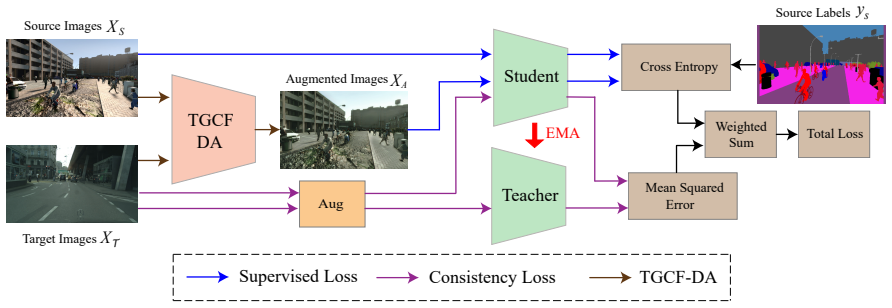
The central object is TGCF-DA, a target-guided, cycle-free GAN generator. It decomposes a source image into content and style, injects target style statistics through adaptive instance normalization (AdaIN), and is trained with an adversarial loss plus a semantic constraint: a pretrained, fixed segmentation network applied to the generated image must predict the original source label map via cross-entropy. The second component is self-ensembling, a mean-teacher setup in which the teacher is an exponential moving average of the student weights; the student is trained on source and augmented images with cross-entropy and on target images with a consistency loss that penalizes disagreement between student and teacher softmax predictions, with Gaussian noise and dropout providing perturbation.
What would settle it
Take a class where the source-only model is known to fail, such as a rare class like 'bus' in GTA5, and inspect TGCF-DA's augmented images for that class: if the fixed segmentation model mislabels most instances, the semantic constraint is not preserving the source labels, and self-ensembling should propagate those errors into lower final IoU for that class.
Extended reading notes
Core claim
The paper claims that unsupervised domain adaptation for semantic segmentation can be decomposed into two complementary steps and that neither alone is sufficient. Self-ensembling alone improves the source-only baseline by only a few mIoU points, and TGCF-DA alone improves it by 7–11 points; together they reach the reported state-of-the-art numbers. The load-bearing mechanism is that TGCF-DA creates augmented images that are visually in the target style but carry source labels, and the self-ensembling student–teacher pair transfers knowledge from those images to real target images. The teacher weights are an exponential moving average of the student weights; the student is supervised on source and augmented images by cross-entropy and on target images by mean squared error between its softmax predictions and the teacher's.
Load-bearing premise
The whole augmented-data pipeline assumes that a segmentation model trained only on source data gives trustworthy pixel-level labels for style-transferred images, so the semantic constraint keeps generated labels correct; if that source-only model is wrong on a class, the augmented images are mislabeled and teacher-student training can amplify the error.
Editorial extensions
If this is right
- If the central claim holds, a model trained on labeled synthetic data and unlabeled real images can be improved without adversarial feature alignment, since the generator is trained separately and the segmentation network never uses a domain-adversarial loss.
- Because the cycle-free generator needs no target-to-source mapping, the pipeline uses fewer translation modules than cycle-consistent baselines, reducing memory and training cost.
- The consistency loss between teacher and student concentrates on object boundaries in later training, so the method also refines boundary predictions on the target domain.
- Per-class results show the gains are concentrated in majority classes rather than minority ones, indicating that the teacher's pseudo-labels inherit and reinforce the class imbalance of the segmentation model.
Reading between the lines
- A natural testable extension is to modulate the semantic constraint by per-class confidence of the frozen source model; classes where the source model is unreliable should be down-weighted, which may reduce the risk of reinforcing wrong pseudo-labels.
- Because the failure modes of self-ensembling and GAN augmentation are largely orthogonal to adversarial feature alignment, combining TGCF-DA plus self-ensembling with an output-space adversarial loss may give further gains, though the paper does not study this.
- The method's success on synthetic-to-real suggests the same style-transfer-as-data-augmentation recipe could apply to other pixel-level tasks with cheap synthetic annotations, such as depth estimation or instance segmentation.
Signed reviews
Editorial analysis
A structured set of objections, weighed in public.
Referee Report
Summary. The manuscript proposes a two-component framework for unsupervised domain adaptation in semantic segmentation. The first component, TGCF-DA, trains a target-guided, cycle-free generator that translates source images into target style while a frozen source-only segmentation network f_seg enforces semantic consistency via the cross-entropy loss of Eq. (2). The second component is a Mean-Teacher-style self-ensembling procedure: a student and a teacher segmenter are trained with supervised loss on source and augmented images and with a consistency loss on target images under Gaussian noise and dropout perturbations. The framework is evaluated on GTA5→Cityscapes and SYNTHIA→Cityscapes, reporting 42.5 mIoU and 38.5 mIoU (46.6 mIoU*), respectively, exceeding the listed prior methods. Ablations in Section 4.4 show that self-ensembling and TGCF-DA each contribute to the final performance, and Section 5.3 reports sensitivity experiments for the ramp-up coefficient and EMA decay.
Significance. If the results are reproducible, the paper makes a useful empirical contribution to the UDA-for-segmentation literature. The two components are complementary rather than ad hoc, and the ablation and sensitivity analysis go beyond a single-table comparison. The paper also identifies a limitation of geometric-only self-ensembling for pixel-level tasks. However, the quantitative claims currently rest on a single seed per configuration, with hyperparameters selected on the same Cityscapes validation set used for evaluation, and the paper does not ship code or the promised supplementary with architecture details. Most importantly, the semantic-preservation assumption behind Eq. (2) is load-bearing and is not measured directly, only visualized. These issues bound confidence in the exact reported numbers, although the reported margin over prior SOTA is large.
major comments (3)
- [Section 3.2, Eq. (2)] The semantic constraint relies on a frozen source-only model f_seg to ensure that generated images retain source labels. This is not an independent content-preservation check. For categories where f_seg performs poorly (Table 1: wall 18.0, fence 19.6, bus 1.1, train 0.0 on GTA5→Cityscapes), the cross-entropy loss can be minimized by images that fool f_seg rather than by images that genuinely preserve source content. Those augmented images are then used as supervised training data with y_s, and the consistency loss of Eq. (6) can propagate any label noise through the teacher-student loop. The paper provides visual examples (Fig. 7) and a qualitative comparison (Fig. 8) but no quantitative label-preservation metric. Please report the per-class and overall mIoU of the fixed f_seg on original source images versus generated images, and discuss failure modes for minority classes.
- [Section 4.2 / 5.3 / Table 2] Hyperparameters for the final model, specifically the ramp-up coefficient δ0=30 and the EMA decay schedule (0.99 then 0.999), are selected using sensitivity runs on the same Cityscapes validation set that is later used to report all mIoU results. No separate validation split, cross-validation, or multiple-seed results are provided. Consequently the reported numbers are the result of in-sample model selection and may overstate expected performance on an unseen target domain. Please provide mean±std over at least three seeds and describe a hyperparameter-selection protocol that does not use the final evaluation set.
- [Section 4.2] Implementation details essential for reproducing the results are deferred to a supplementary that is not present in the submitted arXiv v1 version. The exact generator and discriminator architectures, optimization hyperparameters (learning rates, number of iterations, batch size), and the precise Gaussian-noise and dropout augmentation used for target samples are not fully specified in the main text. The statement that details will be available in the supplementary is insufficient for the version under review. Please integrate the missing details into the paper or provide the supplementary material with the revision.
minor comments (4)
- [Section 5.3] The formula δ = 1 + δ0 e^{-5(1-x)^2} is described as a 'sigmoid ramp-up', but it is a Gaussian-shaped schedule, not a sigmoid function. Please correct the terminology or the formula.
- [Table 2 caption] The caption contains a typo: 'Citysc-paes' should be 'Cityscapes'.
- [Section 3.4, Eq. (6)] The text does not state that the teacher's predictions are detached from the gradient graph. Since the teacher weights are updated by EMA rather than by gradients, it should be made explicit that the teacher is used as a fixed target for the consistency loss.
- [Section 4.4 / 5.2] The statement that 'SE shows the poor results' is imprecise because SE improves over the source-only baseline by 4.3 and 4.9 mIoU in Table 1; the intended claim appears to be that SE is much weaker than the full method. Please rephrase and, if possible, add error bars to the per-class gains in Fig. 6.
Circularity Check
No significant circularity: the headline mIoU is measured on external Cityscapes val labels, and the semantic constraint is an auxiliary loss rather than a fitted prediction.
full rationale
The proposed method is evaluated on the Cityscapes validation set, whose ground-truth annotations are external to the training procedure, so the reported 42.5/38.5 mIoU results are not forced by construction. The semantic constraint in Eq. (2) uses a fixed source-only FCN-8s to encourage the generator to preserve the source label distribution; this is a training objective, not a fitted parameter renamed as a prediction. If that fixed model is inaccurate on target-styled images, the augmented labels can be noisy, but that is a correctness/robustness limitation, not a circular derivation. The consistency loss in Eq. (6) is self-referential only in the standard teacher-student sense (the teacher is an EMA of the student), and the paper's central benchmark claim is independently measured against held-out labels. Hyperparameter choices for δ0, α, and λ_sem are made through sensitivity experiments on the same benchmark, which is a validation-set tuning concern rather than a circularity. There are no load-bearing self-citations: the cited architecture components (MUNIT-style generator, AdaIN, LSGAN, spectral normalization) are external prior work and are not used to justify the paper's own empirical result. The deferred supplementary implementation details are a completeness issue, not a circular step. Overall, no step of the derivation chain reduces to its own inputs, so the circularity score is 0.
Assumptions & free parameters
free parameters (3)
- λ_sem (semantic constraint weight) =
10
- δ0 (ramp-up coefficient for consistency loss) =
30
- EMA decay α schedule =
0.99 for first 37K iterations, 0.999 afterward
assumptions (4)
- domain assumption Images can be decomposed into disentangled content and style representations.
- ad hoc to paper A segmentation model pretrained on source images provides a reliable semantic constraint for generated images.
- domain assumption Consistency regularization on unlabeled target data improves target-domain generalization.
- ad hoc to paper Target-stylized augmented images reduce the domain gap without introducing harmful label noise.
Cite this review
Pith. "Pith review of Self-Ensembling with GAN-based Data Augmentation for Domain Adaptation in Semantic Segmentation." pith.science (2026). https://pith.science/paper/7IUKJNZP
@misc{pith2026190900589,
  author       = {Pith},
  title        = {Pith review of: Self-Ensembling with GAN-based Data Augmentation for Domain Adaptation in Semantic Segmentation},
  year         = {2026},
  howpublished = {\url{https://pith.science/paper/7IUKJNZP}},
  note         = {Machine review of arXiv:1909.00589}
}
read the original abstract
Deep learning-based semantic segmentation methods have an intrinsic limitation that training a model requires a large amount of data with pixel-level annotations. To address this challenging issue, many researchers give attention to unsupervised domain adaptation for semantic segmentation. Unsupervised domain adaptation seeks to adapt the model trained on the source domain to the target domain. In this paper, we introduce a self-ensembling technique, one of the successful methods for domain adaptation in classification. However, applying self-ensembling to semantic segmentation is very difficult because heavily-tuned manual data augmentation used in self-ensembling is not useful to reduce the large domain gap in the semantic segmentation. To overcome this limitation, we propose a novel framework consisting of two components, which are complementary to each other. First, we present a data augmentation method based on Generative Adversarial Networks (GANs), which is computationally efficient and effective to facilitate domain alignment. Given those augmented images, we apply self-ensembling to enhance the performance of the segmentation network on the target domain. The proposed method outperforms state-of-the-art semantic segmentation methods on unsupervised domain adaptation benchmarks.
Figures


Figures from the paper (5 more)


Reference graph
Works this paper leans on
-
[1]
Augmented Cy- cleGAN: Learning many-to-many mappings from unpaired data
Amjad Almahairi, Sai Rajeshwar, Alessandro Sordoni, Philip Bachman, and Aaron Courville. Augmented Cy- cleGAN: Learning many-to-many mappings from unpaired data. In Proceedings of the 35th International Conference on Machine Learning, pages 195–204, 2018
work page 2018
-
[2]
There are many consistent explana- tions of unlabeled data: Why you should average
Ben Athiwaratkun, Marc Finzi, Pavel Izmailov, and An- drew Gordon Wilson. There are many consistent explana- tions of unlabeled data: Why you should average. 2018
work page 2018
-
[3]
A theory of learning from different domains.Machine learn- ing, 79(1-2):151–175, 2010
Shai Ben-David, John Blitzer, Koby Crammer, Alex Kulesza, Fernando Pereira, and Jennifer Wortman Vaughan. A theory of learning from different domains.Machine learn- ing, 79(1-2):151–175, 2010
work page 2010
-
[4]
Liang-Chieh Chen, George Papandreou, Iasonas Kokkinos, Kevin Murphy, and Alan L Yuille. Deeplab: Semantic image segmentation with deep convolutional nets, atrous convolu- tion, and fully connected crfs. IEEE transactions on pattern analysis and machine intelligence, 40(4):834–848, 2018
work page 2018
-
[5]
Road: Reality ori- ented adaptation for semantic segmentation of urban scenes
Yuhua Chen, Wen Li, and Luc Van Gool. Road: Reality ori- ented adaptation for semantic segmentation of urban scenes. In Proceedings of the IEEE Conference on Computer Vision and Pattern Recognition, pages 7892–7901, 2018
2018
-
[6]
No more discrimina- tion: Cross city adaptation of road scene segmenters
Yi-Hsin Chen, Wei-Yu Chen, Yu-Ting Chen, Bo-Cheng Tsai, Yu-Chiang Frank Wang, and Min Sun. No more discrimina- tion: Cross city adaptation of road scene segmenters. In Pro- ceedings of the IEEE International Conference on Computer Vision, pages 1992–2001, 2017
work page 1992
-
[7]
The cityscapes dataset for semantic urban scene understanding
Marius Cordts, Mohamed Omran, Sebastian Ramos, Timo Rehfeld, Markus Enzweiler, Rodrigo Benenson, Uwe Franke, Stefan Roth, and Bernt Schiele. The cityscapes dataset for semantic urban scene understanding. In Proceed- ings of the IEEE conference on computer vision and pattern recognition, pages 3213–3223, 2016
2016
-
[8]
Domain stylization: A strong, simple baseline for synthetic to real image domain adapta- tion
Aysegul Dundar, Ming-Yu Liu, Ting-Chun Wang, John Zedlewski, and Jan Kautz. Domain stylization: A strong, simple baseline for synthetic to real image domain adapta- tion. arXiv preprint arXiv:1807.09384, 2018
arXiv 2018
Show all 57 references
-
[9]
Self- ensembling for visual domain adaptation
Geoff French, Michal Mackiewicz, and Mark Fisher. Self- ensembling for visual domain adaptation. In International Conference on Learning Representations, 2018
2018
-
[10]
Im- age style transfer using convolutional neural networks
Leon A Gatys, Alexander S Ecker, and Matthias Bethge. Im- age style transfer using convolutional neural networks. In Proceedings of the IEEE Conference on Computer Vision and Pattern Recognition, pages 2414–2423, 2016
2016
-
[11]
Image-to-image translation for cross-domain disentan- glement
Abel Gonzalez-Garcia, Joost van de Weijer, and Yoshua Ben- gio. Image-to-image translation for cross-domain disentan- glement. In Advances in Neural Information Processing Sys- tems, pages 1294–1305, 2018
2018
-
[12]
Generative adversarial nets
Ian Goodfellow, Jean Pouget-Abadie, Mehdi Mirza, Bing Xu, David Warde-Farley, Sherjil Ozair, Aaron Courville, and Yoshua Bengio. Generative adversarial nets. In Advances in neural information processing systems, pages 2672–2680, 2014
2014
-
[13]
Deep residual learning for image recognition
Kaiming He, Xiangyu Zhang, Shaoqing Ren, and Jian Sun. Deep residual learning for image recognition. In Proceed- ings of the IEEE conference on computer vision and pattern recognition, pages 770–778, 2016
2016
-
[14]
CyCADA: Cycle-consistent adversarial domain adaptation
Judy Hoffman, Eric Tzeng, Taesung Park, Jun-Yan Zhu, Phillip Isola, Kate Saenko, Alexei Efros, and Trevor Darrell. CyCADA: Cycle-consistent adversarial domain adaptation. In Proceedings of the 35th International Conference on Ma- chine Learning, pages 1989–1998, 2018
1989
-
[15]
Fcns in the wild: Pixel-level adversarial and constraint-based adaptation
Judy Hoffman, Dequan Wang, Fisher Yu, and Trevor Darrell. Fcns in the wild: Pixel-level adversarial and constraint-based adaptation. arXiv preprint arXiv:1612.02649, 2016
2016 arXiv
-
[16]
Conditional generative adversarial network for struc- tured domain adaptation
Weixiang Hong, Zhenzhen Wang, Ming Yang, and Junsong Yuan. Conditional generative adversarial network for struc- tured domain adaptation. In Proceedings of the IEEE Con- ference on Computer Vision and Pattern Recognition, pages 1335–1344, 2018
2018
-
[17]
Augmented cyclic adversarial learning for low resource domain adaptation
Ehsan Hosseini-Asl, Yingbo Zhou, Caiming Xiong, and Richard Socher. Augmented cyclic adversarial learning for low resource domain adaptation. In International Confer- ence on Learning Representations, 2019
2019
-
[18]
Domain transfer through deep activation matching
Haoshuo Huang, Qixing Huang, and Philipp Krahenbuhl. Domain transfer through deep activation matching. In Pro- ceedings of the European Conference on Computer Vision (ECCV), pages 590–605, 2018
2018
-
[19]
Auggan: Cross do- main adaptation with gan-based data augmentation
Sheng-Wei Huang, Che-Tsung Lin, Shu-Ping Chen, Yen-Yi Wu, Po-Hao Hsu, and Shang-Hong Lai. Auggan: Cross do- main adaptation with gan-based data augmentation. In Pro- ceedings of the European Conference on Computer Vision (ECCV), pages 718–731, 2018
2018
-
[20]
Arbitrary style transfer in real-time with adaptive instance normalization
Xun Huang and Serge Belongie. Arbitrary style transfer in real-time with adaptive instance normalization. In Proceed- ings of the IEEE International Conference on Computer Vi- sion, pages 1501–1510, 2017
2017
-
[21]
Multimodal unsupervised image-to-image translation
Xun Huang, Ming-Yu Liu, Serge Belongie, and Jan Kautz. Multimodal unsupervised image-to-image translation. In Proceedings of the European Conference on Computer Vi- sion (ECCV), pages 172–189, 2018
2018
-
[22]
Perceptual losses for real-time style transfer and super-resolution
Justin Johnson, Alexandre Alahi, and Li Fei-Fei. Perceptual losses for real-time style transfer and super-resolution. In European conference on computer vision , pages 694–711. Springer, 2016
2016
-
[23]
Learning to discover cross-domain relations with generative adversarial networks
Taeksoo Kim, Moonsu Cha, Hyunsoo Kim, Jung Kwon Lee, and Jiwon Kim. Learning to discover cross-domain relations with generative adversarial networks. In Proceedings of the 34th International Conference on Machine Learning-Volume 70, pages 1857–1865. JMLR. org, 2017
2017
-
[24]
Temporal ensembling for semi- supervised learning
Samuli Laine and Timo Aila. Temporal ensembling for semi- supervised learning. arXiv preprint arXiv:1610.02242, 2016
2016 arXiv
-
[25]
Diverse image-to-image translation via disentangled representations
Hsin-Ying Lee, Hung-Yu Tseng, Jia-Bin Huang, Maneesh Singh, and Ming-Hsuan Yang. Diverse image-to-image translation via disentangled representations. In Proceedings of the European Conference on Computer Vision (ECCV) , pages 35–51, 2018
2018
-
[26]
Alice: To- wards understanding adversarial learning for joint distribu- tion matching
Chunyuan Li, Hao Liu, Changyou Chen, Yuchen Pu, Liqun Chen, Ricardo Henao, and Lawrence Carin. Alice: To- wards understanding adversarial learning for joint distribu- tion matching. In Advances in Neural Information Process- ing Systems, pages 5495–5503, 2017
2017
-
[27]
Unsupervised image-to-image translation networks
Ming-Yu Liu, Thomas Breuel, and Jan Kautz. Unsupervised image-to-image translation networks. In Advances in Neural Information Processing Systems, pages 700–708, 2017
2017
-
[28]
Pixel level data augmentation for semantic image segmentation using generative adversar- ial networks
Shuangting Liu, Jiaqi Zhang, Yuxin Chen, Yifan Liu, Zengchang Qin, and Tao Wan. Pixel level data augmentation for semantic image segmentation using generative adversar- ial networks. arXiv preprint arXiv:1811.00174, 2018
2018 arXiv
-
[29]
Fully convolutional networks for semantic segmentation
Jonathan Long, Evan Shelhamer, and Trevor Darrell. Fully convolutional networks for semantic segmentation. In Pro- ceedings of the IEEE conference on computer vision and pat- tern recognition, pages 3431–3440, 2015
2015
-
[30]
Deep photo style transfer
Fujun Luan, Sylvain Paris, Eli Shechtman, and Kavita Bala. Deep photo style transfer. In Proceedings of the IEEE Con- ference on Computer Vision and Pattern Recognition, pages 4990–4998, 2017
2017
-
[31]
Exemplar guided unsupervised image-to- image translation with semantic consistency
Liqian Ma, Xu Jia, Stamatios Georgoulis, Tinne Tuytelaars, and Luc Van Gool. Exemplar guided unsupervised image-to- image translation with semantic consistency. InInternational Conference on Learning Representations, 2019
2019
-
[32]
Least squares generative adversarial networks
Xudong Mao, Qing Li, Haoran Xie, Raymond YK Lau, Zhen Wang, and Stephen Paul Smolley. Least squares generative adversarial networks. In Proceedings of the IEEE Interna- tional Conference on Computer Vision , pages 2794–2802, 2017
2017
-
[33]
Spectral normalization for generative ad- versarial networks
Takeru Miyato, Toshiki Kataoka, Masanori Koyama, and Yuichi Yoshida. Spectral normalization for generative ad- versarial networks. In International Conference on Learning Representations, 2018
2018
-
[34]
Image to image translation for domain adaptation
Zak Murez, Soheil Kolouri, David Kriegman, Ravi Ra- mamoorthi, and Kyungnam Kim. Image to image translation for domain adaptation. In Proceedings of the IEEE Con- ference on Computer Vision and Pattern Recognition, pages 4500–4509, 2018
2018
-
[35]
Unsupervised domain adaptation for medical imaging segmentation with self-ensembling
Christian S Perone, Pedro Ballester, Rodrigo C Barros, and Julien Cohen-Adad. Unsupervised domain adaptation for medical imaging segmentation with self-ensembling. arXiv preprint arXiv:1811.06042, 2018
2018 arXiv
-
[36]
Playing for data: Ground truth from computer games
Stephan R Richter, Vibhav Vineet, Stefan Roth, and Vladlen Koltun. Playing for data: Ground truth from computer games. In European Conference on Computer Vision, pages 102–118. Springer, 2016
2016
-
[37]
The synthia dataset: A large collection of synthetic images for semantic segmentation of urban scenes
German Ros, Laura Sellart, Joanna Materzynska, David Vazquez, and Antonio M Lopez. The synthia dataset: A large collection of synthetic images for semantic segmentation of urban scenes. In Proceedings of the IEEE conference on computer vision and pattern recognition, pages 323...
2016
-
[38]
Semi-supervised self-training of object detection models
Chuck Rosenberg, Martial Hebert, and Henry Schneiderman. Semi-supervised self-training of object detection models. In Proceedings of the Seventh IEEE Workshops on Application of Computer Vision (WACV/MOTION’05) - Volume 1 - Vol- ume 01, pages 29–36. IEEE Computer Society, 2005
2005
-
[39]
Maximum classifier discrepancy for unsuper- vised domain adaptation
Kuniaki Saito, Kohei Watanabe, Yoshitaka Ushiku, and Tat- suya Harada. Maximum classifier discrepancy for unsuper- vised domain adaptation. In Proceedings of the IEEE Con- ference on Computer Vision and Pattern Recognition, pages 3723–3732, 2018
2018
-
[40]
Regularization with stochastic transformations and pertur- bations for deep semi-supervised learning
Mehdi Sajjadi, Mehran Javanmardi, and Tolga Tasdizen. Regularization with stochastic transformations and pertur- bations for deep semi-supervised learning. In Advances in Neural Information Processing Systems , pages 1163–1171, 2016
2016
-
[41]
Learning from synthetic data: Addressing domain shift for semantic segmentation
Swami Sankaranarayanan, Yogesh Balaji, Arpit Jain, Ser Nam Lim, and Rama Chellappa. Learning from synthetic data: Addressing domain shift for semantic segmentation. In Proceedings of the IEEE Conference on Computer Vision and Pattern Recognition, pages 3752–3761, 2018
2018
-
[42]
Dropout: a simple way to prevent neural networks from overfitting
Nitish Srivastava, Geoffrey Hinton, Alex Krizhevsky, Ilya Sutskever, and Ruslan Salakhutdinov. Dropout: a simple way to prevent neural networks from overfitting. The Journal of Machine Learning Research, 15(1):1929–1958, 2014
1929
-
[43]
Mean teachers are better role models: Weight-averaged consistency targets improve semi-supervised deep learning results
Antti Tarvainen and Harri Valpola. Mean teachers are better role models: Weight-averaged consistency targets improve semi-supervised deep learning results. In Advances in neural information processing systems, pages 1195–1204, 2017
2017
-
[44]
Learning to adapt structured output space for semantic seg- mentation
Yi-Hsuan Tsai, Wei-Chih Hung, Samuel Schulter, Ki- hyuk Sohn, Ming-Hsuan Yang, and Manmohan Chandraker. Learning to adapt structured output space for semantic seg- mentation. In Proceedings of the IEEE Conference on Com- puter Vision and Pattern Recognition , pages 7472–7481, 2018
2018
-
[45]
In- stance normalization: The missing ingredient for fast styliza- tion
Dmitry Ulyanov, Andrea Vedaldi, and Victor Lempitsky. In- stance normalization: The missing ingredient for fast styliza- tion. arXiv preprint arXiv:1607.08022, 2016
2016 arXiv
-
[46]
High-resolution image syn- thesis and semantic manipulation with conditional gans
Ting-Chun Wang, Ming-Yu Liu, Jun-Yan Zhu, Andrew Tao, Jan Kautz, and Bryan Catanzaro. High-resolution image syn- thesis and semantic manipulation with conditional gans. In Proceedings of the IEEE Conference on Computer Vision and Pattern Recognition, pages 8798–8807, 2018
2018
-
[47]
Dcan: Dual channel-wise alignment networks for un- supervised scene adaptation
Zuxuan Wu, Xintong Han, Yen-Liang Lin, Mustafa Gokhan Uzunbas, Tom Goldstein, Ser Nam Lim, and Larry S Davis. Dcan: Dual channel-wise alignment networks for un- supervised scene adaptation. In Proceedings of the Euro- pean Conference on Computer Vision (ECCV) , pages 518– 534, 2018
2018
-
[48]
Self-ensembling attention net- works: Addressing domain shift for semantic segmentation
Yonghao Xu, Bo Du, Lefei Zhang, Qian Zhang, Guoli Wang, and Liangpei Zhang. Self-ensembling attention net- works: Addressing domain shift for semantic segmentation. In Thirty-Third AAAI Conference on Artificial Intelligence , 2019
2019
-
[49]
Dual- gan: Unsupervised dual learning for image-to-image transla- tion
Zili Yi, Hao Zhang, Ping Tan, and Minglun Gong. Dual- gan: Unsupervised dual learning for image-to-image transla- tion. In Proceedings of the IEEE International Conference on Computer Vision, pages 2849–2857, 2017
2017
-
[50]
Bdd100k: A diverse driving video database with scalable annotation tool- ing
Fisher Yu, Wenqi Xian, Yingying Chen, Fangchen Liu, Mike Liao, Vashisht Madhavan, and Trevor Darrell. Bdd100k: A diverse driving video database with scalable annotation tool- ing. arXiv preprint arXiv:1805.04687, 2018
2018 arXiv
-
[51]
Curricu- lum domain adaptation for semantic segmentation of urban scenes
Yang Zhang, Philip David, and Boqing Gong. Curricu- lum domain adaptation for semantic segmentation of urban scenes. In Proceedings of the IEEE International Conference on Computer Vision, pages 2020–2030, 2017
2020
-
[52]
Fully convolutional adaptation networks for seman- tic segmentation
Yiheng Zhang, Zhaofan Qiu, Ting Yao, Dong Liu, and Tao Mei. Fully convolutional adaptation networks for seman- tic segmentation. In Proceedings of the IEEE Conference on Computer Vision and Pattern Recognition , pages 6810– 6818, 2018
2018
-
[53]
Unpaired image-to-image translation using cycle- consistent adversarial networks
Jun-Yan Zhu, Taesung Park, Phillip Isola, and Alexei A Efros. Unpaired image-to-image translation using cycle- consistent adversarial networks. In Proceedings of the IEEE International Conference on Computer Vision, pages 2223– 2232, 2017
2017
-
[54]
To- ward multimodal image-to-image translation
Jun-Yan Zhu, Richard Zhang, Deepak Pathak, Trevor Dar- rell, Alexei A Efros, Oliver Wang, and Eli Shechtman. To- ward multimodal image-to-image translation. In Advances in Neural Information Processing Systems , pages 465–476, 2017
2017
-
[55]
Penalizing top performers: Conservative loss for semantic segmentation adaptation
Xinge Zhu, Hui Zhou, Ceyuan Yang, Jianping Shi, and Dahua Lin. Penalizing top performers: Conservative loss for semantic segmentation adaptation. In Proceedings of the Eu- ropean Conference on Computer Vision (ECCV), pages 568– 583, 2018
2018
-
[56]
Semi-supervised learning literature sur- vey
Xiaojin Jerry Zhu. Semi-supervised learning literature sur- vey. Technical report, University of Wisconsin-Madison De- partment of Computer Sciences, 2005
2005
-
[57]
Unsupervised domain adaptation for semantic seg- mentation via class-balanced self-training
Yang Zou, Zhiding Yu, BVK Vijaya Kumar, and Jinsong Wang. Unsupervised domain adaptation for semantic seg- mentation via class-balanced self-training. In Proceedings of the European Conference on Computer Vision (ECCV) , pages 289–305, 2018
2018
Reviewed August 14, 2026 · model on record in the stance chip above.
Discussion (0). Continue with ORCID to comment.