REVIEW 6 minor 76 references
Multiscale Modeling, Homogenization and Nonlocal Effects: Mathematical and Computational Issues
T0 review · 0 major / 6 minor · reviewed 2026-08-14 · deepseek-v4-flash
Pith's one-line read Nonlocal operators are the generic homogenization limit of local differential equations.
desk verdict A solid, honest survey with real but modest new examples; the generic nonlocality thesis holds, though the Section 2.3 characterization is conditional. read the letter →
The pith
A machine-rendered reading of the paper's core claim, the machinery that carries it, and where it could break.
The reading
What carries the argument
The load-bearing mechanism is the Peetre theorem combined with the Fourier symbol, or dispersion relation. Peetre's theorem says a local linear operator has finite-order differential form; for a translation-invariant operator this forces its Fourier symbol to be a polynomial in the wave number. Consequently, any effective operator whose symbol is not a polynomial, such as the first Bloch eigenvalue $\lambda_0(k)$ of a periodic elliptic operator, is necessarily nonlocal. To turn this into a model, the paper sets up equation (2.19), $\int \gamma(s)(1-e^{2\pi i k\cdot s})\,ds = \lambda_0(k)$, and constructs the nonlocal interaction kernel $\gamma$ from the dispersion relation, then rescales it as $\gamma^\epsilon(s)=\epsilon^{-d-2}\gamma(s/\epsilon)$. In the numerical-homogenization examples, the analogous mechanism is the Schur complement: eliminating fine degrees of freedom turns a sparse local matrix into a dense, exponentially decaying coupling, i.e., a discrete nonlocal operator.
What would settle it
Take a one-dimensional periodic two-material composite, compute the first Bloch eigenvalue $\lambda_0(k)$ on the Brillouin zone, extend it smoothly to $1$ outside, and numerically Fourier-invert $1-\lambda_0(k)$ to obtain candidate kernels $\gamma$. If every admissible kernel decays only algebraically, fails to be integrable, or changes sign in a way that violates the intended interaction structure, then the paper's claim that smoothness of the symbol 'naturally indicates' a compactly supported or fast-decaying kernel is refuted; equivalently, the nonlocal effective wave equation would lose its practical appeal.
Extended reading notes
Core claim
On its own terms, the paper's central discovery is that nonlocality is not a pathology but the generic output of homogenization and model reduction of local equations, and that the classical local homogenized PDEs are special cases. The argument rests on a theorem of Peetre: a translation-invariant operator that is local must have a polynomial Fourier symbol, or dispersion relation; therefore any effective operator with a non-polynomial symbol is necessarily nonlocal. Working from this, the paper shows that the homogenized limit of a simple two-scale elliptic-PDE operator has a symbol that is not a polynomial unless the coefficient is essentially constant, that wave propagation in periodic media is better approximated for all times by the nonlocal operator whose symbol is the first Bloch eigenvalue than by the classical homogenized wave equation, and that projection, Schur-complement, and lattice-coarse-graining reductions produce discrete nonlocal kernels with exponential or super-algebraic decay. The same mechanism appears in time through Tartar's memory effect and the Mori-Zwanzig formalism, where reduced dynamics carry convolution memory terms that can sometimes be localized by adding auxiliary variables, but the nonlocal form is the intrinsic one.
Load-bearing premise
The load-bearing assumption is that the first Bloch eigenvalue $\lambda_0(k)$, after being smoothly extended to $1$ outside the Brillouin zone, Fourier-inverts to a nonlocal kernel that has compact support or fast decay; the paper states this is 'naturally indicated' but does not prove it, and the defining equation admits more than one kernel, so the practical utility of the nonlocal surrogate depends on this unproved regularity.
Editorial extensions
If this is right
- If the homogenized symbol is non-polynomial, matching it with a local PDE is at best a low-order approximation; long-time or high-frequency behavior requires the nonlocal surrogate.
- The first Bloch eigenvalue gives a constructive, parameter-free way to build an $\epsilon$-dependent nonlocal effective wave equation that tracks the true wave for all time with error $O(\epsilon)$, unlike classical homogenization or truncated dispersive PDEs.
- Numerical homogenization by Schur complement or corrector projection produces coarse-grid operators that are dense but have exponentially decaying kernels; localization of basis functions is justified precisely when this decay holds, and high-contrast media may break it.
- Memory terms from coarse-graining dynamics are intrinsic; exponential kernels can be localized by introducing extra variables, giving a bridge from nonlocal models to extended-state local models.
- The dispersion-relation test, asking whether the symbol is a polynomial, can serve as a general diagnostic for whether a proposed effective model is genuinely local or must be treated as nonlocal.
Reading between the lines
- The polynomial-symbol criterion suggests a practical diagnostic for model reduction: compute the effective dispersion relation numerically, for example from Bloch waves or transfer matrices, and check whether it is algebraic; generically it will not be, so a local surrogate should be treated as an approximation with a quantifiable bandwidth limit.
- Because equation (2.19) admits multiple kernels, one could exploit the freedom to enforce desired kernel properties, such as positivity, compact support, or a chosen horizon, by adding null-space terms that vanish on the Brillouin zone; this may make dispersion-based kernel construction useful for designing peridynamic-type models from measured or computed data.
- In high-contrast or strongly heterogeneous media, where exponential decay of Schur-complement kernels can fail, the decay rate of the effective kernel itself becomes an observable indicator of how nonlocal the problem really is; measuring that rate may inform whether localization is safe.
- A natural testable extension is to random or quasiperiodic media: if the homogenized symbol remains non-polynomial almost surely, then the generic-nonlocality claim extends beyond the periodic examples treated here.
Editorial analysis
A structured set of objections, weighed in public.
Referee Report
Summary. This manuscript is a review article that develops the thesis that nonlocal operators arise generically from homogenization and model reduction of local differential equations. The authors use Peetre's theorem to observe that translation-invariant local operators must have polynomial Fourier symbols, so any effective operator with a non-polynomial symbol is nonlocal. They present a one-dimensional worked example in §2.2 in which homogenization in x of an operator with mixed derivatives yields a homogenized symbol that is genuinely non-polynomial in the Fourier variable k, thereby rigorously exhibiting a nonlocal homogenized limit. They also discuss a Bloch-wave-based construction of a nonlocal effective wave equation (§2.3), Tartar's memory-effect example (§2.1), Schur-complement/LOD equivalences (§3.1), MsFEM/HMM (§3.2), a coarse-grained lattice model (§3.3), and the Mori–Zwanzig formalism (§3.4), followed by open questions on asymptotically compatible schemes.
Significance. The paper's main mathematical contribution is the clean Peetre-theorem criterion and the explicit example in §2.2, which is complete and correct. The equivalence between the projection/Schur-complement homogenized system (3.1) and the LOD formulation (3.3) is also carefully derived and is a useful observation. The survey nature of the paper is a strength: it connects disparate literatures (analytical homogenization, numerical homogenization, nonlocal modeling, and molecular coarse graining) and gives specific, falsifiable expectations about when nonlocal operators should arise. The authors are honest about limitations, explicitly noting the non-uniqueness of kernels satisfying (2.19) and the heuristic nature of the smooth-extension step. If the review claims are accepted, the paper will be a valuable reference for researchers in multiscale modeling and nonlocal methods.
minor comments (6)
- [2.3] In the paragraph following Eq. (2.19), the statement that 'The smoothness of 1 − λ0(k) for large k naturally indicates the possibility of a kernel γ with a compact support or fast decay' is imprecise for the construction described: if λ0 is smoothly extended to 1 outside Z, then 1 − λ0 has compact support, so its inverse Fourier transform is entire and can only be rapidly decaying, not compactly supported; please clarify that compactly supported kernels would require a different choice of solution to (2.19).
- [3.3] Section 3.3 attributes the main results on the coarse-grained lattice kernel (super-algebraic decay, sign properties, and the convergence of the rescaled kernel in (3.11)) to the unpublished preprint [26]; the transparency of the review would be improved by stating the provenance of these results and whether they are proven or numerically observed.
- [1.1] The statement that 'local operators are differential operators of finite order' is a consequence of the globally finite order version of Peetre's theorem cited as [10]; please remind the reader that the classical Peetre theorem yields locally finite sums, to avoid overstating the classical result.
- [2.2] In the expansion (2.8), the convergence of the geometric series relies on |a|/(1+k^2) < 1, which follows from |a| ≤ c0 < 1; it would be helpful to state this explicitly since the subsequent infinite series manipulations require uniform convergence in k.
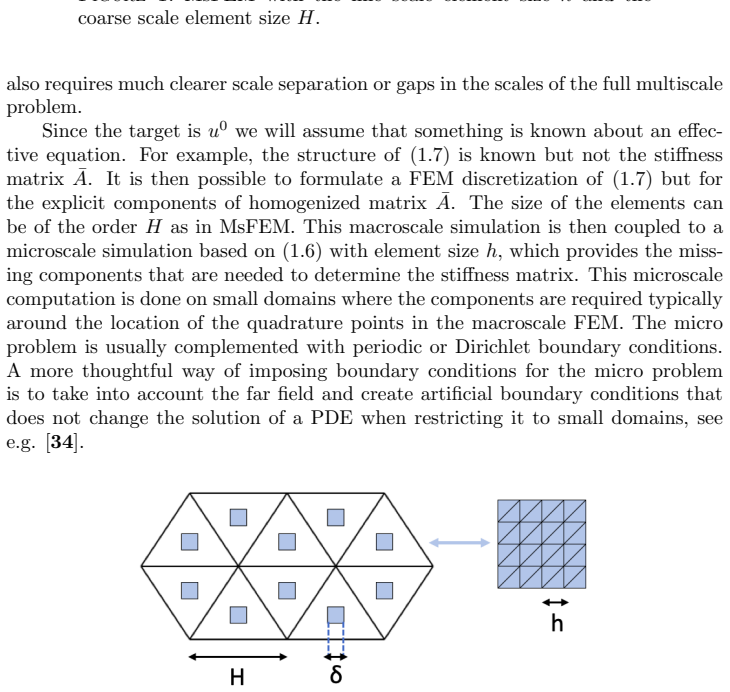
- [3.2] The sentence about the Heterogeneous Multiscale Method being 'similar to the nonlocal version of the quasicontinuum method [66]' would benefit from a specific reference to a nonlocal quasicontinuum formulation, as the cited [66] is the classical local quasicontinuum method.
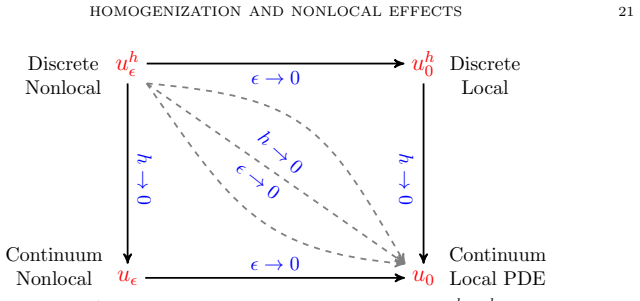
- [4.3] In Figure 3, the label 'Discrete Nonlocal' and the surrounding text use 'nonlocal' to denote both the continuum model and the discrete approximation; consider distinguishing 'nonlocal continuum model' from 'nonlocal discrete approximation' to avoid ambiguity.
Circularity Check
No circular derivation: the homogenized nonlocal operators come from independent symbol/Bloch/Schur-complement computations. The only self-citation burden is Section 3.3's lattice decay claim, which cites an unpublished preprint by the first author but is not load-bearing for the central thesis.
-
other
[Section 3.3, after Eq. (3.10)]
"it was shown in [26] that the resulting nonlocal interaction through the coarse-graining has no compact support but decays faster than any algebraic power, that is, θ(y) = o(|y|−s) for any s >0. The numerical test in fact suggested that θ decays exponentially."
The quantitative decay characterization of the coarse-grained lattice kernel is imported entirely from [26], an unpublished preprint whose first author is the present paper's first author, and no proof is reproduced in this paper. This is a self-citation used as evidence, and the paper also relies on a numerically verified postulation from [26] for the moment relation. It is not a circular derivation of the central claim: Section 3.1 independently establishes nonlocality through the explicit Schur-complement identity, and Sections 2.2-2.3 give self-contained symbol and Bloch arguments. The self-citation is therefore minor and locally load-bearing rather than a reduction of the paper's main result to its own input.
full rationale
The paper's derivation chain is largely self-contained. Section 1.1 uses the classical Peetre theorem to obtain the criterion that a translation-invariant local operator must have a polynomial Fourier symbol. Section 2.2 applies this criterion to an explicitly computed homogenized symbol bbar(k), which is shown to be generically non-polynomial, so the homogenized limit is nonlocal. Section 2.3 constructs a nonlocal wave equation from the first Bloch eigenvalue lambda_0(k) via Eq. (2.19); the non-polynomial nature of lambda_0 is an independent property of the periodic elliptic operator, not an input disguised as an output. The construction is acknowledged to be non-unique, and the compact-support/fast-decay claim rests on an unproved smooth-extension assumption; these are robustness caveats, not circularity. Sections 3.1 and 3.4 derive nonlocality from Schur complements and the Mori-Zwanzig formalism, which are standard algebraic identities. The only notable burden is Section 3.3, where the super-algebraic decay of the coarse-grained lattice kernel and a moment relation are attributed to [26], an unpublished preprint by the present first author; this is a minor self-citation that does not support the central claim by itself, since nonlocality of model reduction is established independently in Section 3.1 and by external results such as Tartar, Mosco, and Santosa-Symes. No prediction in the paper reduces to its inputs by construction.
Assumptions & free parameters
free parameters (1)
- Smooth extension of λ0(k) outside the Brillouin zone
assumptions (5)
- standard math Peetre theorem: every linear operator satisfying supp(Lu) ⊂ supp(u) is a differential operator with smooth coefficients.
- standard math Schwartz kernel theorem: continuous linear maps from test functions to distributions have distributional kernels.
- domain assumption Classical periodic homogenization convergence: for uniformly elliptic periodic coefficients, solutions of (1.6) converge to solutions of the homogenized equation (1.7).
- domain assumption Bloch wave expansion and the estimate that the first mode approximates the full wave solution to O(ε) for all times.
- domain assumption Coercivity and boundedness of the bilinear form in Section 3.1.
Cite this review
Pith. "Pith review of Multiscale Modeling, Homogenization and Nonlocal Effects: Mathematical and Computational Issues." pith.science (2026). https://pith.science/paper/6J6CCYJS
@misc{pith2026190900708,
  author       = {Pith},
  title        = {Pith review of: Multiscale Modeling, Homogenization and Nonlocal Effects: Mathematical and Computational Issues},
  year         = {2026},
  howpublished = {\url{https://pith.science/paper/6J6CCYJS}},
  note         = {Machine review of arXiv:1909.00708}
}
read the original abstract
In this work, we review the connection between the subjects of homogenization and nonlocal modeling and discuss the relevant computational issues. By further exploring this connection, we hope to promote the cross fertilization of ideas from the different research fronts. We illustrate how homogenization may help characterizing the nature and the form of nonlocal interactions hypothesized in nonlocal models. We also offer some perspective on how studies of nonlocality may help the development of more effective numerical methods for homogenization.
Figures

Reference graph
Works this paper leans on
-
[26]
Qiang Du, Xiantao Li, and Liming Yuan, Analysis of coarse-grained lattice models and con- nections to nonlocal interactions, preprint (2019)
work page 2019
-
[1]
Assyr Abdulle and Ondrej Bud´ aˇ c,A reduced basis finite element heterogeneous multiscale method for stokes flow in porous media , Computer Methods in Applied Mechanics and Engi- neering 307 (2016), 1–31
work page 2016
-
[2]
Assyr Abdulle, E Weinan, Bj¨ orn Engquist, and Eric Vanden-Eijnden, The heterogeneous multiscale method, Acta Numerica 21 (2012), 1–87
work page 2012
- [3]
-
[4]
Doghonay Arjmand and Olof Runborg, A time dependent approach for removing the cell boundary error in elliptic homogenization problems , Journal of Computational Physics 314 (2016), 206–227
work page 2016
-
[5]
Michel Bellieud and Isabelle Gruais, Homogenization of an elastic material reinforced by very stiff or heavy fibers. non-local effects. memory effects , Journal de math´ ematiques pures et appliqu´ ees84 (2005), no. 1, 55–96
work page 2005
-
[6]
374, American Mathematical Soc., 2011
Alain Bensoussan, Jacques-Louis Lions, and George Papanicolaou, Asymptotic analysis for periodic structures, vol. 374, American Mathematical Soc., 2011
work page 2011
-
[7]
Arne Beurling and Jacques Deny, Dirichlet spaces, Proceedings of the National Academy of Sciences of the United States of America 45 (1959), no. 2, 208
work page 1959
Show all 76 references
-
[8]
Bobaru, J
F. Bobaru, J. Foster, P. Geubelle, and S. Silling, Handbook of peridynamic modeling , CRC Press, 2016
2016
-
[9]
3, 197–231
Safia Brahim-Otsmane, Gilles A Francfort, and Fran¸ cois Murat, Correctors for the homoge- nization of the wave and heat equations , Journal de math´ ematiques pures et appliqu´ ees71 (1992), no. 3, 197–231
1992
-
[10]
3, 279–319
Ola Bratteli, George A Elliott, and Derek W Robinson, The characterization of differential operators by locality: classical flows , Compositio mathematica 58 (1986), no. 3, 279–319
1986
-
[11]
3-4, 681–711
Marc Briane and Nicoletta Tchou, Fibered microstructures for some nonlocal Dirichlet forms, Annali della Scuola Normale Superiore di Pisa-Classe di Scienze 30 (2001), no. 3-4, 681–711
2001
-
[12]
3, 4, 259–276
Mohamed Camar-Eddine and Graeme W Milton, Non-local interactions in the homogenization closure of thermoelectric functionals , Asymptotic Analysis 41 (2005), no. 3, 4, 259–276
2005
-
[13]
2, 020601
Michele Ceriotti, Giovanni Bussi, and Michele Parrinello, Langevin equation with colored noise for constant-temperature molecular dynamics simulations, Physical review letters 102 (2009), no. 2, 020601
2009
-
[14]
7, 2968–2973
Alexandre J Chorin, Ole H Hald, and Raz Kupferman, Optimal prediction and the mori– zwanzig representation of irreversible processes, Proceedings of the National Academy of Sci- ences 97 (2000), no. 7, 2968–2973
2000
-
[15]
CI Christov, GA Maugin, and MG Velarde,Well-posed boussinesq paradigm with purely spatial higher-order derivatives, Physical Review E 54 (1996), no. 4, 3621
1996
-
[16]
2, 378–398
Weiqi Chu and Xiantao Li, On the asymptotic behavior of the kernel function in the gener- alized langevin equation: A one-dimensional lattice model , Journal of Statistical Physics 170 (2018), no. 2, 378–398
2018
-
[17]
HOMOGENIZATION AND NONLOCAL EFFECTS 23
Eric Chung, Yalchin Efendiev, and Thomas Y Hou, Adaptive multiscale model reduction with generalized multiscale finite element methods , Journal of Computational Physics 320 (2016), 69–95. HOMOGENIZATION AND NONLOCAL EFFECTS 23
2016
-
[18]
Eric T Chung, Yalchin Efendiev, and Wing Tat Leung,Fast online generalized multiscale finite element method using constraint energy minimization, Journal of Computational Physics 355 (2018), 450–463
2018
-
[19]
5, 1166– 1198
Carlos Conca, Rafael Orive, and Muthusamy Vanninathan, Bloch approximation in homog- enization and applications , SIAM journal on mathematical analysis 33 (2002), no. 5, 1166– 1198
2002
-
[20]
8, Springer Science & Business Media, 2012
Gianni Dal Maso, An introduction to Γ-convergence, vol. 8, Springer Science & Business Media, 2012
2012
-
[21]
2, 488–513
Tomas Dohnal, Agnes Lamacz, and Ben Schweizer, Bloch-wave homogenization on large time scales and dispersive effective wave equations , Multiscale Modeling & Simulation 12 (2014), no. 2, 488–513
2014
-
[22]
2, 540–559
Mihai Dorobantu and Bj¨ orn Engquist,Wavelet-based numerical homogenization, SIAM Jour- nal on Numerical Analysis 35 (1998), no. 2, 540–559
1998
-
[23]
94, SIAM, 2019
Qiang Du, Nonlocal modeling, analysis, and computation , CBMS-NSF regional conference series in Applied Mathematics, vol. 94, SIAM, 2019
2019
-
[24]
4, 667–696
Qiang Du, Max Gunzburger, Richard Lehoucq, and Kun Zhou, Analysis and approximation of nonlocal diffusion problems with volume constraints, SIAM Review 54 (2012), no. 4, 667–696. MR 3023366
2012
-
[25]
3, A1430–A1445
Qiang Du, Houde Han, Jiwei Zhang, and Chunxiong Zheng, Numerical solution of a two- dimensional nonlocal wave equation on unbounded domains, SIAM Journal on Scientific Com- puting 40 (2018), no. 3, A1430–A1445
2018
-
[27]
5, 1425–1455
Qiang Du, Robert Lipton, and Tadele Mengesha, Multiscale analysis of linear evolution equa- tions with applications to nonlocal models for heterogeneous media , ESAIM: Mathematical Modelling and Numerical Analysis 50 (2016), no. 5, 1425–1455
2016
-
[28]
Qiang Du, Yunzhe Tao, and Xiaochuan Tian, Nonlocal models with heterogeneous localization and their application to seamless local-nonlocal coupling, Multiscale Modeling and Simulations (2019)
2019
-
[29]
7, 1245–1260
Marta DElia and Max Gunzburger, The fractional laplacian operator on bounded domains as a special case of the nonlocal diffusion operator, Computers & Mathematics with Applications 66 (2013), no. 7, 1245–1260
2013
-
[30]
1, 87–132
Weinan E and Bjorn Engquist, The heterognous multiscale methods , Communications in Mathematical Sciences 1 (2003), no. 1, 87–132
2003
-
[31]
9, 1062– 1070
, Multiscale modeling and computation , Notices of the AMS 50 (2003), no. 9, 1062– 1070
2003
-
[32]
Yalchin Efendiev, Juan Galvis, and Thomas Y Hou, Generalized multiscale finite element methods (gmsfem), Journal of Computational Physics 251 (2013), 116–135
2013
-
[33]
4, Springer Science & Business Media, 2009
Yalchin Efendiev and Thomas Y Hou, Multiscale finite element methods: theory and applica- tions, vol. 4, Springer Science & Business Media, 2009
2009
-
[34]
5, 1765–1766
Bj¨ orn Engquist and Andrew Majda,Absorbing boundary conditions for numerical simulation of waves, Proceedings of the National Academy of Sciences 74 (1977), no. 5, 1765–1766
1977
-
[35]
Bj¨ orn Engquist and Olof Runborg, Wavelet-based numerical homogenization with applica- tions, Multiscale and multiresolution methods, Springer, 2002, pp. 97–148
2002
-
[36]
Bj¨ orn Engquist and Panagiotis E Souganidis, Asymptotic and numerical homogenization , Acta Numerica 17 (2008), 147–190
2008
-
[37]
3, 233–248
A Cemal Eringen and DGB Edelen, On nonlocal elasticity, International Journal of Engineer- ing Science 10 (1972), no. 3, 233–248
1972
-
[38]
3, 331–346
Jacob Fish, Wen Chen, and Gakuji Nagai, Non-local dispersive model for wave propagation in heterogeneous media: one-dimensional case , International Journal for Numerical Methods in Engineering 54 (2002), no. 3, 331–346
2002
-
[39]
4, 1530–1552
Dietmar Gallistl and Daniel Peterseim, Computation of quasi-local effective diffusion ten- sors and connections to the mathematical theory of homogenization , Multiscale Modeling & Simulation 15 (2017), no. 4, 1530–1552
2017
-
[40]
1, 217–296
Antoine Gloria and Zakaria Habibi, Reduction in the resonance error in numerical homog- enization ii: Correctors and extrapolation , Foundations of computational mathematics 16 (2016), no. 1, 217–296. 24 QIANG DU, BJORN ENGQUIST, AND XIAOCHUAN TIAN
2016
-
[41]
Carmen Hij´ on, Pep Espa˜ nol, Eric Vanden-Eijnden, and Rafael Delgado-Buscalioni, Mori– zwanzig formalism as a practical computational tool , Faraday discussions 144 (2010), 301– 322
2010
-
[42]
Lars H¨ ormander,The analysis of linear partial differential operators I: Distribution theory and Fourier analysis , Springer, 1990
1990
-
[43]
1, 169–189
Thomas Y Hou and Xiao-Hui Wu, A multiscale finite element method for elliptic problems in composite materials and porous media , Journal of computational physics 134 (1997), no. 1, 169–189
1997
-
[44]
2, 185–205
Thomas Y Hou, Xiao-Hui Wu, Yu Zhang, et al., Removing the cell resonance error in the multiscale finite element method via a petrov-galerkin formulation , Communications in Math- ematical Sciences 2 (2004), no. 2, 185–205
2004
-
[45]
1-2, 3–24
Thomas JR Hughes, Gonzalo R Feij´ oo, Luca Mazzei, and Jean-Baptiste Quincy, The vari- ational multiscale methoda paradigm for computational mechanics , Computer methods in applied mechanics and engineering 166 (1998), no. 1-2, 3–24
1998
-
[46]
Vasilii Vasil’evich Jikov, Sergei M Kozlov, and Olga Arsen’evna Oleinik, Homogenization of differential operators and integral functionals , Springer Science & Business Media, 2012
2012
-
[47]
1, 156–161
Christoph Junghans, Matej Praprotnik, and Kurt Kremer, Transport properties controlled by a thermostat: An extended dissipative particle dynamics thermostat , Soft Matter 4 (2008), no. 1, 156–161
2008
-
[48]
Walter Kohn, Analytic properties of bloch waves and wannier functions , Physical Review 115 (1959), no. 4, 809
1959
-
[49]
3, 1017– 1036
Ralf Kornhuber and Harry Yserentant, Numerical homogenization of elliptic multiscale prob- lems by subspace decomposition , Multiscale Modeling & Simulation 14 (2016), no. 3, 1017– 1036
2016
-
[50]
Rep Kubo, The fluctuation-dissipation theorem , Reports on progress in physics 29 (1966), no. 1, 255
1966
-
[51]
3, 343–414
Peter Kuchment, An overview of periodic elliptic operators , Bulletin of the American Math- ematical Society 53 (2016), no. 3, 343–414
2016
-
[52]
3, 492–499
Erastus H Lee and Wei H Yang, On waves in composite materials with periodic structure , SIAM Journal on Applied Mathematics 25 (1973), no. 3, 492–499
1973
-
[53]
Richard B Lehoucq and Stewart A Silling, Statistical coarse-graining of molecular dynamics into peridynamics, Report SAND2007-6410, Sandia National Laboratories, Albuquerque, New Mexico (2007)
2007
-
[54]
24, 243128
Zhen Li, Xin Bian, Xiantao Li, and George Em Karniadakis, Incorporation of memory effects in coarse-grained modeling via the mori-zwanzig formalism , The Journal of chemical physics 143 (2015), no. 24, 243128
2015
-
[55]
Fanghua Lin and Zhongwei Shen, Uniform boundary controllability and homogenization of wave equations, arXiv preprint arXiv:1904.12172 (2019)
2019 arXiv
-
[56]
290, 2583–2603
Axel M˚ alqvist and Daniel Peterseim,Localization of elliptic multiscale problems, Mathematics of Computation 83 (2014), no. 290, 2583–2603
2014
-
[57]
5, 1193–1218
Tadele Mengesha and Qiang Du, Multiscale analysis of linearized peridynamics, Communica- tions in Mathematical Sciences 13 (2015), no. 5, 1193–1218
2015
-
[58]
3, 423–455
Hazime Mori, Transport, collective motion, and brownian motion , Progress of theoretical physics 33 (1965), no. 3, 423–455
1965
-
[59]
2, 368–421
U Mosco, Composite media and asymptotic dirichlet forms , Journal of Functional Analysis 123 (1994), no. 2, 368–421
1994
-
[60]
Grigoris Pavliotis and Andrew Stuart, Multiscale methods: averaging and homogenization , Springer Science & Business Media, 2008
2008
-
[61]
Jaak Peetre, Une caract´ erisation abstraite des op´ erateurs diff´ erentiels, Mathematica scandi- navica (1959), 211–218
1959
-
[62]
4, 984–1005
Fadil Santosa and William W Symes, A dispersive effective medium for wave propagation in periodic composites, SIAM Journal on Applied Mathematics 51 (1991), no. 4, 984–1005
1991
-
[63]
2, 245–258
Stewart A Silling, Origin and effect of nonlocality in a composite , Journal of Mechanics of Materials and Structures 9 (2014), no. 2, 245–258
2014
-
[64]
3, 273–283
Jan Slov´ ak,Peetre theorem for nonlinear operators, Annals of Global Analysis and Geometry 6 (1988), no. 3, 273–283. HOMOGENIZATION AND NONLOCAL EFFECTS 25
1988
-
[65]
2176, 20140446
Panos Stinis, Renormalized mori–zwanzig-reduced models for systems without scale separa- tion, Proceedings of the Royal Society A: Mathematical, Physical and Engineering Sciences 471 (2015), no. 2176, 20140446
2015
-
[66]
6, 1529–1563
Ellad B Tadmor, Michael Ortiz, and Rob Phillips, Quasicontinuum analysis of defects in solids, Philosophical magazine A 73 (1996), no. 6, 1529–1563
1996
-
[67]
Luc Tartar, Solutions oscillantes des ´ equations de Carleman , S´ eminaire ´Equations aux d´ eriv´ ees partielles (Polytechnique) (1980), 1–15
1980
-
[68]
, Nonlocal effects induced by homogenization , Partial differential equations and the calculus of variations, Springer, 1989, pp. 925–938
1989
-
[69]
7, Springer Science & Business Media, 2009
, The general theory of homogenization: a personalized introduction , vol. 7, Springer Science & Business Media, 2009
2009
-
[70]
Tian and Q
X. Tian and Q. Du, Analysis and comparison of different approximations to nonlocal diffu- sion and linear peridynamic equations , SIAM J. Numer. Anal. 51 (2013), no. 6, 3458–3482. MR 3143839
2013
-
[71]
, Asymptotically compatible schemes and applications to robust discretization of non- local models, SIAM J. Numer. Anal. 52 (2014), no. 4, 1641–1665. MR 3231986
2014
-
[72]
2, 1621–1644
Xiaochuan Tian and Qiang Du, Trace theorems for some nonlocal function spaces with het- erogeneous localization, SIAM Journal on Mathematical Analysis 49 (2017), no. 2, 1621–1644
2017
-
[73]
6, 1363–1380
Xiaochuan Tian, Qiang Du, and Max Gunzburger, Asymptotically compatible schemes for the approximation of fractional laplacian and related nonlocal diffusion problems on bounded domains, Advances in Computational Mathematics 42 (2016), no. 6, 1363–1380
2016
-
[74]
Xiaochuan Tian and Bj¨ orn Engquist, Fast algorithm for computing nonlocal operators with finite interaction distance, to appear in Communications in Mathematical Sciences (2019)
2019
-
[75]
1, 196–209
Julien Yvonnet and Guy Bonnet, A consistent nonlocal scheme based on filters for the homog- enization of heterogeneous linear materials with non-separated scales , International Journal of Solids and Structures 51 (2014), no. 1, 196–209
2014
-
[76]
Zwanzig, Nonequilibrium statistical mechanics, Oxford University Press, 2001
R. Zwanzig, Nonequilibrium statistical mechanics, Oxford University Press, 2001. Department of Applied Physics and Applied Mathematics, Columbia University, New York, NY 10027, USA E-mail address: qd2125@columbia.edu Department of Mathematics and the Oden Institute, University...
2001
Reviewed August 14, 2026 · model on record in the stance chip above.
Discussion (0). Continue with ORCID to comment.