REVIEW 4 major objections 5 minor 1 cited by
Sentence-Level Content Planning and Style Specification for Neural Text Generation
T0 review · 4 major / 5 minor · reviewed 2026-08-14 · deepseek-v4-flash
Pith's one-line read A two-step neural model that first plans each sentence's content and style, then writes it, produces more coherent and faithful text than one-step baselines on arguments, Wikipedia paragraphs, and scientific abstracts.
desk verdict A solid planner-realizer with a useful new Wikipedia corpus, but the Wikipedia style signal is just sentence length, so the style-control evidence is weaker than the abstract claims. read the letter →
The pith
A machine-rendered reading of the paper's core claim, the machinery that carries it, and where it could break.
The reading
What carries the argument
The central mechanism is the two-decoder decomposition: a sentence-level content-planning LSTM whose attention query is the running sum of previously selected keyphrase encodings, so each selection is conditioned on the history and tends to avoid repetition, and which also emits a per-sentence style label; and a surface-realization LSTM that appends that one-hot style vector to its hidden state and context vectors, so word choice is explicitly conditioned on the intended style. The whole system is trained jointly by summing word-generation loss, keyphrase-selection cross-entropy loss, and style-prediction cross-entropy loss.
What would settle it
A controlled experiment that swaps the style labels for random but equally distributed categorical labels and retrains the model would test the mechanism: if the random-label model matches the reported improvements over the no-style variant, then the specific style specification is not doing the work. Alternatively, if human raters presented with generated sentences cannot distinguish CLAIM from PREMISE sentences, or short from long style classes, above chance, the styles are not being realized in the output.
Extended reading notes
Core claim
On the paper's own terms, an end-to-end trained two-step model with a content-planning LSTM that selects keyphrases sentence by sentence while conditioning on the selection history, and a style-specification head that predicts a per-sentence category such as CLAIM, PREMISE, or FUNCTIONAL for arguments or a length-based complexity bin for Wikipedia, followed by a realization LSTM that receives the predicted style as an extra input, generates text that automatic metrics and human judges rate above one-step baselines and above the same model without style specification. Experiments across three tasks show significant improvements in BLEU, ROUGE, and METEOR over sequence-to-sequence, retrieval, and prior planning-based systems, and on AGENDA the model is competitive with a graph-transformer state of the art while using only titles and entities as input. Ablations show that removing style specification hurts scores and that providing oracle keyphrase plans helps further, indicating that both planning and style conditioning carry the gain.
Load-bearing premise
The automatically constructed sentence-level style labels (hand-written surface patterns for argumentative function, and sentence-length bins for Wikipedia) must correspond to the linguistic styles the model is meant to control; if they only reflect surface statistics, the reported style-control improvements could be artifacts of matching those statistics rather than true stylistic control.
Editorial extensions
If this is right
- If the result holds, end-to-end neural systems can recover the classical NLG structure of content selection, ordering, and realization without sacrificing end-to-end differentiability.
- Style specification is portable across domains: the same mechanism improves persuasive argument text, encyclopedic paragraphs, and simplified-language text, so it likely transfers to other controlled-generation settings.
- Content-selection quality is a strong predictor of generation quality, with Pearson correlations of 0.95 and above between keyphrase-selection F1 and BLEU on Wikipedia, so better selection models should directly improve output.
- Oracle keyphrase plans consistently beat predicted plans, giving a clear upper-bound signal and pointing to content selection as the next bottleneck.
- The no-style ablation's drop shows that explicit style conditioning, not just planning, drives the reported gains.
Reading between the lines
- A natural testable extension is replacing the hand-written argument style rules and length-based Wikipedia bins with learned or latent style categories; if the gains persist, the mechanism is about explicit style conditioning rather than this particular taxonomy.
- The history-aware selection mechanism resembles neural checklist methods and could transfer to summarization or dialogue, where sentence-level what-to-say decisions are central.
- The style-conditioned realizer could be applied to controllable readability or formality rewriting by inferring style labels from parallel data rather than from hand-crafted surface patterns.
- Because the AGENDA experiments omit style specification, the paper's claim about style control is only directly tested where style labels exist; the abstract-generation gains must be attributed to planning alone.
Signed reviews
Editorial analysis
A structured set of objections, weighed in public.
Referee Report
Summary. The paper proposes an end-to-end trained two-step neural text generation model with sentence-level content planning and explicit style specification. A planning decoder first selects keyphrases from a memory bank for each sentence and predicts a sentence-level style label; a realization decoder then generates the output conditioned on the planned content and style. The model is evaluated on three tasks: persuasive counter-argument generation from Reddit ChangeMyView, paragraph generation for normal and simple Wikipedia, and paper abstract generation on AGENDA. The authors report automatic BLEU/ROUGE/METEOR scores, ablations that remove style or content planning, and a human study on two of the tasks, concluding that content planning and style specification improve fluency, correctness, and coherence relative to one-step baselines.
Significance. If the reported gains are robust, the paper makes a useful contribution to neural text generation by demonstrating that separating sentence-level content selection from style-conditioned realization can improve faithfulness and coherence on longer outputs. The work is strengthened by evaluating on three diverse datasets, by providing ablations with oracle plans, and by making data and code available. The central idea is timely, and the planning module's use of selection history is a plausible improvement over static content selection. However, the significance is currently limited by two empirical weaknesses: the Wikipedia style manipulation is confounded with sentence length, and the system underperforms the leading graph-based baseline on AGENDA despite the abstract's general claim of outperforming competitive comparisons. The human evaluation also does not uniformly support the fluency claim for Wikipedia. These issues are fixable and do not invalidate the overall architecture, but they need to be addressed before the paper's conclusions can be accepted as stated.
major comments (4)
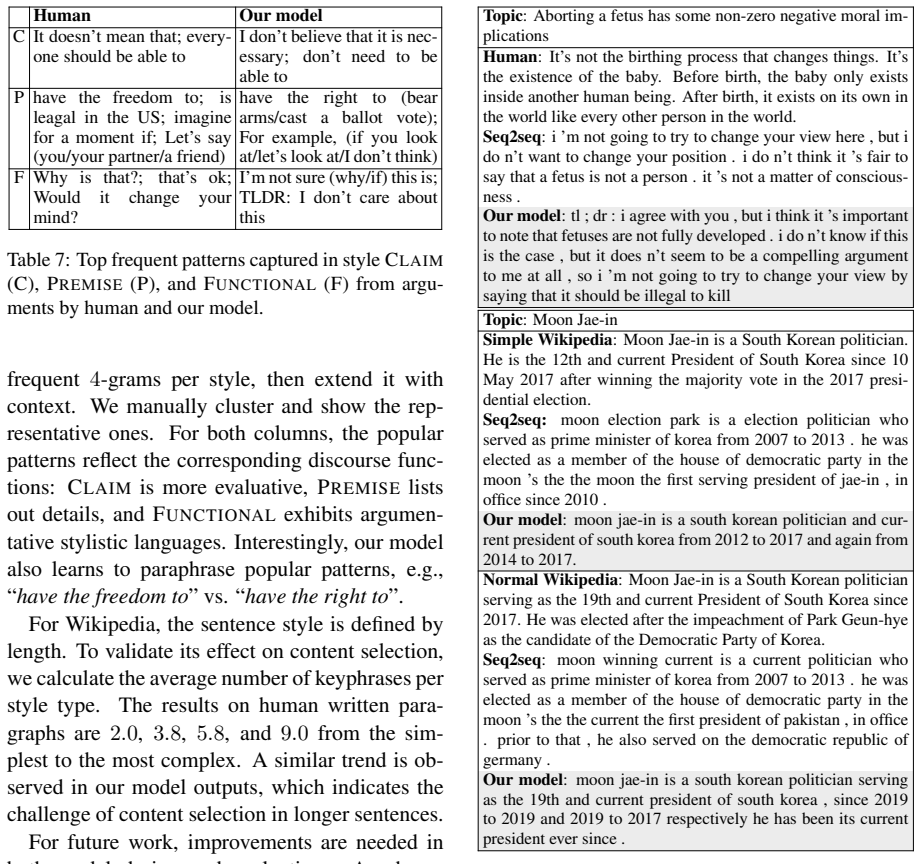
- [§4.2, Appendix A.2, Eq. (9)] The Wikipedia sentence-style labels are defined purely by sentence-length bins, so the one-hot style vector fed to the decoder in Eq. (9) is a length category. The 'w/o Style' ablation therefore removes length information together with style information, and because normal and simple Wikipedia differ strongly in sentence-length distribution (Figure 5), the reported BLEU/ROUGE and human correctness gains may reflect matching the reference length distribution rather than controlling linguistic style. Please report style-prediction accuracy, add an ablation that conditions only on length, and ideally include human judgments of perceived 'simple' versus 'normal' style to establish that the style variable captures something beyond length.
- [Abstract, §6.1, Table 5] The abstract states that the system 'can significantly outperform competitive comparisons,' but Table 5 shows that on AGENDA the model is below GraphWriter on BLEU (20.32 vs. 29.95), ROUGE-L (23.30 vs. 28.56), and METEOR (15.95 vs. 19.90), and even with oracle plans it reaches only 25.03/26.18/19.21. The current wording overgeneralizes the result. Please qualify the claim by dataset or by the settings in which the advantage actually holds.
- [§4.1, Appendix A.1, §3.2] Argument style labels are constructed by hand-written surface rules applied to the target sentences (e.g., 'CLAIM' requires patterns such as 'i (don't)? (believe|agree|...)' and length under 20 tokens). No validation of these labels is reported, and style-prediction accuracy is not given. Because the style classifier is trained on labels generated by the same patterns, the style-specification gains in Table 3 and Table 6 may reflect learning to predict surface features of the gold text rather than meaningful discourse functions. Please add label-quality validation (e.g., comparison with human annotation) and report the style-prediction accuracy on held-out data.
- [§6.2, Table 6] The text says that style-aware output is rated 'more fluent and correct' compared with the variant without style, but the significance markers in Table 6 do not support this uniformly. On Wikipedia, grammaticality (3.38 vs. 2.99) and content richness (3.43 vs. 3.50) are not marked as statistically significant, and content richness is numerically lower for the style-aware model. On the argument task, content richness is not improved at a significant level either. Please align the human-evaluation claims with the reported significance tests and discuss the null or negative results.
minor comments (5)
- [§6.1] There is a typo in the first sentence of Section 6.1: 'precesion-oriented' should be 'precision-oriented.'
- [§3.2, §4.2] Section 4.2 says the global Wikipedia style is encoded as one extra bit appended to mj in Eq. (2), but the equation does not show this bit. Please clarify whether the global style bit also influences the keyphrase selection probability in Eq. (4) or only the planner hidden state.
- [Table 5 caption] The caption uses 'Notice'; use 'Note' for a formal style.
- [Figures 4, 8, and 9] Several sample outputs contain clear repetitive n-grams (e.g., 'the the moon the', 'in 2013 and 2013 respectively', 'cable cable channel 2'). Although these are examples, they suggest that the trigram repetition disallowal is not fully effective; a quantitative repetition analysis across the test set would be informative.
- [§5.1] The hyperparameters gamma and eta are set to 1.0 'for simplicity'; no sensitivity analysis is reported. A sentence noting that results were robust to nearby values (or a small grid search) would strengthen the reproducibility claims.
Circularity Check
No significant circularity: the paper's central claims are empirical supervised-generation comparisons, and the style-label proxy is a confound rather than a circular derivation.
full rationale
The paper does not purport to derive a prediction from first principles; it trains an end-to-end generation model with a content planner and a style-conditioned realizer and evaluates it against external baselines, automatic metrics, and human ratings. The closest candidate for circularity is the Wikipedia sentence-style label, which is defined by sentence-length bins (Section 4.2, Appendix A.2), meaning the style vector in Eq. 9 is a length category and the w/o Style ablation also removes a length prior. However, this is a potential confound about what 'style' controls, not an identity by construction: the model still must select keyphrases, order sentences, and generate words, and the reported gains are not forced by the label definition. Similarly, the argument-task style labels are surface-pattern rules, but they are training targets for a supervised component rather than fitted quantities renamed as predictions. Self-citations to Hua and Wang (2018) and Hua et al. (2019) supply the dataset and a baseline or background formulation; none is load-bearing for the central empirical claim. No circular step can be exhibited by reduction of an equation or fitted parameter to its inputs, so the appropriate finding is no significant circularity.
Assumptions & free parameters
free parameters (5)
- Loss weight gamma for style loss =
1.0
- Loss weight eta for selection loss =
1.0
- Wikipedia sentence-style length bins =
(0,10], (10,20], (20,30], (30,∞)
- Beam size for decoding =
5
- Keyphrase bank size =
70 for argument, 30 for Wikipedia and AGENDA
assumptions (5)
- domain assumption Content-word overlap between a keyphrase and a target sentence indicates that the keyphrase was selected for that sentence.
- domain assumption Sentence length is a valid proxy for language complexity and style in Wikipedia.
- domain assumption The rule-based patterns from Levy et al. (2018) identify the CLAIM, PREMISE, and FUNCTIONAL discourse functions.
- domain assumption BLEU, ROUGE-L, and METEOR are valid measures of generation quality for these tasks.
- domain assumption The retrieved and stance-filtered passages contain enough topical content for counter-argument generation.
Cite this review
Pith. "Pith review of Sentence-Level Content Planning and Style Specification for Neural Text Generation." pith.science (2026). https://pith.science/paper/DJTXDAFV
@misc{pith2026190900734,
  author       = {Pith},
  title        = {Pith review of: Sentence-Level Content Planning and Style Specification for Neural Text Generation},
  year         = {2026},
  howpublished = {\url{https://pith.science/paper/DJTXDAFV}},
  note         = {Machine review of arXiv:1909.00734}
}
read the original abstract
Building effective text generation systems requires three critical components: content selection, text planning, and surface realization, and traditionally they are tackled as separate problems. Recent all-in-one style neural generation models have made impressive progress, yet they often produce outputs that are incoherent and unfaithful to the input. To address these issues, we present an end-to-end trained two-step generation model, where a sentence-level content planner first decides on the keyphrases to cover as well as a desired language style, followed by a surface realization decoder that generates relevant and coherent text. For experiments, we consider three tasks from domains with diverse topics and varying language styles: persuasive argument construction from Reddit, paragraph generation for normal and simple versions of Wikipedia, and abstract generation for scientific articles. Automatic evaluation shows that our system can significantly outperform competitive comparisons. Human judges further rate our system generated text as more fluent and correct, compared to the generations by its variants that do not consider language style.
Figures


Figures from the paper (8 more)


Forward citations
Cited by 1 Pith paper
-
Implementing Long Text Style Transfer with LLMs through Dual-Layered Sentence and Paragraph Structure Extraction and Mapping
A dual-layered sentence and paragraph template method for zero-shot long-text style transfer, with a reported average gain of 0.20 over direct prompting but limited statistical and external support.
Reference graph
Works this paper leans on
-
[1]
URL: " 'urlintro :=
ENTRY address author booktitle chapter edition editor howpublished institution journal key month note number organization pages publisher school series title type volume year eprint doi pubmed url lastchecked label extra.label sort.label short.list INTEGERS output.state before.all mid.sentence after.sentence after.block STRINGS urlintro eprinturl eprintpr...
-
[2]
write newline
" write newline "" before.all 'output.state := FUNCTION n.dashify 't := "" t empty not t #1 #1 substring "-" = t #1 #2 substring "--" = not "--" * t #2 global.max substring 't := t #1 #1 substring "-" = "-" * t #2 global.max substring 't := while if t #1 #1 substring * t #2 global.max substring 't := if while FUNCTION word.in bbl.in capitalize " " * FUNCT...
-
[3]
Waleed Ammar, Dirk Groeneveld, Chandra Bhagavatula, Iz Beltagy, Miles Crawford, Doug Downey, Jason Dunkelberger, Ahmed Elgohary, Sergey Feldman, Vu Ha, Rodney Kinney, Sebastian Kohlmeier, Kyle Lo, Tyler Murray, Hsu-Han Ooi, Matthew Peters, Joanna Power, Sam Skjonsberg, Lucy Wang, Chris Wilhelm, Zheng Yuan, Madeleine van Zuylen, and Oren Etzioni. 2018. htt...
-
[4]
Dzmitry Bahdanau, Kyunghyun Cho, and Yoshua Bengio. 2015. http://arxiv.org/abs/1409.0473 Neural machine translation by jointly learning to align and translate . In 3rd International Conference on Learning Representations, ICLR 2015, San Diego, CA, USA, May 7-9, 2015, Conference Track Proceedings
arXiv 2015
-
[5]
Roy Bar-Haim, Indrajit Bhattacharya, Francesco Dinuzzo, Amrita Saha, and Noam Slonim. 2017. http://aclweb.org/anthology/E17-1024 Stance classification of context-dependent claims . In Proceedings of the 15th Conference of the European Chapter of the Association for Computational Linguistics: Volume 1, Long Papers, pages 251--261. Association for Computati...
work page 2017
-
[6]
Regina Barzilay and Mirella Lapata. 2005. https://www.aclweb.org/anthology/H05-1042 Collective content selection for concept-to-text generation . In Proceedings of Human Language Technology Conference and Conference on Empirical Methods in Natural Language Processing, pages 331--338, Vancouver, British Columbia, Canada. Association for Computational Linguistics
work page 2005
-
[7]
Anja Belz. 2008. Automatic generation of weather forecast texts using comprehensive probabilistic generation-space models. Natural Language Engineering, 14(4):431--455
work page 2008
-
[8]
David L Chen and Raymond J Mooney. 2008. Learning to sportscast: a test of grounded language acquisition. In Proceedings of the 25th international conference on Machine learning, pages 128--135. ACM
work page 2008
Show all 53 references
-
[9]
Andrew Chisholm, Will Radford, and Ben Hachey. 2017. https://www.aclweb.org/anthology/E17-1060 Learning to generate one-sentence biographies from W ikidata . In Proceedings of the 15th Conference of the E uropean Chapter of the Association for Computational Linguistics: Volume...
2017
-
[10]
Emilie Colin, Claire Gardent, Yassine M ' rabet, Shashi Narayan, and Laura Perez-Beltrachini. 2016. https://doi.org/10.18653/v1/W16-6626 The W eb NLG challenge: Generating text from DBP edia data . In Proceedings of the 9th International Natural Language Generation conference,...
2016 doi
-
[11]
Michael Denkowski and Alon Lavie. 2014. http://www.aclweb.org/anthology/W14-3348 Meteor universal: Language specific translation evaluation for any target language . In Proceedings of the Ninth Workshop on Statistical Machine Translation, pages 376--380, Baltimore, Maryland, U...
2014
-
[12]
Pablo Ariel Duboue and Kathleen R. McKeown. 2003. https://www.aclweb.org/anthology/W03-1016 Statistical acquisition of content selection rules for natural language generation . In Proceedings of the 2003 Conference on Empirical Methods in Natural Language Processing, pages 121--128
2003
-
[13]
John Duchi, Elad Hazan, and Yoram Singer. 2011. Adaptive subgradient methods for online learning and stochastic optimization. Journal of Machine Learning Research, 12(Jul):2121--2159
2011
-
[14]
Ond r ej Du s ek, Jekaterina Novikova, and Verena Rieser. 2018. https://doi.org/10.18653/v1/W18-6539 Findings of the E 2 E NLG challenge . In Proceedings of the 11th International Conference on Natural Language Generation, pages 322--328, Tilburg University, The Netherlands. A...
2018 doi
-
[15]
Ond r ej Du s ek, Jekaterina Novikova, and Verena Rieser. 2019. https://arxiv.org/abs/1901.11528 Evaluating the state-of-the-art of end-to-end natural language generation: The E2E NLG Challenge . arXiv preprint arXiv:1901.11528
2019 arXiv
-
[16]
Angela Fan, Mike Lewis, and Yann Dauphin. 2018. https://www.aclweb.org/anthology/P18-1082 Hierarchical neural story generation . In Proceedings of the 56th Annual Meeting of the Association for Computational Linguistics (Volume 1: Long Papers), pages 889--898, Melbourne, Austr...
2018
-
[17]
Yarin Gal and Zoubin Ghahramani. 2016. http://papers.nips.cc/paper/6241-a-theoretically-grounded-application-of-dropout-in-recurrent-neural-networks.pdf A theoretically grounded application of dropout in recurrent neural networks . In D. D. Lee, M. Sugiyama, U. V. Luxburg, I. ...
2016
-
[18]
Eduard H Hovy. 1993. Automated discourse generation using discourse structure relations. Artificial intelligence, 63(1-2):341--385
1993
-
[19]
Xinyu Hua, Zhe Hu, and Lu Wang. 2019. https://www.aclweb.org/anthology/P19-1255 Argument generation with retrieval, planning, and realization . In Proceedings of the 57th Annual Meeting of the Association for Computational Linguistics, pages 2661--2672, Florence, Italy. Associ...
2019
-
[20]
Xinyu Hua and Lu Wang. 2018. https://doi.org/10.18653/v1/P18-1021 Neural argument generation augmented with externally retrieved evidence . In Proceedings of the 56th Annual Meeting of the Association for Computational Linguistics (Volume 1: Long Papers), pages 219--230, Melbo...
2018 doi
-
[21]
Chlo \'e Kiddon, Luke Zettlemoyer, and Yejin Choi. 2016. https://doi.org/10.18653/v1/D16-1032 Globally coherent text generation with neural checklist models . In Proceedings of the 2016 Conference on Empirical Methods in Natural Language Processing, pages 329--339, Austin, Tex...
2016 doi
-
[22]
Rik Koncel-Kedziorski, Dhanush Bekal, Yi Luan, Mirella Lapata, and Hannaneh Hajishirzi. 2019. https://doi.org/10.18653/v1/N19-1238 T ext G eneration from K nowledge G raphs with G raph T ransformers . In Proceedings of the 2019 Conference of the North A merican Chapter of the ...
2019 doi
-
[23]
Ioannis Konstas, Srinivasan Iyer, Mark Yatskar, Yejin Choi, and Luke Zettlemoyer. 2017. https://doi.org/10.18653/v1/P17-1014 Neural AMR : Sequence-to-sequence models for parsing and generation . In Proceedings of the 55th Annual Meeting of the Association for Computational Lin...
2017 doi
-
[24]
Ioannis Konstas and Mirella Lapata. 2013. https://www.aclweb.org/anthology/D13-1157 Inducing document plans for concept-to-text generation . In Proceedings of the 2013 Conference on Empirical Methods in Natural Language Processing, pages 1503--1514, Seattle, Washington, USA. A...
2013
-
[25]
R \'e mi Lebret, David Grangier, and Michael Auli. 2016. https://doi.org/10.18653/v1/D16-1128 Neural text generation from structured data with application to the biography domain . In Proceedings of the 2016 Conference on Empirical Methods in Natural Language Processing, pages...
2016 doi
-
[26]
Ran Levy, Ben Bogin, Shai Gretz, Ranit Aharonov, and Noam Slonim. 2018. https://www.aclweb.org/anthology/C18-1176 Towards an argumentative content search engine using weak supervision . In Proceedings of the 27th International Conference on Computational Linguistics, pages 206...
2018
-
[27]
Jiwei Li, Will Monroe, Tianlin Shi, S \'e bastien Jean, Alan Ritter, and Dan Jurafsky. 2017. https://doi.org/10.18653/v1/D17-1230 Adversarial learning for neural dialogue generation . In Proceedings of the 2017 Conference on Empirical Methods in Natural Language Processing, pa...
2017 doi
-
[28]
Percy Liang, Michael Jordan, and Dan Klein. 2009. https://www.aclweb.org/anthology/P09-1011 Learning semantic correspondences with less supervision . In Proceedings of the Joint Conference of the 47th Annual Meeting of the ACL and the 4th International Joint Conference on Natu...
2009
-
[29]
Chin-Yew Lin. 2004. http://aclweb.org/anthology/W04-1013 Rouge: A package for automatic evaluation of summaries . In Text Summarization Branches Out
2004
-
[30]
Chin-Yew Lin and Eduard Hovy. 2000. http://aclweb.org/anthology/C00-1072 The automated acquisition of topic signatures for text summarization . In COLING 2000 Volume 1: The 18th International Conference on Computational Linguistics
2000
-
[31]
Marco Lippi and Paolo Torroni. 2016. Argumentation mining: State of the art and emerging trends. ACM Transactions on Internet Technology (TOIT), 16(2):10
2016
-
[32]
Yi Luan, Luheng He, Mari Ostendorf, and Hannaneh Hajishirzi. 2018. https://www.aclweb.org/anthology/D18-1360 Multi-task identification of entities, relations, and coreference for scientific knowledge graph construction . In Proceedings of the 2018 Conference on Empirical Metho...
2018
-
[33]
Lara J Martin, Prithviraj Ammanabrolu, Xinyu Wang, William Hancock, Shruti Singh, Brent Harrison, and Mark O Riedl. 2018. Event representations for automated story generation with deep neural nets. In Thirty-Second AAAI Conference on Artificial Intelligence
2018
-
[34]
Kathleen R. McKeown. 1985. Text Generation: Using Discourse Strategies and Focus Constraints to Generate Natural Language Text. Cambridge University Press, New York, NY, USA
1985
-
[35]
Hongyuan Mei, Mohit Bansal, and Matthew R. Walter. 2016. https://doi.org/10.18653/v1/N16-1086 What to talk about and how? selective generation using LSTM s with coarse-to-fine alignment . In Proceedings of the 2016 Conference of the North A merican Chapter of the Association f...
2016 doi
-
[36]
George A. Miller. 1994. http://aclweb.org/anthology/H94-1111 Wordnet: A lexical database for english . In HUMAN LANGUAGE TECHNOLOGY: Proceedings of a Workshop held at Plainsboro, New Jersey, March 8-11, 1994
1994
-
[37]
Amit Moryossef, Yoav Goldberg, and Ido Dagan. 2019. https://doi.org/10.18653/v1/N19-1236 S tep-by-step: S eparating planning from realization in neural data-to-text generation . In Proceedings of the 2019 Conference of the North A merican Chapter of the Association for Computa...
2019 doi
-
[38]
Eric W Noreen. 1989. Computer-intensive methods for testing hypotheses. Wiley New York
1989
-
[39]
Kishore Papineni, Salim Roukos, Todd Ward, and Wei-Jing Zhu. 2002. https://doi.org/10.3115/1073083.1073135 B leu: a method for automatic evaluation of machine translation . In Proceedings of the 40th Annual Meeting of the Association for Computational Linguistics, pages 311--3...
2002
-
[40]
Jeffrey Pennington, Richard Socher, and Christopher Manning. 2014. https://doi.org/10.3115/v1/D14-1162 G love: Global vectors for word representation . In Proceedings of the 2014 Conference on Empirical Methods in Natural Language Processing ( EMNLP ) , pages 1532--1543, Doha,...
2014 doi
-
[41]
Isaac Persing and Vincent Ng. 2016. https://doi.org/10.18653/v1/N16-1164 End-to-end argumentation mining in student essays . In Proceedings of the 2016 Conference of the North A merican Chapter of the Association for Computational Linguistics: Human Language Technologies , pag...
2016 doi
-
[42]
Owen Rambow and Tanya Korelsky. 1992. https://doi.org/10.3115/974499.974508 Applied text generation . In Proceedings of the Third Conference on Applied Natural Language Processing, pages 40--47, Trento, Italy. Association for Computational Linguistics
1992
-
[43]
Ehud Reiter and Robert Dale. 2000. Building applied natural language generation systems. Cambridge University Press
2000
-
[44]
Ehud Reiter, Roma Robertson, and Liesl Osman. 2000. https://doi.org/10.3115/1118253.1118283 Knowledge acquisition for natural language generation . In INLG ' 2000 Proceedings of the First International Conference on Natural Language Generation , pages 217--224, Mitzpe Ramon, I...
2000
-
[45]
Rush, Sumit Chopra, and Jason Weston
Alexander M. Rush, Sumit Chopra, and Jason Weston. 2015. https://doi.org/10.18653/v1/D15-1044 A neural attention model for abstractive sentence summarization . In Proceedings of the 2015 Conference on Empirical Methods in Natural Language Processing, pages 379--389, Lisbon, Po...
2015 doi
-
[46]
Donia Scott and Clarisse Sieckenius de Souza. 1990. Getting the message across in rst-based text generation. Current research in natural language generation, 4:47--73
1990
-
[47]
Liu, and Christopher D
Abigail See, Peter J. Liu, and Christopher D. Manning. 2017. https://doi.org/10.18653/v1/P17-1099 Get to the point: Summarization with pointer-generator networks . In Proceedings of the 55th Annual Meeting of the Association for Computational Linguistics (Volume 1: Long Papers...
2017 doi
-
[48]
Linfeng Song, Yue Zhang, Zhiguo Wang, and Daniel Gildea. 2018. https://www.aclweb.org/anthology/P18-1150 A graph-to-sequence model for AMR -to-text generation . In Proceedings of the 56th Annual Meeting of the Association for Computational Linguistics (Volume 1: Long Papers), ...
2018
-
[49]
Matthew Stone and Christine Doran. 1997. https://doi.org/10.3115/976909.979643 Sentence planning as description using tree adjoining grammar . In Proceedings of the 35th Annual Meeting of the Association for Computational Linguistics, pages 198--205, Madrid, Spain. Association...
1997
-
[50]
Kumiko Tanaka-Ishii, K \^o iti Hasida, and Itsuki Noda. 1998. Reactive content selection in the generation of real-time soccer commentary. In Proceedings of the 17th international conference on Computational linguistics-Volume 2, pages 1282--1288. Association for Computational...
1998
-
[51]
Walker, Owen Rambow, and Monica Rogati
Marilyn A. Walker, Owen Rambow, and Monica Rogati. 2001. https://www.aclweb.org/anthology/N01-1003 SP o T : A trainable sentence planner . In Second Meeting of the North A merican Chapter of the Association for Computational Linguistics
2001
-
[52]
Sam Wiseman, Stuart Shieber, and Alexander Rush. 2017. https://doi.org/10.18653/v1/D17-1239 Challenges in data-to-document generation . In Proceedings of the 2017 Conference on Empirical Methods in Natural Language Processing, pages 2253--2263, Copenhagen, Denmark. Association...
2017 doi
-
[53]
Zhiwei Yu, Jiwei Tan, and Xiaojun Wan. 2018. https://www.aclweb.org/anthology/P18-1153 A neural approach to pun generation . In Proceedings of the 56th Annual Meeting of the Association for Computational Linguistics (Volume 1: Long Papers), pages 1650--1660, Melbourne, Austral...
2018
Reviewed August 14, 2026 · model on record in the stance chip above.
Discussion (0). Continue with ORCID to comment.