REVIEW 5 major objections 5 minor 36 references
HarDNet: A Low Memory Traffic Network
T0 review · 5 major / 5 minor · reviewed 2026-08-14 · deepseek-v4-flash
Pith's one-line read Memory traffic for intermediate feature maps, not arithmetic alone, can decide CNN inference speed.
desk verdict Useful architecture paper with an honest memory-traffic metric, but the headline speedup claims conflate MAC and CIO reductions; still worth refereeing. read the letter →
The pith
A machine-rendered reading of the paper's core claim, the machinery that carries it, and where it could break.
The reading
What carries the argument
The central object is the Harmonic Dense Block (HDB), a connection pattern in which layer $k$ receives input from layers $k - 2^n$ for every nonnegative $n$ with $k - 2^n \ge 0$; once layer $2^n$ is computed, layers $1$ through $2^n - 1$ can be flushed from memory, shortening tensor lifetimes and cutting concatenation cost. Each layer's channel width is scaled by $m^n$, where $n$ is the largest power-of-two divisor of the layer index, so that wider layers carry more influence and the input/output channel ratio stays balanced. This balancing keeps the computational density (MACs over CIO, called MoC) of each layer above the regime where memory traffic dominates, while CIO itself, the summed tensor sizes, serves as the paper's platform-independent proxy for DRAM traffic. The design also includes an inverted transition module that pools along two paths before a pointwise convolution, halving the CIO contribution of transition layers.
What would settle it
Run HarDNet-68 and ResNet-50 at identical batch and input size on a high-end GPU with very wide memory bandwidth, or with all convolutions fused into single kernels, and compare latency against CIO and MAC counts: if latency differences follow MAC counts rather than CIO, the paper's central proportionality claim fails.
Extended reading notes
Core claim
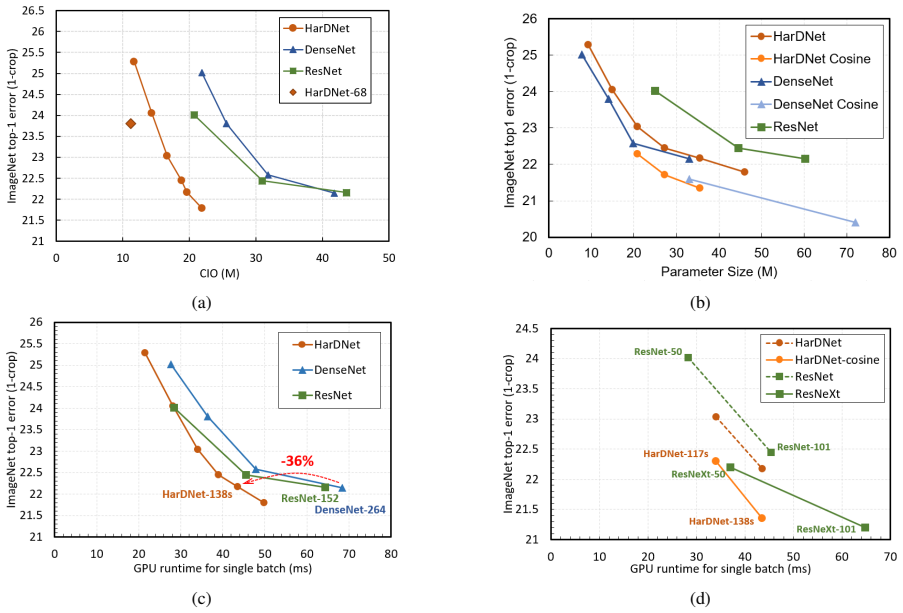
The central claim is that memory traffic for intermediate feature maps can dominate inference latency in high-resolution CNN workloads, and that this traffic is well approximated by CIO, a simple architecture-level quantity. The paper verifies the approximation by measuring DRAM traffic with a GPU profiler and a systolic-array accelerator simulator, finding that inference latency tracks memory traffic more closely than it tracks MACs. HarDNet, the proposed architecture, reaches the same accuracy as DenseNet and ResNet with 30% to 50% less CIO and accordingly 30% to 40% less inference time, with specific measured reductions of 35% versus FC-DenseNet-103, 36% versus DenseNet-264, 30% versus ResNet-50, 32% versus ResNet-152, and 45% versus SSD-VGG. The authors also state the boundary of the claim: CIO assumes layer-by-layer execution without operator fusion, and it predicts latency only when a layer's computational density (MACs per byte) is below a platform-dependent threshold.
Load-bearing premise
The argument rests on the premise that, for the networks and platforms measured, feature-map DRAM traffic is what actually limits inference latency: the authors define a platform-dependent computational-density threshold below which this is true but never measure that threshold for their benchmarks, and they explicitly assume no operator fusion.
Editorial extensions
If this is right
- CIO should be added to MACs and parameter count as a standard reporting axis for CNN efficiency, because a network can be arithmetic-cheap yet latency-heavy.
- Sparse, short-lifetime connections of the HarDNet type offer a direct way to cut feature-map traffic without sacrificing accuracy, especially for segmentation and detection at high resolution.
- The measured speedups are not confined to GPUs: the same 35% reduction against FC-DenseNet-103 appears in the cycle-accurate accelerator simulation, suggesting the design transfers to edge hardware.
- If int8 multipliers make compute cheaper than data movement, memory-traffic-aware architecture choices will become more important, not less.
Reading between the lines
- If operator fusion becomes the default execution model, CIO's predictive value will shrink, because fused layer groups produce no intermediate traffic; the paper acknowledges this and suggests inverted-residual designs would then be preferable.
- A likely testable pattern is that HarDNet's advantage over DenseNet widens as input resolution grows and as DRAM bandwidth shrinks, since both shifts raise the memory-bound share of latency.
- The harmonic connection idea is not tied to convolutions: the same flush-early, weight-by-divisibility principle could apply to transformer or recurrent architectures whose activation caches dominate memory traffic.
- The paper's rough weighting factor for depthwise-separable layers is a patch rather than a derivation; deriving such weights from first principles would strengthen the metric's generality.
Editorial analysis
A structured set of objections, weighed in public.
Referee Report
Summary. The paper introduces Convolutional Input/Output (CIO), a summed input/output tensor size over all convolution layers, as a platform-independent proxy for DRAM traffic in CNN inference. It proposes Harmonic DenseNet (HarDNet), a sparsified DenseNet with power-of-two harmonic connections and channel weighting, designed to reduce CIO without a MAC explosion. Experiments on CamVid, ImageNet, PASCAL VOC, and MS COCO report inference-time reductions of 30–45% relative to DenseNet/ResNet/VGG baselines at comparable accuracy. The authors also report profiler and SCALE-Sim measurements of DRAM traffic to support a claimed proportionality between CIO and inference latency.
Significance. If the causal relationship between CIO/DRAM traffic and inference latency were established, the paper would make a useful practical contribution: a cheap, analytic metric for memory-bound CNN design and a concrete architecture with solid measured speedups, including on mobile GPU. The HarDNet connection pattern is a clean, well-motivated variant of DenseNet sparsification, and the authors deserve credit for measuring DRAM traffic directly with Nvidia profiler and SCALE-Sim across platforms, and for explicitly discussing limitations such as operator fusion and the MoC threshold. However, the present evidence does not isolate the memory-traffic effect from simultaneous MAC reductions, so the significance of the core claim remains conditional.
major comments (5)
- [§4.1, Table 2] The headline speedup of FC-HarDNet-84 over FC-DenseNet-103 (6.7 s vs 11.4 s, 41% reduction) is accompanied by a 25% reduction in GMACs (100 vs 134) and a 41% reduction in CIO (1267 vs 2150 MB), so the latency gain cannot be attributed to memory traffic without controlling compute. The near-MAC-matched comparison (FC-HarDNet-ref100 vs FC-DenseNet-ref100, 151 vs 142 GMACs) is not one of the abstract's headline baselines and still differs by 6% in MACs; please report a MAC-matched ablation (e.g., same MACs with varying CIO) or per-MAC normalized latency to separate the two factors.
- [§3, §5] The paper states that CIO dominates inference time only when per-layer computational density MoC is below a 'platform-dependent and obscure empirically' threshold, but no MoC threshold is ever measured or reported. Consequently the abstract's claim that 'inference latency is indeed proportional to the memory traffic consumption' is stronger than the evidence; please provide a per-layer breakdown of MoC, measured DRAM traffic, and latency on at least one GPU and the SCALE-Sim platform, and quantify for which layers CIO is the binding constraint.
- [§4.2, Table 4] The ImageNet comparisons are not controlled across training setups: HarDNet models use cosine learning-rate decay and fine-tuned weight decay, while the DenseNet/ResNet baselines reuse the original torch7 hyperparameters, and DenseNet-264—a named headline baseline—does not appear in Table 4. Because 'comparable accuracy' is load-bearing for the claimed speedups, either re-run the baselines under the same recipe or justify why the setup mismatch does not affect the comparison.
- [§4.1, Table 2] All GPU timings appear to be single measurements with no variance reported, and FC-SparseNet-ref100 was selected as the best of five training runs while other models were run once; this makes the reported 30–45% savings and the correlation plots in Fig. 4 hard to assess statistically. Please report means and standard deviations over repeated runs and state the selection protocol for all compared models.
- [§5, Table 4] The paper acknowledges that CIO assumes layer-by-layer execution without operator fusion and that a depthwise-separable comparison requires an ad hoc 0.6 weighting factor, yet this weighting is applied without independent validation. As written, the comparison between HarDNet-39DS/68DS and MobileNetV2 in Table 4 and Fig. 5d rests on a fitted correction rather than measured traffic; please validate the weighting on held-out architectures/implementations or report unweighted measured DRAM traffic.
minor comments (5)
- [§3.2, §4.2] Typographical issues: 'DenseNet employees a bottleneck layer' should be 'employs', and 'mealy using depth-wise-separable convolutions' should be 'mainly'.
- [Table 2] The entry for FC-DenseNet56 shows '732.' instead of '73.2' in the Mean IoU column, and the table caption says 'Pytorch' while the text mentions both TensorFlow and PyTorch frameworks; please clarify the framework(s) and input resolution used for the reported timings.
- [Table 4] The caption states GPU time is measured 'at 1024x1024' which is likely a typo for the standard ImageNet resolution; please state the actual evaluation resolution and confirm whether the mobile GPU timings use the same preprocessing.
- [Abstract, §6] The abstract lists five specific speedup percentages (35%, 36%, 30%, 32%, 45%) while the conclusion gives a coarser '35%' and '30%~40%' range; please make the numbers consistent across the paper.
- [Fig. 4 caption] The figure caption mixes 'Nvidia Titan V with Cuda 9.0' with different spellings and versions used elsewhere; please provide a unified experimental setup description with driver and framework versions, and state how many repeated measurements were taken.
Circularity Check
Central speedups are measured against external baselines and are not circular; only a minor fitted 0.6 CIO weighting for depthwise-separable comparisons is ad hoc.
-
fitted input called prediction
[Section 4.2 (ImageNet Datasets), paragraph after Table 4]
"For further comparing CIO between a model using standard convolutions and a model mealy using depth-wise-separable convolutions, we can apply a weighting such as 0.6 on the CIO of the latter. After the weighting, CIO can still be a rough prediction of inference time when comparing among the two very different kinds of model."
The 0.6 multiplier is a free calibration constant applied to depthwise-separable models; it is introduced after the CIO and latency values are already known and is chosen to make CIO agree with measured inference time. Claiming that the weighted CIO 'can still be a rough prediction' is therefore circular for that comparison, since the prediction is fitted to the data it is supposed to predict. However, this weighting is not used in the headline standard-convolution comparisons (FC-DenseNet, DenseNet, ResNet, VGG), which rest on measured latencies and profiler/simulator traffic counts, so the circularity is minor and non-load-bearing.
full rationale
The paper's central empirical claims are not circular. CIO is defined by Eq. 1 as a sum of per-layer input/output tensor sizes; the HarDNet connection pattern and channel balancing are design choices that reduce this quantity, but the headline speedups (35%, 36%, 30%, 32%, 45%) are measured GPU/accelerator latencies against external baselines and are checked with the Nvidia profiler and ARM Scale-Sim. The claim that latency is proportional to memory traffic is supported by measurements (Figs. 4b, 4c), not by definition. The paper also honestly concedes CIO's limitations: Section 3 says the MoC threshold below which CIO dominates is 'platform-dependent and obscure empirically,' and Section 5 says CIO 'failed to predict the actual inference time in some cases' and assumes layer-by-layer execution without fusion. These concessions show the authors are not treating CIO as a universal identity. The only mild circular step is the ad hoc 0.6 weighting used when comparing standard-convolution models with depthwise-separable models: the factor is chosen after the fact to make CIO track the measured latencies, and then CIO is said to be a 'rough prediction.' This factor is not needed for the headline standard-vs-standard comparisons and therefore does not undermine the main result. Overall, no significant circularity in the derivation chain.
Assumptions & free parameters
free parameters (5)
- channel multiplier m =
1.6, 1.6/1.65, 1.7, 1.6 (Table 1)
- transition reduction rate =
0.85
- per-block growth rates k and block depths =
Various values in Tables 1 and 3
- CIO weighting for depthwise models =
0.6
- MoC threshold =
not quantified
assumptions (4)
- domain assumption Layers execute one at a time with no operator fusion
- domain assumption CIO tensor-size sum is proportional to DRAM traffic
- domain assumption Latency is dominated by memory traffic below an MoC threshold
- ad hoc to paper The harmonic sparsification preserves accuracy
invented entities (2)
-
CIO
independent evidence
-
MoC
Cite this review
Pith. "Pith review of HarDNet: A Low Memory Traffic Network." pith.science (2026). https://pith.science/paper/7ZFUELZL
@misc{pith2026190900948,
  author       = {Pith},
  title        = {Pith review of: HarDNet: A Low Memory Traffic Network},
  year         = {2026},
  howpublished = {\url{https://pith.science/paper/7ZFUELZL}},
  note         = {Machine review of arXiv:1909.00948}
}
read the original abstract
State-of-the-art neural network architectures such as ResNet, MobileNet, and DenseNet have achieved outstanding accuracy over low MACs and small model size counterparts. However, these metrics might not be accurate for predicting the inference time. We suggest that memory traffic for accessing intermediate feature maps can be a factor dominating the inference latency, especially in such tasks as real-time object detection and semantic segmentation of high-resolution video. We propose a Harmonic Densely Connected Network to achieve high efficiency in terms of both low MACs and memory traffic. The new network achieves 35%, 36%, 30%, 32%, and 45% inference time reduction compared with FC-DenseNet-103, DenseNet-264, ResNet-50, ResNet-152, and SSD-VGG, respectively. We use tools including Nvidia profiler and ARM Scale-Sim to measure the memory traffic and verify that the inference latency is indeed proportional to the memory traffic consumption and the proposed network consumes low memory traffic. We conclude that one should take memory traffic into consideration when designing neural network architectures for high-resolution applications at the edge.
Figures


Figures from the paper (2 more)

Reference graph
Works this paper leans on
-
[1]
Manoj Alwani, Han Chen, Michael Ferdman, and Peter Milder. Fused-layer CNN accelerators. In 49th Annual IEEE/ACM International Symposium on Microarchitecture (MICRO), pages 1-16, 2016
work page 2016
-
[2]
SegNet: A Deep Convolutional Encoder-Decoder Architec- ture for Image Segmentation
Vijay Badrinarayanan, Alex Kendall, and Roberto Cipolla. SegNet: A Deep Convolutional Encoder-Decoder Architec- ture for Image Segmentation. IEEE Transactions on Pat- tern Analysis and Machine Intelligence, 39(12): 2481-2495, 2017
work page 2017
-
[3]
Brostow, Julien Fauqueur, and Roberto Cipolla
Gabriel J. Brostow, Julien Fauqueur, and Roberto Cipolla. Semantic object classes in video: A high-definition ground truth database. Pattern Recognition Letters 30 (2), 88-97, 2009
work page 2009
-
[4]
Doug Burger, James R. Goodman, and Alain K ¨agi. Memory bandwidth limitations of future microprocessors. In Proceed- ings of the 23rd annual international symposium on Com- puter architecture (ISCA), Pages 78–89, 1996
work page 1996
-
[5]
A dynamically configurable coproces- sor for convolutional neural networks
Srimat Chakradhar, Murugan Sankaradas, Venkata Jakkula, and Srihari Cadambi. A dynamically configurable coproces- sor for convolutional neural networks. In International Sym- posium on Computer Architecture (ISCA), pages 247-257, 2010
work page 2010
-
[6]
Diannao: A small-footprint high-throughput accelerator for ubiquitous machine-learning
Tianshi Chen, Zidong Du, Ninghui Sun, Jia Wang, Chengy- ong Wu, Yunji Chen, and Olivier Temam. Diannao: A small-footprint high-throughput accelerator for ubiquitous machine-learning. In International Conference on Archi- tectural Support for Programming Languages and Operating Systems (ASPLOS), pages 269-284, 2014
work page 2014
-
[7]
Eyeriss: A Spatial Architecture for Energy-Efficient Dataflow for Con- volutional Neural Networks
Yu-Hsin Chen, Joel Emer, and Vivienne Sze. Eyeriss: A Spatial Architecture for Energy-Efficient Dataflow for Con- volutional Neural Networks. In International Symposium on Computer Architecture (ISCA), pages 367-379, 2016
work page 2016
-
[8]
Matthieu Courbariaux, Itay Hubara, Daniel Soudry, Ran El-Yaniv, and Yoshua Bengio. Binarized neural networks: Training Neural Networks with Weights and Activations Constrained to +1 or−1. arXiv preprint arXiv:1602.02830, 2016
arXiv 2016
Show all 36 references
-
[9]
ImageNet: A large-scale hierarchical im- age database
Jia Deng, Wei Dong, Richard Socher, Li-Jia Li, Kai Li, and Li Fei-Fei. ImageNet: A large-scale hierarchical im- age database. In IEEE Conference on Computer Vision and Pattern Recognition (CVPR), pages 248-255, 2009
2009
-
[10]
The importance of skip con- nections in biomedical image segmentation
Michal Drozdzal, Eugene V orontsov, Gabriel Chartrand, Samuel Kadoury, and Chris Pal. The importance of skip con- nections in biomedical image segmentation. arXiv preprint arXiv:1608.04117, 2016
2016 arXiv
-
[11]
NullHop: A Flexible Convolutional Neural Network Accelerator Based on Sparse Representa- tions of Feature Maps
Alessandro Aimar et al. NullHop: A Flexible Convolutional Neural Network Accelerator Based on Sparse Representa- tions of Feature Maps. In IEEE Transactions on Neural Net- works and Learning Systems, 2018
2018
-
[12]
Mark Everingham, Luc Van Gool, Christopher K. I. Williams, John Winn, and Andrew Zisserman. The PAS- CAL Visual Object Classes (VOC) Challenge. International Journal of Computer Vision, 88(2):303–338, 2010
2010
-
[13]
NeuFlow: A runtime reconfigurable dataflow processor for vision
Cl ´ement Farabet, Berin Martini, Benoit Corda, Polina Ak- selrod, Eugenio Culurciello, and Yann LeCun. NeuFlow: A runtime reconfigurable dataflow processor for vision. In Pro- ceedings of the IEEE Conference on Computer Vision and Pattern Recognition Workshops (CVPRW), pages 10...
2011
-
[14]
Hardware-oriented approximation of convolutional neural networks
Philipp Gysel, Mohammad Motamedi, and Soheil Ghiasi. Hardware-oriented approximation of convolutional neural networks. In International Conference on Learning Repre- sentations (ICLR) Workshop, 2016
2016
-
[15]
Song Han, Huizi Mao, and William J. Dally. Deep Com- pression: Compressing Deep Neural Networks with Pruning, Trained Quantization and Huffman Coding. In International Conference on Learning Representations (ICLR), 2016
2016
-
[16]
Deep residual learning for image recognition
Kaiming He, Xiangyu Zhang, Shaoqing Ren, and Jian Sun. Deep residual learning for image recognition. In IEEE Conference on Computer Vision and Pattern Recognition (CVPR), pages 770-778, 2016
2016
-
[17]
Andrew Bagnell
Hanzhang Hu, Debadeepta Dey, Allison Del Giorno, Mar- tial Hebert, and J. Andrew Bagnell. Log-DenseNet: How to Sparsify a DenseNet. arXiv preprint arXiv:1711.00002, 2017
2017 arXiv
-
[18]
Weinberger
Gao Huang, Zhuang Liu, Laurens van der Maaten, and Kil- ian Q. Weinberger. Densely connected convolutional net- works. In IEEE Conference on Computer Vision and Pattern Recognition (CVPR), pages 2261-2269, 2017
2017
-
[19]
Deep networks with stochastic depth
Gao Huang, Yu Sun, Zhuang Liu, Daniel Sedra, and Kil- ian Weinberger. Deep networks with stochastic depth. In European Conference on Computer Vision (ECCV), pages 646-661, 2016
2016
-
[20]
Iandola, Song Han, Matthew W
Forrest N. Iandola, Song Han, Matthew W. Moskewicz, Khalid Ashraf, William J. Dally, and Kurt Keutzer. Squeezenet: Alexnet-level accuracy with 50x fewer pa- rameters and ¡0.5MB model size. arXiv preprint arXiv:1602.07360, 2016
2016 arXiv
-
[21]
The One Hundred Layers Tiramisu: Fully Convolutional DenseNets for Semantic Seg- mentation
Simon J ´egou, Michal Drozdzal, David Vazquez, Adriana Romero, and Yoshua Bengio. The One Hundred Layers Tiramisu: Fully Convolutional DenseNets for Semantic Seg- mentation. In IEEE Conference on Computer Vision and Pat- tern Recognition Workshops (CVPRW), pages 1175-1183, 2017
2017
-
[22]
Learning multiple layers of features from tiny images
Alex Krizhevsky. Learning multiple layers of features from tiny images. Tech Report, 2009
2009
-
[23]
Alex Krizhevsky, Ilya Sutskever, and Geoffrey E. Hinton. Imagenet classification with deep convolutional neural net- works. In International Conference on Neural Information Processing Systems (NIPS), pages 1097-1105, 2012
2012
-
[24]
FractalNet: Ultra-deep neural networks without residuals
Gustav Larsson, Michael Maire, and Gregory Shakhnarovich. FractalNet: Ultra-deep neural networks without residuals. In International Conference on Learning Representations (ICLR), 2017
2017
-
[25]
Optimizing Memory Efficiency for Deep Convolutional Neural Networks on GPUs
Chao Li, Yi Yang, Min Feng, Srimat Chakradhar, and Huiyang Zhou. Optimizing Memory Efficiency for Deep Convolutional Neural Networks on GPUs. In International Conference for High Performance Computing, Networking, Storage and Analysis (SC), pages 633-644, 2016
2016
-
[26]
Lawrence Zitnick, and Piotr Doll ´ar
Tsung-Yi Lin, Michael Maire, Serge Belongie, Lubomir Bourdev, Ross Girshick, James Hays, Pietro Perona, Deva Ramanan, C. Lawrence Zitnick, and Piotr Doll ´ar. Microsoft COCO: Common Objects in Context. In European Confer- ence on Computer Vision (ECCV), pages 740–755, 2014
2014
-
[27]
Fully convolutional networks for semantic segmentation
Jonathan Long, Evan Shelhamer, and Trevor Darrell. Fully convolutional networks for semantic segmentation. In IEEE Conference on Computer Vision and Pattern Recognition (CVPR), pages 3431-3440, 2015
2015
-
[28]
Lee, and Boris Murmann
Daisuke Miyashita, Edward H. Lee, and Boris Murmann. Convolutional neural networks using logarithmic data rep- resentation. arXiv preprint arXiv:1603.01025, 2016
2016 arXiv
-
[29]
XNOR-net: Imagenet classification us- ing binary convolutional neural networks
Mohammad Rastegari, Vicente Ordonez, Joseph Redmon, and Ali Farhadi. XNOR-net: Imagenet classification us- ing binary convolutional neural networks. arXiv preprint arXiv:1603.05279, 2016
2016 arXiv
-
[30]
SCALE-Sim: Systolic CNN Accelerator Simulator
Ananda Samajdar, Yuhao Zhu, Paul Whatmough, Matthew Mattina, and Tushar Krishna. SCALE-Sim: Systolic CNN Accelerator Simulator. arXiv preprint arXiv:1811.02883, 2018
2018 arXiv
-
[31]
MobileNetV2: Inverted Residuals and Linear Bottlenecks
Mark Sandler, Andrew Howard, Menglong Zhu, Andrey Zh- moginov, and Liang-Chieh Chen. MobileNetV2: Inverted Residuals and Linear Bottlenecks. In IEEE Conference on Computer Vision and Pattern Recognition (CVPR), pages 4510–4520, 2018
2018
-
[32]
Very deep con- volutional networks for large-scale image recognition
Karen Simonyan and Andrew Zisserman. Very deep con- volutional networks for large-scale image recognition. In ICLR, 2014
2014
-
[33]
Training very deep networks
Rupesh Kumar Srivastava, Klaus Greff, and J ¨urgen Schmid- huber. Training very deep networks. In International Con- ference on Neural Information Processing Systems (NIPS), pages 2377-2385, 2015
2015
-
[34]
Rethinking the in- ception architecture for computer vision
Christian Szegedy, Vincent Vanhoucke, Sergey Ioffe, Jonathon Shlens, and Zbigniew Wojna. Rethinking the in- ception architecture for computer vision. In IEEE Confer- ence on Computer Vision and Pattern Recognition (CVPR), pages 2818–2826, 2016
2016
-
[35]
Shifeng Zhang, Longyin Wen, Xiao Bian, Zhen Lei, and Stan Z. Li. Single-Shot Refinement Neural Network for Ob- ject Detection. In IEEE Conference on Computer Vision and Pattern Recognition (CVPR), pages 4203-4212, 2018
2018
-
[36]
Sparsely Aggregated Convolu- tional Networks
Ligeng Zhu, Ruizhi Deng, Michael Maire, Zhiwei Deng, Greg Mori, and Ping Tan. Sparsely Aggregated Convolu- tional Networks. In European Conference on Computer Vi- sion (ECCV), 2018
2018
Reviewed August 14, 2026 · model on record in the stance chip above.
Discussion (0). Continue with ORCID to comment.