REVIEW 4 major objections 4 minor 1 cited by
Automatic Argument Quality Assessment -- New Datasets and Methods
T0 review · 4 major / 4 minor · reviewed 2026-08-14 · deepseek-v4-flash
Pith's one-line read Fine-tuning BERT on paired arguments sets a new accuracy high for argument-quality comparison.
desk verdict A genuinely useful dataset contribution with a moderately promising BERT baseline, but the headline SOTA claim rests on a cross-validation setup that likely leaks arguments across folds. read the letter →
The pith
A machine-rendered reading of the paper's core claim, the machinery that carries it, and where it could break.
The reading
What carries the argument
The carrying mechanism is BERT, Bidirectional Encoder Representations from Transformers, a pretrained deep language model, fine-tuned as a binary pair classifier. The two arguments are concatenated as '[CLS]A[SEP]B', the [CLS] embedding is passed through a small task-specific output layer, and training updates BERT's weights for three epochs. This produces Arg-Classifier; for ranking, the concatenation of the last four layers' embeddings feeds a two-layer network with a sigmoid output (Arg-Ranker). The paper's own new machinery is the pair of datasets, collected through a dedicated interface with enforced length limits and crowdsourced with 15–17 annotators per instance, which gives the method cleaner and length-homogeneous inputs.
What would settle it
Sample all possible argument pairs without the 0.2 score-difference filter and re-measure agreement between individual quality scores and pairwise preferences; if agreement falls to chance, the validation of the individual labels collapses.
Extended reading notes
Core claim
The central claim, stated on the paper's own terms, is that pairwise argument-quality classification is better solved by fine-tuning BERT on the [CLS]A[SEP]B sequence than by the supervised preference-learning methods previously applied. On UKPStrict the proposed Arg-Classifier obtains 0.83 accuracy and 0.89 AUC, against 0.79 and 0.87 for GPPL; on the new IBMPairs split it obtains 0.80 and 0.86 against 0.71 and 0.78. The same fine-tuned embeddings, fed into a small regression network (Arg-Ranker), yield correlations on UKPRank comparable to the state of the art. A second claim is that the new data itself is trustworthy: individual quality labels agree with pairwise labels in 75% of pairs (84.3% when scores differ by more than 0.5), pairwise relabeling reproduces scores with correlation 0.81, and 96.2% of labeled triples are transitive. The datasets are released so these claims can be checked and built on.
Load-bearing premise
The load-bearing premise is that the individual quality labels carry a real signal even though annotators agree only slightly (mean pairwise kappa 0.1), and that the 75% agreement with pairwise labels is independent evidence rather than a byproduct of sampling only pairs whose individual scores already differ by at least 0.2.
Editorial extensions
If this is right
- On the standard UKPStrict dataset, fine-tuning BERT yields 0.83 accuracy, above the 0.79–0.81 range reported for earlier preference-learning baselines.
- The released IBM-ArgQ subsets provide 5.3k individually labeled arguments and 9.1k validated pairs, roughly five times the previously available single-argument data.
- Individual quality scores can stand in for pairwise judgments: with a 0.2 score gap the expected winner matches the pairwise winner 75% of the time, so absolute labels can be used to generate relative training data at linear labeling cost.
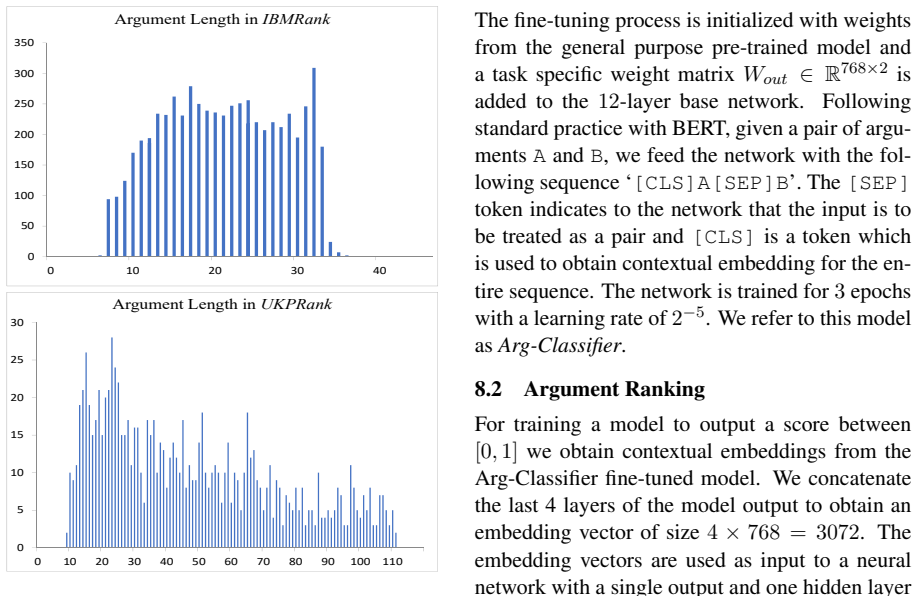
- Because active collection and length limits remove most malformed text, learning systems trained on these arguments are less likely to exploit length as a proxy for quality than on UKPRank.
- The lower accuracy on IBMPairs than on UKPStrict indicates the new dataset is harder, presumably because length and cleanliness confounds were reduced.
Reading between the lines
- Editorial inference: the reported 75% consistency between individual and pairwise labels may partly be a construction artifact, since pairs were sampled only when individual scores differed by at least 0.2; a fair consistency check would sample all pairs regardless of score gap.
- A testable extension the paper does not run: use the individual quality scores as weak supervision to generate pairwise preferences for the unlabeled pairs, then fine-tune on that larger set; the paper only hints at this active-learning direction in the conclusion.
- The same pair-classification setup should transfer to related comparative tasks such as claim evidence strength or answer quality in question answering, because the [CLS]A[SEP]B encoding is task-agnostic; the paper does not make this claim.
- If the low kappa truly reflects subjectivity, then the remaining 17% of pairs where individual and pairwise labels disagree may be a useful diagnostic to find arguments whose quality changes with context, a direction only hinted at in the error analysis.
Signed reviews
Editorial analysis
A structured set of objections, weighed in public.
Referee Report
Summary. The paper introduces new datasets for argument quality assessment: IBM-ArgQ-6.3kArgs, with 6.3k actively collected arguments individually labeled for quality, and IBM-ArgQ-14kPairs, with 14k pairwise preference judgments. Cleaned subsets, IBMRank and IBMPairs, are used for two tasks. For pairwise classification, the authors fine-tune BERT (Arg-Classifier) and report accuracy 0.80 on IBMPairs versus 0.71 for GPPL, and 0.83 on UKPStrict versus quoted baselines of 0.79-0.81. For individual ranking, they use embeddings from the fine-tuned model to train a regressor (Arg-Ranker) and report correlations comparable to GPPL on UKPRank. The paper also analyzes consistency between individual and pairwise labels, reporting 75% agreement.
Significance. If the claimed results hold, this is a valuable contribution: the released datasets are substantially larger than prior argument-quality resources, include explicit individual quality labels that previous work lacked, and are collected in a controlled setting with deliberate length restrictions and annotation quality control. The two-labeling-scheme design is a useful step toward understanding the relationship between absolute and relative quality judgments, and the proposed BERT-based methods are simple, reproducible in principle, and make falsifiable accuracy claims. The authors are also candid about their inability to reproduce the quoted UKPStrict baselines, which is a point in their favor. However, the significance is heavily contingent on resolving the methodological concerns about cross-validation leakage and the partly constructed consistency result.
major comments (4)
- [Section 9.1 / Table 3] The k-fold cross-validation is performed at the level of argument pairs, not at the level of unique arguments. IBMPairs contains 9.1k pairs drawn from 5.3k arguments, and UKPStrict similarly reuses arguments across pairs; because the input to Arg-Classifier is '[CLS]A[SEP]B' (Section 8.1), the same argument text can appear in both training and test folds under a random pair-level split. A fine-tuned BERT model can then memorize argument-specific surface features, and the reported accuracy advantage over GPPL on IBMPairs (0.80 vs 0.71) and on UKPStrict (0.83 vs 0.79) may be inflated. The manuscript must either specify that folds were grouped by unique argument or re-run the comparison with grouped folds; without this, the central SOTA claim is not supported.
- [Section 6.1 / Section 3.2] The consistency result is partially an artifact of the pair-sampling design. Criterion 2 of Section 3.2 restricts annotated pairs to those whose individual quality scores differ by at least 0.2, and the paper reports that agreement rises to 84.3% when the difference exceeds 0.5; the 75% overall agreement is therefore not an independent validation of the individual labels. The authors should report agreement on a random sample of pairs, or otherwise correct for the selection rule, before using this consistency as evidence that the low-kappa individual labels (Task-Average-kappa = 0.1) are meaningful.
- [Section 9.2 / Table 4] The ranking evaluation may inherit the same leakage problem. Arg-Ranker uses embeddings from Arg-Classifier (Section 8.2), which is fine-tuned on IBMPairs; if the pair-training data included arguments that appear in the ranking test folds of IBMRank, the reported correlations (r=0.42, rho=0.41 on IBMRank) do not evaluate ranking of unseen arguments. The paper should describe the split structure between pair-classification training and ranking evaluation, and ideally retrain Arg-Classifier on argument-disjoint folds before extracting embeddings.
- [Section 9.1 / Table 3 / Footnote 16] On UKPStrict, the GPPL opt. and GPC figures are quoted from Simpson and Gurevych (2018) rather than computed under the same fold protocol; the authors state that they could not reproduce those results. The claim to outperform 'all methods tested on this dataset' therefore rests on unreproduced baseline numbers. The authors should provide a directly comparable evaluation, e.g., by running the released implementation under identical grouped folds, or should clearly temper the claim in the abstract and conclusions.
minor comments (4)
- [Section 6.3] The transitivity analysis covers only the 892 triplets for which all pairwise combinations happen to have been labeled; because pair selection was not uniform, this subset may not be representative. A sentence discussing this selection bias would improve the presentation.
- [Section 6.2] The reproducibility correlations (0.81 for pairwise labels, 0.53 for individual labels) would be much more informative with confidence intervals or scatter plots; the current heatmap only shows bin counts for individual labels.
- [Section 8.1] The learning rate is written as '2−5', which is ambiguous; it should be written as 2e-5 or 2×10^{-5}.
- [Section 9.1] The Arg-Length baseline is not described in enough detail: the paper should state whether it always predicts the longer argument as higher quality, and how it breaks ties.
Circularity Check
Pairwise label validation is partially circular: pair sampling and pair-label test questions are derived from individual quality scores, so the reported 75% consistency is partly built into the annotation design; the Arg-Classifier SOTA on external UKPStrict remains independent.
-
self definitional
[Section 5.2, pair-label cleansing; interpreted in Section 6.1]
"In initial annotation rounds the test questions were created based on the previously collected individual arguments labels - considering pairs in which the difference in individual quality scores was≥ 0.6."
The abstract describes the 14k pairwise annotations as 'annotated independently', and Section 6.1 uses pairwise labels to validate individual quality scores by checking that the higher individual score is the actual pairwise winner. However, the pairwise annotation protocol itself used individual-quality-derived test questions, and annotators were alerted when they failed these tests. The pairwise labels are therefore not an independent source of evidence for the individual labels: the agreement in Section 6.1 is partly a consequence of pairwise labelers having been calibrated to the individual scores during quality control.
-
other
[Section 3.2 criterion 2 and Section 6.1]
"Individual quality scores in each pair differ by at least 0.2, aiming for pairs with a relatively high chance of a clear winner."
Section 6.1 defines the expected winner as the argument with the higher individual score and then reports 75% agreement with pairwise labels, rising to 84.3% for differences above 0.5. Because pairs were selected only when individual scores already differed by at least 0.2, the agreement is inflated by the sampling rule: the consistency statistic is not an unbiased estimate of how well individual labels predict pairwise preference on unselected pairs. This makes the 'surprisingly consistent results' claim partly by construction, though it does not affect the external UKPStrict benchmark.
full rationale
The paper's central model claim is not circular: Arg-Classifier's 0.83 accuracy on UKPStrict is compared with GPPL/GPC figures quoted from Simpson and Gurevych (2018), an external dataset and external baselines, and the BERT fine-tuning pipeline is a standard supervised procedure rather than a restatement of the labels. The main circularity is in the dataset-validity argument: the consistency between individual-quality labels and pairwise labels (Abstract; Section 6.1) is weakened because pairwise pairs were filtered by individual-score difference, and pairwise test questions were built from individual scores. Those two mechanisms make the 75% agreement partially a product of the annotation design. The paper's self-citations (e.g., Gleize et al. 2019) are not load-bearing; the relevant baseline comparison is to non-overlapping authors. The quoted GPPL figures on UKPStrict are not reproduced, but that is an auditability limitation, not circularity. A separate potential issue is whether pair-level cross-validation leaks repeated arguments between folds, but that is a methodological risk rather than the circularity identified here. Score 5 reflects partial circularity in the consistency/validity claim while the headline SOTA result remains independently grounded.
Assumptions & free parameters
free parameters (3)
- Annotator filtering thresholds =
20% test failures; kappa <= 0.35; yes-prior >= 80%; < 7 valid judgments
- Pair sampling filters =
stance agreement >= 80%; individual score diff >= 0.2; length diff <= 20%
- Pair agreement threshold =
>= 70% annotator agreement
assumptions (4)
- domain assumption Crowd majority preference is a valid operationalization of argument quality.
- domain assumption Individual quality labels carry real signal despite mean pairwise kappa = 0.1.
- domain assumption BERT's fine-tuned embeddings capture argument-quality-relevant features.
- domain assumption Pairwise preference is transitive enough for evaluation.
Cite this review
Pith. "Pith review of Automatic Argument Quality Assessment -- New Datasets and Methods." pith.science (2026). https://pith.science/paper/RB3AS5RV
@misc{pith2026190901007,
  author       = {Pith},
  title        = {Pith review of: Automatic Argument Quality Assessment -- New Datasets and Methods},
  year         = {2026},
  howpublished = {\url{https://pith.science/paper/RB3AS5RV}},
  note         = {Machine review of arXiv:1909.01007}
}
read the original abstract
We explore the task of automatic assessment of argument quality. To that end, we actively collected 6.3k arguments, more than a factor of five compared to previously examined data. Each argument was explicitly and carefully annotated for its quality. In addition, 14k pairs of arguments were annotated independently, identifying the higher quality argument in each pair. In spite of the inherent subjective nature of the task, both annotation schemes led to surprisingly consistent results. We release the labeled datasets to the community. Furthermore, we suggest neural methods based on a recently released language model, for argument ranking as well as for argument-pair classification. In the former task, our results are comparable to state-of-the-art; in the latter task our results significantly outperform earlier methods.
Figures

Forward citations
Cited by 1 Pith paper
-
Communication is All You Need: Persuasion Dataset Construction via Multi-LLM Communication
A six-role multi-LLM communication framework generates persuasive dialogue data that human judges find nearly indistinguishable from human-written rewrites.
Reference graph
Works this paper leans on
-
[1]
URL: " 'urlintro :=
ENTRY address author booktitle chapter edition editor howpublished institution journal key month note number organization pages publisher school series title type volume year eprint doi pubmed url lastchecked label extra.label sort.label short.list INTEGERS output.state before.all mid.sentence after.sentence after.block STRINGS urlintro eprinturl eprintpr...
-
[2]
write newline
" write newline "" before.all 'output.state := FUNCTION n.dashify 't := "" t empty not t #1 #1 substring "-" = t #1 #2 substring "--" = not "--" * t #2 global.max substring 't := t #1 #1 substring "-" = "-" * t #2 global.max substring 't := while if t #1 #1 substring * t #2 global.max substring 't := if while FUNCTION word.in bbl.in capitalize " " * FUNCT...
-
[3]
Nora Aranberri, Gorka Labaka, Arantza D \'i az de Ilarraza, and Kepa Sarasola. 2017. https://doi.org/10.1007/s10579-016-9335-x Ebaluatoia: crowd evaluation for english--basque machine translation . Language Resources and Evaluation, 51(4):1053--1084
-
[4]
Aristotle, G.A. Kennedy, and G.A. Kennedy. 1991. https://books.google.co.il/books?id=QQFc4FwQz-wC On Rhetoric: A Theory of Civic Discourse . Oxford University Press
work page 1991
-
[5]
Roy Bar-Haim, Indrajit Bhattacharya, Francesco Dinuzzo, Amrita Saha, and Noam Slonim. 2017. https://www.aclweb.org/anthology/E17-1024 Stance classification of context-dependent claims . In Proceedings of the 15th Conference of the E uropean Chapter of the Association for Computational Linguistics: Volume 1, Long Papers , pages 251--261, Valencia, Spain. A...
work page 2017
-
[6]
T Bench-Capon, K Atkinson, and Peter McBurney. 2009. Altruism and agents: an argumentation based approach to designing agent decision mechanisms, pages 1073 -- 1080. Unknown Publisher
work page 2009
-
[7]
Bennett, Kevyn Collins-Thompson, and Eric Horvitz
Xi Chen, Paul N. Bennett, Kevyn Collins-Thompson, and Eric Horvitz. 2013. https://doi.org/10.1145/2433396.2433420 Pairwise ranking aggregation in a crowdsourced setting . In Proceedings of the Sixth ACM International Conference on Web Search and Data Mining, WSDM '13, pages 193--202, New York, NY, USA. ACM
arXiv 2013
-
[8]
Cohen. 1960. A coefficient of agreement for nominal scales. Educ Psychol Meas, pages 37--46
work page 1960
Show all 28 references
-
[9]
Jacob Devlin, Ming - Wei Chang, Kenton Lee, and Kristina Toutanova. 2018. http://arxiv.org/abs/1810.04805 BERT: pre-training of deep bidirectional transformers for language understanding . CoRR, abs/1810.04805
2018 arXiv
-
[10]
Martin Gleize, Eyal Shnarch, Leshem Choshen, Lena Dankin, Guy Moshkowich, Ranit Aharonov, and Noam Slonim. 2019. https://www.aclweb.org/anthology/P19-1093 Are you convinced? choosing the more convincing evidence with a S iamese network . In Proceedings of the 57th Annual Meeti...
2019
-
[11]
Ivan Habernal and Iryna Gurevych. 2016 a . https://doi.org/10.18653/v1/D16-1129 What makes a convincing argument? empirical analysis and detecting attributes of convincingness in web argumentation . In Proceedings of the 2016 Conference on Empirical Methods in Natural Language...
2016 doi
-
[12]
Ivan Habernal and Iryna Gurevych. 2016 b . https://doi.org/10.18653/v1/P16-1150 Which argument is more convincing? analyzing and predicting convincingness of web arguments using bidirectional lstm . In Proceedings of the 54th Annual Meeting of the Association for Computational...
2016 doi
-
[13]
Dirk Hovy, Taylor Berg-Kirkpatrick, Ashish Vaswani, and Eduard Hovy. 2013. https://www.aclweb.org/anthology/N13-1132 Learning whom to trust with MACE . In Proceedings of the 2013 Conference of the North A merican Chapter of the Association for Computational Linguistics: Human ...
2013
-
[14]
Ran Levy, Yonatan Bilu, Daniel Hershcovich, Ehud Aharoni, and Noam Slonim. 2014. https://www.aclweb.org/anthology/C14-1141 Context dependent claim detection . In Proceedings of COLING 2014, the 25th International Conference on Computational Linguistics: Technical Papers , page...
2014
-
[15]
Marco Lippi and Paolo Torroni. 2016. https://doi.org/10.1145/2850417 Argumentation mining: State of the art and emerging trends . ACM Trans. Internet Technol., 16(2):10:1--10:25
2016 doi
-
[16]
Jeffrey Pennington, Richard Socher, and Christopher D. Manning. 2014. Glove: Global vectors for word representation. In In EMNLP
2014
-
[17]
Pranav Rajpurkar, Robin Jia, and Percy Liang. 2018. http://arxiv.org/abs/1806.03822 Know what you don't know: Unanswerable questions for squad . CoRR, abs/1806.03822
2018 arXiv
-
[18]
Pranav Rajpurkar, Jian Zhang, Konstantin Lopyrev, and Percy Liang. 2016. https://doi.org/10.18653/v1/D16-1264 Squad: 100,000+ questions for machine comprehension of text . In Proceedings of the 2016 Conference on Empirical Methods in Natural Language Processing, pages 2383--23...
2016 doi
-
[19]
Chris Reed. 2016. http://aclweb.org/anthology/W16-2800 Proceedings of the third workshop on argument mining (argmining2016) . In Proceedings of the Third Workshop on Argument Mining (ArgMining2016). Association for Computational Linguistics
2016
-
[20]
Nils Reimers, Benjamin Schiller, Tilman Beck, Johannes Daxenberger, Christian Stab, and Iryna Gurevych. 2019. http://arxiv.org/abs/1906.09821 Classification and clustering of arguments with contextualized word embeddings . CoRR, abs/1906.09821
2019 arXiv
-
[21]
Khapra, Ehud Aharoni, and Noam Slonim
Ruty Rinott, Lena Dankin, Carlos Alzate Perez, Mitesh M. Khapra, Ehud Aharoni, and Noam Slonim. 2015. https://doi.org/10.18653/v1/D15-1050 Show me your evidence - an automatic method for context dependent evidence detection . In Proceedings of the 2015 Conference on Empirical ...
2015 doi
-
[22]
Burr Settles. 2009. http://axon.cs.byu.edu/ martinez/classes/778/Papers/settles.activelearning.pdf Active learning literature survey . Computer Sciences Technical Report 1648, University of Wisconsin--Madison
2009
-
[23]
Edwin D Simpson and Iryna Gurevych. 2018. http://aclweb.org/anthology/Q18-1026 Finding convincing arguments using scalable bayesian preference learning . Transactions of the Association for Computational Linguistics, 6:357--371
2018
-
[24]
Christian Stab and Iryna Gurevych. 2014. Annotating argument components and relations in persuasive essays. In COLING , pages 1501--1510. ACL
2014
-
[25]
Henning Wachsmuth, Nona Naderi, Yufang Hou, Yonatan Bilu, Vinodkumar Prabhakaran, Tim Alberdingk Thijm, Graeme Hirst, and Benno Stein. 2017 a . http://aclweb.org/anthology/E17-1017 Computational argumentation quality assessment in natural language . In Proceedings of the 15th ...
2017
-
[26]
Henning Wachsmuth, Martin Potthast, Khalid Al Khatib, Yamen Ajjour, Jana Puschmann, Jiani Qu, Jonas Dorsch, Viorel Morari, Janek Bevendorff, and Benno Stein. 2017 b . Building an argument search engine for the web. In ArgMining@EMNLP, pages 49--59. Association for Computationa...
2017
-
[27]
Douglas Walton, Chris Reed, and Fabrizio Macagno. 2008. Argumentation Schemes. Cambridge University Press
2008
-
[28]
Alex Wang, Amanpreet Singh, Julian Michael, Felix Hill, Omer Levy, and Samuel R. Bowman. 2018. http://arxiv.org/abs/1804.07461 GLUE: A multi-task benchmark and analysis platform for natural language understanding . CoRR, abs/1804.07461
2018 arXiv
Reviewed August 14, 2026 · model on record in the stance chip above.
Discussion (0). Continue with ORCID to comment.