REVIEW 3 major objections 4 minor 65 references
Training Optimization for Gate-Model Quantum Neural Networks
T0 review · 3 major / 4 minor · reviewed 2026-08-14 · deepseek-v4-flash
Pith's one-line read Gate-model QNNs train optimally via supervised learning and backprop
desk verdict A gate-model QNN training paper whose central optimality theorems rest on an undefined objective and an inconsistent constraint; the real content is standard constraint-machine theory and BPTT. read the letter →
The pith
A machine-rendered reading of the paper's core claim, the machinery that carries it, and where it could break.
The reading
What carries the argument
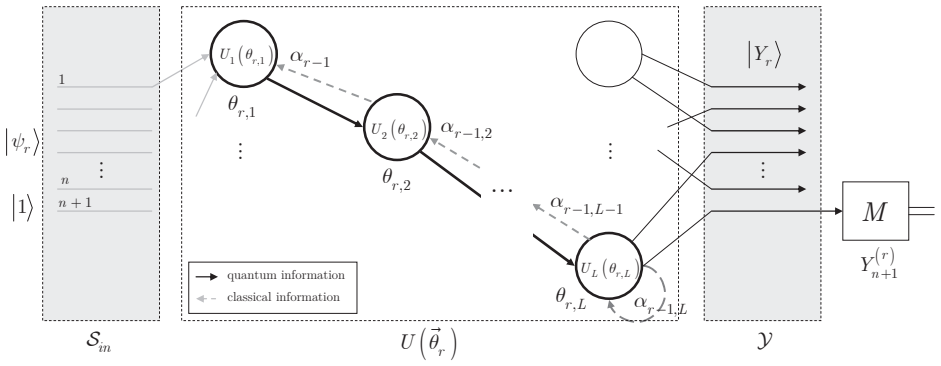
The load-bearing object is the environmental graph $G=(V,S)$, a directed acyclic graph whose vertices are the input, the unitaries and the output, with arcs carrying the gate parameters. From this graph the paper constructs the constraint machine $C(QNN_{QG})$ with linear transition functions, whose task is to satisfy compact constraints $\pi_v$ over states and outputs. The variational machinery is the Lagrangian $\mathcal{L}=\langle Pf^*,Pf^*\rangle+\int_X \lambda(x)\pi_v(x,f^*(x))dx$; setting its variation to zero produces the Euler–Lagrange solution $f^*(x)$, which is what the paper calls optimal. For the recurrent network, the diffuse constraint makes the machine a diffusion machine $D(RQNN_{QG})$, which is the property that licenses the backpropagation algorithm.
What would settle it
Take a two-unitary QNN, write out $f(\vec{\theta})$ exactly as in eq. (8), and test whether the Euler–Lagrange solution $f^*(x)$ from eq. (77) is a stationary point of $f(\vec{\theta})$ and whether Algorithm 1 reaches it; a mismatch, or a failure of Algorithm 1 to converge to it, would refute the optimality claim.
Extended reading notes
Core claim
The paper's central claims are Theorem 3 and Theorem 4: a supervised learning is an optimal learning for a nonrecurrent gate-model QNN, and backpropagation in a recurrent gate-model QNN is an optimal learning in the sense of gradient descent. These are obtained by first proving (Theorems 1 and 2) that the environmental graph of a QNN defines a constraint machine with linear transition functions, and that the recurrent version is a diffusion machine. The optimality statement is carried by the Euler–Lagrange solution $f^*(x)$ of the Lagrangian built from the constraint matrix $A$ and the loss function; because that solution is the stationary point of the variational problem, the paper identifies it with optimal supervised learning. It then writes two algorithms—supervised learning for the QNN and a backpropagation-through-time update for the RQNN—and argues their complexity is $O(|S|)$ in the number of gate parameters.
Load-bearing premise
The whole argument assumes that the training objective of a gate-model QNN is faithfully captured by the constraint-machine formalism with linear transition functions, and that the Euler–Lagrange solution of the Lagrangian is the minimum of the QNN objective $f(\vec{\theta})$; if that mapping is not exact, the optimality theorems do not apply to the QNN.
Editorial extensions
If this is right
- Nonrecurrent gate-model QNNs can be trained with a supervised-learning algorithm that touches every gate parameter through backpropagated classical side information.
- Recurrent gate-model QNNs, which have access to previous measurement rounds, should be trained by a backpropagation-through-time rule; the optimal gradient is the sum of per-round gradients from eq. (116).
- The complexity of the optimal QNN learning procedure is linear in the number of arcs of the environmental graph, i.e., in the number of gate parameters.
- If the proofs hold, near-term gate-model QNN training does not require a new optimizer; standard gradient-descent-based supervised training is already optimal for these structures.
Reading between the lines
- The theorems establish optimality for the constraint-machine representation, not automatically for Algorithms 1 and 2; whether those algorithms attain the Euler–Lagrange solution is a separate, testable question.
- If eq. (8) turns out not to be a well-defined quantum expectation (a scalar loss inside a ket-bra over the parameter vector), the reduction of the QNN objective to the Lagrangian would need repair before the optimality claim applies.
- The same variational reduction could be tested on parameterized quantum circuits with nonlinearities or measurement-based training; the linear-transition assumption would likely fail, and the optimality conclusion would change.
- A direct numerical comparison of Algorithm 2 with standard gradient descent on small recurrent QNNs would separate the optimality of the formalism from the performance of the implemented algorithm.
Editorial analysis
A structured set of objections, weighed in public.
Referee Report
Summary. The paper defines a training-optimization procedure for gate-model quantum neural networks (QNNs) and recurrent gate-model QNNs (RQNNs). It recasts the learning problem in the language of constraint machines and diffusion machines from Gori's framework, derives environmental graphs for the quantum networks, and claims two theorems: supervised learning is optimal for a C(QNN_QG) constraint machine, and backpropagation is optimal for a D(RQNN_QG) diffusion machine in the sense of gradient descent. Two algorithms are presented as the practical incarnations of these optimal learning rules. The paper also includes a closed-form Hessian evaluation for the recurrent case and discusses side-information availability as the distinguishing feature between the two network models.
Significance. If the central claims were sound, the paper would provide a rigorous justification that the standard training methods used for gate-model QNNs—gradient-based supervised learning and backpropagation-through-time—are optimal in a variational sense. The manuscript draws on a well-established constraint-machine formalism and attempts to map quantum gate parameters onto that framework; this is a potentially useful framing. The paper also explicitly provides algorithms and a complexity claim for the nonrecurrent case. However, as written, the formal gaps in the definition of the objective function and in the connection between the generic constraint-machine solution and the proposed QNN algorithms undermine the claimed theorems. The significance of the paper is therefore conditional on a substantial rewriting that would make the objective well-defined and the proofs directly tied to the algorithms.
major comments (3)
- [§3.2, Eq. (8)] The objective function f(θ) = ⟨θ|L(x0, l~tilde(z))|θ⟩ is not well-defined. The loss L(x0, l~tilde(z)) defined in Eq. (9) is a real scalar, but the bra-ket notation requires |θ⟩ to be a vector in a Hilbert space and L to act as an operator. Throughout the paper, θ is a classical parameter vector (Eq. (3)) used only as an argument in the unitaries Ui(θi); no |θ⟩ state, inner product, or operator action is ever specified. Consequently, Theorems 3 and 4, which claim optimality with respect to this f(θ), are statements about an undefined quantity.
- [§4.2 Eq. (38) and §5.1 Eq. (60)] The compact constraint is inconsistently defined. In Eq. (38), πv is written as a sum that is explicitly asserted to be ≠ 0, while in Eq. (60) the same πv is reformulated as Af*(x) − b(x) = 0. These two conditions are not equivalent unless additional structure is specified; the sign and the equality status change without justification. Since the derivation of the optimal supervised learning in Theorem 3 relies on the zero constraint in Eq. (60), the proof is not built on a consistently defined constraint.
- [§5.1, Theorem 3 proof and Algorithm 1] The proof of Theorem 3 analyzes the generic constraint-machine Lagrangian (69) with f*(x) and the constraint πv, and concludes that the Euler–Lagrange solution f*(x) is optimal. However, it never establishes that the QNN objective f(θ) from Eq. (8) corresponds to this f*(x), nor does it show that Algorithm 1 attains or converges to the f*(x) determined by the Euler–Lagrange equations. The optimality claim for Algorithm 1 is therefore unsupported; the same gap applies to Theorem 4 and Algorithm 2 for the recurrent case.
minor comments (4)
- [§5.1, Algorithm 1, Step 4] The update rule uses the condition ⃗∆θz = 1 versus ⃗∆θz ≠ 1, but no justification is given for why the value 1 plays a special role, and the resulting update θ'z = (⃗∆θz)θz is not derived from the gradient descent principle invoked elsewhere.
- [§4.4, Eq. (52)] The function fσ is defined with a condition |Z|1 < 0, but the L1-norm is nonnegative, so this branch is never active. This appears to be a typo, but it makes the definition of the recurrent transition function vacuous in the stated form.
- [§4.3 and §5.2] The transition from a constraint machine C to a diffusion machine D is asserted through Eq. (44) and the relation (45), but the proof does not clearly show why the recurrent structure forces the diffuse constraint to hold exactly; a more explicit argument connecting the backward side-information links to the diffuse constraint would improve readability.
- [§2, references] Several references in the related-work section are cited in blocks (e.g., [4–6, 24, 30, 33, 38, 40–45]) without explaining which specific claim each reference supports; a more granular citation style would help the reader verify the claimed background.
Circularity Check
Theorems 3 and 4 are forced by the constraint-machine/backpropagation definitions; the QNN objective f(θ) plays no role.
-
self definitional
[Theorem 1 (Sec. 4.2) Eq. (38); Theorem 3 (Sec. 5.1) Eqs. (60)-(77)]
"Then, (38) can be reformulated as πv(fT(QNNQG),FO(QNNQG))=Af∗(x)−b(x)=0. (60) ... Since SL(QNN) is non-empty set, f∗(x) can be evaluated by the Euler-Lagrange equations [33,49,50] ... The compact constraint of C(QNNQG) determined via (77) is optimal, since (77) is the optimal solution of the Euler–Lagrange equations."
In Theorem 1 the QNN is declared to be a constraint machine by enforcing πv≠0 (38); Theorem 3 silently rewrites the same πv as the equality constraint Af∗(x)−b(x)=0 (60), and the non-empty supervised set SL(QNN) supplies yκ=f∗(xκ) (64). The Euler-Lagrange solution (65)-(77) is precisely Gori's supervised constraint-machine solution. Hence 'supervised learning is optimal' is true by construction of the substituted constraint problem; the QNN objective f(θ̄) from Eq. (8) never appears in the proof, so no independent first-principles result about the QNN training objective is established.
-
renaming known result
[Theorem 4 (Sec. 5.2) and Algorithm 2, Eqs. (111)-(117)]
"A backpropagation in GRQNNQG is an optimal learning in the sense of gradient descent. ... Utilizing the structure of the GRQNNQG environmental graph allows us to define a modified version of the backpropagation through time algorithm [34] to the RQNNQG. ... In Step 5, the gate parameters are updated via the gradient descent rule [34]."
The optimality predicate is defined as 'in the sense of gradient descent', and Algorithm 2 is exactly the standard gradient descent update θr+1,i=θr,i−ωr (117), with ωr=λ/r Σ_{k=1}^r g_k imported from RNN backpropagation-through-time [34]. Calling this 'optimal' therefore restates the definition of gradient descent; the recurrent-QNN-specific content is just a relabeling of known RNN training, not a derivation that this update minimizes a QNN objective (no connection to f(θ̄) is shown).
full rationale
The paper's central claims (Theorems 3 and 4) reduce to its own modeling choices rather than to an independent derivation. Theorem 1 labels the gate-model QNN as a constraint machine, and Theorem 3 then takes the Euler-Lagrange solution of that constraint machine's Lagrangian as 'optimal supervised learning'; the proof is a restatement of Gori's framework with the compact constraint silently changed from ≠0 (Eq. 38) to =0 (Eq. 60). Theorem 4 similarly announces backpropagation 'optimal in the sense of gradient descent' and Algorithm 2 is textbook gradient descent. No load-bearing self-citation is involved; the circularity is internal to the framework. In addition to the circularity, the objective that the theorems claim to optimize, f(θ̄)=⟨θ̄|L(x0,l̃(z))|θ̄⟩ in Eq. (8), is undefined because θ̄ is a classical parameter vector and no |θ̄⟩ state or operator L is specified, and it is never used in the proofs; this prevents the results from attaching to the stated gate-model QNN training problem. Score 7 reflects that the conclusion is forced by definition/framework choice, while the paper does contain concrete algorithm proposals whose complexity statements (e.g., O(|S|) for Algorithm 1) are independent, non-circular claims.
Assumptions & free parameters
free parameters (3)
- Learning rate lambda =
unspecified
- Bias B_r =
unspecified
- Constants c_kappa of differential operator L =
unspecified
assumptions (5)
- domain assumption The unitary evolution of the QNN contains no nonlinearities, so the transition functions f_T are linear.
- domain assumption The environmental graph G_QNNQG is a directed acyclic graph with vertexes V = S_in union U union Y.
- domain assumption The loss function and the objective are smooth enough for Euler-Lagrange equations and Green's function methods.
- domain assumption Classical side information can propagate arbitrarily in QNN_QG and only backward in RQNN_QG, with no side information about previous runs in QNN_QG.
- domain assumption The constraint-machine framework of Gori [33], including the compact constraint formulation and the Euler-Lagrange solution, applies unchanged to the QNN setting.
Cite this review
Pith. "Pith review of Training Optimization for Gate-Model Quantum Neural Networks." pith.science (2026). https://pith.science/paper/MFG2THZK
@misc{pith2026190901048,
  author       = {Pith},
  title        = {Pith review of: Training Optimization for Gate-Model Quantum Neural Networks},
  year         = {2026},
  howpublished = {\url{https://pith.science/paper/MFG2THZK}},
  note         = {Machine review of arXiv:1909.01048}
}
read the original abstract
Gate-based quantum computations represent an essential to realize near-term quantum computer architectures. A gate-model quantum neural network (QNN) is a QNN implemented on a gate-model quantum computer, realized via a set of unitaries with associated gate parameters. Here, we define a training optimization procedure for gate-model QNNs. By deriving the environmental attributes of the gate-model quantum network, we prove the constraint-based learning models. We show that the optimal learning procedures are different if side information is available in different directions, and if side information is accessible about the previous running sequences of the gate-model QNN. The results are particularly convenient for gate-model quantum computer implementations.
Figures


Figures from the paper (1 more)
Reference graph
Works this paper leans on
-
[1]
Quantum Computing in the NISQ era and beyond, Quantum 2, 79 (2018)
Preskill, J. Quantum Computing in the NISQ era and beyond, Quantum 2, 79 (2018)
work page 2018
-
[2]
Harrow, A. W. and Montanaro, A. Quantum Computational Supremacy, Nature, vol 549, pages 203-209 (2017). 26
work page 2017
-
[3]
Aaronson, S. and Chen, L. Complexity-theoretic foundations of quantum supremacy experi- ments. Proceedings of the 32nd Computational Complexity Conference , CCC ’17, pages 22:1- 22:67, (2017)
work page 2017
-
[4]
Biamonte, J. et al. Quantum Machine Learning. Nature, 549, 195-202 (2017)
work page 2017
-
[5]
LeCun, Y., Bengio, Y. and Hinton, G. Deep Learning. Nature 521, 436-444 (2014)
work page 2014
-
[6]
Goodfellow, I., Bengio, Y. and Courville, A. Deep Learning. MIT Press. Cambridge, MA, (2016)
work page 2016
-
[7]
Debnath, S. et al. Demonstration of a small programmable quantum computer with atomic qubits. Nature 536, 63-66 (2016)
work page 2016
-
[8]
Monz, T. et al. Realization of a scalable Shor algorithm. Science 351, 1068-1070 (2016)
work page 2016
Show all 65 references
-
[9]
Barends, R. et al. Superconducting quantum circuits at the surface code threshold for fault tolerance. Nature 508, 500-503 (2014)
2014
-
[10]
and Wineland, D
Kielpinski, D., Monroe, C. and Wineland, D. J. Architecture for a large-scale ion-trap quantum computer. Nature 417, 709-711 (2002)
2002
-
[11]
Ofek, N. et al. Extending the lifetime of a quantum bit with error correction in superconducting circuits. Nature 536, 441-445 (2016)
2016
-
[12]
and Neven, H
Farhi, E. and Neven, H. Classification with Quantum Neural Networks on Near Term Proces- sors, arXiv:1802.06002v1 (2018)
2018 arXiv
-
[13]
and Neven, H
Farhi, E., Goldstone, J., Gutmann, S. and Neven, H. Quantum Algorithms for Fixed Qubit Architectures. arXiv:1703.06199v1 (2017)
2017 arXiv
-
[14]
and Gutmann, S
Farhi, E., Goldstone, J. and Gutmann, S. A Quantum Approximate Optimization Algorithm. arXiv:1411.4028. (2014)
2014 arXiv
-
[15]
and Harrow, A
Farhi, E. and Harrow, A. W. Quantum Supremacy through the Quantum Approximate Opti- mization Algorithm, arXiv:1602.07674 (2016)
2016 arXiv
-
[16]
and Gutmann, S
Farhi, E., Goldstone, J. and Gutmann, S. A Quantum Approximate Optimization Algorithm Applied to a Bounded Occurrence Constraint Problem. arXiv:1412.6062. (2014)
2014 arXiv
-
[17]
and Temme, K
Farhi, E., Kimmel, S. and Temme, K. A Quantum Version of Schoning’s Algorithm Applied to Quantum 2-SAT, arXiv:1603.06985 (2016)
2016 arXiv
-
[18]
A probabilistic algorithm for k-SAT and constraint satisfaction problems
Schoning, T. A probabilistic algorithm for k-SAT and constraint satisfaction problems. Foun- dations of Computer Science , 1999. 40th Annual Symposium on, pages 410–414. IEEE (1999)
1999
-
[19]
A new way of thinking: The IBM quantum experience
IBM. A new way of thinking: The IBM quantum experience . URL: http://www.research.ibm.com/quantum. (2017)
2017
-
[20]
Brandao, F. G. S. L., Broughton, M., Farhi, E., Gutmann, S. and Neven, H. For Fixed Control Parameters the Quantum Approximate Optimization Algorithm’s Objective Function Value Concentrates for Typical Instances, arXiv:1812.04170 (2018). 27
2018 arXiv
-
[21]
Crooks, G. E. Performance of the Quantum Approximate Optimization Algorithm on the Maximum Cut Problem, arXiv:1811.08419 (2018)
2018 arXiv
-
[22]
and Imre, S
Gyongyosi, L. and Imre, S. Dense Quantum Measurement Theory, Scientific Reports, Nature, DOI: 10.1038/s41598-019-43250-2, (2019)
2019 doi
-
[23]
The Universe as Quantum Computer, A Computable Universe: Understand- ing and exploring Nature as computation , H
Lloyd, S. The Universe as Quantum Computer, A Computable Universe: Understand- ing and exploring Nature as computation , H. Zenil ed., World Scientific, Singapore, 2012, arXiv:1312.4455v1 (2013)
2013 arXiv
-
[24]
and Rebentrost, P
Lloyd, S., Mohseni, M. and Rebentrost, P. Quantum algorithms for supervised and unsuper- vised machine learning, arXiv:1307.0411v2 (2013)
2013 arXiv
-
[25]
H., Wong, F
Lloyd, S., Shapiro, J. H., Wong, F. N. C., Kumar, P., Shahriar, S. M. and Yuen, H. P. Infrastructure for the quantum Internet. ACM SIGCOMM Computer Communication Review, 34, 9-20 (2004)
2004
-
[26]
and Rebentrost, P
Lloyd, S., Mohseni, M. and Rebentrost, P. Quantum principal component analysis. Nature Physics, 10, 631 (2014)
2014
-
[27]
and Lloyd, S
Rebentrost, P., Mohseni, M. and Lloyd, S. Quantum Support Vector Machine for Big Data Classification. Phys. Rev. Lett. 113. (2014)
2014
-
[28]
and Zanardi, P
Lloyd, S., Garnerone, S. and Zanardi, P. Quantum algorithms for topological and geometric analysis of data. Nat. Commun., 7, arXiv:1408.3106 (2016)
2016 arXiv
-
[29]
and Nguyen, H
Gyongyosi, L., Imre, S. and Nguyen, H. V. A Survey on Quantum Channel Capacities, IEEE Communications Surveys and Tutorials 99, 1, doi: 10.1109/COMST.2017.2786748 (2018)
2018
-
[30]
and Petruccione, F
Schuld, M., Sinayskiy, I. and Petruccione, F. An introduction to quantum machine learning. Contemporary Physics 56, pp. 172-185. arXiv: 1409.3097 (2015)
2015 arXiv
-
[31]
Quantum Networking , John Wiley and Sons Ltd, ISBN 1118648927, 9781118648926 (2014)
Van Meter, R. Quantum Networking , John Wiley and Sons Ltd, ISBN 1118648927, 9781118648926 (2014)
2014
-
[32]
and Gyongyosi, L
Imre, S. and Gyongyosi, L. Advanced Quantum Communications - An Engineering Approach . Wiley-IEEE Press (New Jersey, USA), (2012)
2012
-
[33]
Machine Learning: A Constraint-Based Approach, ISBN: 978-0-08-100659-7, Elsevier (2018)
Gori, M. Machine Learning: A Constraint-Based Approach, ISBN: 978-0-08-100659-7, Elsevier (2018)
2018
-
[34]
and Valaee, S
Salehinejad, H., Sankar, S., Barfett, J., Colak, E. and Valaee, S. Recent Advances in Recurrent Neural Networks, arXiv:1801.01078v3 (2018)
2018 arXiv
-
[35]
and Bengio, Y
Arjovsky, M., Shah, A. and Bengio, Y. Unitary Evolution Recurrent Neural Networks. arXiv: 1511.06464 (2015)
2015 arXiv
-
[36]
and Kchler, A
Goller, C. and Kchler, A. Learning task-dependent distributed representations by backpropa- gation through structure. Proc. of the ICNN-96, pp. 347–352, Bochum, Germany, IEEE (1996). 28
1996
-
[37]
and Konig, B
Baldan, P., Corradini, A. and Konig, B. Unfolding Graph Transformation Systems: Theory and Applications to Verification, In: Degano P., De Nicola R., Meseguer J. (eds) Concurrency, Graphs and Models. Lecture Notes in Computer Science, vol 5065. Springer, Berlin, Heidelberg (2008)
2008
-
[38]
Hyland, S. L. and Ratsch, G. Learning Unitary Operators with Help From u(n). arXiv: 1607.04903 (2016)
2016 arXiv
-
[39]
and Svore, K
Wiebe, N., Kapoor, A. and Svore, K. M. Quantum Deep Learning, arXiv:1412.3489 (2015)
2015 arXiv
-
[40]
Wan, K. H. et al. Quantum generalisation of feedforward neural networks. npj Quantum In- formation 3, 36 arXiv: 1612.01045 (2017)
2017 arXiv
-
[41]
and Aspuru-Guzik, A
Cao, Y., Giacomo Guerreschi, G. and Aspuru-Guzik, A. Quantum Neuron: an elementary building block for machine learning on quantum computers. arXiv: 1711.11240 (2017)
2017 arXiv
-
[42]
Dunjko, V. et al. Super-polynomial and exponential improvements for quantum-enhanced re- inforcement learning. arXiv: 1710.11160 (2017)
2017 arXiv
-
[43]
Romero, J. et al. Strategies for quantum computing molecular energies using the unitary coupled cluster ansatz. arXiv: 1701.02691 (2017)
2017 arXiv
-
[44]
Riste, D. et al. Demonstration of quantum advantage in machine learning. arXiv: 1512.06069 (2015)
2015 arXiv
-
[45]
Yoo, S. et al. A quantum speedup in machine learning: finding an N-bit Boolean function for a classification. New Journal of Physics 16.10, 103014 (2014)
2014
-
[46]
and Weedbrook, C
Lloyd, S. and Weedbrook, C. Quantum generative adversarial learning. Phys. Rev. Lett., 121, arXiv:1804.09139 (2018)
2018 arXiv
-
[47]
Dorozhinsky, V. I. and Pavlovsky, O. V. Artificial Quantum Neural Network: quantum neu- rons, logical elements and tests of convolutional nets, arXiv:1806.09664 (2018)
2018 arXiv
-
[48]
and Garcia-Ripoll, J
Torrontegui, E. and Garcia-Ripoll, J. J. Universal quantum perceptron as efficient unitary approximators, arXiv:1801.00934 (2018)
2018 arXiv
-
[49]
Calculus of variations
Roubicek, T. Calculus of variations. Mathematical Tools for Physicists . (Ed. M. Grinfeld) J. Wiley, Weinheim, ISBN 978-3-527-41188-7, pp.551-588. (2014)
2014
-
[50]
and Davies, J
Binmore, K. and Davies, J. Calculus Concepts and Methods . Cambridge University Press. p
-
[51]
Shor, P. W. Scheme for reducing decoherence in quantum computer memory. Phys. Rev. A , 52, R2493-R2496 (1995)
1995
-
[52]
Quantum Information Theory and Quantum Statistics , Springer-Verlag, Heidelberg, Hiv: 6
Petz, D. Quantum Information Theory and Quantum Statistics , Springer-Verlag, Heidelberg, Hiv: 6. (2008)
2008
-
[53]
On the Way to Quantum-Based Satellite Communication, IEEE Comm
Bacsardi, L. On the Way to Quantum-Based Satellite Communication, IEEE Comm. Mag. 51:(08) pp. 50-55. (2013). 29
2013
-
[54]
and Imre, S
Gyongyosi, L. and Imre, S. Multilayer Optimization for the Quantum Internet, Scientific Reports, Nature, DOI:10.1038/s41598-018-30957-x, (2018)
2018 doi
-
[55]
and Imre, S
Gyongyosi, L. and Imre, S. Entanglement Availability Differentiation Service for the Quantum Internet, Scientific Reports , Nature, (DOI:10.1038/s41598-018-28801-3), https://www.nature.com/articles/s41598-018-28801-3, (2018)
2018 doi
-
[56]
and Imre, S
Gyongyosi, L. and Imre, S. Entanglement-Gradient Routing for Quan- tum Networks, Scientific Reports , Nature, (DOI:10.1038/s41598-017-14394-w), https://www.nature.com/articles/s41598-017-14394-w, (2017)
2017 doi
-
[57]
and Imre, S
Gyongyosi, L. and Imre, S. Decentralized Base-Graph Routing for the Quantum Inter- net, Physical Review A , American Physical Society, DOI: 10.1103/PhysRevA.98.022310, https://link.aps.org/doi/10.1103/PhysRevA.98.022310, (2018)
2018 doi
-
[58]
and Banchi, L
Pirandola, S., Laurenza, R., Ottaviani, C. and Banchi, L. Fundamental limits of repeaterless quantum communications, Nature Communications, 15043, doi:10.1038/ncomms15043 (2017)
2017 doi
-
[59]
L., Laurenza, R., Ottaviani, C., Cope, T
Pirandola, S., Braunstein, S. L., Laurenza, R., Ottaviani, C., Cope, T. P. W., Spedalieri, G. and Banchi, L. Theory of channel simulation and bounds for private communication, Quantum Sci. Technol. 3, 035009 (2018)
2018
-
[60]
and Pirandola, S
Laurenza, R. and Pirandola, S. General bounds for sender-receiver capacities in multipoint quantum communications, Phys. Rev. A 96, 032318 (2017)
2017
-
[61]
and Imre, S
Gyongyosi, L. and Imre, S. A Survey on Quantum Computing Technology, Computer Science Review, Elsevier, DOI: 10.1016/j.cosrev.2018.11.002, ISSN: 1574-0137 (2018)
2018 doi
-
[62]
Capacities of repeater-assisted quantum communications, arXiv:1601.00966 (2016)
Pirandola, S. Capacities of repeater-assisted quantum communications, arXiv:1601.00966 (2016)
2016 arXiv
-
[63]
End-to-end capacities of a quantum communication network, Commun
Pirandola, S. End-to-end capacities of a quantum communication network, Commun. Phys. 2 51 (2019)
2019
-
[64]
S., Caleffi, M., Tafuri, F., Cataliotti, F
Cacciapuoti, A. S., Caleffi, M., Tafuri, F., Cataliotti, F. S., Gherardini, S. and Bianchi, G. Quantum Internet: Networking Challenges in Distributed Quantum Computing, arXiv:1810.08421 (2018). 30 A Appendix A.1 Abbreviations AI Artificial Intelligence DAG Directed Acyclic Graph ...
2018 arXiv
-
[190]
OCLC 717598615
ISBN 978-0-521-77541-0. OCLC 717598615. (2007)
2007
Reviewed August 14, 2026 · model on record in the stance chip above.
Discussion (0). Continue with ORCID to comment.