REVIEW 3 major objections 5 minor 14 references
Filtering Approaches for Dealing with Noise in Anomaly Detection
T0 review · 3 major / 5 minor · reviewed 2026-08-14 · deepseek-v4-flash
Pith's one-line read Filtering the anomaly-detection residual shrinks its nominal covariance by a factor of $\tau\omega_c/(2\sqrt{2})$, so the chi-squared threshold stays valid while small attacks become far easier to detect.
desk verdict Useful and honest paper on filtering residuals for attack detection, but the load-bearing covariance formula is only a first-order truncation and the paper never says how small the sampling time must be. read the letter →
The pith
A machine-rendered reading of the paper's core claim, the machinery that carries it, and where it could break.
The reading
What carries the argument
The machinery that carries the argument is a bank of $p$ identical second-order Butterworth low-pass filters in state-space form, discretized with a first-order Euler step $\Phi_d = I + \Phi\tau$ and $\Psi_d = \Psi\tau$. Steady-state Riccati equations on each subblock give the filtered covariance elementwise, and dropping higher-order terms in $\tau\omega_c$ yields (18). The normalized distance measure built from $\rho_k$ is the chi-squared statistic, and the equivalent-control method of sliding-mode theory converts the filtered sign term of the observer into an attack reconstruction.
What would settle it
Compute the exact steady-state covariance of the discretized Butterworth filter keeping all terms in $\tau\omega_c$, form the normalized distance measure (25), and compare its empirical false alarm rate with the Lemma 1 threshold: if the rates depart from $A^*$ for $\tau\omega_c$ near 0.1-1, the small-$\tau\omega_c$ assumption fails and the detector is miscalibrated.
Extended reading notes
Core claim
Theorem 1 is the load-bearing result: for a residual $r_k \sim \mathcal{N}(0,\Sigma_r)$ passed through the second-order Butterworth filter (16)-(17) with bandwidth $\omega_c$ and sampling time $\tau$, the output $\rho_k$ is zero-mean Gaussian with covariance $\Sigma_\rho = \frac{\tau\omega_c}{2\sqrt{2}}\Sigma_r$. Because the filtered distance measure (25) normalizes by this smaller covariance, it remains chi-squared with $p$ degrees of freedom, so Lemma 1 supplies the threshold and the false alarm rate is preserved while the attack's effect on the statistic is magnified. A second claim, equation (39), is that filtering the discontinuous term of a robust sliding-mode observer yields $y_f \approx \ddot{\delta}+a\delta+b\dot{\delta}$, turning the detector into an attack reconstructor: for constant attacks the filter output is approximately $a\delta_0$, which could be fed back to nullify the attack.
Load-bearing premise
Theorem 1's covariance formula assumes the sampling interval $\tau$ is small enough that all terms of order $(\tau\omega_c)^2$ and higher vanish, and the paper gives no bound on $\tau\omega_c$ for when this truncation is accurate.
Editorial extensions
If this is right
- The same threshold from Lemma 1 applies to the filtered detector, so upgrading an existing chi-squared detector requires no re-tuning of the false alarm rate.
- Small constant attacks that change the alarm rate only from 5% to 7% without filtering push the filtered detector's alarm rate to 55%, making previously invisible attacks visible.
- Stealthy attacks on the filtered detector must respect frequency content, not just amplitude, so high-frequency attack components are attenuated by the filter.
- The robust observer with filter reconstructs smooth attacks as $y_f \approx \ddot{\delta}+a\delta+b\dot{\delta}$, enabling mitigation such as canceling constant attacks via feedback.
- Because the filtered detector inherits the chi-squared calibration, its threshold remains meaningful even though the nominal covariance is much smaller.
Reading between the lines
- The covariance law (18) likely extends in spirit to higher-order Butterworth filters with a different numerical constant, giving a family of detectors with tunable noise rejection; this is not shown in the paper.
- Because the scaling is linear in the cutoff frequency $\omega_c$, lowering $\omega_c$ shrinks the nominal covariance but also attenuates low-frequency attacks, so an optimal cutoff must balance detection sensitivity against attack bandwidth; the paper does not solve this tradeoff.
- The same filtering idea could be applied to CUSUM or windowed chi-squared detectors, where the reduced nominal covariance would sharpen change-point statistics; the paper leaves this open.
- An analytic threshold for the observer-based detector could replace the empirical $L_\infty$-norm calibration, making its false alarm rate predictable; the paper explicitly leaves $\alpha_f$ numeric.
Signed reviews
Editorial analysis
A structured set of objections, weighed in public.
Referee Report
Summary. The paper proposes two ways to use low-pass filtering to improve anomaly/attack detection in LTI control systems with Gaussian measurement noise. The first is a "filtered chi-squared detector": residual signals are passed through a bank of second-order Butterworth filters, and the paper derives (Theorem 1) that the steady-state covariance of the filtered residual is proportional to the unfiltered residual covariance, Σρ = (τωc/(2√2))Σr. This covariance is used to normalize a filtered distance measure so that it remains chi-squared with p degrees of freedom, allowing the standard Lemma 1 threshold to set the false alarm rate. The second approach uses a discontinuous (sliding-mode) observer whose filtered switching term approximates a smooth attack signal, giving yf ≈ δ̈ + aδ + bδ̇, and an anomaly detector based on the magnitude of yf. The paper demonstrates both methods on a second-order numerical example, reporting that the filtered chi-squared detector raises alarms at 55% under a small constant attack whereas the unfiltered detector raises alarms at only 7%, and that the sliding-mode observer reconstructs time-varying and constant attacks in the noise-free case.
Significance. If Theorem 1 is correct, the filtered chi-squared detector is a simple and potentially useful retrofit: filtering reduces the nominal covariance of the detection statistic, making low-frequency attacks easier to separate from noise while preserving the threshold-setting procedure of the standard chi-squared detector. The sliding-mode observer section offers a genuinely different detection paradigm, namely attack reconstruction via the filtered discontinuous term, and the noise-free comparison in Fig. 3 between measured and predicted residuals is a credible validation of equation (39). The analytical covariance computation is a parameter-free derivation from the stated stochastic assumptions rather than a curve fit, which is a strength. However, the central claim is currently supported only by a first-order truncation with no quantified error bound, so the quantitative 55%-versus-7% comparison rests on an unverified regime of validity. The overall idea is promising and within scope for the journal, but the missing error control and the empirically tuned threshold in Section IV are load-bearing limitations that require attention.
major comments (3)
- [Section III-B, Theorem 1 (Eqs. (23)-(24))] The proof of Theorem 1 obtains the exact covariance of the Euler-discretized filter, as exhibited before Eq. (24), and then drops all terms of order O((τωc)^2) and higher with the statement "if the sampling time is taken small enough the higher order terms vanish." No quantitative bound on τωc is given, and the text does not state the cutoff frequency ωc used in the Section V-A experiment. Because Eq. (25) uses the truncated covariance to normalize the filtered residual and because Lemma 1's threshold is valid only when the normalized statistic is exactly chi-squared, the claimed false alarm rate A*=5% and the reported 55% alarm rate under attack are not guaranteed unless the truncation error is negligible at the chosen parameters. Please provide either a rigorous error bound on the covariance approximation or a numerical validation that the distribution of the left-hand side of (25) is sufficiently close to chi-squared at the parameters used in Fig. 1, and report ωc for that example.
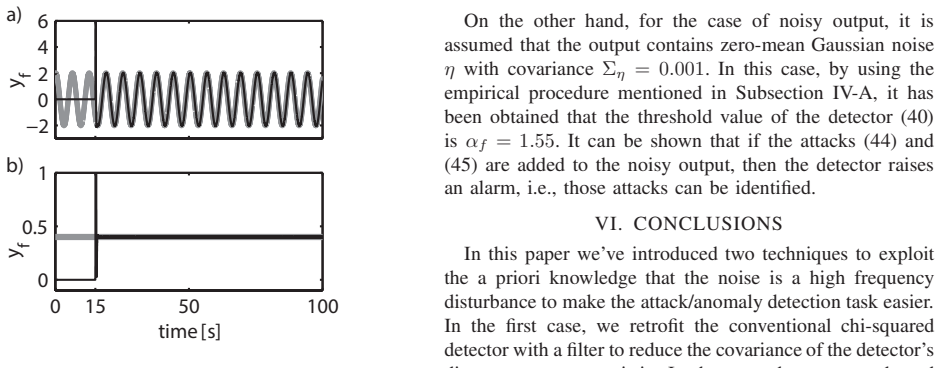
- [Section IV-A, Eq. (40)] The threshold αf for the discontinuous-observer detector is not derived from a false alarm specification but is set empirically to the L∞-norm of the filter output measured under normal noisy operation. As the paper states, there is no formal procedure for determining αf. Consequently, the claim that attacks (44)-(45) "can be identified" in the noisy case is not accompanied by any characterization of the false alarm rate or the detection probability, so it cannot be compared quantitatively with the residual-based detectors. At minimum, the paper should report the empirical false alarm rate for the chosen αf and discuss how the threshold should be adjusted if the noise level changes.
- [Section IV, Eqs. (30)-(39)] The derivation leading to yf ≈ δ̈ + aδ + bδ̇ assumes η=0 and assumes that the system is on the sliding surface (e1 = ė1 = 0). In the noisy example, the detector is applied directly to a noisy output without an analytic extension of the equivalent-control result, so the relationship between the filter output and the attack under noise (including the effect of finite c3 and chattering) is not established. Please clarify under what noise conditions and observer gains (39) remains a valid approximation, or restrict the claim to the noise-free case and treat the noisy case as purely empirical.
minor comments (5)
- [Title] The title contains a typo: "Dete ction" should be "Detection."
- [Introduction, paragraph 4] The phrase "The recent work to to tune classical detectors" contains a duplicated "to."
- [Section III-B, first paragraph] "apriori" should be written as "a priori."
- [Section IV-A, first paragraph] "worth nothing" should be "worth noting."
- [Section V-A, Fig. 1] Please report the number of Monte Carlo runs or the time horizon used to estimate the empirically reported alarm rates, since the rates are compared to four decimals (e.g., 7% and 55%).
Circularity Check
No significant circularity: Theorem 1 is a parameter-free covariance calculation, and the Section IV threshold is an explicitly empirical calibration rather than a fitted input presented as a prediction.
full rationale
The main load-bearing result, Theorem 1, derives the filtered-residual covariance from the stated Gaussian assumption, the chosen Butterworth filter, and the discrete-time Riccati equation; equation (25) then normalizes by that derived covariance, so the chi-squared claim follows algebraically rather than by construction. Lemma 1 is cited from prior work by one of the authors, but it is a standard inverse-gamma threshold relation with stated assumptions that do not include the filtered result, so it is independent support and not a load-bearing self-citation chain. The Section IV detector threshold alpha_f is admittedly 'numerically determined by directly measuring the output of the filter' and taken as the L-infinity norm; this is an openly empirical calibration, not a fitted parameter renamed as a prediction, and the subsequent attack-detection claim depends on the attack-induced filter output exceeding that threshold rather than on the calibration itself. The Fig. 3 comparisons use the analytically derived residuals (39) and (41) against a Simulink simulation, so no fitted values are being recycled. The genuine weakness is a correctness risk rather than circularity: Theorem 1 keeps only first-order terms in tau*omega_c with no stated bound, and Remark 1's claim that the filtered covariance is 'significantly smaller' depends on that unquantified truncation. No step in the derivation reduces to its own input by definition or by a self-citation chain.
Assumptions & free parameters
free parameters (2)
- Filter cutoff frequency ω_c =
12 rad/s in Section V-B example; not stated for Section V-A example
- Threshold α_f of the discontinuous-observer detector =
1.55 (empirically calibrated)
assumptions (7)
- domain assumption Measurement noise η is zero-mean Gaussian and is substantially higher frequency than attack/anomaly signals.
- standard math The pairs (A,C) and (A,B) are detectable and stabilizable, respectively.
- domain assumption Sampling time τ is small enough that the Euler discretization Φ_d = I + Φτ is accurate and higher-order terms can be dropped.
- domain assumption For the discontinuous observer, measurements are noise-free (η=0) and the sliding surface e1=ė1=0 is reached.
- standard math The equivalent control method [14] gives the averaged value of the discontinuous term.
- domain assumption Plant parameter a is known to the detector user.
- standard math Observer gains c1, c2, c3 can be chosen as in [12] to make the observation error globally asymptotically stable in the noise-free, attack-free case.
Cite this review
Pith. "Pith review of Filtering Approaches for Dealing with Noise in Anomaly Detection." pith.science (2026). https://pith.science/paper/ZKRGCIIO
@misc{pith2026190901477,
  author       = {Pith},
  title        = {Pith review of: Filtering Approaches for Dealing with Noise in Anomaly Detection},
  year         = {2026},
  howpublished = {\url{https://pith.science/paper/ZKRGCIIO}},
  note         = {Machine review of arXiv:1909.01477}
}
read the original abstract
The leading workhorse of anomaly (and attack) detection in the literature has been residual-based detectors, where the residual is the discrepancy between the observed output provided by the sensors (inclusive of any tampering along the way) and the estimated output provided by an observer. These techniques calculate some statistic of the residual and apply a threshold to determine whether or not to raise an alarm. To date, these methods have not leveraged the frequency content of the residual signal in making the detection problem easier, specifically dealing with the case of (e.g., measurement) noise. Here we demonstrate some opportunities to combine filtering to enhance the performance of residual-based detectors. We also demonstrate how filtering can provide a compelling alternative to residual-based methods when paired with a robust observer. In this process, we consider the class of attacks that are stealthy, or undetectable, by such filtered detection methods and the impact they can have on the system.
Figures


Reference graph
Works this paper leans on
-
[12]
Robust observation and identification of ndof lagrangian systems,
D. I. Rosas Almeida, J. Alvarez, and L. Fridman, “Robust observation and identification of ndof lagrangian systems,” International Journal of Robust and Nonlinear Control, vol. 17, no. 9, pp. 842–861. [Online]. Available: https://onlinelibrary.wiley.com/doi/abs/10.1002/rnc.1156
-
[1]
J. Chen and R. J. Patton, Robust Model-based Fault Diagnosis for Dynamic Systems. Norwell, MA, USA: Kluwer Academic Publishers, 1999
work page 1999
-
[2]
At- tacks against process control systems: Risk assessment, de tection, and response,
A. C´ ardenas, S. Amin, Z. Lin, Y . Huang, C. Huang, and S. Sa stry, “At- tacks against process control systems: Risk assessment, de tection, and response,” in Proceedings of the 6th ACM Symposium on Information, Computer and Communications Security , 2011, pp. 355–366
work page 2011
-
[3]
Detecting integr ity attacks on scada systems,
Y . Mo, R. Chabukswar, and B. Sinopoli, “Detecting integr ity attacks on scada systems,” IEEE Transactions on Control Systems Technology, vol. 22, no. 4, pp. 1396–1407, 2014
work page 2014
-
[4]
On the performance degradation of cyber- physical systems under stealthy integrity attacks,
Y . Mo and B. Sinopoli, “On the performance degradation of cyber- physical systems under stealthy integrity attacks,” IEEE Transactions on Automatic Control , vol. 61, pp. 2618–2624, 2016
work page 2016
-
[5]
Optimal Linea r Cyber- Attack on Remote State Estimation,
Z. Guo, D. Shi, K. H. Johansson, and L. Shi, “Optimal Linea r Cyber- Attack on Remote State Estimation,” IEEE Transactions on Control of Network Systems , vol. PP , no. 99, pp. 1–10, 2016
work page 2016
-
[6]
J. Miloˇ sevi´ c, D. Umsonst, H. Sandberg, and K. H. Johans son, “Quantifying the impact of cyber-attack strategies for con trol systems equipped with an anomaly detector,” in 2018 European Control Conference (ECC) . IEEE, 2018, pp. 331–337
work page 2018
-
[7]
Anomaly detector metrics fo r sensor data attacks in control systems,
D. Umsonst and H. Sandberg, “Anomaly detector metrics fo r sensor data attacks in control systems,” in 2018 Annual American Control Conference (ACC). IEEE, 2018, pp. 153–158
work page 2018
Show all 14 references
-
[8]
On reachable sets of hidden cps s ensor attacks,
C. Murguia and J. Ruths, “On reachable sets of hidden cps s ensor attacks,” in 2018 Annual American Control Conference (ACC) . IEEE, 2018, pp. 178–184
2018
-
[9]
Tuning windowed chi- squared detectors for sensor attacks,
R. Tunga, C. Murguia, and J. Ruths, “Tuning windowed chi- squared detectors for sensor attacks,” in 2018 Annual American Control Conference (ACC). IEEE, 2018, pp. 1752–1757
2018
-
[10]
A comparison of st ealthy sensor attacks on control systems,
N. Hashemi, C. Murguia, and J. Ruths, “A comparison of st ealthy sensor attacks on control systems,” in 2018 Annual American Control Conference (ACC). IEEE, 2018, pp. 973–979
2018
-
[11]
Generalized chi-squared dete ctor for lti systems with non-gaussian noise,
N. Hashemi and J. Ruths, “Generalized chi-squared dete ctor for lti systems with non-gaussian noise,” in 2019 Annual American Control Conference (ACC). IEEE, 2019
2019
-
[13]
Cusum and chi-squared attack d etection of compromised sensors,
C. Murguia and J. Ruths, “Cusum and chi-squared attack d etection of compromised sensors,” in proceedings of the IEEE Multi-Conference on Systems and Control (MSC) , 2016
2016
-
[14]
V . I. Utkin, Sliding Modes in Control and Optimization . Springer- V erlag Berlin Heidelberg, 1992
1992
Reviewed August 14, 2026 · model on record in the stance chip above.
Discussion (0). Continue with ORCID to comment.