REVIEW 3 major objections 5 minor 1 cited by
Quantum Natural Gradient
T0 review · 3 major / 5 minor · reviewed 2026-08-14 · deepseek-v4-flash
Pith's one-line read The paper defines quantum natural gradient descent on the Fubini-Study metric, shows its block-diagonal form costs one measurement per commuting layer, and demonstrates faster convergence on 7-, 9-, and 11-qubit circuits.
desk verdict The paper that made quantum natural gradient a standard variational-circuit tool: the theoretical core is sound and the block-diagonal QGT estimator is a real contribution, but the empirical 'dramatically fewer iterations' claim rests on single-run curves and needs statistical support. read the letter →
The pith
A machine-rendered reading of the paper's core claim, the machinery that carries it, and where it could break.
The reading
What carries the argument
The load-bearing object is the quantum geometric tensor, $G_{ij}=\langle\partial_i\psi|\partial_j\psi\rangle-\langle\partial_i\psi|\psi\rangle\langle\psi|\partial_j\psi\rangle$, whose real part is the Fubini-Study metric on the space of pure states. The optimizer uses the pseudo-inverse $g^+$ of this metric as a preconditioner, solving $g(\theta_t)(\theta_{t+1}-\theta_t)=-\eta\nabla L(\theta_t)$ instead of materializing the inverse. For layered circuits the metric is approximated block-diagonally: whenever all parametrized gates in a layer commute, the generators $K_i$ satisfy $[K_i,K_j]=0$, the product $K_iK_j$ is Hermitian, and each block reduces to a covariance $\langle\psi_l|K_iK_j|\psi_l\rangle-\langle\psi_l|K_i|\psi_l\rangle\langle\psi_l|K_j|\psi_l\rangle$ that can be read off from one measurement in the shared eigenbasis of the layer's generators.
What would settle it
Simulate the exact update $\theta_{t+1}=\theta_t-\eta g^+(\theta_t)\nabla L(\theta_t)$ for the same physical two-qubit state written in two different parameter coordinate systems; reparametrization invariance predicts identical trajectories on the state manifold, so any divergence in the state-space path would falsify the claim.
Extended reading notes
Core claim
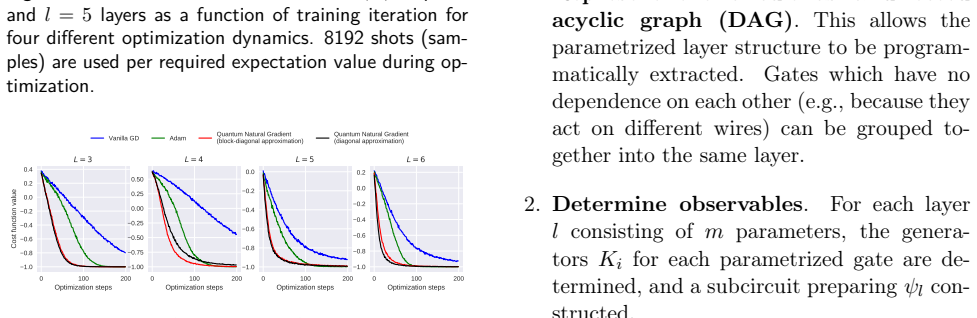
The central claim is that the dynamics $\theta_{t+1}=\theta_t-\eta g^+(\theta_t)\nabla L(\theta_t)$, with $g_{ij}(\theta)=\operatorname{Re}[G_{ij}(\theta)]$, is the reparameterization-invariant steepest descent on the pure-state manifold. Here $G_{ij}(\theta)=\langle\partial_i\psi_\theta|\partial_j\psi_\theta\rangle-\langle\partial_i\psi_\theta|\psi_\theta\rangle\langle\psi_\theta|\partial_j\psi_\theta\rangle$ is the quantum geometric tensor. For a circuit factored into layers whose parametrized gates commute, the $l$-th block of the metric becomes $G^{(l)}_{ij}=\langle\psi_l|K_iK_j|\psi_l\rangle-\langle\psi_l|K_i|\psi_l\rangle\langle\psi_l|K_j|\psi_l\rangle$, which is Hermitian and therefore equals its own real part; this block can be evaluated with a single commuting measurement per layer, and a diagonal variant with even less overhead. Numerical experiments on 7-, 9-, and 11-qubit circuits with five layers, and on 9-qubit circuits with three to six layers, show the quantum natural gradient reaching the target in far fewer iterations than vanilla gradient descent or Adam, with the advantage growing with qubit number and persisting with depth.
Load-bearing premise
The efficient single-measurement estimator assumes that every parametrized gate inside a circuit layer commutes with the others in that layer; if a layer mixes non-commuting gates, the block-diagonal expression is no longer the Fubini-Study metric and the one-setting scheme does not apply.
Editorial extensions
If this is right
- On the tested circuits, quantum natural gradient reaches the minimum in a small number of iterations, while vanilla gradient descent fails to find it on the 7-, 9-, and 11-qubit benchmarks; Adam finds it but needs more iterations.
- Each natural-gradient step costs $2d+L$ quantum evaluations: $2d$ for parameter-shift gradients and $L$ for the metric blocks, one per layer.
- The diagonal approximation to the metric gives convergence close to the block-diagonal version with greatly reduced classical processing, bringing wall time down to roughly the level of vanilla gradient descent.
- Because the metric does not depend on the observable being minimized, the preconditioner reflects state-space geometry rather than loss curvature, making it complementary to historical-averaging methods such as Adam.
- In the zero-step-size limit, the quantum natural gradient dynamics coincides with imaginary-time evolution restricted to the variational subspace.
Reading between the lines
- A direct untested transfer would be to QAOA-style MaxCut circuits, whose layers contain commuting $ZZ$ interactions but whose cost landscape is combinatorial rather than the two-local observable used here; the iteration-count advantage is not guaranteed to carry over.
- Because the metric blocks are independent of the loss Hamiltonian, the same $L$ measurements per layer could be cached and reused when one circuit family is trained on several objectives, amortizing the per-step cost across tasks.
- For circuits with non-commuting gates inside a layer, a natural extension is to split each layer into maximal commuting subsets and estimate a metric block per subset; this would preserve the geometric interpretation at the price of more than one measurement setting per layer.
- Combining quantum natural gradient with Adam-style historical averaging is explicitly left open by the paper, and the supplementary results with a natural-gradient-modified Adam suggest such hybrids may converge even faster.
Editorial analysis
A structured set of objections, weighed in public.
Referee Report
Summary. The paper introduces a quantum analogue of natural gradient descent for variational quantum circuits. The update replaces the Euclidean metric in the gradient-descent proximal problem with the real part of the Quantum Geometric Tensor (the Fubini-Study metric pulled back to the parameter manifold), giving a reparametrization-invariant update (Eqs. 10-13). The authors derive a block-diagonal approximation of the metric for layered circuits, show that each block can be expressed in terms of expectation values of products of generators (Eq. 27), and provide a measurement scheme requiring a single state preparation per layer when the generators within a layer commute (Secs. 2.5-2.6). They also establish an equivalence with imaginary-time evolution (Sec. A.2) and report numerical comparisons on a ladder ansatz with 7-11 qubits (Figs. 1-4).
Significance. If the results hold, the paper makes a valuable contribution: it provides a principled, parameterization-invariant geometry for variational quantum optimization, an explicit and implementable way to estimate the metric on quantum hardware (with open-source PennyLane implementation), and a proof-of-concept that geometric preconditioning can reduce the number of optimization iterations. The derivation of the metric blocks is clean and internally consistent, and the imaginary-time equivalence is a genuine structural insight. The main weakness is that the empirical evidence for "dramatically fewer iterations" rests on single runs with fixed hyperparameters, so the practical advantage is not yet statistically established.
major comments (3)
- [Section 3, Figures 1-4] The paper's central practical claim—that QNG reaches the minimum in dramatically fewer iterations than vanilla GD and Adam—is supported only by single-run cost curves. Each panel shows a single trajectory from one random initialization (the same initialization as Ref. [24]) with no error bars, no multiple seeds, and no summary statistics; Figs. 3-4 in Sec. A.5 have the same limitation for wall time and number of quantum evaluations. Because single trajectories can be unrepresentative, the numerical advantage is not established. I request multiple random initializations with median and quantile bands and, for the shot-noise runs, repeated evaluations to characterize variance.
- [Figures 1-4 and Sec. A.5] The comparison against Adam uses a single learning rate, 0.01, for every optimizer. Adam's default suggested rate in Ref. [18] is 0.001, and optimizer performance is strongly sensitive to this hyperparameter. The observed iteration advantage may therefore reflect an unfavorable baseline setting rather than a property of the geometry. Please report a small learning-rate sweep or sensitivity curves for each optimizer and for both the block and diagonal QNG variants, and state the chosen rates explicitly in the captions.
- [Section 2.5, Eqs. (19)-(28)] The block-diagonal metric is equal to the Fubini-Study metric block, and the single-setting measurement is valid, only when all parameterized generators within each layer commute, so that K_i K_j is Hermitian. While the paper states this as a defining property of a layer, the abstract and introduction promise an efficient algorithm for parametrized quantum circuits without this qualification. Please state the scope in the abstract and introduction, and indicate which standard ansatz families (e.g., QAOA, hardware-efficient circuits with one rotation per qubit per layer, and circuits with multi-qubit parametric entanglers) satisfy or violate the condition; for families violating it, the presented scheme does not apply and the approximation error relative to the full QNG update is not quantified.
minor comments (5)
- [Section 3, Fig. 1] The text states that the block-diagonal approximation is omitted for n = 11, but the figure legend and caption still list the block-diagonal QNG curve; please reconcile the legend or the text.
- [Eq. (39)] The notation "arccos2" should read "arccos^2"; the same notational issue should be checked wherever the squared arccos appears.
- [Sec. 2.1] The statement that CP^{N-1} possesses "a unique unitarily-invariant metric tensor" should be qualified as unique up to an overall scale; otherwise it is technically imprecise.
- [Sec. 2.4] The interval conventions in Eqs. (15)-(17) are terse; a short example or an explanatory sentence for (l:L] and [1:l) would improve readability.
- [Secs. 2.5-2.6] The notation drops the layer index from the generator K, which is convenient but occasionally confusing in Eqs. (25)-(27) when comparing different layers; consider retaining a layer subscript.
Circularity Check
No significant circularity: the QNG update, block-diagonal metric, and imaginary-time equivalence are derived from the Fubini-Study geometry and explicit commuting-layer assumptions, not from the objective or fitted parameters.
full rationale
The derivation chain is self-contained. Section 2.1 defines the Fubini-Study metric from the fidelity distance on CP^{N-1} (Eqs. 5-7), and Appendix A.1 derives Re[G] as the infinitesimal squared line element from the Taylor expansion of |<psi_theta, psi_{theta+dtheta}>|^2, so the metric is not defined in terms of the loss L. The update rule in Eq. (13) is obtained by solving the first-order optimality condition of the metric-weighted steepest-descent problem in Eq. (10); the reparametrization invariance is a property of the Riemannian metric, not a fitted input. The block-diagonal QGT in Eqs. (19)-(28) is a direct calculation for layers whose parametric gates commute, an assumption stated explicitly as the defining property of a layer in Sections 2.4-2.5, and the single-setting measurement follows from the commuting observables in Eq. (32); there is no parameter fit hidden in the measurement scheme. The imaginary-time equivalence in Appendix A.2 is proved from the same equations (Eqs. 46-53), not assumed as a premise. The numerical comparisons use the external McClean et al. circuit with a fixed learning rate of 0.01 for all optimizers and no fitted constants; the lack of multiple seeds or error bars is an empirical robustness limitation, not a circularity. Self-citations (PennyLane, parameter-shift rule, overparameterization discussion) are tooling or context and do not carry the central argument. No step reduces, by construction or by self-citation, to its own output.
Assumptions & free parameters
free parameters (2)
- Learning rate eta =
0.01
- Measurement shots per expectation value =
8192 (and 1024 in supplementary)
assumptions (5)
- standard math The space of pure quantum states is CP^(N-1) with the unique unitarily invariant Fubini-Study metric.
- domain assumption The objective is the expectation value of a Hermitian operator on pure states prepared by a unitary circuit.
- domain assumption All parametrized gates in a layer commute, so [K_i,K_j]=0.
- standard math Standard calculus identities hold: normalization gives Re<psi|partial_i psi>=0 and Taylor expansions to second order are valid.
- domain assumption The parameter-shift rule gives unbiased analytic gradients on quantum hardware.
Cite this review
Pith. "Pith review of Quantum Natural Gradient." pith.science (2026). https://pith.science/paper/2AJYCZNR
@misc{pith2026190902108,
  author       = {Pith},
  title        = {Pith review of: Quantum Natural Gradient},
  year         = {2026},
  howpublished = {\url{https://pith.science/paper/2AJYCZNR}},
  note         = {Machine review of arXiv:1909.02108}
}
read the original abstract
A quantum generalization of Natural Gradient Descent is presented as part of a general-purpose optimization framework for variational quantum circuits. The optimization dynamics is interpreted as moving in the steepest descent direction with respect to the Quantum Information Geometry, corresponding to the real part of the Quantum Geometric Tensor (QGT), also known as the Fubini-Study metric tensor. An efficient algorithm is presented for computing a block-diagonal approximation to the Fubini-Study metric tensor for parametrized quantum circuits, which may be of independent interest.
Figures


Figures from the paper (1 more)

Forward citations
Cited by 1 Pith paper
-
Spectral Geometry and Bosonic-Bloch Probes: Explorations in Quantum Learning
Training reorganizes output similarity graphs in quantum networks, increasing spectral dimension by 0.23, with bosonic interference correlations and Bloch drift enabling high-ROC-AUC anomaly detection via a proposed s...
Reference graph
Works this paper leans on
-
[36]
Theory of variational quantum simulation.Quantum, 3:191, 2019
Xiao Yuan, Suguru Endo, Qi Zhao, Ying Li, and Simon C Benjamin. Theory of variational quantum simulation.Quantum, 3:191, 2019. DOI: 10.22331/q-2019-10-07-191. Accepted in Quantum 2020-05-08, click title to verify. Published under CC-BY 4.0. 15
-
[24]
Jarrod R McClean, Sergio Boixo, Vadim N Smelyanskiy, Ryan Babbush, and Hartmut Neven. Barren plateaus in quantum neural network training landscapes.Nature communications, 9(1): 4812, 2018. DOI: 10.1038/s41467-018-07090-4
-
[18]
Adam: A method for stochastic optimization.arXiv preprint arXiv:1412.6980, 2014
Diederik P Kingma and Jimmy Ba. Adam: A method for stochastic optimization.arXiv preprint arXiv:1412.6980, 2014
arXiv 2014
-
[1]
Natural gradient works efficiently in learning
Shun-Ichi Amari. Natural gradient works efficiently in learning. Neural Computation, 10(2): 251–276, 1998. DOI: 10.1162/089976698300017746
-
[2]
VilleBergholm, JoshIzaac, MariaSchuld, ChristianGogolin, M.SohaibAlam, ShahnawazAhmed, Juan Miguel Arrazola, Carsten Blank, Alain Delgado, Soran Jahangiri, Keri McKiernan, Jo- hannes Jakob Meyer, Zeyue Niu, Antal Szàva, and Nathan Killoran. Pennylane: Automatic differentiation of hybrid quantum-classical computations.arXiv preprint arXiv:1811.04968, 2018
arXiv 2018
-
[3]
Geometric speed limit of accessible many-body state preparation
Marin Bukov, Dries Sels, and Anatoli Polkovnikov. Geometric speed limit of accessible many-body state preparation. Physical Review X, 9(1):011034, 2019. DOI: 10.1103/PhysRevX.9.011034
-
[4]
Localization and glassy dynamicsofmany-bodyquantumsystems
Giuseppe Carleo, Federico Becca, Marco Schiró, and Michele Fabrizio. Localization and glassy dynamicsofmany-bodyquantumsystems. Scientific reports, 2:243, 2012. DOI:10.1038/srep00243
-
[5]
Light-cone effect and supersonic correlations in one-and two-dimensional bosonic superfluids
Giuseppe Carleo, Federico Becca, Laurent Sanchez-Palencia, Sandro Sorella, and Michele Fab- rizio. Light-cone effect and supersonic correlations in one-and two-dimensional bosonic superfluids. Physical Review A, 89(3):031602, 2014. DOI: 10.1103/PhysRevA.89.031602
Show all 36 references
-
[6]
Demonstration of adiabatic variational quantum computing with a superconducting quantum coprocessor.arXiv preprint arXiv:1905.03150, 2019
Ming-Cheng Chen, Ming Gong, Xiao-Si Xu, Xiao Yuan, Jian-Wen Wang, Can Wang, Chong Ying, Jin Lin, Yu Xu, Yulin Wu, et al. Demonstration of adiabatic variational quantum computing with a superconducting quantum coprocessor.arXiv preprint arXiv:1905.03150, 2019
1905 arXiv
-
[7]
Efficient quantum measurement of pauli operators
Ophelia Crawford, Barnaby van Straaten, Daochen Wang, Thomas Parks, Earl Campbell, and Stephen Brierley. Efficient quantum measurement of pauli operators. arXiv preprint arXiv:1908.06942, 2019
1908 arXiv
-
[8]
The expressive power of parame- terized quantum circuits.arXiv preprint arXiv:1810.11922, 2018
Yuxuan Du, Min-Hsiu Hsieh, Tongliang Liu, and Dacheng Tao. The expressive power of parame- terized quantum circuits.arXiv preprint arXiv:1810.11922, 2018
2018 arXiv
-
[9]
Classification with quantum neural networks on near term processors
Edward Farhi and Hartmut Neven. Classification with quantum neural networks on near term processors. arXiv preprint arXiv:1802.06002, 2018
2018 arXiv
-
[10]
A quantum approximate optimization algorithm
Edward Farhi, Jeffrey Goldstone, and Sam Gutmann. A quantum approximate optimization algorithm. arXiv preprint arXiv:1411.4028, 2014
2014 arXiv
-
[11]
Minimizing state preparations in variational quantum eigensolver by partitioning into commuting families.arXiv preprint arXiv:1907.13623, 2019
Pranav Gokhale, Olivia Angiuli, Yongshan Ding, Kaiwen Gui, Teague Tomesh, Martin Suchara, Margaret Martonosi, and Frederic T Chong. Minimizing state preparations in variational quantum eigensolver by partitioning into commuting families.arXiv preprint arXiv:1907.13623, 2019
1907 arXiv
-
[12]
Practical optimization for hybrid quantum- classical algorithms
Gian Giacomo Guerreschi and Mikhail Smelyanskiy. Practical optimization for hybrid quantum- classical algorithms. arXiv preprint arXiv:1701.01450, 2017
2017 arXiv
-
[13]
Low-depth gradient measurements can improve convergence in variational hybrid quantum-classical algorithms.arXiv preprint arXiv:1901.05374, 2019
Aram Harrow and John Napp. Low-depth gradient measurements can improve convergence in variational hybrid quantum-classical algorithms.arXiv preprint arXiv:1901.05374, 2019
1901 arXiv
-
[14]
Towards quantum machine learning with tensor networks.Quantum Science and Technology, 4:024001, 2018
William James Huggins, Piyush Patil, Bradley Mitchell, K Birgitta Whaley, and Miles Stouden- mire. Towards quantum machine learning with tensor networks.Quantum Science and Technology, 4:024001, 2018. DOI: 10.1088/2058-9565/aaea94
2018 doi
-
[15]
Three factors influencing minima in sgd.arXiv preprint arXiv:1711.04623, 2017
Stanislaw Jastrzebski, Zachary Kenton, Devansh Arpit, Nicolas Ballas, Asja Fischer, Yoshua Ben- gio, and Amos Storkey. Three factors influencing minima in sgd.arXiv preprint arXiv:1711.04623, 2017
2017 arXiv
-
[16]
Quantum compilation and circuit optimisation via energy dissipation
Tyson Jones and Simon C Benjamin. Quantum compilation and circuit optimisation via energy dissipation. arXiv preprint arXiv:1811.03147, 2018
2018 arXiv
-
[17]
Variational quantum algorithms for discovering hamiltonian spectra.Physical Review A, 99(6):062304, 2019
Tyson Jones, Suguru Endo, Sam McArdle, Xiao Yuan, and Simon C Benjamin. Variational quantum algorithms for discovering hamiltonian spectra.Physical Review A, 99(6):062304, 2019. DOI: 10.1103/PhysRevA.99.062304
2019 doi
-
[19]
Geometry and non- adiabatic response in quantum and classical systems
Michael Kolodrubetz, Dries Sels, Pankaj Mehta, and Anatoli Polkovnikov. Geometry and non- adiabatic response in quantum and classical systems. Physics Reports, 697:1–87, 2017. DOI: 10.1016/j.physrep.2017.07.001
2017 doi
-
[20]
Springer, 1981
PH Kramer and Marcos Saraceno.Geometry of the time-dependent variational principle in quan- tum mechanics. Springer, 1981. DOI: 10.1007/3-540-10271-X_317. Accepted in Quantum 2020-05-08, click title to verify. Published under CC-BY 4.0. 14
1981 doi
-
[21]
Efficient variational quantum simulator incorporating active error minimization
Ying Li and Simon C Benjamin. Efficient variational quantum simulator incorporating active error minimization. Physical Review X, 7(2):021050, 2017. DOI: 10.1103/PhysRevX.7.021050
2017 doi
-
[22]
Fisher-rao metric, ge- ometry, and complexity of neural networks
Tengyuan Liang, Tomaso Poggio, Alexander Rakhlin, and James Stokes. Fisher-rao metric, ge- ometry, and complexity of neural networks. InThe 22nd International Conference on Artificial Intelligence and Statistics, pages 888–896, 2019
2019
-
[23]
Varia- tional ansatz-based quantum simulation of imaginary time evolution.npj Quantum Information, 5(1):1–6, 2019
Sam McArdle, Tyson Jones, Suguru Endo, Ying Li, Simon C Benjamin, and Xiao Yuan. Varia- tional ansatz-based quantum simulation of imaginary time evolution.npj Quantum Information, 5(1):1–6, 2019. DOI: 10.1038/s41534-019-0187-2
2019 doi
-
[25]
Quantumcircuitlearning
KosukeMitarai, MakotoNegoro, MasahiroKitagawa, andKeisukeFujii. Quantumcircuitlearning. Physical Review A, 98(3):032309, 2018. DOI: 10.1103/PhysRevA.98.032309
2018 doi
-
[26]
Path-SGD: Path-normalized optimization in deep neural networks
Behnam Neyshabur, Ruslan R Salakhutdinov, and Nati Srebro. Path-SGD: Path-normalized optimization in deep neural networks. In Advances in Neural Information Processing Systems, pages 2422–2430, 2015
2015
-
[27]
A variational eigenvalue solver on a photonic quantum processor
Alberto Peruzzo, Jarrod McClean, Peter Shadbolt, Man-Hong Yung, Xiao-Qi Zhou, Peter J Love, Alán Aspuru-Guzik, and Jeremy L O’Brien. A variational eigenvalue solver on a photonic quantum processor. Nature Communications, 5:4213, 2014. DOI: 10.1038/ncomms5213
2014 doi
-
[28]
Information-geometry of quantum states
Dénes Petz. Information-geometry of quantum states. InQuantum Probability Communications: Volume X, pages 135–157. World Scientific, 1998. DOI: 10.1142/9789812816054_0006
1998 doi
-
[29]
Quantum computing in the NISQ era and beyond.Quantum, 2:79, 2018
John Preskill. Quantum computing in the NISQ era and beyond.Quantum, 2:79, 2018. DOI: 10.22331/q-2018-08-06-79
2018 doi
-
[30]
Circuit-centric quantum classi- fiers.arXiv preprint arXiv:1804.00633, 2018
Maria Schuld, Alex Bocharov, Krysta Svore, and Nathan Wiebe. Circuit-centric quantum classi- fiers.arXiv preprint arXiv:1804.00633, 2018. DOI: 10.1103/PhysRevA.101.032308
2018 arXiv
-
[31]
Evaluat- ing analytic gradients on quantum hardware
Maria Schuld, Ville Bergholm, Christian Gogolin, Josh Izaac, and Nathan Killoran. Evaluat- ing analytic gradients on quantum hardware. Physical Review A, 99(3):032331, 2019. DOI: 10.1103/PhysRevA.99.032331
2019 doi
-
[32]
Weak binding between two aromatic rings: Feeling the van der waals attraction by quantum monte carlo methods.The Journal of Chemical Physics, 127(1):014105, 2007
Sandro Sorella, Michele Casula, and Dario Rocca. Weak binding between two aromatic rings: Feeling the van der waals attraction by quantum monte carlo methods.The Journal of Chemical Physics, 127(1):014105, 2007. DOI: 10.1063/1.2746035
2007 doi
-
[33]
Multivariate stochastic approximation using a simultaneous perturbation gradient approximation
James C Spall et al. Multivariate stochastic approximation using a simultaneous perturbation gradient approximation. IEEE Transactions on Automatic Control, 37(3):332–341, 1992. DOI: 10.1109/9.119632
1992 doi
-
[34]
Geometric phases in physics.Geometric Phases In Physics
F Wilczek and A Shapere. Geometric phases in physics.Geometric Phases In Physics. Series: Ad- vanced Series in Mathematical Physics, ISBN: 978-9971-5-0621-6. WORLD SCIENTIFIC, Edited by F Wilczek and A Shapere, vol. 5, 5, 1989. DOI: 10.1142/0613
1989 doi
-
[35]
PennyLane source code
Xanadu Quantum Technologies. PennyLane source code. https://github.com/XanaduAI/ pennylane, 2019. [Online; accessed 3-Mar-2020]
2019
Reviewed August 14, 2026 · model on record in the stance chip above.
Discussion (0). Continue with ORCID to comment.