REVIEW 2 major objections 4 minor 41 references
NERO: A Neural Rule Grounding Framework for Label-Efficient Relation Extraction
T0 review · 2 major / 4 minor · reviewed 2026-08-14 · deepseek-v4-flash
Pith's one-line read Soft rule matching lets 270 rules rival 3,000 sentence labels for relation extraction.
desk verdict A genuinely new learnable soft matcher for rule grounding, with careful low-resource RE experiments; the main claim holds, though pseudo-label quality is never directly measured. read the letter →
The pith
A machine-rendered reading of the paper's core claim, the machinery that carries it, and where it could break.
The reading
What carries the argument
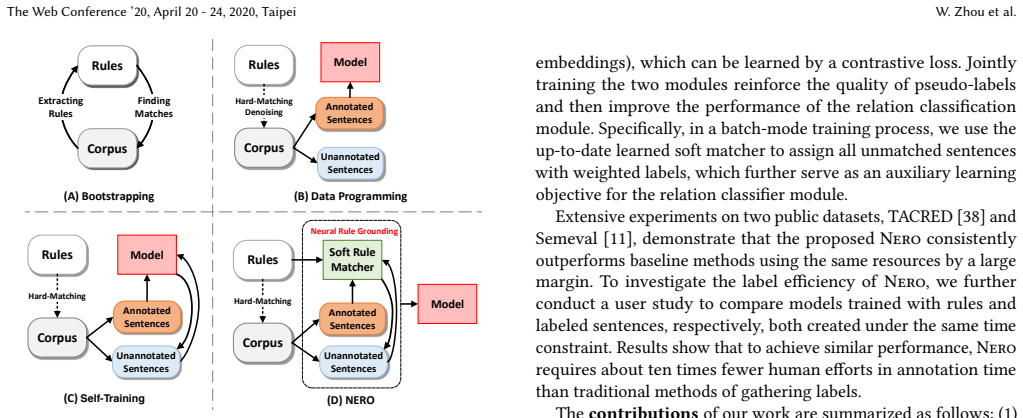
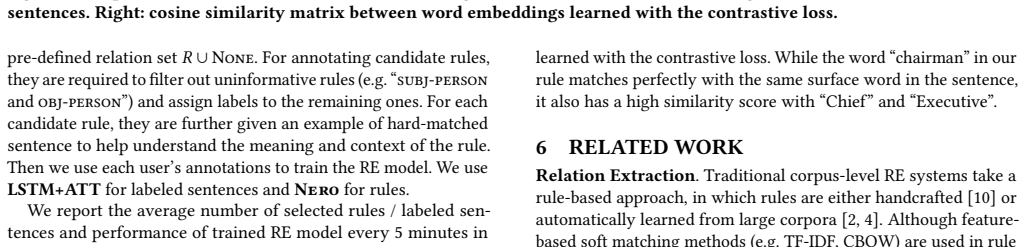
The load-bearing component is the soft rule matcher (SRM), a small neural network that maps a sentence and a rule body into one embedding space and scores their match by cosine similarity, $\mathit{SRM}(s,p) = (D z_s)^T(D z_p)/(\lVert D z_s \rVert \lVert D z_p \rVert)$, where $z_s$ and $z_p$ are word-embedding sums weighted by word-level attention and $D$ is a trainable diagonal matrix. The matcher is trained only with a contrastive clustering loss over rule pairs, which pulls rules of the same relation together and pushes different-relation rules apart; no supervision tells it which sentences match which rules. The framework then uses this matcher to pseudo-label unmatched sentences with the relation of the highest-scoring rule, weighting each pseudo-labeled instance by a softmax over matching scores. Ablations show this pseudo-labeling loss carries the largest reported gain: removing it drops TACRED F1 from 51.3 to 42.9.
What would settle it
Take a trained NERO model, sample unmatched sentences from the TACRED development set, and have annotators check whether the pseudo-label from the highest-scoring rule matches the true relation; if accuracy is near chance for sentences with moderate SRM scores, such as scores between 0.3 and 0.7, the transfer from rule-pair training to sentence grounding fails and the reported gains would come from some other component.
Extended reading notes
Core claim
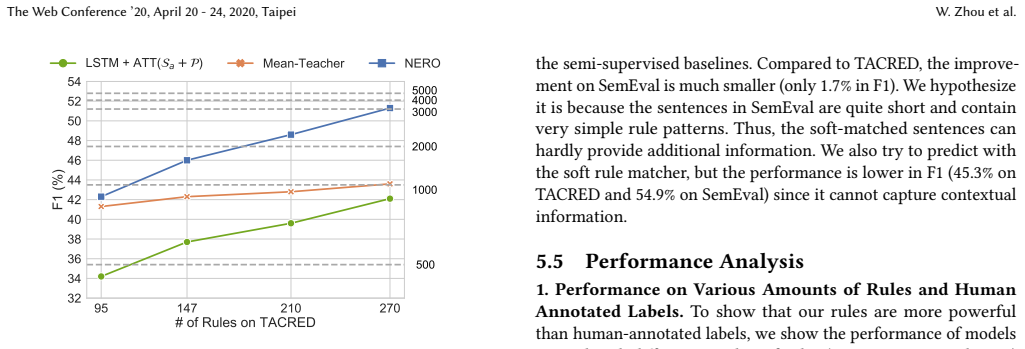
The paper's central claim is that jointly training a relation classifier with a learnable soft rule matcher substantially improves relation extraction when supervision comes from labeling rules rather than labeled sentences. The soft rule matcher computes a matching score $\mathit{SRM}(s,p)\in[-1,1]$ as the cosine similarity between attention-weighted embeddings of a sentence and a rule body, and this score is used to assign every unmatched sentence the relation of its highest-scoring rule, with the score controlling an instance weight in the auxiliary loss. Trained only through a contrastive loss over rule pairs, the matcher nevertheless organizes its space so that high matching scores transfer to sentence-rule pairs. With 270 rules on TACRED, NERO reaches 51.3 F1, outperforming the hard-matching baseline at 42.1 F1 and several semi-supervised baselines; on SemEval it reaches 60.5 F1. The authors further report that this rule-based model is comparable to one trained with approximately 3,000 labeled sentences, and that the learned matcher can be applied to rules for relations unseen during training.
Load-bearing premise
The load-bearing premise is that the soft rule matcher, trained only on rule-rule similarities, produces matching scores whose highest-scoring rule reliably carries the correct relation label for an unseen sentence.
Editorial extensions
If this is right
- Rule annotation becomes a practical substitute for sentence annotation: annotators spend comparable time per rule and per sentence, but one rule can supervise many sentences.
- Soft matching raises the recall of rule-based labeling, so large unlabeled corpora can be leveraged for relation extraction without distant supervision from knowledge bases.
- Because the matcher is trained on rule pairs, it can assign labels to relations never seen during training when new rules are supplied, giving a few-shot capability at test time.
- The relation classifier is interchangeable, so improved sequence encoders can be dropped into the framework without changing the rule-grounding machinery.
Reading between the lines
- The paper's speedup estimate compares annotation time, but the rule-mining pipeline requires frequent surface patterns; for rare relations, few candidate rules will appear, so the tenfold saving may not transfer to long-tail relation sets.
- Because NERO grounds each sentence through only its single most-similar rule, a natural testable extension is to treat the SRM score distribution as a confidence-calibration signal and abstain or down-weight when the top score is not clearly separated; the paper does not report such an analysis.
- The contrastive rule-pair objective creates the embedding space without sentence supervision, which suggests the same machinery could apply to other structured labeling tasks where rules and raw text coexist, such as event extraction or slot filling.
Signed reviews
Editorial analysis
A structured set of objections, weighed in public.
Referee Report
Summary. The paper proposes NERO, a framework for label-efficient relation extraction that combines a neural relation classifier (RC) with a learnable soft rule matcher (SRM). Labeling rules are mined as frequent surface patterns and annotated by humans. Hard matching partitions the corpus into matched and unmatched sentences; the SRM, trained with a contrastive loss over rule pairs, assigns pseudo-labels to unmatched sentences, and the RC is trained jointly on hard-matched, rule, and pseudo-labeled data. Experiments on TACRED and SemEval compare NERO against rule-based, supervised, and semi-supervised baselines, with ablations, sensitivity analysis, unseen-relation evaluation, and a user study on annotation efficiency.
Significance. If the reported results hold, NERO provides a practical and effective way to leverage human effort via rule annotation instead of sentence-level labeling, with a claimed speedup of about an order of magnitude. The empirical evaluation is careful: results are averaged over five runs with standard deviations; the paper includes ablations of each loss term, comparisons of several soft-matching mechanisms, hyper-parameter sensitivity, and a user study. The release of code is a strength, as is the demonstration of unseen-relation prediction, which gives the framework additional value beyond label efficiency.
major comments (2)
- [5.1] The exact rule sets (270 rules for TACRED and 164 for SemEval) are not provided in the paper or supplementary material, and the rule-construction process involves human annotation decisions that are not fully specified. Without the exact rules, the empirical results cannot be independently reproduced or compared against future work. Please release the rule sets, including the raw candidate patterns before human filtering, together with the code, and specify the annotation instructions used by the human annotators.
- [3.5 (Eq. 11), Table 4] The largest performance gain in the ablation study is attributed to Lunmatched, which uses pseudo-labels from an SRM trained only on the rule-pair contrastive loss Lclus. While the Nero-SRM test performance (45.3 F1 on TACRED, Table 2) and the unseen-relation results (Table 3) provide indirect evidence that the SRM has learned meaningful sentence-rule matching, the paper does not directly measure the quality of the pseudo-labels on Sunmatched. Please add a direct analysis, for example, the precision and recall of the top-1 SRM pseudo-labels on a labeled subset of the unmatched sentences, or the agreement between SRM confidence and label correctness. This would confirm that the gain reflects semantic grounding rather than a surface-level bias such as a tendency to predict relation labels with high frequency.
minor comments (4)
- [Abstract; Sec. 5.7] The abstract states a 9.5x speedup from using 270 rules versus 3,000 labeled sentences, but the user study reports an 8x speedup for 1,000 labels (40 minutes of rule annotation versus 320 minutes of sentence annotation). The calculation behind the 9.5x figure is not shown. Please clarify how this number is derived and ensure consistency with the user-study results.
- [Sec. 6] The word 'psuedo-labels' appears in the Related Work section; it should be 'pseudo-labels'.
- [Sec. 3.5, Eq. (10)] The parameter sigma is called a temperature but is used as a multiplier inside the exponential rather than as a denominator. Please clarify whether this is intentional or a typo in the equation.
- [Sec. 5.5.1 and Fig. 6] The claims about the equivalence between one rule and ten labeled sentences are based on Figure 6, but the figure is difficult to read in the provided manuscript. Please ensure the figure is legible and include error bars as the text reports multiple runs with standard deviations.
Circularity Check
No significant circularity: NERO's soft rule grounding and label-efficiency results are not forced by construction or by load-bearing self-citation.
full rationale
The derivation chain is self-contained rather than circular. Relation semantics enter only through human-annotated rule heads; hard-matched labels (Eq. 7) and pseudo-labels (Eq. 11) both trace to those external rule annotations. The soft rule matcher is trained with the contrastive loss L_clus (Eq. 9) on rule pairs, using no sentence-level supervision and no test labels, and the reported F1 scores are measured on the public TACRED and SemEval test sets rather than recovered from a fitted constant. The joint-training feedback via shared word embeddings is a standard semi-supervised loop and, while it may raise robustness concerns about pseudo-label noise, it does not make any equation equal to its input by definition. Self-citations to the authors' prior work appear only as baseline methods or auxiliary pattern-mining pointers, not as load-bearing premises or uniqueness claims. No equation in the paper reduces the central result to its inputs, so no circular step is exhibited.
Assumptions & free parameters
free parameters (6)
- alpha (Lrules weight) =
1.0 on TACRED, 0.1 on SemEval
- beta (Lclus weight) =
0.05
- gamma (Lunmatched weight) =
0.5
- tau (contrastive margin) =
1.0
- sigma (SoftMax temperature) =
10
- delta (None threshold) =
tuned on dev set
assumptions (4)
- domain assumption The contrastive loss on rule pairs trains an embedding space in which high SRM(s,p) implies the rule's relation label applies to the sentence.
- domain assumption Hard-matched sentences are accurate training labels.
- domain assumption Frequent surface patterns (frequency >= 3) plus Porter stemming produce a sufficient candidate rule pool.
- domain assumption Pre-trained GloVe embeddings provide a good starting point for both RC and SRM.
Cite this review
Pith. "Pith review of NERO: A Neural Rule Grounding Framework for Label-Efficient Relation Extraction." pith.science (2026). https://pith.science/paper/GMT4G6HF
@misc{pith2026190902177,
  author       = {Pith},
  title        = {Pith review of: NERO: A Neural Rule Grounding Framework for Label-Efficient Relation Extraction},
  year         = {2026},
  howpublished = {\url{https://pith.science/paper/GMT4G6HF}},
  note         = {Machine review of arXiv:1909.02177}
}
read the original abstract
Deep neural models for relation extraction tend to be less reliable when perfectly labeled data is limited, despite their success in label-sufficient scenarios. Instead of seeking more instance-level labels from human annotators, here we propose to annotate frequent surface patterns to form labeling rules. These rules can be automatically mined from large text corpora and generalized via a soft rule matching mechanism. Prior works use labeling rules in an exact matching fashion, which inherently limits the coverage of sentence matching and results in the low-recall issue. In this paper, we present a neural approach to ground rules for RE, named NERO, which jointly learns a relation extraction module and a soft matching module. One can employ any neural relation extraction models as the instantiation for the RE module. The soft matching module learns to match rules with semantically similar sentences such that raw corpora can be automatically labeled and leveraged by the RE module (in a much better coverage) as augmented supervision, in addition to the exactly matched sentences. Extensive experiments and analysis on two public and widely-used datasets demonstrate the effectiveness of the proposed NERO framework, comparing with both rule-based and semi-supervised methods. Through user studies, we find that the time efficiency for a human to annotate rules and sentences are similar (0.30 vs. 0.35 min per label). In particular, NERO's performance using 270 rules is comparable to the models trained using 3,000 labeled sentences, yielding a 9.5x speedup. Moreover, NERO can predict for unseen relations at test time and provide interpretable predictions. We release our code to the community for future research.
Figures


Figures from the paper (6 more)



Reference graph
Works this paper leans on
-
[1]
Martín Abadi, Ashish Agarwal, Paul Barham, Eugene Brevdo, Zhifeng Chen, Craig Citro, Greg S. Corrado, Andy Davis, Jeffrey Dean, Matthieu Devin, San- jay Ghemawat, Ian Goodfellow, Andrew Harp, Geoffrey Irving, Michael Isard, Yangqing Jia, Rafal Jozefowicz, Lukasz Kaiser, Manjunath Kudlur, Josh Levenberg, Dandelion Mané, Rajat Monga, Sherry Moore, Derek Mur...
-
[2]
Eugene Agichtein and Luis Gravano. 2000. Snowball: Extracting relations from large plain-text collections. In Proceedings of the fifth ACM conference on Digital libraries. ACM, 85–94
work page 2000
-
[3]
Dzmitry Bahdanau, Kyunghyun Cho, and Yoshua Bengio. 2014. Neural ma- chine translation by jointly learning to align and translate. arXiv preprint arXiv:1409.0473 (2014)
arXiv 2014
-
[4]
David S Batista, Bruno Martins, and Mário J Silva. 2015. Semi-supervised boot- strapping of relationship extractors with distributional semantics. In Proceedings of the 2015 Conference on Empirical Methods in Natural Language Processing . 499–504
work page 2015
-
[5]
Jacob Devlin, Ming-Wei Chang, Kenton Lee, and Kristina Toutanova. 2018. BERT: Pre-training of Deep Bidirectional Transformers for Language Understanding. arXiv preprint arXiv:1810.04805 (2018)
arXiv 2018
-
[6]
John Duchi, Elad Hazan, and Yoram Singer. 2011. Adaptive subgradient methods for online learning and stochastic optimization. Journal of Machine Learning Research 12, Jul (2011), 2121–2159
2011
-
[7]
Zhijiang Guo, Yan Zhang, and Wei Lu. 2019. Attention Guided Graph Con- volutional Networks for Relation Extraction. arXiv preprint arXiv:1906.07510 (2019)
arXiv 2019
-
[8]
Pankaj Gupta, Benjamin Roth, and Hinrich Schütze. 2018. Joint bootstrapping machines for high confidence relation extraction. arXiv preprint arXiv:1805.00254 (2018)
work page Pith review arXiv 2018
Show all 41 references
-
[9]
Braden Hancock, Paroma Varma, Stephanie Wang, Martin Bringmann, Percy Liang, and Christopher RÃľ. 2018. Training Classifiers with Natural Language Explanations. Proceedings of the 56th Annual Meeting of the Association for Computational Linguistics (Volume 1: Long Papers) (201...
2018
-
[10]
Marti A Hearst. 1992. Automatic acquisition of hyponyms from large text cor- pora. In Proceedings of the 14th conference on Computational linguistics-Volume 2 . Association for Computational Linguistics, 539–545
1992
-
[11]
Iris Hendrickx, Su Nam Kim, Zornitsa Kozareva, Preslav Nakov, Diarmuid Ó Séaghdha, Sebastian Padó, Marco Pennacchiotti, Lorenza Romano, and Stan Szpakowicz. 2009. Semeval-2010 task 8: Multi-way classification of semantic relations between pairs of nominals. In Proceedings of t...
2009
-
[12]
Sepp Hochreiter and Jürgen Schmidhuber. 1997. Long short-term memory.Neural computation 9, 8 (1997), 1735–1780
1997
-
[13]
Jing Jiang and ChengXiang Zhai. 2007. Instance weighting for domain adap- tation in NLP. In Proceedings of the 45th annual meeting of the association of computational linguistics. 264–271
2007
-
[14]
Meng Jiang, Jingbo Shang, Taylor Cassidy, Xiang Ren, Lance M Kaplan, Timothy P Hanratty, and Jiawei Han. 2017. Metapad: Meta pattern discovery from massive text corpora. In Proceedings of the 23rd ACM SIGKDD International Conference on Knowledge Discovery and Data Mining . ACM...
2017
-
[15]
Rosie Jones, Andrew McCallum, Kamal Nigam, and Ellen Riloff. 1999. Bootstrap- ping for text learning tasks. In IJCAI-99 Workshop on Text Mining: Foundations, Techniques and Applications, Vol. 1
1999
-
[16]
Dong-Hyun Lee. 2013. Pseudo-label: The simple and efficient semi-supervised learning method for deep neural networks
2013
-
[17]
Shen Li, Hengru Xu, and Zhengdong Lu. 2018. Generalize Symbolic Knowledge With Neural Rule Engine. arXiv preprint arXiv:1808.10326 (2018)
2018 arXiv
-
[18]
Hongtao Lin, Jun Yan, Meng Qu, and Xiang Ren. 2019. Learning Dual Retrieval Module for Semi-supervised Relation Extraction. In The Web Conference
2019
-
[19]
Tomas Mikolov, Ilya Sutskever, Kai Chen, Greg S Corrado, and Jeff Dean. 2013. Distributed representations of words and phrases and their compositionality. In Advances in neural information processing systems . 3111–3119
2013
-
[20]
Mike Mintz, Steven Bills, Rion Snow, and Dan Jurafsky. 2009. Distant supervision for relation extraction without labeled data. In Proceedings of the Joint Conference of the 47th Annual Meeting of the ACL and the 4th International Joint Conference on Natural Language Processing...
2009
-
[21]
Ndapandula Nakashole, Gerhard Weikum, and Fabian Suchanek. 2012. PATTY: a taxonomy of relational patterns with semantic types. In Proceedings of the 2012 Joint Conference on Empirical Methods in Natural Language Processing and Com- putational Natural Language Learning. Associa...
2012
-
[22]
Paul Neculoiu, Maarten Versteegh, and Mihai Rotaru. 2016. Learning Text Simi- larity with Siamese Recurrent Networks. In Rep4NLP@ACL
2016
-
[23]
Jeffrey Pennington, Richard Socher, and Christopher Manning. 2014. Glove: Global vectors for word representation. In Proceedings of the 2014 conference on empirical methods in natural language processing (EMNLP) . 1532–1543
2014
-
[24]
Meng Qu, Xiang Ren, Yu Zhang, and Jiawei Han. 2018. Weakly-supervised Relation Extraction by Pattern-enhanced Embedding Learning. In Proceedings of the 2018 World Wide Web Conference on World Wide Web . International World Wide Web Conferences Steering Committee, 1257–1266
2018
-
[25]
Alexander J Ratner, Christopher M De Sa, Sen Wu, Daniel Selsam, and Christopher Ré. 2016. Data programming: Creating large training sets, quickly. In Advances in neural information processing systems . 3567–3575
2016
-
[26]
Chuck Rosenberg, Martial Hebert, and Henry Schneiderman. 2005. Semi- supervised self-training of object detection models. (2005)
2005
-
[27]
Benjamin Roth, Tassilo Barth, Michael Wiegand, Mittul Singh, and Dietrich Klakow. 2014. Effective slot filling based on shallow distant supervision methods. arXiv preprint arXiv:1401.1158 (2014)
2014 arXiv
-
[28]
Nitish Srivastava, Geoffrey Hinton, Alex Krizhevsky, Ilya Sutskever, and Ruslan Salakhutdinov. 2014. Dropout: a simple way to prevent neural networks from overfitting. The Journal of Machine Learning Research 15, 1 (2014), 1929–1958
2014
-
[29]
Mitchell
Shashank Srivastava, Igor Labutov, and Tom M. Mitchell. 2017. Joint Concept Learning and Semantic Parsing from Natural Language Explanations. InEMNLP
2017
-
[30]
Mihai Surdeanu, Julie Tibshirani, Ramesh Nallapati, and Christopher D Manning
-
[31]
Antti Tarvainen and Harri Valpola. 2017. Mean teachers are better role models: Weight-averaged consistency targets improve semi-supervised deep learning results. In Advances in neural information processing systems . 1195–1204
2017
-
[32]
Linlin Wang, Zhu Cao, Gerard de Melo, and Zhiyuan Liu. 2016. Relation Clas- sification via Multi-Level Attention CNNs. In Proceedings of the 54th Annual Meeting of the Association for Computational Linguistics (Volume 1: Long Pa- pers). Association for Computational Linguistic...
2016 doi
-
[33]
Peter Willett. 2006. The Porter stemming algorithm: then and now. Program 40, 3 (2006), 219–223
2006
-
[34]
Weidi Xu, Haoze Sun, Chao Deng, and Ying Tan. 2017. Variational autoencoder for semi-supervised text classification. In Thirty-First AAAI Conference on Artificial Intelligence
2017
-
[35]
Mo Yu and Mark Dredze. 2015. Learning composition models for phrase em- beddings. Transactions of the Association for Computational Linguistics 3 (2015), 227–242
2015
-
[36]
Daojian Zeng, Kang Liu, Yubo Chen, and Jun Zhao. 2015. Distant supervision for relation extraction via piecewise convolutional neural networks. In Proceedings of the 2015 Conference on Empirical Methods in Natural Language Processing . 1753–1762
2015
-
[37]
Yuhao Zhang, Peng Qi, and Christopher D Manning. 2018. Graph convolution over pruned dependency trees improves relation extraction. arXiv preprint arXiv:1809.10185 (2018)
2018 arXiv
-
[38]
Yuhao Zhang, Victor Zhong, Danqi Chen, Gabor Angeli, and Christopher D Manning. 2017. Position-aware attention and supervised data improve slot filling. In Proceedings of the 2017 Conference on Empirical Methods in Natural Language Processing. 35–45
2017
-
[39]
Peng Zhou, Wei Shi, Jun Tian, Zhenyu Qi, Bingchen Li, Hongwei Hao, and Bo Xu. 2016. Attention-Based Bidirectional Long Short-Term Memory Networks for Relation Classification. In Proceedings of the 54th Annual Meeting of the Association for Computational Linguistics (Volume 2: ...
2016
-
[2012]
In Proceedings of the 2012 joint conference on empirical methods in natural language processing and computational natural language learning
Multi-instance multi-label learning for relation extraction. In Proceedings of the 2012 joint conference on empirical methods in natural language processing and computational natural language learning . Association for Computational Linguistics, 455–465
2012
-
[2015]
https://www.tensorflow.org/ Software available from tensorflow.org
TensorFlow: Large-Scale Machine Learning on Heterogeneous Systems. https://www.tensorflow.org/ Software available from tensorflow.org
Reviewed August 14, 2026 · model on record in the stance chip above.
Discussion (0). Continue with ORCID to comment.