REVIEW 2 major objections 6 minor 47 references
Strangeness production in the new version of the Li\`ege Intra-Nuclear Cascade model
T0 review · 2 major / 6 minor · reviewed 2026-08-14 · deepseek-v4-flash
Pith's one-line read The paper presents INCL++6, a version of the Liège Intra-Nuclear Cascade model that adds strange particles and extends nucleon-nucleon collisions to about 15–20 GeV, and tests it against kaon and Lambda production data.
desk verdict Solid incremental advance: first strangeness implementation in INCL plus a variance reduction scheme that is well described but under-tested at the extreme bias factors used for the most exotic sub-threshold prediction. read the letter →
The pith
A machine-rendered reading of the paper's core claim, the machinery that carries it, and where it could break.
The reading
What carries the argument
The central object is the new strange-particle sector of INCL++6: a set of included strange hadrons with their mean-field potentials, and a collision network of production, scattering, and absorption reactions, complemented by theoretically estimated $\Delta$-induced and multi-particle strangeness cross sections. The scheme is carried by a variance reduction method that biases each binary-collision reaction choice by a vertex cross-section ratio while conserving total interaction cross sections, then multiplies each final particle by the product of ratios along its history. This importance weighting is what makes rare strangeness observables computable, and the paper verifies that the biased calculations converge to the same limits as unbiased ones while reducing the required computing time.
What would settle it
A direct measurement of the elementary $\Delta N \to N\Lambda K$ and $\Delta N \to N\Sigma K$ cross sections at center-of-mass energies up to about 200 MeV above threshold, or a reliable theoretical calculation that includes hyperonic resonances, would settle whether the overestimation of $K^+$ data in that region is due to this input.
Extended reading notes
Core claim
The new INCL++6 is the first version of the cascade model that carries strangeness explicitly: kaons, antikaons, Sigma, and Lambda have masses, decays, absorption channels, and average nuclear potentials; binary collisions include production and scattering reactions based on data and isospin symmetry, plus $\Delta$-induced and multi-particle channels from theory. The paper demonstrates, for proton, deuteron, and pion projectiles and targets from beryllium to lead, that the model reproduces the shape and often the absolute value of measured strange-particle cross sections over a wide range of angles and energies. It also introduces a variance reduction scheme with an importance factor per vertex, allowing sub-nanobarn cross sections, including the LINP sub-threshold $K^+$ production, to be computed in hours rather than prohibitive time. The paper's own comparisons indicate that the remaining largest systematic uncertainty is the $\Delta$-induced strangeness cross sections, which are not measured and are probably too high at center-of-mass energies a few hundred MeV above threshold.
Load-bearing premise
The model relies on theoretically calculated, unmeasured cross sections for $\Delta$-induced strangeness production, and the paper's own comparisons indicate these cross sections are likely too high in the 2.1–2.9 GeV region.
Editorial extensions
If this is right
- If the central claim holds, INCL++6 can be used as a practical spallation tool up to about 15–20 GeV incident energy, filling the gap between low-energy cascade models and string models.
- Coincidence-level strangeness observables such as hyperon-kaon correlations can be estimated with event importances, rather than particle importances, when correlations matter.
- Sub-threshold kaon production cross sections, even below the nanobarn level, become accessible with modest computing time thanks to the bias factor.
- The model can be embedded in a transport code and used to study strange particles and hypernuclei in macroscopic systems, as the paper notes is already planned.
- The mismatch in the 2.1–2.9 GeV $K^+$ region points to a specific, improvable input: the theoretical Delta-induced strangeness cross sections.
Reading between the lines
- The paper leaves open that measuring or better constraining $\Delta N \to N\Lambda K$ and $\Delta N \to N\Sigma K$ near threshold would likely remove the 2.1–2.9 GeV $K^+$ overestimation; nothing in the present data rules this out.
- The overestimation at sub-threshold energies hints that the semi-classical treatment of the nuclear ground state or of Delta propagation, rather than the newly added strange channels, may be the next lever to pull.
- The same variance reduction scheme could be applied to other rare channels, such as $\eta$ or $\omega$ production or to specific phase-space selections, and would be a testable extension of the method beyond strangeness.
- The reported 65% excess in $K^0_s$ production at HADES energies could be revisited by using INCL's own total reaction cross section for normalization, a check the paper discusses but does not fully resolve.
Editorial analysis
A structured set of objections, weighed in public.
Referee Report
Summary. The paper presents INCL++6, a new version of the Liège Intra-Nuclear Cascade model extended to strangeness production and to incident energies up to about 15–20 GeV. It describes the newly implemented strange particles (kaons, antikaons, Λ, Σ), their average nuclear potentials, the production/scattering/absorption cross sections used (partly experimental, partly from the theoretical work of Tsushima et al.), the post-cascade treatment of hyperremnants, and a variance reduction scheme (VRS) designed to make rare strangeness production computationally accessible. The model is then validated against experimental data for K+ and K− production (KaoS, ITEP, ANKE, LBL), Λ and K0s production (HADES), neutral kaon production (FOPI), high-energy K+ production (E-802), and subthreshold K+ production (LINP). Most comparisons show reasonable agreement in shape and absolute normalization, with several explicitly acknowledged discrepancies, most notably a factor 4–6 overestimation of the LINP subthreshold K+ data and an underestimation of low-momentum K− from KaoS.
Significance. If the model and its VRS are sound, INCL++6 would be a practically valuable tool for spallation applications, cosmic-ray interaction modeling, and predictions of strangeness and hypernucleus observables, especially given its integration into Geant4. The paper is commendably transparent about which cross sections are experimentally constrained and which are model-based, and it explicitly flags the suspected overestimation of Δ-induced strangeness channels. The range of validation—many targets, projectile types, and energies—is a genuine strength. However, the reliability of the VRS in the extreme bias-factor regime used for the subthreshold LINP calculations is not established, and this directly affects the paper's strongest claim about the VRS's success and the subsequent physical interpretation of the LINP discrepancy.
major comments (2)
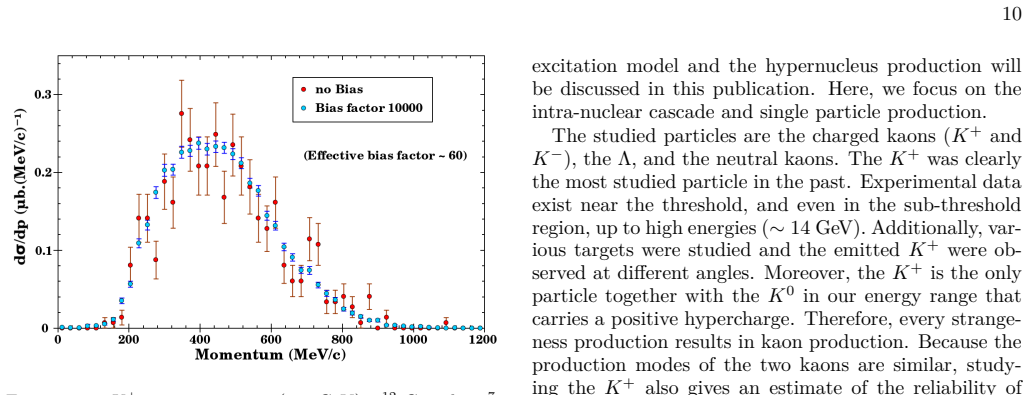
- [III.B, III.D, IV.H] The VRS is validated only at modest bias factors. Figure 3 tests the K+ mean momentum with bias factors 10 and 100, and Figure 4 shows that for p(10 GeV)+208Pb the optimal bias factor is about 2.5, with bias factor 10 already producing large importance dispersion, variance jumps, and a global underestimation relative to the unbiased calculation. Section IIIB explicitly warns that when pronounced variance jumps are seen, the associated error bars may be underestimated and the observables 'should not be trusted.' Yet the LINP subthreshold calculations in Figure 16, presented as a major success of the VRS, use effective bias factors of order 1000–2000 as stated in Section IV.H. No convergence check, variance-jump diagnostic, or comparison between different bias factors is shown for these runs. If those calculations fall into the pathological regime described in Section IIIB, the reported factor 4–6 overestimation of K+ production, and the subsequent inference that Δ-induced strangeness production is overestimated, could be artifacts of poor sampling rather than physical defects in the model. This concern is load-bearing because the subthreshold LINP comparison is the most extreme claim made with the new VRS and is explicitly used to support the paper's validation narrative; it also applies in milder form to the ITEP comparisons in Section IV.B, which use bias factors 20–50 without reporting importance-dispersion diagnostics.
- [IV.H] The LINP section states that 'the major success of these calculations is the variance reduction' and notes that cross sections below the nanobarn scale were obtained in about half a day. This is a computational achievement, but it does not by itself demonstrate that the VRS is unbiased in that regime. The authors should provide a convergence test for at least one LINP configuration, e.g., a comparison of results obtained with effective bias factors of a few hundred, one thousand, and two thousand, or a comparison with a lower-bias run where feasible, together with the distribution of particle importances. Without such diagnostics, the claim that the VRS works at these bias factors is unsupported, and the reliability of the cross-section values in Figure 16 remains an open question.
minor comments (6)
- [II, paragraph 3] The word 'strageness' should be 'strangeness'.
- [II.C, after Table II] The phrase 'phase phase generation' contains a duplicated word; it should be 'phase-space generation'.
- [III.B, paragraph 5] The sentence 'Thus, is would be a new source of variance' should read 'Thus, it would be a new source of variance.'
- [III.D, paragraph 1] The phrase 'do not derivate from Equation 4' should be 'do not derive from Equation 4.'
- [IV.H, final paragraph] The phrase 'it is difficult to proof or reject this hypothesis' should use 'prove' instead of 'proof.'
- [Figure 4 caption] The caption contains a typo: 'the prefect case' should be 'the perfect case.'
Circularity Check
No circularity: external benchmarks and unbiased VRS checks make the strangeness predictions self-contained.
full rationale
The paper's central claims are a model description plus comparisons of INCL++6 predictions to independent experimental data. The elementary strangeness production, scattering, and absorption cross sections are taken from experimental measurements, isospin symmetry, and the theoretical calculations of Tsushima et al., not fitted to the validation datasets. Comparisons with KaoS, ITEP, ANKE, LBL, HADES, FOPI, E-802, and LINP data are all external benchmarks, and the variance reduction scheme is explicitly validated against unbiased simulations in Section IIID, including convergence tests showing that biased and unbiased estimators converge to the same limit. The self-citations to refs. [9] and [12] provide implementation details and potential values, but the load-bearing validation is against data outside the model and outside the paper's fitted parameters. The concern about large effective bias factors in the subthreshold LINP calculations is a statistical reliability issue about possible variance jumps and underestimated error bars, not a circular reduction of the prediction to its input; the paper itself flags this regime and still compares to external data. No target observable is fitted and then renamed as a prediction.
Assumptions & free parameters
free parameters (7)
- Average nuclear potential for K+ =
25 MeV (repulsive)
- Average nuclear potential for K0 =
15 MeV (repulsive)
- Average nuclear potential for K- =
-60 MeV (attractive)
- Average nuclear potential for anti-K0 =
-50 MeV (attractive)
- Average nuclear potential for Sigma =
16 MeV (repulsive)
- Average nuclear potential for Lambda =
[-28, -41] MeV (attractive, asymmetry dependent)
- Bias factor =
User-defined, examples from 1 to 10^4
assumptions (5)
- domain assumption Inclusive strangeness production cross sections can be assembled from experimental data, isospin symmetry, and model calculations for channels without data.
- domain assumption The cascade can be simulated semi-classically with straight-line propagation and binary collisions; quantum effects not included.
- domain assumption At the end of the cascade, trapped kaons are ejected, while trapped Sigmas and antikaons are fully absorbed and their energy converted to excitation energy.
- standard math The variance reduction estimator is unbiased when total cross sections are conserved and no reaction is forbidden (Equation 12).
- domain assumption Average nuclear potentials for strange particles are approximately constant or vary only with asymmetry.
Cite this review
Pith. "Pith review of Strangeness production in the new version of the Li\`ege Intra-Nuclear Cascade model." pith.science (2026). https://pith.science/paper/T57KPFW3
@misc{pith2026190902246,
  author       = {Pith},
  title        = {Pith review of: Strangeness production in the new version of the Li\`ege Intra-Nuclear Cascade model},
  year         = {2026},
  howpublished = {\url{https://pith.science/paper/T57KPFW3}},
  note         = {Machine review of arXiv:1909.02246}
}
abstract
The capabilities of the new version of the Li\`ege Intra-Nuclear Cascade model (INCL++6) are presented in detail. This new version INCL is able to handle strange particles, such as kaons and the $\Lambda$ particle, and the associated reactions and also allows extending nucleon-nucleon collisions up to about $15-20$ GeV incident energy. Compared to the previous version, new observables can be studied, e.g., kaon, hyperon, and hypernuclei production cross sections (with the use of a suitable de-excitation code) as well as aspects of kaon-induced spallation reactions. The main purpose of this paper is to present the specific ingredients of the new INCL version and its new features, notably the new variance reduction scheme. We also compare for some illustrative strangeness production cases calculated using this version of INCL with experimental data.
Figures


Figures from the paper (13 more)




Reference graph
Works this paper leans on
-
[1]
Strangeness production in the new version of the Li\`ege Intra-Nuclear Cascade model
as one of the best spallation models when combined to the ABLA07 [2] de-excitation code, has been consider- ably improved during the last decade. One can mention the light ion induced reactions [3], the improvements for few nucleons removal [4, 5], and the extension to high energy [6, 7]. The last point was motivated by various reasons. A notable example ...
work page Pith review arXiv 1909
-
[2]
Example 2 The second example shown in Figure 18 illustrates the case of branch recombination. Continuing the case pre- sented in section A1, a particle coming from vertexB, which is itself induced by a particle from vertexA, col- lides with a particle directly produced by vertex A. The Equation A2 givesCSR(C) in case of strangeness production. CSR(C) = 1 ...
-
[3]
No solution was found to solve this problem
Such a binary collision can result in a strange particle that does not have the aimed importance of the strange particles. No solution was found to solve this problem. However, the dispersion of particle importances due to this phenomenon in most of cases is marginal thanks to the precautions discussed below and does not introduce a new significant source ...
- [4]
-
[5]
J. L. Rodríguez-Sánchez et al., Phys. Rev. C 96, 054602 (2017)
work page 2017
- [6]
- [7]
-
[8]
The two non-strange particles at the origin of the vertexA are considered without any history
Example 1 In the first example (Figure 17) we consider two suc- cessive binary collisions. The two non-strange particles at the origin of the vertexA are considered without any history. Let us assume that the total cross section for the vertexA is 20 mb, with the reaction cross section for the production of strangeness is0.1 mb and therefore the non-strang...
Show all 47 references
-
[9]
Hirtz, J.C
J. Hirtz, J.C. David, et al., Eur. Phys. J. Plus 133:436 (2018)
2018
-
[10]
Let us assume that no strange particles were produced in the vertices A and B but that strangeness production happened in vertex C
Example 3 The last example shown in Figure 19 is a more complex case of branch recombination. Let us assume that no strange particles were produced in the vertices A and B but that strangeness production happened in vertex C. CSR(A) and CSR(B) are determined as described in se...
-
[11]
Leray etal., J
S. Leray etal., J. Korean Phys. Soc. 59, 791-796 (2011) IAEA Benchmark of Spallation Models
2011
-
[12]
is introduced to improve hypernuclei physics. Typi- cally, the potential used for theΛ is a28 MeV attractive potential for the symmetric nuclei that grows up to a 41 MeV attractive potential for the highest asymmetries ((A−2 Z)/A = 0.25). TheK + and K−have been rela- tively we...
-
[13]
Proceed- ings of Joint ICTP-IAEA Advanced Workshop on Model Codes for Spallation Reactions, ICTP Trieste, Italy, 4-8 February 2008
A. Kelić, M. V. Ricciardi, and K.-H. Schmidt,“Proceed- ings of Joint ICTP-IAEA Advanced Workshop on Model Codes for Spallation Reactions, ICTP Trieste, Italy, 4-8 February 2008”, edited by D. Filges, S. Leray, Y. Yariv, et al., (IAEA, Vienna, 2008), pp. 181-221
2008
-
[14]
Mancusi et al., Phys
D. Mancusi et al., Phys. Rev. C 90, 054602 (2014)
2014
-
[15]
Tsushima, A
K. Tsushima, A. Sibirtsev, A. Thomas, and G. Li, Phys. Rev. C 59, 369 (1999), Erratum: Phys. Rev. C 61, 029903 (2000)
1999
-
[16]
Owen, Monte Carlo theory, methods and examples (2013)
A. Owen, Monte Carlo theory, methods and examples (2013)
2013
-
[17]
Scheinast et al., PRL 96, 072301 (2006)
W. Scheinast et al., PRL 96, 072301 (2006)
2006
-
[18]
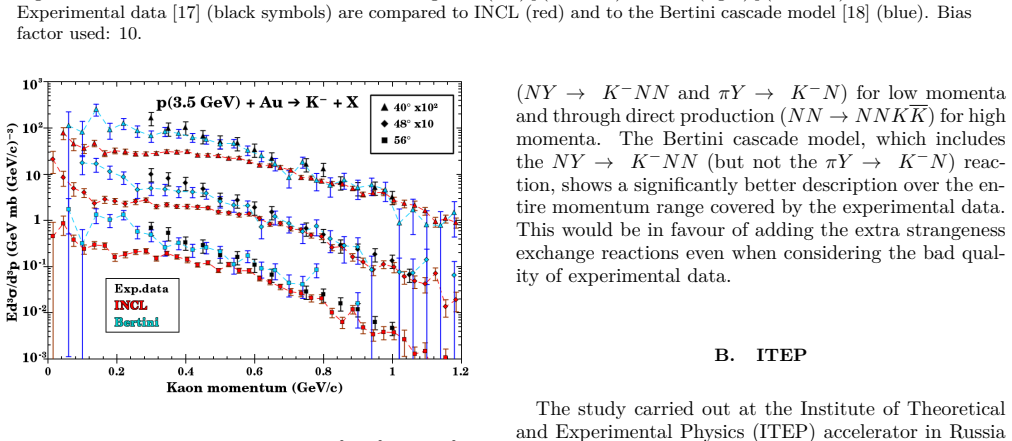
Bias factor used:10
(blue). Bias factor used:10. drastically the invariant cross section at low momenta. Experimental data at lower momenta would help to test the K + potential. Figure 7 shows the invariant cross section forK−pro- duction for the reaction proton onAu at 3.5 GeV. It can be seen th...
-
[19]
The nuclei studied were Be, Al, Cu, and Ta
measured theK + production in proton-nucleus col- lisions. The nuclei studied were Be, Al, Cu, and Ta. This choice covers a mass range from A = 9 to 181 (Z = 4 to 73). The projectile energy range from 1.65 up to 2.91 GeV. The experiment measured the produc- tion ofK + with a m...
-
[20]
Uzhinsky (SNA + MC2010) Hitotsubashi Memorial Hall, Tokyo, Japan, October 17-21 (2010)
V. Uzhinsky (SNA + MC2010) Hitotsubashi Memorial Hall, Tokyo, Japan, October 17-21 (2010)
2010
-
[21]
Boudard et al., Phys
A. Boudard et al., Phys. Rev. C 87, 014606 (2013)
2013
-
[22]
Patrignani et al., Chin
C. Patrignani et al., Chin. Phys. C 40, 100001 (2016)
2016
-
[23]
J. L. Rodríguez-Sánchez, J.-C. David, J. Hirtz, et al., Phys. Rev. C 98, 021602(R) (2018)
2018
-
[24]
It can be seen that the best description of the experimental data are obtained using GiBUU
are compared to GiBUU calculations with and with- out a chiral potential, to the Bertini cascade model, and to INCL. It can be seen that the best description of the experimental data are obtained using GiBUU. However, the version of GiBUU used here is a modified version in whic...
-
[25]
Metag, M
V. Metag, M. Nanova, and E. Paryev, Prog. Part. Nucl. Phys. 97, 199-260 (2017)
2017
-
[26]
T.RijkenandH.-J.Schulze, Eur.Phys.J.A52:21(2016)
2016
-
[27]
Herbach et al., NIM A 562, 729 (2006)
C.-M. Herbach et al., NIM A 562, 729 (2006)
2006
-
[28]
Wright and M
D. Wright and M. Kelsey, NIM A 804, 175-188 (2015)
2015
-
[29]
The meaning of the hatched area is explained in the text
(pink dash-dotted line), HSD [30, 31] (red dashed line), Bertini [18] (green circles), and INCL (orange circles) models. The meaning of the hatched area is explained in the text. The original figure comes from ref. [28]. Bias factor used:10. [28], the authors compared their exp...
-
[30]
Akindinov et al., JETP Letters, Vol
A. Akindinov et al., JETP Letters, Vol. 72, 100 (2000)
2000
-
[31]
Büscher, V
M. Büscher, V. Koptev, M. Nekipelov, et al., Eur. Phys. J. A 22:301 (2004)
2004
- [32]
-
[33]
Schnetzer, R
S. Schnetzer, R. Lombard, et al., Phys. Rev. C 40, 640 (1990). Erratum: Phys. Rev. C 41, 1320 (1990)
1990
-
[34]
HADES Collaboration, Eur. Phys. J. A 50:81 (2014)
2014
-
[35]
HADES Collaboration, Phys. Rev. C 90, 054906 (2014)
2014
- [36]
-
[37]
Buss et al., Physics Reports 512, 1-124 (2012)
O. Buss et al., Physics Reports 512, 1-124 (2012)
2012
-
[38]
Benabderrahmane et al., PRL 102, 182501 (2009)
M. Benabderrahmane et al., PRL 102, 182501 (2009)
2009
-
[39]
Tsushima, A
K. Tsushima, A. Sibirtsev, and A. Thomas, Phys. Rev. C 62, 064904 (2000)
2000
-
[40]
Cassing et al., Phys
W. Cassing et al., Phys. Rep. 308, 65 (1999),
1999
-
[41]
Cassing et al., Nucl
W. Cassing et al., Nucl. Phys.A 614, 415 (1997)
1997
-
[42]
E-802 Collaboration, Phys. Rev. D 45, 3906 (1992)
1992
-
[43]
Koptev et al., Zh
V. Koptev et al., Zh. Eksp. Teor. Fiz. 94,1-14 (1988)
1988
-
[44]
Geant4 Collaboration, Geant4 Physics Reference Manual Release 10.5
-
[45]
Saito et al., Proceedings of the IX International Con- ference on Hypernuclear and Strange Particle Physics
T. Saito et al., Proceedings of the IX International Con- ference on Hypernuclear and Strange Particle Physics. Springer, Berlin, Heidelberg (2007)
2007
- [46]
-
[47]
Friese, Proceedings of Science 47 (2008))
V. Friese, Proceedings of Science 47 (2008))
2008
Reviewed August 14, 2026 · model on record in the stance chip above.
Discussion (0). Continue with ORCID to comment.