REVIEW 4 major objections 4 minor 26 references
The distance modulus in dark energy and Cardassian cosmologies via the hypergeometric function
T0 review · 4 major / 4 minor · reviewed 2026-08-14 · deepseek-v4-flash
Pith's one-line read The paper derives closed-form expressions for the Hubble-distance integral in wCDM and Cardassian cosmologies using the regularized Gaussian hypergeometric function, enabling analytic distance moduli and parameter fits to supernova and…
desk verdict The paper's advertised hypergeometric solution for the wCDM Hubble-distance integral is not an antiderivative; a simple Ω_M=1 check kills the central claim, so the paper should not be published. read the letter →
The pith
A machine-rendered reading of the paper's core claim, the machinery that carries it, and where it could break.
The reading
What carries the argument
The central object is the regularized Gaussian hypergeometric function $_2\tilde{F}_1(a,b;c;z)$, the standard $_2F_1$ normalized by Gamma functions, which appears as the exact antiderivative of the reciprocal of the Hubble function after the substitution $t=(1+z)^3$. This identity is the load-bearing result of the paper: it turns the Hubble-distance integral into an expression that can be evaluated pointwise, from which the luminosity distance and distance modulus follow directly, and it also yields the two Taylor approximations (order 7 about $z=0$ and order 2 about $z=1$) by series-expanding the integrand before integrating. The same substitution produces the Cardassian antiderivative in Eq. (31).
What would settle it
Differentiate the closed-form expression in Eq. (14) numerically with respect to $z$ at several points (for example $z=0.2,0.5,1.0$ with $\Omega_M=0.3$, $w=-1$) and subtract the integrand $d_H(z;\Omega_M,w)$ from Eq. (10); if the residual exceeds $10^{-6}$, the hypergeometric antiderivative is not a true antiderivative.
Extended reading notes
Core claim
The central discovery is an explicit antiderivative for the Hubble-distance integrand in a flat wCDM universe, written with the regularized Gaussian hypergeometric function $_2\tilde{F}_1(a,b;c;z)$ in Eq. (13), and an analogous expression for the flat Cardassian model in Eq. (31). From these, the luminosity distance $d_L = \frac{c}{H_0}(1+z)F(z;\Omega_M,w)$ and the distance modulus $(m-M)=25+5\log_{10}(d_L)$ follow analytically, letting the paper obtain best-fit parameters from Type Ia supernova data via the Levenberg-Marquardt method, for example $H_0\approx70\,\mathrm{km\,s^{-1}\,Mpc^{-1}}$, $\Omega_M\approx0.28$, and $w\approx-1$ for wCDM, and $n\approx-0.08$ for Cardassian cosmology.
Load-bearing premise
The load-bearing premise is that the change of variable in Eq. (12) is algebraically correct, since the printed exponent appears to insert an extra factor $t^{1/3}$, which would make the hypergeometric antiderivative fail to differentiate back to the Hubble function.
Editorial extensions
If this is right
- The distance modulus in wCDM and Cardassian cosmologies can be evaluated in closed form, avoiding numerical quadrature of the Hubble function.
- From the Union 2.1, JLA, and Hymnium samples, the paper derives cosmological parameters such as $H_0\approx70\,\mathrm{km\,s^{-1}\,Mpc^{-1}}$, $\Omega_M\approx0.28$, $w\approx-1$, with $\chi^2_{\mathrm{red}}\approx0.85\text{--}0.98$ depending on the sample.
- The seventh-order Taylor approximation about $z=0$ and the second-order approximation about $z=1$ reproduce the exact integral to within a small percent error, with the crossover at $z\approx0.58$.
- For the variable equation of state $w(z)=w_0+w_1 z/(1+z)$, the Taylor approximation extends the analytic treatment to that case.
Reading between the lines
- Because the distance modulus is now an analytic function of the parameters, its gradients with respect to $H_0$, $\Omega_M$, and $w$ could be computed in closed form, which would accelerate and stabilize chi-square fits relative to numerical differentiation.
- Special values of $w$ may reduce the hypergeometric form to elementary or elliptic functions, giving compact distance-modulus formulas for regimes such as $w=-1/3$ or $w=0$.
- The same $t=(1+z)^3$ substitution should apply to other models in which the Hubble function is a binomial radical in $t$, such as extended dark-energy or curvature models, although the paper does not treat those cases.
Signed reviews
Editorial analysis
A structured set of objections, weighed in public.
Referee Report
Summary. The paper claims to derive exact analytical expressions, in terms of the regularized Gauss hypergeometric function, for the comoving distance integral in flat wCDM cosmology (Eq. (13)) and in flat Cardassian cosmology (Eq. (31)). On this basis it proposes analytic luminosity distances and distance moduli (Eqs. (34)-(36) and (42)-(43)), derives seventh-order Taylor approximations for the constant and variable equation-of-state cases, and fits the Union 2.1, JLA, and Union 2.1 + Hymnium GRB samples to determine H0, Omega_M, and w (or w0, w1, or n) using a Levenberg-Marquardt chi-square minimization.
Significance. If the central hypergeometric identities were correct, the paper would provide a compact and useful closed form for the Hubble-distance integral and would make the full set of distance-modulus fits straightforward. However, the derivation fails at the first step: the change of variable in Eq. (12) is algebraically wrong, and Eq. (13) is not an antiderivative of the original integrand even in the Omega_M=1 limit. Since the exact distance-modulus formulas in Section 6 are built on this unsupported expression, the advertised analytical solution is not established. The paper also contains useful, carefully listed Taylor coefficients (Appendices A and C), but they do not rescue the main claim. Given the fundamental nature of the error, the significance of the paper in its present form is minimal.
major comments (4)
- [§3.1, Eq. (12)] The change of variable 1+z = t^{1/3} gives dz = (1/3) t^{-2/3} dt and (1+z)^{3+3w} = t^{1+w}, so the integrand in Eq. (11) becomes (1/3) t^{-7/6} [Omega_M + (1-Omega_M) t^w]^{-1/2}. The printed Eq. (12), with t^{2/3} inside the square root, produces instead (1/3) t^{-5/6} [Omega_M + (1-Omega_M) t^w]^{-1/2}, which is too large by a factor t^{1/3}. This error is inherited by every later expression that derives from Eq. (12).
- [§3.1, Eq. (13)] Eq. (13) is not an antiderivative of Eq. (10). Setting Omega_M=1 makes the hypergeometric argument vanish, reducing Eq. (13) to a constant times t^{-1/2}; differentiating with respect to z yields a term proportional to (1+z)^{-5/2}, whereas Eq. (10) at Omega_M=1 is (1+z)^{-3/2}. The mismatch is z-dependent, so it cannot be removed by any choice of normalization or by the Gamma-function prefactor of the regularized hypergeometric function. Consequently Eqs. (14), (15), (34), and (36), and all fits based on them, are unsupported.
- [§5, Eq. (30)] The Cardassian change of variable has the same defect. With t=(1+z)^3, the correct integrand is (1/3) t^{-7/6} [Omega_M + (1-Omega_M) t^{n-1}]^{-1/2}, but Eq. (30) contains an extra t^{2/3} factor inside the square root and an incorrect term structure. Eq. (31) therefore does not follow from Eq. (28), and the Cardassian distance modulus in Eq. (43) lacks a valid derivation.
- [§6, Tables 1-3 and Eq. (7)] The chi-square in Eq. (7) uses only the diagonal uncertainties and ignores the full covariance matrix of the supernova samples, particularly for JLA, so the quoted parameter errors and the reported Q values are statistically incomplete. In addition, Table 2 shows an internal inconsistency: the wCDM Taylor approximation gives Omega_M=0.133 and w=-0.709, far from the hypergeometric result Omega_M=0.293 and w=-0.996, even though both fits are meant to describe the same wCDM model. This discrepancy indicates a breakdown in the Taylor approximation that is not discussed.
minor comments (4)
- [§2.1] In the sentence 'In the case of Ω_K = we have the flat case' the value of Ω_K is missing; presumably Ω_K=0.
- [§6, Eq. (44)] Eq. (44) is malformed: the factors '×' and '+ 3.4146' appear without clear placement, and Eq. (45) contains the confusing expression '1/ln(10) 25 ln(10)'. These formulas should be rederived and re-typeset.
- [§7] The cross-reference 'equation (reficardz)' in the conclusion is broken and should refer to Eq. (32).
- [§3.1, Eq. (13) and Appendix B] The paper states that Eq. (13) uses the regularized hypergeometric function, but the text and Appendix B denote it by the same symbol 2F1 used for the ordinary hypergeometric function; this notational ambiguity is confusing because the Gamma prefactor changes the Omega_M=1 limit.
Circularity Check
No circularity: the fitted parameters are fits to data, the analytic integral is derived from the stated integrand, and the Taylor approximation is an internal consistency check rather than a prediction.
full rationale
I find no significant circularity. The claimed analytical results are obtained by direct manipulation of the stated model integrands, not by assuming the conclusions: the wCDM formula is derived from the Hubble radius through the stated change of variable, and the Cardassian formula is likewise derived from its Hubble radius. Whether the change-of-variable exponent in Eq. (12) is correct is a mathematical-correctness question, not a circularity question. The Section 6 parameters are fits to the same supernova distance-modulus samples and are presented explicitly as fits, so no fitted parameter is renamed as a prediction. The Taylor approximation F7 in Eq. (21) uses the paper's own analytic F only to choose the branch boundary between two series approximations; this is an internal accuracy and consistency comparison, not independent evidence, but it also does not smuggle the target conclusion into the input. There are no load-bearing self-citations, no imported uniqueness theorems, and no ansatz smuggled in via citation from the authors' prior work. A possible algebraic error in Eqs. (12)-(14) would invalidate the analytic formulas, but that is an error in execution, not circular reasoning.
Assumptions & free parameters
free parameters (6)
- H0 (Hubble constant) =
69.7 to 70.15 km/s/Mpc across samples
- Omega_M (matter density parameter) =
0.277 to 0.305 depending on model and sample
- w (dark energy equation of state, wCDM) =
-1.003 (Union 2.1), -0.996 (JLA)
- w0 (evolving EOS constant part) =
-1.03 (Union 2.1), -1.05 (JLA/GRB)
- w1 (evolving EOS slope) =
0.1 (Union 2.1/JLA/GRB)
- n (Cardassian exponent) =
-0.081 (Union 2.1), -0.063 (GRB), -0.055 (JLA)
assumptions (6)
- domain assumption Flatness: Omega_M + Omega_DE = 1
- domain assumption wCDM Hubble radius formula, Eq. (8), adopted from Refs. [13,14]
- domain assumption Cardassian Hubble radius formula, Eq. (28), adopted from Ref. [14]
- domain assumption Linear parametrization w(z)=w0+w1 z/(1+z), Eq. (22)
- standard math Hypergeometric function series, Gamma-function representation, and Pfaff transformation in Appendix B
- domain assumption SN and GRB distance moduli can be modeled by the standard distance-modulus formula with uncorrelated errors
Cite this review
Pith. "Pith review of The distance modulus in dark energy and Cardassian cosmologies via the hypergeometric function." pith.science (2026). https://pith.science/paper/PNPWQ4RW
@misc{pith2026190902360,
  author       = {Pith},
  title        = {Pith review of: The distance modulus in dark energy and Cardassian cosmologies via the hypergeometric function},
  year         = {2026},
  howpublished = {\url{https://pith.science/paper/PNPWQ4RW}},
  note         = {Machine review of arXiv:1909.02360}
}
read the original abstract
The presence of the dark energy allows both the acceleration and the expansion of the universe. In the case of a constant equation of state for dark energy we derived an analytical solution for the Hubble radius in terms of the hypergeometric function. An approximate Taylor expansion of order seven is derived for both the constant and the variable equation of state for dark energy. In the case of the Cardassian cosmology we also derived an analytical solution for the Hubble radius in terms of the hypergeometric function. The astronomical samples of the distance modulus for Supernova (SN) of type Ia allows the derivation of the involved cosmological in the case of constant equation of state, variable equation of state and Cardassian cosmology.
Figures

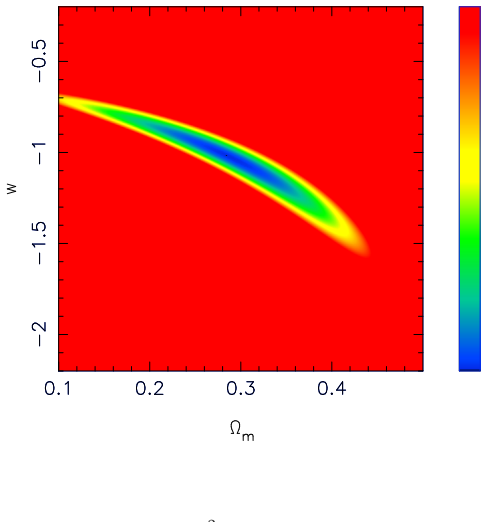

Figures from the paper (2 more)


Reference graph
Works this paper leans on
-
[15]
Wickramasinghe T and Ukwatta T N 2010 An analytical approach for the determination of the luminosity distance in a flat universe with dark energy MNRAS 406, 548 (Preprint 1003.0483)
work page Pith review arXiv 2010
-
[1]
Huterer D and Turner M S 1999 Prospects for probing the dark energy via supernova distance measurements Phys. Rev. D 60(8) 081301 ( Preprint astro-ph/9808133)
arXiv 1999
-
[2]
Huterer D and Shafer D L 2018 Dark energy two decades after: observables, probes, consistency tests Reports on Progress in Physics 81(1) 016901 (Preprint 1709.01091)
arXiv 2018
-
[3]
Brax P 2018 What makes the Universe accelerate? A review on what dark energy could be and how to test it Reports on Progress in Physics 81(1) 016902
work page 2018
-
[4]
Freese K and Lewis M 2002 Cardassian expansion: a model in which the universe is flat, matter dominated, and accelerating Physics Letters B 540, 1 (Preprint astro-ph/0201229)
arXiv 2002
-
[5]
Maga˜ na J, Amante M H, Garcia-Aspeitia M A and Motta V 2018 The Car- dassian expansion revisited: constraints from updated Hubble parameter measurements and type Ia supernova data MNRAS 476, 1036 ( Preprint 1706.09848)
arXiv 2018
-
[6]
Perlmutter S, Gabi S, Goldhaber G, Goobar A, Groom D E, Hook I M, Kim A G, Kim M Y, Lee J C, Pain R, Pennypacker C R, Small I A, Ellis R S, McMahon R G, Boyle B J, Bunclark P S, Carter D, Irwin M J, Glazebrook K, Newberg H J M, Filippenko A V, Matheson T, Dopita M and Couch W J 1997 Measurements of the Cosmological Parameters Ω and Λ from the First Seven ...
arXiv 1997
-
[7]
Riess A G, Filippenko A V, Challis P and Clocchiatti A 1998 Observational Evidence from Supernovae for an Accelerating Universe and a Cosmological Constant AJ 116, 1009 (Preprint astro-ph/9805201)
arXiv 1998
Show all 26 references
-
[8]
Perlmutter S, Aldering G, Goldhaber G and Knop R A 1999 Measurements of Omega and Lambda from 42 High-Redshift Supernovae ApJ 517, 565 (Preprint astro-ph/9812133)
1999 arXiv
-
[9]
Suzuki N, Rubin D, Lidman C, Aldering G, Amanullah R, Barbary K and Barrientos L F 2012 The Hubble Space Telescope Cluster Supernova Survey. V. Improving the Dark-energy Constraints above z greater than 1 and Building an Early-type-hosted Supernova Sample ApJ 746 85
2012
-
[10]
Betoule M, Kessler R, Guy J and Mosher J 2014 Improved cosmological constraints from a joint analysis of the SDSS-II and SNLS supernova sam- ples A&A 568 A22
2014
-
[11]
Wei H 2010 Observational constraints on cosmological models with the updated long gamma-ray bursts Journal of Cosmology and Astroparticle Physic 8 020 (Preprint 1004.4951)
2010 arXiv
-
[12]
Peebles P J E 1993 Principles of Physical Cosmology (Princeton, N.J.: Princeton University Press) 17
1993
-
[13]
Tripathi A, Sangwan A and Jassal H K 2017 Dark energy equation of state parameter and its evolution at low redshift Journal of Cosmology and Astroparticle Physic 6 012 (Preprint 1611.01899)
2017 arXiv
-
[14]
Wei J J, Ma Q B and Wu X F 2015 Utilizing the Updated Gamma-Ray Bursts and Type Ia Supernovae to Constrain the Cardassian Expansion Model and Dark Energy Advances in Astronomy 2015 576093 ( Preprint 1504.02308)
2015 arXiv
-
[16]
The Art of Scientific Computing (Cambridge, UK: Cambridge University Press)
Press W H, Teukolsky S A, Vetterling W T and Flannery B P 1992 Numer- ical Recipes in FORTRAN. The Art of Scientific Computing (Cambridge, UK: Cambridge University Press)
1992
-
[17]
Liang N and Zhang S N 2008 Cosmology-Independent Distance Moduli of 42 Gamma-Ray Bursts between Redshift of 1.44 and 6.60 in Y F Huang, Z G Dai and B Zhang, eds,American Institute of Physics Conference Series vol 1065 of American Institute of Physics Conference Series pp 367–3...
2008 arXiv
-
[18]
Lin H N, Li X and Chang Z 2016 Model-independent distance calibration of high-redshift gamma-ray bursts and constrain on the ΛCDM model MN- RAS 455(2), 2131 (Preprint 1507.06662)
2016 arXiv
-
[19]
Gupta R P 2019 Weighing cosmological models with sne ia and gamma ray burst redshift data Universe 5(5)
2019
-
[20]
Marosi L A 2019 Extended Hubble Diagram on the Basis of Gamma Ray Bursts Including the High Redshift Range of z = 0.0331 - 8.1 International Journal of Astronomy and Astrophysics 9(1), 1
2019
-
[21]
Abramowitz M and Stegun I A 1965 Handbook of Mathematical Functions with Formulas, Graphs, and Mathematical Tables (New York: Dover)
1965
-
[22]
von Seggern D 1992 CRC Standard Curves and Surfaces (New York: CRC)
1992
-
[23]
Thompson W J 1997 Atlas for computing mathematical functions (New York: Wiley-Interscience)
1997
-
[24]
Gradshteyn, I S and Ryzhik, I M and Jeffrey, A and Zwillinger, D 2007 Table of Integrals, Series, and Products (New York: Academic Press)
2007
-
[25]
(Cambridge: Cambridge University Press
Olver F W J e, Lozier D W e, Boisvert R F e and Clark C W e 2010 NIST handbook of mathematical functions. (Cambridge: Cambridge University Press. )
2010
-
[26]
Oldham K B, Myland J and Spanier J 2010 An atlas of functions: with equator, the atlas function calculator (Springer Science & Business Media) 18
2010
Reviewed August 14, 2026 · model on record in the stance chip above.
Discussion (0). Continue with ORCID to comment.