REVIEW 3 major objections 6 minor 67 references
Gas velocity structure of the Orion A Integral Shaped Filament
T0 review · 3 major / 6 minor · reviewed 2026-08-14 · deepseek-v4-flash
Pith's one-line read This paper argues that supersonic gas in Orion A's Integral Shaped Filament may still be deeply gravitationally bound, with a possible 1.4 Myr^-1 rotation.
desk verdict A useful multi-tracer kinematics paper whose central 'deeply bound' claim is weakened by a factor-of-three error in the kinetic energy normalization. read the letter →
The pith
A machine-rendered reading of the paper's core claim, the machinery that carries it, and where it could break.
The reading
What carries the argument
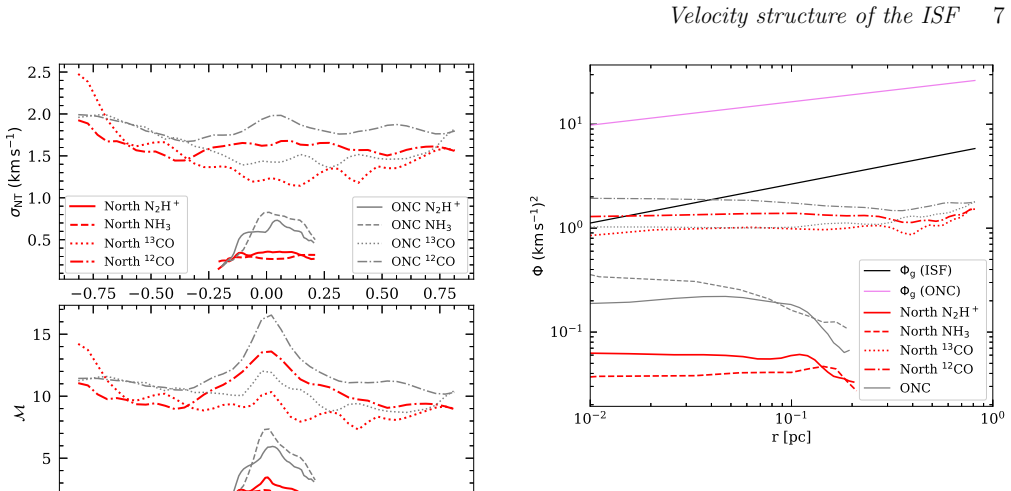
The load-bearing machinery is the comparison of measured non-thermal line widths to previously derived gravitational potentials. The non-thermal dispersion is obtained by subtracting the thermal term $\sqrt{kT_k/m}$ from the observed width, using the dust temperature power law $T_d=9\,(r/{\rm pc})^{0.22}\,{\rm K}$ as a proxy for kinetic temperature; the resulting $\sigma_{\rm NT}$ enters the specific kinetic energy $\frac{1}{2}\sigma_{\rm NT}^2$ plotted against $\Phi_{\rm ISF}$ and $\Phi_{\rm ONC}$. The visualization tool that uncovers the kinematic features is the intensity-weighted position-velocity diagram, where each pixel's line velocity centroid is plotted against declination and weighted by integrated emission, revealing structures muddled in traditional PV diagrams. The rotation signature is extracted by identifying two 12CO velocity loci in the northern filament and applying the circular model $\omega = (\delta v / 2) / r$ with $\delta v = 3.6\,{\rm km\,s^{-1}}$ and $r = 1.3\,{\rm pc}$.
What would settle it
A direct measurement of the line-of-sight depth and three-dimensional geometry of the ISF, for example from dust polarization, parallax gradients, or multi-line radiative transfer, that shows the true gravitational potential is below the measured kinetic energy over a broad area beyond the central 0.04 pc would falsify the claim that the gas is deeply bound.
Extended reading notes
Core claim
The central discovery, stated in Section 4.2, is that the non-thermal line widths are consistent with the gas being deeply gravitationally bound: when the specific kinetic energy $\frac{1}{2}\sigma_{\rm NT}^2$ inferred from the four tracers is compared with the analytic ISF and ONC gravitational potentials $\Phi_{\rm ISF}(R)=6.3\,(R/{\rm pc})^{3/8}\,({\rm km\,s^{-1}})^2$ and $\Phi_{\rm ONC}(R)=27.6\,(R/{\rm pc})^{0.225}\,({\rm km\,s^{-1}})^2$, the potential dominates almost everywhere, despite Mach numbers of 5 to 15. Only in the central roughly 0.04 pc region do the low-density 12CO and 13CO kinetic energies become comparable to the potential. The paper further reports, for the first time, a double 12CO velocity locus in the northern ISF with components near $v_{\rm LSR}=6.9$ and $10.5\,{\rm km\,s^{-1}}$; interpreting these as circular rotation with spatial separation $r=1.3\,{\rm pc}$ gives $\omega=1.4\,{\rm Myr^{-1}}$. Small-scale NH3 and N2H+ 'twisting and turning' structures are detected with short associated timescales, giving the impression of a torsional wave, though the paper states their nature and relation to the larger-scale wave are not yet understood.
Load-bearing premise
The bound conclusion assumes the analytic ISF and ONC gravitational potential profiles are accurate, but those profiles were obtained by deprojecting observed gas and stellar mass distributions under cylindrical and spherical symmetry, so if the true three-dimensional geometry is different the potential could be overestimated and the kinetic energy could approach or exceed it.
Editorial extensions
If this is right
- If the gas is deeply bound while supersonic, turbulent pressure alone is not disrupting the filament; collapse or additional support from magnetic fields or rotation is required.
- Dense-gas tracers (NH3, N2H+) show roughly six times smaller non-thermal line widths than CO, so CO-only analyses overestimate turbulent support in the dense gas where stars form.
- The 1.4 Myr^-1 angular velocity, if rotational, is fast enough to matter dynamically on the filament's roughly 1 Myr free-fall and wave timescales.
- The observed north-south velocity gradient ending at the ONC is consistent with a standing-wave interpretation and provides a kinematic test for the Slingshot scenario for the filament.
Reading between the lines
- Editorial inference: if the two CO velocity components are two sides of a rotating filament, higher-resolution maps should show the velocity split increasing with projected distance from the filament spine; this can be tested with existing interferometric data.
- Editorial inference: the near-periodic roughly 0.44 pc spacing of the 12CO velocity peaks and their roughly 1 Myr timescale suggest the small-scale 'twisting' and the large-scale wave share a common dynamical clock; a unified model could predict the phase relation between the two.
- Editorial inference: the deeply-bound conclusion is only as secure as the deprojected gravitational potentials; a direct measurement of the three-dimensional geometry of the ISF would be the decisive test.
Signed reviews
Editorial analysis
A structured set of objections, weighed in public.
Referee Report
Summary. This paper analyzes the gas kinematics of the Orion A Integral Shaped Filament (ISF) using public observations of 12CO(1-0), 13CO(1-0), NH3(1,1), and N2H+(1-0). The authors introduce an intensity-weighted position-velocity (PV) diagram technique and apply it to trace a north-south velocity gradient, a blue-shifted velocity peak near the ONC, and small-scale 'twisting and turning' structures. They measure non-thermal line-width profiles, compute Mach numbers and specific kinetic energies K = (1/2)σ_NT^2, and compare these to analytic gravitational potential profiles for the ISF and ONC taken from Stutz & Gould (2016) and Stutz (2018); they conclude that the gas is deeply gravitationally bound despite Mach numbers of 5–15. They also identify two 12CO velocity components in the northern ISF and, if interpreted as circular rotation, derive ω = 1.4 Myr−1 from Eq. (3). An appendix analyzes regularly spaced blueshifted 12CO velocity peaks and cross-matches them with YSO/protostar catalogs.
Significance. The intensity-weighted PV visualization is a useful addition and is well suited to the multi-tracer comparison; the Monte Carlo test for the N2H+ S/N threshold and the residual checks are careful steps. The paper exploits public data and compares four tracers spanning a wide range of critical densities, which is genuinely informative. If the binding conclusion were correct, it would be an important counterexample to the common assumption that supersonic line widths imply unbound gas. However, the central energy comparison in Section 4.2 uses a 1D dispersion as if it were the total turbulent kinetic energy, which changes the quantitative conclusion and may overturn the headline claim for the lower-density gas. The rotation interpretation in Section 4.4 is explicitly conditional but is presented in the abstract without the same caution.
major comments (3)
- [Section 4.2, Figure 6] The binding comparison uses K = (1/2)σ_NT^2 with σ_NT derived from the observed line-of-sight line width. For an isotropic turbulent velocity field, the specific kinetic energy is (3/2)σ_NT^2, so the binding criterion should be σ_NT^2 < (2/3)Φ, not σ_NT^2 < 2Φ. Quantitatively, the northern 12CO average σ_NT = 1.61 km s−1 gives (3/2)σ_NT^2 ≈ 3.9 (km s−1)^2, exceeding the ISF potential Φ ≈ 2.7 (km s−1)^2 at r = 0.1 pc, whereas the paper's (1/2)σ_NT^2 ≈ 1.3 (km s−1)^2 is well below it. This is a factor-of-three normalization issue in the headline result, and it must be corrected or explicitly justified before the conclusion 'deeply gravitationally bound' can stand.
- [Section 4.2, Eqs. (1)-(2)] The gravitational potential profiles are adopted from Stutz & Gould (2016) and Stutz (2018) without re-derivation or sensitivity testing. Since the central claim is quantitative ('dominates almost everywhere'), the paper should include a robustness test: for example, recompute the binding condition under a plausible lower-limit potential, such as varying the assumed deprojected geometry or line-of-sight depth, and state whether the conclusion survives. As written, the claim depends entirely on the accuracy of the borrowed profiles.
- [Section 4.4, Eq. (3)] The two 12CO velocity components are identified visually in the PV diagrams, with no spectral decomposition or uncertainty estimate, and the value r = 1.3 pc is assumed to be the rotation radius. Because the line-of-sight geometry and inclination are unknown, the relation between the observed Δv and a true angular velocity is not established. The abstract reports ω = 1.4 Myr−1 without the caution that appears in the body ('if interpreted as circular rotation'); this should be rephrased and the assumptions and uncertainties of Eq. (3) should be quantified.
minor comments (6)
- [Sections 2.3 and 2.4] The word 'pannel' should be 'panel' in both places.
- [Figure 5 caption, Section 4.1] The ONC region is written as 'δ−5.48°' in the caption; an equals sign appears to be missing and it should read 'δ = −5.48°'.
- [Abstract, Section 4.4, Section 5] 'impresion' and 'remiscent' are typos for 'impression' and 'reminiscent'.
- [Figure 4 caption] The first-panel axis label 'M /uni2299p⊙−1' appears corrupted and should read M☉/pc.
- [Section 4.2, references] The reference to Liu et al. (2019) in the text is incomplete in the bibliography ('MNRAS, p. 1279'); please provide the full volume and page range.
- [Section 4.4, Eq. (3)] The symbol δv is used in Eq. (3) but is not explicitly defined in the text; it should be stated to be the velocity difference between the two components, approximately 3.6 km s−1.
Circularity Check
No significant circularity: the line-width comparison and rotation conversion rest on independent measurements or explicit kinematic definitions, not on fitted inputs renamed as predictions.
full rationale
The central bound claim compares newly fitted non-thermal line widths (12CO, 13CO, NH3, N2H+) to gravitational potentials taken from Stutz & Gould (2016) and Stutz (2018). Those potentials were derived from Herschel column density and stellar mass maps, not from the line-width data used here, and the present paper does not adjust the potentials to force the comparison. The kinetic energy K = 1/2 sigma_NT^2 and the potential Phi are therefore independent inputs; the conclusion is a comparison, not a fitted parameter renamed as a prediction. Equation (3) is an explicit kinematic conversion omega = (delta v / 2) / r applied to a two-component velocity signature that the paper itself labels conditional ('if interpreted as circular rotation'); the interpretation does not feed back into the measurement. The dust temperature profile from Reissl et al. (2018) is an adopted external model, and the self-citations to Stutz & Gould, Stutz, and Stutz et al. supply data products (column density maps, ridgeline, potential) rather than the target conclusion. The isotropic 3D kinetic-energy factor (3/2 sigma_NT^2) is a legitimate physical/correctness critique of the bound claim, but it is not an input-output equivalence, so it is outside the circularity definition. No circular step can be exhibited by quoting an equation in which the result is defined by the input.
Assumptions & free parameters
free parameters (4)
- Dust temperature power law T_d = 9 (r/pc)^0.22 K =
normalization 9 K, exponent 0.22
- ISF gravitational potential normalization and exponent =
Phi_ISF = 6.3 (R/pc)^(3/8) km^2/s^2
- ONC gravitational potential normalization and exponent =
Phi_ONC = 27.6 (R/pc)^0.225 km^2/s^2
- Spatial separation r between the two 12CO velocity components =
1.3 pc
assumptions (4)
- domain assumption The gravitational potential profiles from Stutz and Gould (2016) and Stutz (2018), obtained by deprojecting observed mass distributions under cylindrical and spherical symmetry, correctly describe the true potential of the ISF and ONC.
- domain assumption The kinetic temperature of the gas equals the dust temperature profile T_d = 9 (r/pc)^0.22 K from Reissl et al. (2018).
- domain assumption The dust ridgeline from Stutz (2018) marks the center of the gravitational potential well of the ISF.
- domain assumption For the 12CO rotation interpretation, the two velocity loci at 6.9 and 10.5 km/s are coherent gas structures physically separated by 1.3 pc, rather than unrelated line-of-sight clouds or outflow signatures.
Cite this review
Pith. "Pith review of Gas velocity structure of the Orion A Integral Shaped Filament." pith.science (2026). https://pith.science/paper/JT4UAJQU
@misc{pith2026190902589,
  author       = {Pith},
  title        = {Pith review of: Gas velocity structure of the Orion A Integral Shaped Filament},
  year         = {2026},
  howpublished = {\url{https://pith.science/paper/JT4UAJQU}},
  note         = {Machine review of arXiv:1909.02589}
}
abstract
We present analysis of the gas kinematics of the Integral Shaped Filament (ISF) in Orion~A using four different molecular lines, $^{12}$CO (1-0), $^{13}$CO (1-0), NH$_3$ (1,1), and N$_2$H$^+$ (1-0). We describe our method to visualize the position-velocity (PV) structure using the intensity-weighted line velocity centroid, which enables us to identify structures that were previously muddled or invisible. We observe a north to south velocity gradient in all tracers that terminates in a velocity peak near the center of the Orion Nebula Cluster (ONC), consistent with the previously reported "wave-like" properties of the ISF. We extract the velocity dispersion profiles and compare the non-thermal line widths to the gas gravitational potential. We find supersonic Mach number profiles, yet the line widths are consistent with the gas being deeply gravitationally bound. We report the presence of two $^{12}$CO velocity components along the northern half of the ISF; if interpreted as circular rotation, the angular velocity is $\omega=1.4\,{\rm Myr}^{-1}$. On small scales we report the detection of N$_2$H$^+$ and NH$_3$ "twisting and turning" structures, with short associated timescales that give the impression of a torsional wave. Neither the nature of these structures nor their relation to the larger scale wave is presently understood.
Figures


Figures from the paper (3 more)


Reference graph
Works this paper leans on
-
[1]
Bally J., Langer W. D., Stark A. A., Wilson R. W., 1987, @doi [ ] 10.1086/184817 , https://ui.adsabs.harvard.edu/abs/1987ApJ...312L..45B 312, L45
doi:10.1086/184817 1987
-
[2]
Bally J., Ginsburg A., Arce H., Eisner J., Youngblood A., Zapata L., Zinnecker H., 2017, @doi [ ] 10.3847/1538-4357/aa5c8b , http://adsabs.harvard.edu/abs/2017ApJ...837...60B 837, 60
-
[3]
Becklin E. E., Neugebauer G., 1967, @doi [ ] 10.1086/149055 , http://adsabs.harvard.edu/abs/1967ApJ...147..799B 147, 799
doi:10.1086/149055 1967
-
[4]
Chini R., Reipurth B., Ward-Thompson D., Bally J., Nyman L.- ., Sievers A., Billawala Y., 1997, @doi [ ] 10.1086/310436 , http://adsabs.harvard.edu/abs/1997ApJ...474L.135C 474, L135
doi:10.1086/310436 1997
-
[5]
Chuss D. T., et al., 2019, @doi [ ] 10.3847/1538-4357/aafd37 , https://ui.adsabs.harvard.edu/abs/2019ApJ...872..187C 872, 187
-
[6]
M., et al., 2003, 2MASS All Sky Catalog of point sources
Cutri R. M., et al., 2003, 2MASS All Sky Catalog of point sources
work page 2003
-
[7]
Da Rio N., Robberto M., Hillenbrand L. A., Henning T., Stassun K. G., 2012, @doi [ ] 10.1088/0004-637X/748/1/14 , http://adsabs.harvard.edu/abs/2012ApJ...748...14D 748, 14
-
[8]
Daniel F., Dubernet M.-L., Meuwly M., Cernicharo J., Pagani L., 2005, @doi [ ] 10.1111/j.1365-2966.2005.09542.x , http://adsabs.harvard.edu/abs/2005MNRAS.363.1083D 363, 1083
arXiv 2005
Show all 67 references
-
[9]
Federrath C., 2016, @doi [ ] 10.1093/mnras/stv2880 , http://adsabs.harvard.edu/abs/2016MNRAS.457..375F 457, 375
2016 doi
-
[10]
K., et al., 2017, @doi [ ] 10.3847/1538-4357/aa6d58 , http://adsabs.harvard.edu/abs/2017ApJ...843...63F 843, 63
Friesen R. K., et al., 2017, @doi [ ] 10.3847/1538-4357/aa6d58 , http://adsabs.harvard.edu/abs/2017ApJ...843...63F 843, 63
2017 doi
-
[11]
Fukui Y., et al., 2018, @doi [ ] 10.3847/1538-4357/aac217 , https://ui.adsabs.harvard.edu/abs/2018ApJ...859..166F 859, 166
2018 doi
-
[12]
Furlan E., et al., 2016, @doi [ ] 10.3847/0067-0049/224/1/5 , http://adsabs.harvard.edu/abs/2016ApJS..224....5F 224, 5
2016 doi
-
[13]
V., Broos P
Getman K. V., Broos P. S., Kuhn M. A., Feigelson E. D., Richert A. J. W., Ota Y., Bate M. R., Garmire G. P., 2017, @doi [ ] 10.3847/1538-4365/229/2/28 , http://adsabs.harvard.edu/abs/2017ApJS..229...28G 229, 28
2017 doi
-
[14]
V., Feigelson E
Getman K. V., Feigelson E. D., Kuhn M. A., Garmire G. P., 2019, arXiv e-prints, https://ui.adsabs.harvard.edu/abs/2019arXiv190510251G p. arXiv:1905.10251
2019 arXiv
-
[15]
Ginsburg A., Mirocha J., 2011, PySpecKit: Python Spectroscopic Toolkit , Astrophysics Source Code Library ( @eprint ascl 1109.001 )
2011
-
[16]
E., et al., 2018, @doi [ ] 10.1051/0004-6361/201833901 , https://ui.adsabs.harvard.edu/abs/2018A&A...619A.106G 619, A106
Gro schedl J. E., et al., 2018, @doi [ ] 10.1051/0004-6361/201833901 , https://ui.adsabs.harvard.edu/abs/2018A&A...619A.106G 619, A106
2018 doi
-
[17]
R., 2017, @doi [ ] 10.1051/0004-6361/201730732 , http://adsabs.harvard.edu/abs/2017A
Hacar A., Alves J., Tafalla M., Goicoechea J. R., 2017, @doi [ ] 10.1051/0004-6361/201730732 , http://adsabs.harvard.edu/abs/2017A
2017 doi
-
[18]
S., 2018, @doi [ ] 10.1051/0004-6361/201731894 , http://adsabs.harvard.edu/abs/2018A
Hacar A., Tafalla M., Forbrich J., Alves J., Meingast S., Grossschedl J., Teixeira P. S., 2018, @doi [ ] 10.1051/0004-6361/201731894 , http://adsabs.harvard.edu/abs/2018A
2018 doi
-
[19]
Hanawa T., et al., 1993, @doi [ ] 10.1086/186749 , https://ui.adsabs.harvard.edu/abs/1993ApJ...404L..83H 404, L83
1993 doi
-
[20]
Heiles C., 1997, @doi [ ] 10.1086/313010 , https://ui.adsabs.harvard.edu/abs/1997ApJS..111..245H 111, 245
1997 doi
-
[21]
K., Tan J
Hernandez A. K., Tan J. C., 2011, @doi [ ] 10.1088/0004-637X/730/1/44 , http://adsabs.harvard.edu/abs/2011ApJ...730...44H 730, 44
2011 doi
-
[22]
A., Hartmann L
Hillenbrand L. A., Hartmann L. W., 1998, @doi [ ] 10.1086/305076 , http://adsabs.harvard.edu/abs/1998ApJ...492..540H 492, 540
1998 doi
-
[23]
Ikeda N., Sunada K., Kitamura Y., 2007, @doi [ ] 10.1086/519484 , http://adsabs.harvard.edu/abs/2007ApJ...665.1194I 665, 1194
2007 doi
-
[24]
J., Mergen J., Odewahn S., Gehrz R
Jones T. J., Mergen J., Odewahn S., Gehrz R. D., Gatley I., Merrill K. M., Probst R., Woodward C. E., 1994, @doi [ ] 10.1086/117023 , http://adsabs.harvard.edu/abs/1994AJ....107.2120J 107, 2120
1994 doi
-
[25]
M., Stanke T., Abreu-Vicente J., Beuther H., Henning T., Johnston K
Kainulainen J., Stutz A. M., Stanke T., Abreu-Vicente J., Beuther H., Henning T., Johnston K. G., Megeath S. T., 2017, @doi [ ] 10.1051/0004-6361/201628481 , http://adsabs.harvard.edu/abs/2017A
2017 doi
-
[26]
E., Low F
Kleinmann D. E., Low F. J., 1967, @doi [ ] 10.1086/180039 , http://adsabs.harvard.edu/abs/1967ApJ...149L...1K 149, L1
1967 doi
-
[27]
Kong S., et al., 2018, @doi [ ] 10.3847/1538-4365/aabafc , http://adsabs.harvard.edu/abs/2018ApJS..236...25K 236, 25
2018 doi
-
[28]
Kounkel M., et al., 2018, @doi [ ] 10.3847/1538-3881/aad1f1 , https://ui.adsabs.harvard.edu/abs/2018AJ....156...84K 156, 84
2018 doi
-
[29]
Kroupa P., 2000, @doi [ ] 10.1016/S1384-1076(99)00048-2 , http://adsabs.harvard.edu/abs/2000NewA....4..615K 4, 615
2000 doi
-
[30]
Kroupa P., 2001, @doi [ ] 10.1046/j.1365-8711.2001.04022.x , http://adsabs.harvard.edu/abs/2001MNRAS.322..231K 322, 231
2001
-
[31]
Liu H.-L., Stutz A., Yuan J.-H., 2019, @doi [ ] 10.1093/mnras/stz1340 , https://ui.adsabs.harvard.edu/abs/2019MNRAS.tmp.1279L p. 1279
2019 doi
-
[32]
C., Wilson C
Matthews B. C., Wilson C. D., 2000, @doi [ ] 10.1086/308523 , https://ui.adsabs.harvard.edu/abs/2000ApJ...531..868M 531, 868
2000 doi
-
[33]
T., et al., 2012, @doi [ ] 10.1088/0004-6256/144/6/192 , http://adsabs.harvard.edu/abs/2012AJ....144..192M 144, 192
Megeath S. T., et al., 2012, @doi [ ] 10.1088/0004-6256/144/6/192 , http://adsabs.harvard.edu/abs/2012AJ....144..192M 144, 192
2012 doi
-
[34]
T., et al., 2016, @doi [ ] 10.3847/0004-6256/151/1/5 , http://adsabs.harvard.edu/abs/2016AJ....151....5M 151, 5
Megeath S. T., et al., 2016, @doi [ ] 10.3847/0004-6256/151/1/5 , http://adsabs.harvard.edu/abs/2016AJ....151....5M 151, 5
2016 doi
-
[35]
A., Lada E
Muench A. A., Lada E. A., Lada C. J., Alves J., 2002, @doi [ ] 10.1086/340554 , http://adsabs.harvard.edu/abs/2002ApJ...573..366M 573, 366
2002 doi
-
[36]
Nishimura A., et al., 2015, @doi [ ] 10.1088/0067-0049/216/1/18 , https://ui.adsabs.harvard.edu/abs/2015ApJS..216...18N 216, 18
2015 doi
-
[37]
Pattle K., et al., 2017, @doi [ ] 10.3847/1538-4357/aa80e5 , https://ui.adsabs.harvard.edu/abs/2017ApJ...846..122P 846, 122
2017 doi
-
[38]
F., 2016, @doi [ ] 10.1093/mnras/stv2831 , http://adsabs.harvard.edu/abs/2016MNRAS.457..313P 457, 313
Portegies Zwart S. F., 2016, @doi [ ] 10.1093/mnras/stv2831 , http://adsabs.harvard.edu/abs/2016MNRAS.457..313P 457, 313
2016 doi
-
[39]
M., Brauer R., Pellegrini E
Reissl S., Stutz A. M., Brauer R., Pellegrini E. W., Schleicher D. R. G., Klessen R., 2018, preprint, http://adsabs.harvard.edu/abs/2018arXiv180502674R ( @eprint arXiv 1805.02674 )
2018 arXiv
-
[40]
H., Gutermuth R., Snell R
Ripple F., Heyer M. H., Gutermuth R., Snell R. L., Brunt C. M., 2013, @doi [ ] 10.1093/mnras/stt247 , http://adsabs.harvard.edu/abs/2013MNRAS.431.1296R 431, 1296
2013 doi
-
[41]
V., Mundt R., Eisl \"o ffel J., 2009, @doi [ ] 10.1051/0004-6361/200811427 , http://adsabs.harvard.edu/abs/2009A
Rodr \' guez-Ledesma M. V., Mundt R., Eisl \"o ffel J., 2009, @doi [ ] 10.1051/0004-6361/200811427 , http://adsabs.harvard.edu/abs/2009A
2009 doi
-
[42]
J., et al., 2015, @doi [ ] 10.1093/mnras/stu2297 , http://adsabs.harvard.edu/abs/2015MNRAS.449.1769S 449, 1769
Salji C. J., et al., 2015, @doi [ ] 10.1093/mnras/stu2297 , http://adsabs.harvard.edu/abs/2015MNRAS.449.1769S 449, 1769
2015 doi
-
[43]
N., Kazarovets E
Samus' N. N., Kazarovets E. V., Durlevich O. V., Kireeva N. N., Pastukhova E. N., 2017, @doi [Astronomy Reports] 10.1134/S1063772917010085 , http://adsabs.harvard.edu/abs/2017ARep...61...80S 61, 80
2017 doi
-
[44]
F., et al., 2014, @doi [ ] 10.1088/0004-637X/786/1/29 , http://adsabs.harvard.edu/abs/2014ApJ...786...29S 786, 29
Schlafly E. F., et al., 2014, @doi [ ] 10.1088/0004-637X/786/1/29 , http://adsabs.harvard.edu/abs/2014ApJ...786...29S 786, 29
2014 doi
-
[45]
Schleicher D. R. G., Stutz A., 2018, @doi [ ] 10.1093/mnras/stx2975 , http://adsabs.harvard.edu/abs/2018MNRAS.475..121S 475, 121
2018 doi
-
[46]
Shimajiri Y., Takahashi S., Takakuwa S., Saito M., Kawabe R., 2009, @doi [ ] 10.1093/pasj/61.5.1055 , http://adsabs.harvard.edu/abs/2009PASJ...61.1055S 61, 1055
2009 doi
-
[47]
L., 2015, @doi [ ] 10.1086/680342 , http://adsabs.harvard.edu/abs/2015PASP..127..299S 127, 299
Shirley Y. L., 2015, @doi [ ] 10.1086/680342 , http://adsabs.harvard.edu/abs/2015PASP..127..299S 127, 299
2015 doi
-
[48]
Stanke T., et al., 2010, @doi [ ] 10.1051/0004-6361/201014612 , https://ui.adsabs.harvard.edu/abs/2010A&A...518L..94S 518, L94
2010 doi
-
[49]
M., 2018, @doi [ ] 10.1093/mnras/stx2629 , http://adsabs.harvard.edu/abs/2018MNRAS.473.4890S 473, 4890
Stutz A. M., 2018, @doi [ ] 10.1093/mnras/stx2629 , http://adsabs.harvard.edu/abs/2018MNRAS.473.4890S 473, 4890
2018 doi
-
[50]
M., Gould A., 2016, @doi [ ] 10.1051/0004-6361/201527979 , http://adsabs.harvard.edu/abs/2016A
Stutz A. M., Gould A., 2016, @doi [ ] 10.1051/0004-6361/201527979 , http://adsabs.harvard.edu/abs/2016A
2016 doi
-
[51]
M., Kainulainen J., 2015, @doi [ ] 10.1051/0004-6361/201526243 , http://adsabs.harvard.edu/abs/2015A
Stutz A. M., Kainulainen J., 2015, @doi [ ] 10.1051/0004-6361/201526243 , http://adsabs.harvard.edu/abs/2015A
2015 doi
-
[52]
M., et al., 2013, @doi [ ] 10.1088/0004-637X/767/1/36 , http://adsabs.harvard.edu/abs/2013ApJ...767...36S 767, 36
Stutz A. M., et al., 2013, @doi [ ] 10.1088/0004-637X/767/1/36 , http://adsabs.harvard.edu/abs/2013ApJ...767...36S 767, 36
2013 doi
-
[53]
M., Gonzalez-Lobos V
Stutz A. M., Gonzalez-Lobos V. I., Gould A., 2018, arXiv e-prints, https://ui.adsabs.harvard.edu/abs/2018arXiv180711496S p. arXiv:1807.11496
2018 arXiv
-
[54]
C., Kainulainen J., 2018, @doi [ ] 10.1051/0004-6361/201732219 , https://ui.adsabs.harvard.edu/abs/2018A&A...614A.100T 614, A100
Tahani M., Plume R., Brown J. C., Kainulainen J., 2018, @doi [ ] 10.1051/0004-6361/201732219 , https://ui.adsabs.harvard.edu/abs/2018A&A...614A.100T 614, A100
2018 doi
-
[55]
Tatematsu K., et al., 1993, @doi [ ] 10.1086/172318 , https://ui.adsabs.harvard.edu/abs/1993ApJ...404..643T 404, 643
1993 doi
-
[56]
Tatematsu K., Kandori R., Umemoto T., Sekimoto Y., 2008, @doi [ ] 10.1093/pasj/60.3.407 , http://adsabs.harvard.edu/abs/2008PASJ...60..407T 60, 407
2008 doi
-
[57]
Tatematsu K., Ohashi S., Sanhueza P., Nguyen Luong Q., Umemoto T., Mizuno N., 2016, @doi [ ] 10.1093/pasj/psw002 , http://adsabs.harvard.edu/abs/2016PASJ...68...24T 68, 24
2016 doi
-
[58]
S., Takahashi S., Zapata L
Teixeira P. S., Takahashi S., Zapata L. A., Ho P. T. P., 2016, @doi [ ] 10.1051/0004-6361/201526807 , http://adsabs.harvard.edu/abs/2016A
2016 doi
-
[59]
J., Hartmann L., Furesz G., Mateo M., Megeath S
Tobin J. J., Hartmann L., Furesz G., Mateo M., Megeath S. T., 2009, @doi [ ] 10.1088/0004-637X/697/2/1103 , http://adsabs.harvard.edu/abs/2009ApJ...697.1103T 697, 1103
2009 doi
-
[60]
Tsujimoto M., Koyama K., Tsuboi Y., Goto M., Kobayashi N., 2002, @doi [ ] 10.1086/338110 , http://adsabs.harvard.edu/abs/2002ApJ...566..974T 566, 974
2002 doi
-
[61]
T., 2003, @doi [ ] 10.1086/346277 , http://adsabs.harvard.edu/abs/2003AJ....125.1537T 125, 1537
Tsujimoto M., Koyama K., Kobayashi N., Goto M., Tsuboi Y., Tokunaga A. T., 2003, @doi [ ] 10.1086/346277 , http://adsabs.harvard.edu/abs/2003AJ....125.1537T 125, 1537
2003 doi
-
[62]
Wenger M., et al., 2000, @doi [ ] 10.1051/aas:2000332 , http://adsabs.harvard.edu/abs/2000A
2000 doi
-
[63]
L., Rohlfs K., H \"u ttemeister S., 2009, Tools of Radio Astronomy
Wilson T. L., Rohlfs K., H \"u ttemeister S., 2009, Tools of Radio Astronomy . Springer-Verlag, @doi 10.1007/978-3-540-85122-6
2009 doi
-
[64]
Wu G., Jarken E., Baan W., Zhou J.-J., Zhou D.-D., Han X.-H., Agishev A., 2018, @doi [Research in Astronomy and Astrophysics] 10.1088/1674-4527/18/7/77 , http://adsabs.harvard.edu/abs/2018RAA....18...77W 18, 077
2018 doi
-
[65]
C., Bally J., Devine D., 1997, @doi [ ] 10.1086/310799 , http://adsabs.harvard.edu/abs/1997ApJ...485L..45Y 485, L45
Yu K. C., Bally J., Devine D., 1997, @doi [ ] 10.1086/310799 , http://adsabs.harvard.edu/abs/1997ApJ...485L..45Y 485, L45
1997 doi
-
[66]
A., Schmid-Burgk J., Ho P
Zapata L. A., Schmid-Burgk J., Ho P. T. P., Rodr \' guez L. F., Menten K. M., 2009, @doi [ ] 10.1088/0004-637X/704/1/L45 , http://adsabs.harvard.edu/abs/2009ApJ...704L..45Z 704, L45
2009 doi
-
[67]
Zari E., Hashemi H., Brown A. G. A., Jardine K., de Zeeuw P. T., 2018, @doi [ ] 10.1051/0004-6361/201834150 , https://ui.adsabs.harvard.edu/abs/2018A&A...620A.172Z 620, A172
2018 doi
Reviewed August 14, 2026 · model on record in the stance chip above.
Discussion (0). Continue with ORCID to comment.