REVIEW 5 major objections 5 minor 77 references
Semantic Correlation Promoted Shape-Variant Context for Segmentation
T0 review · 5 major / 5 minor · reviewed 2026-08-14 · deepseek-v4-flash
Pith's one-line read Semantic segmentation improves when each pixel draws context from a learned semantic-correlated shape rather than a fixed window.
desk verdict A new context-aggregation module with strong empirical results, but the key ablation does not isolate the proposed semantic-correlation mechanism. read the letter →
The pith
A machine-rendered reading of the paper's core claim, the machinery that carries it, and where it could break.
The reading
What carries the argument
The load-bearing object is the paired convolution plus Gaussian mapping that produces the shape mask. For each offset $(m,n)$ within a $K\times K$ window, the paired convolution applies one kernel at the target pixel and another at the neighbor; the difference $D_{m,n}^{i,j}$ is mapped by $\phi(a)=\exp(-a^2/\sigma^2)$ to a mask value that is high when the two features are judged correlated. The shape-variant convolution then reweights each tap of a standard location-invariant filter by $M_{m,n}^{i,j}$ (with depthwise-separable simplification for large kernels), so the effective receptive field at each pixel is customized by the input. The labeling-denoising module is secondary machinery: it computes category existence potentials from high-level score maps and subtracts learned penalties from lower-level score maps before fusion.
What would settle it
Measure, on a test set with dense instance or part annotations, the average shape-mask weight assigned to pixels of the same object or support category versus pixels of other categories inside the $K\times K$ window; the central claim would be falsified if same-category weights are not systematically higher, or if replacing the learned masks with random masks of the same statistics does not change accuracy.
Extended reading notes
Core claim
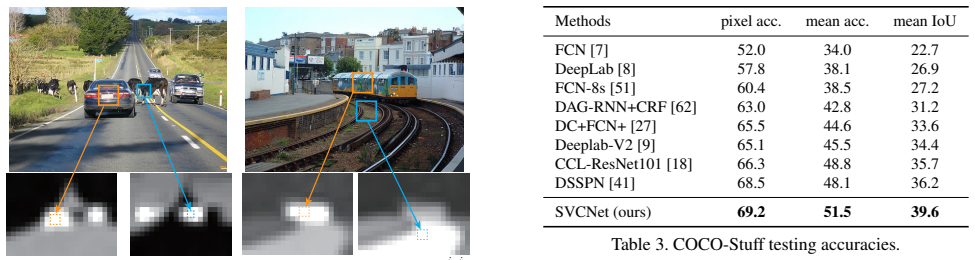
The central discovery is that context for classification can be made shape-variant in a differentiable, end-to-end way: a paired convolution estimates the semantic correlation between a target pixel and each neighbor, a Gaussian mapping turns the convolution discrepancy into a mask value $M_{m,n}^{i,j}=\phi(D_{m,n}^{i,j})$, and a shape-variant convolution multiplies its location-invariant filter weights by that mask before aggregating. The same mask values crop the fixed $K\times K$ kernel into different shapes and scales at different spatial positions and for different test images. On top of this, the labeling-denoising (LD) model uses high-level existence potentials to penalize lower-level score maps of categories unlikely to be in the image. The paper reports that this SVCNet outperforms previous state-of-the-art methods on COCO-Stuff, SIFT-Flow, CamVid, PASCAL-Person-Part, PASCAL-Context, and Cityscapes, and that in ablation SVC beats shape-fixed context at every kernel size tested.
Load-bearing premise
The central assumption is that pixels of the same object and its supporting context have correlated local appearances, so the paired convolution can learn to give them high mask weights; if that correlation is absent, the inferred masks will not match the intended context.
Editorial extensions
If this is right
- Shape-variant context captures multi-shape and multi-scale information in a single convolution layer instead of requiring parallel or stacked fixed-size context branches.
- Because the shape mask is inferred from the input at test time, the same trained filters adapt their receptive fields per image and per pixel, unlike standard convolutions or fixed pooling.
- The labeling-denoising module reduces noisy low-level contributions by suppressing categories with low existence potential, and the paper's ablation shows larger gains on datasets with more classes (COCO-Stuff, 171 classes, versus PASCAL-Context, 59 classes).
- If the reported numbers hold, the method improves mean IoU over prior state of the art on all six benchmarks, including large margins on CamVid, PASCAL-Person-Part, and PASCAL-Context.
Reading between the lines
- The per-pixel shape mask is essentially a learned pairwise affinity field, so it could be reused as an attention or grouping signal for other dense prediction tasks such as depth estimation, boundary detection, or instance segmentation.
- The SFC-versus-SVC comparison at matched kernel sizes suggests the improvement comes from shape variability rather than parameter count, which invites a direct test of whether the Gaussian mapping is essential or just a convenient monotone transform.
- A natural extension is to apply the same mask-based reshaping to self-attention or large-kernel operators in vision backbones, where the masks could prune which positions contribute at each pixel and reduce the cost of global context.
Signed reviews
Editorial analysis
A structured set of objections, weighed in public.
Referee Report
Summary. This paper introduces SVCNet, a semantic segmentation network with three main components: a paired convolution that estimates per-pixel semantic correlation with neighboring positions, a shape-variant convolution that aggregates context using the inferred shape mask, and a labeling denoising model that suppresses low-level feature noise using high-level class-existence potentials. The method is evaluated on six public benchmarks (COCO-Stuff, SIFT-Flow, CamVid, PASCAL-Person-Part, PASCAL-Context, Cityscapes), reporting improvements over the listed baselines and an ablation study (Table 2) that compares shape-variant context (SVC) with shape-fixed context (SFC).
Significance. The idea of learning an input-dependent, per-pixel context mask from feature correlations is a potentially useful direction for semantic segmentation, and the architecture is clearly specified with all components end-to-end differentiable. The paper provides a structured ablation and covers multiple datasets. However, the central claim that performance gains come specifically from semantic-correlation-driven shape masks is not convincingly isolated from added model capacity, and the state-of-the-art comparisons are against a limited set of baselines. If the mechanism were rigorously verified, the contribution would be of interest to the segmentation community.
major comments (5)
- [Table 2 and Section 4.1] The SVC-versus-SFC comparison does not isolate the effect of the learned shape mask: SFC (M=1) removes the entire paired-convolution side branch (Eqs. (1)-(2)), so it has fewer parameters and FLOPs than SVC. The claim in the table caption that the gain is 'not simply brought by the increased number of parameters' is therefore not supported by this comparison. Please provide a matched-parameter control (e.g., a version that retains the side branch but uses a fixed mask, or an SFC with proportionally more channels) to separate the effect of the mask from the effect of added capacity.
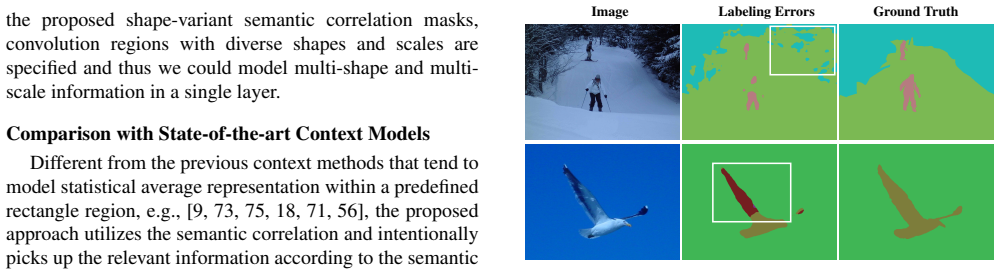
- [Section 3.1 and Figure 7] The paper asserts that the inferred masks capture semantic correlation, but no quantitative evidence is provided; the visualizations in Fig. 7 are selected examples. Please evaluate the mask quality against ground-truth semantic relationships (e.g., compute the distribution of mask values for pixel pairs of same class vs different class, or a correlation with class-conditional co-occurrence) on a validation set. Without this, the evidence is consistent with the mask being a generic input-dependent attention pattern learned only from the segmentation loss.
- [Section 4.3] The claim of 'new state-of-the-arts consistently on the six public segmentation datasets' is not substantiated because the comparison tables omit many strong baselines that were available at the time of submission (e.g., DeepLabv3+, PSANet, OCNet, DANet, HRNet). Please update the comparisons to contemporary methods under the same evaluation protocol, or restrict the claim accordingly.
- [Section 4] No repeated runs or variance estimates are reported for any of the experiments, including the ablation study. Given the large reported gains (e.g., ~10 IoU points on PASCAL-Context in Table 1) and the small evaluation sets (SIFT-Flow, CamVid), the results may not be stable. Please report the mean and standard deviation over at least three runs, or otherwise justify the robustness of the reported numbers.
- [Sections 3.1-3.2 and 4] The sensitivity to key hyperparameters (σ in Eq. (2), kernel size K in Table 2, and penalty threshold T in Eq. (6)) is not analyzed. The paper states that σ is not sensitive but provides no evidence; T is set to t, 2t, 4t without an ablation. Please include a sensitivity study for these parameters, especially T in the labeling denoising model, since they directly affect the mask values and the denoising behavior.
minor comments (5)
- [Equation (1) and surrounding text] There is a typo in the text: it reads '(i−m, j −m)' when describing the features, but the equation uses '(i−m, j−n)'. Please correct the offset notation.
- [Section 4.1] The text contains a typo: 'PASCAL-Conext' should be 'PASCAL-Context'.
- [Section 4] The description of the depthwise-separable modification of Eq. (4) is underspecified. Please provide the exact equations or pseudocode so that the implementation of SVC with large kernels is reproducible.
- [Figure 7] The gray-scale mask panels are difficult to interpret. Overlaying the masks on the input image with a color map and marking the center pixel would improve readability.
- [Section 3.1 and Section 4] The paper does not report the runtime or memory overhead of the paired-convolution branch, which adds about 18·D·K^2 parameters. An efficiency comparison would help the reader assess the method's practical value.
Circularity Check
No significant circularity: SVCNet is trained end-to-end and evaluated on held-out benchmarks; the SFC/SVC ablation imbalance is an attribution confound, not a circular derivation.
full rationale
The paper's derivation chain is self-contained with respect to the six benchmark results: the shape mask M is defined from paired-convolution feature discrepancies (Eqs. 1-2) and then used to modulate convolution weights (Eqs. 3-4), with all parameters learned from the segmentation loss. No quantity that is called a prediction is a fitted parameter in disguise; the state-of-the-art claims are comparisons against external methods on standard held-out test sets. The only self-citations (e.g., CCL [18]) are related-work comparisons, not load-bearing justifications. The main concern, that Table 2's SFC-vs-SVC comparison adds both the mask mechanism and an entire learnable paired-convolution branch so the gain may reflect capacity rather than semantic correlation, is a legitimate experimental-control criticism but not circularity: SVC's result is not equivalent to its input by construction, and the mask mechanism could in principle fail. The explicit correlation assumption in Sec. 3.1 is stated as an assumption, not derived from the target result. Accordingly the circularity score is 0.
Assumptions & free parameters
free parameters (3)
- sigma in Gaussian mapping =
3
- kernel size K for shape-variant convolution =
23
- penalty threshold T in labeling denoising =
t=1/C, 2t, 4t
assumptions (4)
- domain assumption Feature appearances of pixels belonging to the same object and its context show strong correlation because they frequently coexist in training images.
- domain assumption Higher-level features are more robust to noise and encode what categories exist, while lower-level features provide spatial detail.
- domain assumption A ResNet-101 pretrained on ImageNet provides suitable local features for segmentation.
- standard math Standard convolution and Gaussian function are differentiable and correctly compute the described operations.
Cite this review
Pith. "Pith review of Semantic Correlation Promoted Shape-Variant Context for Segmentation." pith.science (2026). https://pith.science/paper/DHKNGARI
@misc{pith2026190902651,
  author       = {Pith},
  title        = {Pith review of: Semantic Correlation Promoted Shape-Variant Context for Segmentation},
  year         = {2026},
  howpublished = {\url{https://pith.science/paper/DHKNGARI}},
  note         = {Machine review of arXiv:1909.02651}
}
read the original abstract
Context is essential for semantic segmentation. Due to the diverse shapes of objects and their complex layout in various scene images, the spatial scales and shapes of contexts for different objects have very large variation. It is thus ineffective or inefficient to aggregate various context information from a predefined fixed region. In this work, we propose to generate a scale- and shape-variant semantic mask for each pixel to confine its contextual region. To this end, we first propose a novel paired convolution to infer the semantic correlation of the pair and based on that to generate a shape mask. Using the inferred spatial scope of the contextual region, we propose a shape-variant convolution, of which the receptive field is controlled by the shape mask that varies with the appearance of input. In this way, the proposed network aggregates the context information of a pixel from its semantic-correlated region instead of a predefined fixed region. Furthermore, this work also proposes a labeling denoising model to reduce wrong predictions caused by the noisy low-level features. Without bells and whistles, the proposed segmentation network achieves new state-of-the-arts consistently on the six public segmentation datasets.
Figures


Figures from the paper (4 more)


Reference graph
Works this paper leans on
-
[1]
Higher order conditional random fields in deep neural networks
Anurag Arnab, Sadeep Jayasumana, Shuai Zheng, and Philip HS Torr. Higher order conditional random fields in deep neural networks. In ECCV, 2016
work page 2016
-
[2]
Segnet: A deep convolutional encoder-decoder architecture for image segmentation
Vijay Badrinarayanan, Alex Kendall, and Roberto Cipolla. Segnet: A deep convolutional encoder-decoder architecture for image segmentation. TPAMI, 2017
work page 2017
-
[3]
Dense decoder shortcut connections for single-pass semantic segmentation
Piotr Bilinski and Victor Prisacariu. Dense decoder shortcut connections for single-pass semantic segmentation. In CVPR, 2018
work page 2018
-
[4]
Segmentation and recognition using structure from motion point clouds
Gabriel J Brostow, Jamie Shotton, Julien Fauqueur, and Roberto Cipolla. Segmentation and recognition using structure from motion point clouds. In ECCV, 2008
work page 2008
-
[5]
Loss max-pooling for semantic image segmentation
S Rota Bulo, Gerhard Neuhold, and Peter Kontschieder. Loss max-pooling for semantic image segmentation. In CVPR, 2017
work page 2017
-
[6]
Breuel, Federico Raue, and Marcus Liwicki
Wonmin Byeon, Thomas M. Breuel, Federico Raue, and Marcus Liwicki. Scene labeling with lstm recurrent neural networks. In CVPR, 2015
work page 2015
-
[7]
Coco- stuff: Thing and stuff classes in context
Holger Caesar, Jasper Uijlings, and Vittorio Ferrari. Coco- stuff: Thing and stuff classes in context. In CVPR, 2018
work page 2018
-
[8]
Semantic image segmentation with deep convolutional nets and fully connected crfs
Liang-Chieh Chen, George Papandreou, Iasonas Kokkinos, Kevin Murphy, and Alan L Yuille. Semantic image segmentation with deep convolutional nets and fully connected crfs. In ICLR, 2015
work page 2015
Show all 77 references
-
[9]
Deeplab: Semantic image segmentation with deep convolutional nets, atrous convolution, and fully connected crfs
Liang-Chieh Chen, George Papandreou, Iasonas Kokkinos, Kevin Murphy, and Alan L Yuille. Deeplab: Semantic image segmentation with deep convolutional nets, atrous convolution, and fully connected crfs. TPAMI, 2018
2018
-
[10]
Attention to scale: Scale-aware semantic image segmentation
Liang-Chieh Chen, Yi Yang, Jiang Wang, Wei Xu, and Alan L Yuille. Attention to scale: Scale-aware semantic image segmentation. In CVPR, 2016
2016
-
[11]
Encoder-decoder with atrous separable convolution for semantic image segmentation
Liang-Chieh Chen, Yukun Zhu, George Papandreou, Florian Schroff, and Hartwig Adam. Encoder-decoder with atrous separable convolution for semantic image segmentation. arXiv:1802.02611, 2018
2018 arXiv
-
[12]
Detect what you can: Detecting and representing objects using holistic models and body parts
Xianjie Chen, Roozbeh Mottaghi, Xiaobai Liu, Sanja Fidler, Raquel Urtasun, and Alan Yuille. Detect what you can: Detecting and representing objects using holistic models and body parts. In CVPR, 2014
2014
-
[13]
Xception: Deep learning with depthwise separable convolutions
Francois Chollet. Xception: Deep learning with depthwise separable convolutions. In CVPR, 2017
2017
-
[14]
The cityscapes dataset for semantic urban scene understanding
Marius Cordts, Mohamed Omran, Sebastian Ramos, Timo Rehfeld, Markus Enzweiler, Rodrigo Benenson, Uwe Franke, Stefan Roth, and Bernt Schiele. The cityscapes dataset for semantic urban scene understanding. In CVPR, 2016
2016
-
[15]
Boxsup: Exploiting bounding boxes to supervise convolutional networks for semantic segmentation
Jifeng Dai, Kaiming He, and Jian Sun. Boxsup: Exploiting bounding boxes to supervise convolutional networks for semantic segmentation. In ICCV, 2015
2015
-
[16]
Deformable convolutional networks
Jifeng Dai, Haozhi Qi, Yuwen Xiong, Yi Li, Guodong Zhang, Han Hu, and Yichen Wei. Deformable convolutional networks. In ICCV, 2017
2017
-
[17]
A classification refinement strategy for semantic segmentation
James W Davis, Christopher Menart, Muhammad Akbar, and Roman Ilin. A classification refinement strategy for semantic segmentation. arXiv:1801.07674, 2018
2018 arXiv
-
[18]
Context contrasted feature and gated multi- scale aggregation for scene segmentation
Henghui Ding, Xudong Jiang, Bing Shuai, Ai Qun Liu, and Gang Wang. Context contrasted feature and gated multi- scale aggregation for scene segmentation. In CVPR, 2018
2018
-
[19]
Learning hierarchical features for scene labeling
Clement Farabet, Camille Couprie, Laurent Najman, and Yann LeCun. Learning hierarchical features for scene labeling. TPAMI, 35(8), 2013
2013
-
[20]
A network structure to explicitly reduce confusion errors in semantic segmentation
Qichuan Geng, Xinyu Huang, Zhong Zhou, and Ruigang Yang. A network structure to explicitly reduce confusion errors in semantic segmentation. arXiv:1808.00313, 2018
2018 arXiv
-
[21]
Laplacian pyramid reconstruction and refinement for semantic segmentation
Golnaz Ghiasi and Charless C Fowlkes. Laplacian pyramid reconstruction and refinement for semantic segmentation. In ECCV, 2016
2016
-
[22]
Unpaired image captioning by language pivoting
Jiuxiang Gu, Shafiq Joty, Jianfei Cai, and Gang Wang. Unpaired image captioning by language pivoting. In ECCV, 2018
2018
-
[23]
Recent advances in convolutional neural networks
Jiuxiang Gu, Zhenhua Wang, Jason Kuen, Lianyang Ma, Amir Shahroudy, Bing Shuai, Ting Liu, Xingxing Wang, Gang Wang, Jianfei Cai, et al. Recent advances in convolutional neural networks. Pattern Recognition, 2018
2018
-
[24]
Scene graph generation with external knowledge and image reconstruction
Jiuxiang Gu, Handong Zhao, Zhe Lin, Sheng Li, Jianfei Cai, and Mingyang Ling. Scene graph generation with external knowledge and image reconstruction. In CVPR, 2019
2019
-
[25]
Hypercolumns for object segmentation and fine-grained localization
Bharath Hariharan, Pablo Arbel ´aez, Ross Girshick, and Jitendra Malik. Hypercolumns for object segmentation and fine-grained localization. In CVPR, 2015
2015
-
[26]
Deep residual learning for image recognition
Kaiming He, Xiangyu Zhang, Shaoqing Ren, and Jian Sun. Deep residual learning for image recognition. In CVPR, 2016
2016
-
[27]
Labelbank: Revisiting global perspectives for semantic segmentation
Hexiang Hu, Zhiwei Deng, Guang-Tong Zhou, Fei Sha, and Greg Mori. Labelbank: Revisiting global perspectives for semantic segmentation. arXiv:1703.09891, 2017
2017 arXiv
-
[28]
Weinberger
Gao Huang, Zhuang Liu, Laurens van der Maaten, and Kilian Q. Weinberger. Densely connected convolutional networks. In CVPR, 2017
2017
-
[29]
Error correction for dense semantic image labeling
Yu-Hui Huang, Xu Jia, Stamatios Georgoulis, Tinne Tuytelaars, and Luc Van Gool. Error correction for dense semantic image labeling. arXiv:1712.03812, 2017
2017 arXiv
-
[30]
Scene parsing with global context embedding
Wei-Chih Hung, Yi-Hsuan Tsai, Xiaohui Shen, Zhe L Lin, Kalyan Sunkavalli, Xin Lu, and Ming-Hsuan Yang. Scene parsing with global context embedding. In ICCV, 2017
2017
-
[31]
Batch normalization: Accelerating deep network training by reducing internal covariate shift
Sergey Ioffe and Christian Szegedy. Batch normalization: Accelerating deep network training by reducing internal covariate shift. In ICML, 2015
2015
-
[32]
Gated feedback refinement network for dense image labeling
Md Amirul Islam, Mrigank Rochan, Neil DB Bruce, and Yang Wang. Gated feedback refinement network for dense image labeling. In CVPR, 2017
2017
-
[33]
The one hundred layers tiramisu: Fully convolutional densenets for semantic segmentation
Simon J ´egou, Michal Drozdzal, David Vazquez, Adriana Romero, and Yoshua Bengio. The one hundred layers tiramisu: Fully convolutional densenets for semantic segmentation. In CVPRW, 2017
2017
-
[34]
Adaptive affinity fields for semantic segmentation
Tsung-Wei Ke, Jyh-Jing Hwang, Ziwei Liu, and Stella X Yu. Adaptive affinity fields for semantic segmentation. InECCV, 2018
2018
-
[35]
Recurrent scene parsing with perspective understanding in the loop
Shu Kong and Charless C Fowlkes. Recurrent scene parsing with perspective understanding in the loop. In CVPR, 2018
2018
-
[36]
Efficient inference in fully connected crfs with gaussian edge potentials
Philipp Kr ¨ahenb¨uhl and Vladlen Koltun. Efficient inference in fully connected crfs with gaussian edge potentials. In NIPS, 2011
2011
-
[37]
Imagenet classification with deep convolutional neural networks
Alex Krizhevsky, Ilya Sutskever, and Geoffrey E Hinton. Imagenet classification with deep convolutional neural networks. In NIPS, 2012
2012
-
[38]
Feature space optimization for semantic video segmentation
Abhijit Kundu, Vibhav Vineet, and Vladlen Koltun. Feature space optimization for semantic video segmentation. In CVPR, 2016. 9
2016
-
[39]
Semantic object parsing with graph lstm
Xiaodan Liang, Xiaohui Shen, Jiashi Feng, Liang Lin, and Shuicheng Yan. Semantic object parsing with graph lstm. In ECCV, 2016
2016
-
[40]
Semantic object parsing with local-global long short-term memory
Xiaodan Liang, Xiaohui Shen, Donglai Xiang, Jiashi Feng, Liang Lin, and Shuicheng Yan. Semantic object parsing with local-global long short-term memory. In CVPR, 2016
2016
-
[41]
Dynamic- structured semantic propagation network
Xiaodan Liang, Hongfei Zhou, and Eric Xing. Dynamic- structured semantic propagation network. In CVPR, 2018
2018
-
[42]
Multi-scale context intertwining for semantic segmentation
Di Lin, Yuanfeng Ji, Dani Lischinski, Daniel Cohen-Or, and Hui Huang. Multi-scale context intertwining for semantic segmentation. In ECCV, 2018
2018
-
[43]
Refinenet: Multi-path refinement networks for high- resolution semantic segmentation
Guosheng Lin, Anton Milan, Chunhua Shen, and Ian Reid. Refinenet: Multi-path refinement networks for high- resolution semantic segmentation. In CVPR, 2017
2017
-
[44]
G. Lin, C. Shen, A. van dan Hengel, and I. Reid. Efficient piecewise training of deep structured models for semantic segmentation. In CVPR, 2016
2016
-
[45]
Nonparametric scene parsing: Label transfer via dense scene alignment
Ce Liu, Jenny Yuen, and Antonio Torralba. Nonparametric scene parsing: Label transfer via dense scene alignment. In CVPR, 2009
2009
-
[46]
Sift flow: Dense correspondence across scenes and its applications
Ce Liu, Jenny Yuen, and Antonio Torralba. Sift flow: Dense correspondence across scenes and its applications. TPAMI, 2011
2011
-
[47]
Feature boosting network for 3d pose estimation
Jun Liu, Henghui Ding, Amir Shahroudy, Ling-Yu Duan, Xudong Jiang, Gang Wang, and Alex Kot Chichung. Feature boosting network for 3d pose estimation. TPAMI, 2019
2019
-
[48]
Semantic image segmentation via deep parsing network
Ziwei Liu, Xiaoxiao Li, Ping Luo, Chen-Change Loy, and Xiaoou Tang. Semantic image segmentation via deep parsing network. In ICCV, 2015
2015
-
[49]
Learning markov clustering networks for scene text detection
Zichuan Liu, Guosheng Lin, Sheng Yang, Jiashi Feng, Weisi Lin, and Wang Ling Goh. Learning markov clustering networks for scene text detection. In CVPR, 2018
2018
-
[50]
Towards robust curve text detection with conditional spatial expansion
Zichuan Liu, Guosheng Lin, Sheng Yang, Fayao Liu, Weisi Lin, and Wang Ling Goh. Towards robust curve text detection with conditional spatial expansion. InCVPR, 2019
2019
-
[51]
Fully convolutional networks for semantic segmentation
Jonathan Long, Evan Shelhamer, and Trevor Darrell. Fully convolutional networks for semantic segmentation. In CVPR, 2015
2015
-
[52]
Are spatial and global constraints really necessary for segmentation? In ICCV, 2011
Aurelien Lucchi, Yunpeng Li, Xavier Boix, Kevin Smith, and Pascal Fua. Are spatial and global constraints really necessary for segmentation? In ICCV, 2011
2011
-
[53]
Feedforward semantic segmentation with zoom-out features
Mohammadreza Mostajabi, Payman Yadollahpour, and Gre- gory Shakhnarovich. Feedforward semantic segmentation with zoom-out features. In CVPR, 2015
2015
-
[54]
The role of context for object detection and semantic segmentation in the wild
Roozbeh Mottaghi, Xianjie Chen, Xiaobai Liu, Nam-Gyu Cho, Seong-Whan Lee, Sanja Fidler, Raquel Urtasun, and Alan Yuille. The role of context for object detection and semantic segmentation in the wild. In CVPR, 2014
2014
-
[55]
Learning deconvolution network for semantic segmentation
Hyeonwoo Noh, Seunghoon Hong, and Bohyung Han. Learning deconvolution network for semantic segmentation. In ICCV, 2015
2015
-
[56]
Large kernel matters – improve semantic segmentation by global convolutional network
Chao Peng, Xiangyu Zhang, Gang Yu, Guiming Luo, and Jian Sun. Large kernel matters – improve semantic segmentation by global convolutional network. In CVPR, 2017
2017
-
[57]
Recurrent convolu- tional neural networks for scene labeling
Pedro Pinheiro and Ronan Collobert. Recurrent convolu- tional neural networks for scene labeling. In ICML, 2014
2014
-
[58]
Imagenet large scale visual recognition challenge
Olga Russakovsky, Jia Deng, Hao Su, Jonathan Krause, Sanjeev Satheesh, Sean Ma, Zhiheng Huang, Andrej Karpathy, Aditya Khosla, Michael Bernstein, et al. Imagenet large scale visual recognition challenge. IJCV, 2015
2015
-
[59]
Recursive context propagation network for semantic scene labeling
Abhishek Sharma, Oncel Tuzel, and Ming-Yu Liu. Recursive context propagation network for semantic scene labeling. In NIPS, 2014
2014
-
[60]
Fully convolutional networks for semantic segmentation
Evan Shelhamer, Jonathon Long, and Trevor Darrell. Fully convolutional networks for semantic segmentation. TPAMI, 2016
2016
-
[61]
Toward achieving robust low-level and high- level scene parsing
Bing Shuai, Henghui Ding, Ting Liu, Gang Wang, and Xudong Jiang. Toward achieving robust low-level and high- level scene parsing. TIP, 2019
2019
-
[62]
Scene segmentation with dag-recurrent neural networks
Bing Shuai, Zhen Zuo, Bing Wang, and Gang Wang. Scene segmentation with dag-recurrent neural networks. TPAMI, 2018
2018
-
[63]
Very deep convolutional networks for large-scale image recognition
Karen Simonyan and Andrew Zisserman. Very deep convolutional networks for large-scale image recognition. arXiv:1409.1556, 2014
2014 arXiv
-
[64]
Going deeper with convolutions
Christian Szegedy, Wei Liu, Yangqing Jia, Pierre Sermanet, Scott Reed, Dragomir Anguelov, Dumitru Erhan, Vincent Vanhoucke, and Andrew Rabinovich. Going deeper with convolutions. In CVPR, 2015
2015
-
[65]
Aanet: Attribute attention network for person re-identification
Chiat-Pin Tay, Sharmili Roy, and Kim-Hui Yap. Aanet: Attribute attention network for person re-identification. In CVPR, 2019
2019
-
[66]
Finding things: Image parsing with regions and per-exemplar detectors
Joseph Tighe and Svetlana Lazebnik. Finding things: Image parsing with regions and per-exemplar detectors. In CVPR, 2013
2013
-
[67]
Bridging category-level and instance-level semantic image segmentation
Zifeng Wu, Chunhua Shen, and Anton van den Hengel. Bridging category-level and instance-level semantic image segmentation. arXiv:1605.06885, 2016
2016 arXiv
-
[68]
Zoom better to see clearer: Human and object parsing with hierarchical auto-zoom net
Fangting Xia, Peng Wang, Liang-Chieh Chen, and Alan L Yuille. Zoom better to see clearer: Human and object parsing with hierarchical auto-zoom net. In ECCV, 2016
2016
-
[69]
Combining the best of convolutional layers and recurrent layers: A hybrid network for semantic segmentation
Zhicheng Yan, Hao Zhang, Yangqing Jia, Thomas Breuel, and Yizhou Yu. Combining the best of convolutional layers and recurrent layers: A hybrid network for semantic segmentation. arXiv:1603.04871, 2016
2016 arXiv
-
[70]
Context driven scene parsing with attention to rare classes
Jimei Yang, Brian Price, Scott Cohen, and Ming-Hsuan Yang. Context driven scene parsing with attention to rare classes. In CVPR, 2014
2014
-
[71]
Denseaspp for semantic segmentation in street scenes
Maoke Yang, Kun Yu, Chi Zhang, Zhiwei Li, and Kuiyuan Yang. Denseaspp for semantic segmentation in street scenes. In CVPR, 2018
2018
-
[72]
Learning a discriminative feature network for semantic segmentation
Changqian Yu, Jingbo Wang, Chao Peng, Changxin Gao, Gang Yu, and Nong Sang. Learning a discriminative feature network for semantic segmentation. In CVPR, 2018
2018
-
[73]
Multi-scale context aggregation by dilated convolutions
Fisher Yu and Vladlen Koltun. Multi-scale context aggregation by dilated convolutions. arXiv:1511.07122, 2015
2015 arXiv
-
[74]
Context encoding for semantic segmentation
Hang Zhang, Kristin Dana, Jianping Shi, Zhongyue Zhang, Xiaogang Wang, Ambrish Tyagi, and Amit Agrawal. Context encoding for semantic segmentation. In CVPR, 2018
2018
-
[75]
Pyramid scene parsing network
Hengshuang Zhao, Jianping Shi, Xiaojuan Qi, Xiaogang Wang, and Jiaya Jia. Pyramid scene parsing network. In CVPR, 2017
2017
-
[76]
Psanet: Point-wise spatial attention network for scene parsing
Hengshuang Zhao, Yi Zhang, Shu Liu, Jianping Shi, Chen Change Loy, Dahua Lin, and Jiaya Jia. Psanet: Point-wise spatial attention network for scene parsing. In ECCV, 2018
2018
-
[77]
Conditional random fields as recurrent neural networks
Shuai Zheng, Sadeep Jayasumana, Bernardino Romera- Paredes, Vibhav Vineet, Zhizhong Su, Dalong Du, Chang Huang, and Philip HS Torr. Conditional random fields as recurrent neural networks. In ICCV, 2015. 10
2015
Reviewed August 14, 2026 · model on record in the stance chip above.
Discussion (0). Continue with ORCID to comment.