Co-Design quantum simulation of nanoscale NMR
Pith reviewed 2026-05-24 12:19 UTC · model grok-4.3
The pith
Co-designed superconducting processor enables nanoscale NMR simulation on NISQ devices with over 90% fewer SWAP gates.
A machine-rendered reading of the paper's core claim, the machinery that carries it, and where it could break.
Core claim
A superconducting application-specific co-design quantum processor consisting of transmon qubits capacitively coupled via tunable couplers to a central co-planar waveguide resonator with a quantum circuit refrigerator can simulate and predict nanoscale NMR resonances, reduces the number of SWAP gates by over 90 percent for chips with more than 20 qubits, and implements the non-unitary quantum operations required to simulate nuclear hyperpolarization scenarios.
What carries the argument
The co-design quantum processor architecture of transmon qubits capacitively coupled via tunable couplers to a central co-planar waveguide resonator equipped with a quantum circuit refrigerator for fast reset and non-unitary operations.
If this is right
- Nanoscale NMR resonances become simulatable and predictable on current noisy quantum hardware.
- Non-unitary operations for nuclear hyperpolarization scenarios can be executed directly via the quantum circuit refrigerator.
- Circuit depth for larger qubit counts drops sharply, making previously intractable NMR simulations feasible.
- Application-specific processors of this type can be extended to other spin-system simulations that require reset or non-unitary steps.
Where Pith is reading between the lines
- The same resonator-plus-refrigerator motif might reduce overhead in simulations of other open quantum systems beyond NMR.
- If the tunable couplers prove difficult to fabricate at scale, an alternative coupling scheme would be needed to retain the SWAP savings.
- The reported gate-count improvement could be benchmarked directly against standard linear qubit arrays on existing cloud quantum processors.
Load-bearing premise
The proposed layout of transmon qubits capacitively coupled via tunable couplers to a central co-planar waveguide resonator together with the quantum circuit refrigerator can be realized in hardware with gate fidelities high enough to deliver the claimed SWAP reduction and execute the non-unitary hyperpolarization operations without prohibitive error accumulation.
What would settle it
Fabrication and testing of the proposed processor layout that shows either less than 80 percent SWAP gate reduction or accumulated errors that prevent accurate simulation of hyperpolarization scenarios would falsify the central claim.
Figures






read the original abstract
Quantum computers have the potential to efficiently simulate the dynamics of nanoscale NMR systems. In this work we demonstrate that a noisy intermediate-scale quantum computer can be used to simulate and predict nanoscale NMR resonances. In order to minimize the required gate fidelities, we propose a superconducting application-specific Co-Design quantum processor that reduces the number of SWAP gates by over 90 % for chips with more than 20 qubits. The processor consists of transmon qubits capacitively coupled via tunable couplers to a central co-planar waveguide resonator with a quantum circuit refrigerator (QCR) for fast resonator reset. The QCR implements the non-unitary quantum operations required to simulate nuclear hyperpolarization scenarios.
Editorial analysis
A structured set of objections, weighed in public.
Referee Report
Summary. The manuscript proposes a superconducting co-design quantum processor architecture consisting of transmon qubits capacitively coupled via tunable couplers to a central CPW resonator, augmented by a quantum circuit refrigerator (QCR), for efficient simulation of nanoscale NMR resonances and hyperpolarization dynamics on NISQ hardware. It asserts that this layout reduces SWAP gate count by over 90% for chips with more than 20 qubits and that the QCR enables the required non-unitary operations.
Significance. If the proposed architecture can be realized with gate fidelities sufficient to realize the claimed SWAP reduction and faithful non-unitary evolution, the work could lower the resource overhead for quantum simulation of NMR systems and extend NISQ capabilities to open-system dynamics. The manuscript supplies no numerical benchmarks, circuit compilations, or error models, so these potential benefits remain unquantified.
major comments (3)
- [Abstract] Abstract: the claim that the processor 'reduces the number of SWAP gates by over 90 % for chips with more than 20 qubits' is presented without any qubit connectivity graph, SWAP-mapping algorithm, gate-count table, or scaling analysis that would allow independent verification of the reduction factor.
- [Abstract] Abstract: the statement that 'a noisy intermediate-scale quantum computer can be used to simulate and predict nanoscale NMR resonances' and that the QCR 'implements the non-unitary quantum operations required' is unsupported by any circuit diagrams, Trotter-step decompositions, fidelity estimates, or decoherence analysis showing that the non-unitary reset remains accurate under realistic noise.
- The central hardware proposal (transmons + tunable couplers + central CPW + QCR) is described at the block-diagram level only; no quantitative error budget, target T1/T2 values, or circuit-depth estimates are given to demonstrate that the claimed SWAP reduction yields a net advantage once decoherence is included.
Simulated Author's Rebuttal
We thank the referee for the constructive and detailed feedback. We agree that the manuscript would benefit from additional supporting material to substantiate the claims in the abstract and to quantify the advantages of the proposed architecture. We address each major comment below and will revise the manuscript to incorporate the requested details.
read point-by-point responses
-
Referee: [Abstract] Abstract: the claim that the processor 'reduces the number of SWAP gates by over 90 % for chips with more than 20 qubits' is presented without any qubit connectivity graph, SWAP-mapping algorithm, gate-count table, or scaling analysis that would allow independent verification of the reduction factor.
Authors: We agree that the reduction claim requires explicit supporting analysis for verification. The central resonator provides effective all-to-all connectivity that eliminates most SWAP operations relative to sparse graphs; however, the current manuscript does not include the requested graph, algorithm description, table, or scaling plot. In the revised version we will add these elements, including a comparison against standard compilers on representative qubit counts. revision: yes
-
Referee: [Abstract] Abstract: the statement that 'a noisy intermediate-scale quantum computer can be used to simulate and predict nanoscale NMR resonances' and that the QCR 'implements the non-unitary quantum operations required' is unsupported by any circuit diagrams, Trotter-step decompositions, fidelity estimates, or decoherence analysis showing that the non-unitary reset remains accurate under realistic noise.
Authors: The manuscript describes the overall simulation approach and the role of the QCR at a conceptual level but does not supply the detailed circuit decompositions or noise analysis requested. We will add explicit Trotter-step circuit diagrams, a decomposition of the hyperpolarization reset operation, estimated gate fidelities, and a simple decoherence model for the QCR reset in the revised manuscript. revision: yes
-
Referee: The central hardware proposal (transmons + tunable couplers + central CPW + QCR) is described at the block-diagram level only; no quantitative error budget, target T1/T2 values, or circuit-depth estimates are given to demonstrate that the claimed SWAP reduction yields a net advantage once decoherence is included.
Authors: We acknowledge that a quantitative error budget is needed to confirm a net advantage. The current text provides only the high-level architecture without T1/T2 targets, depth estimates, or decoherence accounting. In revision we will include realistic transmon coherence targets, an error budget for the reduced-depth circuits, and a comparison of total error with and without the co-design layout. revision: yes
Circularity Check
No circularity: claims rest on architectural proposal and unverified hardware assumptions, not self-referential derivations or fits
full rationale
The paper's central claims concern a proposed transmon-QCR co-design processor that reduces SWAP gates and enables non-unitary operations for NMR simulation. No equations, fitted parameters, or derivations are presented that reduce by construction to the inputs (e.g., no self-definitional scaling, no prediction of a fitted quantity, no load-bearing self-citation chain). The architecture is introduced as a design choice whose benefits are asserted from layout considerations; feasibility remains an external assumption rather than an internal loop. This is the common case of a hardware proposal whose correctness risk lies in realizability, not circularity.
Axiom & Free-Parameter Ledger
invented entities (1)
-
Quantum circuit refrigerator (QCR)
no independent evidence
Lean theorems connected to this paper
-
IndisputableMonolith/Foundation/AbsoluteFloorClosure.leanreality_from_one_distinction unclear?
unclearRelation between the paper passage and the cited Recognition theorem.
The processor consists of transmon qubits capacitively coupled via tunable couplers to a central co-planar waveguide resonator with a quantum circuit refrigerator (QCR) for fast resonator reset.
-
IndisputableMonolith/Cost/FunctionalEquation.leanwashburn_uniqueness_aczel unclear?
unclearRelation between the paper passage and the cited Recognition theorem.
reduces the number of SWAP gates by over 90 % for chips with more than 20 qubits
What do these tags mean?
- matches
- The paper's claim is directly supported by a theorem in the formal canon.
- supports
- The theorem supports part of the paper's argument, but the paper may add assumptions or extra steps.
- extends
- The paper goes beyond the formal theorem; the theorem is a base layer rather than the whole result.
- uses
- The paper appears to rely on the theorem as machinery.
- contradicts
- The paper's claim conflicts with a theorem or certificate in the canon.
- unclear
- Pith found a possible connection, but the passage is too broad, indirect, or ambiguous to say the theorem truly supports the claim.
Reference graph
Works this paper leans on
-
[1]
Native gates The hardware for the quantum simulation plays a ma- jor role in choosing the optimal quantum algorithm and its specific implementation. In our case, we consider a quantum computer based on superconducting qubits with the following native single-qubit gate set: Rxy(φ,θ ) =e−i(cosφX+sinφY )θ 2 ; and (3) Rz(θ) =e−iZθ 2, (4) whereX,Y , and Z are P...
-
[2]
Qubit reset In the hyperpolarization process the state of the NV needs to be re-initialized after each cycle. It is therefore necessary to be able to reset the state of the qubit repre- senting the NV center in the quantum computer. A qubit reset operation can be defined by two Kraus operators: Kreset 1 = ( 1 0 0 0 ) , Kreset 2 = ( 0 1 0 0 ) . (6) On super...
-
[3]
Noise and errors In this paper we show that the simulation can tol- erate the noise of the quantum processing unit (QPU), and that the simulation does not require large overheads to implement imperfections present in the nanoscale- NMR system, as discussed in Sec. II. We will refer by system imperfections to effects in the nanoscale NMR system only, while ...
-
[4]
Initial state preparationSimulation protocolMeasurement (a) 𝐻!
Initial state preparation To enable the polarization transfer, it is necessary to prepare the NV center in a specific initial state that de- pends on the driving scheme. For the continuous-driving scheme it is the |+⟩ or|−⟩ state, and for the pulsed- driving scheme it is one of the two computational basis states,|0⟩ or|1⟩. 5 𝑋rnd NV initTrotterized evoluti...
-
[5]
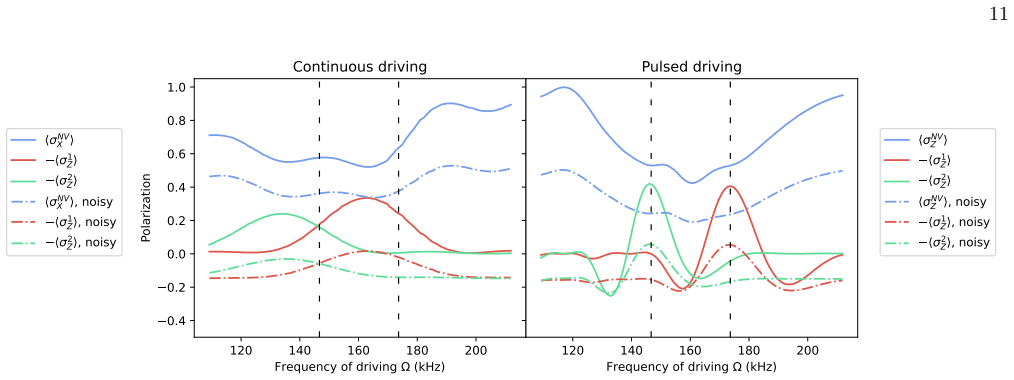
Time evolution We choose to implement the time evolution generated by the Hamiltonian in Eq. (1) through Trotterization. For that, the Hamiltonian is rewritten in terms of qubit Pauli operators and arranged into non-commuting terms for an optimal Trotter splitting. The resulting circuit, which performs one Trotter step of the evolution in the continuous d...
-
[6]
Cycles and reset The dynamics of the system is known to produce an ex- change of polarization between the NV center and the nu- clei. This exchange is oscillatory, and therefore choosing a proper stopping time is important in order to achieve an effective polarization transfer from the NV center to the nuclei. In practice, a sub-optimal transfer time can s...
-
[7]
Square grid A common choice in superconducting quantum chips is the square grid of qubits. It has high connectivity and is suitable for performing the surface code error correction when scaled to large enough qubit counts with fast mea- surement and feedback [46]. The qubit routing problem (a) (b) FIG. 3. (a) Three steps of the SWAP patterns in a five-qubi...
-
[8]
Star architecture A star topology allows to implement the simulation of the simplified case without internuclear interactions directly, without any SWAP gates. With internuclear interactions considered, we still find a reduction in SWAP gates as compared to the square grid topology, as shown in Fig. 3b. This reduction comes from the SWAP routing we implemen...
-
[9]
Prepare all qubits and the resonator in their ground states
-
[10]
Select one qubit to form the effective central qubit together with the resonator
-
[11]
Prepare an arbitrary state in the selected qubit
-
[12]
Perform an iSWAP operation from the selected qubit to the resonator initially in the ground state 9
-
[13]
Perform CZ gates between the resonator and any other qubits
-
[14]
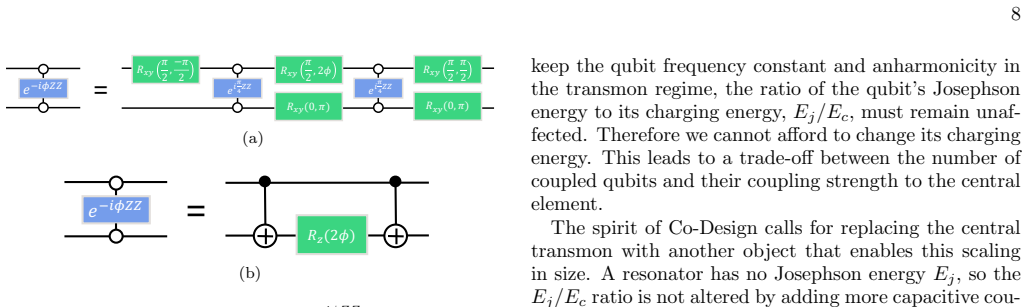
Perform an iSWAP operation back from the res- onator to the selected qubit for measurement The theoretically most straightforward protocol would be to perform a SWAP gate from the qubit to the resonator. The iSWAP, on the other hand, is a native gate that can directly be implemented on the hardware in Fig. 6b. The iSWAP gate between the resonator and the ...
-
[15]
(12) This gate is equivalent to the UZZ (φ) gate in Eq
Conditional-Z gate The CZ operation between the resonator and the qubit is described by the unitary operator: CZ(φ) = 1 0 0 0 0 1 0 0 0 0 1 0 0 0 0 e−iφ . (12) This gate is equivalent to the UZZ (φ) gate in Eq. 5 up to two Rz-rotations. To operate a CZ gate, we initialize the resonator-coupler-qubit set up shown in Fig. 6b at the idling configurat...
-
[16]
iSWAP gate Just as the CZ gate, the iSWAP gate can be natively realized in superconducting quantum computing archi- tecture [37]. With our device, we can perform high- fidelity iSWAP gates between zero- and single-excitation computational states. The two-photon state |1⟩r⊗| 1⟩, where|1⟩r denotes the first excited state of the resonator, must be excluded bec...
-
[17]
To illustrate the mechanism, we consider a system including a single NV center and a single nucleus
Hartmann-Hahn sequence Here we explain the dynamics induced by the continuous driving on the hyperpolarization protocol. To illustrate the mechanism, we consider a system including a single NV center and a single nucleus. The corresponding Hamiltonian, now including the driving term, reads: H =DS2 z−γeBzSz−γcBzIz +Sz⃗A·⃗I +Sx √ 2 Ω cos(ωt−φ), (B1) In the ...
-
[18]
Simulation protocolMeasurement Pulse𝑅!
Pulsed sequence Now we consider the pulsed case, represented by the driving term Hdr = Ω(t) 2 σφ where Ω(t) is a train of π-pulses. The Hamiltonian is already expressed in the interaction picture from Eq. (B4). From there, we further move into a rotating frame with respect to the driving term. The corresponding unitary transformation is U0 = (−iσφ)k for t...
-
[19]
Initialize the state of the NV center in the second qubit
-
[20]
Perform interactions with the first and third qubits
-
[21]
SWAP the NV center qubit to the right
-
[22]
Perform interaction with right qubit
-
[23]
Repeat steps 3-4 until all interactions have been achieved. 20 𝜔!" 𝐴! x y z 𝜙!"#𝜙 𝑘$ 𝜃 (a) 𝜔!",$%& x y z𝐴⃗!$%& (b) FIG. 11. a) Coefficients vectors of the first qubit ⃗A1,⃗ ωc 1 before the rotation, with projection over the three axis, b) coefficient vectors of the first qubit ⃗Arot 1 ,⃗ ωc,rot 1 after the rotation, being ⃗Arot 1 in the Z-axis. The pattern is s...
-
[24]
Feynman, Simulating physics with computers, in Feynman and computation (CRC Press, 2018) pp
R. Feynman, Simulating physics with computers, in Feynman and computation (CRC Press, 2018) pp. 133– 153
work page 2018
-
[25]
Lloyd, Universal quantum simulators, Science , 1073 (1996)
S. Lloyd, Universal quantum simulators, Science , 1073 (1996)
work page 1996
-
[26]
Preskill, Quantum computing in the NISQ era and beyond, Quantum 2, 79 (2018)
J. Preskill, Quantum computing in the NISQ era and beyond, Quantum 2, 79 (2018)
work page 2018
- [27]
-
[28]
M. J. S. Smith, Application-specific integrated circuits, Vol. 7 (Addison-Wesley Reading, MA, 1997)
work page 1997
-
[29]
K.-C. Hsu and H.-W. Tseng, Accelerating applications using edge tensor processing units, in Proceedings of the International Conference for High Performance Comput- ing, Networking, Storage and Analysis (ACM, 2021)
work page 2021
-
[30]
T. Lu, T. Marin, Y. Zhuo, Y.-F. Chen, and C. Ma, Accel- erating MRI reconstruction on TPUs, in 2020 IEEE High Performance Extreme Computing Conference (HPEC) (IEEE, 2020) pp. 1–9
work page 2020
-
[31]
T. Staudacher, F. Shi, S. Pezzagna, J. Meijer, J. Du, C. A. Meriles, F. Reinhard, and J. Wrachtrup, Nuclear Magnetic Resonance Spectroscopy on a (5-Nanometer)3 Sample Volume, Science 339, 561 (2013)
work page 2013
-
[32]
M. Nielsen and I. Chuang, Quantum Computation and Quantum Information (Cambridge University Press, 2000)
work page 2000
- [33]
-
[34]
K. Seetharam, D. Biswas, C. Noel, A. Risinger, D. Zhu, O. Katz, S. Chattopadhyay, M. Cetina, C. Monroe, E. Demler, et al. , Digital quantum simulation of NMR experiments, arXiv preprint arXiv:2109.13298 (2021)
- [35]
-
[36]
D. Sels, H. Dashti, S. Mora, O. Demler, and E. Dem- ler, Quantum approximate Bayesian computation for NMR model inference, Nature machine intelligence2, 396 (2020)
work page 2020
-
[37]
D. Sels and E. Demler, Quantum generative model for sampling many-body spectral functions, Physical Review B 103, 014301 (2021)
work page 2021
-
[38]
M. H. Levitt, Spin dynamics: basics of nuclear magnetic resonance (John Wiley & Sons, 2013)
work page 2013
-
[39]
M. W. Doherty, N. B. Manson, P. Delaney, F. Jelezko, J. Wrachtrup, and L. C. L. Hollenberg, The nitrogen- vacancy colour centre in diamond, Physics Reports 528, 1 (2013)
work page 2013
-
[40]
M. H. Abobeih, J. Randall, C. E. Bradley, H. P. Bartling, M. A. Bakker, M. J. Degen, M. Markham, D. J. Twitchen, and T. H. Taminiau, Atomic-scale imaging of a 27-nuclear-spin cluster using a quantum sensor, Nature 576, 411 (2019)
work page 2019
-
[41]
C. Munuera-Javaloy, R. Puebla, and J. Casanova, Dy- namical decoupling methods in nanoscale NMR, EPL (Europhysics Letters) 134, 30001 (2021)
work page 2021
-
[42]
C. Munuera-Javaloy, R. Puebla, B. D’Anjou, M. B. Ple- nio, and J. Casanova, Detection of molecular transitions with nitrogen-vacancy centers and electron-spin labels, arXiv preprint arXiv:2110.14255 (2021)
-
[43]
A. Ajoy, K. Liu, R. Nazaryan, X. Lv, P. Zangara, B. Safvati, G. Wang, D. Arnold, G. Li, A. Lin, et al. , Orientation-independent room temperature optical 13c hyperpolarization in powdered diamond, Science ad- vances 4, 5492 (2018)
work page 2018
-
[44]
S. Hartmann and E. Hahn, Nuclear double resonance in the rotating frame, Physical Review 128, 2042 (1962)
work page 2042
-
[45]
H. Carr and E. Purcell, Effects of diffusion on free preces- sion in nuclear magnetic resonance experiments, Physical review 94, 630 (1954)
work page 1954
-
[46]
S. Meiboom and D. Gill, Modified spin-echo method for measuring nuclear relaxation times, Review of scientific instruments 29, 688 (1958)
work page 1958
-
[47]
A. Maudsley, Modified Carr-Purcell-Meiboom-Gill se- quence for NMR Fourier imaging applications, Journal of Magnetic Resonance (1969) 69, 488 (1986)
work page 1969
-
[48]
T. Gullion, D. Baker, and M. Conradi, New, compen- sated Carr-Purcell sequences, Journal of Magnetic Reso- nance (1969) 89, 479 (1990)
work page 1969
-
[49]
J. Casanova, Z. Wang, and M. B. Plenio, Noise-resilient quantum computing with a nitrogen-vacancy center and nuclear spins, Phys. Rev. Lett. 117, 130502 (2016)
work page 2016
-
[50]
G. Uhlenbeck and L. Ornstein, On the theory of the Brownian motion, Physical review 36, 823 (1930)
work page 1930
-
[51]
J. Cai, B. Naydenov, R. Pfeiffer, L. McGuinness, K. Jahnke, F. Jelezko, M. Plenio, and A. Retzker, Ro- bust dynamical decoupling with concatenated continuous driving, New Journal of Physics 14, 113023 (2012)
work page 2012
-
[52]
Gillespie, Exact numerical simulation of the Ornstein- Uhlenbeck process and its integral, Phys
D. Gillespie, Exact numerical simulation of the Ornstein- Uhlenbeck process and its integral, Phys. Rev. E54, 2084 (1996)
work page 2084
-
[53]
A. Ajoy, B. Safvati, Nazaryan, R., and et al., Hyperpo- larized relaxometry based nuclear T1 noise spectroscopy in diamond, Nature communications 10 (2019)
work page 2019
-
[54]
M. Suzuki, Generalized Trotter’s formula and systematic approximants of exponential operators and inner deriva- tions with applications to many-body problems, Commu- nications in Mathematical Physics 51, 183 (1976)
work page 1976
-
[55]
Campbell, Random compiler for fast Hamiltonian sim- ulation, Phys
E. Campbell, Random compiler for fast Hamiltonian sim- ulation, Phys. Rev. Lett. 123, 070503 (2019)
work page 2019
-
[56]
X. Yuan, S. Endo, Q. Zhao, Y. Li, and S. Benjamin, Theory of variational quantum simulation, Quantum 3, 191 (2019)
work page 2019
-
[57]
K. Bharti and T. Haug, Quantum-assisted simulator, Physical Review A 104, 042418 (2021)
work page 2021
- [58]
-
[59]
N. Hatano and M. Suzuki, Finding Exponential Product Formulas of Higher Orders (Springer, Berlin, Heidelberg,
- [60]
-
[61]
D. C. McKay, C. J. Wood, S. Sheldon, J. M. Chow, and J. M. Gambetta, Efficient Z gates for quantum comput- ing, Phys. Rev. A 96, 022330 (2017)
work page 2017
-
[62]
F. Yan, P. Krantz, Y. Sung, M. Kjaergaard, D. L. Camp- bell, T. P. Orlando, S. Gustavsson, and W. D. Oliver, Tunable coupling scheme for implementing high-fidelity two-qubit gates, Physical Review Applied 10, 054062 (2018)
work page 2018
-
[63]
K. Y. Tan, M. Partanen, R. E. Lake, J. Govenius, S. Ma- suda, and M. M¨ ott¨ onen, Quantum-circuit refrigerator, Nature communications 8, 1 (2017)
work page 2017
-
[64]
M. Silveri, H. Grabert, S. Masuda, K. Y. Tan, and M. M¨ ott¨ onen, Theory of quantum-circuit refrigeration by photon-assisted electron tunneling, Physical Review B 96, 094524 (2017). 23
work page 2017
-
[65]
H. Hsu, M. Silveri, A. Gunyh´ o, J. Goetz, G. Catelani, and M. M¨ ott¨ onen, Tunable refrigerator for nonlinear quan- tum electric circuits, Physical Review B 101, 235422 (2020)
work page 2020
-
[66]
V. Sevriuk, K. Y. Tan, E. Hyypp¨ a, M. Silveri, M. Par- tanen, M. Jenei, S. Masuda, J. Goetz, V. Vesterinen, L. Gr¨ onberg,et al. , Fast control of dissipation in a su- perconducting resonator, Applied Physics Letters 115, 082601 (2019)
work page 2019
-
[67]
M. Celio, New method to calculate the muon polarization function, Physical review letters 56, 2720 (1986)
work page 1986
-
[68]
S. McArdle, Learning from physics experiments with quantum computers: Applications in muon spectroscopy, PRX Quantum 2 (2021)
work page 2021
-
[69]
A. G. Fowler, M. Mariantoni, J. M. Martinis, and A. N. Cleland, Surface codes: Towards practical large-scale quantum computation, Phys. Rev. A 86, 032324 (2012)
work page 2012
- [70]
-
[71]
G. Li, Y. Ding, and Y. Xie, Tackling the qubit mapping problem for NISQ-era quantum devices, in Proceedings of the Twenty-Fourth International Conference on Architec- tural Support for Programming Languages and Operating Systems (ACM, 2019)
work page 2019
- [72]
-
[73]
A. Zulehner, A. Paler, and R. Wille, Efficient mapping of quantum circuits to the IBM QX architectures, in 2018 Design, Automation & Test in Europe Conference & Ex- hibition (DATE) (IEEE, 2018)
work page 2018
-
[74]
E. Magesan and J. M. Gambetta, Effective Hamiltonian models of the cross-resonance gate, Physical Review A 101 (2020)
work page 2020
-
[75]
N. Lacroix, C. Hellings, C. K. Andersen, A. D. Paolo, A. Remm, S. Lazar, S. Krinner, G. J. Norris, M. Gabu- reac, J. Heinsoo, A. Blais, C. Eichler, and A. Wallraff, Improving the performance of deep quantum optimiza- tion algorithms with continuous gate sets, PRX Quantum 1, 110304 (2020)
work page 2020
-
[76]
A Quantum Approximate Optimization Algorithm
E. Farhi, J. Goldstone, and S. Gutmann, A quan- tum approximate optimization algorithm, arXiv preprint arXiv:1411.4028 (2014)
work page internal anchor Pith review Pith/arXiv arXiv 2014
-
[77]
M. Mariantoni, F. Deppe, A. Marx, R. Gross, F. K. Wilhelm, and E. Solano, Two-resonator circuit quantum electrodynamics: A superconducting quantum switch, Physical Review B 78, 104508 (2008)
work page 2008
- [78]
-
[79]
C. Song, K. Xu, W. Liu, C. Yang, S. Zheng, H. Deng, Q. Xie, K. Huang, Q. Guo, L. Zhang, et al. , 10-qubit entanglement and parallel logic operations with a super- conducting circuit, Physical review letters 119, 180511 (2017)
work page 2017
-
[80]
C. Song, K. Xu, H. Li, Y. Zhang, X. Zhang, W. Liu, Q. Guo, Z. Wang, W. Ren, J. Hao, et al., Generation of multicomponent atomic Schr¨ odinger cat states of up to 20 qubits, Science 365, 574 (2019)
work page 2019
discussion (0)
Sign in with ORCID, Apple, or X to comment. Anyone can read and Pith papers without signing in.