Graph State-Space Models and Latent Relational Inference
Pith reviewed 2026-05-24 10:02 UTC · model grok-4.3
The pith
A probabilistic framework learns state-space dynamics and latent relational graphs jointly from time series.
A machine-rendered reading of the paper's core claim, the machinery that carries it, and where it could break.
Core claim
We propose Graph State-Space Models, a novel probabilistic framework that jointly learns state-space dynamics and latent relational structures end-to-end on downstream tasks. The proposed framework generalizes several state-of-the-art methods and is effective in extracting meaningful latent relational structures and obtaining accurate forecasts.
What carries the argument
Graph State-Space Models, a framework that augments state-space models with a latent functional graph representing dependencies among variables.
If this is right
- Accurate forecasts can be obtained by exploiting the learned relational structure.
- The framework can extract interpretable latent graphs from multivariate time series.
- Several existing state-of-the-art methods are generalized by this approach.
- The model can be trained end-to-end on downstream tasks without separate supervision for the graph.
Where Pith is reading between the lines
- If the graph learning works, it could enable better causal inference in time series data.
- The method might extend to non-stationary systems where relations change over time.
- Applications in sensor networks or biological systems could benefit from the extracted structures.
Load-bearing premise
A single functional graph is sufficient to capture the latent dependencies and can be identified and learned jointly from time series data alone.
What would settle it
Observing that the learned graph does not correspond to ground-truth relations in controlled experiments with known dependencies or that forecasting performance does not improve over unstructured models would falsify the claim.
Figures


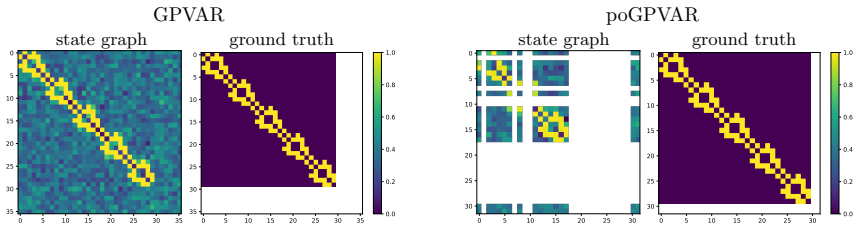
read the original abstract
State-space models effectively model multivariate time series by updating over time a representation of the system state from which predictions are made. The state representation is usually a vector without any explicit structure. Relational inductive biases, e.g., associated with dependencies among input signals and state representations, are not explicitly exploited during processing, leaving unattended opportunities for effective modeling. The manuscript aims to fill this gap by matching state-space modeling and spatio-temporal data where the relational information, say the functional graph capturing latent dependencies, is learned directly from time series. In particular, we propose Graph State-Space Models, a novel probabilistic framework that jointly learns state-space dynamics and latent relational structures end-to-end on downstream tasks. The proposed framework generalizes several state-of-the-art methods and, as we show, is effective in extracting meaningful latent relational structures and obtaining accurate forecasts.
Editorial analysis
A structured set of objections, weighed in public.
Referee Report
Summary. The manuscript proposes Graph State-Space Models (GSSMs), a novel probabilistic framework that jointly learns state-space dynamics and latent relational structures (functional graphs capturing dependencies among signals and states) end-to-end from multivariate time series for downstream tasks such as forecasting. It claims to generalize several state-of-the-art methods and demonstrates effectiveness in extracting meaningful latent graphs alongside accurate predictions.
Significance. If the joint learning and identifiability claims hold, the work would unify relational inductive biases with state-space modeling, offering a principled way to improve both forecast accuracy and interpretability on spatio-temporal data; the generalization of existing methods would be a notable strength if shown via explicit reductions or shared likelihoods.
major comments (2)
- [Abstract] Abstract: the central claim that a single static functional graph is both identifiable and jointly learnable with SSM dynamics from raw time series alone (without supervision or explicit constraints) is load-bearing for the entire framework, yet the provided description gives no derivation, likelihood term, or constraint that would rule out observational equivalence with multiple distinct graphs or time-varying relations.
- [Abstract] Abstract: the generalization claim over several SOTA methods is stated without reference to specific models, shared functional forms, or limiting cases, making it impossible to assess whether the GSSM likelihood reduces to those methods or merely contains them as special cases.
minor comments (1)
- The abstract uses the phrase 'functional graph capturing latent dependencies' without defining the precise mathematical object (e.g., adjacency matrix, edge weights, or directed/undirected) or how it enters the state transition.
Simulated Author's Rebuttal
We thank the referee for their thoughtful comments. We address the two major comments on the abstract point by point below. Both concerns are valid regarding the level of detail in the abstract; we will revise the abstract accordingly while preserving its length constraints.
read point-by-point responses
-
Referee: [Abstract] Abstract: the central claim that a single static functional graph is both identifiable and jointly learnable with SSM dynamics from raw time series alone (without supervision or explicit constraints) is load-bearing for the entire framework, yet the provided description gives no derivation, likelihood term, or constraint that would rule out observational equivalence with multiple distinct graphs or time-varying relations.
Authors: The abstract is necessarily brief. The likelihood is defined in Section 3.1 as a joint distribution over observations, states, and a time-invariant adjacency matrix with a sparsity-inducing variational prior; identifiability of the static graph follows from the fixed-graph assumption and the end-to-end optimization that penalizes time-varying alternatives by construction (see also Appendix B). No additional supervision is used. We will add one sentence to the abstract referencing the static-graph constraint and the relevant section. revision: yes
-
Referee: [Abstract] Abstract: the generalization claim over several SOTA methods is stated without reference to specific models, shared functional forms, or limiting cases, making it impossible to assess whether the GSSM likelihood reduces to those methods or merely contains them as special cases.
Authors: We agree the abstract should be more precise. Section 4.1 explicitly shows that the GSSM likelihood recovers standard linear SSMs (by setting the graph to complete), graph neural ODEs (by taking the continuous-time limit), and certain latent graph models (by fixing the dynamics) as special cases. We will revise the abstract to name these three families and cite the relevant reductions. revision: yes
Circularity Check
No circularity detected; framework presented as end-to-end learning without self-referential reductions in provided text
full rationale
The abstract and available excerpts describe a proposed probabilistic framework for jointly learning state-space dynamics and latent relational structures from time series on downstream tasks. No equations, fitting procedures, self-citations, or derivation steps are exhibited that reduce a claimed prediction or result to its inputs by construction. The central claim of joint learning and generalization is presented as a modeling contribution rather than a mathematical identity or fitted renaming. Per rules, absence of quotable reductions to self-definition, fitted inputs called predictions, or load-bearing self-citation chains yields score 0. The identifiability assumption flagged in the skeptic note is a modeling risk, not a circularity in the derivation chain.
Axiom & Free-Parameter Ledger
Lean theorems connected to this paper
-
IndisputableMonolith/Cost/FunctionalEquation.leanwashburn_uniqueness_aczel unclear?
unclearRelation between the paper passage and the cited Recognition theorem.
We propose Graph State-Space Models, a novel probabilistic framework that jointly learns state-space dynamics and latent relational structures end-to-end on downstream tasks.
-
IndisputableMonolith/Foundation/RealityFromDistinction.leanreality_from_one_distinction unclear?
unclearRelation between the paper passage and the cited Recognition theorem.
The proposed framework generalizes several state-of-the-art methods and is effective in extracting meaningful latent relational structures
What do these tags mean?
- matches
- The paper's claim is directly supported by a theorem in the formal canon.
- supports
- The theorem supports part of the paper's argument, but the paper may add assumptions or extra steps.
- extends
- The paper goes beyond the formal theorem; the theorem is a base layer rather than the whole result.
- uses
- The paper appears to rely on the theorem as machinery.
- contradicts
- The paper's claim conflicts with a theorem or certificate in the canon.
- unclear
- Pith found a possible connection, but the passage is too broad, indirect, or ambiguous to say the theorem truly supports the claim.
Reference graph
Works this paper leans on
-
[1]
Intelligence for embedded systems, volume 89
Cesare Alippi. Intelligence for embedded systems, volume 89. Springer, 2014
work page 2014
-
[2]
A gentle introduction to deep learning for graphs
Davide Bacciu, Federico Errica, Alessio Micheli, and Marco Podda. A gentle introduction to deep learning for graphs. Neural Networks, 2020
work page 2020
-
[3]
Spectral clustering with graph neural networks for graph pooling
Filippo Maria Bianchi, Daniele Grattarola, and Cesare Alippi. Spectral clustering with graph neural networks for graph pooling. In International Conference on Machine Learning, pages 874--883. PMLR, 2020
work page 2020
-
[4]
Geometric deep learning: going beyond euclidean data
Michael M Bronstein, Joan Bruna, Yann LeCun, Arthur Szlam, and Pierre Vandergheynst. Geometric deep learning: going beyond euclidean data. IEEE Signal Processing Magazine, 34 0 (4): 0 18--42, 2017
work page 2017
-
[5]
Geometric Deep Learning: Grids, Groups, Graphs, Geodesics, and Gauges
Michael M Bronstein, Joan Bruna, Taco Cohen, and Petar Veli c kovi \'c . Geometric deep learning: Grids, groups, graphs, geodesics, and gauges. arXiv preprint arXiv:2104.13478, 2021
work page internal anchor Pith review Pith/arXiv arXiv 2021
-
[6]
Discovering governing equations from data by sparse identification of nonlinear dynamical systems
Steven L Brunton, Joshua L Proctor, and J Nathan Kutz. Discovering governing equations from data by sparse identification of nonlinear dynamical systems. Proceedings of the national academy of sciences, 113 0 (15): 0 3932--3937, 2016
work page 2016
-
[7]
Modern koopman theory for dynamical systems
Steven L Brunton, Marko Budi s i \'c , Eurika Kaiser, and J Nathan Kutz. Modern koopman theory for dynamical systems. arXiv preprint arXiv:2102.12086, 2021
-
[8]
Maximum correntropy kalman filter
Badong Chen, Xi Liu, Haiquan Zhao, and Jose C Principe. Maximum correntropy kalman filter. Automatica, 76: 0 70--77, 2017
work page 2017
-
[9]
Adaptive graph recurrent network for multivariate time series imputation
Yakun Chen, Zihao Li, Chao Yang, Xianzhi Wang, Guodong Long, and Guandong Xu. Adaptive graph recurrent network for multivariate time series imputation. In International Conference on Neural Information Processing, 2022
work page 2022
-
[10]
Cluster-based aggregate load forecasting with deep neural networks
Andrea Cini, Slobodan Lukovic, and Cesare Alippi. Cluster-based aggregate load forecasting with deep neural networks. In 2020 International Joint Conference on Neural Networks (IJCNN), pages 1--8. IEEE, 2020
work page 2020
-
[11]
Filling the g\_ap\_s: Multivariate time series imputation by graph neural networks
Andrea Cini, Ivan Marisca, and Cesare Alippi. Filling the g\_ap\_s: Multivariate time series imputation by graph neural networks. In International Conference on Learning Representations, 2021
work page 2021
-
[12]
Sparse graph learning for spatiotemporal time series, 2022
Andrea Cini, Daniele Zambon, and Cesare Alippi. Sparse graph learning for spatiotemporal time series, 2022. URL https://arxiv.org/abs/2205.13492
-
[13]
State-space network topology identification from partial observations
Mario Coutino, Elvin Isufi, Takanori Maehara, and Geert Leus. State-space network topology identification from partial observations. IEEE Transactions on Signal and Information Processing over Networks, 6: 0 211--225, 2020
work page 2020
-
[14]
Time series analysis by state space methods, volume 38
James Durbin and Siem Jan Koopman. Time series analysis by state space methods, volume 38. OUP Oxford, 2012
work page 2012
-
[15]
Neural message passing for quantum chemistry
Justin Gilmer, Samuel S Schoenholz, Patrick F Riley, Oriol Vinyals, and George E Dahl. Neural message passing for quantum chemistry. In Proceedings of the 34th International Conference on Machine Learning-Volume 70, pages 1263--1272. JMLR. org, 2017
work page 2017
-
[16]
Understanding pooling in graph neural networks
Daniele Grattarola, Daniele Zambon, Filippo Bianchi, and Cesare Alippi. Understanding pooling in graph neural networks. IEEE Transactions on Neural Networks and Learning Systems, pages 1--11, 2022. doi:10.1109/TNNLS.2022.3190922
-
[17]
Sepp Hochreiter and J \"u rgen Schmidhuber. Long short-term memory. Neural computation, 9 0 (8): 0 1735--1780, 1997
work page 1997
-
[18]
New results in linear filtering and prediction theory
Rudolph E Kalman and Richard S Bucy. New results in linear filtering and prediction theory. Journal of Basic Engineering, 83 0 (1): 0 95--108, 03 1961. ISSN 0021-9223. doi:10.1115/1.3658902. URL https://doi.org/10.1115/1.3658902
-
[19]
A new approach to linear filtering and prediction problems
Rudolph Emil Kalman. A new approach to linear filtering and prediction problems. Journal of Basic Engineering, 82 0 (1): 0 35--45, 03 1960. ISSN 0021-9223. doi:10.1115/1.3662552. URL https://doi.org/10.1115/1.3662552
-
[20]
Representation learning for dynamic graphs: A survey
Seyed Mehran Kazemi, Rishab Goel, Kshitij Jain, Ivan Kobyzev, Akshay Sethi, Peter Forsyth, and Pascal Poupart. Representation learning for dynamic graphs: A survey. J. Mach. Learn. Res., 21 0 (70): 0 1--73, 2020
work page 2020
-
[21]
Differentiable graph module (dgm) for graph convolutional networks
Anees Kazi, Luca Cosmo, Seyed-Ahmad Ahmadi, Nassir Navab, and Michael Bronstein. Differentiable graph module (dgm) for graph convolutional networks. IEEE Transactions on Pattern Analysis and Machine Intelligence, 2022
work page 2022
-
[22]
Neural relational inference for interacting systems
Thomas Kipf, Ethan Fetaya, Kuan-Chieh Wang, Max Welling, and Richard Zemel. Neural relational inference for interacting systems. In International Conference on Machine Learning, pages 2688--2697. PMLR, 2018
work page 2018
-
[23]
Diffusion convolutional recurrent neural network: Data-driven traffic forecasting
Yaguang Li, Rose Yu, Cyrus Shahabi, and Yan Liu. Diffusion convolutional recurrent neural network: Data-driven traffic forecasting. In International Conference on Learning Representations, 2018. URL https://openreview.net/forum?id=SJiHXGWAZ
work page 2018
-
[24]
Learning to reconstruct missing data from spatiotemporal graphs with sparse observations
Ivan Marisca, Andrea Cini, and Cesare Alippi. Learning to reconstruct missing data from spatiotemporal graphs with sparse observations. To appear in Advances in Neural Information Processing Systems, 2022
work page 2022
-
[25]
Monte carlo gradient estimation in machine learning
Shakir Mohamed, Mihaela Rosca, Michael Figurnov, and Andriy Mnih. Monte carlo gradient estimation in machine learning. Journal of Machine Learning Research, 21 0 (132): 0 1--62, 2020
work page 2020
-
[26]
Rnn with particle flow for probabilistic spatio-temporal forecasting
Soumyasundar Pal, Liheng Ma, Yingxue Zhang, and Mark Coates. Rnn with particle flow for probabilistic spatio-temporal forecasting. In International Conference on Machine Learning, pages 8336--8348. PMLR, 2021
work page 2021
-
[27]
Deepar: Probabilistic forecasting with autoregressive recurrent networks
David Salinas, Valentin Flunkert, Jan Gasthaus, and Tim Januschowski. Deepar: Probabilistic forecasting with autoregressive recurrent networks. International Journal of Forecasting, 36 0 (3): 0 1181--1191, 2020
work page 2020
-
[28]
Structured sequence modeling with graph convolutional recurrent networks
Youngjoo Seo, Micha \"e l Defferrard, Pierre Vandergheynst, and Xavier Bresson. Structured sequence modeling with graph convolutional recurrent networks. In International conference on neural information processing, pages 362--373. Springer, 2018
work page 2018
-
[29]
Ljubisa Stankovic, Danilo P Mandic, Milos Dakovic, Ilia Kisil, Ervin Sejdic, and Anthony G Constantinides. Understanding the basis of graph signal processing via an intuitive example-driven approach [lecture notes]. IEEE Signal Processing Magazine, 36 0 (6): 0 133--145, 2019
work page 2019
-
[30]
Dyrep: Learning representations over dynamic graphs
Rakshit Trivedi, Mehrdad Farajtabar, Prasenjeet Biswal, and Hongyuan Zha. Dyrep: Learning representations over dynamic graphs. In International Conference on Learning Representations, 2019. URL https://openreview.net/forum?id=HyePrhR5KX
work page 2019
-
[31]
Yuyang Wang, Alex Smola, Danielle Maddix, Jan Gasthaus, Dean Foster, and Tim Januschowski. Deep factors for forecasting. In International conference on machine learning, pages 6607--6617. PMLR, 2019
work page 2019
-
[32]
Graph wavenet for deep spatial-temporal graph modeling
Z Wu, S Pan, G Long, J Jiang, and C Zhang. Graph wavenet for deep spatial-temporal graph modeling. In The 28th International Joint Conference on Artificial Intelligence (IJCAI). International Joint Conferences on Artificial Intelligence Organization, 2019
work page 2019
-
[33]
Hierarchical graph representation learning with differentiable pooling
Zhitao Ying, Jiaxuan You, Christopher Morris, Xiang Ren, Will Hamilton, and Jure Leskovec. Hierarchical graph representation learning with differentiable pooling. In Advances in neural information processing systems, pages 4800--4810, 2018
work page 2018
-
[34]
Az-whiteness test: a test for uncorrelated noise on spatio-temporal graphs, 2022
Daniele Zambon and Cesare Alippi. Az-whiteness test: a test for uncorrelated noise on spatio-temporal graphs, 2022. URL https://arxiv.org/abs/2204.11135
discussion (0)
Sign in with ORCID, Apple, or X to comment. Anyone can read and Pith papers without signing in.