Perturbation-theory informed integrators for cosmological simulations
Pith reviewed 2026-05-24 10:13 UTC · model grok-4.3
The pith
Integrators derived by matching leapfrog steps to Lagrangian perturbation theory trajectories exactly recover the Zel'dovich solution in 1D and need fewer timesteps to match power spectra in 2D and 3D cosmological simulations.
A machine-rendered reading of the paper's core claim, the machinery that carries it, and where it could break.
Core claim
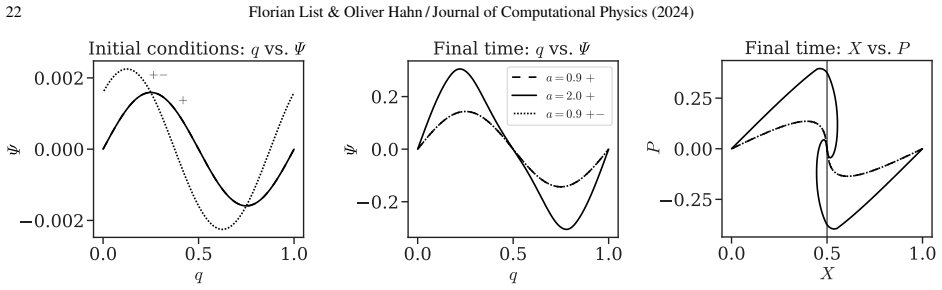
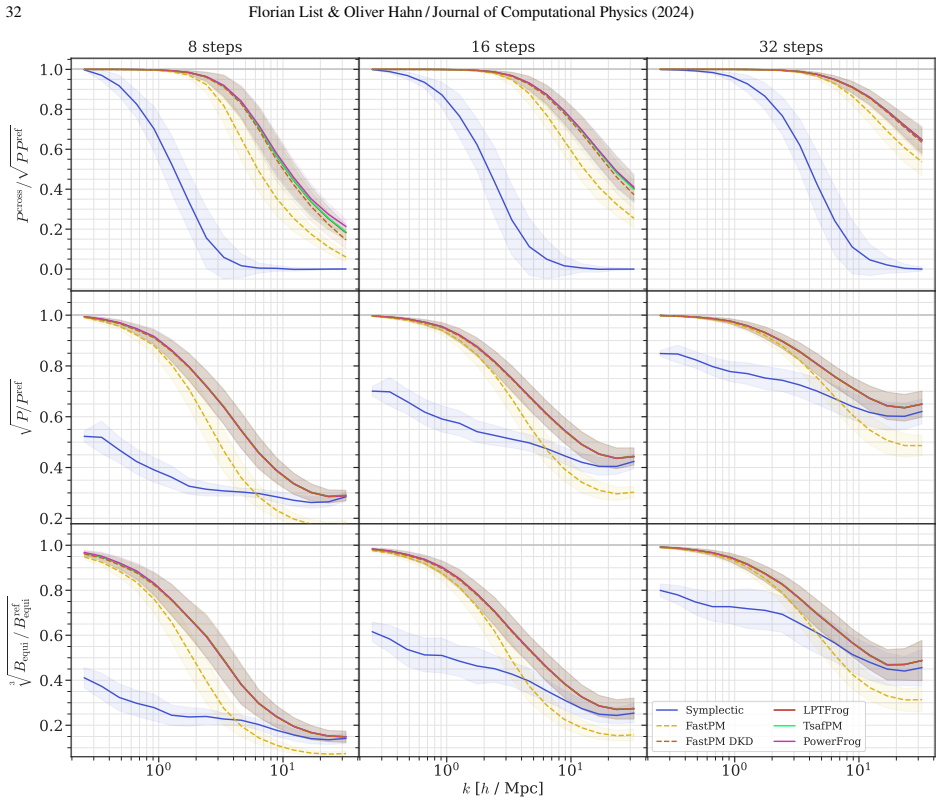
By equating the displacement produced by one Verlet drift-kick-drift step to the first-order Lagrangian perturbation theory displacement, a family of integrators is obtained that yields the exact Zel'dovich solution in one dimension before shell crossing. In higher dimensions these integrators require fewer timesteps than conventional or FastPM methods to reach a given accuracy in the power spectrum and bispectrum for fast approximate simulations with O(1-100) steps. Post-shell-crossing convergence is limited to order 3/2 for any integrator because the acceleration field is not sufficiently regular, and symplecticity plays only a secondary role when the number of timesteps is small.
What carries the argument
The LPT-matching condition that sets the coefficients of a single drift-kick-drift step so its displacement equals the Lagrangian perturbation theory prediction.
If this is right
- The schemes exactly reproduce the analytic Zel'dovich solution in one-dimensional pre-shell-crossing collapse.
- Fewer timesteps suffice to match power spectrum and bispectrum accuracy in two- and three-dimensional fast simulations.
- Convergence order after shell crossing is capped at 3/2 for any integrator because the acceleration field lacks higher regularity.
- Symplecticity has only minor effect on accuracy when the timestep count is small.
- Timestep spacing and the presence of a decaying mode in the initial conditions both affect the achieved accuracy.
Where Pith is reading between the lines
- The same matching idea could be applied to second-order Lagrangian perturbation theory to extend the accurate regime deeper into the nonlinear regime.
- Hybrid integrators that switch from LPT-matched steps to conventional steps after shell crossing could mitigate the 3/2-order limit.
- The reduced importance of symplecticity suggests that energy conservation is secondary to local trajectory accuracy when only a handful of steps are affordable.
- Adaptive choice of timestep spacing guided by the local LPT error estimate might further lower the step count needed for a target accuracy.
Load-bearing premise
That matching trajectories in one isolated step to first-order perturbation theory still improves global statistics such as power spectra once the simulation enters the mildly nonlinear regime in two or three dimensions.
What would settle it
A controlled 3D N-body run with exactly ten timesteps that directly compares the power-spectrum error of the new LPT-matched integrator against FastPM at identical step count and initial conditions.
Figures





read the original abstract
Large-scale cosmological simulations are an indispensable tool for modern cosmology. To enable model-space exploration, fast and accurate predictions are critical. In this paper, we show that the performance of such simulations can be further improved with time-stepping schemes that use input from cosmological perturbation theory. Specifically, we introduce a class of time-stepping schemes derived by matching the particle trajectories in a single leapfrog/Verlet drift-kick-drift step to those predicted by Lagrangian perturbation theory (LPT). As a corollary, these schemes exactly yield the analytic Zel'dovich solution in 1D in the pre-shell-crossing regime (i.e. before particle trajectories cross). One representative of this class is the popular FastPM scheme by Feng et al. 2016, which we take as our baseline. We then construct more powerful LPT-inspired integrators and show that they outperform FastPM and standard integrators in fast simulations in two and three dimensions with $\mathcal{O}(1 - 100)$ timesteps, requiring less steps to accurately reproduce the power spectrum and bispectrum of the density field. Furthermore, we demonstrate analytically and numerically that, for any integrator, convergence is limited in the post-shell-crossing regime (to order 3/2 for planar wave collapse), owing to the lacking regularity of the acceleration field, which makes the use of high-order integrators in this regime futile. Also, we study the impact of the timestep spacing and of a decaying mode present in the initial conditions. Importantly, we find that symplecticity of the integrator plays a minor role for fast approximate simulations with a small number of timesteps.
Editorial analysis
A structured set of objections, weighed in public.
Referee Report
Summary. The manuscript introduces a class of time-stepping integrators for cosmological N-body simulations derived by matching the particle trajectories in a single drift-kick-drift Verlet step to those from Lagrangian perturbation theory (LPT). It shows that these schemes exactly reproduce the Zel'dovich solution in one dimension before shell-crossing. Building on FastPM as a baseline, the authors construct improved variants and demonstrate through 2D and 3D simulations that they require fewer timesteps to accurately match the power spectrum and bispectrum compared to standard leapfrog or FastPM. Additionally, they argue analytically and numerically that convergence is limited to order 3/2 post-shell-crossing due to the irregularity of the acceleration field, rendering high-order integrators ineffective in that regime, and find that symplecticity plays a minor role for simulations with small timestep counts.
Significance. If the reported performance improvements hold, this provides a principled route to more efficient approximate cosmological simulations for model-space exploration. The exact 1D pre-shell-crossing match to Zel'dovich and the analytic/numeric demonstration of the post-shell-crossing convergence limit (order 3/2 for planar collapse) are clear strengths that add both practical value and theoretical insight. The observation that symplecticity is secondary for low-timestep runs challenges standard assumptions in the integrator literature.
major comments (2)
- [sections presenting 2D/3D numerical experiments] The central performance claim—that the new LPT-informed integrators outperform FastPM and standard leapfrog for P(k) and B(k) in 2D/3D with O(1–100) timesteps—depends on the assumption that single-step first-order LPT trajectory matching remains advantageous once the simulation enters the mildly nonlinear regime. The numerical tests must include explicit convergence plots versus timestep number and direct comparisons against runs that incorporate higher-order LPT corrections to confirm the benefit survives.
- [analytic and numeric post-shell-crossing convergence discussion] The analytic argument that any integrator is limited to order-3/2 convergence post-shell-crossing (due to lacking regularity of the acceleration field) is load-bearing for the recommendation against high-order schemes in that regime; the manuscript should state the precise regularity assumption on the force field and confirm that the proposed integrators obey the same bound in the planar-wave test.
minor comments (2)
- The study of timestep spacing and the impact of a decaying mode in the initial conditions is mentioned but would benefit from dedicated quantitative figures or tables showing the sensitivity of the reported gains.
- [methods section] Notation for the drift-kick-drift operators and the specific LPT order used in each integrator variant should be made fully explicit in the methods section to aid reproducibility.
Simulated Author's Rebuttal
We thank the referee for their positive evaluation and constructive feedback. We address each major comment below. Where the suggestions strengthen the manuscript without altering its core claims, we will incorporate revisions.
read point-by-point responses
-
Referee: [sections presenting 2D/3D numerical experiments] The central performance claim—that the new LPT-informed integrators outperform FastPM and standard leapfrog for P(k) and B(k) in 2D/3D with O(1–100) timesteps—depends on the assumption that single-step first-order LPT trajectory matching remains advantageous once the simulation enters the mildly nonlinear regime. The numerical tests must include explicit convergence plots versus timestep number and direct comparisons against runs that incorporate higher-order LPT corrections to confirm the benefit survives.
Authors: We agree that explicit convergence plots versus timestep number would improve clarity. In the revised version we will add these for the 2D and 3D power-spectrum and bispectrum errors, comparing our LPT-matched integrators directly to FastPM and leapfrog across O(1–100) steps. On higher-order LPT corrections: our schemes are constructed by matching to first-order LPT within a single Verlet step; FastPM is likewise first-order. The reported gains are therefore relative to an equivalent baseline. Incorporating higher-order LPT into the force evaluation would change the underlying simulation rather than test the integrator. We will add a clarifying paragraph noting this scope and confirming that the advantage is demonstrated within the first-order LPT framework used throughout the paper. This constitutes a partial revision. revision: partial
-
Referee: [analytic and numeric post-shell-crossing convergence discussion] The analytic argument that any integrator is limited to order-3/2 convergence post-shell-crossing (due to lacking regularity of the acceleration field) is load-bearing for the recommendation against high-order schemes in that regime; the manuscript should state the precise regularity assumption on the force field and confirm that the proposed integrators obey the same bound in the planar-wave test.
Authors: The manuscript already derives the 3/2-order bound from the fact that the acceleration field is continuous but not differentiable across the shell-crossing surface in planar collapse. We will revise the analytic section to state the regularity assumption explicitly (acceleration belongs to C^0 but not C^1). We will also add a sentence confirming that the numerical convergence rate measured for our integrators in the planar-wave test saturates at the same 3/2 order, consistent with the bound applying to any integrator. This is a clarification of existing content. revision: yes
Circularity Check
No significant circularity: derivations anchored in external LPT and standard Verlet structure
full rationale
The paper constructs integrators by matching single D-K-D leapfrog trajectories to external Lagrangian perturbation theory (LPT) solutions, with FastPM (Feng et al. 2016) as an explicit baseline from other authors. The 1D pre-shell-crossing exact match to the Zel'dovich solution follows directly from using first-order LPT as the target, which is stated as a corollary rather than a novel prediction. Numerical tests of power/bispectrum accuracy in 2D/3D with O(1-100) steps are empirical validations against simulations, not reductions by construction. No parameters are fitted to data and then relabeled as predictions; no load-bearing self-citations appear; no uniqueness theorems or ansatzes are imported from the authors' prior work. The central claims remain independent of the paper's own inputs.
Axiom & Free-Parameter Ledger
axioms (2)
- domain assumption Lagrangian perturbation theory supplies accurate particle trajectories in the pre-shell-crossing regime
- domain assumption The acceleration field loses sufficient regularity after shell-crossing to limit convergence order to 3/2 for planar collapse
Reference graph
Works this paper leans on
-
[1]
FastPM: a new scheme for fast simulations of dark matter and halos
Y. Feng, M.-Y. Chu, U. Seljak, P. McDonald, FastPM: A new scheme for fast simulations of dark matter and haloes, Monthly Notices of the Royal Astronomical Society 463 (3) (2016) 2273–2286.arXiv:1603.00476, doi:10.1093/mnras/stw2123
work page internal anchor Pith review Pith/arXiv arXiv doi:10.1093/mnras/stw2123 2016
-
[2]
R. E. Angulo, O. Hahn, Large-scale dark matter simulations, Living Reviews in Computational Astrophysics 8 (1) (2022) 1.arXiv: 2112.05165, doi:10.1007/s41115-021-00013-z
-
[3]
P. Peebles, The Large-scale Structure of the Universe, Princeton Series in Physics, Princeton University Press, 1980
work page 1980
-
[4]
Time stepping N-body simulations
T. Quinn, N. Katz, J. Stadel, G. Lake, Time stepping N-body simulations, PreprintarXiv:astro-ph/9710043
work page internal anchor Pith review Pith/arXiv arXiv
-
[5]
The cosmological simulation code GADGET-2
V.Springel,ThecosmologicalsimulationcodeGADGET-2,MonthlyNoticesoftheRoyalAstronomicalSociety364(4)(2005)1105–1134. arXiv:astro-ph/0505010, doi:10.1111/j.1365-2966.2005.09655.x
work page internal anchor Pith review Pith/arXiv arXiv doi:10.1111/j.1365-2966.2005.09655.x 2005
-
[6]
R.Laureijs,J.Amiaux,S.Arduini,J.-L.Augueres,J.Brinchmann,R.Cole,M.Cropper,C.Dabin,L.Duvet,A.Ealet,etal.,Eucliddefinition study report, PreprintarXiv:1110.3193
work page internal anchor Pith review Pith/arXiv arXiv
-
[7]
LSST: from Science Drivers to Reference Design and Anticipated Data Products
Ž. Ivezić, S. M. Kahn, J. A. Tyson, B. Abel, E. Acosta, R. Allsman, D. Alonso, Y. AlSayyad, S. F. Anderson, J. Andrew, et al., LSST: from science drivers to reference design and anticipated data products, The Astrophysical Journal 873 (2) (2019) 111.arXiv:0805.2366
work page internal anchor Pith review Pith/arXiv arXiv 2019
-
[8]
Wide-Field InfraRed Survey Telescope (WFIRST) Final Report
J. Green, P. Schechter, C. Baltay, R. Bean, D. Bennett, R. Brown, C. Conselice, M. Donahue, X. Fan, B. Gaudi, et al., Wide-field infrared survey telescope (WFIRST) final report, PreprintarXiv:1208.4012
work page internal anchor Pith review Pith/arXiv arXiv
-
[9]
PKDGRAV3: Beyond Trillion Particle Cosmological Simulations for the Next Era of Galaxy Surveys
D. Potter, J. Stadel, R. Teyssier, PKDGRAV3: beyond trillion particle cosmological simulations for the next era of galaxy surveys, Computational Astrophysics and Cosmology 4 (1) (2017) 2.arXiv:1609.08621, doi:10.1186/s40668-017-0021-1
work page internal anchor Pith review Pith/arXiv arXiv doi:10.1186/s40668-017-0021-1 2017
-
[10]
N. A. Maksimova, L. H. Garrison, D. J. Eisenstein, B. Hadzhiyska, S. Bose, T. P. Satterthwaite, AbacusSummit: a massive set of high- accuracy, high-resolution N-body simulations, Monthly Notices of the Royal Astronomical Society 508 (3) (2021) 4017–4037.arXiv: 2110.11398, doi:10.1093/mnras/stab2484
-
[11]
HACC: Simulating Sky Surveys on State-of-the-Art Supercomputing Architectures
S. Habib, A. Pope, H. Finkel, N. Frontiere, K. Heitmann, D. Daniel, P. Fasel, V. Morozov, G. Zagaris, T. Peterka, et al., HACC: Simulating sky surveys on state-of-the-art supercomputing architectures, New Astronomy 42 (2016) 49–65.arXiv:1410.2805
work page internal anchor Pith review Pith/arXiv arXiv 2016
-
[12]
K. Heitmann, T. D. Uram, H. Finkel, N. Frontiere, S. Habib, A. Pope, E. Rangel, J. Hollowed, D. Korytov, P. Larsen, et al., HACC Cosmological Simulations: First Data Release, The Astrophysical Journal Supplement Series 244 (1) (2019) 17.arXiv:1904.11966
-
[13]
J. D. Emberson, H.-R. Yu, D. Inman, T.-J. Zhang, U.-L. Pen, J. Harnois-Déraps, S. Yuan, H.-Y. Teng, H.-M. Zhu, X. Chen, Z.-Z. Xing, Cosmological neutrino simulations at extreme scale, Research in Astronomy and Astrophysics 17 (8) (2017) 085.arXiv:1311.6130, doi:10.1088/1674-4527/17/8/85
work page internal anchor Pith review Pith/arXiv arXiv doi:10.1088/1674-4527/17/8/85 2017
-
[14]
T.Ishiyama,F.Prada,A.A.Klypin,M.Sinha,R.B.Metcalf,E.Jullo,B.Altieri,S.A.Cora,D.Croton,S.DeLaTorre,D.E.Millán-Calero, T. Oogi, J. Ruedas, C. A. Vega-Martínez, The Uchuu simulations: Data Release 1 and dark matter halo concentrations, Monthly Notices of the Royal Astronomical Society 506 (3) (2021) 4210–4231.arXiv:2007.14720, doi:10.1093/mnras/stab1755
-
[15]
J. S. Bagla, TreePM: A Code for Cosmological N-Body Simulations, Journal of Astrophysics and Astronomy 23 (2002) 185–196.arXiv: astro-ph/9911025, doi:10.1007/BF02702282
work page internal anchor Pith review Pith/arXiv arXiv doi:10.1007/bf02702282 2002
-
[16]
J. Barnes, P. Hut, A hierarchical O(N log N) force-calculation algorithm, Nature 324 (6096) (1986) 446–449.doi:10.1038/324446a0
-
[17]
A. W. Appel, An Efficient Program for Many-Body Simulation, SIAM Journal on Scientific and Statistical Computing 6 (1) (1985) 85–103
work page 1985
-
[18]
T. Darden, D. York, L. Pedersen, Particle mesh Ewald: An N log(N) method for Ewald sums in large systems, Journal of Computational Physics 98 (12) (1993) 10089–10092.doi:10.1063/1.464397
-
[19]
L. Greengard, V. Rokhlin, A Fast Algorithm for Particle Simulations, Journal of Computational Physics 73 (2) (1987) 325–348.doi: 10.1016/0021-9991(87)90140-9
-
[20]
R. Hockney, J. Eastwood, Computer Simulation Using Particles, Taylor & Francis, 1988
work page 1988
-
[21]
O. Hahn, T. Abel, R. Kaehler, A new approach to simulating collisionless dark matter fluids, Monthly Notices of the Royal Astronomical Society 434 (2) (2013) 1171–1191.arXiv:1210.6652, doi:10.1093/mnras/stt1061
work page internal anchor Pith review Pith/arXiv arXiv doi:10.1093/mnras/stt1061 2013
-
[22]
M. Michaux, O. Hahn, C. Rampf, R. E. Angulo, Accurate initial conditions for cosmological N-body simulations: minimizing truncation anddiscretenesserrors,MonthlyNoticesoftheRoyalAstronomicalSociety500(1)(2021)663–683. arXiv:2008.09588, doi:10.1093/ mnras/staa3149
-
[23]
S. Colombi, Phase-space structure of protohalos: Vlasov versus particle-mesh, Astronomy and Astrophysics 647 (2021) A66.arXiv: 2012.04409, doi:10.1051/0004-6361/202039719
-
[24]
Hayli, The method of the doubly individual step for N-body computations., in: D
A. Hayli, The method of the doubly individual step for N-body computations., in: D. Bettis (Ed.), Proceedings of the Conference on the Numerical Solution of Ordinary Differential Equations. Lecture Notes in Mathematics, Springer, Berlin, Heidelberg, 1974, pp. 304–312. doi:10.1007/BFb0066598
-
[25]
S. L. W. McMillan, The Vectorization of Small-N Integrators, in: P. Hut, S. L. W. McMillan (Eds.), The Use of Supercomputers in Stellar Dynamics, Vol. 267, Springer, Berlin, Heidelberg, New York, 1986, p. 156.doi:10.1007/BFb0116406
-
[26]
Y. B. Zel’dovich, Gravitational instability: An approximate theory for large density perturbations., Astronomy and Astrophysics 5 (1970) 84–89
work page 1970
-
[27]
B.Marcos,T.Baertschiger,M.Joyce,A.Gabrielli,F.SylosLabini,LinearperturbativetheoryofthediscretecosmologicalN-bodyproblem, Physical Review D 73 (10) (2006) 103507.arXiv:astro-ph/0601479, doi:10.1103/PhysRevD.73.103507
work page internal anchor Pith review Pith/arXiv arXiv doi:10.1103/physrevd.73.103507 2006
-
[28]
M. Joyce, B. Marcos, T. Baertschiger, Towards quantitative control on discreteness error in the non-linear regime of cosmological N- body simulations, Monthly Notices of the Royal Astronomical Society 394 (2) (2009) 751–773.arXiv:0805.1357, doi:10.1111/j. 1365-2966.2008.14290.x. 5https://github.com/DifferentiableUniverseInitiative/jax_cosmo 6https://pypi....
work page internal anchor Pith review Pith/arXiv arXiv doi:10.1111/j 2009
-
[29]
J. Jasche, G. Lavaux, Physical Bayesian modelling of the non-linear matter distribution: New insights into the nearby universe, Astronomy and Astrophysics 625 (2019) A64.arXiv:1806.11117, doi:10.1051/0004-6361/201833710. URL https://www.aanda.org/10.1051/0004-6361/201833710
work page internal anchor Pith review Pith/arXiv arXiv doi:10.1051/0004-6361/201833710 2019
-
[30]
The frontier of simulation-based inference
K. Cranmer, J. Brehmer, G. Louppe, The frontier ofsimulation-based inference, Proceedings of the NationalAcademy of Sciences 117 (48) (2020) 30055–30062.arXiv:1911.01429, doi:10.1073/pnas.1912789117. URL https://pnas.org/doi/full/10.1073/pnas.1912789117
-
[31]
C. Modi, F. Lanusse, U. Seljak, FlowPM: Distributed TensorFlow implementation of the FastPM cosmological N-body solver, Astronomy and Computing 37 (2021) 100505.arXiv:2010.11847, doi:10.1016/j.ascom.2021.100505. URL https://linkinghub.elsevier.com/retrieve/pii/S2213133721000597
- [32]
-
[33]
F. Villaescusa-Navarro, C. Hahn, E. Massara, A. Banerjee, A. M. Delgado, D. K. Ramanah, T. Charnock, E. Giusarma, Y. Li, E. Allys, A. Brochard, C. Uhlemann, C.-T. Chiang, S. He, A. Pisani, A. Obuljen, Y. Feng, E. Castorina, G. Contardo, C. D. Kreisch, A. Nicola, J. Alsing, R. Scoccimarro, L. Verde, M. Viel, S. Ho, S. Mallat, B. Wandelt, D. N. Spergel, The...
-
[34]
F. Villaescusa-Navarro, D. Anglés-Alcázar, S. Genel, D. N. Spergel, R. S. Somerville, R. Dave, A. Pillepich, L. Hernquist, D. Nelson, P. Torrey, D. Narayanan, Y. Li, O. Philcox, V. La Torre, A. M. Delgado, S. Ho, S. Hassan, B. Burkhart, D. Wadekar, N. Battaglia, G. Contardo, The CAMELS project: Cosmology and Astrophysics with MachinE Learning Simulations,...
-
[35]
C.Rampf,U.Frisch,O.Hahn,Unveilingthesingulardynamicsinthecosmiclarge-scalestructure,MonthlyNoticesoftheRoyalAstronomical Society 505 (1) (2021) L90–L94.arXiv:1912.00868, doi:10.1093/mnrasl/slab053
-
[36]
Arnold, Mathematical methods of classical mechanics, Vol
V. Arnold, Mathematical methods of classical mechanics, Vol. 60, Springer, 1989
work page 1989
-
[37]
T. Abel, O. Hahn, R. Kaehler, Tracing the dark matter sheet in phase space, Monthly Notices of the Royal Astronomical Society 427 (1) (2012) 61–76.arXiv:1111.3944, doi:10.1111/j.1365-2966.2012.21754.x
work page internal anchor Pith review Pith/arXiv arXiv doi:10.1111/j.1365-2966.2012.21754.x 2012
-
[38]
A. G. Doroshkevich, V. S. Ryaben’kii, S. F. Shandarin, Nonlinear theory of the development of potential perturbations, Astrophysics 9 (2) (1973) 144–153.doi:10.1007/BF01011421
-
[39]
A Convenient Set of Comoving Cosmological Variables and Their Application
H. Martel, P. R. Shapiro, A convenient set of comoving cosmological variables and their application, Monthly Notices of the Royal Astronomical Society 297 (2) (1998) 467–485.arXiv:astro-ph/9710119, doi:10.1046/j.1365-8711.1998.01497.x
work page internal anchor Pith review Pith/arXiv arXiv doi:10.1046/j.1365-8711.1998.01497.x 1998
-
[40]
T.Buchert,J.Ehlers,LagrangiantheoryofgravitationalinstabilityofFriedman-Lemaitrecosmologies–second-orderapproach: animproved model for non-linear clustering, Monthly Notices of the Royal Astronomical Society 264 (1993) 375–387.doi:10.1093/mnras/264.2. 375
-
[41]
F. R. Bouchet, S. Colombi, E. Hivon, R. Juszkiewicz, Perturbative Lagrangian approach to gravitational instability., Astronomy and Astrophysics 296 (1995) 575.arXiv:astro-ph/9406013
work page internal anchor Pith review Pith/arXiv arXiv 1995
-
[42]
The recursion relation in Lagrangian perturbation theory
C.Rampf,TherecursionrelationinLagrangianperturbationtheory,JournalofCosmologyandAstroparticlePhysics2012(12)(2012)004. arXiv:1205.5274, doi:10.1088/1475-7516/2012/12/004
work page internal anchor Pith review Pith/arXiv arXiv doi:10.1088/1475-7516/2012/12/004 2012
-
[43]
C. Rampf, Cosmological Vlasov-Poisson equations for dark matter, Reviews of Modern Plasma Physics 5 (1) (2021) 10.doi:10.1007/ s41614-021-00055-z
work page 2021
-
[44]
C. Rampf, S. O. Schobesberger, O. Hahn, Analytical growth functions for cosmic structures in aΛCDM Universe, Monthly Notices of the Royal Astronomical Society 516 (2) (2022) 2840–2850.arXiv:2205.11347, doi:10.1093/mnras/stac2406. URL http://arxiv.org/abs/2205.11347
-
[45]
A. D. Chernin, D. I. Nagirner, S. V. Starikova, Growth rate of cosmological perturbations in standard model: Explicit analytical solution, Astronomy and Astrophysics 399 (2003) 19–21.arXiv:astro-ph/0110107, doi:10.1051/0004-6361:20021763
work page internal anchor Pith review Pith/arXiv arXiv doi:10.1051/0004-6361:20021763 2003
-
[46]
Evolution of density perturbations in a realistic universe
M. Demianski, Z. A. Golda, A. Woszczyna, Evolution of density perturbations in a realistic universe, General Relativity and Gravitation 37 (12) (2005) 2063–2082.arXiv:gr-qc/0504089, doi:10.1007/s10714-005-0180-2
work page internal anchor Pith review Pith/arXiv arXiv doi:10.1007/s10714-005-0180-2 2005
-
[47]
R. D. Skeel, D. J. Hardy, Practical construction of modified hamiltonians, SIAM J. Sci. Comput. 23 (4) (2001) 1172–1188.doi: 10.1137/S106482750138318X
-
[48]
E. Hairer, M. Hochbruck, A. Iserles, C. Lubich, Geometric numerical integration, Oberwolfach Reports 3 (1) (2006) 805–882.doi: 10.14760/OWR-2006-14
-
[49]
H. Yoshida, Construction of higher order symplectic integrators, Physics Letters A 150 (5-7) (1990) 262–268. doi:10.1016/ 0375-9601(90)90092-3
work page 1990
-
[50]
R. I. McLachlan, M. Perlmutter, G. Quispel, On the nonlinear stability of symplectic integrators, BIT Numer. Math. 44 (2004) 99–117. doi:10.1023/B:BITN.0000025088.13092.7f
-
[51]
Shang, Kam theorem of symplectic algorithms for hamiltonian systems, Numer
Z.-j. Shang, Kam theorem of symplectic algorithms for hamiltonian systems, Numer. Math. 83 (1999) 477–496. doi:10.1007/ s002110050460
work page 1999
-
[52]
A. N. Kolmogorov, On conservation of conditionally periodic motions for a small change in hamilton’s function, in: Dokl. Akad. Nauk SSSR, Vol. 98, 1954, pp. 527–530
work page 1954
-
[53]
Moser, On invariant curves of area-preserving mappings of an annulus, Nachr
J. Moser, On invariant curves of area-preserving mappings of an annulus, Nachr. Akad. Wiss. Göttingen, II (1962) 1–20
work page 1962
-
[54]
V.I.Arnol’d,Proofofatheoremofa.n.kolmogorovontheinvarianceofquasi-periodicmotionsundersmallperturbationsofthehamiltonian, Russ. Math. Surv. 18 (5) (1963) 9.doi:10.1070/RM1963v018n05ABEH004130. URL https://dx.doi.org/10.1070/RM1963v018n05ABEH004130
-
[55]
W. Magnus, On the exponential solution of differential equations for a linear operator, Communications on Pure and Applied Mathematics 7 (4) (1954) 649–673.doi:10.1002/cpa.3160070404
-
[56]
The Magnus expansion and some of its applications
S. Blanes, F. Casas, J. A. Oteo, J. Ros, The Magnus expansion and some of its applications, Physics Reports 470 (5-6) (2009) 151–238. arXiv:0810.5488, doi:10.1016/j.physrep.2008.11.001
work page internal anchor Pith review Pith/arXiv arXiv doi:10.1016/j.physrep.2008.11.001 2009
-
[57]
Kolmogorov, On the notion of mean, Selected works of AN Kolmogorov 25 (1991) 144–146
A. Kolmogorov, On the notion of mean, Selected works of AN Kolmogorov 25 (1991) 144–146
work page 1991
-
[58]
R. Teyssier, Cosmological hydrodynamics with adaptive mesh refinement: A new high resolution code called RAMSES, Astronomy and Florian List & Oliver Hahn/Journal of Computational Physics (2024) 39 Astrophysics 385 (1) (2002) 337–364.arXiv:0111367, doi:10.1051/0004-6361:20011817
-
[59]
J. E. Campbell, On a law of combination of operators, Proc. London Math. Soc. 29 (1897) 14–32
-
[60]
H. F. Baker, Alternant and continuous groups, Proc. London Math. Soc. 3 (1905) 24–47
work page 1905
-
[61]
Hausdorff, Die symbolische Exponentialformel in der Gruppentheorie, Leipziger Ber
F. Hausdorff, Die symbolische Exponentialformel in der Gruppentheorie, Leipziger Ber. 58 (1906) 19–48
work page 1906
-
[62]
S. A. Chin, C.-R. Chen, Fourth order gradient symplectic integrator methods for solving the time-dependent Schrödinger equation, The Journal of Chemical Physics 114 (17) (2001) 7338–7341
work page 2001
- [63]
-
[64]
J. Candy, W. Rozmus, A Symplectic Integration Algorithm for Separable Hamiltonian Functions, Journal of Computational Physics 92 (1) (1991) 230–256.doi:10.1016/0021-9991(91)90299-Z
-
[65]
A. Taruya, S. Colombi, Post-collapse perturbation theory in 1D cosmology - beyond shell-crossing, Monthly Notices of the Royal Astro- nomical Society 470 (4) (2017) 4858–4884.doi:10.1093/MNRAS/STX1501
-
[66]
A.L.Melott,S.F.Shandarin,Gravitationalinstabilitywithhighresolution,TheAstrophysicalJournal343(1989)26. doi:10.1086/167681. URL http://adsabs.harvard.edu/doi/10.1086/167681
-
[67]
S.Tassev,M.Zaldarriaga,D.J.Eisenstein,SolvinglargescalestructureinteneasystepswithCOLA,JournalofCosmologyandAstroparticle Physics 2013 (6) (2013) 036.arXiv:1301.0322, doi:10.1088/1475-7516/2013/06/036
work page internal anchor Pith review Pith/arXiv arXiv doi:10.1088/1475-7516/2013/06/036 2013
-
[68]
L-PICOLA: A parallel code for fast dark matter simulation
C. Howlett, M. Manera, W. J. Percival, L-PICOLA: A parallel code for fast dark matter simulation, Astronomy and Computing 12 (2015) 109–126.arXiv:1506.03737
work page internal anchor Pith review Pith/arXiv arXiv 2015
-
[69]
sCOLA: The N-body COLA Method Extended to the Spatial Domain
S. Tassev, D. J. Eisenstein, B. D. Wandelt, M. Zaldarriaga, sCOLA: The N-body COLA Method Extended to the Spatial Domain, Preprint arXiv:1502.07751
work page internal anchor Pith review Pith/arXiv arXiv
-
[70]
ICE-COLA: Towards fast and accurate synthetic galaxy catalogues optimizing a quasi $N$-body method
A. Izard, M. Crocce, P. Fosalba, ICE-COLA: Towards fast and accurate synthetic galaxy catalogues optimizing a quasi-N-body method, Monthly Notices of the Royal Astronomical Society 459 (3) (2016) 2327–2341.arXiv:1509.04685, doi:10.1093/mnras/stw797
work page internal anchor Pith review Pith/arXiv arXiv doi:10.1093/mnras/stw797 2016
-
[71]
J. Koda, C. Blake, F. Beutler, E. Kazin, F. Marin, Fast and accurate mock catalogue generation for low-mass galaxies, Monthly Notices of the Royal Astronomical Society 459 (2) (2016) 2118–2129.arXiv:1507.05329, doi:10.1093/mnras/stw763
work page internal anchor Pith review Pith/arXiv arXiv doi:10.1093/mnras/stw763 2016
-
[72]
C. Rampf, O. Hahn, Shell-crossing in aΛcDM Universe, Monthly Notices of the Royal Astronomical Society Letters 501 (1) (2021) L71–L75.doi:10.1093/mnrasl/slaa198
-
[73]
A. E. Bayer, A. Banerjee, Y. Feng, A fast particle-mesh simulation of non-linear cosmological structure formation with massive neutrinos, Journal of Cosmology and Astroparticle Physics 2021 (01) (2021) 016.doi:10.1088/1475-7516/2021/01/016
-
[74]
Y. Brenier, U. Frisch, M. Hénon, G. Loeper, S. Matarrese, R. Mohayaee, A. Sobolevskiˇı, Reconstruction of the early Universe as a convex optimization problem, Monthly Notices of the Royal Astronomical Society 346 (2) (2003) 501–524.arXiv:0304214, doi: 10.1046/j.1365-2966.2003.07106.x
-
[75]
M. McQuinn, M. White, Cosmological perturbation theory in 1+ 1 dimensions, Journal of Cosmology and Astroparticle Physics 2016 (01) (2016) 043. doi:10.1088/1475-7516/2016/01/043
-
[76]
G. F. Corliss, Integrating ODEs in the complex plane—pole vaulting, Mathematics of Computation 35 (152) (1980) 1181–1189
work page 1980
-
[77]
J. E. Chambers, Symplectic Integrators with Complex Time Steps, The Astronomical Journal 126 (2) (2003) 1119–1126.doi:10.1086/ 376844
work page 2003
-
[78]
A critical look at cosmological perturbation theory techniques
J. Carlson, M. White, N. Padmanabhan, Critical look at cosmological perturbation theory techniques, Physical Review D 80 (4) (2009) 043531. arXiv:0905.0479, doi:10.1103/PhysRevD.80.043531
work page internal anchor Pith review Pith/arXiv arXiv doi:10.1103/physrevd.80.043531 2009
-
[79]
A.Klypin,F.Prada,Darkmatterstatisticsforlargegalaxycatalogues: Powerspectraandcovariancematrices,MonthlyNoticesoftheRoyal Astronomical Society 478 (4) (2018) 4602–4621.arXiv:1701.05690, doi:10.1093/mnras/sty1340
work page internal anchor Pith review Pith/arXiv arXiv doi:10.1093/mnras/sty1340 2018
-
[80]
M. Pietroni, Structure formation beyond shell-crossing: Nonperturbative expansions and late-time attractors, Journal of Cosmology and Astroparticle Physics 2018 (6).arXiv:1804.09140, doi:10.1088/1475-7516/2018/06/028
work page internal anchor Pith review Pith/arXiv arXiv doi:10.1088/1475-7516/2018/06/028 2018
discussion (0)
Sign in with ORCID, Apple, or X to comment. Anyone can read and Pith papers without signing in.