Observation of 2D Weyl Fermion States in Epitaxial Bismuthene
Pith reviewed 2026-05-24 09:50 UTC · model grok-4.3
The pith
Monolayer bismuthene on SnS(Se) realizes a 2D Weyl semimetal through substrate symmetry breaking.
A machine-rendered reading of the paper's core claim, the machinery that carries it, and where it could break.
Core claim
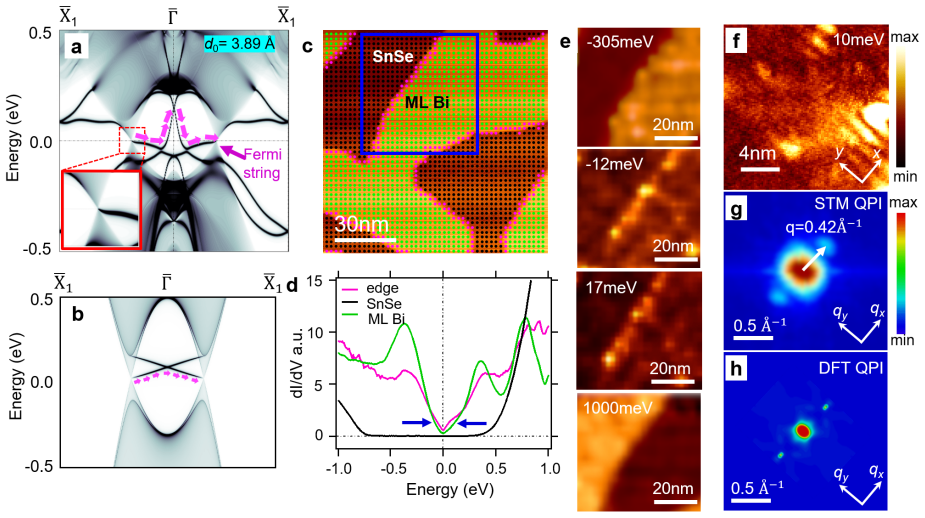
Monolayer-thick epitaxial bismuthene grown on SnS(Se) substrate forms a 2D Weyl semimetal. Substrate perturbations break space-inversion symmetry and close the intrinsic gap of bismuthene, yielding a gapless spin-polarized Weyl band dispersion. Spin- and angle-resolved photoemission measurements confirm the linear dispersion and spin polarization of these states. Scanning tunneling microscopy and spectroscopy additionally show pronounced local density of states at the sample edge, indicating the presence of Fermi string edge states.
What carries the argument
Substrate-induced breaking of space-inversion symmetry that closes the bismuthene gap and produces gapless spin-polarized Weyl bands.
If this is right
- The topology of the 2D Weyl cones requires Fermi string edge states as protected boundary modes.
- Epitaxial thin-film growth becomes a viable route to realize 2D Weyl semimetals.
- The linear dispersion and spin texture are directly accessible by spin-resolved photoemission.
- Edge local density of states enhancements become a signature for the new boundary states.
Where Pith is reading between the lines
- Substrate engineering of inversion symmetry could be applied to other monolayer materials to induce similar topological phases.
- Confirmed Fermi string states would imply protected one-dimensional conduction channels distinct from conventional edge states in quantum spin Hall systems.
- Momentum-resolved measurements could locate the precise positions of the Weyl points relative to the substrate Brillouin zone.
Load-bearing premise
That the substrate-induced breaking of space-inversion symmetry is the sole mechanism that closes the bismuthene gap and that the measured linear bands and edge density of states arise from intrinsic 2D Weyl states rather than from substrate-induced bands, defects, or hybridization effects.
What would settle it
Detection of an energy gap at the expected Weyl crossing points or absence of spin polarization in the linear bands in photoemission, or lack of enhanced edge density of states in tunneling spectra, would falsify the identification as intrinsic 2D Weyl states.
Figures



read the original abstract
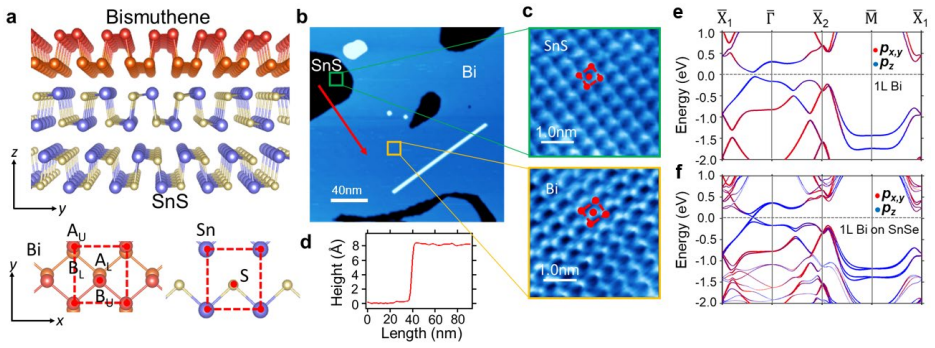
A two-dimensional (2D) Weyl semimetal featuring a spin-polarized linear band dispersion and a nodal Fermi surface is a new topological phase of matter. It is a solid-state realization of Weyl fermions in an intrinsic 2D system. The nontrivial topology of 2D Weyl cones guarantees the existence of a new form of topologically protected boundary states, Fermi string edge states. In this work, we report the realization of a 2D Weyl semimetal in monolayer-thick epitaxial bismuthene grown on SnS(Se) substrate. The intrinsic band gap of bismuthene is eliminated by the space-inversion-symmetry-breaking substrate perturbations, resulting in a gapless spin-polarized Weyl band dispersion. The linear dispersion and spin polarization of the Weyl fermion states are observed in our spin and angle-resolved photoemission measurements. In addition, the scanning tunneling microscopy/spectroscopy reveals a pronounced local density of states at the edge, suggesting the existence of Fermi string edge states. These results open the door for the experimental exploration of the exotic properties of Weyl fermion states in reduced dimensions.
Editorial analysis
A structured set of objections, weighed in public.
Referee Report
Summary. The paper reports the realization of a 2D Weyl semimetal in monolayer epitaxial bismuthene grown on SnS(Se) substrates. Substrate-induced breaking of space-inversion symmetry is claimed to close the intrinsic bismuthene gap, producing gapless spin-polarized linear Weyl bands whose dispersion and spin texture are observed by spin-ARPES; STM/STS additionally shows enhanced edge LDOS interpreted as topologically protected Fermi string states.
Significance. If the central attribution holds, the result would constitute the first experimental realization of intrinsic 2D Weyl fermions and their protected edge states, providing a new platform for reduced-dimensional topological physics. The combination of SARPES and STM data is in principle capable of supporting such a claim, but the manuscript's evidential strength rests on the untested assumption that interface hybridization and substrate bands do not contribute to the reported features.
major comments (1)
- [Results (SARPES and STM sections)] The weakest assumption identified in the skeptic note is load-bearing: the manuscript provides no thickness-dependent ARPES series, bare-substrate reference spectra, or heterostructure DFT calculations that quantitatively separate bismuthene-intrinsic bands from possible SnS(Se) hybridization or defect states in the energy window of the claimed Weyl cones. Without such controls, the linear spin-polarized dispersion cannot be unambiguously assigned to 2D Weyl states of bismuthene.
minor comments (1)
- [Introduction] The abstract and main text use 'Fermi string edge states' without a brief definition or reference to the expected LDOS signature of such states in 2D Weyl systems; a short explanatory sentence would improve accessibility.
Simulated Author's Rebuttal
We thank the referee for their careful and constructive review. We address the single major comment below and will revise the manuscript accordingly to strengthen the band assignment.
read point-by-point responses
-
Referee: [Results (SARPES and STM sections)] The weakest assumption identified in the skeptic note is load-bearing: the manuscript provides no thickness-dependent ARPES series, bare-substrate reference spectra, or heterostructure DFT calculations that quantitatively separate bismuthene-intrinsic bands from possible SnS(Se) hybridization or defect states in the energy window of the claimed Weyl cones. Without such controls, the linear spin-polarized dispersion cannot be unambiguously assigned to 2D Weyl states of bismuthene.
Authors: We agree that additional controls would strengthen the attribution. The manuscript currently relies on the observed spin texture (which is not expected from the substrate) and the appearance of the linear bands only in bismuthene-covered regions. We will add heterostructure DFT calculations in the revised version to quantitatively separate the contributions and confirm the bismuthene origin of the Weyl cones. Bare-substrate reference spectra will also be included where available; thickness-dependent ARPES is limited by the monolayer growth mode but can be discussed. revision: yes
Circularity Check
No circularity: experimental observation paper with no derivation chain
full rationale
This is an experimental report of ARPES, spin-ARPES, and STM measurements on epitaxial bismuthene. The abstract and available text contain no equations, fitting procedures, theoretical derivations, or predictions that could reduce to self-referential inputs. Claims rest on direct observation of linear dispersion, spin polarization, and edge LDOS, with interpretive attribution to substrate-induced symmetry breaking; no self-citation load-bearing steps, ansatz smuggling, or fitted-input-as-prediction patterns appear. The derivation chain is therefore self-contained as raw data reporting.
Axiom & Free-Parameter Ledger
Lean theorems connected to this paper
-
IndisputableMonolith/Foundation/AlexanderDuality.leanalexander_duality_circle_linking unclear?
unclearRelation between the paper passage and the cited Recognition theorem.
The intrinsic band gap of bismuthene is eliminated by the space-inversion-symmetry-breaking substrate perturbations, resulting in a gapless spin-polarized Weyl band dispersion... spin and angle-resolved photoemission measurements... pronounced local density of states at the edge, suggesting the existence of Fermi string edge states.
-
IndisputableMonolith/Foundation/RealityFromDistinction.leanreality_from_one_distinction unclear?
unclearRelation between the paper passage and the cited Recognition theorem.
The 2D Weyl fermion states... winding number... Berry phase... parity anomaly
What do these tags mean?
- matches
- The paper's claim is directly supported by a theorem in the formal canon.
- supports
- The theorem supports part of the paper's argument, but the paper may add assumptions or extra steps.
- extends
- The paper goes beyond the formal theorem; the theorem is a base layer rather than the whole result.
- uses
- The paper appears to rely on the theorem as machinery.
- contradicts
- The paper's claim conflicts with a theorem or certificate in the canon.
- unclear
- Pith found a possible connection, but the passage is too broad, indirect, or ambiguous to say the theorem truly supports the claim.
Forward citations
Cited by 1 Pith paper
-
Observation of Temperature Independent Anomalous Hall Effect in Thin Bismuth from Near Absolute Zero to 300 K Temperature
Observation of temperature-independent anomalous Hall effect in 68 nm pure bismuth film from 15 mK to 300 K, proposed as intrinsic due to surface Berry curvature.
Reference graph
Works this paper leans on
-
[1]
and the hexagonal honeycomb-like phase [57], are allowed by this requirement. The two phases are referred to as α- and β-phases, respectively, in the literature. Here we focus on the phosphorene-like α-bismuthene (bismuthene for short in the following discussion). In our experiment, bismuthene thin films were grown with molecular beam epitaxy (MBE). The Sn...
-
[2]
Two-dimensional gas of massless Dirac fermions in graphene,
K. S. Novoselov, A. K. Geim, S. V. Morozov, D. Jiang, M. I. Katsnelson, I. V. Grigorieva, S. V. Dubonos, and A. A. Firsov, “Two-dimensional gas of massless Dirac fermions in graphene,” Nature, vol. 438, no. 7065, pp. 197–200, 2005
work page 2005
-
[3]
Experimental observation of the quantum Hall effect and Berry’s phase in graphene,
Y. Zhang, Y.-W. Tan, H. L. Stormer, and P. Kim, “Experimental observation of the quantum Hall effect and Berry’s phase in graphene,” Nature, vol. 438, no. 7065, pp. 201–204, 2005
work page 2005
-
[4]
The electronic properties of graphene,
A. H. Castro Neto, F. Guinea, N. M. R. Peres, K. S. Novoselov, and A. K. Geim, “The electronic properties of graphene,” Reviews of Modern Physics , vol. 81, no. 1, pp. 109–162, 2009
work page 2009
-
[5]
Colloquium : Topological insulators,
M. Z. Hasan and C. L. Kane, “ Colloquium : Topological insulators,” Rev. Mod. Phys., vol. 82, pp. 3045–3067, Nov 2010
work page 2010
-
[6]
Topological insulators and superconductors,
X.-L. Qi and S.-C. Zhang, “Topological insulators and superconductors,” Rev. Mod. Phys. , vol. 83, pp. 1057–1110, Oct 2011
work page 2011
-
[7]
A valley valve and electron beam splitter,
J. Li, R.-X. Zhang, Z. Yin, J. Zhang, K. Watanabe, T. Taniguchi, C. Liu, and J. Zhu, “A valley valve and electron beam splitter,” Science, vol. 362, no. 6419, pp. 1149–1152, 2018
work page 2018
-
[8]
Twistable 13 electronics with dynamically rotatable heterostructures,
R. Ribeiro-Palau, C. Zhang, K. Watanabe, T. Taniguchi, J. Hone, and C. R. Dean, “Twistable 13 electronics with dynamically rotatable heterostructures,” Science, vol. 361, no. 6403, pp. 690– 693, 2018
work page 2018
-
[9]
Correlated insulator behaviour at half-filling in magic-angle graphene superlattices,
Y. Cao, V. Fatemi, A. Demir, S. Fang, S. L. Tomarken, J. Y. Luo, J. D. Sanchez-Yamagishi, K. Watanabe, T. Taniguchi, E. Kaxiras, R. C. Ashoori, and P. Jarillo-Herrero, “Correlated insulator behaviour at half-filling in magic-angle graphene superlattices,” Nature, vol. 556, no. 7699, pp. 80–84, 2018
work page 2018
-
[10]
Unconventional superconductivity in magic-angle graphene superlattices,
Y. Cao, V. Fatemi, S. Fang, K. Watanabe, T. Taniguchi, E. Kaxiras, and P. Jarillo-Herrero, “Unconventional superconductivity in magic-angle graphene superlattices,” Nature, vol. 556, no. 7699, pp. 43–50, 2018
work page 2018
-
[11]
Discovery of a Three-Dimensional Topological Dirac Semimetal, Na 3Bi,
Z. K. Liu, B. Zhou, Y. Zhang, Z. J. Wang, H. M. Weng, D. Prabhakaran, S.-K. Mo, Z. X. Shen, Z. Fang, X. Dai, Z. Hussain, and Y. L. Chen, “Discovery of a Three-Dimensional Topological Dirac Semimetal, Na 3Bi,” Science, vol. 343, no. 6173, pp. 864–867, 2014
work page 2014
-
[12]
Observation of fermi arc surface states in a topological metal,
S.-Y. Xu, C. Liu, S. K. Kushwaha, R. Sankar, J. W. Krizan, I. Belopolski, M. Neupane, G. Bian, N. Alidoust, T.-R. Chang, H.-T. Jeng, C.-Y. Huang, W.-F. Tsai, H. Lin, P. P. Shibayev, F.-C. Chou, R. J. Cava, and M. Z. Hasan, “Observation of fermi arc surface states in a topological metal,” Science, vol. 347, no. 6219, pp. 294–298, 2015
work page 2015
-
[13]
Ex- perimental realization of a three-dimensional dirac semimetal,
S. Borisenko, Q. Gibson, D. Evtushinsky, V. Zabolotnyy, B. B¨ uchner, and R. J. Cava, “Ex- perimental realization of a three-dimensional dirac semimetal,” Phys. Rev. Lett. , vol. 113, p. 027603, Jul 2014
work page 2014
-
[14]
Lorentz-violating type-II Dirac fermions in transition metal dichalcogenide PtTe2,
M. Yan, H. Huang, K. Zhang, E. Wang, W. Yao, K. Deng, G. Wan, H. Zhang, M. Arita, H. Yang, Z. Sun, H. Yao, Y. Wu, S. Fan, W. Duan, and S. Zhou, “Lorentz-violating type-II Dirac fermions in transition metal dichalcogenide PtTe2,” Nature Communications, vol. 8, no. 1, p. 257, 2017
work page 2017
-
[15]
Evidence for the chiral anomaly in the dirac semimetal na¡sub¿3¡/sub¿bi,
J. Xiong, S. K. Kushwaha, T. Liang, J. W. Krizan, M. Hirschberger, W. Wang, R. J. Cava, and N. P. Ong, “Evidence for the chiral anomaly in the dirac semimetal na¡sub¿3¡/sub¿bi,” Science, vol. 350, no. 6259, pp. 413–416, 2015
work page 2015
-
[16]
Weyl and dirac semimetals in three- dimensional solids,
N. P. Armitage, E. J. Mele, and A. Vishwanath, “Weyl and dirac semimetals in three- dimensional solids,” Rev. Mod. Phys., vol. 90, p. 015001, Jan 2018
work page 2018
-
[17]
X. Wan, A. M. Turner, A. Vishwanath, and S. Y. Savrasov, “Topological semimetal and fermi- arc surface states in the electronic structure of pyrochlore iridates,” Phys. Rev. B , vol. 83, p. 205101, May 2011. 14
work page 2011
-
[18]
Discovery of a weyl fermion semimetal and topological fermi arcs,
S.-Y. Xu, I. Belopolski, N. Alidoust, M. Neupane, G. Bian, C. Zhang, R. Sankar, G. Chang, Z. Yuan, C.-C. Lee, S.-M. Huang, H. Zheng, J. Ma, D. S. Sanchez, B. Wang, A. Bansil, F. Chou, P. P. Shibayev, H. Lin, S. Jia, and M. Z. Hasan, “Discovery of a weyl fermion semimetal and topological fermi arcs,” Science, vol. 349, no. 6248, pp. 613–617, 2015
work page 2015
-
[19]
Experimental discovery of weyl semimetal taas,
B. Q. Lv, H. M. Weng, B. B. Fu, X. P. Wang, H. Miao, J. Ma, P. Richard, X. C. Huang, L. X. Zhao, G. F. Chen, Z. Fang, X. Dai, T. Qian, and H. Ding, “Experimental discovery of weyl semimetal taas,” Phys. Rev. X , vol. 5, p. 031013, Jul 2015
work page 2015
-
[20]
A. A. Soluyanov, D. Gresch, Z. Wang, Q. Wu, M. Troyer, X. Dai, and B. A. Bernevig, “Type-II Weyl semimetals.,” Nature, vol. 527, no. 7579, pp. 495–8, 2015
work page 2015
-
[21]
Chiral anomaly and classical negative magnetoresistance of weyl metals,
D. T. Son and B. Z. Spivak, “Chiral anomaly and classical negative magnetoresistance of weyl metals,” Phys. Rev. B , vol. 88, p. 104412, Sep 2013
work page 2013
-
[22]
Observation of the chiral-anomaly-induced negative magnetoresistance in 3d weyl semimetal taas,
X. Huang, L. Zhao, Y. Long, P. Wang, D. Chen, Z. Yang, H. Liang, M. Xue, H. Weng, Z. Fang, X. Dai, and G. Chen, “Observation of the chiral-anomaly-induced negative magnetoresistance in 3d weyl semimetal taas,” Phys. Rev. X , vol. 5, p. 031023, Aug 2015
work page 2015
-
[23]
Signatures of the Adler-Bell-Jackiw chiral anomaly in a Weyl fermion semimetal,
C.-L. Zhang, S.-Y. Xu, I. Belopolski, Z. Yuan, Z. Lin, B. Tong, G. Bian, N. Alidoust, C.-C. Lee, S.-M. Huang, T.-R. Chang, G. Chang, C.-H. Hsu, H.-T. Jeng, M. Neupane, D. Sanchez, H. Zheng, J. Wang, H. Lin, C. Zhang, H.-Z. Lu, S.-Q. Shen, T. Neupert, M. Hasan, and S. Jia, “Signatures of the Adler-Bell-Jackiw chiral anomaly in a Weyl fermion semimetal,” Na...
work page 2016
-
[24]
Chiral gauge field and axial anomaly in a weyl semimetal,
C.-X. Liu, P. Ye, and X.-L. Qi, “Chiral gauge field and axial anomaly in a weyl semimetal,” Phys. Rev. B , vol. 87, p. 235306, Jun 2013
work page 2013
-
[25]
Excitonic phases from weyl semimetals,
H. Wei, S.-P. Chao, and V. Aji, “Excitonic phases from weyl semimetals,” Phys. Rev. Lett. , vol. 109, p. 196403, Nov 2012
work page 2012
-
[26]
Magneto-optical conductivity of weyl semimetals,
P. E. C. Ashby and J. P. Carbotte, “Magneto-optical conductivity of weyl semimetals,” Phys. Rev. B, vol. 87, p. 245131, Jun 2013
work page 2013
-
[27]
Weyl semimetals, Fermi arcs and chiral anomalies,
S. Jia, S.-Y. Xu, and M. Z. Hasan, “Weyl semimetals, Fermi arcs and chiral anomalies,” Nature Materials, vol. 15, no. 11, pp. 1140–1144, 2016
work page 2016
-
[28]
Topological response in weyl semimetals and the chiral anomaly,
A. A. Zyuzin and A. A. Burkov, “Topological response in weyl semimetals and the chiral anomaly,” Phys. Rev. B , vol. 86, p. 115133, Sep 2012
work page 2012
-
[29]
Probing the chiral anomaly with nonlocal transport in three-dimensional topological semimetals,
S. A. Parameswaran, T. Grover, D. A. Abanin, D. A. Pesin, and A. Vishwanath, “Probing the chiral anomaly with nonlocal transport in three-dimensional topological semimetals,” Phys. 15 Rev. X, vol. 4, p. 031035, Sep 2014
work page 2014
-
[30]
Nonlocal transport in weyl semimetals in the hydrodynamic regime,
E. V. Gorbar, V. A. Miransky, I. A. Shovkovy, and P. O. Sukhachov, “Nonlocal transport in weyl semimetals in the hydrodynamic regime,” Phys. Rev. B , vol. 98, p. 035121, Jul 2018
work page 2018
-
[31]
Weyl, Dirac and high-fold chiral fermions in topological quantum materials,
M. Z. Hasan, G. Chang, I. Belopolski, G. Bian, S.-Y. Xu, and J.-X. Yin, “Weyl, Dirac and high-fold chiral fermions in topological quantum materials,” Nature Reviews Materials , vol. 0123456789, 2021
work page 2021
-
[32]
Model for a quantum hall effect without landau levels: Condensed-matter realization of the
F. D. M. Haldane, “Model for a quantum hall effect without landau levels: Condensed-matter realization of the ”parity anomaly”,” Phys. Rev. Lett., vol. 61, pp. 2015–2018, Oct 1988
work page 2015
-
[33]
Fractional charge and zero modes for planar systems in a magnetic field,
R. Jackiw, “Fractional charge and zero modes for planar systems in a magnetic field,” Phys. Rev. D, vol. 29, pp. 2375–2377, May 1984
work page 1984
-
[34]
Physical realization of the parity anomaly in condensed matter physics,
E. Fradkin, E. Dagotto, and D. Boyanovsky, “Physical realization of the parity anomaly in condensed matter physics,” Phys. Rev. Lett., vol. 57, pp. 2967–2970, Dec 1986
work page 1986
-
[35]
Condensed-matter simulation of a three-dimensional anomaly,
G. W. Semenoff, “Condensed-matter simulation of a three-dimensional anomaly,” Phys. Rev. Lett., vol. 53, pp. 2449–2452, Dec 1984
work page 1984
-
[36]
Experimental signa- ture of the parity anomaly in a semi-magnetic topological insulator,
M. Mogi, Y. Okamura, M. Kawamura, R. Yoshimi, K. Yasuda, A. Tsukazaki, K. S. Takahashi, T. Morimoto, N. Nagaosa, M. Kawasaki, Y. Takahashi, and Y. Tokura, “Experimental signa- ture of the parity anomaly in a semi-magnetic topological insulator,” Nature Physics, vol. 18, no. 4, pp. 390–394, 2022
work page 2022
-
[37]
Electron fractionalization in two-dimensional graphenelike structures,
C.-Y. Hou, C. Chamon, and C. Mudry, “Electron fractionalization in two-dimensional graphenelike structures,” Phys. Rev. Lett., vol. 98, p. 186809, May 2007
work page 2007
-
[38]
Solitons with fermion number ½,
R. Jackiw and C. Rebbi, “Solitons with fermion number ½,” Phys. Rev. D , vol. 13, pp. 3398– 3409, Jun 1976
work page 1976
-
[39]
W. P. Su, J. R. Schrieffer, and A. J. Heeger, “Solitons in polyacetylene,” Phys. Rev. Lett. , vol. 42, pp. 1698–1701, Jun 1979
work page 1979
-
[40]
N. Read and D. Green, “Paired states of fermions in two dimensions with breaking of parity and time-reversal symmetries and the fractional quantum hall effect,” Phys. Rev. B , vol. 61, pp. 10267–10297, Apr 2000
work page 2000
-
[41]
Multiple unpinned Dirac points in group-Va single-layers with phosphorene structure,
Y. Lu, D. Zhou, G. Chang, S. Guan, W. Chen, Y. Jiang, J. Jiang, X.-s. Wang, S. A. Yang, Y. P. Feng, Y. Kawazoe, and H. Lin, “Multiple unpinned Dirac points in group-Va single-layers with phosphorene structure,” npj Computational Materials , vol. 2, no. 1, p. 16011, 2016
work page 2016
-
[42]
Topolog- ical nodal-line fermions in spin-orbit metal PbTaSe2,
G. Bian, T.-R. Chang, R. Sankar, S.-Y. Xu, H. Zheng, T. Neupert, C.-K. Chiu, S.-M. Huang, 16 G. Chang, I. Belopolski, D. S. Sanchez, M. Neupane, N. Alidoust, C. Liu, B. Wang, C.-C. Lee, H.-T. Jeng, C. Zhang, Z. Yuan, S. Jia, A. Bansil, F. Chou, H. Lin, and M. Z. Hasan, “Topolog- ical nodal-line fermions in spin-orbit metal PbTaSe2,” Nature Communications,...
work page 2016
-
[43]
J. D. Mella and L. E. F. F. Torres, “Robustness of spin-polarized edge states in a two- dimensional topological semimetal without inversion symmetry,” Phys. Rev. B , vol. 105, p. 075403, Feb 2022
work page 2022
-
[44]
Gated silicene as a tunable source of nearly 100electrons,
W.-F. Tsai, C.-Y. Huang, T.-R. Chang, H. Lin, H.-T. Jeng, and A. Bansil, “Gated silicene as a tunable source of nearly 100electrons,” Nature Communications, vol. 4, no. 1, p. 1500, 2013
work page 2013
-
[45]
Quantum nonlinear hall effect induced by berry curvature dipole in time-reversal invariant materials,
I. Sodemann and L. Fu, “Quantum nonlinear hall effect induced by berry curvature dipole in time-reversal invariant materials,” Phys. Rev. Lett., vol. 115, p. 216806, Nov 2015
work page 2015
-
[46]
Z. Z. Du, H.-Z. Lu, and X. C. Xie, “Nonlinear Hall effects,” Nature Reviews Physics , vol. 3, no. 11, pp. 744–752, 2021
work page 2021
-
[47]
Two-dimensional quadratic double weyl semimetal,
X. Zhao, F. Ma, P.-J. Guo, and Z.-Y. Lu, “Two-dimensional quadratic double weyl semimetal,” Phys. Rev. Res., vol. 4, p. 043183, Dec 2022
work page 2022
-
[48]
A. Panigrahi, V. Juriˇ ci´ c, and B. Roy, “Projected topological branes,” Communications Physics, vol. 5, no. 1, p. 230, 2022
work page 2022
-
[49]
Topological excitonic corner states and nodal phase in bilayer quantum spin hall insulators,
Z.-R. Liu, L.-H. Hu, C.-Z. Chen, B. Zhou, and D.-H. Xu, “Topological excitonic corner states and nodal phase in bilayer quantum spin hall insulators,” Phys. Rev. B, vol. 103, p. L201115, May 2021
work page 2021
-
[50]
Tunable weyl half-semimetals in two- dimensional iron-based materials mFeSe(m = Tl, In, Ga),
H. Huan, Y. Xue, B. Zhao, H. Bao, L. Liu, and Z. Yang, “Tunable weyl half-semimetals in two- dimensional iron-based materials mFeSe(m = Tl, In, Ga),” Phys. Rev. B , vol. 106, p. 125404, Sep 2022
work page 2022
-
[51]
Phosphorene: An Unexplored 2D Semiconductor with a High Hole Mobility,
H. Liu, A. T. Neal, Z. Zhu, Z. Luo, X. Xu, D. Tom´ anek, and P. D. Ye, “Phosphorene: An Unexplored 2D Semiconductor with a High Hole Mobility,” ACS Nano, vol. 8, pp. 4033–4041, apr 2014
work page 2014
-
[52]
Black phosphorus field-effect transistors,
L. Li, Y. Yu, G. J. Ye, Q. Ge, X. Ou, H. Wu, D. Feng, X. H. Chen, and Y. Zhang, “Black phosphorus field-effect transistors,” Nat Nano, vol. 9, pp. 372–377, may 2014
work page 2014
-
[53]
Quantum spin hall effect in silicene and two-dimensional germanium,
C.-C. Liu, W. Feng, and Y. Yao, “Quantum spin hall effect in silicene and two-dimensional germanium,” Phys. Rev. Lett., vol. 107, p. 076802, Aug 2011
work page 2011
-
[54]
Evi- 17 dence for dirac fermions in a honeycomb lattice based on silicon,
L. Chen, C.-C. Liu, B. Feng, X. He, P. Cheng, Z. Ding, S. Meng, Y. Yao, and K. Wu, “Evi- 17 dence for dirac fermions in a honeycomb lattice based on silicon,” Phys. Rev. Lett., vol. 109, p. 056804, Aug 2012
work page 2012
-
[55]
Realization of unpinned two-dimensional dirac states in antimony atomic lay- ers,
Q. Lu, J. Cook, X. Zhang, K. Y. Chen, M. Snyder, D. T. Nguyen, P. V. S. Reddy, B. Qin, S. Zhan, L.-D. Zhao, P. J. Kowalczyk, S. A. Brown, T.-C. Chiang, S. A. Yang, T.-R. Chang, and G. Bian, “Realization of unpinned two-dimensional dirac states in antimony atomic lay- ers,” Nature Communications, vol. 13, no. 1, p. 4603, 2022
work page 2022
-
[57]
Realization of Symmetry-Enforced Two-Dimensional Dirac Fermions in Nonsymmorphic α-Bismuthene,
P. J. Kowalczyk, S. A. Brown, T. Maerkl, Q. Lu, C.-K. Chiu, Y. Liu, S. A. Yang, X. Wang, I. Zasada, F. Genuzio, T. O. Mente¸ s, A. Locatelli, T.-C. Chiang, and G. Bian, “Realization of Symmetry-Enforced Two-Dimensional Dirac Fermions in Nonsymmorphic α-Bismuthene,” ACS Nano, vol. 14, pp. 1888–1894, feb 2020
work page 2020
-
[58]
Bismuthene on a sic substrate: A candidate for a high-temperature quantum spin hall material,
F. Reis, G. Li, L. Dudy, M. Bauernfeind, S. Glass, W. Hanke, R. Thomale, J. Sch¨ afer, and R. Claessen, “Bismuthene on a sic substrate: A candidate for a high-temperature quantum spin hall material,” Science, vol. 357, no. 6348, pp. 287–290, 2017
work page 2017
-
[59]
A novel electron spin-polarization detector with very large analyzing power,
R. Bertacco, D. Onofrio, and F. Ciccacci, “A novel electron spin-polarization detector with very large analyzing power,” Review of Scientific Instruments , vol. 70, no. 9, pp. 3572–3576, 1999
work page 1999
-
[60]
A new spin-polarized photoemission spectrometer with very high efficiency and energy resolution,
T. Okuda, Y. Takeichi, Y. Maeda, A. Harasawa, I. Matsuda, T. Kinoshita, and A. Kak- izaki, “A new spin-polarized photoemission spectrometer with very high efficiency and energy resolution,” Review of Scientific Instruments , vol. 79, no. 12, p. 123117, 2008
work page 2008
-
[61]
Efficient iterative schemes for ab initio total-energy calculations using a plane-wave basis set,
G. Kresse and J. Furthm¨ uller, “Efficient iterative schemes for ab initio total-energy calculations using a plane-wave basis set,” Phys. Rev. B , vol. 54, pp. 11169–11186, Oct 1996
work page 1996
-
[62]
Generalized gradient approximation made simple,
J. P. Perdew, K. Burke, and M. Ernzerhof, “Generalized gradient approximation made simple,” Phys. Rev. Lett., vol. 77, pp. 3865–3868, Oct 1996
work page 1996
-
[63]
Maximally localized generalized wannier functions for com- posite energy bands,
N. Marzari and D. Vanderbilt, “Maximally localized generalized wannier functions for com- posite energy bands,” Phys. Rev. B , vol. 56, pp. 12847–12865, Nov 1997
work page 1997
-
[64]
Maximally localized wannier functions for entangled energy bands,
I. Souza, N. Marzari, and D. Vanderbilt, “Maximally localized wannier functions for entangled energy bands,” Phys. Rev. B , vol. 65, p. 035109, Dec 2001
work page 2001
-
[65]
wannier90: 18 A tool for obtaining maximally-localised wannier functions,
A. A. Mostofi, J. R. Yates, Y.-S. Lee, I. Souza, D. Vanderbilt, and N. Marzari, “wannier90: 18 A tool for obtaining maximally-localised wannier functions,” Computer Physics Communica- tions, vol. 178, no. 9, pp. 685–699, 2008
work page 2008
-
[66]
C.-C. Lee, M. Fukuda, Y.-T. Lee, and T. Ozaki, “Realization of intrinsically broken dirac cones in graphene via the momentum-resolved electronic band structure,” Journal of Physics: Condensed Matter, vol. 30, p. 295502, jun 2018
work page 2018
-
[67]
F. Bisti, V. A. Rogalev, M. Karolak, S. Paul, A. Gupta, T. Schmitt, G. G¨ untherodt, V. Eyert, G. Sangiovanni, G. Profeta, and V. N. Strocov, “Weakly-correlated nature of ferromagnetism in nonsymmorphic cro 2 revealed by bulk-sensitive soft-x-ray arpes,” Phys. Rev. X , vol. 7, p. 041067, Dec 2017
work page 2017
-
[68]
Universal signatures of fermi arcs in quasiparticle interference on the surface of weyl semimetals,
S. Kourtis, J. Li, Z. Wang, A. Yazdani, and B. A. Bernevig, “Universal signatures of fermi arcs in quasiparticle interference on the surface of weyl semimetals,” Phys. Rev. B , vol. 93, p. 041109, Jan 2016
work page 2016
-
[69]
Quasiparticle interference of the fermi arcs and surface-bulk connectivity of a weyl semimetal,
H. Inoue, A. Gyenis, Z. Wang, J. Li, S. W. Oh, S. Jiang, N. Ni, B. A. Bernevig, and A. Yaz- dani, “Quasiparticle interference of the fermi arcs and surface-bulk connectivity of a weyl semimetal,” Science, vol. 351, no. 6278, pp. 1184–1187, 2016. 19 FIGURES 20 E k E k E k Gapped 2D Dirac Rashba Splitting Gapless 2D Weyl b c surface bulkkx ky 0 3D Dirac sem...
work page 2016
discussion (0)
Sign in with ORCID, Apple, or X to comment. Anyone can read and Pith papers without signing in.