Atiyah-Hirzebruch spectral sequence for topological insulators and superconductors: E₂ pages for 1651 magnetic space groups
Pith reviewed 2026-05-24 09:09 UTC · model grok-4.3
The pith
The Atiyah-Hirzebruch spectral sequence determines the topological K-groups for about 59 percent of three-dimensional magnetic space group settings.
A machine-rendered reading of the paper's core claim, the machinery that carries it, and where it could break.
Core claim
We compute the E2 pages of the momentum-space and real-space Atiyah-Hirzebruch spectral sequence for topological crystalline insulators and superconductors up to three spatial dimensions, considering the cell decomposition in which if a group action fixes a cell setwise then its group action fixes the same cell pointwise. Under a physically reasonable assumption, we enumerate all possible K-groups that are compatible with the E2 pages for both momentum and real-space AHSS. As a result, we determine the K-groups for approximately 59% of symmetry settings in three spatial dimensions.
What carries the argument
The Atiyah-Hirzebruch spectral sequence applied to a cell decomposition of momentum or real space, where the group action fixes fixed cells pointwise.
If this is right
- Explicit lists of allowed topological invariants now exist for 59 percent of three-dimensional magnetic space groups.
- Both momentum-space and real-space E2 pages are supplied so that classifications can be cross-checked.
- The tabulated results cover every one of the 1651 magnetic space groups considered.
- The same cell-decomposition procedure yields E2 pages in lower dimensions for the same groups.
Where Pith is reading between the lines
- Screening of candidate materials can now use the enumerated K-groups to predict which invariants are possible under given symmetries.
- Cases outside the 59 percent may require computation of higher pages of the spectral sequence or additional physical constraints.
- The dual momentum and real-space computations could reveal when extra consistency conditions beyond the E2 pages are needed.
Load-bearing premise
The actual K-groups are precisely the ones compatible with the computed E2 pages of both the momentum-space and real-space versions.
What would settle it
A numerical or experimental determination of a topological invariant for one of the enumerated symmetry settings that lies outside the listed possible K-groups.
Figures


read the original abstract
We compute the $E_2$ pages of the momentum-space and real-space Atiyah-Hirzebruch spectral sequence (AHSS) for topological crystalline insulators and superconductors up to three spatial dimensions, considering the cell decomposition in which if a group action fixes a cell setwise then its group action fixes the same cell pointwise. We provide a detailed description of the implementation for computing the $E_2$ pages of AHSS. Under a physically reasonable assumption, we enumerate all possible $K$-groups that are compatible with the $E_2$ pages for both momentum and real-space AHSS. As a result, we determine the $K$-groups for approximately 59\% of symmetry settings in three spatial dimensions. All the results can be found at this http \href{https://www2.yukawa.kyoto-u.ac.jp/~ken.shiozaki/ahss/e2.html}{URL}.
Editorial analysis
A structured set of objections, weighed in public.
Referee Report
Summary. The manuscript computes the E₂ pages of both the momentum-space and real-space Atiyah-Hirzebruch spectral sequences (AHSS) for topological crystalline insulators and superconductors up to three spatial dimensions. It employs a cell decomposition in which a group action that fixes a cell setwise also fixes it pointwise, provides a detailed implementation description, and, under one physically reasonable assumption, enumerates all K-groups compatible with the computed E₂ pages from both AHSS constructions. This yields unique K-group determinations for approximately 59% of the 1651 magnetic space groups in three dimensions, with all tabulated results posted online.
Significance. If the enumerated K-groups hold, the work supplies a large, directly computed reference database for topological classifications in crystalline systems, covering a majority fraction of 3D magnetic space groups without fitted parameters or circular reductions. The explicit online tabulation and implementation details constitute a reproducible resource that can accelerate material searches and further spectral-sequence studies in the field.
major comments (1)
- [Enumeration procedure (near abstract and § on K-group compatibility)] The 59% coverage claim (abstract and enumeration procedure) rests on a single 'physically reasonable assumption' whose precise statement, domain of applicability, and justification are not reproduced in the abstract and must be located and verified in the main text. Because this assumption directly gates the uniqueness of the K-group determinations, its explicit formulation and any counter-examples should be highlighted in a dedicated subsection.
minor comments (2)
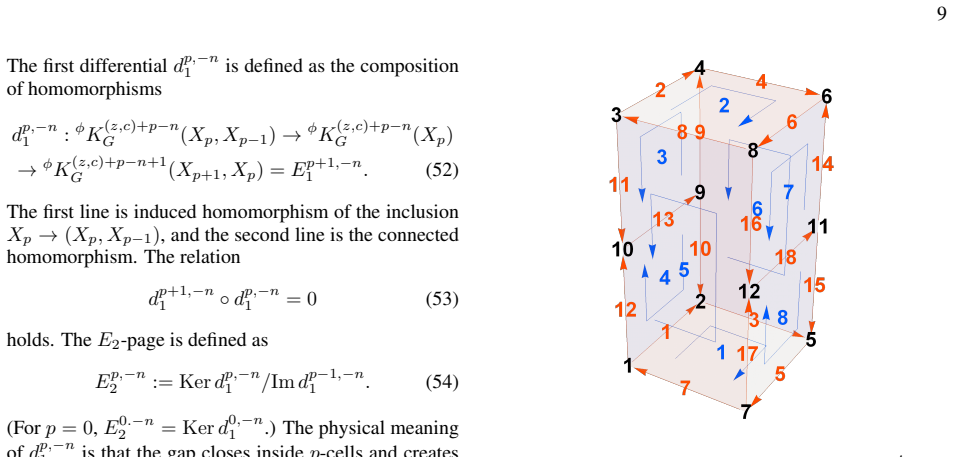
- [Implementation description] The cell-decomposition convention (group action fixes cell pointwise when fixing setwise) is central to the E₂-page computation; a short dedicated paragraph or figure illustrating the distinction from other common decompositions would improve readability for readers outside the immediate subfield.
- [Abstract] The online URL in the abstract appears as a raw hyperlink; ensure the published version contains a stable, citable link or DOI to the tabulated E₂ pages and K-group lists.
Simulated Author's Rebuttal
We thank the referee for their positive evaluation and recommendation of minor revision. We address the major comment below and will incorporate the suggested changes to improve clarity.
read point-by-point responses
-
Referee: [Enumeration procedure (near abstract and § on K-group compatibility)] The 59% coverage claim (abstract and enumeration procedure) rests on a single 'physically reasonable assumption' whose precise statement, domain of applicability, and justification are not reproduced in the abstract and must be located and verified in the main text. Because this assumption directly gates the uniqueness of the K-group determinations, its explicit formulation and any counter-examples should be highlighted in a dedicated subsection.
Authors: We agree that the assumption merits more prominent and self-contained presentation. The assumption is formulated in the main text (specifically in the section on K-group compatibility), but we acknowledge that its placement and the abstract's brevity make verification less immediate. In the revised manuscript we will insert a dedicated subsection immediately preceding the enumeration results. This subsection will: (i) state the assumption verbatim, (ii) delineate its domain of applicability (including the symmetry settings and dimensions to which it applies), (iii) supply the physical justification, and (iv) discuss any known or potential counter-examples together with their implications for the 59 % figure. We will also revise the abstract to include a concise parenthetical description of the assumption so that the coverage claim is transparent on first reading. revision: yes
Circularity Check
No significant circularity; direct computation of spectral-sequence pages
full rationale
The paper performs explicit computation of E2 pages for the Atiyah-Hirzebruch spectral sequence under a fixed cell decomposition (group action fixes cells pointwise when fixing them setwise). It then enumerates K-groups compatible with both momentum- and real-space E2 pages under one explicitly stated physical assumption. No equation reduces an output to a fitted input by construction, no parameter is renamed as a prediction, and no load-bearing step relies on a self-citation whose content is itself unverified or tautological. The derivation chain consists of group-cohomology calculations and compatibility checks that remain independent of the final enumerated K-groups.
Axiom & Free-Parameter Ledger
axioms (1)
- domain assumption Physically reasonable assumption allowing enumeration of all K-groups compatible with the computed E2 pages
Forward citations
Cited by 1 Pith paper
-
Towards complete characterization of topological insulators and superconductors: A systematic construction of topological invariants based on Atiyah-Hirzebruch spectral sequence
A systematic construction via Atiyah-Hirzebruch spectral sequence yields topological invariants that completely characterize K-groups for TRS spinful superconductors in 159 space groups.
Reference graph
Works this paper leans on
-
[1]
ch shφh φhch sh ch shφh φhch sh TABLE I
Z classification For each irrep of the little group for each orbit, we con- struct a vector ⃗ ap,−n∈ Ep 0 consisting of the matrix di- mensions of the generating Dirac Hamiltonians with the 11 Wα T Wα C Wα Γ n = 0 n = 1 n = 2 n = 3 n = 4 n = 5 n = 6 n = 7 A 0 0 0 (Z, 1) 0 ( Z, 2) 0 ( Z, 4) 0 ( Z, 8) 0 AIII 0 0 1 0 ( Z, 2) 0 ( Z, 4) 0 ( Z, 8) 0 ( Z, 16) AI ...
-
[2]
(75) We note that since the p-cells inCp are oriented sym- metrically, there is no sign change due to the mismatch of orientations
-
[3]
crys- talline topological liquid
Z2 classification No sign difference exists in the Z2 number. For each irrep of each orbit, we construct a vector ⃗bp,−n ∈ Ep 0 consisting of matrix sizes of generator Dirac Hamilto- nians as follows. Pick a representative p-cell Dp i of an orbit of equivalent p-cells inCp. For an irrep αr(kp i ), if the classification of degree n is Z2, we definebp,−n ir by...
-
[4]
Pick a representative p-cell Dp i of an or- bit of equivalent p-cells inCp
Z classification For each irrep of each orbit, we construct a vector ⃗ ap,−n∈ E0 p. Pick a representative p-cell Dp i of an or- bit of equivalent p-cells inCp. For an irrep αr(xp i ), if the classification of degree −n is Z, we set ap,−n ir to be the matrix size of generator Dirac Hamiltonian listed in Table II. The components for other equivalent irreps h[...
-
[5]
Z2 classification For an irrep αr(xp i ), if the classification of degree −n is Z2, set bp,−n ir = dim (H), the matrix dimension listed in Table II. For other equivalent irreps h[α(xp i )] at h(x)∈ X, set bp,−n h(i)h(r) = bp,−n ir . Constructing the vectors⃗bp,−n 1 ,⃗bp,−n 2 ,..., for all inequivalent irreps and inequivalent orbits, we have E1Z2 p,−n :=⟨⃗bp...
-
[6]
(147) From the observation above, to list all the possible pairs of Kerf and Cokerf, we do the following. First, we tabulate all possible homomorphisms f2 : A → B. Next, we tabulate all possible homomorphisms f′ 1 : Z⊕q→B/Imf2 for eachf2. Computing the E2 and E2-pages explicitly for the symmetry classes summarized in Sec. II, we find that the torsion sub-Z...
work page 2022
-
[7]
Fundamental domain LetG be an MSG. Pick a reference point a∈ R3 such that the little groupGa ={g∈G| g(a) = a} is the same as that for generic points in R3. From such a reference point, a stereohedron is given by ([62], Theorem 1.2.1.) DV (a) ={x∈ R3| |x−a|<|x−g(a)| for allg∈G\G a}. (A1) (DV means the Dirichlet-V oronoi stereohedron in [62].) Note thatDV (...
-
[8]
To specify the 3-cellDV (a), we use the set of corner vertices e3 ={x1,x 2,
Cell decomposition of the boundary of DV (a) In this section, we denote the interior of the convex hull of a convex sete by ˜e. To specify the 3-cellDV (a), we use the set of corner vertices e3 ={x1,x 2,... } of DV (a). Similarly, let e2 i⊂ e3,i = 1,..., be the sets of corner vertices of boundary convex polygons ofDV (a). 30 The convex polygon ˜e2 i may n...
-
[9]
(C4) Using the second isomorphism theorem, we get Imf = ( ˜f( ˜A) +PB)/PB
Imf From (C3), we have Imf = ˜f( ˜A) modPB = ˜f( ˜A)/( ˜f( ˜A)∩PB). (C4) Using the second isomorphism theorem, we get Imf = ( ˜f( ˜A) +PB)/PB. (C5) Here, ˜f( ˜A) +PB is the union ˜f( ˜A) +PB ={x +y∈ ˜B|x∈ ˜f( ˜A),y∈PB}. (C6) 31
-
[10]
(C7) Using ˜f(PA)⊂PB, Kerf ={˜a∈ ˜A| ˜f(˜a)∈PB}/PA
Kerf Note that Kerf ={a∈A|f(a) = 0} ={˜a∈ ˜A| ˜f(˜a)∈PB} modPA. (C7) Using ˜f(PA)⊂PB, Kerf ={˜a∈ ˜A| ˜f(˜a)∈PB}/PA. (C8) Here, the numerator can be expressed as {˜a∈ ˜A| ˜f(˜a)∈PB} ={˜a∈ ˜A|∃˜b∈PB, s.t. ˜f(˜a) +˜b = 0}. (C9) Thus, introducing the homomorphism ˜f⊕ IdPB : ˜A⊕PB→ ˜B, (˜a,˜b)↦→ ˜f(˜a) +˜b, (C10) we have {˜a∈ ˜A| ˜f(˜a)⊂PB} = Ker (˜f⊕ IdPB)| ˜...
-
[11]
Kerg/Imf Now let us consider a sequence of homomorphisms A f −−−−→B g −−−−→C (C13) satisfying Imf⊂ Kerg. By use of the formulas above, the quotient group Kerg/Imf is given by Kerg/Imf = Ker (˜g⊕ IdPC)| ˜B/PB ( ˜f( ˜A) +PB)/PB . (C14) Applying the third isomorphism theorem to it, this is a quotient group between torsion-free abelian subgroups of ˜B, Kerg/I...
-
[12]
A. P. Schnyder, S. Ryu, A. Furusaki, and A. W. W. Lud- wig, Classification of topological insulators and super- conductors in three spatial dimensions, Phys. Rev. B 78, 195125 (2008)
work page 2008
-
[13]
A. Kitaev, Periodic table for topological insulators and superconductors, AIP Conference Proceedings 1134, 22 (2009)
work page 2009
-
[14]
S. Ryu, A. P. Schnyder, A. Furusaki, and A. W. Ludwig, Topological insulators and superconductors: tenfold way and dimensional hierarchy, New Journal of Physics 12, 065010 (2010)
work page 2010
-
[15]
C.-K. Chiu, H. Yao, and S. Ryu, Classification of topo- logical insulators and superconductors in the presence of reflection symmetry, Phys. Rev. B 88, 075142 (2013)
work page 2013
-
[16]
T. Morimoto and A. Furusaki, Topological classification with additional symmetries from clifford algebras, Phys. Rev. B 88, 125129 (2013)
work page 2013
- [17]
-
[18]
K. Shiozaki and M. Sato, Topology of crystalline insula- tors and superconductors, Phys. Rev. B90, 165114 (2014)
work page 2014
-
[19]
K. Shiozaki, M. Sato, and K. Gomi, Topology of nonsym- morphic crystalline insulators and superconductors, Phys. Rev. B 93, 195413 (2016)
work page 2016
-
[20]
C.-K. Chiu, J. C. Y . Teo, A. P. Schnyder, and S. Ryu, Clas- sification of topological quantum matter with symmetries, Rev. Mod. Phys. 88, 035005 (2016)
work page 2016
-
[21]
J. Kruthoff, J. de Boer, J. van Wezel, C. L. Kane, and R.- J. Slager, Topological classification of crystalline insula- tors through band structure combinatorics, Phys. Rev. X 7, 041069 (2017)
work page 2017
-
[22]
H. C. Po, A. Vishwanath, and H. Watanabe, Complete the- ory of symmetry-based indicators of band topology, Nat. Commun. 8, 50 (2017)
work page 2017
-
[23]
B. Bradlyn, L. Elcoro, J. Cano, M. G. Vergniory, Z. Wang, C. Felser, M. I. Aroyo, and B. A. Bernevig, Topological quantum chemistry, Nature 547, 298 (2017)
work page 2017
-
[24]
H. Watanabe, H. C. Po, and A. Vishwanath, Structure and topology of band structures in the 1651 magnetic space groups, Science Advances 4, eaat8685 (2018)
work page 2018
-
[25]
K. Shiozaki, M. Sato, and K. Gomi, Atiyah-hirzebruch spectral sequence in band topology: General formalism and topological invariants for 230 space groups, Phys. Rev. B 106, 165103 (2022)
work page 2022
-
[26]
E. Cornfeld and A. Chapman, Classification of crys- talline topological insulators and superconductors with point group symmetries, Phys. Rev. B 99, 075105 (2019)
work page 2019
-
[27]
E. Cornfeld and S. Carmeli, Tenfold topology of crystals: Unified classification of crystalline topological insulators and superconductors, Phys. Rev. Res. 3, 013052 (2021)
work page 2021
- [28]
-
[29]
K. Shiozaki, The classification of surface states of topological insulators and superconductors with mag- netic point group symmetry, Progress of Theoretical and Experimental Physics 2022, 10.1093/ptep/ptep026 (2022), 04A104, https://academic.oup.com/ptep/article- pdf/2022/4/04A104/43471665/ptac026.pdf
- [30]
-
[31]
B. Peng, H. Weng, and C. Fang, Wire construction of class DIII topological crystalline superconductors in two dimensions, Phys. Rev. B 106, 174512 (2022)
work page 2022
- [32]
-
[33]
W. A. Benalcazar, B. A. Bernevig, and T. L. Hughes, Quantized electric multipole insulators, Science 357, 61 (2017)
work page 2017
-
[34]
C. Fang and L. Fu, New classes of topological crystalline insulators having surface rotation anomaly, Science Ad- vances 5, eaat2374 (2019)
work page 2019
-
[35]
Z. Song, Z. Fang, and C. Fang, (d − 2)-dimensional edge states of rotation symmetry protected topological states, Phys. Rev. Lett. 119, 246402 (2017)
work page 2017
-
[36]
J. Langbehn, Y . Peng, L. Trifunovic, F. von Oppen, and P. W. Brouwer, Reflection-symmetric second-order topo- logical insulators and superconductors, Phys. Rev. Lett. 119, 246401 (2017)
work page 2017
-
[37]
F. Schindler, A. M. Cook, M. G. Vergniory, Z. Wang, S. S. P. Parkin, B. A. Bernevig, and T. Neupert, Higher-order topological insulators, Science Advances 4, eaat0346 (2018)
work page 2018
-
[38]
L. Trifunovic and P. W. Brouwer, Higher-order bulk- boundary correspondence for topological crystalline phases, Phys. Rev. X 9, 011012 (2019)
work page 2019
-
[39]
K. Shiozaki, C. Z. Xiong, and K. Gomi, Generalized homology and atiyah-hirzebruch spectral sequence in crystalline symmetry protected topological phenomena, arXiv:1810.00801
-
[40]
H. Song, S.-J. Huang, L. Fu, and M. Hermele, Topological phases protected by point group symmetry, Phys. Rev. X 7, 011020 (2017)
work page 2017
- [41]
-
[42]
Z. Song, S.-J. Huang, Y . Qi, C. Fang, and M. Hermele, Topological states from topological crystals, Science Ad- vances 5, eaax2007 (2019)
work page 2019
-
[43]
Z. Song, C. Fang, and Y . Qi, Real-space recipes for general topological crystalline states, Nature communications 11, 4197 (2020)
work page 2020
-
[44]
D. S. Freed and M. J. Hopkins, Invertible phases of matter with spatial symmetry, arXiv preprint arXiv:1901.06419 (2019)
work page internal anchor Pith review Pith/arXiv arXiv 1901
-
[45]
C. Z. Xiong, Minimalist approach to the classification of symmetry protected topological phases, Journal of Physics 34 A: Mathematical and Theoretical 51, 445001 (2018)
work page 2018
-
[46]
D. V . Else and R. Thorngren, Crystalline topological phases as defect networks, Phys. Rev. B 99, 115116 (2019)
work page 2019
-
[47]
D. S. Freed and G. W. Moore, Twisted equivariant matter, Annales Henri Poincar´e 14, 1927 (2013)
work page 1927
-
[48]
G. C. Thiang, On the K-theoretic classification of topolog- ical phases of matter, in Annales Henri Poincar´e, V ol. 17 (Springer, 2016) pp. 757–794
work page 2016
-
[49]
K. Shiozaki, M. Sato, and K. Gomi, Topological crys- talline materials: General formulation, module structure, and wallpaper groups, Phys. Rev. B 95, 235425 (2017)
work page 2017
-
[50]
Gomi, Freed-moore K-theory, arXiv preprint arXiv:1705.09134 (2017)
K. Gomi, Freed-moore K-theory, arXiv preprint arXiv:1705.09134 (2017)
- [51]
-
[52]
Karoubi, K-theory: An introduction , V ol
M. Karoubi, K-theory: An introduction , V ol. 226 (Springer Science & Business Media, 2008)
work page 2008
-
[53]
G. G. Kasparov, The operator K-functor and extensions of C*-algebras, Mathematics of the USSR-Izvestiya 16, 513 (1981)
work page 1981
- [54]
-
[55]
Y . Kubota, Notes on twisted equivariant K-theory for C*-algebras, International Journal of Mathematics 27, 1650058 (2016)
work page 2016
-
[56]
K. Gomi, Y . Kubota, and G. C. Thiang, Twisted crystal- lographic t-duality via the baum–connes isomorphism, In- ternational Journal of Mathematics 32, 2150078 (2021)
work page 2021
-
[57]
M. F. Atiyah and F. Hirzebruch, Vector bundles and homo- geneous spaces, in Topological Library: Part 3: Spectral Sequences in Topology (World Scientific, 2012) pp. 423– 454
work page 2012
- [58]
-
[59]
A. Altland and M. R. Zirnbauer, Nonstandard symme- try classes in mesoscopic normal-superconducting hybrid structures, Phys. Rev. B 55, 1142 (1997)
work page 1997
-
[60]
R. Thorngren and D. V . Else, Gauging spatial symmetries and the classification of topological crystalline phases, Phys. Rev. X 8, 011040 (2018)
work page 2018
-
[61]
W. L ¨uck and B. Oliver, Chern characters for the equivari- ant K-theory of proper G-CW-complexes, in Cohomolog- ical Methods in Homotopy Theory , edited by J. Aguad ´e, C. Broto, and C. Casacuberta (Birkh ¨auser Basel, Basel,
-
[62]
C. A. Weibel, An introduction to homological algebra, 38 (Cambridge university press, 1995)
work page 1995
-
[63]
See Supplemental Material
-
[64]
D. B. Litvin, Magnetic group tables, International Union of Crystallography (2013)
work page 2013
- [65]
-
[66]
Z. Song, T. Zhang, Z. Fang, and C. Fang, Quantitative mappings between symmetry and topology in solids, Na- ture communications 9, 3530 (2018)
work page 2018
- [67]
-
[68]
B. Peng, Y . Jiang, Z. Fang, H. Weng, and C. Fang, Topological classification and diagnosis in magnetically ordered electronic materials, Phys. Rev. B 105, 235138 (2022)
work page 2022
-
[69]
Z. Song, T. Zhang, and C. Fang, Diagnosis for nonmag- netic topological semimetals in the absence of spin-orbital coupling, Phys. Rev. X 8, 031069 (2018)
work page 2018
- [70]
-
[71]
S. Ono, H. C. Po, and H. Watanabe, Refined symme- try indicators for topological superconductors in all space groups, Science Advances 6, eaaz8367 (2020)
work page 2020
-
[72]
S. Ono, H. C. Po, and K. Shiozaki, Z2-enriched symme- try indicators for topological superconductors in the 1651 magnetic space groups, Phys. Rev. Res.3, 023086 (2021)
work page 2021
-
[73]
M. W. Schmitt, On Space Groups and Dirichlet-Voronoi Stereohedra, Dissertation (2016)
work page 2016
-
[74]
H. Watanabe, Irreducible representation of space groups and point group, SOLID STATE PHYSICS 54, 187 (2019), written in Japanese
work page 2019
discussion (0)
Sign in with ORCID, Apple, or X to comment. Anyone can read and Pith papers without signing in.