Classically efficient regimes in measurement based quantum computation performed using diagonal two qubit gates and cluster measurements
Pith reviewed 2026-05-24 07:23 UTC · model grok-4.3
The pith
Any two-qubit diagonal gate has an explicitly computable λ that marks a classically simulatable regime for measurement-based quantum computation on finite-degree graphs.
A machine-rendered reading of the paper's core claim, the machinery that carries it, and where it could break.
Core claim
By calculating λ for arbitrary diagonal two-qubit gates the work shows that, for any finite-degree graph, there is a two-parameter family of pure entangled states (or three-parameter family of thermal states) whose permitted measurements admit efficient classical simulation, although other values of the same parameters can support ideal cluster-state quantum computation. The calculation rests on a separability criterion expressed through cylindrical sets of operators; the authors also prove optimality of this choice inside a broad class of sets while exhibiting numerically stronger sets outside that class.
What carries the argument
Explicit computation of λ for each two-qubit diagonal gate by testing separability inside cylindrical sets of operators; λ directly sets the radius of the classically efficient ball around diagonal initial states.
If this is right
- The classically efficient regime applies uniformly to every finite-degree graph.
- A two-parameter family of pure entangled states on such graphs remains classically simulatable under the allowed measurements.
- A three-parameter family of thermal states is likewise covered by the same bound.
- The permitted measurements are exactly those in the computational basis and bases unbiased to it.
- Cylindrical sets are optimal inside a broad class of operator sets for establishing the separability bound.
Where Pith is reading between the lines
- The explicit λ now makes it possible to rank different diagonal gates by the size of their classically efficient regime.
- Numerical evidence outside the cylindrical class indicates that still larger simulatable regions may exist for some gates.
- The same λ construction could be applied directly to small test graphs to verify the predicted boundary between simulable and non-simulable regimes.
Load-bearing premise
Initial qudits must lie within λ to the power of minus D of a diagonal state under the given distance, and all measurements must be performed in the computational basis or in bases unbiased to it.
What would settle it
A concrete numerical counter-example would be any two-qubit diagonal gate together with a small finite graph on which states initialized exactly at distance λ^{-D} produce measurement statistics that cannot be reproduced by the classical algorithm whose correctness the paper claims.
Figures
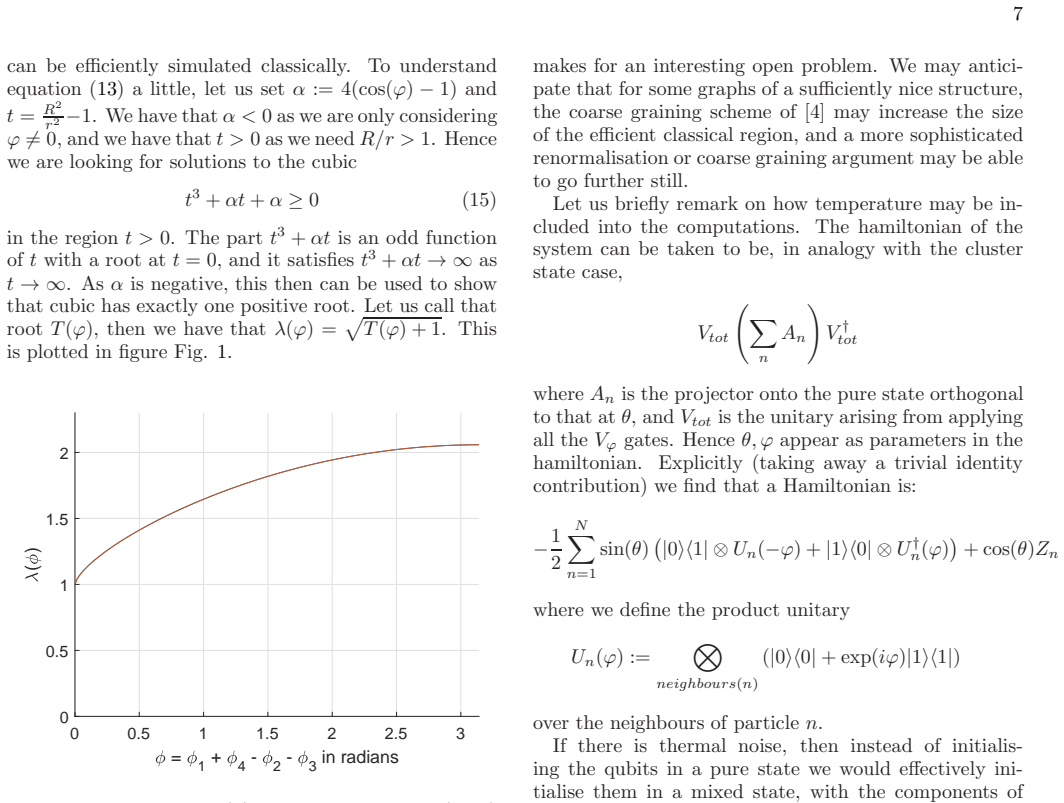


read the original abstract
In a recent work arXiv:2201.07655v2 we showed that there is a constant $\lambda >0$ such that it is possible to efficiently classically simulate a quantum system in which (i) qudits are placed on the nodes of a graph, (ii) each qudit undergoes at most $D$ diagonal gates, (iii) each qudit is destructively measured in the computational basis or bases unbiased to it, and (iv) each qudit is initialised within $\lambda^{-D}$ of a diagonal state according to a particular distance measure. In this work we explicitly compute $\lambda$ for any two qubit diagonal gate, thereby extending the computation of arXiv:2201.07655v2 beyond CZ gates. For any finite degree graph this allows us to describe a two parameter family of pure entangled quantum states (or three parameter family of thermal states) which have a non-trivial classically efficiently simulatable "phase" for the permitted measurements, even though other values of the parameters may enable ideal cluster state quantum computation. The main the technical tool involves considering separability in terms of "cylindrical" sets of operators. We also consider whether a different choice of set can strengthen the algorithm, and prove that they are optimal among a broad class of sets, but also show numerically that outside this class there are choices that can increase the size of the classically efficient regime.
Editorial analysis
A structured set of objections, weighed in public.
Referee Report
Summary. The manuscript extends the authors' prior result (arXiv:2201.07655v2) by explicitly computing the constant λ > 0 for arbitrary two-qubit diagonal gates. In the model, qudits on a graph undergo at most D such gates, are initialized within λ^{-D} of a diagonal state under a stated distance measure, and are measured in the computational basis or unbiased bases. Using separability with respect to cylindrical sets of operators, the work identifies a two-parameter family of pure entangled states (or three-parameter family of thermal states) on finite-degree graphs that remain classically efficiently simulatable, even though other parameter values permit ideal cluster-state quantum computation. The cylindrical sets are shown to be optimal inside a broad class, with numerical evidence that superior sets exist outside it.
Significance. If the explicit λ computation holds, the result supplies concrete, gate-specific thresholds that delineate classically simulatable regimes in MBQC, thereby sharpening the boundary between efficient classical simulation and potential quantum advantage. Credit is due for the parameter-free derivation of λ via the cylindrical-set construction and for the accompanying optimality proof within the stated class together with numerical checks outside it; these features make the simulatable phase directly usable for any diagonal gate.
minor comments (2)
- [Abstract] Abstract: the sentence 'The main the technical tool involves...' contains a duplicated word and should read 'The main technical tool involves...'.
- [§2 (or equivalent)] The distance measure used for the λ^{-D} initialization bound is referenced to the prior work but its explicit form and triangle-inequality properties are not restated; a brief self-contained definition in §2 or an appendix would improve readability without altering the central argument.
Simulated Author's Rebuttal
We thank the referee for their positive summary of our manuscript, the recognition of its significance in providing explicit, gate-specific thresholds for classical simulability in MBQC, and the recommendation of minor revision. The referee's description accurately reflects the extension of our prior work to arbitrary diagonal two-qubit gates via the cylindrical-set construction.
Circularity Check
Minor self-citation of framework; explicit λ computation independent
full rationale
The paper cites arXiv:2201.07655v2 solely for the existence of some λ>0 and the overall simulation framework (initialization bound, permitted measurements, graph structure). The central new contribution—an explicit computation of λ for arbitrary two-qubit diagonal gates via separability with respect to cylindrical operator sets—is presented as a direct calculation that does not reduce to any fitted parameter or equation taken from the cited work. The manuscript further proves optimality of the chosen sets inside a stated broad class and supplies numerical evidence of better sets outside that class, confirming that the size of the classically efficient regime is not forced by prior self-citations. No self-definitional step, fitted-input prediction, or load-bearing uniqueness theorem appears in the derivation chain.
Axiom & Free-Parameter Ledger
axioms (2)
- domain assumption Existence of a constant λ > 0 such that systems with initial states within λ^{-D} of diagonal states admit efficient classical simulation (from arXiv:2201.07655v2)
- standard math Standard definitions of separability for sets of operators on qudits
Reference graph
Works this paper leans on
-
[1]
[”,“]”, reserving curved brackets “(
(roughly speaking the idea that entanglement may be considered relative to a privileged set of observables) may be used to develop efficient classical algorithms for classes of entangled quantum system [4, 13–17] that are not amenable to other methods. We will primarily build upon the work of [4], in which we developed a generalised separability based algor...
-
[2]
where ϕ = ϕ 4 +ϕ 1 − ϕ 2 − ϕ 3. Hence w.l.o.g. we may consider two qubit diagonal unitaries of this controlled-phase form, so that ϕ is the only free parameter. ■ As local diagonal unitaries do not affect our arguments, we will consider unitaries of the form ( 3). In the case of qubits, we define a ‘cylinder of radius r’ as the following set of normalised (...
-
[3]
Proof: Our goal is to establish whether the output is Cyl(RA), Cyl(RB)-separable
We refer to an operator of the form of equation ( 5) as being Cyl(RA), Cyl(RB)-separable. Proof: Our goal is to establish whether the output is Cyl(RA), Cyl(RB)-separable. Forϕ = 0 the entangling gate Vϕ is the identity and the output is trivially separable as long as fA,f B ≤ 1. So in the remainder of the proof we only consider ϕ ̸= 0. As Vϕ is a linear ...
-
[4]
Since UA ⊗ UB commutes with Vϕ and cylin- ders are invariant under Z rotations, we have the Cyl(rA), Cyl(rB)-separable decomposition: Vϕ ( UAρAU † A ⊗ UBρBU † B ) V † ϕ = ∑ i piUAω i AU † A ⊗ UBω i BU † B where ω i k ∈ Cyl(Rk). This shows that the decom- position (7) is invariant up to local Z-rotations, and hence we may restrict our attention to inputs t...
-
[5]
DefiningUϕ := exp(−iϕ/ 2)|0⟩⟨0|+ exp(iϕ/ 2)|1⟩⟨1|, we have the identity Vϕ (X ⊗ X) = (X ⊗ UϕX)Vϕ
If both inputs havez = − 1, then the input extrema: [1,r A, 0, − 1] ⊗ [1,r B, 0, − 1] can be expressed as X ⊗ X ([1,r A, 0, 1] ⊗ [1,r B, 0, 1])X † ⊗ X †. DefiningUϕ := exp(−iϕ/ 2)|0⟩⟨0|+ exp(iϕ/ 2)|1⟩⟨1|, we have the identity Vϕ (X ⊗ X) = (X ⊗ UϕX)Vϕ. Applying this to ( 7), we arrive at: Vϕ ( Xρ AX † ⊗ Xρ BX †) V † ϕ = ∑ i piXω i AX † ⊗ UϕXω i B(UϕX)† 5 Th...
-
[6]
Next, consider input states of the form [1,r A, 0, 1] ⊗ [1,r B, 0, − 1] and [1,r A, 0, − 1] ⊗ [1,r B, 0, 1]. As Vϕ is symmetric between the two input states, we can switch the control and target state, there- fore we need only consider one input extremum where the z-components are are not the same
-
[7]
At this stage, we have managed to reduce the inputs we need to consider to just two inputs [1,r A, 0, 1] ⊗ [1,r B, 0, ± 1]. However it will be convenient to note that because of the identity Vϕ(I ⊗ X) = eiϕ/2(Uϕ ⊗ X)V−ϕ, checking the separability of the output correspond- ing to [1 ,r A, 0, 1] ⊗ [1,r B, 0, − 1] can instead be achieved by considering the o...
-
[8]
can be expressed in the Pauli basis as (the quickest way to com- pute this is to note that terms X ⊗ (I +Z), (I +Z)⊗ I,Z ⊗ Z,I ⊗Z,Z ⊗I,I ⊗I are all invariant under transformation byVϕ, so one only needs to compute Vϕ(X ⊗ X)V † ϕ ): 1 rB 0 1 rA rArB(cos (ϕ ) + 1)/ 2 rArB sin(ϕ )/ 2 rA 0 rArB sin(ϕ )/ 2 rArB(1 − cos (ϕ ))/ 2 0 1 rB 0 1 Our task ...
-
[9]
is Cyl (1) , Cyl (1)-separable. Following similar reasoning to [4], we will now see that determining whether equation ( 8) is Cyl(1), Cyl(1)- separable is equivalent to checking quantum separability of a different two-qubit operator. First, suppose that we have a quantum separable decomposition ∑ i pi[1,x i A,y i A,z i A] ⊗ [1,x i B,y i B,z i B] for the fo...
-
[10]
by setting the coefficients corresponding to at least one Z operator to zero): 1 fB 0 0 fA fAfB (cos (ϕ ) + 1)/ 2 fAfB sin (ϕ )/ 2 0 0 fAfB sin (ϕ )/ 2 fAfB (1 − cos (ϕ ))/ 2 0 0 0 0 0 (10) Now given such a decomposition, then by taking this de- composition and resetting zi A =zi B = 1 for all i, it follows that ∑ i pi[1,x i A,y i A, 1] ⊗ [1,x i...
-
[11]
is quantum separable. In order for it to be quantum separable, it must be both positive and a PPT (‘positive partial transpose’ [6]) op- erator. However for operators of the form of (
-
[12]
the partial transpose with respect to particle A can simply be implemented by applying an X ⊗ I transformation. This means that the operator ( 10) and its partial trans- position have identical eigenvalues, and we merely need to check that one of them is positive semi-definite. It is convenient to re-express (
-
[13]
as: (I +fAX) ⊗ (I +fBX) +fAfB(e−iϕ − 1)|00⟩⟨11| +fAfB(eiϕ − 1)|11⟩⟨00|. To simplify notation we set fAfB(eiϕ − 1) = ceiγ, where c> 0 can be taken to be positive as by assumption ϕ ̸= 0. We also note that this implies that eiϕ − 1 has a strictly negative real component, and hence c cos(γ)< 0. Hence (10) becomes: (I +fAX) ⊗ (I +fBX) +c ( e−iγ|00⟩⟨11|+eiγ|11...
-
[14]
In this case it is impossible to be separable, because (for example) from equa- tion (
fA> 1 and/or fB > 1. In this case it is impossible to be separable, because (for example) from equa- tion (
-
[15]
we see that the expected value of X ⊗ I or I ⊗ X would be greater than 1, which is impossible for a separable quantum state
-
[16]
Assume that fA = 1 (if instead fB = 1 the argument is identical by sym- metry)
fA = 1 and/or fB = 1. Assume that fA = 1 (if instead fB = 1 the argument is identical by sym- metry). This means that the term ( I +fAX) ⊗ (I +fBX) has at least two zero eigenvalues, with eigenstates | − −⟩ and | − +⟩. Computing the first of these overlaps gives: ⟨− − | c ( eiγ|00⟩⟨11|+ce−iγ|11⟩⟨00| ) | − −⟩ = c 2 cos(γ). Under our assumption that ϕ ̸= 0 t...
-
[17]
The final possibility is fA,f B < 1. Let us define two operators K := (I +fAX) ⊗ (I +fBX) +c (|00⟩⟨00|+ |11⟩⟨11|) and L := −c ( |00⟩⟨00|+ |11⟩⟨11| −e−iγ|00⟩⟨11| −eiγ|11⟩⟨00| ) Then we have that equation ( 12) can be re- expressed as: K +L as this corresponds to simply adding and subtract- ing c (|00⟩⟨00|+ |11⟩⟨11|) to equation ( 12). We now note that K is a...
-
[18]
can have at most one nega- tive eigenvalue. Hence, under the assumption that fA,f B < 1, we have a separable decomposition iff the determinant of (
-
[19]
As the de- terminant is given by equation ( 6) this establishes the lemma
is non-negative. As the de- terminant is given by equation ( 6) this establishes the lemma. V. CLASSICALLY EFFICIENT PHASES, WITH CLUSTER STATE MEASUREMENTS We now discuss how the above lemma can be used to determine an efficiently classically simulatable ‘phase’ for a family of systems with two parameters r ∈ [0, 1],ϕ ∈ [0, 2π ). In particular, suppose tha...
-
[20]
states with Bloch vectors [x,y,z ] such that x2 +y2 ≤ r2 - are placed at the nodes of a graph
Qubits drawn from Cyl( r) - i.e. states with Bloch vectors [x,y,z ] such that x2 +y2 ≤ r2 - are placed at the nodes of a graph
-
[21]
Each qubit undergoes at most D gates Vϕ
-
[22]
Each qubit is then measured adaptively in the com- putational basis or equatorial bases. We will apply the lemma, following the approach of [4], to derive a region of r,ϕ for which the system can be efficiently simulated classically, in the sense of sampling to within an arbitrary fixed total variational distance in polynomial time. We begin by considering t...
-
[23]
in the sym- metric case fA = fB = f . In this case the determinant simplifies to: ( 1 − f 2) ( ( 1 − f 2) 3 + 4(cos(ϕ ) − 1)f 4 ) As 1 − f 2 is always positive (apart from f = 1, which we are excluding when ϕ ̸= 0), we have separability if and only if: ( 1 − f 2) 3 + 4(cos(ϕ ) − 1)f 4 ≥ 0 In terms of the ratios R/r this can be written as (also multiplying ...
-
[24]
We have that α< 0 as we are only considering ϕ ̸= 0, and we have that t> 0 as we needR/r> 1
a little, let us set α := 4(cos(ϕ ) − 1) and t = R2 r2 − 1. We have that α< 0 as we are only considering ϕ ̸= 0, and we have that t> 0 as we needR/r> 1. Hence we are looking for solutions to the cubic t3 +αt +α ≥ 0 (15) in the region t> 0. The part t3 +αt is an odd function of t with a root at t = 0, and it satisfies t3 +αt → ∞ as t → ∞ . As α is negative,...
-
[25]
would then become { (ϕ,θ,T ) ⏐ ⏐ ⏐ ⏐θ ≤ sin−1 ( λ(ϕ )−D 1 − 2pT )} Local dephasing noise can be handled in a similar way - it simply changes the effective size of the starting cylinder that we can efficiently simulate, making it larger. We note that while incorporating noise/temperature in this way is straightforward, we anticipate that other methods such as...
-
[26]
The initial state |ψ ⟩ is con- tained within B(r, √ 1 − r2) ⊂ B(r, 1) = Cyl( r). In the previous classical simulation we found that two elements of Cyl(r), after a CZ gate, would be separable w.r.t. a bigger cylinder Cyl(λ(π )r). However, we have found nu- merically for most values of r that when two elements of B(r, √ 1 − r2) undergo a CZ gate, then they...
-
[27]
R. Raussendorf and H.J. Briegel, A One-Way Quantum Computer. Phys. Rev. Lett. 86, 5188 (2001)
work page 2001
-
[28]
S. Barrett, S. Bartlett, A. Doherty, D. Jennings, D. & T. Rudolph, Transitions in the computational power of thermal states for measurement-based quantum compu- tation. Physical Review A . 80, 062328 (2009)
work page 2009
-
[29]
Browne, D., Elliott, M., Flammia, S., Merkel, S., Miyake, A. & Short, A. Phase transition of computational power in the resource states for one-way quantum computation. New Journal Of Physics . 10, 023010 (2008)
work page 2008
-
[30]
S. Atallah, M. Garn, S. Jevtic, Y. Tao, and S. Virmani, Efficient classical simulation of cluster state quantum cir- cuits with alternative inputs, arXiv:2201.07655
-
[31]
https://en.wikipedia.org/wiki/Weyl%27s inequality
-
[32]
A. Peres, . Separability Criterion for Density Matrices. Phys. Rev. Lett. 77 (8): 1413 (1996); M. Horodecki, P. Horodecki, and R. Horodecki, Separability of mixed states: necessary and sufficient conditions. Phys. Lett. A. 223 (1–2): 1–8. (1996)
work page 1996
-
[33]
Mora, C., Piani, M., Miyake, A., Van den Nest, M., D¨ ur, W. & Briegel, H. Universal resources for approx- imate and stochastic measurement-based quantum com- putation. Physical Review A . 81, 042315 (2010)
work page 2010
-
[34]
M. Van den Nest, A. Miyake, W. D¨ ur, H. J. Briegel, Uni- versal Resources for Measurement-Based Quantum Com- putation. Phys. Rev. Lett. 97, 150504 (2006)
work page 2006
-
[35]
F. Verstraete and J.I. Cirac, Valence-bond states for quantum computation. Phys. Rev. A 70, 060302(R) (2004)
work page 2004
-
[36]
D. Gross and J. Eisert, Novel Schemes for Measurement- Based Quantum Computation. Phys. Rev. Lett. 98, 220503 (2007)
work page 2007
-
[37]
A. Harrow and M. Nielsen, Robustness of quantum gates in the presence of noise. Phys. Rev. A 68, 012308 (2003)
work page 2003
- [38]
- [39]
-
[40]
N. Ratanje and S. Virmani, Generalized state spaces and nonlocality in fault-tolerant quantum-computing schemes. Phys. Rev. A 83 032309 (2011)
work page 2011
-
[41]
N. Ratanje and S. Virmani, Exploiting non-quantum entanglement to widen applicability of limited- entanglement classical simulations of quantum systems. arXiv:1201.0613v1
work page internal anchor Pith review Pith/arXiv arXiv
-
[42]
H. Anwar, S Jevtic, O. Rudolph, and S. Virmani, Families of pure PEPS with efficiently simulatable lo- cal hidden variable models for most measurements. arXiv:1412.3780v2
work page internal anchor Pith review Pith/arXiv arXiv
-
[43]
H. Anwar, S Jevtic, O. Rudolph, and S. Virmani, Small- est disentangling state spaces for general entangled bi- partite quantum states. New J. Phys. 17 093047 (2015); H. Anwar, S Jevtic, O. Rudolph, and S. Virmani, Gen- 12 eralised versions of separable decompositions applicable to bipartite entangled quantum states. New J. Phys. 21 093031 (2019)
work page 2015
-
[44]
D. Aharonov and M. Ben-Or, Polynomial simula- tions of decohered quantum computers, Proceedings of 37th Conference on Foundations of Computer Sci- ence, Burlington, VT, USA, 1996, pp. 46-55, doi: 10.1109/SFCS.1996.548463
-
[45]
S. Aaronson and D. Gottesman, Improved simulation of stabilizer circuits. Phys. Rev. A 70 (5): 052328, (2004)
work page 2004
-
[46]
B. M. Terhal and D. P. DiVincenzo, Classical simulation of noninteracting-fermion quantum circuits. Phys. Rev. A, 65(3):032325, (2002)
work page 2002
-
[47]
S. Popescu and D. Rohrlich, Generic quantum nonlocal- ity. Phys. Lett. A 166, 293 (1992)
work page 1992
-
[48]
R. Jozsa and N. Linden, On the role of entanglement in quantum-computational speed-up. Proc. Roy. Soc. A , 459 2036 (2003)
work page 2036
-
[49]
M. A. Nielsen, Cluster-state quantum computation. Rep. Math. Phys. 57 147–61 (2006)
work page 2006
-
[50]
N. Yoran and A. J. Short, Classical Simulation of Limited-Width Cluster-State Quantum Computation. Phys. Rev. Lett. 96, 170503 (2006)
work page 2006
-
[51]
I. L. Markov and Y. Shi, Simulating Quantum Computa- tion by Contracting Tensor Networks. SIAM Journal on Computing, 38(3):963-981, (2008)
work page 2008
-
[52]
M. B. Hastings, An area law for one dimensional quan- tum systems. J. Stat. Mech. , 2007:08024, (2007)
work page 2007
-
[53]
S. Virmani, S. F. Huelga, and M. B. Plenio, Classical simulability, entanglement breaking, and quantum com- putation thresholds. Phys. Rev. A , 71, 042328 (2005)
work page 2005
-
[54]
Van den Nest, M., D¨ ur, W., Vidal, G. & Briegel, H. Classical simulation versus universality in measurement- based quantum computation. Physical Review A . 75, 012337 (2007)
work page 2007
-
[55]
On the simulation of quantum circuits
Jozsa, R. On the simulation of quantum circuits. ArXiv Preprint quant-ph/0603163. (2006)
work page internal anchor Pith review Pith/arXiv arXiv 2006
-
[56]
A. Kissinger, J. van de Wetering, Universal MBQC with generalised parity-phase interactions and Pauli measure- ments. Quantum 3, 134 (2019)
work page 2019
-
[57]
Miyake, Quantum Computation on the Edge of a Symmetry-Protected Topological Order
A. Miyake, Quantum Computation on the Edge of a Symmetry-Protected Topological Order. Phys. Rev. Lett. 105, 040501 (2010)
work page 2010
-
[58]
J. Miller and A. Miyake, Resource Quality of a Symmetry-Protected Topologically Ordered Phase for Quantum Computation. Phys. Rev. Lett. 114, 120506 (2015)
work page 2015
-
[59]
D. V. Else, I. Schwarz, S. D. Bartlett, and A. C. Doherty, Symmetry-Protected Phases for Measurement- Based Quantum Computation. Phys. Rev. Lett. 108, 240505 (2012)
work page 2012
-
[60]
R. Raussendorf, A. Prakash, D. S. Wang, T. C.Wei, D. T. Stephen, Symmetry-protected topological phases with uniform computational power in one dimension. Phys. Rev. A 96, 012302 (2017)
work page 2017
-
[61]
R. Raussendorf, C. Okay, D. S. Wang, D. T. Stephen, and H. Poulsen Nautrup, Computationally Universal Phase of Quantum Matter. Phys. Rev. Lett. 122, 090501 (2019)
work page 2019
-
[62]
R Raussendorf, J. Harrington, and K. Goyal, Topologi- cal fault-tolerance in cluster state quantum computation. New J. Phys. 9 199 (2007)
work page 2007
-
[63]
Consider a fault tolerant construction of cluster state quantum computation, such as [36]. Now replace each initial qubit |+⟩ state with a ‘bag’ of n physical qubits each prepared in |ψ⟩ := cos( θ/2)|0⟩ + sin( θ/2)|1⟩. The state |ψ⟩⊗n can be expressed as a sum of even and odd parity states, with amplitudes that equalise in magni- tude as n is increased. N...
-
[64]
J. Walgate, A. J. Short, L. Hardy, and V. Vedral, Local Distinguishability of Multipartite Orthogonal Quantum States. Phys. Rev. Lett. 85, 4972 (2000)
work page 2000
-
[65]
S. Virmani, M. F. Sacchi, M. B. Plenio, D. Markham. Op- timal local discrimination of two multipartite pure states , Phys. Lett. A. 288 62 (2001)
work page 2001
-
[66]
M. Garn, Y. Tao, and S. Virmani, in preparation
discussion (0)
Sign in with ORCID, Apple, or X to comment. Anyone can read and Pith papers without signing in.