Revealing fingerprints of valence excitons in x-ray absorption spectra with the Bethe-Salpeter equation
Pith reviewed 2026-05-24 03:13 UTC · model grok-4.3
The pith
An ab initio Bethe-Salpeter equation framework models x-ray absorption spectra to reveal fingerprints of valence excitons in pump-probe experiments.
A machine-rendered reading of the paper's core claim, the machinery that carries it, and where it could break.
Core claim
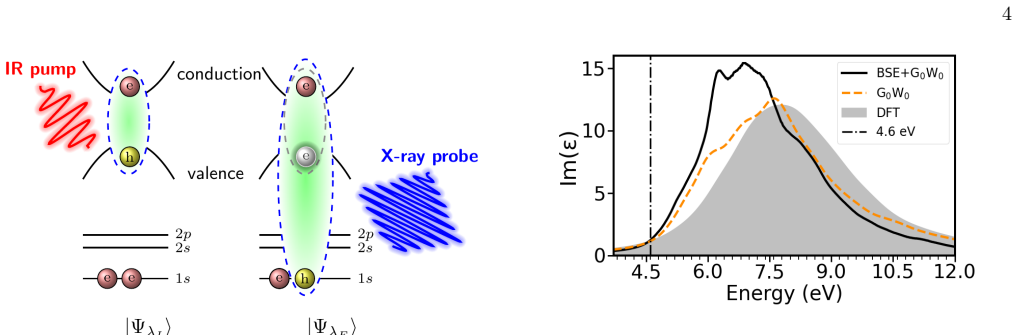
We developed an ab initio framework based on the BSE to describe a pump-probe experiment, in which an x-ray pulse probes solid-state valence excitons by means of x-ray absorption spectroscopy. Our theoretical framework is of relevance for an accurate modeling of pump-probe experiments of photo-excited materials that utilize novel capabilities offered by x-ray science.
What carries the argument
The Bethe-Salpeter equation extended to compute x-ray absorption spectra in the presence of photo-excited valence excitons.
Load-bearing premise
The Bethe-Salpeter equation remains sufficiently accurate when extended to model x-ray absorption in a pump-probe setup on photo-excited materials without requiring additional empirical adjustments or unstated approximations.
What would settle it
Direct comparison between the x-ray absorption spectra computed by the framework and measured spectra from a pump-probe experiment on a chosen photo-excited solid would confirm or refute the central claim.
Figures




read the original abstract
The Bethe-Salpeter equation (BSE) is a powerful theoretical approach that is capable to accurately treat electron-hole interactions in materials in an excited state. We developed an ab initio framework based on the BSE to describe a pump-probe experiment, in which an x-ray pulse probes solid-state valence excitons by means of x-ray absorption spectroscopy. Our theoretical framework is of relevance for an accurate modeling of pump-probe experiments of photo-excited materials that utilize novel capabilities offered by x-ray science.
Editorial analysis
A structured set of objections, weighed in public.
Referee Report
Summary. The manuscript develops an ab initio framework based on the Bethe-Salpeter equation (BSE) to model a pump-probe x-ray absorption spectroscopy (XAS) experiment, in which an x-ray pulse probes valence excitons in photo-excited solid-state materials. The framework is presented as relevant for accurate modeling of such experiments utilizing novel x-ray capabilities.
Significance. If the framework proves accurate and transferable, it could offer a useful theoretical tool for interpreting time-resolved XAS data on non-equilibrium excited states in solids, extending standard BSE applications to pump-probe setups. The abstract supplies no derivations, validation data, error analysis, or comparisons, limiting assessment of whether the extension requires unstated approximations or empirical adjustments.
major comments (1)
- The abstract states that the framework was developed but supplies no derivations, validation data, error analysis, or comparisons with existing methods or experimental data. Without these, it is not possible to verify whether the BSE remains sufficiently accurate in the non-equilibrium extension without additional adjustments.
Simulated Author's Rebuttal
We thank the referee for their comments on our manuscript. The primary concern raised is addressed point-by-point below by clarifying the scope of the abstract versus the full manuscript content.
read point-by-point responses
-
Referee: The abstract states that the framework was developed but supplies no derivations, validation data, error analysis, or comparisons with existing methods or experimental data. Without these, it is not possible to verify whether the BSE remains sufficiently accurate in the non-equilibrium extension without additional adjustments.
Authors: Abstracts are by design concise summaries and do not contain derivations, data, or detailed analysis. The full manuscript provides these elements: the derivation of the BSE framework extended to non-equilibrium valence excitons is given in Sections II and III; validation through direct comparisons to standard equilibrium BSE results and available experimental XAS data appears in Section IV; quantitative error analysis and discussion of accuracy/transferability without empirical adjustments is presented in Section V; and comparisons to other theoretical approaches are in Section VI. These sections allow verification that the non-equilibrium extension preserves the accuracy of the BSE without additional adjustments. revision: no
Circularity Check
No significant circularity detected
full rationale
The abstract and available description present the development of an ab initio BSE-based framework for pump-probe XAS on photo-excited solids as a standard extension of the Bethe-Salpeter equation without any equations, fitted parameters, self-citations, or derivation steps shown. No load-bearing claim reduces to its own inputs by construction, no predictions are statistically forced from subsets of data, and no uniqueness theorems or ansatzes are imported via self-citation. The central claim remains self-contained against external benchmarks with no visible internal reduction, qualifying as an honest non-finding.
Axiom & Free-Parameter Ledger
axioms (1)
- domain assumption The Bethe-Salpeter equation accurately treats electron-hole interactions in materials in an excited state.
Reference graph
Works this paper leans on
-
[1]
Independent particle approximation for optically-excited states Eq. (3) implies that both valence-excited states cre- ated by a pump pulse and core-excited states created by a probe pulse are obtained with the BSE. We now derive the signal by describing only core-excited states within the BSE and valence-excited states within the independent-particle appr...
-
[2]
F. De Groot and A. Kotani, Core level spectroscopy of solids (CRC press, 2008)
work page 2008
-
[3]
J. Yano and V. K. Yachandra, X-ray absorption spec- troscopy, Photosynthesis research 102, 241 (2009)
work page 2009
-
[4]
L. Baumgarten, X-ray absorption spectroscopy, Scatter- ing Methods for Condensed Matter Research: Towards Novel Applications at Future Sources, J¨ ulich (Germany) 33, F4.1 (2012)
work page 2012
-
[5]
K. Ramasesha, S. R. Leone, and D. M. Neumark, Real- time probing of electron dynamics using attosecond time- resolved spectroscopy, Annual Review of Physical Chem- istry 67, 41 (2016)
work page 2016
-
[6]
F. G. Santomauro, J. Grilj, L. Mewes, G. Nedelcu, S. Yakunin, T. Rossi, G. Capano, A. Al Haddad, J. Bu- darz, D. Kinschel, D. S. Ferreira, G. Rossi, M. Gutier- rez Tovar, D. Grolimund, M. Samson, Valerieand Nachte- gaal, G. Smolentsev, M. Kovalenko V, and M. Chergui, Localized holes and delocalized electrons in photoexcited inorganic perovskites: Watching...
work page 2017
-
[7]
M. Fracchia, P. Ghigna, A. Vertova, S. Rondinini, and A. Minguzzi, Time-resolved x-ray absorption spec- troscopy in (photo) electrochemistry, Surfaces 1, 138 (2018)
work page 2018
- [8]
-
[9]
D. Garratt, L. Misiekis, D. Wood, E. Witting-Larsen, M. Matthews, O. Alexander, P. Ye, S. Jarosch, A. Bakulin, T. Penfold, and J. Marangos, Ultrafast ex- citon dynamics in poly(3-hexylthiophene) probed with time resolved x-ray absorption spectroscopy at the car- bon k-edge, 2021 Conference on Lasers and Electro- Optics Europe and European Quantum Electron...
work page 2021
-
[10]
D. Garratt, L. Misiekis, D. Wood, E. W. Larsen, M. Matthews, O. Alexander, P. Ye, S. Jarosch, C. Fer- chaud, C. Str¨ uber, A. S. Johnson, A. A. Bakulin, and J. P. Penfold, T. J. Marangos, Direct observation of ul- trafast exciton localization in an organic semiconductor with soft x-ray transient absorption spectroscopy, Nature Communications 13, 3414 (2022)
work page 2022
-
[11]
P. Hillyard, S. Kuchibhatla, T. Glover, M. Hertlein, N. Huse, P. Nachimuthu, L. Saraf, S. Thevuthasan, and K. Gaffney, Atomic resolution mapping of the excited- state electronic structure of cu2o with time-resolved x-ray absorption spectroscopy, Physical Review B 80, 125210 (2009)
work page 2009
-
[12]
T. Palmieri, E. Baldini, A. Steinhoff, A. Akrap, M. Koll´ ar, E. Horv´ ath, L. Forr´ o, F. Jahnke, and M. Cher- gui, Mahan excitons in room-temperature methylammo- nium lead bromide perovskites, Nature communications 11, 850 (2020)
work page 2020
-
[13]
M. Z¨ urch, H.-T. Chang, L. J. Borja, P. M. Kraus, S. K. Cushing, A. Gandman, C. J. Kaplan, M. H. Oh, J. S. Prell, D. Prendergast, C. D. Pemmaraju, D. M. Neu- mark, and S. R. Leone, Direct and simultaneous obser- vation of ultrafast electron and hole dynamics in germa- nium, Nature Communications 8, 15734 (2017)
work page 2017
-
[14]
D. Garratt, M. Matthews, and J. Marangos, Toward ul- trafast soft x-ray spectroscopy of organic photovoltaic de- vices, Structural Dynamics 11, 010901 (2024)
work page 2024
-
[15]
E. E. Salpeter and H. A. Bethe, A relativistic equation for bound-state problems, Physical Review 84, 1232 (1951)
work page 1951
-
[16]
G. Strinati, Application of the green’s functions method to the study of the optical properties of semiconductors, La Rivista del Nuovo Cimento 11, 1 (1988)
work page 1988
- [17]
- [18]
-
[19]
X. Gui, C. Holzer, and W. Klopper, Accuracy assessment of gw starting points for calculating molecular excitation energies using the bethe–salpeter formalism, Journal of Chemical Theory and Computation 14, 2127 (2018)
work page 2018
-
[20]
F. Bruneval, S. M. Hamed, and J. B. Neaton, A system- atic benchmark of the ab initio bethe-salpeter equation approach for low-lying optical excitations of small organic molecules, The Journal of Chemical Physics 142 (2015)
work page 2015
-
[21]
D. Jacquemin, I. Duchemin, and X. Blase, Is the bethe- salpeter formalism accurate for excitation energies? com- parisons with td-dft, caspt2, and eom-ccsd, The Journal of Physical Chemistry Letters 8, 1524 (2017)
work page 2017
-
[22]
A. Gulans, S. Kontur, C. Meisenbichler, D. Nabok, P. Pavone, S. Rigamonti, S. Sagmeister, U. Werner, and C. Draxl, Exciting: a full-potential all-electron package implementing density-functional theory and many-body perturbation theory, Journal of Physics: Condensed Mat- ter 26, 363202 (2014)
work page 2014
-
[23]
C. Draxl and C. Cocchi, exciting core-level spectroscopy, International Tables for Crystallography 1 (2020)
work page 2020
-
[24]
D. Sangalli, M. D’Alessandro, and C. Attaccalite, Exciton-exciton transitions involving strongly bound ex- citons: An ab initio approach, Physical Review B 107, 205203 (2023)
work page 2023
-
[25]
A. Pic´ on, L. Plaja, and J. Biegert, Attosecond x-ray transient absorption in condensed-matter: a core-state- resolved bloch model, New Journal of Physics 21, 043029 (2019)
work page 2019
-
[26]
G. Cistaro, M. Malakhov, J. J. Esteve-Paredes, A. J. Ur´ ıa-´Alvarez, R. E. F. Silva, F. Mart´ ın, J. J. Palacios, and A. Pic´ on, Theoretical approach for electron dynamics and ultrafast spectroscopy (edus), Journal of Chemical Theory and Computation 19, 333 (2023)
work page 2023
-
[27]
M. Malakhov, G. Cistaro, F. Mart´ ın, and A. Pic´ on, Ex- citon migration in two-dimensional materials, Communi- cations Physics 7, 196 (2024)
work page 2024
- [28]
-
[29]
J. Vinson, Advances in the ocean-3 spectroscopy package, Physical Chemistry Chemical Physics 24, 12787 (2022)
work page 2022
-
[30]
A. D. Dutoi, K. Gokhberg, and L. S. Cederbaum, Time- resolved pump-probe spectroscopy to follow valence elec- tronic motion in molecules: Theory, Phys. Rev. A 88, 12 013419 (2013)
work page 2013
-
[31]
A. S. Skeidsvoll, A. Balbi, and H. Koch, Time-dependent coupled-cluster theory for ultrafast transient-absorption spectroscopy, Phys. Rev. A 102, 023115 (2020)
work page 2020
-
[32]
K. Khalili, L. Inhester, C. Arnold, A. S. Gert- sen, J. W. Andreasen, and R. Santra, Simulation of time-resolved x-ray absorption spectroscopy of ultra- fast dynamics in particle-hole-excited 4-(2-thienyl)-2,1,3- benzothiadiazole, Structural Dynamics 7, 044101 (2020)
work page 2020
-
[33]
F. Rott, M. Reduzzi, T. Schnappinger, Y. Kobayashi, K. F. Chang, H. Timmers, D. M. Neumark, R. d. Vivie- Riedle, and S. R. Leone, Ultrafast strong-field dissocia- tion of vinyl bromide: An attosecond transient absorp- tion spectroscopy and non-adiabatic molecular dynamics study, Structural Dynamics 8, 034104 (2021)
work page 2021
-
[34]
M. Bockstedte, A. Marini, O. Pankratov, and A. Rubio, Many-body effects in the excitation spectrum of a defect in sic, Physical review letters 105, 026401 (2010)
work page 2010
-
[35]
W. M. Klahold, W. J. Choyke, and R. P. Devaty, High resolution optical spectroscopy of free exciton and elec- tronic band structure near the fundamental gap in 4h sic, in Materials Science Forum , Vol. 924 (Trans Tech Publ,
-
[36]
W. Klahold, W. Choyke, and R. Devaty, Band structure properties, phonons, and exciton fine structure in 4 h-sic measured by wavelength-modulated absorption and low- temperature photoluminescence, Physical Review B 102, 205203 (2020)
work page 2020
-
[37]
X. Zhang and E. Kioupakis, Phonon-assisted optical ab- sorption of sic polytypes from first principles, Physical Review B 107, 115207 (2023)
work page 2023
-
[38]
K. Demmouche and J. Coutinho, Electronic exchange- correlation, many-body effect issues on first-principles calculations of bulk sic polytypes, International Journal of Modern Physics B 32, 1850328 (2018)
work page 2018
-
[39]
X. Peng-Shou, X. Chang-Kun, P. Hai-Bin, and X. Fa- Qiang, Theoretical study on the band structure and opti- cal properties of 4h-sic, Chinese Physics 13, 2126 (2004)
work page 2004
-
[40]
A. de Oliveira, J. Freitas Jr, W. Moore, A. Silva, I. Pepe, J. Almeida, J. Os´ orio-Guill´ en, R. Ahuja, C. Persson, K. J¨ arrendahl, O. Lindquist, N. Edwards, and Q. Wa- hab, Spectroscopy studies of 4h-sic, Materials Research 6, 43 (2003)
work page 2003
- [41]
- [42]
-
[43]
W. Ching, Y.-N. Xu, P. Rulis, and L. Ouyang, The elec- tronic structure and spectroscopic properties of 3c, 2h, 4h, 6h, 15r and 21r polymorphs of sic, Materials Science and Engineering: A 422, 147 (2006)
work page 2006
-
[44]
S.-P. Gao, Band gaps and dielectric functions of cubic and hexagonal diamond polytypes calculated by many- body perturbation theory, physica status solidi (b) 252, 235 (2015)
work page 2015
-
[45]
O. Lindquist, K. J¨ arrendahl, S. Peters, J. Zettler, C. Co- bet, N. Esser, D. Aspnes, A. Henry, and N. Edwards, Ordinary and extraordinary dielectric functions of 4h– and 6h–sic from 3.5 to 9.0 ev, Applied Physics Letters 78, 2715 (2001)
work page 2001
-
[46]
G. L. Harris, Properties of silicon carbide , EMIS datare- views series (INSPEC, Institution of Electrical Engineers, 1995)
work page 1995
-
[47]
M. Tallarida, D. Schmeißer, F. Zheng, and F. Himpsel, X-ray absorption and photoemission spectroscopy of 3c- and 4h-sic, Surface science 600, 3879 (2006)
work page 2006
-
[48]
J. L¨ uning, S. Eisebitt, J.-E. Rubensson, C. Ellmers, and W. Eberhardt, Electronic structure of silicon carbide polytypes studied by soft x-ray spectroscopy, Physical Review B 59, 10573 (1999)
work page 1999
-
[49]
S. H. Park, A. Katoch, K. H. Chae, S. Gautam, P. Miedema, S. W. Cho, M. Kim, R.-P. Wang, M. Lazemi, F. de Groot, and S. Kwon, Direct and real-time observa- tion of hole transport dynamics in anatase tio2 using x- ray free-electron laser, Nature Communications 13, 2531 (2022)
work page 2022
-
[50]
C. J. Milne, N. Nagornova, T. Pope, H.-Y. Chen, T. Rossi, J. Szlachetko, W. Gawelda, A. Britz, T. B. van Driel, L. Sala, S. Ebner, T. Katayama, S. H. Southworth, G. Doumy, A. M. March, C. S. Lehmann, M. Mucke, D. Iablonskyi, Y. Kumagai, G. Knopp, K. Motomura, T. Togashi, S. Owada, M. Yabashi, M. M. Nielsen, M. Pa- jek, K. Ueda, R. Abela, T. J. Penfold, an...
-
[51]
R. Santra, Concepts in x-ray physics, Journal of Physics B: Atomic, Molecular and Optical Physics 42, 023001 (2008)
work page 2008
-
[52]
A. L. Fetter and J. D. Walecka,Quantum theory of many- particle systems (Courier Corporation, 2012)
work page 2012
-
[53]
M. Quintela, J. Henriques, and N. Peres, Theoretical methods for excitonic physics in two-dimensional mate- rials, physica status solidi (b) 259 (2022)
work page 2022
-
[54]
O. Karni, E. Barr´ e, V. Pareek, J. D. Georgaras, M. K. Man, C. Sahoo, D. R. Bacon, X. Zhu, H. B. Ribeiro, A. L. O’Beirne, J. Hu, A. Al-Mahboob, M. M. M. Abdelrasoul, N. S. Chan, A. Karmakar, A. J. Winchester, B. Kim, K. Watanabe, T. Taniguchi, K. Barmak, J. Mad´ eo, F. H. d. Jornada, T. F. Heinz, and K. M. Dani, Moir´ e- localized interlayer exciton wave...
-
[55]
M. K. Man, J. Mad´ eo, C. Sahoo, K. Xie, M. Campbell, V. Pareek, A. Karmakar, E. L. Wong, A. Al-Mahboob, N. S. Chan, D. R. Bacon, X. Zhu, M. M. M. Abdelrasoul, X. Li, T. F. Heinz, F. H. da Jornada, T. C. Cao, and K. M. Dani, Experimental measurement of the intrinsic excitonic wave function, Science advances 7, eabg0192 (2021)
work page 2021
-
[56]
G. Cistaro, M. Malakhov, J. J. Esteve-Paredes, A. J. Ur´ ıa-´Alvarez, R. E. Silva, F. Martin, J. J. Palacios, and A. Picon, Theoretical approach for electron dynamics and ultrafast spectroscopy (edus), Journal of Chemical The- ory and Computation 19, 333 (2022)
work page 2022
-
[57]
C. Vorwerk, F. Sottile, and C. Draxl, Excitation path- ways in resonant inelastic x-ray scattering of solids, Phys- ical Review Research 2, 042003 (2020)
work page 2020
-
[58]
S. Eric L, Ab initio inclusion of electron-hole attraction: Application to x-ray absorption and resonant inelastic x-ray scattering., Physical review letters 80 (1998)
work page 1998
-
[59]
John, Advances in the ocean-3 spectroscopy package., Physical Chemistry Chemical Physics 21 (2022)
V. John, Advances in the ocean-3 spectroscopy package., Physical Chemistry Chemical Physics 21 (2022). 13
work page 2022
-
[60]
S. Sagmeister and C. Ambrosch-Draxl, Time-dependent density functional theory versus bethe–salpeter equa- tion: an all-electron study, Physical Chemistry Chemical Physics 11, 4451 (2009)
work page 2009
-
[61]
P. Puschnig and C. Ambrosch-Draxl, Optical absorp- tion spectra of semiconductors and insulators including electron-hole correlations: An ab initio study within the lapw method, Physical Review B 66, 165105 (2002)
work page 2002
-
[62]
X. Leng, F. Jin, M. Wei, and Y. Ma, Gw method and bethe–salpeter equation for calculating electronic excita- tions, Wiley Interdisciplinary Reviews: Computational Molecular Science 6, 532 (2016)
work page 2016
-
[63]
C. Vorwerk, B. Aurich, C. Cocchi, and C. Draxl, Bethe- salpeter equation for absorption and scattering spec- troscopy: implementation in the exciting code, Electronic Structure 1, 037001 (2019)
work page 2019
-
[64]
F. Henneke, L. Lin, C. Vorwerk, C. Draxl, R. Klein, and C. Yang, Fast optical absorption spectra calculations for periodic solid state systems, Communications in Applied Mathematics and Computational Science 15, 89 (2020)
work page 2020
-
[65]
C. Vorwerk, F. Sottile, and C. Draxl, All-electron many- body approach to resonant inelastic x-ray scattering, Physical Chemistry Chemical Physics 24, 17439 (2022)
work page 2022
-
[66]
M. L. Urquiza, M. Gatti, and F. Sottile, Pseudopotential bethe-salpeter calculations for shallow-core x-ray absorp- tion near-edge structures: Excitonic effects in α- al 2 o 3, Physical Review B 107, 205148 (2023)
work page 2023
-
[67]
W. Olovsson, I. Tanaka, T. Mizoguchi, P. Puschnig, and C. Ambrosch-Draxl, All-electron bethe-salpeter calcula- tions for shallow-core x-ray absorption near-edge struc- tures, Physical Review B 79, 041102 (2009)
work page 2009
-
[68]
F. M. de Groot, H. Elnaggar, F. Frati, R.-p. Wang, M. U. Delgado-Jaime, M. van Veenendaal, J. Fernandez- Rodriguez, M. W. Haverkort, R. J. Green, G. van der Laan, Y. Kvashnin, A. Hariki, H. Ikeno, H. Ramanan- toanina, C. Daul, B. Delley, M. Odelius, M. Lundberg, O. Kuhn, S. I. Bokarev, E. Shirley, J. Vinson, K. Gilmore, M. Stener, G. Fronzoni, P. Decleva,...
work page 2021
-
[69]
A. L. Kutepov, Atomic forces from dirac–kohn–sham equations: implementation in flexible (apw+ lo/lapw)+ lo basis set, Journal of Physics: Condensed Matter 33, 235503 (2021)
work page 2021
- [70]
-
[71]
C. Stampfl, W. Mannstadt, R. Asahi, and A. J. Freeman, Electronic structure and physical properties of early tran- sition metal mononitrides: Density-functional theory lda, gga, and screened-exchange lda flapw calculations, Phys- ical Review B 63, 155106 (2001)
work page 2001
-
[72]
J.-H. Yuan, Q. Chen, L. R. Fonseca, M. Xu, K.-H. Xue, and X.-S. Miao, Gga-1/2 self-energy correction for ac- curate band structure calculations: the case of resistive switching oxides, Journal of Physics Communications 2, 105005 (2018)
work page 2018
- [73]
-
[74]
N. Salas-Illanes, D. Nabok, and C. Draxl, Electronic structure of representative band-gap materials by all- electron quasiparticle self-consistent g w calculations, Physical Review B 106, 045143 (2022)
work page 2022
-
[75]
Nomad database, dataset: pump-probe BSE+G0W0
-
[76]
K. Momma and F. Izumi, Vesta: a three-dimensional vi- sualization system for electronic and structural analysis, Journal of Applied crystallography 41, 653 (2008)
work page 2008
-
[77]
P. Wernet, Chemical interactions and dynamics with fem- tosecond x-ray spectroscopy and the role of x-ray free- electron lasers, Philosophical Transactions of the Royal Society A 377, 20170464 (2019)
work page 2019
discussion (0)
Sign in with ORCID, Apple, or X to comment. Anyone can read and Pith papers without signing in.