A discrete formulation for three-dimensional winding number
Pith reviewed 2026-05-24 02:43 UTC · model grok-4.3
The pith
A discrete formulation using θ-gaps computes the three-dimensional winding number W3 even when degeneracies are present.
A machine-rendered reading of the paper's core claim, the machinery that carries it, and where it could break.
Core claim
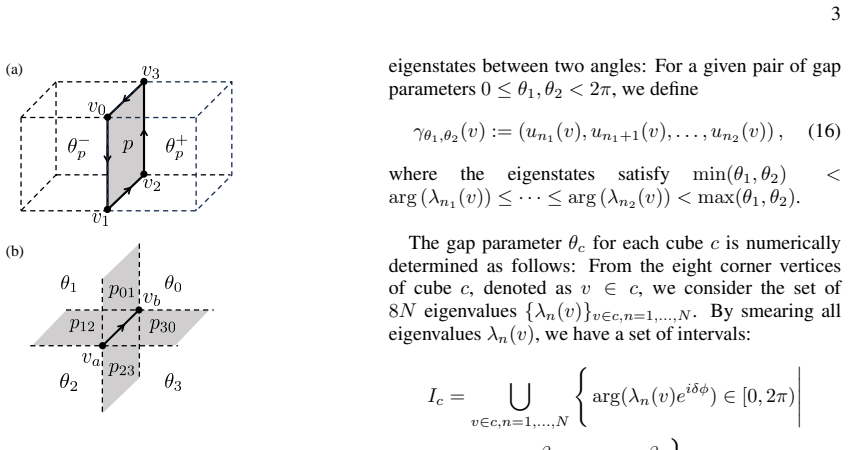
For a smooth map g: X → U(N), where X is a three-dimensional, oriented, and closed manifold, the winding number is defined as W3 = 1/(24π²) ∫_X Tr[(g^{-1} dg)^3]. We present a discrete formulation to compute W3 based on the concept of θ-gaps. Our approach provides a robust scheme that is directly applicable even to systems with accidental or symmetry-enforced degeneracies. Furthermore, we define two versions of the discrete flux: a simple unmodified flux that is highly practical and almost always quantized for fine grids, and a modified flux that strictly ensures integer quantization.
What carries the argument
θ-gaps, which identify local contributions on a discretized manifold that sum to the global winding number without topological loss even at degeneracy points.
If this is right
- The method applies directly to physical systems with degeneracies where continuous integrals fail.
- The simple unmodified flux is highly practical and yields near-quantized results on fine grids.
- The modified flux version guarantees strict integer quantization of W3.
- Computation becomes feasible on numerical grids or lattices in three dimensions.
Where Pith is reading between the lines
- Numerical implementations could study 3D topological materials with band crossings or touchings.
- The θ-gap discretization might extend to other higher-dimensional topological invariants.
- Verification on exactly solvable models with known degeneracies would confirm the approach.
Load-bearing premise
The discretization of the three-dimensional manifold permits the consistent identification of θ-gaps whose local contributions sum to the global winding number without topological loss, even at points of degeneracy.
What would settle it
A numerical test on a known map with winding number 1 that includes enforced degeneracies, where the discrete computation on successively finer grids fails to approach the integer value 1.
Figures

read the original abstract
For a smooth map $g: X \to U(N)$, where $X$ is a three-dimensional, oriented, and closed manifold, the winding number is defined as $W_3 = \frac{1}{24\pi^2} \int_{X} \mathrm{Tr}\left[(g^{-1}dg)^3\right]$. We present a discrete formulation to compute $W_3$ based on the concept of $\theta$-gaps. Our approach provides a robust scheme that is directly applicable even to systems with accidental or symmetry-enforced degeneracies. Furthermore, we define two versions of the discrete flux: a simple unmodified flux that is highly practical and almost always quantized for fine grids, and a modified flux that strictly ensures integer quantization.
Editorial analysis
A structured set of objections, weighed in public.
Referee Report
Summary. The manuscript presents a discrete formulation for computing the three-dimensional winding number W_3 = (1/(24π²)) ∫_X Tr[(g^{-1} dg)^3] for a smooth map g: X → U(N) from a closed oriented 3-manifold X. The approach relies on the concept of θ-gaps to define local contributions, claims robustness to accidental or symmetry-enforced degeneracies, and introduces an unmodified discrete flux (practical and nearly quantized on fine grids) together with a modified discrete flux that strictly enforces integer quantization.
Significance. If the discretization rules and summation properties hold, the method would supply a practical numerical tool for evaluating topological invariants in condensed-matter systems where degeneracies are common, extending the utility of winding-number diagnostics beyond the smooth, non-degenerate case.
major comments (2)
- [Abstract and θ-gaps section] The central claim that local θ-gap contributions sum to the global integer W_3 without topological loss at degeneracy points is load-bearing, yet the manuscript supplies neither an explicit discretization algorithm for identifying θ-gaps on a lattice nor a proof that the discrete sum converges to the continuous integral (abstract and the section introducing θ-gaps).
- [Results / numerical examples] No numerical benchmarks or convergence tests are reported to substantiate that the unmodified flux is “almost always quantized for fine grids” or that the modified flux remains topologically faithful; such tests are required to establish practical utility (results section).
minor comments (1)
- [Definitions] Notation for the discrete flux should be introduced with a clear equation number and distinguished from the continuous 3-form at first appearance.
Simulated Author's Rebuttal
We thank the referee for their careful reading and constructive comments. We address each major comment below and indicate planned revisions to strengthen the manuscript.
read point-by-point responses
-
Referee: [Abstract and θ-gaps section] The central claim that local θ-gap contributions sum to the global integer W_3 without topological loss at degeneracy points is load-bearing, yet the manuscript supplies neither an explicit discretization algorithm for identifying θ-gaps on a lattice nor a proof that the discrete sum converges to the continuous integral (abstract and the section introducing θ-gaps).
Authors: We agree that an explicit discretization algorithm and convergence argument are necessary to fully support the central claim. In the revised manuscript we will add a dedicated subsection with a precise step-by-step algorithm (including pseudocode) for identifying θ-gaps on a discrete lattice. We will also include a concise proof sketch, placed in an appendix, showing that the discrete sum converges to the continuous integral W_3 while preserving topological integrity at degeneracy points. revision: yes
-
Referee: [Results / numerical examples] No numerical benchmarks or convergence tests are reported to substantiate that the unmodified flux is “almost always quantized for fine grids” or that the modified flux remains topologically faithful; such tests are required to establish practical utility (results section).
Authors: We acknowledge that the present version lacks explicit numerical benchmarks. We will augment the results section with convergence tests on successively refined grids, reporting the quantization error for both the unmodified and modified fluxes. Additional examples will include systems with accidental and symmetry-enforced degeneracies to verify that the modified flux remains topologically faithful. revision: yes
Circularity Check
No significant circularity
full rationale
The derivation begins from the standard continuous integral definition of W3 and introduces a discrete formulation via θ-gaps that is presented as a new computational scheme. No self-definitional reductions, fitted inputs renamed as predictions, or load-bearing self-citations are visible in the provided text. The central claim of robustness at degeneracies follows from the discretization construction without reducing to the input integral by definition.
Axiom & Free-Parameter Ledger
axioms (1)
- standard math The continuous winding number is given by the integral W3 = 1/(24 π²) ∫ Tr[(g⁻¹ dg)³] over the closed oriented 3-manifold.
invented entities (2)
-
θ-gaps
no independent evidence
-
modified discrete flux
no independent evidence
Lean theorems connected to this paper
-
IndisputableMonolith/Foundation/AlexanderDuality.leanalexander_duality_circle_linking echoes?
echoesECHOES: this paper passage has the same mathematical shape or conceptual pattern as the Recognition theorem, but is not a direct formal dependency.
W3[g] = 1/2π ∑p ˜Φp with ˜Φp from modified connections ei˜A that diagonal-sum block U(1) phases between rearranged θ↑j
What do these tags mean?
- matches
- The paper's claim is directly supported by a theorem in the formal canon.
- supports
- The theorem supports part of the paper's argument, but the paper may add assumptions or extra steps.
- extends
- The paper goes beyond the formal theorem; the theorem is a base layer rather than the whole result.
- uses
- The paper appears to rely on the theorem as machinery.
- contradicts
- The paper's claim conflicts with a theorem or certificate in the canon.
- unclear
- Pith found a possible connection, but the passage is too broad, indirect, or ambiguous to say the theorem truly supports the claim.
Forward citations
Cited by 1 Pith paper
-
Does hot QCD have a conformal manifold in the chiral limit?
An 't Hooft anomaly at general imaginary baryon chemical potential constrains the QCD chiral transition to three minimal CFT scenarios, with the favored one for N_f >= 3 featuring a conformal manifold of theta_B-depen...
Reference graph
Works this paper leans on
-
[1]
G. E. V olovik, The universe in a helium droplet , V ol. 117 (OUP Oxford, 2003)
work page 2003
-
[2]
A. P. Schnyder, S. Ryu, A. Furusaki, and A. W. W. Lud- wig, Classification of topological insulators and super- conductors in three spatial dimensions, Phys. Rev. B 78, 195125 (2008)
work page 2008
-
[3]
Nakahara, Geometry, topology and physics (CRC press, 2018)
M. Nakahara, Geometry, topology and physics (CRC press, 2018)
work page 2018
-
[4]
Lüscher, Topology of lattice gauge fields, Communi- cations in Mathematical Physics 85, 39 (1982)
M. Lüscher, Topology of lattice gauge fields, Communi- cations in Mathematical Physics 85, 39 (1982)
work page 1982
-
[5]
T. Fujiwara, H. Suzuki, and K. Wu, Topolog- ical Charge of Lattice Abelian Gauge The- ory, Progress of Theoretical Physics 105, 789 (2001), https://academic.oup.com/ptp/article- pdf/105/5/789/5186102/105-5-789.pdf
work page 2001
-
[6]
T. Fukui, Y . Hatsugai, and H. Suzuki, Chern num- bers in discretized brillouin zone: Efficient method of computing (spin) hall conductances, Journal of the Physical Society of Japan 74, 1674 (2005), https://doi.org/10.1143/JPSJ.74.1674
-
[7]
F. Knöppel and U. Pinkall, Complex line bundles over simplicial complexes and their applications, in Advances in Discrete Differential Geometry, edited by A. I. Bobenko (Springer Berlin Heidelberg, Berlin, Heidelberg, 2016) pp. 197–239
work page 2016
-
[8]
Bundle gerbes for topological insulators
K. Gawedzki, Bundle gerbes for topological insulators (2015), arXiv:1512.01028 [math-ph]
work page internal anchor Pith review Pith/arXiv arXiv 2015
-
[9]
D. Carpentier, P. Delplace, M. Fruchart, K. Gaw˛ edzki, and C. Tauber, Construction and properties of a topological in- dex for periodically driven time-reversal invariant 2d crys- tals, Nuclear Physics B 896, 779 (2015)
work page 2015
-
[10]
K. Gaw˛ edzki and N. Reis, WZW branes and gerbes, Reviews in Mathematical Physics 14, 1281 (2002), https://doi.org/10.1142/S0129055X02001557
discussion (0)
Sign in with ORCID, Apple, or X to comment. Anyone can read and Pith papers without signing in.