Deep Privacy Funnel Model: From a Discriminative to a Generative Approach with an Application to Face Recognition
Pith reviewed 2026-05-24 01:56 UTC · model grok-4.3
The pith
The deep variational privacy funnel model bounds information leakage in trainable face recognition systems.
A machine-rendered reading of the paper's core claim, the machinery that carries it, and where it could break.
Core claim
The DVPF framework, associated with both the DisPF and GenPF models, yields a tractable variational bound for measuring information leakage and enables optimization in deep representation-learning settings, providing a controllable privacy-utility trade-off while substantially reducing leakage about sensitive attributes.
What carries the argument
The deep variational privacy funnel (DVPF) that supplies a variational bound on mutual information leakage between representations and sensitive attributes.
If this is right
- The framework supports end-to-end training of privacy-preserving face recognition networks.
- It achieves a controllable trade-off between recognition utility and reduction in sensitive attribute leakage.
- The approach integrates with modern networks such as AdaFace and ArcFace.
- Connections are clarified between privacy funnels and models including VAEs, GANs, and diffusion models.
Where Pith is reading between the lines
- The generative formulation may enable creation of privacy-protected synthetic face data.
- Similar variational bounds could be applied to privacy in other representation learning tasks such as speaker verification.
- Optimization under the bound might reveal new ways to regularize deep networks against attribute inference attacks.
Load-bearing premise
The variational bound in the DVPF model accurately captures and bounds the true information leakage about sensitive attributes in the end-to-end trainable deep network setting.
What would settle it
Training a face recognition model with the DVPF objective and then measuring actual mutual information leakage that exceeds the reported variational bound.
Figures




read the original abstract
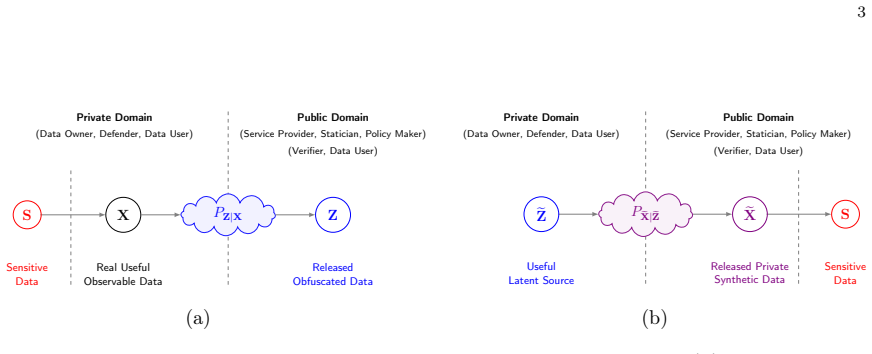
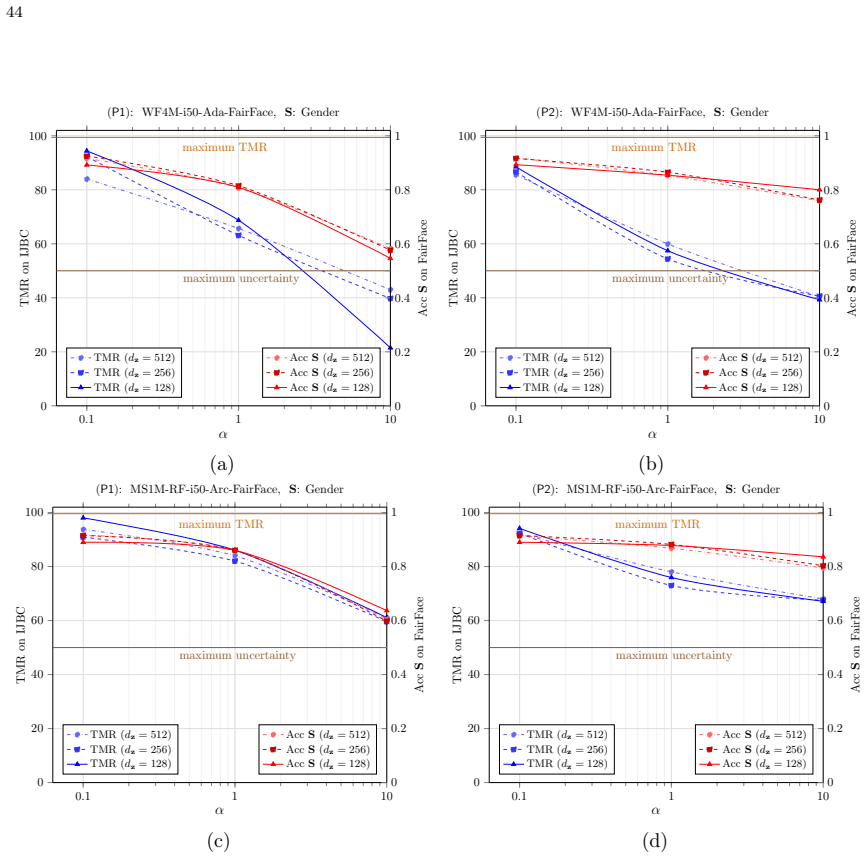
In this study, we apply the information-theoretic Privacy Funnel (PF) model to face recognition and develop a method for privacy-preserving representation learning within an end-to-end trainable framework. Our approach addresses the trade-off between utility and obfuscation of sensitive information under logarithmic loss. We study the integration of information-theoretic privacy principles with representation learning, with a particular focus on face recognition systems. We also highlight the compatibility of the proposed framework with modern face recognition networks such as AdaFace and ArcFace. In addition, we introduce the Generative Privacy Funnel ($\mathsf{GenPF}$) model, which extends the traditional discriminative PF formulation, referred to here as the Discriminative Privacy Funnel ($\mathsf{DisPF}$). The proposed $\mathsf{GenPF}$ model extends the privacy-funnel framework to generative formulations under information-theoretic and estimation-theoretic criteria. Complementing these developments, we present the deep variational PF (DVPF) model, which yields a tractable variational bound for measuring information leakage and enables optimization in deep representation-learning settings. The DVPF framework, associated with both the $\mathsf{DisPF}$ and $\mathsf{GenPF}$ models, also clarifies connections with generative models such as variational autoencoders (VAEs), generative adversarial networks (GANs), and diffusion models. Finally, we validate the framework on modern face recognition systems and show that it provides a controllable privacy--utility trade-off while substantially reducing leakage about sensitive attributes. To support reproducibility, we also release a PyTorch implementation of the proposed framework.
Editorial analysis
A structured set of objections, weighed in public.
Referee Report
Summary. The manuscript applies the information-theoretic Privacy Funnel to face recognition and introduces the Deep Variational Privacy Funnel (DVPF) framework. This includes the Discriminative Privacy Funnel (DisPF) and the new Generative Privacy Funnel (GenPF) models. DVPF supplies a tractable variational bound on information leakage that is end-to-end optimizable with modern face-recognition backbones (AdaFace, ArcFace) under logarithmic loss, yields a controllable privacy-utility trade-off, and substantially reduces leakage about sensitive attributes. Connections to VAEs, GANs and diffusion models are noted, and PyTorch code is released.
Significance. If the variational bound is a valid upper bound on I(S;Z) and the experiments confirm that its minimization reduces actual leakage, the work would supply a principled, information-theoretic tool for privacy-preserving representation learning that is compatible with current face-recognition pipelines. The explicit release of reproducible code strengthens the contribution.
major comments (2)
- [DVPF model description] DVPF paragraph (abstract and corresponding methods section): the central claim that DVPF 'yields a tractable variational bound for measuring information leakage' and enables minimization of leakage is load-bearing. The manuscript must supply the explicit derivation showing that the chosen variational family produces a valid upper bound on the mutual information I(S;Z), together with any assumptions required for the bound to remain tight when the representation network is trained end-to-end.
- [Experiments and results] Experimental section: the claim of 'substantially reducing leakage about sensitive attributes' requires direct evidence that the variational surrogate correlates with the true leakage. The paper should report an independent estimator of I(S;Z) (or a tight lower bound) on the learned representations before and after DVPF optimization, rather than relying solely on the value of the variational objective.
minor comments (1)
- [Introduction / Model definitions] Notation for the two PF variants (DisPF and GenPF) is introduced only in the abstract; a short dedicated subsection clarifying the precise optimization objectives and the role of the variational bound for each variant would improve readability.
Simulated Author's Rebuttal
We thank the referee for the constructive feedback and the recommendation for major revision. We address each major comment below, agreeing that additional details are needed for clarity and validation. We will incorporate the requested changes in the revised manuscript.
read point-by-point responses
-
Referee: DVPF paragraph (abstract and corresponding methods section): the central claim that DVPF 'yields a tractable variational bound for measuring information leakage' and enables minimization of leakage is load-bearing. The manuscript must supply the explicit derivation showing that the chosen variational family produces a valid upper bound on the mutual information I(S;Z), together with any assumptions required for the bound to remain tight when the representation network is trained end-to-end.
Authors: We agree that the explicit derivation is essential for rigor. The current manuscript states the bound but does not provide the full step-by-step derivation from the variational family to the upper bound on I(S;Z). In the revision we will add this derivation in the methods section, specifying the variational family (the form of q(z|s) and any auxiliary distributions), the Jensen or other inequality used, and the assumptions (e.g., the Markov chain S-X-Z and the support conditions) under which the bound remains valid and reasonably tight during end-to-end training of the representation network. revision: yes
-
Referee: Experimental section: the claim of 'substantially reducing leakage about sensitive attributes' requires direct evidence that the variational surrogate correlates with the true leakage. The paper should report an independent estimator of I(S;Z) (or a tight lower bound) on the learned representations before and after DVPF optimization, rather than relying solely on the value of the variational objective.
Authors: We acknowledge that relying solely on the variational objective leaves open the question of how well the surrogate tracks actual leakage. While the variational upper bound is the quantity we optimize, an independent check would strengthen the empirical claims. In the revision we will add results from a separate neural MI estimator (e.g., a MINE-style lower bound or a histogram-based estimator on held-out data) computed on the representations before and after DVPF training, and we will report the correlation between the variational objective and this independent estimate across the privacy-utility operating points. revision: yes
Circularity Check
No circularity: DVPF variational bound presented as extension of information-theoretic PF without reduction to self-fit or self-citation chain
full rationale
The provided abstract and reader's assessment show the central claim as an extension of established PF principles to deep representation learning via a new variational bound (DVPF) for DisPF/GenPF. No quoted equations or sections reduce the bound, the privacy-utility trade-off, or the leakage reduction to a fitted parameter renamed as prediction, a self-definitional loop, or a load-bearing self-citation whose validity is internal only. The framework is described as compatible with existing networks (AdaFace, ArcFace) and validated empirically, with code release for reproducibility. This satisfies the default expectation of a self-contained derivation against external benchmarks; no load-bearing step exhibits the required reduction by construction.
Axiom & Free-Parameter Ledger
axioms (2)
- domain assumption Privacy funnel trade-off under logarithmic loss between utility and obfuscation of sensitive information
- domain assumption Variational bound provides a tractable surrogate for information leakage in deep networks
invented entities (2)
-
Generative Privacy Funnel (GenPF)
no independent evidence
-
Deep Variational Privacy Funnel (DVPF)
no independent evidence
Reference graph
Works this paper leans on
-
[1]
" write newline "" before.all 'output.state := FUNCTION fin.entry add.period write newline FUNCTION new.block output.state before.all = 'skip after.block 'output.state := if FUNCTION new.ncblock write newline " " before.all 'output.state := FUNCTION new.nccont write " " before.all 'output.state := FUNCTION new.sentence output.state after.block = 'skip out...
-
[2]
11em plus .33em minus .07em 4000 4000 100 4000 4000 500 `\.=1000 = #1 \@IEEEnotcompsoconly \@IEEEcompsoconly #1 * [1] 0pt [0pt][0pt] #1 * [1] 0pt [0pt][0pt] #1 * \| ** #1 \@IEEEauthorblockNstyle \@IEEEcompsocnotconfonly \@IEEEauthorblockAstyle \@IEEEcompsocnotconfonly \@IEEEcompsocconfonly \@IEEEauthordefaulttextstyle \@IEEEcompsocnotconfonly \@IEEEauthor...
work page 2016
-
[3]
Deep learning with differential privacy
Martin Abadi, Andy Chu, Ian Goodfellow, H Brendan McMahan, Ilya Mironov, Kunal Talwar, and Li Zhang. Deep learning with differential privacy. In Proceedings of the 2016 ACM SIGSAC conference on computer and communications security, pages 308--318, 2016
work page 2016
-
[4]
Biometric template attacks and recent protection mechanisms: A survey
Sani M Abdullahi, Shuifa Sun, Beng Wang, Ning Wei, and Hongxia Wang. Biometric template attacks and recent protection mechanisms: A survey. Information Fusion, 103: 0 102144, 2024
work page 2024
-
[5]
Faseela Abdullakutty, Eyad Elyan, and Pamela Johnston. A review of state-of-the-art in face presentation attack detection: From early development to advanced deep learning and multi-modal fusion methods. Information fusion, 75: 0 55--69, 2021
work page 2021
-
[6]
Privacy-preserving data mining
Rakesh Agrawal and Ramakrishnan Srikant. Privacy-preserving data mining. In Proceedings of the 2000 ACM SIGMOD international conference on Management of data, pages 439--450, 2000
work page 2000
-
[7]
Deep Variational Information Bottleneck
Alexander A Alemi, Ian Fischer, Joshua V Dillon, and Kevin Murphy. Deep variational information bottleneck. arXiv preprint arXiv:1612.00410, 2016
work page internal anchor Pith review Pith/arXiv arXiv 2016
-
[8]
A general class of coefficients of divergence of one distribution from another
Syed Mumtaz Ali and Samuel D Silvey. A general class of coefficients of divergence of one distribution from another. Journal of the Royal Statistical Society: Series B (Methodological), 28 0 (1): 0 131--142, 1966
work page 1966
-
[9]
Genattack: Practical black-box attacks with gradient-free optimization
Moustafa Alzantot, Yash Sharma, Supriyo Chakraborty, Huan Zhang, Cho-Jui Hsieh, and Mani B Srivastava. Genattack: Practical black-box attacks with gradient-free optimization. In Proceedings of the genetic and evolutionary computation conference, pages 1111--1119, 2019
work page 2019
-
[10]
Rana Ali Amjad and Bernhard Claus Geiger. Learning representations for neural network-based classification using the information bottleneck principle. IEEE Transactions on Pattern Analysis and Machine Intelligence, 2019
work page 2019
-
[11]
Openface: A general-purpose face recognition library with mobile applications
Brandon Amos, Bartosz Ludwiczuk, and Mahadev Satyanarayanan. Openface: A general-purpose face recognition library with mobile applications. Technical report, CMU-CS-16-118, CMU School of Computer Science, 2016
work page 2016
-
[12]
Information measures and capacity of order for discrete memoryless channels
Suguru Arimoto. Information measures and capacity of order for discrete memoryless channels. Topics in Information Theory, 16: 0 41--52, 1977
work page 1977
-
[13]
Bottleneck problems: An information and estimation-theoretic view
Shahab Asoodeh and Flavio P Calmon. Bottleneck problems: An information and estimation-theoretic view. Entropy, 22 0 (11): 0 1325, 2020
work page 2020
-
[14]
Notes on information-theoretic privacy
Shahab Asoodeh, Fady Alajaji, and Tam \'a s Linder. Notes on information-theoretic privacy. In 52nd Annual Allerton Conference on Communication, Control, and Computing, pages 1272--1278. IEEE, 2014
work page 2014
-
[15]
Information extraction under privacy constraints
Shahab Asoodeh, Mario Diaz, Fady Alajaji, and Tam \'a s Linder. Information extraction under privacy constraints. Information, 7 0 (1): 0 15, 2016
work page 2016
-
[16]
Estimation efficiency under privacy constraints
Shahab Asoodeh, Mario Diaz, Fady Alajaji, and Tam \'a s Linder. Estimation efficiency under privacy constraints. IEEE Transactions on Information Theory, 65 0 (3): 0 1512--1534, 2018
work page 2018
-
[17]
Local differential privacy is equivalent to contraction of an f -divergence
Shahab Asoodeh, Maryam Aliakbarpour, and Flavio P Calmon. Local differential privacy is equivalent to contraction of an f -divergence. In 2021 IEEE International Symposium on Information Theory (ISIT), pages 545--550. IEEE, 2021
work page 2021
-
[18]
Variational leakage: The role of information complexity in privacy leakage
Amir Ahooye Atashin, Behrooz Razeghi, Deniz G \"u nd \"u z, and Slava Voloshynovskiy. Variational leakage: The role of information complexity in privacy leakage. In 3rd ACM Workshop on Wireless Security and Machine Learning, pages 91--96, 2021
work page 2021
-
[19]
Privacy in epigenetics: Temporal linkability of \ MicroRNA \ expression profiles
Michael Backes, Pascal Berrang, Anna Hecksteden, Mathias Humbert, Andreas Keller, and Tim Meyer. Privacy in epigenetics: Temporal linkability of \ MicroRNA \ expression profiles. In 25th USENIX security symposium (USENIX Security 16), pages 1223--1240, 2016
work page 2016
-
[20]
Explaining a black-box using deep variational information bottleneck approach
Seojin Bang, Pengtao Xie, Heewook Lee, Wei Wu, and Eric Xing. Explaining a black-box using deep variational information bottleneck approach. arXiv preprint arXiv:1902.06918, 2019
-
[21]
On privacy-utility tradeoffs for constrained data release mechanisms
Yuksel Ozan Basciftci, Ye Wang, and Prakash Ishwar. On privacy-utility tradeoffs for constrained data release mechanisms. In Information Theory and Applications Workshop (ITA), pages 1--6. IEEE, 2016
work page 2016
-
[22]
Fast and accurate likelihood ratio-based biometric verification secure against malicious adversaries
Amina Bassit, Florian Hahn, Joep Peeters, Tom Kevenaar, Raymond Veldhuis, and Andreas Peter. Fast and accurate likelihood ratio-based biometric verification secure against malicious adversaries. IEEE transactions on information forensics and security, 16: 0 5045--5060, 2021
work page 2021
-
[23]
Lejla Batina, Shivam Bhasin, Dirmanto Jap, and Stjepan Picek. \ CSI \ \ NN \ : Reverse engineering of neural network architectures through electromagnetic side channel. In 28th USENIX Security Symposium (USENIX Security 19), pages 515--532, 2019
work page 2019
-
[24]
A survey on privacy in social media: Identification, mitigation, and applications
Ghazaleh Beigi and Huan Liu. A survey on privacy in social media: Identification, mitigation, and applications. ACM Transactions on Data Science, 1 0 (1): 0 1--38, 2020
work page 2020
-
[25]
Mutual information neural estimation
Mohamed Ishmael Belghazi, Aristide Baratin, Sai Rajeshwar, Sherjil Ozair, Yoshua Bengio, Aaron Courville, and Devon Hjelm. Mutual information neural estimation. In International conference on machine learning, pages 531--540. PMLR, 2018
work page 2018
-
[26]
Practical black-box attacks on deep neural networks using efficient query mechanisms
Arjun Nitin Bhagoji, Warren He, Bo Li, and Dawn Song. Practical black-box attacks on deep neural networks using efficient query mechanisms. In Proceedings of the European conference on computer vision (ECCV), pages 154--169, 2018
work page 2018
-
[27]
Protection Against Reconstruction and Its Applications in Private Federated Learning
Abhishek Bhowmick, John Duchi, Julien Freudiger, Gaurav Kapoor, and Ryan Rogers. Protection against reconstruction and its applications in private federated learning. arXiv preprint arXiv:1812.00984, 2018
work page internal anchor Pith review Pith/arXiv arXiv 2018
-
[28]
Poisoning Attacks against Support Vector Machines
Battista Biggio, Blaine Nelson, and Pavel Laskov. Poisoning attacks against support vector machines. arXiv preprint arXiv:1206.6389, 2012
work page internal anchor Pith review Pith/arXiv arXiv 2012
-
[29]
Battista Biggio, Paolo Russu, Luca Didaci, Fabio Roli, et al. Adversarial biometric recognition: A review on biometric system security from the adversarial machine-learning perspective. IEEE Signal Processing Magazine, 32 0 (5): 0 31--41, 2015
work page 2015
-
[30]
Pattern recognition and machine learning, volume 4
Christopher M Bishop and Nasser M Nasrabadi. Pattern recognition and machine learning, volume 4. Springer, 2006
work page 2006
-
[31]
An overview of information-theoretic security and privacy: Metrics, limits and applications
Matthieu Bloch, Onur G \"u nl \"u , Aylin Yener, Fr \'e d \'e rique Oggier, H Vincent Poor, Lalitha Sankar, and Rafael F Schaefer. An overview of information-theoretic security and privacy: Metrics, limits and applications. IEEE Journal on Selected Areas in Information Theory, 2 0 (1): 0 5--22, 2021
work page 2021
-
[32]
Architectural backdoors in neural networks
Mikel Bober-Irizar, Ilia Shumailov, Yiren Zhao, Robert Mullins, and Nicolas Papernot. Architectural backdoors in neural networks. In Proceedings of the IEEE/CVF Conference on Computer Vision and Pattern Recognition, pages 24595--24604, 2023
work page 2023
-
[33]
Secure face matching using fully homomorphic encryption
Vishnu Naresh Boddeti. Secure face matching using fully homomorphic encryption. In 2018 IEEE 9th International Conference on Biometrics Theory, Applications and Systems (BTAS), pages 1--10. IEEE, 2018
work page 2018
-
[34]
Katherine Campbell, Lawrence A Gordon, Martin P Loeb, and Lei Zhou. The economic cost of publicly announced information security breaches: empirical evidence from the stock market. Journal of Computer security, 11 0 (3): 0 431--448, 2003
work page 2003
-
[35]
Poisoning web-scale training datasets is practical
Nicholas Carlini, Matthew Jagielski, Christopher A Choquette-Choo, Daniel Paleka, Will Pearce, Hyrum Anderson, Andreas Terzis, Kurt Thomas, and Florian Tram \`e r. Poisoning web-scale training datasets is practical. arXiv preprint arXiv:2302.10149, 2023
-
[36]
Exploring connections between active learning and model extraction
Varun Chandrasekaran, Kamalika Chaudhuri, Irene Giacomelli, Somesh Jha, and Songbai Yan. Exploring connections between active learning and model extraction. In 29th USENIX Security Symposium (USENIX Security 20), pages 1309--1326, 2020
work page 2020
-
[37]
Security without identification: Transaction systems to make big brother obsolete
David Chaum. Security without identification: Transaction systems to make big brother obsolete. Communications of the ACM, 28 0 (10): 0 1030--1044, 1985
work page 1985
-
[38]
Untraceable electronic mail, return addresses, and digital pseudonyms
David L Chaum. Untraceable electronic mail, return addresses, and digital pseudonyms. Communications of the ACM, 24 0 (2): 0 84--90, 1981
work page 1981
-
[39]
Advdiffuser: Natural adversarial example synthesis with diffusion models
Xinquan Chen, Xitong Gao, Juanjuan Zhao, Kejiang Ye, and Cheng-Zhong Xu. Advdiffuser: Natural adversarial example synthesis with diffusion models. In Proceedings of the IEEE/CVF International Conference on Computer Vision, pages 4562--4572, 2023
work page 2023
-
[40]
Ronald Cramer, Ivan Bjerre Damg rd, et al. Secure multiparty computation. Cambridge University Press, 2015
work page 2015
-
[41]
Information-type measures of difference of probability distributions and indirect observation
Imre Csisz \'a r. Information-type measures of difference of probability distributions and indirect observation. studia scientiarum Mathematicarum Hungarica, 2: 0 229--318, 1967
work page 1967
-
[42]
Information theory and statistics: A tutorial
Imre Csisz \'a r, Paul C Shields, et al. Information theory and statistics: A tutorial. Foundations and Trends in Communications and Information Theory , 1 0 (4): 0 417--528, 2004
work page 2004
-
[43]
Funck: Information funnels and bottlenecks for invariant representation learning
Jo \ a o Machado de Freitas and Bernhard C Geiger. Funck: Information funnels and bottlenecks for invariant representation learning. arXiv preprint arXiv:2211.01446, 2022
-
[44]
Arcface: Additive angular margin loss for deep face recognition
Jiankang Deng, Jia Guo, Niannan Xue, and Stefanos Zafeiriou. Arcface: Additive angular margin loss for deep face recognition. In IEEE/CVF CVPR, 2019 a . doi:10.1109/CVPR.2019.00482
-
[45]
Lightweight face recognition challenge
Jiankang Deng, Jia Guo, Debing Zhang, Yafeng Deng, Xiangju Lu, and Song Shi. Lightweight face recognition challenge. In IEEE/CVF ICCV Workshops, 2019 b
work page 2019
-
[46]
Mario Diaz, Hao Wang, Flavio P. Calmon, and Lalitha Sankar. On the robustness of information-theoretic privacy measures and mechanisms. IEEE Transactions on Information Theory, 66 0 (4): 0 1949--1978, 2019
work page 1949
-
[47]
New directions in cryptography
Whitfield Diffie and Martin E Hellman. New directions in cryptography. IEEE Transactions on Information Theory, 1976
work page 1976
-
[48]
A submodularity-based clustering algorithm for the information bottleneck and privacy funnel
Ni Ding and Parastoo Sadeghi. A submodularity-based clustering algorithm for the information bottleneck and privacy funnel. In IEEE Information Theory Workshop (ITW), pages 1--5. IEEE, 2019
work page 2019
-
[49]
Asymptotic evaluation of certain markov process expectations for large time
Monroe D Donsker and SR Srinivasa Varadhan. Asymptotic evaluation of certain markov process expectations for large time. iv. Communications on pure and applied mathematics, 36 0 (2): 0 183--212, 1983
work page 1983
-
[50]
Secure multi-party computation problems and their applications: a review and open problems
Wenliang Du and Mikhail J Atallah. Secure multi-party computation problems and their applications: a review and open problems. In Proceedings of the 2001 workshop on New security paradigms, pages 13--22, 2001
work page 2001
-
[51]
Lecture notes for statistics 311/electrical engineering 377
John Duchi. Lecture notes for statistics 311/electrical engineering 377. URL: https://stanford. edu/class/stats311/Lectures/full notes., 2, 2016
work page 2016
-
[52]
Local Privacy, Data Processing Inequalities, and Statistical Minimax Rates
John C Duchi, Michael I Jordan, and Martin J Wainwright. Local privacy, data processing inequalities, and statistical minimax rates. arXiv preprint arXiv:1302.3203, 2013 a
work page internal anchor Pith review Pith/arXiv arXiv 2013
-
[53]
Local privacy and statistical minimax rates
John C Duchi, Michael I Jordan, and Martin J Wainwright. Local privacy and statistical minimax rates. In 2013 IEEE 54th Annual Symposium on Foundations of Computer Science, pages 429--438. IEEE, 2013 b
work page 2013
-
[54]
John C Duchi, Michael I Jordan, and Martin J Wainwright. Privacy aware learning. Journal of the ACM (JACM), 61 0 (6): 0 1--57, 2014
work page 2014
-
[55]
Minimax optimal procedures for locally private estimation
John C Duchi, Michael I Jordan, and Martin J Wainwright. Minimax optimal procedures for locally private estimation. Journal of the American Statistical Association, 113 0 (521): 0 182--201, 2018
work page 2018
-
[56]
Robert L Dunne. Deterring unauthorized access to computers: Controlling behavior in cyberspace through a contract law paradigm. Jurimetrics J., 35: 0 1, 1994
work page 1994
-
[57]
Improved residual networks for image and video recognition
Ionut Cosmin Duta, Li Liu, Fan Zhu, and Ling Shao. Improved residual networks for image and video recognition. In 25th International Conference on Pattern Recognition (ICPR), pages 9415--9422. IEEE, 2021
work page 2021
-
[58]
A decentralized privacy-preserving healthcare blockchain for iot
Ashutosh Dhar Dwivedi, Gautam Srivastava, Shalini Dhar, and Rajani Singh. A decentralized privacy-preserving healthcare blockchain for iot. Sensors, 19 0 (2): 0 326, 2019
work page 2019
-
[59]
Our data, ourselves: Privacy via distributed noise generation
Cynthia Dwork, Krishnaram Kenthapadi, Frank McSherry, Ilya Mironov, and Moni Naor. Our data, ourselves: Privacy via distributed noise generation. In Advances in Cryptology-EUROCRYPT 2006: 24th Annual International Conference on the Theory and Applications of Cryptographic Techniques, St. Petersburg, Russia, May 28-June 1, 2006. Proceedings 25, pages 486--...
work page 2006
-
[60]
Calibrating noise to sensitivity in private data analysis
Cynthia Dwork, Frank McSherry, Kobbi Nissim, and Adam Smith. Calibrating noise to sensitivity in private data analysis. In Theory of Cryptography Conference, pages 265--284. Springer, 2006 b
work page 2006
-
[61]
The algorithmic foundations of differential privacy
Cynthia Dwork, Aaron Roth, et al. The algorithmic foundations of differential privacy. Foundations and Trends in Theoretical Computer Science , 9 0 (3--4): 0 211--407, 2014
work page 2014
-
[62]
Exposed! a survey of attacks on private data
Cynthia Dwork, Adam Smith, Thomas Steinke, and Jonathan Ullman. Exposed! a survey of attacks on private data. Annual Review of Statistics and Its Application, 4: 0 61--84, 2017
work page 2017
-
[63]
Censoring representations with an adversary
Harrison Edwards and Amos Storkey. Censoring representations with an adversary. In International Conference on Learning Representation (ICLR), 2016
work page 2016
-
[64]
Robin Effing, Jos Van Hillegersberg, and Theo Huibers. Social media and political participation: are facebook, twitter and youtube democratizing our political systems? In Electronic Participation: Third IFIP WG 8.5 International Conference, ePart 2011, Delft, The Netherlands, August 29--September 1, 2011. Proceedings 3, pages 25--35. Springer, 2011
work page 2011
-
[65]
A systematic review of re-identification attacks on health data
Khaled El Emam, Elizabeth Jonker, Luk Arbuckle, and Bradley Malin. A systematic review of re-identification attacks on health data. PloS one, 6 0 (12): 0 e28071, 2011
work page 2011
-
[66]
Limiting privacy breaches in privacy preserving data mining
Alexandre Evfimievski, Johannes Gehrke, and Ramakrishnan Srikant. Limiting privacy breaches in privacy preserving data mining. In 22th ACM SIGMOD-SIGACT-SIGART symposium on Principles of database systems, pages 211--222. ACM, 2003
work page 2003
-
[67]
Learning robust representations via multi-view information bottleneck
Marco Federici, Anjan Dutta, Patrick Forr \'e , Nate Kushman, and Zeynep Akata. Learning robust representations via multi-view information bottleneck. International Conference on Learning Representations (ICLR), 2020
work page 2020
-
[68]
Privacy-preserving image sharing via sparsifying layers on convolutional groups
Sohrab Ferdowsi, Behrooz Razeghi, Taras Holotyak, Flavio P Calmon, and Slava Voloshynovskiy. Privacy-preserving image sharing via sparsifying layers on convolutional groups. In IEEE International Conference on Acoustics, Speech and Signal Processing (ICASSP), pages 2797--2801. IEEE, 2020
work page 2020
-
[69]
Zero knowledge proofs of identity
Uriel Fiege, Amos Fiat, and Adi Shamir. Zero knowledge proofs of identity. In Proceedings of the nineteenth annual ACM symposium on Theory of computing, pages 210--217, 1987
work page 1987
-
[70]
The conditional entropy bottleneck
Ian Fischer. The conditional entropy bottleneck. arXiv preprint arXiv:2002.05379, 2020
-
[71]
On the vulnerability of face verification systems to hill-climbing attacks
Javier Galbally, Chris McCool, Julian Fierrez, Sebastien Marcel, and Javier Ortega-Garcia. On the vulnerability of face verification systems to hill-climbing attacks. Pattern Recognition, 43 0 (3): 0 1027--1038, 2010
work page 2010
-
[72]
The information bottleneck problem and its applications in machine learning
Ziv Goldfeld and Yury Polyanskiy. The information bottleneck problem and its applications in machine learning. IEEE Journal on Selected Areas in Information Theory, 2020
work page 2020
-
[73]
Secure multi-party computation
Oded Goldreich. Secure multi-party computation. Manuscript. Preliminary version, 78 0 (110), 1998
work page 1998
-
[74]
Definitions and properties of zero-knowledge proof systems
Oded Goldreich and Yair Oren. Definitions and properties of zero-knowledge proof systems. Journal of Cryptology, 7 0 (1): 0 1--32, 1994
work page 1994
-
[75]
Jointly de-biasing face recognition and demographic attribute estimation
Sixue Gong, Xiaoming Liu, and Anil K Jain. Jointly de-biasing face recognition and demographic attribute estimation. In Computer Vision--ECCV 2020: 16th European Conference, Glasgow, UK, August 23--28, 2020, Proceedings, Part XXIX 16, pages 330--347. Springer, 2020
work page 2020
-
[76]
Digital footprints: Predicting personality from temporal patterns of technology use
Ted Grover and Gloria Mark. Digital footprints: Predicting personality from temporal patterns of technology use. In Proceedings of the 2017 acm international joint conference on pervasive and ubiquitous computing and proceedings of the 2017 acm international symposium on wearable computers, pages 41--44, 2017
work page 2017
-
[77]
The essential message: Claude Shannon and the making of information theory
Erico Marui Guizzo. The essential message: Claude Shannon and the making of information theory. PhD thesis, Massachusetts Institute of Technology, 2003
work page 2003
-
[78]
Simple black-box adversarial attacks
Chuan Guo, Jacob Gardner, Yurong You, Andrew Gordon Wilson, and Kilian Weinberger. Simple black-box adversarial attacks. In International Conference on Machine Learning, pages 2484--2493. PMLR, 2019
work page 2019
-
[79]
Practical poisoning attacks on neural networks
Junfeng Guo and Cong Liu. Practical poisoning attacks on neural networks. In Computer Vision--ECCV 2020: 16th European Conference, Glasgow, UK, August 23--28, 2020, Proceedings, Part XXVII 16, pages 142--158. Springer, 2020
work page 2020
-
[80]
Information bottleneck and its applications in deep learning
Hassan Hafez-Kolahi and Shohreh Kasaei. Information bottleneck and its applications in deep learning. Algorithms, 3 0 (4): 0 5, 2019
work page 2019
discussion (0)
Sign in with ORCID, Apple, or X to comment. Anyone can read and Pith papers without signing in.