Measurement-based quantum machine learning
Pith reviewed 2026-05-24 00:45 UTC · model grok-4.3
The pith
The multiple-triangle ansatz assembles a universal quantum neural network from MBQC neurons with bias engineering and tunable entanglement.
A machine-rendered reading of the paper's core claim, the machinery that carries it, and where it could break.
Core claim
The central claim is that the multiple-triangle ansatz (MuTA) constitutes a universal quantum neural network assembled from MBQC neurons, featuring bias engineering, monotonic expressivity, tunable entanglement, and scalable training. Numerical demonstrations establish that MuTA can learn a universal set of gates in the presence of noise, serve as a quantum-state classifier and quantum instrument, classify classical data using a quantum kernel tailored to MuTA, and incorporate hardware constraints from photonic Gottesman-Kitaev-Preskill qubits.
What carries the argument
The multiple-triangle ansatz (MuTA), a universal quantum neural network assembled from MBQC neurons featuring bias engineering, monotonic expressivity, tunable entanglement, and scalable training.
If this is right
- MuTA can learn a universal set of quantum gates even when noise is present.
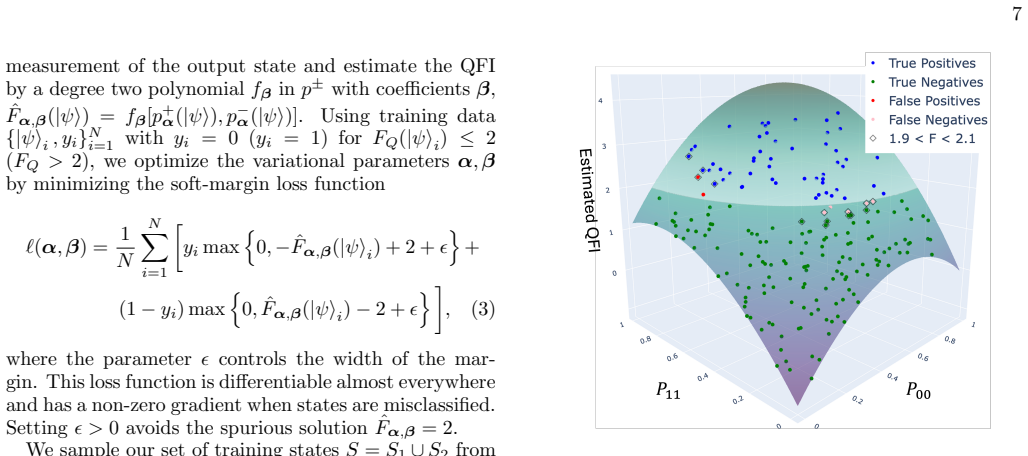
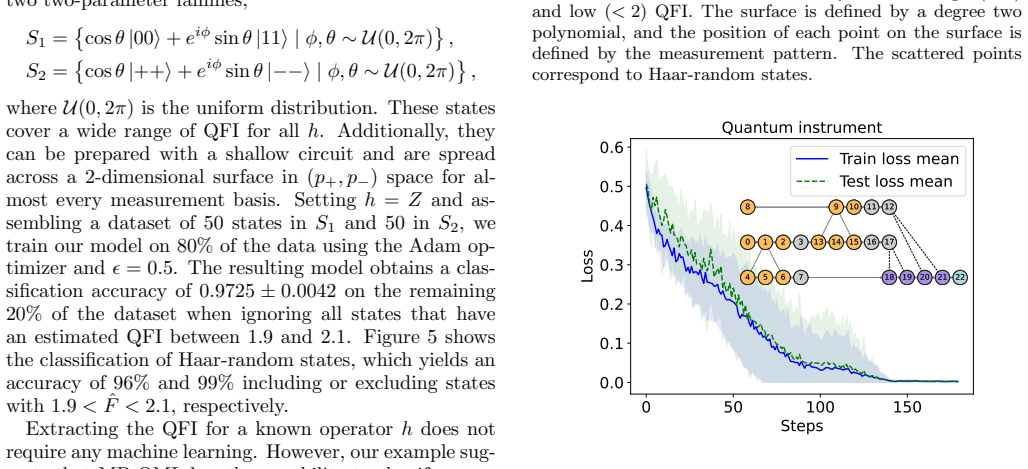
- MuTA functions as a quantum-state classifier and implements quantum instruments.
- Classical data classification is possible using a quantum kernel designed specifically for MuTA.
- Photonic GKP qubit hardware constraints can be directly incorporated into the network design.
- Scalable training becomes feasible due to the monotonic expressivity property.
Where Pith is reading between the lines
- MBQC's built-in mid-circuit measurements may allow hybrid classical-quantum training loops that reduce overall circuit depth compared with circuit-model approaches.
- Tunable entanglement in MuTA could be used to study how entanglement structure affects generalization in quantum kernels.
- The assembly from MBQC neurons suggests a path toward fault-tolerant quantum neural networks once MBQC error correction matures.
- Monotonic expressivity may enable controlled increases in network capacity without encountering barren-plateau issues during training.
Load-bearing premise
The numerical demonstrations of learning under noise and with photonic GKP constraints will generalize beyond the specific simulations performed without post-hoc tuning that affects the reported performance.
What would settle it
An experiment or simulation in which MuTA fails to learn the target universal gate set at the reported noise levels or under the stated GKP constraints would falsify the claim of practical utility.
Figures




read the original abstract
Quantum machine learning (QML) leverages quantum computing for classical inference, furnishes the processing of quantum data with machine-learning methods, and provides quantum algorithms adapted to noisy devices. Typically, QML proposals are framed in terms of the circuit model of quantum computation. The alternative measurement-based quantum computing (MBQC) paradigm can exhibit lower circuit depths, is naturally compatible with classical co-processing of mid-circuit measurements, and offers a promising avenue towards error correction. Despite significant progress on MBQC devices, QML in terms of MBQC has been hardly explored. We propose the multiple-triangle ansatz (MuTA), a universal quantum neural network assembled from MBQC neurons featuring bias engineering, monotonic expressivity, tunable entanglement, and scalable training. We numerically demonstrate that MuTA can learn a universal set of gates in the presence of noise, a quantum-state classifier, as well as a quantum instrument, and classify classical data using a quantum kernel tailored to MuTA. Finally, we incorporate hardware constraints imposed by photonic Gottesman-Kitaev-Preskill qubits. Our framework lays the foundation for versatile quantum neural networks native to MBQC, allowing to explore MBQC-specific algorithmic advantages and QML on MBQC devices.
Editorial analysis
A structured set of objections, weighed in public.
Referee Report
Summary. The manuscript proposes the multiple-triangle ansatz (MuTA), a universal quantum neural network assembled from MBQC neurons that incorporates bias engineering, monotonic expressivity, tunable entanglement, and scalable training. It numerically demonstrates MuTA's ability to learn a universal set of gates under noise, perform quantum-state classification, learn a quantum instrument, classify classical data via a MuTA-tailored quantum kernel, and incorporate photonic GKP qubit constraints.
Significance. If the numerical results prove robust, the work establishes the first systematic framework for measurement-based quantum machine learning. It opens exploration of MBQC-specific advantages such as reduced circuit depth, native classical co-processing of mid-circuit measurements, and compatibility with error correction, while providing a concrete ansatz for photonic hardware constraints.
major comments (2)
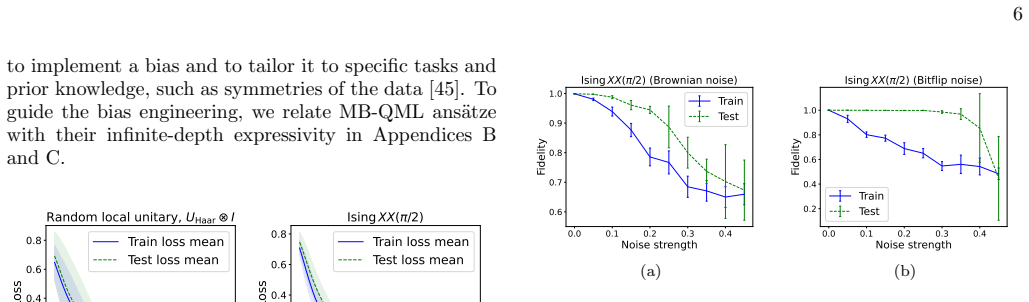
- [Abstract and §4] Abstract and §4 (numerical demonstrations): the claims of success on gate learning, state classification, and instrument tasks under noise are stated without any quantitative metrics, baselines, error bars, or exclusion criteria. This absence prevents verification of the central performance claims and leaves the generalization assumption untested.
- [§4] §4 (GKP and noise simulations): the reported performance under specific noise models and GKP constraints lacks sensitivity analysis or ablation over modest changes in hyperparameters, noise strength, or circuit size. Without this, it is impossible to distinguish robust advantages from simulation-specific tuning.
minor comments (2)
- [MuTA definition] Clarify the precise definition of 'monotonic expressivity' and 'bias engineering' with explicit equations or pseudocode in the ansatz construction section.
- Add a table comparing MuTA resource requirements (qubits, measurements, classical post-processing) against standard circuit-model QNNs for the demonstrated tasks.
Simulated Author's Rebuttal
We thank the referee for the detailed and constructive report. We address the two major comments below and commit to revisions that strengthen the quantitative presentation of our numerical results while preserving the manuscript's core contributions.
read point-by-point responses
-
Referee: [Abstract and §4] Abstract and §4 (numerical demonstrations): the claims of success on gate learning, state classification, and instrument tasks under noise are stated without any quantitative metrics, baselines, error bars, or exclusion criteria. This absence prevents verification of the central performance claims and leaves the generalization assumption untested.
Authors: We agree that the absence of explicit quantitative metrics, statistical error bars, baselines, and exclusion criteria in the current text limits verifiability. In the revised manuscript we will add tables reporting average fidelities or accuracies with standard deviations over multiple independent training runs (e.g., 10–20 seeds), include simple baselines such as random guessing or non-entangling circuits, and state any data-exclusion rules. These additions will be placed in §4 and referenced from the abstract. revision: yes
-
Referee: [§4] §4 (GKP and noise simulations): the reported performance under specific noise models and GKP constraints lacks sensitivity analysis or ablation over modest changes in hyperparameters, noise strength, or circuit size. Without this, it is impossible to distinguish robust advantages from simulation-specific tuning.
Authors: The referee correctly identifies that the present simulations are performed at fixed hyperparameter and noise values. We will perform and report a limited sensitivity study in the revision: for the gate-learning and state-classification tasks we will vary depolarizing noise strength by ±20 % around the reported values and test one additional circuit depth; results will be summarized in new panels or a supplementary table. Full ablation across all hyperparameters remains computationally intensive, but the targeted checks will address the core concern of robustness versus tuning. revision: partial
Circularity Check
No significant circularity; MuTA introduced as independent construction with numerical demonstrations
full rationale
The paper proposes MuTA as a new ansatz assembled from MBQC neurons, claiming features such as bias engineering, monotonic expressivity, tunable entanglement, and scalable training without reducing these to prior fitted quantities or self-citations. Numerical demonstrations of gate learning under noise, state classification, instrument learning, and GKP constraints are presented as simulation results rather than predictions forced by construction from the same data. No load-bearing steps in the provided abstract or described claims equate outputs to inputs via self-definition, renaming, or imported uniqueness theorems. The derivation chain remains self-contained with independent architectural content.
Axiom & Free-Parameter Ledger
axioms (1)
- domain assumption The measurement-based quantum computing paradigm provides a valid and universal model for quantum computation
invented entities (1)
-
MuTA (multiple-triangle ansatz)
no independent evidence
Reference graph
Works this paper leans on
-
[1]
a non-entangling gate between wiresiandj∈Jif Ci,j is measured atα j ∈ {0, π},
-
[2]
an entangling gate between wiresiandj∈JifC i,j is measured atα j /∈ {0, π}. Here, we call a gateGentangling for wiresiandjiff there exists somen-qubit state|ψ⟩=|ψ i⟩ ⊗ |ψj⟩ ⊗ |ψrest⟩ such thatG|ψ⟩reduced to the(i, j)-subspace is entangled. Proof.In Appendix B, see Eq. (B2) and the subsequent paragraph, we translate a general MuTA layer into a 4 T1,2 (a) 0...
-
[3]
Adding disconnected wires
-
[4]
Adding admissible triangles to a layerlof widthn and inserting an additional layerl ′ of widthnbe- tween layerslandl+ 1. Layerl ′ can have any in- tralayer connectivity. It takes all outputs of layerl as inputs. The interlayer connectivity between lay- ersl ′ andl+ 1is inherited from the initial connec- tivity betweenlandl+ 1. Proof.For weak monotonicity,...
work page 2000
-
[5]
R. Raussendorf and H. J. Briegel, Physical review letters 86, 5188 (2001)
work page 2001
-
[6]
R. Raussendorf, D. E. Browne, and H. J. Briegel, Physical review A68, 022312 (2003)
work page 2003
-
[7]
R. Raussendorf and T.-C. Wei, Annual Review of Con- densed Matter Physics3, 239 (2012)
work page 2012
- [8]
-
[9]
S. Chen, L.-C. Peng, Y.-P. Guo, X.-M. Gu, X. Ding, R.- Z. Liu, J.-Y. Zhao, X. You, J. Qin, Y.-F. Wang, Y.-M. He, J. J. Renema, Y.-H. Huo, H. Wang, C.-Y. Lu, and J.-W. Pan, Phys. Rev. Lett.132, 130603 (2024)
work page 2024
- [10]
-
[11]
S. Yokoyama, R. Ukai, S. C. Armstrong, C. Sornphiphat- phong, T. Kaji, S. Suzuki, J.-i. Yoshikawa, H. Yonezawa, N. C. Menicucci, and A. Furusawa, Nat. Phot.7, 982 (2013)
work page 2013
- [12]
-
[13]
A. Broadbent and E. Kashefi, Theoretical computer sci- ence410, 2489 (2009)
work page 2009
-
[14]
R. Raussendorf, S. Bravyi, and J. Harrington, Phys. Rev. A71, 062313 (2005)
work page 2005
-
[15]
R. Raussendorf, J. Harrington, and K. Goyal, Annals of Physics321, 2242 (2006)
work page 2006
- [16]
-
[17]
D. Malz, G. Styliaris, Z.-Y. Wei, and J. I. Cirac, Physical Review Letters132, 10.1103/PhysRevLett.132.040404 (2024)
-
[18]
J. Biamonte, P. Wittek, N. Pancotti, P. Rebentrost, N. Wiebe, and S. Lloyd, Nature549, 195 (2017)
work page 2017
- [19]
-
[20]
I. Cong, S. Choi, and M. D. Lukin, Nature Physics15, 1273 (2019)
work page 2019
-
[21]
K. Beer, D. Bondarenko, T. Farrelly, T. J. Osborne, R. Salzmann, D. Scheiermann, and R. Wolf, Nat Com- mun11, 808 (2020)
work page 2020
- [22]
- [23]
- [24]
-
[25]
Y. Liu, S. Arunachalam, and K. Temme, Nature Physics 17, 1013 (2021)
work page 2021
-
[26]
R. R. Ferguson, L. Dellantonio, A. Al Balushi, K. Jansen, W. D¨ ur, and C. A. Muschik, Physical review letters126, 220501 (2021)
work page 2021
-
[27]
Z. Qin, X. Li, Y. Zhou, S. Zhang, R. Li, C. Du, and Z. Xiao, New Journal of Physics26, 073040 (2024)
work page 2024
-
[28]
A. Majumder, M. Krumm, T. Radkohl, L. J. Fiderer, H. P. Nautrup, S. Jerbi, and H. J. Briegel, Phys. Rev. A 110, 062616 (2024)
work page 2024
-
[29]
D. E. Browne, E. Kashefi, M. Mhalla, and S. Perdrix, New Journal of Physics9, 250 (2007)
work page 2007
- [30]
-
[31]
De Beaudrap, Physical Review A77, 022328 (2008)
N. De Beaudrap, Physical Review A77, 022328 (2008)
work page 2008
-
[32]
M. Mhalla and S. Perdrix, inAutomata, Languages and Programming: 35th International Colloquium, ICALP 2008, Reykjavik, Iceland, July 7-11, 2008, Proceedings, Part I 35(Springer, 2008) pp. 857–868
work page 2008
-
[33]
I. Goodfellow, Y. Bengio, and A. Courville,Deep Learn- ing(MIT Press, 2016)http://www.deeplearningbook. org
work page 2016
- [34]
-
[35]
V. Nair and G. E. Hinton, inProceedings of the 27th international conference on machine learning (ICML-10) (2010) pp. 807–814
work page 2010
-
[36]
A. J. da Silva, T. B. Ludermir, and W. R. de Oliveira, Neural Networks76, 55 (2016)
work page 2016
-
[37]
M. Benedetti, E. Lloyd, S. Sack, and M. Fiorentini, Quantum Science and Technology4, 043001 (2019)
work page 2019
- [38]
-
[39]
M. A. Nielsen and I. L. Chuang,Quantum computation and quantum information(Cambridge university press, 2010)
work page 2010
-
[40]
M. J. Bremner, C. M. Dawson, J. L. Dodd, A. Gilchrist, A. W. Harrow, D. Mortimer, M. A. Nielsen, and T. J. Osborne, Physical review letters89, 247902 (2002)
work page 2002
- [41]
-
[42]
M. Hein, J. Eisert, and H. J. Briegel, Phys. Rev. A69, 062311 (2004)
work page 2004
-
[43]
J. R. McClean, S. Boixo, V. N. Smelyanskiy, R. Babbush, and H. Neven, Nature communications9, 4812 (2018)
work page 2018
-
[44]
D. Bondarenko and P. Feldmann, Physical review letters 124, 130502 (2020)
work page 2020
-
[45]
E. Torrontegui and J. J. Garc´ ıa-Ripoll, Europhysics Let- ters125, 30004 (2019)
work page 2019
-
[46]
D. P. Kingma and J. Ba, Adam: A method for stochastic optimization (2017), arXiv:1412.6980 [cs.LG]
work page internal anchor Pith review Pith/arXiv arXiv 2017
-
[47]
K. Poland, K. Beer, and T. J. Osborne, arXiv preprint arXiv:2003.14103 10.48550/arXiv.2003.14103 (2020)
- [48]
-
[49]
L. Schatzki, M. Larocca, Q. T. Nguyen, F. Sauvage, and M. Cerezo, Theoretical guarantees for permutation- equivariant quantum neural networks (2022), arXiv:2210.09974 [quant-ph]. 11
- [50]
-
[51]
D. Garc´ ıa-Mart´ ın, M. Larocca, and M. Cerezo, Physical Review Research6, 013295 (2024)
work page 2024
-
[52]
C. M. Bishop, Springer2, 1122 (2006)
work page 2006
-
[53]
C. L. Degen, F. Reinhard, and P. Cappellaro, Reviews of modern physics89, 035002 (2017)
work page 2017
-
[54]
V. Giovannetti, S. Lloyd, and L. Maccone, Nature pho- tonics5, 222 (2011)
work page 2011
-
[55]
M. C. Caro, H.-Y. Huang, N. Ezzell, J. Gibbs, A. T. Sornborger, L. Cincio, P. J. Coles, and Z. Holmes, Nature Communications14, 3751 (2023)
work page 2023
- [56]
-
[57]
P. Feldmann,Generalized Quantum Phase Transitions for Quantum-State Engineering in Spinor Bose-Einstein Condensates, Ph.D. thesis, Gottfried Wilhelm Leibniz Universit¨ at Hannover (2021)
work page 2021
-
[58]
G. T´ oth and D. Petz, Physical Review A—Atomic, Molecular, and Optical Physics87, 032324 (2013)
work page 2013
- [59]
-
[60]
V. Havl´ ıˇ cek, A. D. C´ orcoles, K. Temme, A. W. Harrow, A. Kandala, J. M. Chow, and J. M. Gambetta, Nature 567, 209 (2019)
work page 2019
- [61]
-
[62]
G. Gentinetta, D. Sutter, C. Zoufal, B. Fuller, and S. Wo- erner, in2023 IEEE International Conference on Quan- tum Computing and Engineering (QCE), Vol. 1 (IEEE,
-
[63]
D. Gottesman, A. Kitaev, and J. Preskill, Physical Re- view A64, 012310 (2001)
work page 2001
- [64]
-
[65]
P. J. Shadbolt, M. R. Verde, A. Peruzzo, A. Politi, A. Laing, M. Lobino, J. C. Matthews, M. G. Thompson, and J. L. O’Brien, Nature Photonics6, 45 (2012)
work page 2012
-
[66]
Fault-Tolerant Postselected Quantum Computation: Schemes
E. Knill, Fault-tolerant postselected quantum computa- tion: Schemes (2004), arXiv:quant-ph/0402171 [quant- ph]
work page internal anchor Pith review Pith/arXiv arXiv 2004
- [67]
-
[68]
V. Mnih, K. Kavukcuoglu, D. Silver, A. A. Rusu, J. Ve- ness, M. G. Bellemare, A. Graves, M. Riedmiller, A. K. Fidjeland, G. Ostrovski,et al., nature518, 529 (2015)
work page 2015
- [69]
-
[70]
D. Bondarenko, R. Salzmann, and V.-S. Schmiesing, arXiv preprint arXiv:2301.08167 (2023)
-
[71]
W. F. Stinespring, Proceedings of the American Mathe- matical Society6, 211 (1955)
work page 1955
-
[72]
P. Kidger and T. Lyons, Universal approximation with deep narrow networks, arXiv:1905.08539 (2020), arXiv:1905.08539 [cs.LG]
-
[73]
Z. Lu, H. Pu, F. Wang, Z. Hu, and L. Wang, The expres- sive power of neural networks: A view from the width, arXiv:1709.02540 (2017), arXiv:1709.02540 [cs.LG]
work page internal anchor Pith review Pith/arXiv arXiv 2017
-
[74]
D. Perekrestenko, S. M¨ uller, and H. B¨ olcskei, inInterna- tional Conference on Machine Learning(PMLR, 2020) pp. 7610–7619
work page 2020
-
[75]
X. Glorot, A. Bordes, and Y. Bengio, inProceedings of the fourteenth international conference on artificial intel- ligence and statistics(JMLR Workshop and Conference Proceedings, 2011) pp. 315–323. 12 Appendix A: Monotonic expressivity of classical neurons When designing a model, it is very convenient if in- creasing its complexity leads to increased cap...
work page 2011
-
[76]
Repeatedly applying the flow functionfto a proper input qubititraces a path fromito a proper output qubit. We call such a path anf-path. Proof:ftraces a path becausef(j)is a neighbor ofj∀j; this path is finite becausef(j)> jand the number of qubits is finite; the final qubit of the path must be an output qubit because otherwise we could prolong the path b...
-
[77]
Differentf-paths do not intersect. Proof: iff(i) =f(j)fori̸=jthenjis a neighbor off(i)such thatj > i, andiis a neighbor off(j) such thati > j, which is a contradiction
-
[78]
Qubits j∈I∩Odo not lie onf-paths
Every qubitj /∈I∩Olies on anf-path. Qubits j∈I∩Odo not lie onf-paths. Proof: applyingfton− |I∩O|proper input qubits defines paths ending inn− |I∩O|different proper output qubits; ifj /∈I∩Odoes not lie on any of these paths, repeatedly applyingfmust trace a path 13 fromjto another proper output qubit; however, no other proper output qubits exist;j∈I∩Ocanno...
-
[79]
e., within a single f-path,Ghas no edges between non-consecutive qubits
Allf-paths are induced paths; i. e., within a single f-path,Ghas no edges between non-consecutive qubits. Proof: letj < kbe non-consecutive qubits in anf- path; then there existsk ′ > jsuch thatk=f(k ′); ifjis a neighbor ofkthenj > k ′, which is a con- tradiction. Hence, any|G⟩consists ofn− |I∩O|interconnected 1-dimensional cluster states connected to|I∩O...
discussion (0)
Sign in with ORCID, Apple, or X to comment. Anyone can read and Pith papers without signing in.