REVIEW 1 major objections 1 minor 2 cited by
EgoExo++: Integrating On-demand Exocentric Visuals with 2.5D Ground Surface Estimation for Interactive Teleoperation of Underwater ROVs
T0 review · 1 major / 1 minor · reviewed 2026-05-23 · grok-4.3
Pith's one-line read EgoExo++ generates on-demand exocentric views plus 2.5D ground estimates from a single egocentric camera to improve underwater ROV teleoperation.
desk verdict EgoExo++ adds 2.5D ground estimation to exocentric view synthesis for ROV teleop and reports user-study gains, but the monocular SLAM accuracy assumption in turbid water stays unquantified. read the letter →
The pith
A machine-rendered reading of the paper's core claim, the machinery that carries it, and where it could break.
The reading
What carries the argument
The anchor-free aerial viewpoint with piecewise planar 2.5D surface fitting, which performs closed-form view synthesis and plane estimation from monocular SLAM poses to enable ground-relative reasoning.
What would settle it
A controlled underwater trial in which operators using the synthesized views record more collisions or larger path deviations than the same operators using only the raw egocentric feed would show the added visuals introduce net error.
Extended reading notes
Core claim
EgoExo++ augments 2D exocentric view synthesis with on-the-fly piecewise planar 2.5D ground surface estimation. Both steps are closed-form, rely only on egocentric images and monocular SLAM poses, and produce an anchor-free aerial viewpoint that directly supports ground-relative reasoning such as clearance estimation and terrain-based navigation marker following. Geometric accuracy is verified in 2-DOF indoor and 6-DOF underwater cave trials; two 15-participant user studies then show improved SUS scores, lower NASA-TLX workload, 16 percent faster missions, fivefold reduction in path deviation ratio, and fewer collisions (2 versus 5) relative to baseline egocentric teleoperation.
Load-bearing premise
Monocular SLAM estimates remain accurate and drift-free in low-light turbid water so that the synthesized views and plane fits stay geometrically correct.
Editorial extensions
If this is right
- Ground-relative tasks such as clearance verification and terrain marker following become possible without external cameras or fiducials.
- The method ports directly to existing teleoperation engines because it uses only egocentric images and standard monocular SLAM outputs.
- Objective performance gains appear in both simulation and real cave data: 16 percent shorter missions, fivefold lower path deviation, and reduced collisions.
- Augmented visuals support shared autonomy and embodied teleoperation by supplying operators with an additional spatial reference frame.
Reading between the lines
- The same closed-form pipeline could be tested on surface vehicles or aerial platforms operating in fog or dust where monocular SLAM is already available.
- Integration with low-level obstacle avoidance controllers might further reduce the observed collision count by acting on the newly estimated ground plane.
- Repeating the user studies with operators of varying experience levels would show whether the workload reduction holds for novices versus experts.
- Extending the planar fit to a small number of non-ground surfaces could enable wall-relative navigation in confined caves without changing the core computation.
Signed reviews
Editorial analysis
A structured set of objections, weighed in public.
Referee Report
Summary. The manuscript proposes EgoExo++, which extends prior EgoExo work by integrating on-demand exocentric visual synthesis with piecewise planar 2.5D ground surface estimation for underwater ROV teleoperation. The method is presented as geometry-driven and closed-form, relying solely on egocentric camera feeds and monocular SLAM estimates to enable ground-relative reasoning such as clearance estimation and terrain marker following. Validation consists of 2-DOF indoor navigation and 6-DOF underwater cave experiments in low-light conditions, plus two 15-participant user studies reporting 16% faster missions, 5-fold reduction in path deviation ratio, and fewer collisions (2 vs. 5).
Significance. If the geometric accuracy of the synthesized exocentric views and 2.5D surfaces holds, the work provides a portable augmentation to existing teleoperation pipelines that could measurably improve operator situational awareness, reduce workload, and support shared autonomy in unstructured subsea settings.
major comments (1)
- [Validation experiments (as described in abstract and method)] The central claim that closed-form view synthesis and planar surface fitting produce geometrically correct exocentric visuals rests on the accuracy of monocular SLAM estimates in low-light, turbid conditions. The abstract states that geometric accuracy was validated in cave trials, yet no per-sequence SLAM metrics (ATE, RPE, scale drift) or error propagation analysis to plane parameters or viewpoint synthesis appear in the reported experiments. This omission is load-bearing because degraded feature tracking or inconsistent scale would render the anchor-free aerial viewpoint and clearance/terrain reasoning unreliable.
minor comments (1)
- [Abstract] The abstract reports concrete performance metrics from the user studies but does not indicate whether statistical tests (e.g., paired t-tests or Wilcoxon) were applied or how trial conditions were selected to avoid post-hoc bias.
Simulated Author's Rebuttal
We thank the referee for the constructive feedback emphasizing the need for explicit validation of the underlying monocular SLAM estimates. We address the major comment below and commit to strengthening the manuscript with additional analysis.
read point-by-point responses
-
Referee: [Validation experiments (as described in abstract and method)] The central claim that closed-form view synthesis and planar surface fitting produce geometrically correct exocentric visuals rests on the accuracy of monocular SLAM estimates in low-light, turbid conditions. The abstract states that geometric accuracy was validated in cave trials, yet no per-sequence SLAM metrics (ATE, RPE, scale drift) or error propagation analysis to plane parameters or viewpoint synthesis appear in the reported experiments. This omission is load-bearing because degraded feature tracking or inconsistent scale would render the anchor-free aerial viewpoint and clearance/terrain reasoning unreliable.
Authors: We acknowledge that the current manuscript does not report per-sequence SLAM metrics such as ATE, RPE, or scale drift, nor an explicit error propagation analysis. The geometric accuracy claim in the cave trials is supported by end-to-end task success and user-study performance gains, but we agree this is insufficient to fully substantiate the closed-form synthesis claims. In the revised version we will add: (i) ATE/RPE results for the indoor 2-DOF sequences against motion-capture ground truth; (ii) scale-drift and loop-closure consistency metrics for the underwater sequences; and (iii) a short error-propagation analysis relating typical SLAM covariance to synthesized viewpoint and plane-parameter uncertainty. These additions will appear in the experiments section. revision: yes
Circularity Check
No circularity: closed-form geometry from external SLAM estimates
full rationale
The paper presents EgoExo++ as a geometry-driven, closed-form pipeline that synthesizes exocentric views and fits piecewise planar 2.5D surfaces directly from monocular SLAM poses and points. No equations, parameters, or performance metrics are defined in terms of the target outputs; the method is explicitly stated to rely solely on egocentric inputs and SLAM estimates without fitting or self-referential definitions. No self-citation chains or uniqueness theorems are invoked to justify core steps. The reported gains (mission time, path deviation) are measured outcomes, not quantities forced by construction.
Assumptions & free parameters
Cite this review
Pith. "Pith review of EgoExo++: Integrating On-demand Exocentric Visuals with 2.5D Ground Surface Estimation for Interactive Teleoperation of Underwater ROVs." pith.science (2026). https://pith.science/paper/H6EUBHRA
@misc{pith2026240700848,
  author       = {Pith},
  title        = {Pith review of: EgoExo++: Integrating On-demand Exocentric Visuals with 2.5D Ground Surface Estimation for Interactive Teleoperation of Underwater ROVs},
  year         = {2026},
  howpublished = {\url{https://pith.science/paper/H6EUBHRA}},
  note         = {Machine review of arXiv:2407.00848}
}
read the original abstract
Underwater ROVs (Remotely Operated Vehicles) are indispensable for subsea exploration and task execution, yet typical teleoperation engines based on egocentric (first-person) video feeds restrict human operators' field-of-view and limit precise maneuvering in complex, unstructured underwater environments. To address this, we first propose EgoExo, a geometry-driven solution integrated into a visual SLAM pipeline that synthesizes on-demand exocentric (third-person) views from egocentric camera feeds. We further propose EgoExo++, which extends beyond 2D exocentric view synthesis (EgoExo) to augment a piecewise planar 2.5D ground surface estimation on-the-fly. Its anchor-free aerial viewpoint supports ground-relative reasoning, such as clearance and terrain-based navigation marker following. The computations involved are closed-form and rely solely on egocentric views and monocular SLAM estimates, which makes it portable across existing teleoperation engines and robust to varying waterbody characteristics. We validate the geometric accuracy of our approach through extensive experiments of 2-DOF indoor navigation and 6-DOF underwater cave exploration in challenging low-light conditions. To assess operational benefits, we conduct two user studies with simulation and real-world data, each involving 15 participants, comparing baseline egocentric teleoperation and EgoExo++. Results indicate improved system usability (SUS), reduced perceived workload (NASA-TLX), and significant gains in objective teleoperation performance, including 16% faster missions, 5-fold reduction in path deviation ratio, and fewer collision events (2 vs. 5 across trials). Furthermore, we highlight the role of EgoExo++ augmented visuals in supporting shared autonomy and embodied teleoperation. The source packages for EgoExo++ are available at: https://github.com/uf-robopi/EgoExo.
Figures

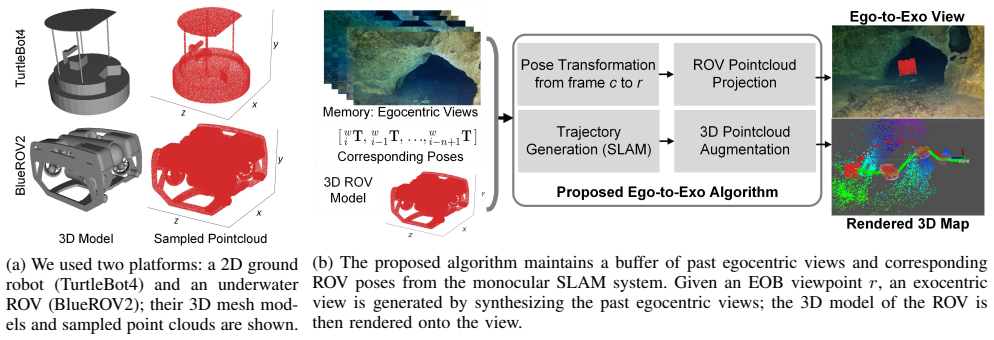

Figures from the paper (4 more)


Lean theorems connected to this paper
-
IndisputableMonolith/Foundation/RealityFromDistinction.leanreality_from_one_distinction unclear?
unclearRelation between the paper passage and the cited Recognition theorem.
The computations involved are closed-form and rely solely on egocentric views and monocular SLAM estimates... We use an ORB-SLAM3-based framework to obtain camera poses... ˜P = (wrR−1 wcR)·P + (wct − wrt)
-
IndisputableMonolith/Foundation/AlexanderDuality.leanalexander_duality_circle_linking unclear?
unclearRelation between the paper passage and the cited Recognition theorem.
We validate the geometric accuracy... ground plane estimation errors and reprojection errors... homography estimation approach
-
IndisputableMonolith/Cost/FunctionalEquation.leanwashburn_uniqueness_aczel unclear?
unclearRelation between the paper passage and the cited Recognition theorem.
J-cost is never mentioned; all geometry is up-to-scale monocular SLAM with empirical λ scaling
What do these tags mean?
- matches
- The paper's claim is directly supported by a theorem in the formal canon.
- supports
- The theorem supports part of the paper's argument, but the paper may add assumptions or extra steps.
- extends
- The paper goes beyond the formal theorem; the theorem is a base layer rather than the whole result.
- uses
- The paper appears to rely on the theorem as machinery.
- contradicts
- The paper's claim conflicts with a theorem or certificate in the canon.
- unclear
- Pith found a possible connection, but the passage is too broad, indirect, or ambiguous to say the theorem truly supports the claim.
Forward citations
Cited by 2 Pith papers
-
BlueME: Robust Underwater Robot-to-Robot Communication Using Compact Magnetoelectric Antennas
A 15-element magnetoelectric antenna array demonstrated underwater signal detection out to 730 meters in ocean trials while consuming roughly 1 to 10 watts.
-
Bridging Perspectives: A Survey on Cross-view Collaborative Intelligence with Egocentric-Exocentric Vision
A comprehensive review of cross-view video understanding that uses both first-person and third-person cameras, organized into a three-direction taxonomy with a dataset catalog and future research gaps.
Reviewed May 23, 2026 · model on record in the stance chip above.
Discussion (0). Continue with ORCID to comment.