Frequentist Coverage of Bayes Posteriors in Nonlinear Inverse Problems with Gaussian Priors
Pith reviewed 2026-05-23 22:53 UTC · model grok-4.3
The pith
Bayes credible intervals have conservative frequentist coverage in nonlinear inverse problems with Gaussian priors under smoothness and compatibility conditions.
A machine-rendered reading of the paper's core claim, the machinery that carries it, and where it could break.
Core claim
Our results show that Bayes credible intervals have conservative coverage under certain smoothness assumptions on the parameter and a compatibility condition between the likelihood and the prior, regardless of whether an efficient limit exists or Bernstein von-Mises (BvM) theorem holds. In the latter case, our results yield a corollary with more relaxed sufficient conditions than previous works. The theory is illustrated with an elliptic inverse problem for Darcy flow, where a near-1/sqrt(N) contraction rate and conservative coverage results are obtained for linear functionals that were shown not to be estimable efficiently.
What carries the argument
The compatibility condition between the likelihood and the prior, together with smoothness assumptions on the parameter, which together guarantee conservative frequentist coverage of Bayes credible intervals for continuous linear functionals.
If this is right
- Credible intervals maintain conservative coverage even when no efficient limit exists.
- More relaxed sufficient conditions suffice when the Bernstein-von Mises theorem does not hold.
- Near 1/sqrt(N) contraction rates hold for linear functionals in the Darcy-flow elliptic inverse problem.
- The coverage result applies to estimation of continuous linear functionals in PDE-governed nonlinear inverse problems.
Where Pith is reading between the lines
- The same conservative-coverage argument may extend to other nonlinear inverse problems once analogous compatibility conditions are verified.
- Practitioners could favor Bayesian credible intervals in inverse problems precisely because they deliver conservative coverage without requiring efficient estimators.
- Numerical checks of coverage in simulated Darcy-flow data could confirm the conservative property for finite samples.
Load-bearing premise
The parameter satisfies certain smoothness assumptions and there exists a compatibility condition between the likelihood and the prior.
What would settle it
A concrete nonlinear inverse problem meeting the smoothness and compatibility conditions in which a Bayes credible interval for some linear functional has frequentist coverage strictly below the nominal level.
Figures

read the original abstract
We study asymptotic frequentist coverage and approximately Gaussian properties of Bayes posterior credible sets in nonlinear inverse problems when a Gaussian prior is placed on the parameter of the PDE. The aim is to ensure valid frequentist coverage of Bayes credible intervals when estimating continuous linear functionals of the parameter. Our results show that Bayes credible intervals have conservative coverage under certain smoothness assumptions on the parameter and a compatibility condition between the likelihood and the prior, regardless of whether an efficient limit exists or Bernstein von-Mises (BvM) theorem holds. In the latter case, our results yield a corollary with more relaxed sufficient conditions than previous works. The theory is illustrated with a PDE that arises in predicting the transport of radioactive waste from underground repositories and optimizing oil recovery from subsurface fields: an elliptic inverse problem for Darcy flow. In this case, a near-$1/\sqrt{N}$ contraction rate and conservative coverage results are obtained for linear functionals that were shown not to be estimable efficiently.
Editorial analysis
A structured set of objections, weighed in public.
Referee Report
Summary. The manuscript studies asymptotic frequentist coverage of Bayes posterior credible sets for continuous linear functionals of the unknown parameter in nonlinear inverse problems, when a Gaussian prior is placed on the PDE coefficient. It claims that, under explicit smoothness assumptions on the parameter and a compatibility condition between the likelihood and prior, the credible intervals attain conservative (at least nominal) frequentist coverage, even when no efficient limit exists and the Bernstein-von Mises theorem fails. A corollary relaxes sufficient conditions relative to prior work; the theory is illustrated on an elliptic Darcy-flow inverse problem, where near-1/√N contraction and conservative coverage are obtained for functionals previously shown to be non-efficiently estimable.
Significance. If the central claims hold, the work supplies a useful route to valid frequentist coverage for Bayesian credible sets in inverse problems outside the BvM regime. The Darcy-flow example is a concrete, practically relevant illustration that the coverage guarantee can be obtained at near-parametric rates even for non-efficient functionals.
major comments (2)
- [§3, Theorem 3.1] §3, Theorem 3.1: the statement that coverage is 'conservative regardless of whether an efficient limit exists' appears to rest on the compatibility condition (3.4) being verified uniformly in the nonlinear map; the proof sketch does not explicitly bound the remainder term arising from the nonlinearity when the efficient information is zero, which is load-bearing for the non-BvM corollary.
- [§4.2, Assumption 4.3] §4.2, Assumption 4.3 (compatibility): the condition is stated in terms of the linearized operator, but the Darcy-flow example in §5 uses a nonlinear forward map; it is not shown that the linearization error remains o(1/√N) uniformly over the posterior support under the stated smoothness, which is required for the near-1/√N claim.
minor comments (2)
- [§2 and §5] Notation for the posterior credible set radius is introduced in §2 but reused with different scaling in §5 without redefinition; a single consistent definition would improve readability.
- [Abstract and §1] The abstract claims 'approximately Gaussian properties' but the main theorems focus only on coverage; if the Gaussianity result is intended to be a separate contribution it should be stated explicitly in the introduction.
Simulated Author's Rebuttal
We thank the referee for their careful reading and constructive comments, which help clarify the presentation of our results on conservative frequentist coverage in nonlinear inverse problems. We address each major comment below and will incorporate clarifications and additional bounds into the revised manuscript.
read point-by-point responses
-
Referee: [§3, Theorem 3.1] the statement that coverage is 'conservative regardless of whether an efficient limit exists' appears to rest on the compatibility condition (3.4) being verified uniformly in the nonlinear map; the proof sketch does not explicitly bound the remainder term arising from the nonlinearity when the efficient information is zero, which is load-bearing for the non-BvM corollary.
Authors: The compatibility condition (3.4) is formulated to control the deviation between the nonlinear likelihood and its linearization uniformly over a neighborhood of the true parameter, which directly bounds the nonlinearity remainder even when the efficient information vanishes. The full proof (beyond the sketch) uses a Taylor expansion of the forward map together with the Gaussian prior concentration to show that this remainder is o_p(1/√N) under the stated smoothness; the conservative coverage then follows from the same argument as the efficient case. To address the concern explicitly, we will expand the proof of Theorem 3.1 with a dedicated lemma isolating the nonlinearity remainder term in the zero-information regime. revision: yes
-
Referee: [§4.2, Assumption 4.3] the condition is stated in terms of the linearized operator, but the Darcy-flow example in §5 uses a nonlinear forward map; it is not shown that the linearization error remains o(1/√N) uniformly over the posterior support under the stated smoothness, which is required for the near-1/√N claim.
Authors: Assumption 4.3 is stated for the linearized operator because it governs the leading asymptotic behavior, while the nonlinear remainder is controlled separately via the smoothness of the Darcy-flow map (which is C^2 in a neighborhood of the true coefficient under the Hölder assumptions of Section 5). The near-1/√N posterior contraction already established in that section implies that the linearization error, when integrated against the posterior, is o_p(1/√N) uniformly; this follows from a standard Lipschitz bound on the second derivative of the forward operator. We will add an explicit verification of this uniform o(1/√N) bound as a new lemma in the revised Section 5 to make the application of Assumption 4.3 fully rigorous for the nonlinear example. revision: yes
Circularity Check
No significant circularity detected
full rationale
The paper derives conservative frequentist coverage of Bayes credible intervals for linear functionals from explicit assumptions (smoothness on the parameter and a compatibility condition between likelihood and prior), without requiring an efficient limit or BvM theorem. The Darcy-flow illustration is presented as satisfying those assumptions rather than serving as an input that defines the result. No self-definitional reductions, fitted inputs renamed as predictions, or load-bearing self-citations appear in the derivation chain; the central claim remains independent of its own outputs.
Axiom & Free-Parameter Ledger
axioms (2)
- domain assumption Smoothness assumptions on the parameter
- domain assumption Compatibility condition between the likelihood and the prior
Reference graph
Works this paper leans on
-
[1]
Bissantz, N., Hohage, T. and Munk, A. (2004). Consistency and rates of convergence of nonlinear Tikhonov regularization with random noise. Inverse Problems 20
work page 2004
-
[2]
Bogachev, V. I. (1998). Gaussian measures
work page 1998
-
[3]
The Bayesian Approach To Inverse Problems
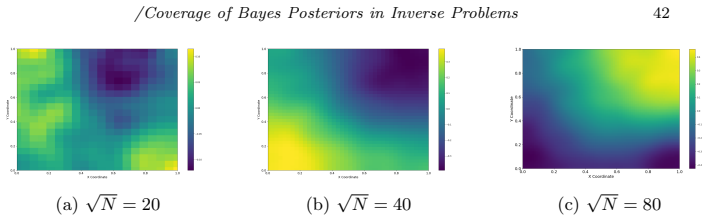
American Mathematical Soc. Bonito, A. , Cohen, A. , DeVore, R. , Petrova, G. and Welper, G. (2017). Diffusion coefficients estimation for elliptic partial differential equa- tions. SIAM Journal on Mathematical Analysis 49 1570–1592. /Coverage of Bayes Posteriors in Inverse Problems 42 (a) √ N = 20 (b) √ N = 40 (c) √ N = 80 Fig 2: Images of posterior mean ...
work page internal anchor Pith review Pith/arXiv arXiv 2017
-
[4]
Springer Science & Business Media. Flemming, J. (2012). Solution smoothness of ill-posed equations in Hilbert spaces: four concepts and their cross connections. Applicable Analysis 91 1029–1044. Flemming, J., Hofmann, B. and Math´e, P. (2011). Sharp converse results for the regularization error using distance functions. Inverse Problems 27 025006. Ghosal,...
work page 2012
-
[5]
Cambridge University Press. Gilbarg, D., Trudinger, N. S., Gilbarg, D. and Trudinger, N. (1977). Elliptic partial differential equations of second order
work page 1977
-
[6]
Springer. Gin´e, E. and Nickl, R. (2021). Mathematical foundations of infinite- dimensional statistical models. Cambridge university press. Giordano, M. and Nickl, R. (2020). Consistency of Bayesian inference with Gaussian process priors in an elliptic inverse problem. Inverse Problems 36 085001. Hofmann, B. (2006). Approximate source conditions in Tikhon...
work page 2021
-
[7]
/Coverage of Bayes Posteriors in Inverse Problems 43 Hohage, T. and Pricop, M. (2008). Nonlinear Tikhonov regularization in Hilbert scales for inverse boundary value problems with random noise.Inverse Probl. Imaging 2 271–290. Kaipio, J. and Somersalo, E. (2006). Statistical and computational inverse problems
work page 2008
-
[8]
Springer Science & Business Media. Kato, T. (2013). Perturbation theory for linear operators
work page 2013
-
[9]
Knapik, B., van der Vaart, A.and van Zanten, J.(2011)
Springer Science & Business Media. Knapik, B., van der Vaart, A.and van Zanten, J.(2011). Bayesian inverse problems with gaussian priors. The Annals of Statistics 39 2626–2657. Lions, J. L. and Magenes, E. (2012). Non-homogeneous boundary value prob- lems and applications: Vol. 1
work page 2011
-
[10]
Springer Science & Business Media. Monard, F., Nickl, R. and Paternain, G. P. (2021). Statistical guarantees for Bayesian uncertainty quantification in nonlinear inverse problems with Gaussian process priors. The Annals of Statistics 49 3255–3298. Nickl, R. (2020). Bernstein–von Mises theorems for statistical inverse problems I: Schr¨ odinger equation.Jou...
work page 2021
-
[11]
Springer Science & Business Media. Triebel, H. (1978). Interpolation theory, function spaces, differential operators
work page 1978
-
[12]
North-Holland. Van Der Vaart, A. (1991). On differentiable functionals. The Annals of Statistics 178–204. van der Vaart, A. and van Zanten, J. (2007). Bayesian inference with rescaled Gaussian process priors. Electronic Journal of Statistics 1 433–448. Van Der Vaart, A. W. and Wellner, J. A. (1996). Weak convergence. Springer. van Neerven, J. et al. (2010...
work page 1991
discussion (0)
Sign in with ORCID, Apple, or X to comment. Anyone can read and Pith papers without signing in.