Fully Passive Quantum Conference Key Agreement
Pith reviewed 2026-05-23 22:38 UTC · model grok-4.3
The pith
Extending fully passive modulation to interference-based quantum conference key agreement removes source side-channels while retaining measurement-device independence and single-photon interference performance.
A machine-rendered reading of the paper's core claim, the machinery that carries it, and where it could break.
Core claim
We extend the fully passive idea to an interference-based CKA, which has a high level of implementation security for many-user communication. The protocol combines passive source modulation with the interference-based prepare-and-measure CKA framework to achieve immunity to side-channels from both source and detector while preserving single-photon interference advantages for high-loss channels.
What carries the argument
Integration of fully passive source modulation into the interference-based prepare-and-measure CKA framework, which carries both the MDI security property and the single-photon interference performance.
If this is right
- The resulting protocol provides a high level of implementation security for many-user communication.
- The protocol remains immune to side-channels from the detector side.
- The protocol retains good key-rate performance especially for high-loss channels due to single-photon interference.
- All side channels from the source modulation side are eliminated.
Where Pith is reading between the lines
- - Practical multi-party quantum networks could operate with less trust placed in any single device or modulator.
- - The same passive-modulation integration might be tested on other interference-based multi-user protocols to check whether the security gain generalizes.
- - Laboratory verification would need to confirm that passive intensity and phase control does not introduce new timing or spectral leaks that offset the intended security benefit.
Load-bearing premise
The fully passive source modulation can be integrated with the existing interference-based CKA framework while preserving both the measurement-device-independent security and the single-photon interference performance advantages.
What would settle it
An experiment that implements the passive source modulation and measures a drop in single-photon interference visibility or a failure to maintain MDI security against detector side-channels would falsify the claim that the extension works without loss of advantages.
Figures



read the original abstract
Quantum Conference Key Agreement (CKA) provides a secure method for multi-party communication. A recently developed interference-based prepare-and-measure quantum CKA possesses the advantages of measurement-device-independence, namely, being immune to side-channels from the detector side. Besides, it achieves good key rate performance, especially for high-loss channels, due to the use of single photon interference. Meanwhile, several fully passive QKD schemes have been proposed, which eliminate all side channels from the source modulation side. We extend the fully passive idea to an interference-based CKA, which has a high level of implementation security for many-user communication.
Editorial analysis
A structured set of objections, weighed in public.
Referee Report
Summary. The manuscript proposes extending the fully passive source modulation technique, previously developed for two-party QKD, to an existing interference-based prepare-and-measure quantum conference key agreement (CKA) protocol. The resulting scheme aims to achieve measurement-device-independent security (immune to detector side-channels) while eliminating source modulation side-channels, thereby providing high implementation security for multi-party communication. It retains the single-photon interference advantages for key-rate performance in high-loss channels.
Significance. If the security proof and key-rate analysis hold, the work would combine two established techniques—fully passive sources and interference-based MDI-CKA—into a protocol with stronger implementation security for many-user scenarios. This addresses a practical gap in multi-party quantum key distribution by removing active modulation vulnerabilities without sacrificing the interference-based performance benefits. The approach could inform experimental realizations of secure conference key agreement in quantum networks.
minor comments (4)
- §3 (Protocol Description): The integration of passive intensity and phase modulation with the multi-user interference setup is described at a high level; explicit definitions of the passive source states and how they map onto the original CKA basis choices would improve reproducibility.
- §4 (Security Analysis): The reduction to the original MDI-CKA security is asserted but the explicit bound on the new passive-modulation side-channel leakage term is not derived; adding a short inequality or reference to the two-party passive QKD bound would clarify the argument.
- Figure 2: The schematic omits the passive modulator components; labeling the passive elements would help readers connect the diagram to the protocol steps.
- Table 1: The key-rate comparison uses a fixed loss value; stating the channel-loss range over which the advantage holds would strengthen the performance claim.
Simulated Author's Rebuttal
We thank the referee for the constructive summary and positive assessment of our work extending fully passive sources to interference-based CKA. The recommendation of minor revision is appreciated. No major comments were raised in the report, so we address the overall evaluation below and will handle any minor points (e.g., typos or clarifications) in the revision.
Circularity Check
No significant circularity detected
full rationale
The paper describes an extension of fully passive source modulation to an interference-based prepare-and-measure CKA protocol, claiming preservation of MDI security and single-photon interference performance. No equations, parameter-fitting procedures, self-definitional reductions, or load-bearing self-citations that collapse the central claim to its inputs are present in the provided abstract or described content. The derivation is presented as a direct conceptual combination of two previously established techniques without internal circularity.
Axiom & Free-Parameter Ledger
Forward citations
Cited by 2 Pith papers
-
Spanning-tree-packing protocol for conference key propagation in quantum networks
Spanning-tree packing yields an optimal protocol for conference key generation from pairwise QKD links in arbitrary quantum network topologies.
-
From Fundamental Dynamics to Applied Cryptography: Studies on the Quantum Speed Limit and Fully Passive Quantum Key Distribution
Thesis exploring quantum speed limits on dynamical evolution alongside a fully passive quantum key distribution scheme.
Reference graph
Works this paper leans on
-
[1]
Each party locally measures the two phases, denoted ϕi1 and ϕi2
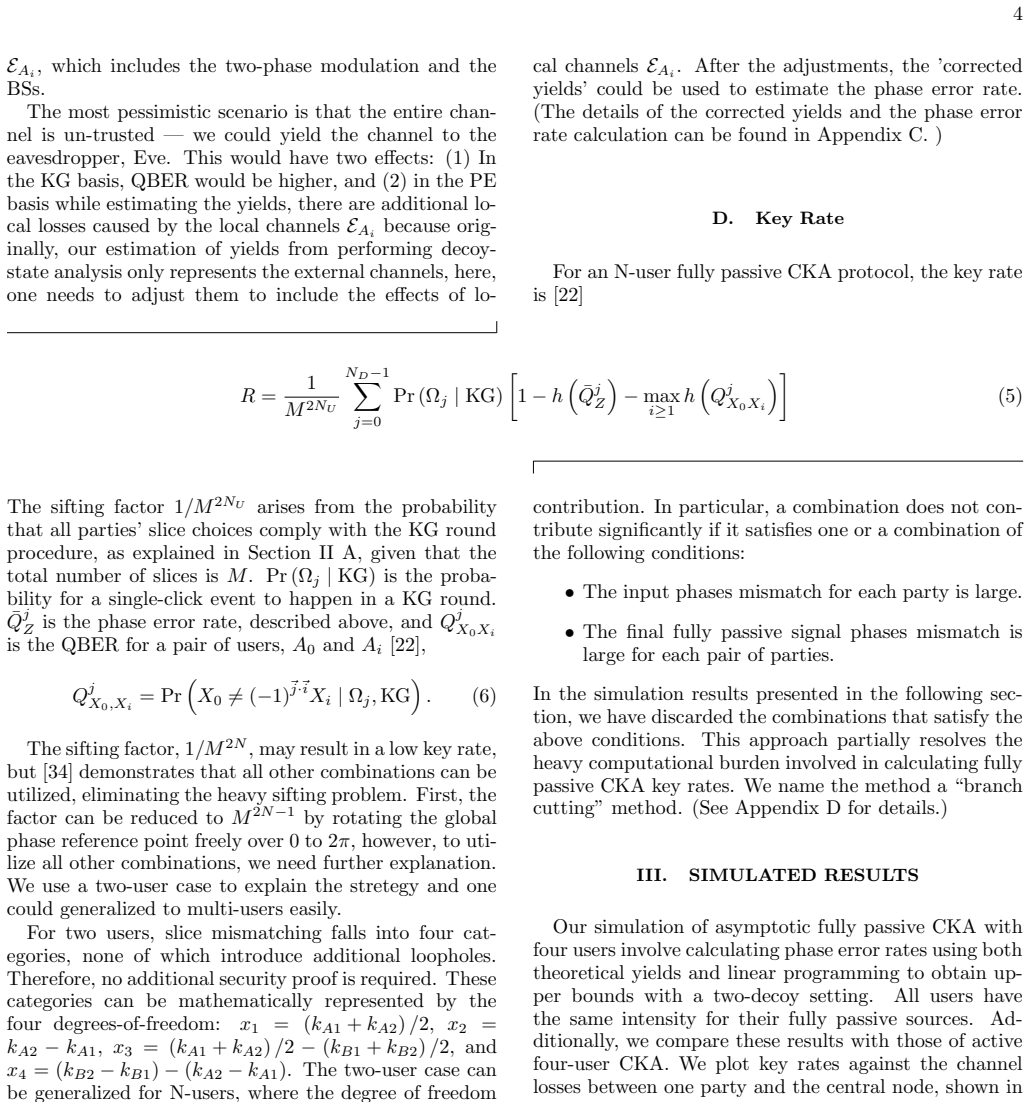
State preparation and measurement: Each party, Ai, prepares the state based on the fully passive source setup and sends out the signals to the untrusted party that poccesses the BS network as shown in the Fig 1 (c). Each party locally measures the two phases, denoted ϕi1 and ϕi2. Charlie, the untrusted party at the detection side, publicly announces the d...
-
[2]
Post-processing: A round of experiment is done when all parties send the fully passive signals and re- ceive Charlie’s detection announcement. After a large number of rounds are performed, the first party,A0, pub- licly announce a random binary sequence that decides if the corresponding round is a key generation (KG) round or a parameter estimation (PE) r...
-
[3]
All parties perform many rounds described in step 2. Their raw key is from many succesful KG rounds, each party record a classical 0 or 1 from one successful KG round. All parties perform error correction and privacy amplification to obtain the final key, the same as what would be done in active CKA protocols [22]. C. Security The security analysis for fu...
-
[4]
C. H. Bennett and G. Brassard, Quantum cryptogra- phy: Public key distribution and coin tossing, Theoreti- cal Computer Science 560, 7 (2014)
work page 2014
-
[5]
A. K. Ekert, Quantum cryptography based on bell’s the- orem, Physical Review Letters 67, 661 (1991)
work page 1991
- [6]
- [7]
-
[8]
J. E. Bourassa, A. Gnanapandithan, L. Qian, and H.-K. Lo, Measurement-device-independent quantum key dis- tribution with passive time-dependent source side chan- nels, Physical Review A 106, 062618 (2022)
work page 2022
-
[9]
K. ichiro Yoshino, M. Fujiwara, K. Nakata, T. Sumiya, T. Sasaki, M. Takeoka, M. Sasaki, A. Tajima, M. Koashi, and A. Tomita, Quantum key distribution with an effi- cient countermeasure against correlated intensity fluctu- ations in optical pulses, npj Quantum Information 4, 8 (2018)
work page 2018
-
[10]
L. Lydersen, C. Wiechers, C. Wittmann, D. Elser, J. Skaar, and V. Makarov, Hacking commercial quan- tum cryptography systems by tailored bright illumina- tion, Nature Photonics 4, 686 (2010)
work page 2010
-
[11]
H.-K. Lo, M. Curty, and B. Qi, Measurement-device- independent quantum key distribution, Physical Review Letters 108, 130503 (2012)
work page 2012
-
[12]
M. Lucamarini, Z. L. Yuan, J. F. Dynes, and A. J. Shields, Overcoming the rate-distance limit of quantum key distribution without quantum repeaters, Nature557, 400 (2018)
work page 2018
- [13]
-
[14]
K. Chen and H.-K. Lo, Multi-partite quantum crypto- graphic protocols with noisy ghz states, (2004)
work page 2004
- [15]
-
[16]
G. Murta, F. Grasselli, H. Kampermann, and D. Bruß, Quantum conference key agreement: A review, Advanced Quantum Technologies 3, 10.1002/qute.202000025 (2020)
- [17]
-
[18]
C. Ottaviani, C. Lupo, R. Laurenza, and S. Pirandola, Modular network for high-rate quantum conferencing, Communications Physics 2, 118 (2019)
work page 2019
-
[19]
F. Grasselli, H. Kampermann, and D. Bruß, Finite-key effects in multipartite quantum key distribution proto- cols, New Journal of Physics 20, 113014 (2018). 8
work page 2018
- [20]
-
[21]
K. Horodecki, M. Winczewski, and S. Das, Fundamen- tal limitations on the device-independent quantum con- ference key agreement, Physical Review A 105, 022604 (2022)
work page 2022
-
[22]
S. Das, S. B¨ auml, M. Winczewski, and K. Horodecki, Universal limitations on quantum key distribution over a network, Physical Review X 11, 041016 (2021)
work page 2021
- [23]
-
[24]
C.-L. Li, Y. Fu, W.-B. Liu, Y.-M. Xie, B.-H. Li, M.- G. Zhou, H.-L. Yin, and Z.-B. Chen, Breaking universal limitations on quantum conference key agreement with- out quantum memory, Communications Physics 6, 122 (2023)
work page 2023
-
[25]
G. Carrara, G. Murta, and F. Grasselli, Overcoming fun- damental bounds on quantum conference key agreement, Physical Review Applied 19, 064017 (2023)
work page 2023
-
[26]
S. Zhao, P. Zeng, W.-F. Cao, X.-Y. Xu, Y.-Z. Zhen, X. Ma, L. Li, N.-L. Liu, and K. Chen, Phase-matching quantum cryptographic conferencing, Phys. Rev. Appl. 14, 024010 (2020)
work page 2020
-
[27]
F. Grasselli, H. Kampermann, and D. Bruß, Confer- ence key agreement with single-photon interference, New Journal of Physics 21, 123002 (2019)
work page 2019
-
[28]
W. Wang, R. Wang, C. Hu, V. Zapatero, L. Qian, B. Qi, M. Curty, and H.-K. Lo, Fully passive quantum key dis- tribution, Physical Review Letters 130, 220801 (2023)
work page 2023
-
[29]
V. Zapatero, W. Wang, and M. Curty, A fully passive transmitter for decoy-state quantum key distribution, Quantum Science and Technology 8, 025014 (2023)
work page 2023
-
[30]
V. Zapatero and M. Curty, Finite-key security of passive quantum key distribution, Phys. Rev. Appl. 21, 014018 (2024)
work page 2024
- [31]
-
[32]
C. Hu, W. Wang, K.-S. Chan, Z. Yuan, and H.-K. Lo, Proof-of-principle demonstration of fully passive quan- tum key distribution, Physical Review Letters 131, 110801 (2023)
work page 2023
- [33]
- [34]
-
[35]
J. Li, W. Wang, and H.-K. Lo, Fully passive measurement-device-independent quantum key distribu- tion, Physical Review Applied 21, 064056 (2024)
work page 2024
-
[36]
X. Wang, F.-Y. Lu, Z.-H. Wang, Z.-Q. Yin, S. Wang, J.- Q. Geng, W. Chen, D.-Y. He, G.-C. Guo, and Z.-F. Han, Fully passive measurement-device-independent quantum key distribution, Phys. Rev. Appl. 21, 064067 (2024)
work page 2024
-
[37]
W. Wang, R. Wang, and H.-K. Lo, Fully-passive twin- field quantum key distribution, (2023)
work page 2023
- [38]
-
[39]
T. Hahn, Cuba—a library for multidimensional numeri- cal integration, Computer Physics Communications 168, 78 (2005)
work page 2005
discussion (0)
Sign in with ORCID, Apple, or X to comment. Anyone can read and Pith papers without signing in.