On the non-Markovian quantum control dynamics
Pith reviewed 2026-05-23 21:39 UTC · model grok-4.3
The pith
Non-Markovian atom-oscillator interactions yield linear time-varying equations for quantum state amplitudes via stability analysis of nonlinear decay rates.
A machine-rendered reading of the paper's core claim, the machinery that carries it, and where it could break.
Core claim
In non-Markovian cavity-QED systems the stochastic atom-oscillator interactions produce a time-varying decay rate described by nonlinear equations; stability analysis of those equations yields linear time-varying equations for the quantum state amplitudes. Measurement feedback through homodyne detection of the cavity output modulates the steady atomic and photonic states, and in multiple coupled systems it influences the dynamics of high-dimensional states and the associated stable and unstable subspaces.
What carries the argument
Stability analysis of the nonlinear equations that govern the time-varying decay rate, which directly supplies the linear time-varying equations obeyed by the quantum state amplitudes.
If this is right
- Open-loop evolution exhibits linear time-varying dynamics during the non-Markovian transient.
- Homodyne feedback can be used to adjust the steady-state values of atomic and photonic amplitudes.
- In networks of coupled cavity-QED systems the same feedback influences both the high-dimensional state vector and the locations of its stable and unstable subspaces.
Where Pith is reading between the lines
- The same stability-derived linear time-varying description could be tested in other non-Markovian baths whose memory kernels admit a comparable nonlinear rate equation.
- Feedback design based on the resulting linear time-varying model might be combined with existing Markovian control techniques to handle mixed memory effects.
Load-bearing premise
The assumption that stability analysis performed on the nonlinear equations for the time-varying decay rate directly produces the linear time-varying equations that govern the quantum state amplitudes.
What would settle it
An experiment in which the measured quantum state amplitudes in a non-Markovian cavity-QED setup fail to follow the predicted linear time-varying equations would falsify the central claim.
Figures
read the original abstract
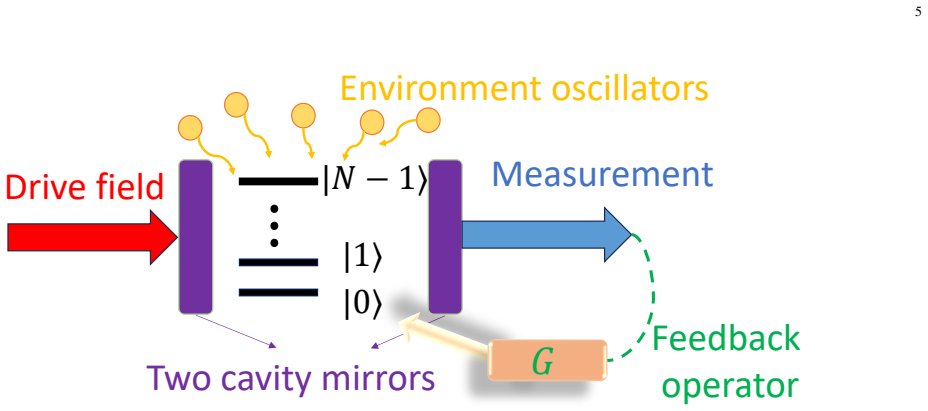
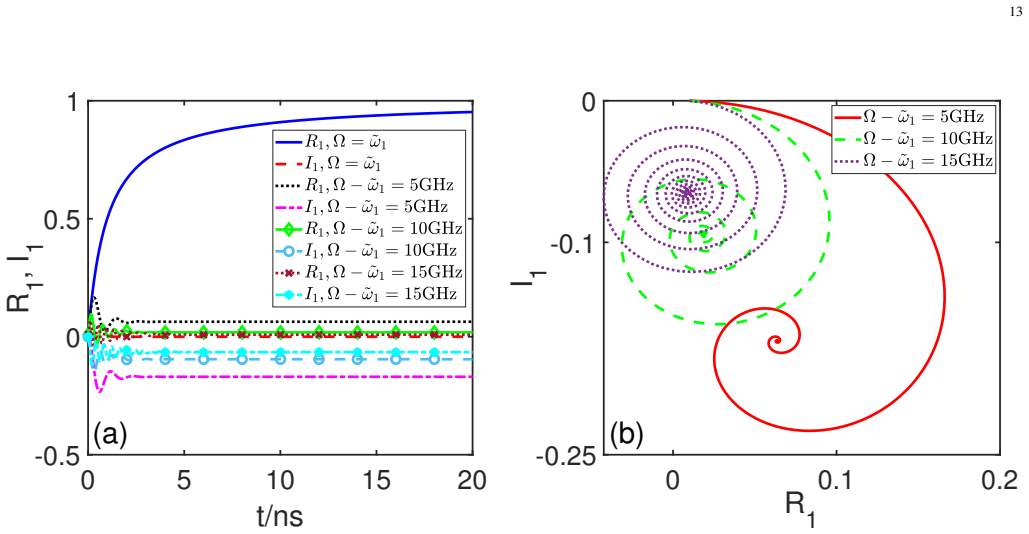
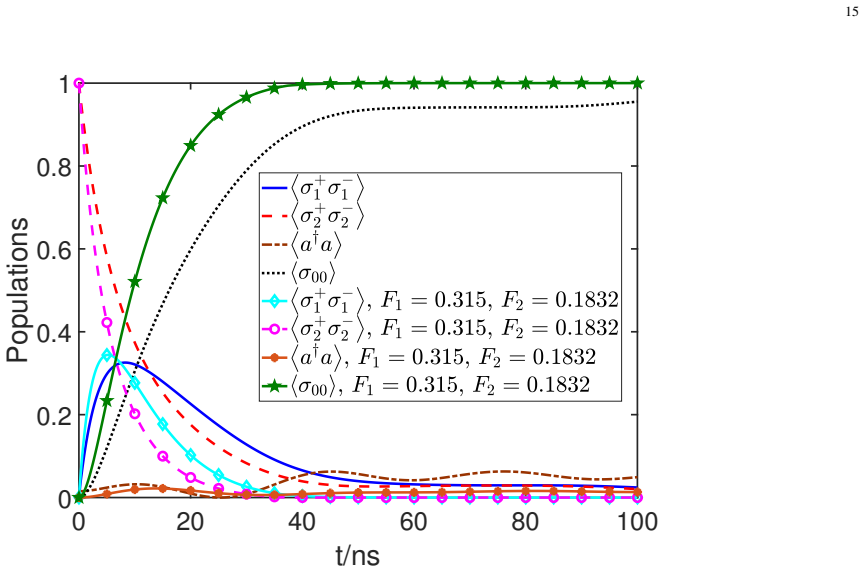
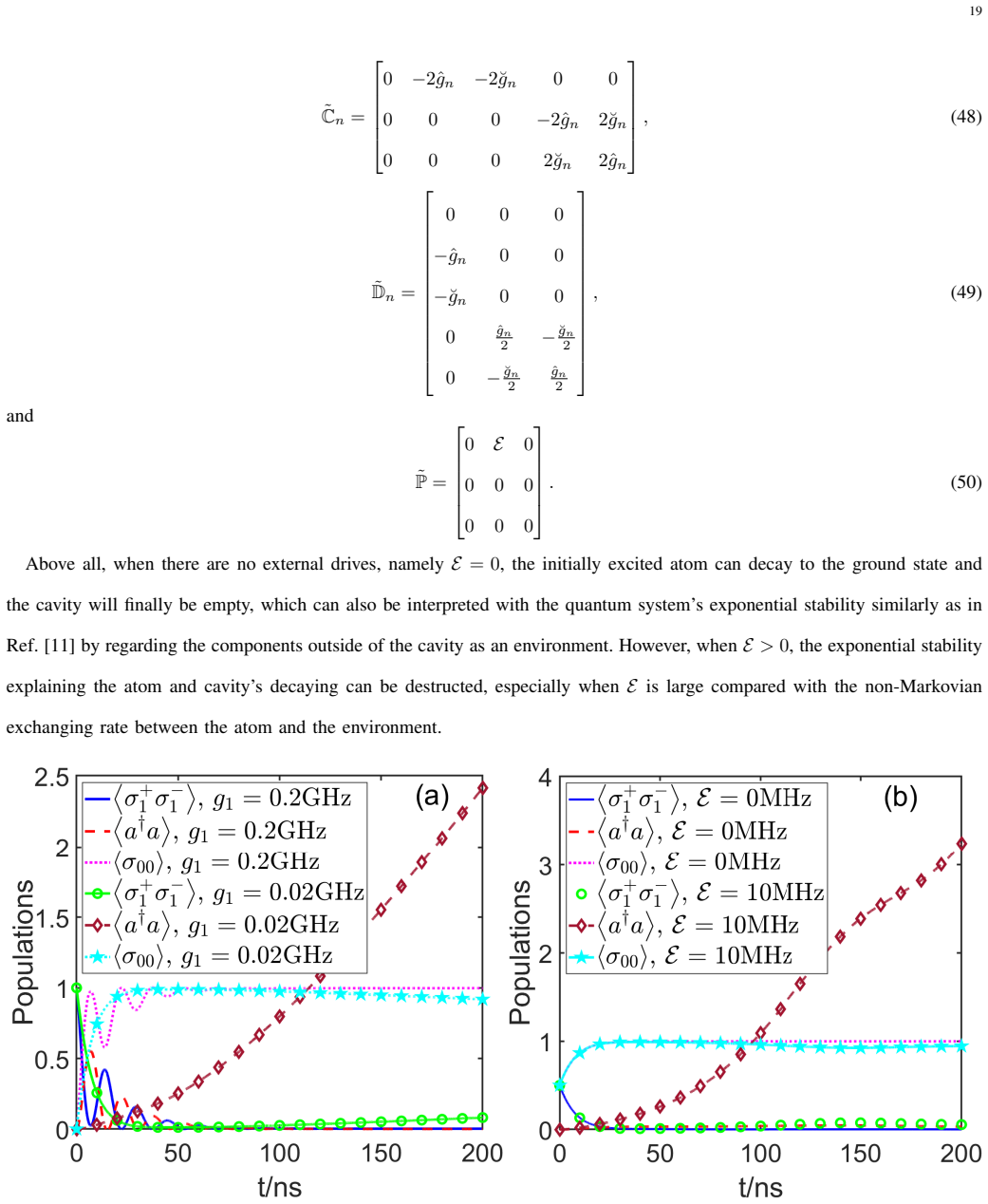
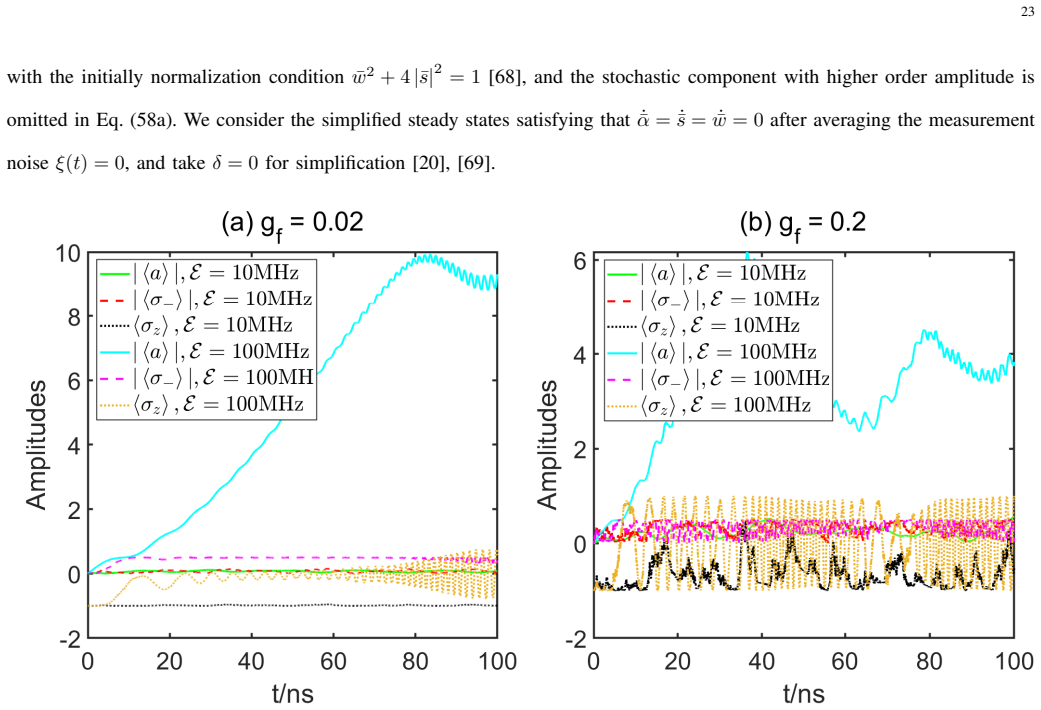
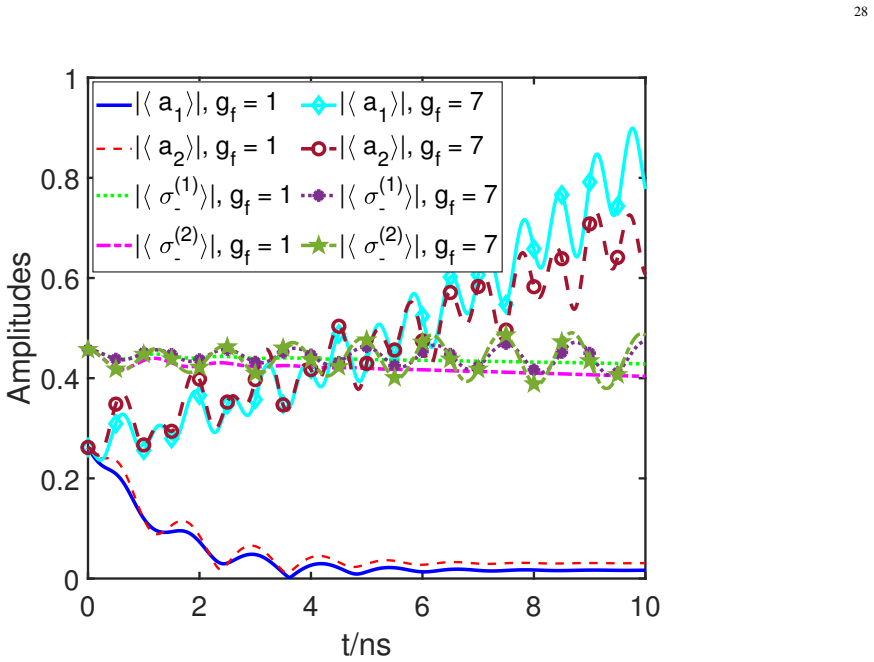
In this paper, we study both open-loop control and closed-loop measurement feedback control of non-Markovian quantum dynamics arising from the interaction between a quantum system and its environment. We use the widely studied cavity quantum electrodynamics (cavity-QED) system as an example, where an atom interacts with the environment composed of a collection of oscillators. In this scenario, the stochastic interactions between the atom and the environment can introduce non-Markovian characteristics into the evolution of quantum states, differing from the conventional Markovian dynamics observed in open quantum systems. As a result, the atom's decay rate to the environment varies with time and can be described by nonlinear equations. The solutions to these nonlinear equations can be analyzed in terms of the stability of a nonlinear system. Consequently, the evolution of quantum state amplitudes follows linear time-varying equations as a result of the non-Markovian quantum transient process. Additionally, by using measurement feedback through homodyne detection of the cavity output, we can modulate the steady atomic and photonic states in the non-Markovian process. When multiple coupled cavity-QED systems are involved, measurement-based feedback control can influence the dynamics of high-dimensional quantum states, as well as the resulting stable and unstable subspaces.
Editorial analysis
A structured set of objections, weighed in public.
Referee Report
Summary. The paper examines open-loop and closed-loop measurement feedback control for non-Markovian quantum dynamics in cavity-QED systems consisting of an atom interacting with a collection of oscillators. It posits that stochastic interactions result in a time-varying decay rate governed by nonlinear equations, whose stability analysis leads to linear time-varying equations for the quantum state amplitudes. The work also explores how homodyne detection feedback can modulate steady atomic and photonic states, and in coupled systems, influence high-dimensional states and their stable/unstable subspaces.
Significance. If the asserted mapping from the stability of nonlinear decay-rate equations to linear time-varying quantum amplitude evolution is rigorously established with explicit derivations, the paper would offer a novel perspective on controlling non-Markovian quantum systems, with potential applications in quantum information and open quantum system theory. The inclusion of measurement feedback and multi-system coupling extends the analysis to practical control scenarios.
major comments (1)
- [Abstract] Abstract: The transition from 'the atom's decay rate to the environment varies with time and can be described by nonlinear equations. The solutions to these nonlinear equations can be analyzed in terms of the stability of a nonlinear system. Consequently, the evolution of quantum state amplitudes follows linear time-varying equations' lacks any shown intermediate steps or model assumptions. Stability analysis of a nonlinear rate equation does not automatically dictate the form of the quantum amplitude equations unless the substitution of the time-dependent rate into the underlying master or Schrödinger equation (and any approximations such as rotating-wave or weak-coupling) is derived explicitly; this mapping is load-bearing for the central claim.
Simulated Author's Rebuttal
We thank the referee for their careful reading and constructive feedback. We address the single major comment below.
read point-by-point responses
-
Referee: [Abstract] Abstract: The transition from 'the atom's decay rate to the environment varies with time and can be described by nonlinear equations. The solutions to these nonlinear equations can be analyzed in terms of the stability of a nonlinear system. Consequently, the evolution of quantum state amplitudes follows linear time-varying equations' lacks any shown intermediate steps or model assumptions. Stability analysis of a nonlinear rate equation does not automatically dictate the form of the quantum amplitude equations unless the substitution of the time-dependent rate into the underlying master or Schrödinger equation (and any approximations such as rotating-wave or weak-coupling) is derived explicitly; this mapping is load-bearing for the central claim.
Authors: We agree that the abstract presents a high-level summary without the intermediate steps. The manuscript derives the mapping explicitly in Section II: the stochastic atom-oscillator interactions yield the nonlinear decay-rate equations; their stability properties are analyzed; the resulting time-dependent rate is substituted into the Schrödinger equation (under rotating-wave and weak-coupling approximations) to produce the linear time-varying amplitude equations (see Eqs. (3)–(8) and the accompanying text). To address the concern directly, we will revise the abstract to include a brief clause referencing these assumptions and the section containing the full derivation. revision: yes
Circularity Check
No significant circularity detected
full rationale
The paper's derivation chain, as presented in the abstract, asserts that nonlinear equations for a time-varying decay rate (arising from standard cavity-QED atom-oscillator interactions) have solutions whose stability analysis yields linear time-varying equations for quantum state amplitudes. No equations, fitted parameters, self-citations, or ansatzes are quoted that reduce any claimed prediction or result to its own inputs by construction. The central mapping is presented as a modeling consequence within established non-Markovian open quantum systems theory rather than a self-referential or statistically forced step. The derivation therefore remains self-contained against external benchmarks of cavity-QED dynamics.
Axiom & Free-Parameter Ledger
axioms (1)
- domain assumption Stochastic atom-oscillator interactions produce a time-varying decay rate governed by nonlinear equations whose stability determines quantum evolution.
Lean theorems connected to this paper
-
IndisputableMonolith/Cost/FunctionalEquationwashburn_uniqueness_aczel unclear?
unclearRelation between the paper passage and the cited Recognition theorem.
the atom's decay rate to the environment varies with time and can be described by nonlinear equations. The solutions to these nonlinear equations can be analyzed in terms of the stability of a nonlinear system. Consequently, the evolution of quantum state amplitudes follows linear time-varying equations
-
IndisputableMonolith/Foundation/RealityFromDistinctionreality_from_one_distinction unclear?
unclearRelation between the paper passage and the cited Recognition theorem.
non-Markovian quantum dynamics arising from the interaction between a quantum system and its environment... cavity quantum electrodynamics (cavity-QED) system
What do these tags mean?
- matches
- The paper's claim is directly supported by a theorem in the formal canon.
- supports
- The theorem supports part of the paper's argument, but the paper may add assumptions or extra steps.
- extends
- The paper goes beyond the formal theorem; the theorem is a base layer rather than the whole result.
- uses
- The paper appears to rely on the theorem as machinery.
- contradicts
- The paper's claim conflicts with a theorem or certificate in the canon.
- unclear
- Pith found a possible connection, but the passage is too broad, indirect, or ambiguous to say the theorem truly supports the claim.
Reference graph
Works this paper leans on
-
[1]
Quantum feedback: theory, experiments, and applications,
J. Zhang, Y .-x. Liu, R.-B. Wu, K. Jacobs, and F. Nori, “Quantum feedback: theory, experiments, and applications,” Phys. Rep., vol. 679, pp. 1–60, 2017
work page 2017
-
[2]
Quantum coherent nonlinear feedback with applications to quantum optics on chip,
J. Zhang, R.-B. Wu, Y .-x. Liu, C.-W. Li, and T.-J. Tarn, “Quantum coherent nonlinear feedback with applications to quantum optics on chip,” IEEE Trans. Autom. Control, vol. 57, no. 8, pp. 1997–2008, 2012
work page 1997
-
[3]
Quantum estimation, control and learning: Opportunities and challenges,
D. Dong and I. R. Petersen, “Quantum estimation, control and learning: Opportunities and challenges,” Annu. Rev. Control, vol. 54, pp. 243–251, 2022. 32
work page 2022
-
[4]
A. M. Zagoskin, Quantum engineering: theory and design of quantum coherent structures. Cambridge University Press, 2011
work page 2011
-
[5]
Quantum control theory and applications: a survey,
D. Dong and I. R. Petersen, “Quantum control theory and applications: a survey,” IET Control Theory and Appl., vol. 4, no. 12, pp. 2651–2671, 2010
work page 2010
-
[6]
N. Khaneja, T. Reiss, C. Kehlet, T. Schulte-Herbr ¨uggen, and S. J. Glaser, “Optimal control of coupled spin dynamics: design of NMR pulse sequences by gradient ascent algorithms,” J. Magn. Res., vol. 172, no. 2, pp. 296–305, 2005
work page 2005
-
[7]
Learning robust and high-precision quantum controls,
R.-B. Wu, H. Ding, D. Dong, and X. Wang, “Learning robust and high-precision quantum controls,” Phys. Rev. A, vol. 99, no. 4, p. 042327, 2019
work page 2019
-
[8]
On the control of flying qubits,
W.-L. Li, G. Zhang, and R.-B. Wu, “On the control of flying qubits,” Automatica, vol. 143, p. 110338, 2022
work page 2022
-
[9]
Comparison between continuous- and discrete-mode coherent feedback for the Jaynes-Cummings model,
N. N ´emet, A. Carmele, S. Parkins, and A. Knorr, “Comparison between continuous- and discrete-mode coherent feedback for the Jaynes-Cummings model,” Phys. Rev. A, vol. 100, p. 023805, Aug 2019
work page 2019
-
[10]
Quantum coherent feedback control with photons,
H. Ding and G. Zhang, “Quantum coherent feedback control with photons,” IEEE Trans. Autom. Control, vol. 69, no. 2, pp. 856–871, 2024
work page 2024
-
[11]
Quantum coherent feedback control of an N-Level atom with multiple excitations,
——, “Quantum coherent feedback control of an N-Level atom with multiple excitations,” IEEE Transactions on Automatic Control, vol. 70, no. 5, pp. 3117–3132, 2025
work page 2025
-
[12]
Quantum feedback control of a two-atom network closed by a semi-infinite waveguide,
H. Ding, G. Zhang, M.-T. Cheng, and G. Cai, “Quantum feedback control of a two-atom network closed by a semi-infinite waveguide,” arXiv preprint arXiv:2306.06373, 2023
-
[13]
“Quantum coherent and measurement feedback control based on atoms coupled with a semi-infinite waveguide,” SIAM J. Control Optim., no. 0, pp. S231–S257, 2025
work page 2025
-
[14]
Quantum control through measurement feedback,
H. Uys, H. Bassa, P. Du Toit, S. Ghosh, and T. Konrad, “Quantum control through measurement feedback,” Phys. Rev. A, vol. 97, no. 6, p. 060102, 2018
work page 2018
-
[15]
H. M. Wiseman and G. J. Milburn, Quantum measurement and control. Cambridge university press, 2009
work page 2009
-
[16]
An exponential quantum projection filter for open quantum systems,
Q. Gao, G. Zhang, and I. R. Petersen, “An exponential quantum projection filter for open quantum systems,” Automatica, vol. 99, pp. 59–68, 2019
work page 2019
-
[17]
An improved quantum projection filter,
——, “An improved quantum projection filter,” Automatica, vol. 112, p. 108716, 2020
work page 2020
-
[18]
Feedback control of quantum state reduction,
R. Van Handel, J. K. Stockton, and H. Mabuchi, “Feedback control of quantum state reduction,” IEEE Trans. Autom. Control, vol. 50, no. 6, pp. 768–780, 2005
work page 2005
-
[19]
Continuous quantum error correction via quantum feedback control,
C. Ahn, A. C. Doherty, and A. J. Landahl, “Continuous quantum error correction via quantum feedback control,” Phys. Rev. A, vol. 65, no. 4, p. 042301, 2002
work page 2002
-
[20]
Protecting coherence and entanglement by quantum feedback controls,
J. Zhang, R.-B. Wu, C.-W. Li, and T.-J. Tarn, “Protecting coherence and entanglement by quantum feedback controls,” IEEE Trans. Autom. Control, vol. 55, no. 3, pp. 619–633, 2010
work page 2010
-
[21]
Exact non-Markovian master equation for the spin-boson and Jaynes-Cummings models,
L. Ferialdi, “Exact non-Markovian master equation for the spin-boson and Jaynes-Cummings models,” Phys. Rev. A, vol. 95, no. 2, p. 020101, 2017
work page 2017
-
[22]
Dynamics of non-Markovian open quantum systems,
I. De Vega and D. Alonso, “Dynamics of non-Markovian open quantum systems,” Rev. Mod. Phys., vol. 89, no. 1, p. 015001, 2017
work page 2017
-
[23]
D. Khurana, B. K. Agarwalla, and T. Mahesh, “Experimental emulation of quantum non-Markovian dynamics and coherence protection in the presence of information backflow,” Phys. Rev. A, vol. 99, no. 2, p. 022107, 2019
work page 2019
-
[24]
H.-P. Breuer and F. Petruccione, The theory of open quantum systems. OUP Oxford, 2002
work page 2002
-
[25]
Detecting non-Markovianity via quantified coherence: theory and experiments,
K.-D. Wu, Z. Hou, G.-Y . Xiang, C.-F. Li, G.-C. Guo, D. Dong, and F. Nori, “Detecting non-Markovianity via quantified coherence: theory and experiments,” npj Quantum Inf., vol. 6, no. 1, p. 55, 2020
work page 2020
-
[26]
The non-Markovian stochastic Schr ¨odinger equation for open systems,
L. Di ´osi and W. T. Strunz, “The non-Markovian stochastic Schr ¨odinger equation for open systems,” Phys. Lett. A, vol. 235, no. 6, pp. 569–573, 1997
work page 1997
-
[27]
Non-Markovian quantum state diffusion,
L. Di ´osi, N. Gisin, and W. T. Strunz, “Non-Markovian quantum state diffusion,” Phys. Rev. A, vol. 58, no. 3, p. 1699, 1998
work page 1998
-
[28]
Open system dynamics with non-Markovian quantum trajectories,
W. T. Strunz, L. Di ´osi, and N. Gisin, “Open system dynamics with non-Markovian quantum trajectories,” Phys. Rev. Lett., vol. 82, pp. 1801–1805, Mar 1999
work page 1999
-
[29]
Nonadiabatic elimination of auxiliary modes in continuous quantum measurements,
H. Yang, H. Miao, and Y . Chen, “Nonadiabatic elimination of auxiliary modes in continuous quantum measurements,” Phys. Rev. A, vol. 85, no. 4, p. 040101, 2012
work page 2012
-
[30]
Memory effect and non-Markovian dynamics in an open quantum system,
F. Liu, X. Zhou, and Z.-W. Zhou, “Memory effect and non-Markovian dynamics in an open quantum system,” Phys. Rev. A, vol. 99, no. 5, p. 052119, 2019
work page 2019
-
[31]
Machine learning non-markovian quantum dynamics,
I. Luchnikov, S. Vintskevich, D. Grigoriev, and S. Filippov, “Machine learning non-markovian quantum dynamics,” Phys. Rev. Lett., vol. 124, no. 14, p. 140502, 2020. 33
work page 2020
-
[32]
Probing non-markovian quantum dynamics with data-driven analysis: Beyond “black-box
I. Luchnikov, E. Kiktenko, M. Gavreev, H. Ouerdane, S. Filippov, and A. Fedorov, “Probing non-markovian quantum dynamics with data-driven analysis: Beyond “black-box” machine-learning models,” Phys. Rev. Res., vol. 4, no. 4, p. 043002, 2022
work page 2022
-
[33]
B. Leggio, R. Lo Franco, D. O. Soares-Pinto, P. Horodecki, and G. Compagno, “Distributed correlations and information flows within a hybrid multipartite quantum-classical system,” Phys. Rev. A, vol. 92, no. 3, p. 032311, 2015
work page 2015
-
[34]
Control of a qubit under Markovian and non-Markovian noise,
G. Delben, M. Beims, and M. da Luz, “Control of a qubit under Markovian and non-Markovian noise,” Phys. Rev. A, vol. 108, no. 1, p. 012620, 2023
work page 2023
-
[35]
Accelerated adiabatic quantum search algorithm via pulse control in a non-Markovian environment,
F.-H. Ren, Z.-M. Wang, and L.-A. Wu, “Accelerated adiabatic quantum search algorithm via pulse control in a non-Markovian environment,” Phys. Rev. A, vol. 102, no. 6, p. 062603, 2020
work page 2020
-
[36]
Stochastic learning control of adiabatic speedup in a non-Markovian open qutrit system,
Y .-Y . Xie, F.-H. Ren, R.-H. He, A. Ablimit, and Z.-M. Wang, “Stochastic learning control of adiabatic speedup in a non-Markovian open qutrit system,” Phys. Rev. A, vol. 106, no. 6, p. 062612, 2022
work page 2022
-
[37]
On the dynamics of the Tavis-Cummings model,
Z. Dong, G. Zhang, A.-G. Wu, and R.-B. Wu, “On the dynamics of the Tavis-Cummings model,” IEEE Trans. Autom. Control, vol. 68, no. 4, pp. 2048–2063, 2022
work page 2048
-
[38]
Exact non-Markovian master equations for multiple qubit systems: Quantum-trajectory approach,
Y . Chen, J. You, and T. Yu, “Exact non-Markovian master equations for multiple qubit systems: Quantum-trajectory approach,” Phys. Rev. A, vol. 90, no. 5, p. 052104, 2014
work page 2014
-
[39]
Non-Markovian relaxation of a three-level system: Quantum trajectory approach,
J. Jing and T. Yu, “Non-Markovian relaxation of a three-level system: Quantum trajectory approach,” Phys. Rev. Lett., vol. 105, no. 24, p. 240403, 2010
work page 2010
-
[40]
S. Mondal, S. S. Sahoo, A. K. Mohapatra, and A. Bandyopadhyay, “Formation of electromagnetically induced transparency and two-photon absorption in close and open multi-level ladder systems,” Opt. Commun., vol. 472, p. 126036, 2020
work page 2020
-
[41]
Non-Markovian quantum-state diffusion: Perturbation approach,
T. Yu, L. Di ´osi, N. Gisin, and W. T. Strunz, “Non-Markovian quantum-state diffusion: Perturbation approach,” Phys. Rev. A, vol. 60, no. 1, p. 91, 1999
work page 1999
-
[42]
I. de Vega, D. Alonso, and P. Gaspard, “Two-level system immersed in a photonic band-gap material: A non-Markovian stochastic Schr ¨odinger-equation approach,” Phys. Rev. A, vol. 71, no. 2, p. 023812, 2005
work page 2005
-
[43]
L. Accardi, A. Frigerio, and J. Lewis, “Quantum stochastic processes,” Publ. Res. Inst. Math. Sci., vol. 18, pp. 97–133, 1982
work page 1982
- [44]
-
[45]
Controlling the dynamics of a coupled atom-cavity system by pure dephasing,
A. Auff `eves, D. Gerace, J.-M. G ´erard, M. F. Santos, L. Andreani, and J.-P. Poizat, “Controlling the dynamics of a coupled atom-cavity system by pure dephasing,” Phys. Rev. B, vol. 81, no. 24, p. 245419, 2010
work page 2010
-
[46]
L. Wang, J. Hu, J. Du, and K. Di, “Broadband coherent perfect absorption by cavity coupled to three-level atoms in linear and nonlinear regimes,” New J. Phys., vol. 23, no. 12, p. 123040, 2021
work page 2021
-
[47]
Two-photon emission spectrum of a two-level atom in an ideal cavity,
L.-s. He and X.-l. Feng, “Two-photon emission spectrum of a two-level atom in an ideal cavity,” Phys. Rev. A, vol. 49, no. 5, p. 4009, 1994
work page 1994
-
[48]
Spontaneous collective coherence in driven dissipative cavity arrays,
J. Ruiz-Rivas, E. del Valle, C. Gies, P. Gartner, and M. J. Hartmann, “Spontaneous collective coherence in driven dissipative cavity arrays,” Phys. Rev. A, vol. 90, no. 3, p. 033808, 2014
work page 2014
-
[49]
Stability and robustness analysis of nonlinear systems via contraction metrics and SOS programming,
E. M. Aylward, P. A. Parrilo, and J.-J. E. Slotine, “Stability and robustness analysis of nonlinear systems via contraction metrics and SOS programming,” Automatica, vol. 44, no. 8, pp. 2163–2170, 2008
work page 2008
-
[50]
On contraction analysis for non-linear systems,
W. Lohmiller and J.-J. E. Slotine, “On contraction analysis for non-linear systems,” Automatica, vol. 34, no. 6, pp. 683–696, 1998
work page 1998
-
[51]
Some extensions of Liapunov’s second method,
J. LaSalle, “Some extensions of Liapunov’s second method,” IRE Trans. Circuit Theory, vol. 7, no. 4, pp. 520–527, 1960
work page 1960
-
[52]
Convergent systems vs. incremental stability,
B. S. R ¨uffer, N. Van De Wouw, and M. Mueller, “Convergent systems vs. incremental stability,” Systems & Control Letters, vol. 62, no. 3, pp. 277–285, 2013
work page 2013
-
[53]
Electromagnetically induced transparency with single atoms in a cavity,
M. M ¨ucke, E. Figueroa, J. Bochmann, C. Hahn, K. Murr, S. Ritter, C. J. Villas-Boas, and G. Rempe, “Electromagnetically induced transparency with single atoms in a cavity,” Nature, vol. 465, no. 7299, pp. 755–758, 2010
work page 2010
-
[54]
Climbing the Jaynes–Cummings ladder and observing its nonlinearity in a cavity QED system,
J. Fink, M. G ¨oppl, M. Baur, R. Bianchetti, P. J. Leek, A. Blais, and A. Wallraff, “Climbing the Jaynes–Cummings ladder and observing its nonlinearity in a cavity QED system,” Nature, vol. 454, no. 7202, pp. 315–318, 2008
work page 2008
-
[55]
Quantum-to-classical transition in cavity quantum electrodynamics,
J. Fink, L. Steffen, P. Studer, L. S. Bishop, M. Baur, R. Bianchetti, D. Bozyigit, C. Lang, . f. S. Filipp, P. J. Leek et al., “Quantum-to-classical transition in cavity quantum electrodynamics,” Phys. Rev. Lett., vol. 105, no. 16, p. 163601, 2010
work page 2010
-
[56]
Adiabatic speedup in a non-Markovian quantum open system,
Z.-M. Wang, D.-W. Luo, M. S. Byrd, L.-A. Wu, T. Yu, and B. Shao, “Adiabatic speedup in a non-Markovian quantum open system,” Phys. Rev. A, vol. 98, no. 6, p. 062118, 2018. 34
work page 2018
-
[57]
Necessary and sufficient conditions for asymptotic decoupling of stable modes in LTV systems,
Z. Hu, Z. Chen, and H.-T. Zhang, “Necessary and sufficient conditions for asymptotic decoupling of stable modes in LTV systems,” IEEE Trans. Autom. Control, vol. 66, no. 10, pp. 4546–4559, 2020
work page 2020
-
[58]
Bellman, Stability theory of differential equations
R. Bellman, Stability theory of differential equations. Courier Corporation, 2008
work page 2008
-
[59]
A note on uniform exponential stability of linear periodic time-varying systems,
R. Vrabel, “A note on uniform exponential stability of linear periodic time-varying systems,” IEEE Trans. Autom. Control, vol. 65, no. 4, pp. 1647–1651, 2019
work page 2019
-
[60]
Quantum theory of continuous feedback,
H. M. Wiseman, “Quantum theory of continuous feedback,” Phys. Rev. A, vol. 49, no. 3, p. 2133, 1994
work page 1994
-
[61]
Quantum Markovian subsystems: invariance, attractivity, and control,
F. Ticozzi and L. Viola, “Quantum Markovian subsystems: invariance, attractivity, and control,” IEEE Trans. Autom. Control, vol. 53, no. 9, pp. 2048–2063, 2008
work page 2048
-
[62]
C. W. Gardiner et al., Handbook of stochastic methods. springer Berlin, 1985, vol. 3
work page 1985
-
[63]
Feedback control of quantum systems using continuous state estimation,
A. C. Doherty and K. Jacobs, “Feedback control of quantum systems using continuous state estimation,” Phys. Rev. A, vol. 60, no. 4, p. 2700, 1999
work page 1999
-
[64]
Partially dark optical molecule via phase control,
Z. Wang, X.-W. Xu, and Y . Li, “Partially dark optical molecule via phase control,” Phys. Rev. A, vol. 95, no. 1, p. 013815, 2017
work page 2017
-
[65]
A straightforward introduction to continuous quantum measurement,
K. Jacobs and D. A. Steck, “A straightforward introduction to continuous quantum measurement,” Contemp. Phys., vol. 47, no. 5, pp. 279–303, 2006
work page 2006
-
[66]
Conditional and unconditional Gaussian quantum dynamics,
M. G. Genoni, L. Lami, and A. Serafini, “Conditional and unconditional Gaussian quantum dynamics,” Contemp. Phys., vol. 57, no. 3, pp. 331–349, 2016
work page 2016
-
[67]
Transition from weak to strong measurements by nonlinear quantum feedback control,
J. Zhang, Y .-x. Liu, R.-B. Wu, C.-W. Li, and T.-J. Tarn, “Transition from weak to strong measurements by nonlinear quantum feedback control,” Phys. Rev. A, vol. 82, no. 2, p. 022101, 2010
work page 2010
-
[68]
Quantum jumps between dressed states: A proposed cavity-QED test using feedback,
J. Reiner, H. Wiseman, and H. Mabuchi, “Quantum jumps between dressed states: A proposed cavity-QED test using feedback,” Phys. Rev. A, vol. 67, no. 4, p. 042106, 2003
work page 2003
-
[69]
Stabilization of stochastic quantum dynamics via open-and closed-loop control,
F. Ticozzi, K. Nishio, and C. Altafini, “Stabilization of stochastic quantum dynamics via open-and closed-loop control,” IEEE Trans. Autom. Control, vol. 58, no. 1, pp. 74–85, 2012
work page 2012
-
[70]
Emission spectrum in dissipative cavities coupled with quantum dots,
Y . Zhang and S.-C. L ¨u, “Emission spectrum in dissipative cavities coupled with quantum dots,” J. Phys. B, At. Mol. Opt. Phys., vol. 52, no. 12, p. 125502, 2019
work page 2019
-
[71]
Photon localization versus population trapping in a coupled-cavity array,
F. Lombardo, F. Ciccarello, and G. M. Palma, “Photon localization versus population trapping in a coupled-cavity array,” Phys. Rev. A, vol. 89, no. 5, p. 053826, 2014
work page 2014
-
[72]
Controllable scattering of a single photon inside a one-dimensional resonator waveguide,
L. Zhou, Z. Gong, Y .-x. Liu, C. Sun, and F. Nori, “Controllable scattering of a single photon inside a one-dimensional resonator waveguide,” Phys. Rev. Lett., vol. 101, no. 10, p. 100501, 2008
work page 2008
-
[73]
Quantum optics of chiral spin networks,
Hannes, Pichler, Tom ´as, Ramos, Andrew, J., Daley, Peter, and Zoller, “Quantum optics of chiral spin networks,” Phys. Rev. A, vol. 91, no. 4, pp. 42 116–42 116, 2015
work page 2015
-
[74]
Bounded-input bounded-output stability of nonlinear time-varying differential systems,
P. Varaiya and R. Liu, “Bounded-input bounded-output stability of nonlinear time-varying differential systems,” SIAM J. Contr., vol. 4, no. 4, pp. 698–704, 1966
work page 1966
-
[75]
Bounded-input bounded-output stability of nonlinear time-varying discrete control systems,
J. Lin and P. Varaiya, “Bounded-input bounded-output stability of nonlinear time-varying discrete control systems,” IEEE Trans. Autom. Control, vol. 12, no. 4, pp. 423–427, 1967
work page 1967
-
[76]
Stability of nonlinear systems,
G. Chen, “Stability of nonlinear systems,” Encyclopedia of RF and Microwave Engineering, pp. 4881–4896, 2004
work page 2004
discussion (0)
Sign in with ORCID, Apple, or X to comment. Anyone can read and Pith papers without signing in.