Shot-noise reduction for lattice Hamiltonians
Pith reviewed 2026-05-25 08:58 UTC · model grok-4.3
The pith
A geometric partitioning of lattice Hamiltonians into local patches reduces the variance of energy estimators compared with Pauli grouping and thereby cuts the number of required shots.
A machine-rendered reading of the paper's core claim, the machinery that carries it, and where it could break.
Core claim
By partitioning the Hamiltonian into local patches and measuring in the eigenbases of those patches, the resulting energy estimator exhibits smaller variance than Pauli grouping schemes for energy eigenstates, providing rigorous guarantees even in the presence of depolarizing noise, which reduces the total number of measurement shots required while allowing control over circuit depth through choice of patch size.
What carries the argument
Geometric partitioning of the Hamiltonian into local patches with measurements performed in the eigenbases of those patches.
If this is right
- Fewer total shots are needed to reach a target precision in energy estimation.
- The variance reduction holds with rigorous guarantees for energy eigenstates even under depolarizing noise.
- Patch size can be tuned to keep measurement circuit depth practical.
- Numerical experiments show shot-count reductions of several orders of magnitude on 2D XY, Ising, and Fermi-Hubbard models.
- The approach applies to any quantum algorithm subroutine that requires energy expectation values of lattice Hamiltonians.
Where Pith is reading between the lines
- The same partitioning idea could be tested on approximate eigenstates prepared by variational methods if inter-patch correlations remain moderate.
- Hierarchical or overlapping patch schemes might yield further variance gains on larger lattices.
- Similar local-eigenbasis measurements could be adapted to estimate other local observables beyond the energy.
- The method may combine with existing grouping or importance-sampling techniques for additional shot savings.
Load-bearing premise
The prepared states are eigenstates of the full Hamiltonian so that cross-patch correlations do not increase the variance beyond the derived bounds.
What would settle it
A direct numerical comparison of estimator variances on a small 2D lattice for an exact energy eigenstate, where the new method must show strictly lower variance than a Pauli grouping scheme.
Figures

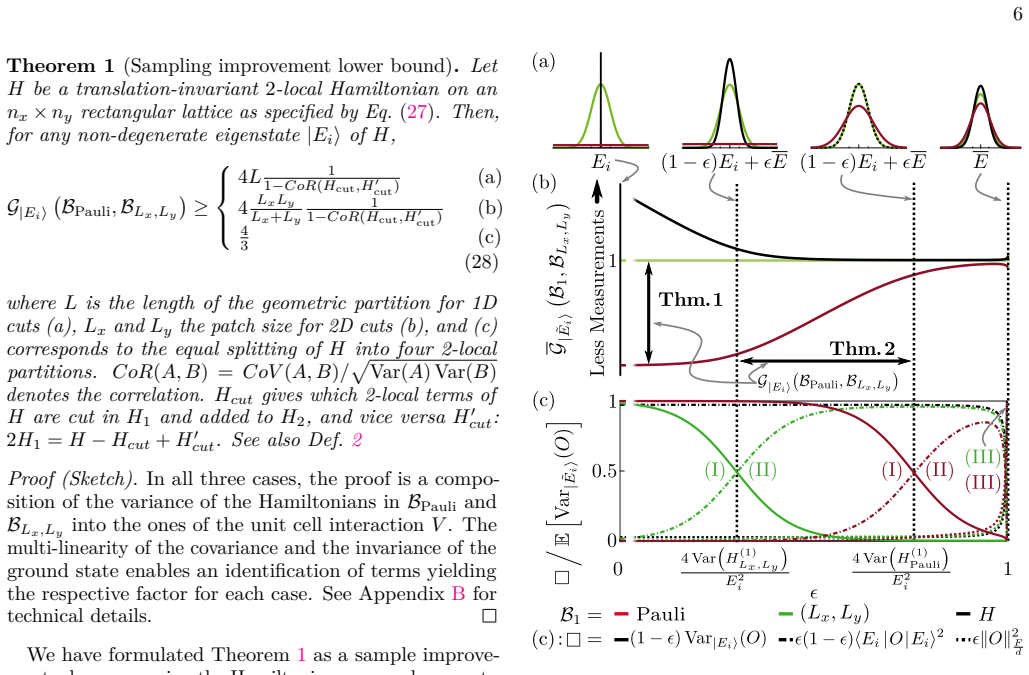


read the original abstract
Efficiently estimating energy expectation values of quantum lattice systems on quantum computers is a crucial subroutine for various quantum algorithms, which can lead to significant overhead due to the high measurement shot numbers required. We introduce a measurement strategy tailored to quantum lattice systems and (noisy) energy eigenstates. It is based on a geometric partitioning of the Hamiltonian into local patches, and performing the measurements in the eigenbases of those patches. The resulting energy estimator has a smaller variance than the ones of Pauli grouping schemes, which leads to a reduction of the total number of shots. We provide rigorous guarantees for this variance improvement for energy eigentstates, also in the presence of depolarizing noise. As one can choose the subsystem size, one can ensure that measurement circuits remain within implementable depths. In numerical experiments, we demonstrate the shot count reduction for various 2D lattice models, including the transverse field XY and Ising models, as well as the Fermi-Hubbard model. We find sampling improvements of several orders of magnitude already for plaquettes of two by two qubits, where the required readout circuits remain very moderate in depth.
Editorial analysis
A structured set of objections, weighed in public.
Referee Report
Summary. The manuscript introduces a measurement strategy for estimating expectation values of lattice Hamiltonians on quantum computers. It partitions the Hamiltonian geometrically into local patches, performs measurements in the eigenbases of those patches, and claims that the resulting energy estimator has provably smaller variance than standard Pauli-grouping estimators when the prepared state is a (noisy) energy eigenstate of the full Hamiltonian. This variance reduction is asserted to translate into fewer total shots; rigorous bounds are provided that remain valid under depolarizing noise, and the patch size can be chosen to keep readout circuits shallow. Numerical experiments on 2D transverse-field XY, Ising, and Fermi-Hubbard models report shot-count reductions of several orders of magnitude already for 2×2 plaquettes.
Significance. If the variance bounds hold, the approach offers a concrete route to lowering the dominant measurement overhead in quantum lattice simulations whenever eigenstates (or noisy eigenstates) are prepared. The explicit provision of rigorous guarantees that survive depolarizing noise, together with the tunable patch size that keeps circuit depth practical, constitutes a clear technical strength. The numerical demonstrations across multiple models supply reproducible evidence of the claimed improvement and support the practical relevance of the method within its stated scope.
minor comments (3)
- [§2] §2 (or wherever the patch Hamiltonian is defined): the notation for the local patch operators and their eigenbases would benefit from an explicit equation immediately after the geometric-partitioning paragraph to avoid ambiguity when the reader reaches the variance derivation.
- [Numerical experiments] Figure 4 and associated table: the reported shot-reduction factors lack error bars or a statement of the number of independent runs; adding this information would make the numerical claims easier to assess.
- [Abstract] The abstract states that the method works 'also in the presence of depolarizing noise,' but the precise noise model (local vs. global depolarizing, strength relative to patch size) is only clarified later; a one-sentence reminder in the abstract would improve readability.
Simulated Author's Rebuttal
We thank the referee for the positive assessment of our manuscript, the accurate summary of our geometric partitioning approach, and the recommendation for minor revision. The referee's comments highlight the strengths of the variance bounds under depolarizing noise and the numerical results across models.
Circularity Check
No significant circularity; variance bounds derived from eigenstate properties
full rationale
The paper introduces a geometric partitioning strategy and derives variance reduction guarantees directly from the mathematical properties of energy eigenstates (including under depolarizing noise) and the structure of local patch measurements. No steps reduce by construction to fitted parameters, self-citations, or renamed inputs; the central claims rest on explicit bounds that hold for the stated class of states and Hamiltonians without circular redefinition. The derivation is self-contained against external benchmarks such as standard Pauli grouping variances.
Axiom & Free-Parameter Ledger
axioms (1)
- standard math Standard quantum measurement theory and variance formulas for expectation values
Forward citations
Cited by 1 Pith paper
-
Preparation Circuits for Matrix Product States by Classical Variational Disentanglement
A layer-by-layer classical variational disentanglement algorithm compiles preparation circuits for matrix product states by minimizing bipartite entanglement to reduce bond dimensions.
Reference graph
Works this paper leans on
-
[1]
(48) we use again O ( ∥H∥2 F d /E2 i ) = O (1/n) to truncate the norm terms in Eq
To show Eq. (48) we use again O ( ∥H∥2 F d /E2 i ) = O (1/n) to truncate the norm terms in Eq. (30). Then we do a similar calculation to Corollary 2, but with two different perturbation strengths ϵfor Pauli and geometric 10 partitioning: δ+ 1 ! =G|˜Ei⟩ ( BPauli/L x,Ly,BH ) = 4 Var|Ei⟩(H1) +ϵ(threshold)(1 +α2)E2 i ϵ(threshold)E2 i +O (1 n ) = 1 +α2 + 4 Var...
-
[2]
Two-dimensional Transverse Field XY-Model Theorem 1 indicates that measuring via geometric par- titionings can become (almost) as good as via the eigenba- sis. The relative sampling complexity improvement lower bound comparing geometric partitioning with mutually commuting local operator grouping, which mostly coin- cides with Pauli partitioning for simpl...
-
[3]
Two-dimensional Transverse field Ising-Model Another way to search for large sampling improvement examples is to take the relative sampling complexity defi- nition (Def. 1) directly and to look out for cases where Var|Ei⟩(H1) = Var|Ei⟩(H2) scale more beneficial than Pauli partitioning. One such instance is one standard test bed of quantum spin models, the...
-
[4]
Two-dimensional Transverse field biaxial next-nearest-neighbour Ising model To arrive at a model, which we need to partition simi- larly to an (axial) 3-local one, we can add an axial next nearest-neighbor ZiZj interaction to the TFIM. Then, we obtain on a two-dimensional rectangular lattice the Transverse field biaxial next-nearest-neighbour Ising (TF- B...
-
[5]
Two-dimensional hard-core Bose-Hubbard model If we parameterize the TFXYM, see Eq. (49), with a symmetric interaction strength J, HHCBH =−J 2 ∑ ⟨i,j⟩ (XiXj +YiYj) +h 2 ∑ i Zi (53) we obtain an Hamiltonian equivalent to the hard-core limit of the Bose Hubbard model [30, 31] HHCBH =−J ∑ ⟨i,j⟩ ( a† iaj +aia† j ) +h ∑ i ni (54) with ai, a† i and ni =a† iai be...
-
[6]
Two-dimensional Spinless Hubbard Model Next, we want to demonstrate, how our geometric sampling idea is well applicable to fermionic lattice models as well. For these models, we geometrically partition the Hamiltonian in the fermionic Fock basis and then perform a local fermion-to-qubit mapping for each patch separately (together with the transfomations U...
-
[7]
Two-dimensional Spinful Hubbard Model As a final example for geometric partitioning to reduce the measurement effort when estimating energies of eigen- states, we show the Hubbard model. This model, which was originally proposed as an effective model to study electron correlations, like for example how transitions from conductors to insulators occur [ 35]...
-
[8]
J. Haah, A. W. Harrow, Z. Ji, X. Wu, and N. Yu, Sample- optimal tomography of quantum states, IEEE Transac- tions on Information Theory 63, 5628 (2017)
work page 2017
-
[9]
S. Arunachalam and R. De Wolf, Optimal quantum sam- ple complexity of learning algorithms, Journal of Machine Learning Research 19, 1 (2018)
work page 2018
- [10]
-
[11]
P. Gokhale, O. Angiuli, Y. Ding, K. Gui, T. Tomesh, M. Suchara, M. Martonosi, and F. T. Chong, Minimizing state preparations in variational quantum eigensolver by partitioning into commuting families, arXiv:1907.13623 [quant-ph] (2019)
-
[12]
A. Jena, S. Genin, and M. Mosca, Pauli partitioning with respect to gate sets, arXiv:1907.07859 [quant-ph]
work page internal anchor Pith review Pith/arXiv arXiv 1907
-
[13]
V. Verteletskyi, T.-C. Yen, and A. F. Izmaylov, Measure- ment optimization in the variational quantum eigensolver using a minimum clique cover, J. Chem. Phys.152, 124114 (2020), arXiv:1907.03358 [quant-ph]
-
[14]
W. J. Huggins, J. R. McClean, N. C. Rubin, Z. Jiang, N. Wiebe, K. B. Whaley, and R. Babbush, Efficient and noise resilient measurements for quantum chemistry on near-term quantum computers, npj Quantum Information 7, 1 (2021)
work page 2021
-
[15]
A. Gresch and M. Kliesch, Guaranteed efficient energy estimation of quantum many-body Hamiltonians using ShadowGrouping, arXiv:2301.03385 [quant-ph] (2023)
- [16]
-
[17]
C. Hadfield, S. Bravyi, R. Raymond, and A. Mezzacapo, Measurements of quantum Hamiltonians with locally- biased classical shadows, arXiv:2006.15788 [quant-ph] (2020)
-
[18]
Hadfield, Adaptive Pauli shadows for energy estimation, arXiv:2105.12207 [quant-ph]
C. Hadfield, Adaptive Pauli shadows for energy estimation, arXiv:2105.12207 [quant-ph]
- [19]
-
[20]
R. Brieger, M. Heinrich, I. Roth, and M. Kliesch, Sta- bility of classical shadows under gate-dependent noise, arXiv:2310.19947 [quant-ph] (2023)
-
[21]
O. Crawford, B. van Straaten, D. Wang, T. Parks, E. Campbell, and S. Brierley, Efficient quantum measure- ment of pauli operators in the presence of finite sampling error, Quantum 5, 385 (2021)
work page 2021
-
[22]
A. Chatterjee, P. Stevenson, S. De Franceschi, A. Morello, N. P. de Leon, and F. Kuemmeth, Semiconductor qubits in practice, Nature Reviews Physics 3, 157 (2021)
work page 2021
-
[23]
G. Burkard, T. D. Ladd, A. Pan, J. M. Nichol, and J. R. Petta, Semiconductor spin qubits, Reviews of Modern Physics 95, 025003 (2023)
work page 2023
-
[24]
F. Arute, K. Arya, R. Babbush, D. Bacon, J. C. Bardin, R. Barends, R. Biswas, S. Boixo, F. G. S. L. Brandao, D. A. Buell, B. Burkett, Y. Chen, Z. Chen, B. Chiaro, R. Collins, W. Courtney, A. Dunsworth, 17 E. Farhi, B. Foxen, A. Fowler, C. Gidney, M. Giustina, R. Graff, K. Guerin, S. Habegger, M. P. Harrigan, M. J. Hartmann, A. Ho, M. Hoffmann, T. Huang, T...
work page 2019
- [25]
-
[26]
F. Verstraete, J. I. Cirac, and J. I. Latorre, Quantum circuits for strongly correlated quantum systems, Physical Review A 79, 032316 (2009)
work page 2009
-
[27]
H. P. Robertson, The uncertainty principle, Physical Re- view 34, 163 (1929)
work page 1929
-
[28]
M. B. Hastings and T. Koma, Spectral gap and exponen- tial decay of correlations, Communications in mathemati- cal physics 265, 781 (2006)
work page 2006
-
[29]
M. Henkel, Statistical mechanics of the 2d quantum xy model in a transverse field, Journal of Physics A: Mathe- matical and General 17, L795 (1984)
work page 1984
-
[30]
Y. Nishiyama, Multicritical behavior of the fidelity sus- ceptibility for the 2d quantum transverse-field xy model, The European Physical Journal B 92, 1 (2019)
work page 2019
-
[31]
Ising, Beitrag zur Theorie des Ferro-und Paramag- netismus, Ph.D
E. Ising, Beitrag zur Theorie des Ferro-und Paramag- netismus, Ph.D. thesis, Hamburgische Universit¨ at (1924)
work page 1924
-
[32]
L. Onsager, Crystal statistics. i. a two-dimensional model with an order-disorder transition, Physical Review 65, 117 (1944)
work page 1944
-
[33]
T. D. Schultz, D. C. Mattis, and E. H. Lieb, Two- dimensional ising model as a soluble problem of many fermions, Reviews of Modern Physics 36, 856 (1964)
work page 1964
-
[34]
H. W. J. Bl¨ ote and Y. Deng, Cluster monte carlo sim- ulation of the transverse Ising model, Phys. Rev. E 66, 066110 (2002)
work page 2002
-
[35]
R. Hornreich, R. Liebmann, H. Schuster, and W. Selke, Lifshitz points in Ising systems, Zeitschrift f¨ ur Physik B Condensed Matter 35, 91 (1979)
work page 1979
-
[36]
T. Eckstein, R. Mansuroglu, P. Czarnik, J.-X. Zhu, M. J. Hartmann, L. Cincio, A. T. Sornborger, and Z. Holmes, Large-scale simulations of floquet physics on near-term quantum computers, npj Quantum Information 10, 84 (2024)
work page 2024
-
[37]
V. Murg, F. Verstraete, and J. I. Cirac, Variational study of hard-core bosons in a two-dimensional optical lattice using projected entangled pair states, Physical Review A—Atomic, Molecular, and Optical Physics 75, 033605 (2007)
work page 2007
- [38]
-
[39]
H. A. Gersch and G. C. Knollman, Quantum cell model for bosons, Physical Review 129, 959 (1963)
work page 1963
- [40]
-
[41]
N. Zhang and C. Henley, Stripes and holes in a two- dimensional model of spinless fermions or hardcore bosons, Phys. Rev. B 68, 014506 (2003)
work page 2003
-
[42]
Hubbard, Electron correlations in narrow energy bands, Proceedings of the Royal Society of London
J. Hubbard, Electron correlations in narrow energy bands, Proceedings of the Royal Society of London. Series A. Mathematical and Physical Sciences 276, 238 (1963)
work page 1963
-
[43]
E. H. Lieb, Two theorems on the hubbard model, Physical review letters 62, 1201 (1989)
work page 1989
-
[44]
A. Barenco, C. H. Bennett, R. Cleve, D. P. DiVincenzo, N. Margolus, P. Shor, T. Sleator, J. A. Smolin, and H. Weinfurter, Elementary gates for quantum compu- tation, Physical review A 52, 3457 (1995)
work page 1995
-
[45]
A. Anshu, Concentration bounds for quantum states with finite correlation length on quantum spin lattice systems, New Journal of Physics 18, 083011 (2016)
work page 2016
-
[46]
M. Kliesch and I. Roth, Theory of quantum system certification, PRX Quantum 2, 010201 (2021), tutorial, arXiv:2010.05925 [quant-ph]. 18 Appendix A: How to compare measurement strategies A measurement strategy in quantum mechanics has the aim of determining an estimator for the true observable expectation value⟨ψ|H|ψ⟩as accurate as possible with a given nu...
-
[47]
”Disordered phase” h>>J We normalize the Hamiltonian to obtain (this does not change the variance ratio): H =− ∑ i Xi− (J h ) ∑ ⟨i,j⟩ ZiZj =− ∑ i Xi−λ ∑ ⟨i,j⟩ ZiZj =H0 +λV (D1) The ground state|E0⟩is given up to second order in λby: |E(0) 0 ⟩=|+⟩⊗n (D2) |E(1) 0 ⟩= ∑ |b⟩̸=|+⟩⊗n ⣨ b ⏐⏐⏐ ∑ ⟨i,j⟩ZiZj ⏐⏐⏐ +⊗n ⟩ −n−(n−2·2) |b⟩= 1 4 ∑ ⟨i,j⟩ ZiZj|+⟩⊗n (D3) |E(2) ...
-
[48]
Further note that we defined Hr =T−1HlT1
”Ordered phase” h<<J We normalize the Hamiltonian to obtain (this does not change the variance ratio): H =− ∑ ⟨i,j⟩ ZiZj− (h J )∑ i Xi =− ∑ ⟨i,j⟩ ZiZj−λ ∑ i Xi =H0 +λV (D32) Then we can calculate the perturbed state order by order: Var(H2) Var(1 2(H−Hl +Hr)) = 4 Var(H1) Var(Hl−Hr) (D33) We now want to calculate |E(0) 0 ⟩=|0⟩⊗n (D34) |E(1) 0 ⟩= ∑ |b⟩̸=|0⟩⊗...
discussion (0)
Sign in with ORCID, Apple, or X to comment. Anyone can read and Pith papers without signing in.