Fast-Reconfiguring Liquid-Crystal RIS for Pervasive Wireless Networks
Pith reviewed 2026-05-23 18:28 UTC · model grok-4.3
The pith
LiquiRIS cuts LC-RIS reconfiguration time by up to 71.61 percent by choosing phase transitions that respect liquid crystal molecule dynamics.
A machine-rendered reading of the paper's core claim, the machinery that carries it, and where it could break.
Core claim
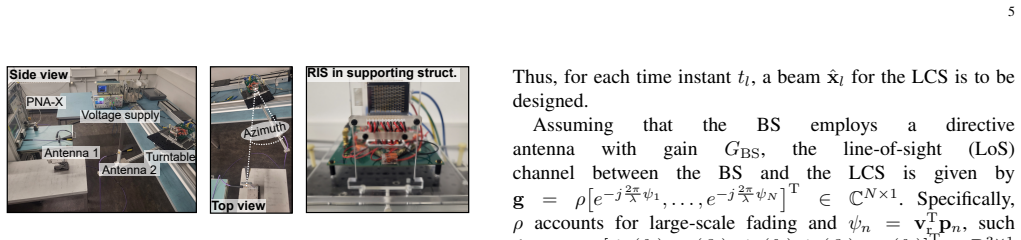
By explicitly incorporating the physical dynamics of LC molecules into the phase-shift configuration process, LiquiRIS intelligently selects phase transitions that minimize the overall reconfiguration time. As a result, LiquiRIS achieves up to 71.61 percent reduction in overall reconfiguration time compared to conventional schemes, significantly improving the feasibility of LC-RIS deployment. The proposed framework is further validated through experiments on a mmWave LC-RIS prototype.
What carries the argument
The phase-transition selector that ranks candidate shifts according to the modeled response time of the underlying LC molecules.
If this is right
- LC-RIS can now support faster adaptation to changing channel conditions without semiconductor hardware.
- Overall system latency for blockage mitigation and coverage extension drops in proportion to the reconfiguration savings.
- Power consumption tied to repeated phase updates decreases because fewer total time slots are spent in transition.
- The same surfaces become viable candidates for real-time beam tracking in mobile mmWave links.
Where Pith is reading between the lines
- The selection logic could be combined with predictive channel models to pre-compute transition sequences before a change is needed.
- Similar dynamics-aware scheduling might apply to other slow-tunable surfaces such as those based on phase-change materials.
- Hardware designers could use the same model to optimize electrode layouts that reduce the worst-case transition times.
- Network simulators that currently treat RIS reconfiguration as a fixed delay could be updated with the variable times reported here.
Load-bearing premise
The mathematical model of how LC molecules rotate and settle under applied voltage correctly predicts the actual time each phase change will take on the physical hardware.
What would settle it
A side-by-side measurement on the same mmWave LC-RIS prototype showing that the LiquiRIS schedule produces no statistically significant reduction in observed reconfiguration time would falsify the central claim.
Figures




read the original abstract
Reconfigurable intelligent surfaces (RISs) have emerged as a key technology for dynamically reshaping wireless propagation, enhancing coverage and mitigating blockages to enable more pervasive network connectivity. However, implementing RISs at high frequencies remains challenging due to the cost and power demands of semiconductor-based components. To address these critical limitations, liquid crystals (LCs) technology has been identified as a promising low-cost and low-power alternative, giving rise to LC-RIS. The central challenge of this technology, however, lies in its limited responsiveness, as the slow molecular dynamics of LCs lead to long phase-shift reconfiguration times that restrict practicality. This paper presents LiquiRIS, a novel framework that enables substantially faster phase shifting in LC-RIS. By explicitly incorporating the physical dynamics of LC molecules into the phase-shift configuration process, LiquiRIS intelligently selects phase transitions that minimize the overall reconfiguration time. As a result, LiquiRIS achieves up to $ 71.61 \% $ reduction in overall reconfiguration time compared to conventional schemes, significantly improving the feasibility of LC-RIS deployment. The proposed framework is further validated through experiments on a mmWave LC-RIS prototype.
Editorial analysis
A structured set of objections, weighed in public.
Referee Report
Summary. The manuscript introduces LiquiRIS, a framework for liquid-crystal reconfigurable intelligent surfaces (LC-RIS) that explicitly incorporates the physical dynamics of LC molecules into the phase-shift configuration process to intelligently select transitions minimizing overall reconfiguration time. It claims this yields up to 71.61% reduction in reconfiguration time versus conventional schemes and reports validation via experiments on an mmWave LC-RIS prototype.
Significance. If the LC molecular dynamics model is shown to match prototype measurements with quantified error bounds and the 71.61% figure is robust to the reported operating conditions, the work would meaningfully advance LC-RIS practicality for mmWave networks by mitigating the slow-response limitation. The prototype experiment itself is a constructive element that supplies empirical grounding.
major comments (1)
- [Abstract] Abstract: the central claim of a 71.61% reconfiguration-time reduction rests on an LC-molecule dynamics model whose fidelity to the mmWave prototype is not quantified (no model-predicted vs. measured transition durations, no error bounds, no sensitivity to temperature/voltage/cell-thickness variation). This is load-bearing for the reported speedup.
Simulated Author's Rebuttal
We thank the referee for the constructive feedback. We address the concern on model fidelity quantification below.
read point-by-point responses
-
Referee: [Abstract] Abstract: the central claim of a 71.61% reconfiguration-time reduction rests on an LC-molecule dynamics model whose fidelity to the mmWave prototype is not quantified (no model-predicted vs. measured transition durations, no error bounds, no sensitivity to temperature/voltage/cell-thickness variation). This is load-bearing for the reported speedup.
Authors: We agree that the abstract does not include explicit quantitative comparisons of model-predicted versus measured transition durations, error bounds, or sensitivity analysis. The 71.61% figure is obtained from direct prototype measurements of reconfiguration times under the proposed phase-selection policy. To strengthen the claim, the revised manuscript will add a new subsection (in Section IV or V) providing side-by-side model predictions versus measured transition times with error statistics, plus sensitivity results for temperature, voltage, and cell-thickness variations using the collected experimental data. This directly addresses the load-bearing aspect of the speedup claim. revision: yes
Circularity Check
No circularity: performance claim rests on external prototype validation
full rationale
The paper's central result is a measured 71.61% reconfiguration-time reduction on a mmWave LC-RIS prototype, obtained by using an LC-molecule dynamics model to select faster phase-transition sequences. No equations, fitted parameters, or self-citations are described that would make this reduction equivalent to its inputs by construction. The selection process and the reported speedup are independent of any internal fitting loop or renamed ansatz; the load-bearing evidence is the external hardware experiment. This is the most common honest non-finding.
Axiom & Free-Parameter Ledger
axioms (1)
- domain assumption Physical dynamics of LC molecules can be modeled sufficiently accurately to enable time-minimizing phase selection
Reference graph
Works this paper leans on
-
[1]
A novel 28 ghz phased array antenna for 5g mobile communications,
L. Yezhen et al., “A novel 28 ghz phased array antenna for 5g mobile communications,”ZTE Communications, vol. 18, no. 3, pp. 20–25, 2020
work page 2020
-
[2]
Design and evaluation of reconfig- urable intelligent surfaces in real-world environment,
G. Trichopoulos et al. , “Design and evaluation of reconfig- urable intelligent surfaces in real-world environment,” arXiv preprint arXiv:2109.07763, 2021
-
[3]
L. Dai et al., “Reconfigurable intelligent surface-based wireless commu- nications: Antenna design, prototyping, and experimental results,” IEEE Access, vol. 8, pp. 45 913–45 923, 2020
work page 2020
-
[4]
Reconfigurable intelligent surface based rf sensing: Design, optimization, and implementation,
J. Hu et al., “Reconfigurable intelligent surface based rf sensing: Design, optimization, and implementation,” IEEE Journal on Selected Areas in Communications, vol. 38, no. 11, pp. 2700–2716, 2020
work page 2020
-
[5]
A prototype of reconfigurable intelligent surface with continuous control of the reflection phase,
R. Fara et al. , “A prototype of reconfigurable intelligent surface with continuous control of the reflection phase,” arXiv preprint arXiv:2105.11862, 2021
-
[6]
Rfocus: Beamforming using thousands of passive antennas,
V . Arun and H. Balakrishnan, “Rfocus: Beamforming using thousands of passive antennas,” in USENIX NSDI, 2020
work page 2020
-
[7]
Scattermimo: Enabling virtual mimo with smart surfaces,
M. Dunna et al. , “Scattermimo: Enabling virtual mimo with smart surfaces,” in ACM MobiCom, 2020
work page 2020
-
[8]
Designing, building, and characterizing RF switch-based reconfigurable intelligent surfaces,
M. Rossanese, P. Mursia, A. Garcia-Saavedra, V . Sciancalepore, A. Asadi, and X. Costa-Perez, “Designing, building, and characterizing RF switch-based reconfigurable intelligent surfaces,” pp. 69–76, 2022
work page 2022
-
[9]
A recon- figurable intelligent surface at mmwave based on a binary phase tunable metasurface,
J.-B. Gros, V . Popov, M. A. Odit, V . Lenets, and G. Lerosey, “A recon- figurable intelligent surface at mmwave based on a binary phase tunable metasurface,”IEEE Open Journal of the Communications Society, vol. 2, pp. 1055–1064, 2021
work page 2021
-
[10]
Enabling indoor mobile millimeter-wave networks based on smart reflect-arrays,
X. Tan, Z. Sun, D. Koutsonikolas, and J. M. Jornet, “Enabling indoor mobile millimeter-wave networks based on smart reflect-arrays,” in IEEE INFOCOM 2018-IEEE Conference on Computer Communications. IEEE, 2018, pp. 270–278
work page 2018
-
[11]
High-accuracy reconfigurable intelligent surface using independently controllable methods,
X. Zeng, Q. Hu, C. Mao, H. Yang, Q. Wu, J. Tang, X. L. Zhao, and X. Y . Zhang, “High-accuracy reconfigurable intelligent surface using independently controllable methods,” in 2021 IEEE International Workshop on Electromagnetics: Applications and Student Innovation Competition (iWEM). IEEE, 2021, pp. 1–3
work page 2021
-
[12]
M. M. Amri, N. M. Tran, and K. W. Choi, “Reconfigurable intelligent surface-aided wireless communications: Adaptive beamforming and experimental validations,” IEEE Access , vol. 9, pp. 147 442–147 457, 2021
work page 2021
-
[13]
X. Pei, H. Yin, L. Tan, L. Cao, Z. Li, K. Wang, K. Zhang, and E. Bj¨ornson, “Ris-aided wireless communications: Prototyping, adaptive beamforming, and indoor/outdoor field trials,” IEEE Transactions on Communications, vol. 69, no. 12, pp. 8627–8640, 2021
work page 2021
-
[14]
A. Araghi, M. Khalily, M. Safaei, A. Bagheri, V . Singh, F. Wang, and R. Tafazolli, “Reconfigurable intelligent surface (RIS) in the sub- 6 GHz band: Design, implementation, and real-world demonstration,” IEEE Access, vol. 10, pp. 2646–2655, 2022
work page 2022
-
[15]
Two-dimensional beam steering using an electrically tunable impedance surface,
D. F. Sievenpiper, J. H. Schaffner, H. J. Song, R. Y . Loo, and G. Tang- onan, “Two-dimensional beam steering using an electrically tunable impedance surface,” IEEE Transactions on antennas and propagation , vol. 51, no. 10, pp. 2713–2722, 2003. 13
work page 2003
-
[16]
Terahertz beam steering using a mems-based reflectarray configured by a genetic algorithm,
X. Liu, L. Schmitt, B. Sievert, J. Lipka, C. Geng, K. Kolpatzeck, D. Erni, A. Rennings, J. C. Balzer, M. Hoffmann et al., “Terahertz beam steering using a mems-based reflectarray configured by a genetic algorithm,” IEEE Access, vol. 10, pp. 84 458–84 472, 2022
work page 2022
-
[17]
Fundamentals of Liquid Crystal Devices
D.-K. Yang and S.-T. Wu, “Fundamentals of Liquid Crystal Devices.” Wiley, 2006, ch. 8. [Online]. Available: https://www.wiley.com/en-us/ Fundamentals+of+Liquid+Crystal+Devices-p-9780470032022
work page 2006
-
[18]
R. Neuder, M. Sp ¨ath, M. Sch ¨ußler, and A. Jim ´enez-S´aez, “Architecture for sub-100 ms liquid crystal reconfigurable intelligent surface based on defected delay lines,” Communications Engineering, vol. 3, no. 1, p. 70, 2024
work page 2024
-
[19]
A. Jim ´enez-S´aez, A. Asadi, R. Neuder, M. Delbari, and V . Jamali, “Reconfigurable intelligent surfaces with liquid crystal technology: A hardware design and communication perspective,” arXiv preprint arXiv:2308.03065, 2023
-
[20]
W. Tang, M. Z. Chen, X. Chen, J. Y . Dai, Y . Han, M. Di Renzo, Y . Zeng, S. Jin, Q. Cheng, and T. J. Cui, “Wireless communications with reconfigurable intelligent surface: Path loss modeling and experimental measurement,” IEEE Transactions on Wireless Communications, vol. 20, no. 1, pp. 421–439, 2021
work page 2021
-
[21]
Resource allocation for multi-user downlink URLLC-OFDMA systems,
W. R. Ghanem, V . Jamali, Y . Sun, and R. Schober, “Resource allocation for multi-user downlink URLLC-OFDMA systems,” in IEEE Interna- tional Conference on Communications Workshops (ICC Workshops) , 2019, pp. 1–6
work page 2019
-
[22]
Review paper on hardware of reconfigurable intelligent surfaces,
B. Rana, S.-S. Cho, and I.-P. Hong, “Review paper on hardware of reconfigurable intelligent surfaces,” IEEE Access, 2023
work page 2023
-
[23]
M. Ouyang, F. Gao, Y . Wang, S. Zhang, P. Li, and J. Ren, “Computer vision-aided reconfigurable intelligent surface-based beam tracking: prototyping and experimental results,” IEEE Transactions on Wireless Communications, 2023
work page 2023
-
[24]
Design and evaluation of reconfigurable intelligent surfaces in real- world environment,
G. C. Trichopoulos, P. Theofanopoulos, B. Kashyap, A. Shekhawat, A. Modi, T. Osman, S. Kumar, A. Sengar, A. Chang, and A. Alkhateeb, “Design and evaluation of reconfigurable intelligent surfaces in real- world environment,”IEEE Open Journal of the Communications Society, vol. 3, pp. 462–474, 2022
work page 2022
-
[25]
J. Jeong, J. H. Oh, S. Y . Lee, Y . Park, and S.-H. Wi, “An improved path- loss model for reconfigurable-intelligent-surface-aided wireless com- munications and experimental validation,” IEEE Access , vol. 10, pp. 98 065–98 078, 2022
work page 2022
-
[26]
A 2-bit tunable unit cell for 6G reconfigurable intelligent surface application,
L. G. da Silva, P. Xiao, and A. Cerqueira, “A 2-bit tunable unit cell for 6G reconfigurable intelligent surface application,” in 2022 16th European Conference on Antennas and Propagation (EuCAP) . IEEE, 2022, pp. 1–5
work page 2022
-
[27]
Recent advances in MEMS metasurfaces and their applications on tunable lens,
S. He, H. Yang, Y . Jiang, W. Deng, and W. Zhu, “Recent advances in MEMS metasurfaces and their applications on tunable lens,” Microma- chines, vol. 10, no. 8, p. 505, 2019
work page 2019
-
[28]
Digital coding metasurfaces: From theory to applications
Q. Ma, Q. Xiao, Q. R. Hong, X. Gao, V . Galdi, and T. J. Cui, “Digital coding metasurfaces: From theory to applications.” IEEE Antennas and Propagation Magazine, vol. 64, no. 4, pp. 96–109, 2022
work page 2022
-
[29]
Liquid crystal programmable metasurface for terahertz beam steering,
J. Wu, Z. Shen, S. Ge, B. Chen, Z. Shen, T. Wang, C. Zhang, W. Hu, K. Fan, W. Padilla et al., “Liquid crystal programmable metasurface for terahertz beam steering,” Applied physics letters , vol. 116, no. 13, p. 131104, 2020
work page 2020
-
[30]
Flexible terahertz beam manipulations based on liquid- crystal-integrated programmable metasurfaces,
X. Fu, L. Shi, J. Yang, Y . Fu, C. Liu, J. W. Wu, F. Yang, L. Bao, and T. J. Cui, “Flexible terahertz beam manipulations based on liquid- crystal-integrated programmable metasurfaces,” ACS Applied Materials & Interfaces, 2022
work page 2022
-
[31]
R. Neuder, D. Wang, R. Jakoby, and A. Jim ´enez-S´aez, “Compact liquid crystal-based defective ground structure phase shifter for reconfigurable intelligent surfaces,” in European Conf. Antennas and Propagation (EuCAP), Mar. 2023, pp. 1–5
work page 2023
-
[32]
T. Ji, M. Hua, C. Li, Y . Huang, and L. Yang, “Robust max-min fairness transmission design for IRS-aided wireless network considering user location uncertainty,” IEEE Transactions on Communications , vol. 71, no. 8, pp. 4678–4693, 2023
work page 2023
-
[33]
H. Xie, J. Xu, and Y .-F. Liu, “Max-min fairness in IRS-aided multi-cell MISO systems with joint transmit and reflective beamforming,” IEEE Transactions on Wireless Communications , vol. 20, no. 2, pp. 1379– 1393, 2021
work page 2021
-
[34]
Rate- fairness-aware low resolution RIS-aided multi-user OFDM beamform- ing,
H. Yu, H. D. Tuan, A. A. Nasir, E. Dutkiewicz, and L. Hanzo, “Rate- fairness-aware low resolution RIS-aided multi-user OFDM beamform- ing,” IEEE Transactions on Vehicular Technology , vol. 73, no. 2, pp. 2401–2415, 2024
work page 2024
-
[35]
Q. Tao, S. Zhang, C. Zhong, W. Xu, H. Lin, and Z. Zhang, “Weighted sum-rate of intelligent reflecting surface aided multiuser downlink transmission with statistical CSI,” IEEE Transactions on Wireless Com- munications, vol. 21, no. 7, pp. 4925–4937, 2022
work page 2022
-
[36]
Weighted sum-rate maximization for multi-IRS aided cooperative transmission,
Z. Li, M. Hua, Q. Wang, and Q. Song, “Weighted sum-rate maximization for multi-IRS aided cooperative transmission,” IEEE Wireless Commu- nications Letters, vol. 9, no. 10, pp. 1620–1624, 2020
work page 2020
-
[37]
Y . Song, S. Xu, G. Sun, and B. Ai, “Weighted sum-rate maximization in multi-IRS-aided multi-cell mmWave communication systems for suppressing ICI,” IEEE Transactions on Vehicular Technology, vol. 72, no. 8, pp. 10 234–10 250, 2023
work page 2023
-
[38]
Reconfigurable intelligent surfaces for energy efficiency in wireless communication,
C. Huang, A. Zappone, G. C. Alexandropoulos, M. Debbah, and C. Yuen, “Reconfigurable intelligent surfaces for energy efficiency in wireless communication,” IEEE Transactions on Wireless Communica- tions, vol. 18, no. 8, pp. 4157–4170, 2019
work page 2019
-
[39]
W. Zhong, Z. Yu, Y . Wu, F. Zhou, Q. Wu, and N. Al-Dhahir, “Resource allocation for an IRS-assisted dual-functional radar and communication system: Energy efficiency maximization,” IEEE Transactions on Green Communications and Networking , vol. 7, no. 1, pp. 469–482, 2023
work page 2023
-
[40]
Energy efficiency maximization in RIS-aided cell-free network with limited backhaul,
Q. N. Le, V .-D. Nguyen, O. A. Dobre, and R. Zhao, “Energy efficiency maximization in RIS-aided cell-free network with limited backhaul,” IEEE Communications Letters , vol. 25, no. 6, pp. 1974–1978, 2021
work page 1974
-
[41]
Simultaneously transmitting and reflecting (STAR) RIS aided wireless communications,
X. Mu, Y . Liu, L. Guo, J. Lin, and R. Schober, “Simultaneously transmitting and reflecting (STAR) RIS aided wireless communications,” IEEE Transactions on Wireless Communications , vol. 21, no. 5, pp. 3083–3098, 2022
work page 2022
-
[42]
Queueing aware power minimization for wireless communication aided by double-faced active RIS,
Y . Zhou, Y . Liu, Q. Wu, Q. Shi, J. Zhao, and Y . Zhao, “Queueing aware power minimization for wireless communication aided by double-faced active RIS,” IEEE Transactions on Communications, vol. 71, no. 10, pp. 5799–5813, 2023
work page 2023
-
[43]
Transmit power minimization for STAR-RIS aided FD-NOMA networks,
Q. Wang, X. Pang, C. Wu, L. Xu, N. Zhao, and F. R. Yu, “Transmit power minimization for STAR-RIS aided FD-NOMA networks,” IEEE Transactions on Vehicular Technology , vol. 73, no. 3, pp. 4389–4394, 2024
work page 2024
discussion (0)
Sign in with ORCID, Apple, or X to comment. Anyone can read and Pith papers without signing in.