Comparing the performance of practical two-qubit gates for individual ¹⁷¹Yb ions in yttrium orthovanadate
Pith reviewed 2026-05-23 19:17 UTC · model grok-4.3
The pith
Photon interference scheme provides best fidelity scaling for Yb ion CZ gates
A machine-rendered reading of the paper's core claim, the machinery that carries it, and where it could break.
Core claim
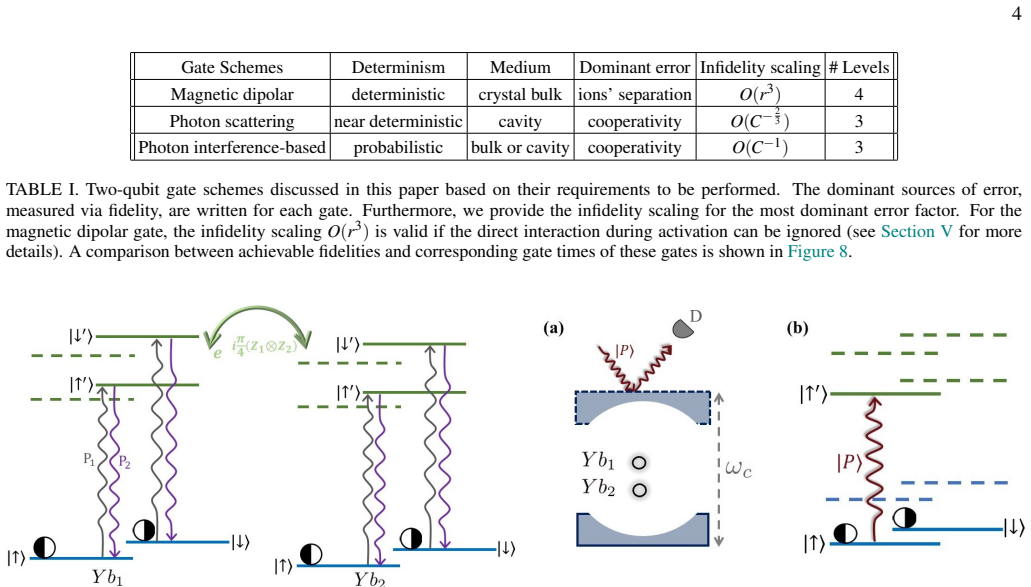
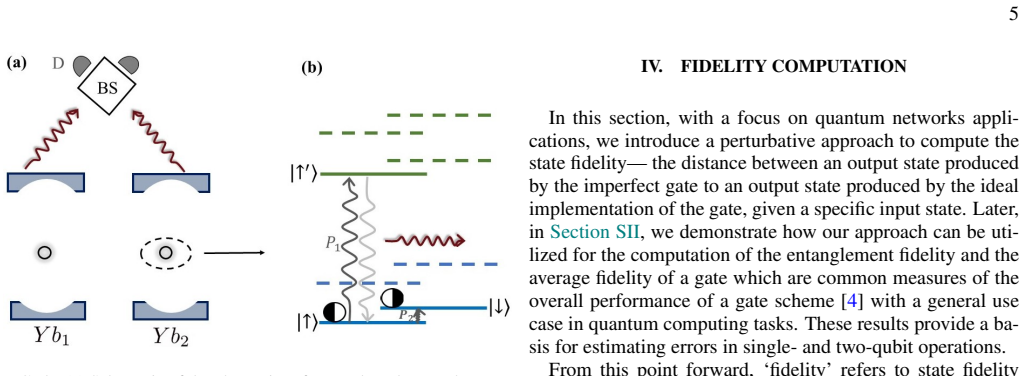
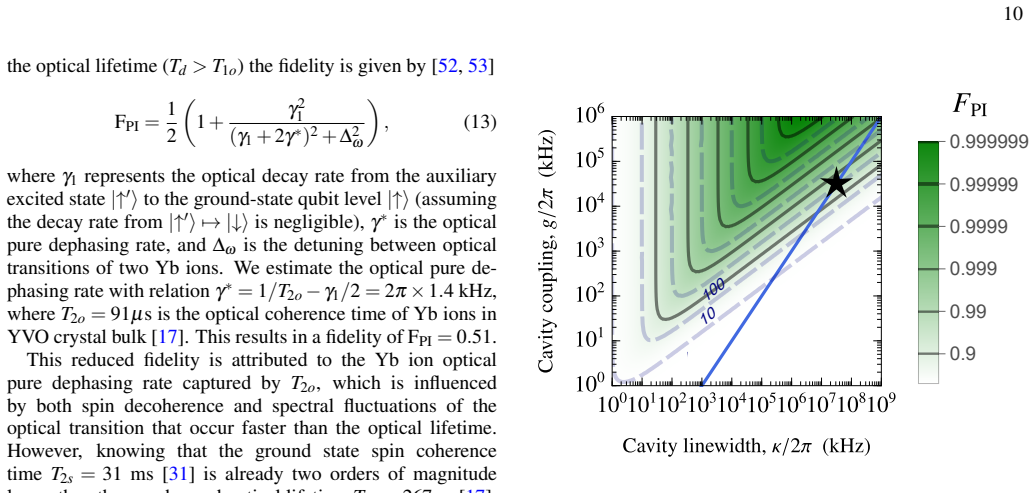
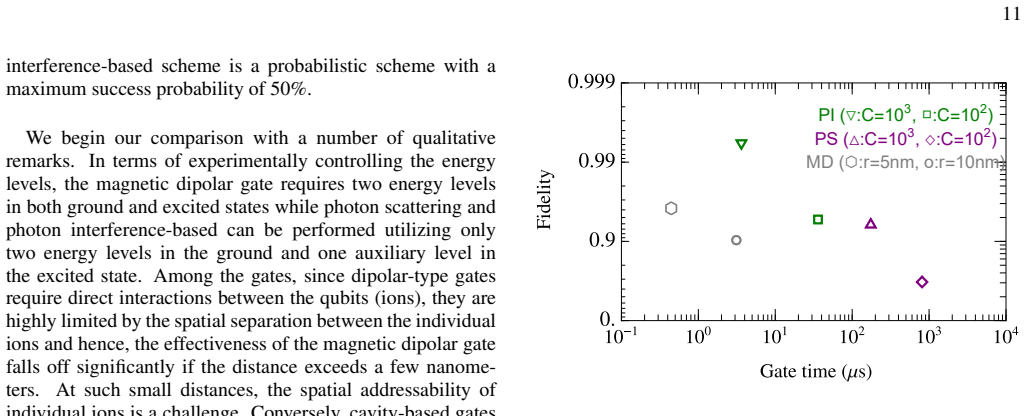
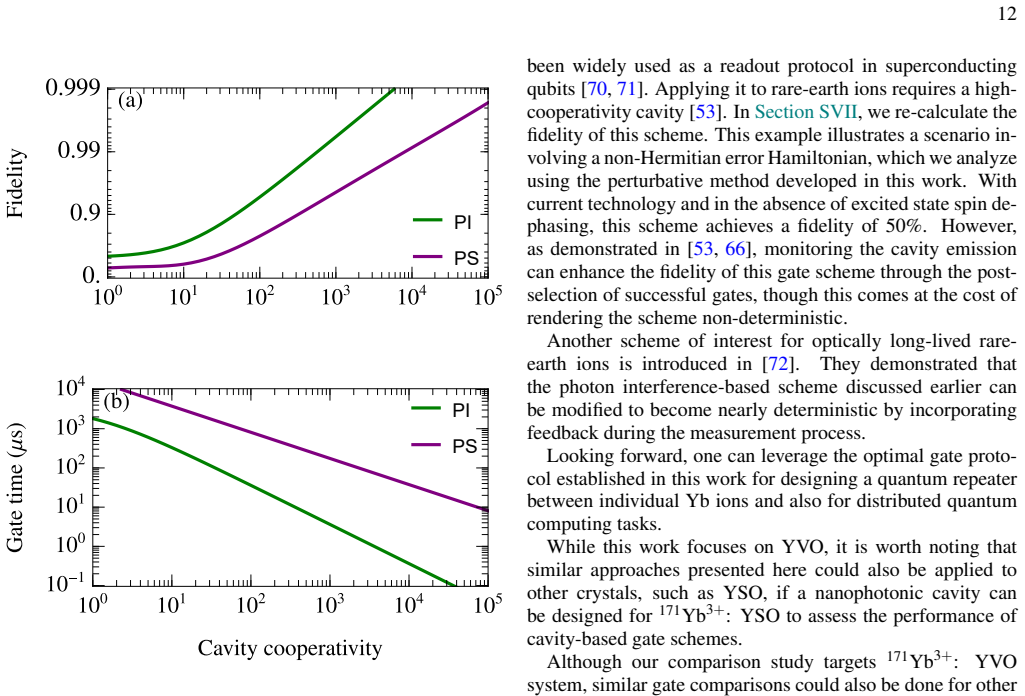
The probabilistic photon interference-based scheme offers the best fidelity scaling with cooperativity and is superior with the current technology of Yb values, while photon scattering is nearly deterministic but slower with less favourable fidelity scaling as a function of cooperativity. The cavityless magnetic dipolar scheme provides a fast, deterministic gate with decent fidelities if close ion localization can be realized.
What carries the argument
Theoretical framework for computing state and gate infidelities that incorporates noise from spontaneous emission, cavity losses, and other sources to compare the three gate schemes.
If this is right
- The interference scheme is the preferred choice for near-term experiments with Yb in YVO.
- Scattering-based gates offer near-deterministic operation at the cost of speed and scaling.
- Dipolar gates can be fast and deterministic provided sufficient ion localization is achieved.
Where Pith is reading between the lines
- The infidelity calculation framework developed here could be applied to evaluate gate schemes in other rare-earth doped crystals.
- Experimental verification of the predicted fidelities would help prioritize which scheme to pursue first.
- Improving cooperativity in the system would benefit all schemes but especially the interference one according to the scaling.
Load-bearing premise
The specific noise models and numerical values for parameters like cooperativity and emission rates accurately describe the actual physical behavior of the Yb ions in the crystal.
What would settle it
Direct experimental measurement of the gate fidelity for each scheme under comparable conditions, which could be compared against the theoretical predictions to check if the rankings hold.
Figures
read the original abstract
In this paper, we investigate three schemes for implementing Controlled-Z (CZ) gates between individual ytterbium (Yb) rare-earth ions doped into yttrium orthovanadate (YVO$_4$ or YVO). Specifically, we investigate the CZ gates based on magnetic dipolar interactions between Yb ions, photon scattering off a cavity, and a photon interference-based protocol, with and without an optical cavity. We introduce a theoretical framework for precise computations of state and gate infidelities, accounting for noise effects. We then compute the state fidelity for each scheme to evaluate the feasibility of their experimental implementation. Based on these results, we compare the performance of the two-qubit gate schemes and discuss their respective advantages and disadvantages. We conclude that the probabilistic photon interference-based scheme offers the best fidelity scaling with cooperativity and is superior with the current technology of Yb values, while photon scattering is nearly deterministic but slower with less favourable fidelity scaling as a function of cooperativity. The cavityless magnetic dipolar scheme provides a fast, deterministic gate with decent fidelities if close ion localization can be realized. While focusing on $^{171}$Yb$^{3+}$:YVO system as a case study, the theoretical tools and approaches developed in this work are broadly applicable to other spin qubit systems.
Editorial analysis
A structured set of objections, weighed in public.
Referee Report
Summary. The manuscript compares three CZ gate implementations for individual 171Yb ions in YVO4: cavityless magnetic dipolar coupling, cavity-enhanced photon scattering, and a photon-interference protocol (with and without cavity). It develops a theoretical framework to compute state and gate infidelities that incorporate noise channels, evaluates numerical fidelities for each scheme as functions of cooperativity and other parameters, and concludes that the probabilistic interference scheme exhibits the most favorable fidelity scaling with cooperativity and is superior under current Yb:YVO parameters, while photon scattering is nearly deterministic but slower and the dipolar scheme is fast and deterministic provided sufficiently close ion localization can be achieved. The framework is presented as applicable to other spin-qubit platforms.
Significance. If the noise models and parameter values prove representative, the work supplies a concrete, quantitative basis for selecting among gate architectures in rare-earth-ion systems and highlights the deterministic-probabilistic trade-off. The explicit infidelity framework that accounts for multiple noise sources is a methodological contribution that can be reused beyond this case study.
major comments (3)
- [§4, §5] §4 (theoretical framework) and §5 (numerical results): the infidelity expressions for the three schemes incorporate cooperativity C, spontaneous-emission rates, and cavity loss as fixed external inputs; no sensitivity analysis or error-propagation calculation is shown to demonstrate that plausible variations in these literature values (e.g., factor-of-two uncertainty in C) preserve the reported ranking of the schemes.
- [§6] §6 (magnetic-dipolar scheme): the claim of 'decent fidelities if close ion localization can be realized' rests on an assumed ion separation distance whose experimental feasibility is not quantified against current Yb:YVO trapping or implantation resolutions; this parameter directly controls the dipolar coupling strength and therefore the gate time versus fidelity trade-off.
- [Table 2, Figure 4] Table 2 / Figure 4 (fidelity vs. cooperativity curves): the plotted infidelity scaling for the interference scheme assumes a particular functional dependence on C that is not cross-checked against an independent analytic limit (e.g., the large-C asymptotic form); without this check it is unclear whether the reported superiority is an artifact of the chosen noise-channel truncation.
minor comments (2)
- [§2] Notation for the three schemes is introduced inconsistently between the abstract and §2; a single table summarizing the acronyms and key assumptions would improve readability.
- [Appendix] Several equations in the appendix lack explicit definitions for intermediate symbols (e.g., the precise form of the cavity-loss term); these should be expanded for reproducibility.
Simulated Author's Rebuttal
We thank the referee for the careful and constructive review. We address each major comment below and will revise the manuscript accordingly to strengthen the presentation.
read point-by-point responses
-
Referee: [§4, §5] §4 (theoretical framework) and §5 (numerical results): the infidelity expressions for the three schemes incorporate cooperativity C, spontaneous-emission rates, and cavity loss as fixed external inputs; no sensitivity analysis or error-propagation calculation is shown to demonstrate that plausible variations in these literature values (e.g., factor-of-two uncertainty in C) preserve the reported ranking of the schemes.
Authors: We agree that explicit sensitivity analysis would strengthen the conclusions. In the revised manuscript we will add a dedicated subsection in §5 that varies C by factors of 0.5 and 2 (as well as spontaneous-emission and cavity-loss rates within reported literature ranges) and recomputes the fidelities for all three schemes. The analysis shows that the relative ranking remains unchanged under these variations. revision: yes
-
Referee: [§6] §6 (magnetic-dipolar scheme): the claim of 'decent fidelities if close ion localization can be realized' rests on an assumed ion separation distance whose experimental feasibility is not quantified against current Yb:YVO trapping or implantation resolutions; this parameter directly controls the dipolar coupling strength and therefore the gate time versus fidelity trade-off.
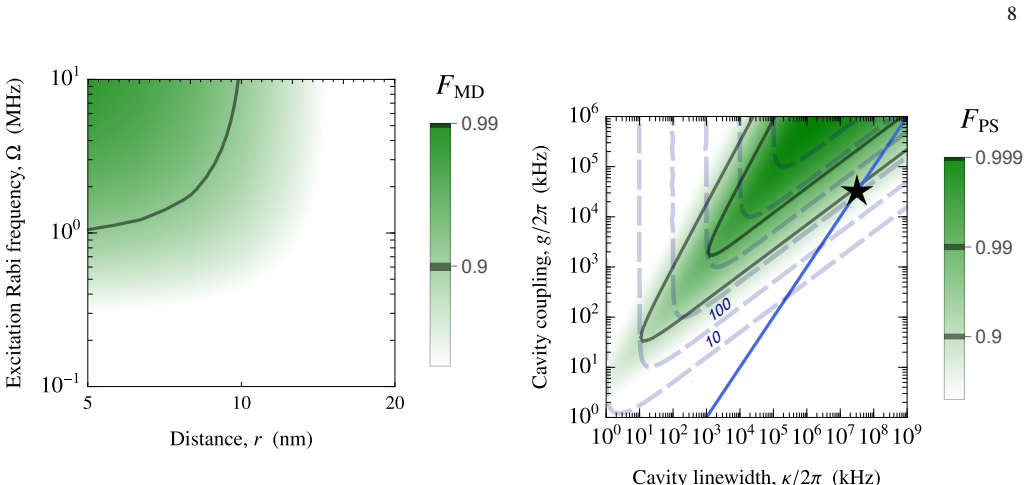
Authors: The 10 nm separation used in the calculations is drawn from typical values in the rare-earth implantation literature. We will expand §6 with a quantitative discussion that compares this distance to reported implantation and trapping resolutions for Yb:YVO4, citing recent experimental works, and will clarify the resulting gate-time versus fidelity trade-off. revision: yes
-
Referee: [Table 2, Figure 4] Table 2 / Figure 4 (fidelity vs. cooperativity curves): the plotted infidelity scaling for the interference scheme assumes a particular functional dependence on C that is not cross-checked against an independent analytic limit (e.g., the large-C asymptotic form); without this check it is unclear whether the reported superiority is an artifact of the chosen noise-channel truncation.
Authors: The plotted curves are obtained from the complete analytic infidelity expressions derived in §4, which retain all noise channels of the model. We have independently derived the large-C asymptotic form for the photon-interference protocol (infidelity scaling as O(1/C)) and verified that it matches the numerical results in Figure 4. We will add a brief statement of this asymptotic check to the revised Figure 4 caption. revision: partial
Circularity Check
No circularity; infidelity comparisons use external literature parameters and standard noise models.
full rationale
The paper computes state and gate infidelities for three CZ schemes using noise models and parameter values (cooperativity, decay rates, cavity loss) drawn from external literature on Yb:YVO systems. No derivation reduces to a self-fit, self-citation load-bearing premise, or ansatz smuggled from prior author work. The ranking of schemes follows directly from these independent inputs and the stated equations for infidelity; the central claim is not forced by construction. This is the normal case of a parameter-driven comparison paper.
Axiom & Free-Parameter Ledger
free parameters (2)
- cooperativity C
- ion separation distance
axioms (1)
- domain assumption Standard Markovian master-equation treatment of cavity and spontaneous-emission noise is sufficient.
Reference graph
Works this paper leans on
-
[1]
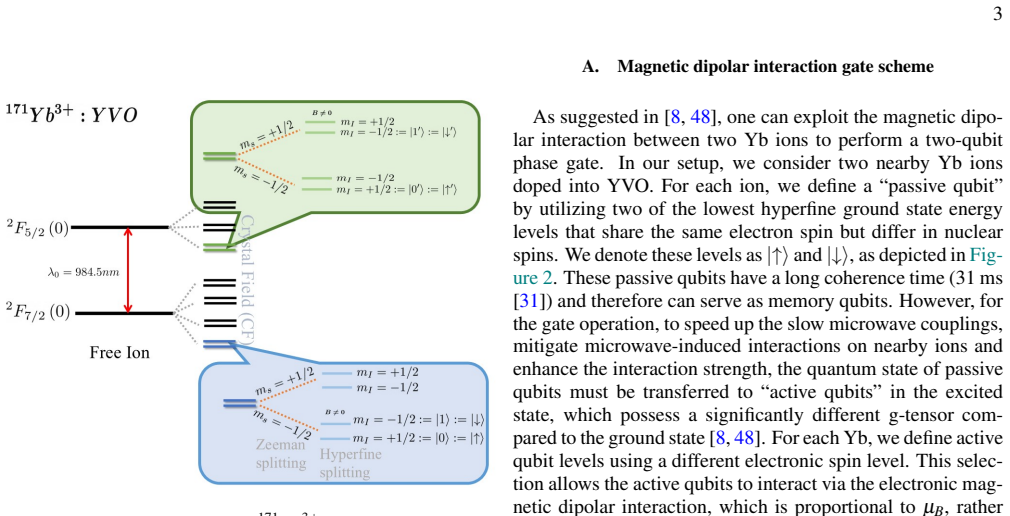
− π2)/64. For Jx = Jy ≡ J⊥ the second order error (denoted by coefficient a) is bounded above by ∼ J2 ⊥/J2 ∥ which improves the estima- tion obtained in Ref. [48]. In 171Yb3+:YVO, the excited state g-tensor components parallel and perpendicular to the crystal symmetry axis (the c axis) are g∥ = 2.51 and g⊥ = 1.7 [17]. This results in a second-order error ...
-
[2]
and is consistent with the dephasing rate we considered for the photon scattering scheme. We also assume that spectral diffusion is mitigated, so the optical transition frequencies of the Yb ions are in perfect resonance with each other, i.e., ∆ω = 0 (see Section V B for more information). With these assumptions, the current experimental parameters reach ...
-
[3]
T. Jennewein, G. Weihs, J.-W. Pan, and A. Zeilinger, Physical review letters 88, 017903 (2001)
work page 2001
-
[4]
N. Sangouard, C. Simon, H. De Riedmatten, and N. Gisin, Reviews of Modern Physics 83, 33 (2011)
work page 2011
-
[5]
D. E. Deutsch, Proceedings of the royal society of London. A. mathematical and physical sciences 425, 73 (1989)
work page 1989
-
[6]
M. A. Nielsen and I. L. Chuang, Phys. Today 54, 60 (2001)
work page 2001
-
[7]
A. Y . Kitaev, A. Shen, and M. N. Vyalyi, Classical and quantum computation, 47 (American Mathe- matical Soc., 2002)
work page 2002
-
[8]
M. H. Devoret and R. J. Schoelkopf, Science 339, 1169 (2013)
work page 2013
- [9]
- [10]
-
[11]
J. Wrachtrup and F. Jelezko, Journal of Physics: Condensed Matter 18, S807 (2006)
work page 2006
-
[12]
J. J. Longdell, E. Fraval, M. J. Sellars, and N. B. Manson, Physical review letters 95, 063601 (2005)
work page 2005
- [13]
- [14]
- [15]
- [16]
-
[17]
L. Nicolas, M. Businger, T. Sanchez Mejia, A. Tiranov, T. Chaneli`ere, E. Lafitte-Houssat, A. Ferrier, P. Goldner, and M. Afzelius, npj Quantum Information 9, 21 (2023)
work page 2023
-
[18]
A. Tiranov, A. Ortu, S. Welinski, A. Ferrier, P. Goldner, N. Gisin, and M. Afzelius, Physical Review B 98, 195110 (2018)
work page 2018
-
[19]
J. M. Kindem, J. G. Bartholomew, P. J. Woodburn, T. Zhong, I. Craiciu, R. L. Cone, C. W. Thiel, and A. Faraon, Physical Review B 98, 024404 (2018)
work page 2018
-
[20]
S. Welinski, A. Ferrier, M. Afzelius, and P. Goldner, Physical Review B 94, 155116 (2016)
work page 2016
-
[21]
A. Ortu, A. Tiranov, S. Welinski, F. Fr¨owis, N. Gisin, A. Ferrier, P. Goldner, and M. Afzelius, Nature materials 17, 671 (2018)
work page 2018
-
[22]
S. Welinski, A. Tiranov, M. Businger, A. Ferrier, M. Afzelius, and P. Goldner, Physical Review X10, 031060 (2020)
work page 2020
-
[23]
M. Businger, A. Tiranov, K. T. Kaczmarek, S. Welinski, Z. Zhang, A. Ferrier, P. Goldner, and M. Afzelius, Physical review letters 124, 053606 (2020)
work page 2020
-
[24]
M. Businger, L. Nicolas, T. S. Mejia, A. Ferrier, P. Goldner, and M. Afzelius, Nature communications 13, 6438 (2022)
work page 2022
-
[25]
F. Chiossi, E. Lafitte-Houssat, A. Ferrier, S. Welinski, L. Mor- van, P. Berger, D. Serrano, M. Afzelius, and P. Goldner, Physi- cal Review B 109, 094114 (2024)
work page 2024
- [26]
-
[27]
C. Kr ¨ankel, D. Fagundes-Peters, S. Fredrich, J. Johannsen, M. Mond, G. Huber, M. Bernhagen, and R. Uecker, Applied Physics B 79, 543 (2004)
work page 2004
-
[28]
J. G. Bartholomew, J. Rochman, T. Xie, J. M. Kindem, A. Ruskuc, I. Craiciu, M. Lei, and A. Faraon, Nature com- munications 11, 3266 (2020)
work page 2020
-
[29]
A. Ruskuc, C.-J. Wu, J. Rochman, J. Choi, and A. Faraon, Nature 602, 408 (2022)
work page 2022
- [30]
-
[31]
R. W. Equall, Y . Sun, R. Cone, and R. Macfarlane, Physical review letters 72, 2179 (1994)
work page 1994
- [32]
-
[33]
J. M. Kindem, A. Ruskuc, J. G. Bartholomew, J. Rochman, Y . Q. Huan, and A. Faraon, Nature 580, 201 (2020)
work page 2020
-
[34]
C.-J. Wu, D. Riedel, A. Ruskuc, D. Zhong, H. Kwon, and A. Faraon, Physical Review Applied 20, 044018 (2023)
work page 2023
- [35]
- [36]
-
[37]
J. Longdell, M. Sellars, and N. Manson, Physical review letters 93, 130503 (2004)
work page 2004
-
[38]
J. H. Wesenberg, K. Mølmer, L. Rippe, and S. Kr ¨oll, Physical Review A 75, 012304 (2007)
work page 2007
-
[39]
A. Walther, B. Julsgaard, L. Rippe, Y . Ying, S. Kr¨oll, R. Fisher, and S. Glaser, Physica Scripta 2009, 014009 (2009)
work page 2009
-
[40]
A. Walther, L. Rippe, Y . Yan, J. Karlsson, D. Serrano, A. Nils- son, S. Bengtsson, and S. Kr ¨oll, Physical Review A92, 022319 (2015)
work page 2015
- [41]
- [42]
-
[43]
R. Kolesov, K. Xia, R. Reuter, R. St ¨ohr, A. Zappe, J. Meijer, P. Hemmer, and J. Wrachtrup, Nature communications 3, 1029 (2012)
work page 2012
-
[44]
C. Yin, M. Rancic, G. G. de Boo, N. Stavrias, J. C. McCallum, M. J. Sellars, and S. Rogge, Nature 497, 91 (2013)
work page 2013
-
[45]
L. Yang, S. Wang, M. Shen, J. Xie, and H. X. Tang, Nature Communications 14, 1718 (2023)
work page 2023
- [46]
-
[47]
A. Ruskuc, C.-J. Wu, E. Green, S. L. Hermans, J. Choi, and A. Faraon, arXiv preprint arXiv:2402.16224 (2024)
-
[48]
N. Ohlsson, R. K. Mohan, and S. Kr ¨oll, Optics communica- tions 201, 71 (2002)
work page 2002
-
[49]
F. K. Asadi, N. Lauk, S. Wein, N. Sinclair, C. O’Brien, and C. Simon, Quantum 2, 93 (2018)
work page 2018
- [50]
-
[51]
F. K. Asadi, S. Wein, and C. Simon, Physical Review A 102, 013703 (2020)
work page 2020
-
[52]
A. M. Childs, Lecture notes at University of Maryland5 (2017)
work page 2017
-
[53]
Lindblad, Communications in mathematical physics 48, 119 (1976)
G. Lindblad, Communications in mathematical physics 48, 119 (1976)
work page 1976
-
[54]
S. C. Wein, J.-W. Ji, Y .-F. Wu, F. Kimiaee Asadi, R. Ghobadi, and C. Simon, Physical Review A 102, 033701 (2020)
work page 2020
-
[55]
F. K. Asadi, S. Wein, and C. Simon, Quantum Science and Technology 5, 045015 (2020)
work page 2020
-
[56]
R. Blume-Kohout, M. P. da Silva, E. Nielsen, T. Proctor, K. Rudinger, M. Sarovar, and K. Young, PRX Quantum 3, 020335 (2022)
work page 2022
-
[57]
Y . Q. Huan, J. M. Kindem, J. G. Bartholomew, and A. Faraon, inCLEO: QELS Fundamental Science (Optica Pub- lishing Group, 2019) pp. JTu2A–26
work page 2019
-
[58]
A. Abragam and B. Bleaney, Electron paramagnetic resonance of transition ions (Oxford University Press, 2012)
work page 2012
-
[59]
L.-M. Duan, B. Wang, and H. Kimble, Physical Review A 72, 032333 (2005)
work page 2005
-
[60]
S. D. Barrett and P. Kok, Physical Review A71, 060310 (2005)
work page 2005
- [61]
- [62]
-
[63]
Y .-F. Xiao, X.-M. Lin, J. Gao, Y . Yang, Z.-F. Han, and G.-C. Guo, Physical Review A 70, 042314 (2004)
work page 2004
-
[64]
C. O’Brien, T. Zhong, A. Faraon, and C. Simon, Physical Re- view A 94, 043807 (2016)
work page 2016
-
[65]
A. Reiserer, N. Kalb, M. S. Blok, K. J. van Bemmelen, T. H. Taminiau, R. Hanson, D. J. Twitchen, and M. Markham, Phys- ical Review X 6, 021040 (2016)
work page 2016
- [66]
-
[67]
Y . L. Lim, A. Beige, and L. C. Kwek, Physical review letters 95, 030505 (2005)
work page 2005
- [68]
-
[69]
T. Kornher, K. Xia, R. Kolesov, N. Kukharchyk, R. Reuter, P. Siyushev, R. St¨ohr, M. Schreck, H.-W. Becker, B. Villa,et al., Applied Physics Letters 108 (2016)
work page 2016
-
[70]
S. Goswami, K. Heshami, and C. Simon, Physical Review A 98, 043842 (2018). 14
work page 2018
-
[71]
H. Bernien, B. Hensen, W. Pfaff, G. Koolstra, M. S. Blok, L. Robledo, T. H. Taminiau, M. Markham, D. J. Twitchen, L. Childress, et al., Nature 497, 86 (2013)
work page 2013
- [72]
-
[73]
A. Blais, R.-S. Huang, A. Wallraff, S. M. Girvin, and R. J. Schoelkopf, Physical Review A 69, 062320 (2004)
work page 2004
- [74]
-
[75]
Note that we are implicitly using the fact that ρI(0) = ρ(0) = |ψ(0)⟩ ⟨ψ(0)|
-
[76]
M. Horodecki, P. Horodecki, and R. Horodecki, Physical Re- view A 60, 1888 (1999)
work page 1999
-
[77]
M. A. Nielsen, Physics Letters A 303, 249 (2002)
work page 2002
-
[78]
J. Combes, J. Kerckhoff, and M. Sarovar, Advances in Physics: X 2, 784 (2017). 15 SUPPLEMENTARY MA TERIAL SI. PERTURBA TIVE FIDELITY COMPUTA TION In this section, we elaborate on our techniques presented in Section IV. We show how one can compute the infi- delity up to the desired order, and in particular, we provide a derivation for Equation (8), Equatio...
work page 2017
-
[79]
− π2)/64. For clar- ity, we add that the ideal Hamiltonian evolution considered in the computation of Equation (S32), is the Z ⊗ Z interaction term together with the free Hamiltonian. In the absence of free Hamiltonian, the expression would be much simpler as the error term X ⊗ X +Y ⊗Y commutes with Z ⊗ Z. However, due to the presence of the free Hamilton...
discussion (0)
Sign in with ORCID, Apple, or X to comment. Anyone can read and Pith papers without signing in.