Harnessing quantum back-action for time-series processing
Pith reviewed 2026-05-23 17:42 UTC · model grok-4.3
The pith
Indirect measurements with tunable strength improve performance and execution scaling in quantum reservoir computing.
A machine-rendered reading of the paper's core claim, the machinery that carries it, and where it could break.
Core claim
Incorporating indirect measurements into quantum reservoir computing provides advantages in both execution time scaling and overall performance. Analysis of different measurement settings by varying the measurement strength across two benchmarking tasks shows that carefully optimizing both the reservoir Hamiltonian parameters and the measurement strength can significantly improve the quantum reservoir computing algorithm performance. The approach also demonstrates improved memory performance when compared with state-of-the-art classical feedback protocols, supplying a practical recipe for indirect measurement-based protocols in this setting.
What carries the argument
The tunable strength parameter of indirect measurements, which balances information extraction against back-action disturbance while the reservoir evolves under its Hamiltonian.
If this is right
- Joint optimization of Hamiltonian parameters and measurement strength yields significant performance gains on time-series benchmarking tasks.
- The protocol achieves better memory performance than classical feedback methods.
- Execution time scaling improves relative to standard projective measurement approaches.
- A practical recipe emerges for implementing indirect-measurement protocols in quantum reservoir computing.
Where Pith is reading between the lines
- Back-action effects could be treated as a tunable resource in quantum information tasks beyond reservoir computing.
- Real-device tests with independently controllable measurement strength might expose interactions with decoherence not visible in simulation.
- The same optimization strategy may apply to other quantum machine-learning architectures that process sequential data.
Load-bearing premise
The performance and scaling gains come from being able to vary and optimize measurement strength independently of other noise sources or hardware constraints in the tested tasks.
What would settle it
An experiment on quantum hardware that varies indirect measurement strength but finds no improvement in task error or execution time over projective measurements under the same conditions would falsify the claim.
Figures


read the original abstract
Quantum measurements affect the state of the observed systems via back-action. While projective measurements extract maximal classical information, they drastically alter the system's configuration. In contrast, indirect measurements balance information extraction with the degree of disturbance. Considering the prevalent use of projective measurements in quantum computing and communication protocols, the potential benefits of indirect measurements in these fields remain largely unexplored. In this work, we demonstrate that incorporating indirect measurements into a quantum machine-learning protocol known as quantum reservoir computing provides advantages in both execution time scaling and overall performance. We analyze different measurement settings by varying the measurement strength across two benchmarking tasks. Our results reveal that carefully optimizing both the reservoir Hamiltonian parameters and the measurement strength can significantly improve the quantum reservoir computing algorithm performance. Furthermore, our approach demonstrates improved memory performance when compared with state-of-the-art classical feedback protocols. This work provides a comprehensive and practical recipe to promote the implementation of indirect measurement-based protocols in quantum reservoir computing. Moreover, our findings motivate further exploration of experimental protocols that leverage the back-action effects of indirect measurements.
Editorial analysis
A structured set of objections, weighed in public.
Referee Report
Summary. The manuscript claims that incorporating indirect measurements with tunable strength into quantum reservoir computing (QRC) for time-series processing yields advantages in execution time scaling and task performance over projective measurements and classical feedback protocols. Through numerical analysis on two benchmarking tasks, optimizing both the reservoir Hamiltonian and measurement strength is shown to enhance the QRC algorithm, with improved memory performance demonstrated.
Significance. If the numerical demonstrations hold, the result is significant as it provides a method to harness quantum back-action constructively in quantum machine learning, offering a practical approach for indirect measurement-based QRC protocols. This could motivate experimental implementations and further theoretical exploration in the field of quantum reservoir computing. The internal consistency of the simulated models and joint optimization of parameters are strengths.
minor comments (3)
- [Abstract] Abstract: the two benchmarking tasks are referenced but not named; specifying them (e.g., NARMA or similar) would improve immediate clarity for readers.
- [Results] Results section: performance claims would be strengthened by explicit reporting of the number of independent runs, standard deviations, or statistical tests supporting the reported improvements from measurement-strength optimization.
- [Methods] Notation: the symbol for measurement strength should be introduced with its mathematical definition (likely an equation in the methods) at first use rather than assumed from context.
Simulated Author's Rebuttal
We thank the referee for the positive summary, significance assessment, and recommendation of minor revision. The report correctly captures the core claims regarding advantages of indirect measurements in QRC. No major comments were listed in the report, so we provide no point-by-point responses below.
Circularity Check
No significant circularity; claims rest on numerical optimization and benchmarking
full rationale
The paper presents a numerical study of quantum reservoir computing where measurement strength is treated as an optimizable parameter alongside Hamiltonian parameters. Performance metrics are evaluated across varied settings on benchmarking tasks, with comparisons to projective and classical baselines. No load-bearing step reduces a claimed prediction or uniqueness result to a fitted quantity by construction, nor does any central premise collapse to a self-citation chain. Minor self-citations appear but are not invoked to justify uniqueness or forbid alternatives. The derivation chain is therefore self-contained within the simulated models and externally falsifiable via the reported benchmarks.
Axiom & Free-Parameter Ledger
free parameters (1)
- measurement strength
axioms (1)
- standard math Standard quantum measurement theory that distinguishes projective measurements from indirect measurements with tunable back-action
Reference graph
Works this paper leans on
-
[1]
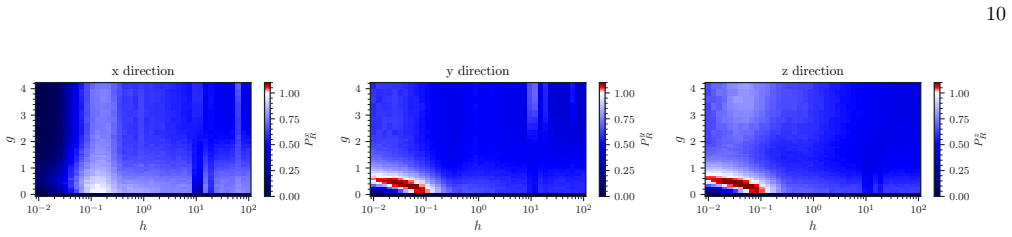
to justify the dependence of the performance on the hvalue. In fact, along the horizontal axis, the quantum system undergoes a transition from a localized regime to an ergodic one and it was showcased that being in the ergodic regime is a preferential condition to perform reservoir computing. Moreover, what emerges clearly is that optimizing the measureme...
-
[2]
J. von Neumann,Mathematical Foundations of Quantum Mechanics, Goldstine Printed Materials (Princeton Uni- versity Press, 1955)
work page 1955
-
[3]
J. Wheeler and W. Zurek,Quantum Theory and Mea- surement, Princeton Series in Physics (Princeton Uni- versity Press, 2014)
work page 2014
-
[4]
C. H. Bennett and G. Brassard, Quantum cryptogra- phy: Public key distribution and coin tossing, Theo- retical Computer Science560, 7 (2014), theoretical As- pects of Quantum Cryptography – celebrating 30 years of BB84
work page 2014
-
[5]
C. L. Degen, F. Reinhard, and P. Cappellaro, Quantum sensing, Reviews of modern physics89, 035002 (2017)
work page 2017
-
[6]
H.-P. Breuer and F. Petruccione,The Theory of Open Quantum Systems(Oxford University Press, 2007)
work page 2007
-
[7]
S. Lloyd and J.-J. E. Slotine, Quantum feedback with weak measurements, Phys. Rev. A62, 012307 (2000)
work page 2000
-
[8]
U. Singh and A. K. Pati, Quantum discord with weak measurements, Annals of Physics343, 141 (2014)
work page 2014
-
[9]
Y. Pan, J. Zhang, E. Cohen, C.-w. Wu, P.-X. Chen, and N. Davidson, Weak-to-strong transition of quantum mea- surement in a trapped-ion system, Nature Physics16, 1206 (2020)
work page 2020
-
[10]
M. Spagnolo, J. Morris, S. Piacentini, M. Antesberger, F. Massa, A. Crespi, F. Ceccarelli, R. Osellame, and P. Walther, Experimental photonic quantum memristor, Nature Photonics16, 318 (2022)
work page 2022
-
[11]
K. W. Murch, S. Weber, C. Macklin, and I. Siddiqi, Ob- serving single quantum trajectories of a superconducting quantum bit, Nature502, 211 (2013)
work page 2013
-
[12]
Introduction to Experimental Quantum Measurement with Superconducting Qubits
M. Naghiloo, Introduction to experimental quan- tum measurement with superconducting qubits, arXiv:1904.09291 10.48550/arXiv.1904.09291 (2019)
work page internal anchor Pith review Pith/arXiv arXiv doi:10.48550/arxiv.1904.09291 1904
-
[13]
S. J. Weber, K. W. Murch, M. E. Kimchi-Schwartz, N. Roch, and I. Siddiqi, Quantum trajectories of super- conducting qubits, Comptes Rendus. Physique17, 766 (2016)
work page 2016
-
[14]
K. W. Murch, R. Vijay, and I. Siddiqi, Weak measure- ment and feedback in superconducting quantum circuits, inSuperconducting Devices in Quantum Optics, edited by R. H. Hadfield and G. Johansson (Springer Interna- tional Publishing, Cham, 2016) pp. 163–185
work page 2016
-
[15]
M. Hatridge, S. Shankar, M. Mirrahimi, F. Schackert, K. Geerlings, T. Brecht, K. M. Sliwa, B. Abdo, L. Frun- 11 zio, S. M. Girvin, R. J. Schoelkopf, and M. H. Devoret, Quantum back-action of an individual variable-strength measurement, Science339, 178 (2013)
work page 2013
-
[16]
T. Yasuda, Y. Suzuki, T. Kubota, K. Nakajima, Q. Gao, W. Zhang, S. Shimono, H. I. Nurdin, and N. Yamamoto, Quantum reservoir computing with repeated measure- ments on superconducting devices, arXiv:2310.06706 10.48550/arXiv.2310.06706 (2023)
-
[17]
F. Hu, S. A. Khan, N. T. Bronn, G. Angelatos, G. E. Rowlands, G. J. Ribeill, and H. E. Türeci, Overcoming the coherence time barrier in quantum machine learn- ing on temporal data, Nature Communications15, 7491 (2024)
work page 2024
-
[18]
J. D. Viqueira, D. Faílde, M. M. Juane, A. Gómez, and D. Mera, Density matrix emulation of quantum recurrent neural networks for multivariate time series prediction, Machine Learning: Science and Technology6, 015023 (2025)
work page 2025
- [19]
-
[20]
A. Dawid, J. Arnold, B. Requena, A. Gresch, M. Płodzień, K. Donatella, K. A. Nicoli, P. Stornati, R. Koch, M. Büttner, R. Okuła, G. Muñoz-Gil, R. A. Vargas-Hernández, A. Cervera-Lierta, J. Carrasquilla, V. Dunjko, M. Gabrié, P. Huembeli, E. van Nieuwen- burg, F. Vicentini, L. Wang, S. J. Wetzel, G. Car- leo, E. Greplová, R. Krems, F. Marquardt, M. Tomza, ...
-
[21]
K. Fujii and K. Nakajima, Harnessing disordered- ensemble quantum dynamics for machine learning, Phys. Rev. Appl.8, 024030 (2017)
work page 2017
-
[22]
H. Jaeger and H. Haas, Harnessing nonlinearity: Predict- ing chaotic systems and saving energy in wireless com- munication, Science304, 78 (2004)
work page 2004
-
[23]
K. Nakajima, K. Fujii, M. Negoro, K. Mitarai, and M. Kitagawa, Boosting computational power through spatial multiplexing in quantum reservoir computing, Phys. Rev. Appl.11, 034021 (2019)
work page 2019
- [24]
- [25]
-
[26]
A. Kutvonen, K. Fujii, and T. Sagawa, Optimizing a quantum reservoir computer for time series prediction, Scientific Reports10, 14687 (2020)
work page 2020
-
[27]
R. Martínez-Peña, J. Nokkala, G. L. Giorgi, R. Zambrini, and M. C. Soriano, Information processing capacity of spin-based quantum reservoir computing systems, Cog- nitive Computation15, 1440–1451 (2020)
work page 2020
- [28]
-
[29]
Q. H. Tran and K. Nakajima, Higher-order quantum reservoir computing, arXiv:2006.08999 10.48550/arXiv.2006.08999 (2020)
-
[30]
J. Nokkala, R. Martínez-Peña, G. L. Giorgi, V. Pa- rigi, M. C. Soriano, and R. Zambrini, Gaussian states of continuous-variable quantum systems provide univer- sal and versatile reservoir computing, Communications Physics4, 53 (2021)
work page 2021
-
[31]
R. Martínez-Peña, G. L. Giorgi, J. Nokkala, M. C. So- riano, and R. Zambrini, Dynamical phase transitions in quantum reservoir computing, Phys. Rev. Lett.127, 100502 (2021)
work page 2021
- [32]
- [33]
-
[34]
L. C. G. Govia, G. J. Ribeill, G. E. Rowlands, and T. A. Ohki, Nonlinear input transformations are ubiquitous in quantum reservoir computing, Neuromorphic Computing and Engineering2, 014008 (2022)
work page 2022
-
[35]
G. Angelatos, S. A. Khan, and H. E. Türeci, Reser- voir computingapproachtoquantumstate measurement, Phys. Rev. X11, 041062 (2021)
work page 2021
-
[36]
J. Nokkala, R. Martinez-Pena, R. Zambrini, and M. C. Soriano, High-performance reservoir computing with fluctuations in linear networks, IEEE Transactions on Neural Networks and Learning Systems33, 2664–2675 (2022)
work page 2022
- [37]
-
[38]
L. Domingo, G. Carlo, and F. Borondo, Optimal quan- tum reservoir computing for the noisy intermediate-scale quantum era, Phys. Rev. E106, L043301 (2022)
work page 2022
-
[39]
R.A.Bravo, K.Najafi, X.Gao,andS.F.Yelin,Quantum reservoir computing using arrays of rydberg atoms, PRX Quantum3, 030325 (2022)
work page 2022
-
[40]
J. Nokkala, Online quantum time series processing with random oscillator networks, Scientific Reports13, 7694 (2023)
work page 2023
-
[42]
R. Martínez-Peña and J.-P. Ortega, Quantum reservoir computinginfinitedimensions,Phys.Rev.E107,035306 (2023)
work page 2023
-
[43]
T.Krisnanda, H.Xu, S.Ghosh,andT.C.H.Liew,Tomo- graphic completeness and robustness of quantum reser- voir networks, Phys. Rev. A107, 042402 (2023)
work page 2023
- [44]
-
[45]
L.Innocenti, S.Lorenzo, I.Palmisano, A.Ferraro, M.Pa- ternostro, and G. M. Palma, Potential and limitations of quantum extreme learning machines, Communications Physics6, 118 (2023)
work page 2023
-
[46]
F. Wudarski, D. O‘Connor, S. Geaney, A. A. Asan- jan, M. Wilson, E. Strbac, P. A. Lott, and D. Ven- turelli, Hybrid quantum-classical reservoir comput- ing for simulating chaotic systems, arXiv:2311.14105 10.48550/arXiv.2311.14105 (2023). 12
-
[47]
J. García-Beni, G. L. Giorgi, M. C. Soriano, and R. Zam- brini, Squeezing as a resource for time series processing in quantum reservoir computing, Opt. Express32, 6733 (2024)
work page 2024
- [48]
-
[49]
J. Nokkala, G. L. Giorgi, and R. Zambrini, Retriev- ing past quantum features with deep hybrid classical- quantum reservoir computing, Machine Learning: Sci- ence and Technology5, 035022 (2024)
work page 2024
-
[50]
S. Čindrak, B. Donvil, K. Lüdge, and L. Jaurigue, En- hancing the performance of quantum reservoir comput- ing and solving the time-complexity problem by artificial memory restriction, Phys. Rev. Res.6, 013051 (2024)
work page 2024
-
[51]
Y. Li, S. Ghosh, J. Shang, Q. Xiong, and X. Zhang, Esti- mating many properties of a quantum state via quantum reservoir processing, Phys. Rev. Res.6, 013211 (2024)
work page 2024
-
[52]
K. Kobayashi, K. Fujii, and N. Yamamoto, Feedback- driven quantum reservoir computing for time-series anal- ysis, PRX Quantum5, 10.1103/prxquantum.5.040325 (2024)
-
[53]
L. Domingo, F. Borondo, G. Scialchi, A. J. Roncaglia, G. G. Carlo, and D. A. Wisniacki, Quantum reservoir complexity by the krylov evolution approach, Phys. Rev. A110, 022446 (2024)
work page 2024
-
[54]
S. Kobayashi, Q. H. Tran, and K. Nakajima, Extend- ing echo state property for quantum reservoir computing, Phys. Rev. E110, 024207 (2024)
work page 2024
-
[55]
A. Palacios, R. Martínez-Peña, M. C. Soriano, G. L. Giorgi, and R. Zambrini, Role of coherence in many-body quantum reservoir computing, Communications Physics 7, 369 (2024)
work page 2024
- [56]
-
[57]
Machine learning with controllable quantum dynamics of a nuclear spin ensemble in a solid
M. Negoro, K. Mitarai, K. Fujii, K. Nakajima, and M. Kitagawa, Machine learning with controllable quan- tum dynamics of a nuclear spin ensemble in a solid, arXiv:1806.10910 10.48550/arXiv.1806.10910 (2018)
work page internal anchor Pith review Pith/arXiv arXiv doi:10.48550/arxiv.1806.10910 2018
-
[58]
J. Chen, H. I. Nurdin, and N. Yamamoto, Temporal in- formation processing on noisy quantum computers, Phys. Rev. Appl.14, 024065 (2020)
work page 2020
- [59]
-
[60]
P. Pfeffer, F. Heyder, and J. Schumacher, Hybrid quantum-classicalreservoircomputingofthermalconvec- tion flow, Phys. Rev. Res.4, 033176 (2022)
work page 2022
- [61]
-
[62]
A. Suprano, D. Zia, L. Innocenti, S. Lorenzo, V. Ci- mini, T. Giordani, I. Palmisano, E. Polino, N. Spagnolo, F. Sciarrino, G. M. Palma, A. Ferraro, and M. Paternos- tro, Experimental property reconstruction in a photonic quantum extreme learning machine, Phys. Rev. Lett. 132, 160802 (2024)
work page 2024
-
[63]
M. Kornjača, H.-Y. Hu, C. Zhao, J. Wurtz, P. Wein- berg, M. Hamdan, A. Zhdanov, S. H. Cantu, H. Zhou, R. A. Bravo, K. Bagnall, J. I. Basham, J. Campo, A. Choukri, R. DeAngelo, P. Frederick, D. Haines, J. Hammett, N. Hsu, M.-G. Hu, F. Huber, P. N. Jepsen, N. Jia, T. Karolyshyn, M. Kwon, J. Long, J. Lopatin, A. Lukin, T. Macrì, O. Marković, L. A. Martínez-M...
-
[64]
F. Monzani, E. Ricci, L. Nigro, and E. Prati, Leveraging non-unital noise for gate-based quantum reservoir com- puting, arXiv:2409.07886 10.48550/arXiv.2409.07886 (2024)
- [65]
-
[66]
J. Settino, L. Salatino, L. Mariani, F. D’Amore, M. Channab, L. Bozzolo, S. Vallisa, P. Barillà, A. Poli- cicchio, N. Lo Gullo, A. Giordano, C. Mastroianni, and F. Plastina, Memory-augmented hybrid quantum reser- voir computing, Phys. Rev. Appl.24, 024019 (2025). [66]https://github.com/GiacomoFrn/QRC_backaction
work page 2025
-
[67]
J. García-Beni, G. L. Giorgi, M. C. Soriano, and R. Zam- brini, Scalable photonic platform for real-time quantum reservoir computing, Phys. Rev. Appl.20, 014051 (2023)
work page 2023
-
[68]
M. Larocca, S. Thanasilp, S. Wang, K. Sharma, J. Bia- monte, P. J. Coles, L. Cincio, J. R. McClean, Z. Holmes, and M. Cerezo, Barren plateaus in variational quantum computing, Nature Reviews Physics7, 174–189 (2025)
work page 2025
discussion (0)
Sign in with ORCID, Apple, or X to comment. Anyone can read and Pith papers without signing in.