REVIEW 60 references
Non-Fermi Liquids from Subsystem Symmetry Breaking in van der Waals Multilayers
T0 review · reviewed 2026-08-12 · deepseek-v4-flash
Pith's one-line read Interlayer exciton condensation in multilayer van der Waals metals is predicted to create a three-dimensional marginal Fermi liquid with specific heat C ~ T(log(1/T))^2.
The pith
A machine-rendered reading of the paper's core claim, the machinery that carries it, and where it could break.
The reading
In each layer, electron number is conserved separately since interlayer tunneling is strongly suppressed. When electrons in adjacent layers form excitons and condense, the relative electron number between layers is no longer conserved. This spontaneous symmetry breaking produces Goldstone modes, collective phase oscillations of the condensate. The authors show these modes couple to electrons with a strength that does not vanish at low momentum transfer, unlike the usual coupling of Goldstone modes to current. This strong coupling shortens the quasiparticle lifetime, turning the system into a marginal Fermi liquid when many layers are stacked.
Using a microscopic model with gallium arsenide parameters, they solve mean-field equations to find the exciton condensate. They then include fluctuations at the random phase approximation level and compute the electron self-energy and free energy. The result is a quasiparticle lifetime scaling as 1/(E log(1/E)) and a specific heat C ~ T(log(1/T))^2, the latter being a signature of the flat dispersion of the Goldstone mode along the stacking direction.
Extended reading notes
Core claim
The central claim is that a stack of two-dimensional Fermi liquid metals with interlayer exciton condensation and spontaneously broken subsystem number conservation forms a three-dimensional anisotropic marginal Fermi liquid. Concretely, the quasiparticle lifetime scales as tau(omega) ~ 1/(|omega| log(1/|omega|)) (Eq. 13), and the specific heat is C ~ T(log(1/T))^2 (Eq. 26). The abstract states: 'This coupling, which remains non-zero for small momentum transfers, leads to the emergence of a three-dimensional anisotropic marginal Fermi liquid state when the number of layers is sufficiently large.'
Load-bearing premise
The prediction depends on interlayer tunneling being negligible, so that each layer's particle number conservation is nearly exact. If tunneling is not exponentially small, the Goldstone modes acquire a gap m_e ~ t_e/c^2 (Appendix D), and the non-Fermi liquid behavior is confined to energies above that gap; below it the system returns to a Fermi liquid. The paper itself states that the discussion 'neglected interlayer tunneling, which explicitly breaks the subsystem symmetry' and that it 'can can be strongly suppressed in experiments'. The experimental realizability of the scenario rests on this suppression.
Editorial analysis
A structured set of objections, weighed in public.
Assumptions & free parameters
free parameters (3)
- rho_s
- c
- UV cutoff Lambda
assumptions (6)
- domain assumption Each layer has a conserved particle number (subsystem U(1) symmetry) and interlayer tunneling is negligible.
- domain assumption The Goldstone mode action contains no z-derivative terms; the phase field has a flat dispersion along the stacking direction.
- domain assumption The mean-field approximation with only interlayer exciton order is valid; intralayer interactions, Hartree terms, and screening are neglected.
- domain assumption The random phase approximation captures the dominant fluctuations.
- ad hoc to paper A spherical Fermi surface is assumed for the low-energy scaling calculations.
- domain assumption Vortices in the phase field are neglected; the system is clean.
Cite this review
Pith. "Pith review of Non-Fermi Liquids from Subsystem Symmetry Breaking in van der Waals Multilayers." pith.science (2026). https://pith.science/paper/I7RCHO6B
@misc{pith2026241108091,
  author       = {Pith},
  title        = {Pith review of: Non-Fermi Liquids from Subsystem Symmetry Breaking in van der Waals Multilayers},
  year         = {2026},
  howpublished = {\url{https://pith.science/paper/I7RCHO6B}},
  note         = {Machine review of arXiv:2411.08091}
}
abstract
We investigate the spontaneous breaking of subsystem symmetry in a stack of two-dimensional Fermi liquid metals, each maintaining a subsystem number conservation symmetry, driven by interlayer exciton condensation. The resulting Goldstone modes in this broken symmetry phase couple to the quasiparticle current perpendicular to the layers. This coupling, which remains non-zero for small momentum transfers, leads to the emergence of a three-dimensional anisotropic marginal Fermi liquid state when the number of layers is sufficiently large. We propose a possible experimental realization of this phenomenon in two-dimensional multilayer van der Waals heterostructures. Using self-consistent mean-field calculations, we characterize the subsystem symmetry-broken metallic state and examine the effects of fluctuations on its physical properties within the random phase approximation. We find that these fluctuations produce additional logarithmic enhancements to the specific heat at low temperature, specifically $C\sim T (\log(1/T))^2$.
Figures
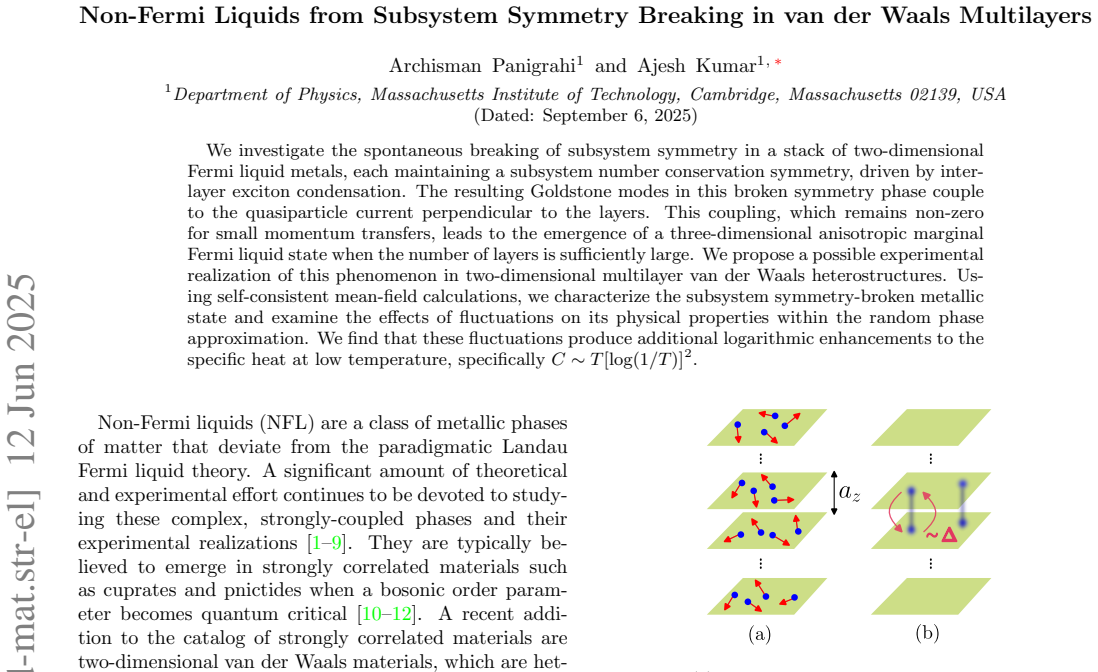


Figures from the paper (1 more)

Reference graph
Works this paper leans on
-
[1]
H. v. L¨ ohneysen, A. Rosch, M. Vojta, and P. W¨ olfle, Fermi-liquid instabilities at magnetic quantum phase transitions, Rev. Mod. Phys.79, 1015 (2007)
2007
-
[2]
S.-S. Lee, Recent Developments in Non-Fermi Liquid Theory, Annual Review of Condensed Matter Physics9, 227 (2018)
work page 2018
-
[3]
A. V. Chubukov, A. Abanov, Y. Wang, and Y.-M. Wu, The interplay between superconductivity and non-Fermi liquid at a quantum-critical point in a metal, Annals of Physics417, 168142 (2020)
work page 2020
-
[4]
C. Nayak and F. Wilczek, Non-Fermi liquid fixed point in 2 + 1 dimensions, Nuclear Physics B417, 359 (1994)
work page 1994
-
[5]
S.-S. Lee, Low-energy effective theory of Fermi surface coupled with U(1) gauge field in 2 + 1 dimensions, Phys. Rev. B80, 165102 (2009)
work page 2009
-
[6]
M. A. Metlitski and S. Sachdev, Quantum phase transi- tions of metals in two spatial dimensions. I. Ising-nematic order, Phys. Rev. B82, 075127 (2010)
work page 2010
-
[7]
M. A. Metlitski and S. Sachdev, Quantum phase transi- tions of metals in two spatial dimensions. II. Spin density wave order, Phys. Rev. B82, 075128 (2010)
2010
-
[8]
I. Mandal and S.-S. Lee, Ultraviolet/infrared mixing in non-Fermi liquids, Phys. Rev. B92, 035141 (2015)
work page 2015
Show all 60 references
-
[9]
Holder and W
T. Holder and W. Metzner, Anomalous dynamical scaling from nematic and U(1) gauge field fluctuations in two- dimensional metals, Phys. Rev. B92, 041112 (2015)
2015
-
[10]
P. A. Lee, N. Nagaosa, and X.-G. Wen, Doping a Mott in- sulator: Physics of high-temperature superconductivity, Rev. Mod. Phys.78, 17 (2006)
2006
-
[11]
Paschen and Q
S. Paschen and Q. Si, Quantum phases driven by strong correlations, Nature Reviews Physics3, 9–26 (2021)
2021
-
[12]
Taillefer, Scattering and Pairing in Cuprate Supercon- ductors, Annual Review of Condensed Matter Physics1, 51 (2010)
L. Taillefer, Scattering and Pairing in Cuprate Supercon- ductors, Annual Review of Condensed Matter Physics1, 51 (2010)
2010
-
[13]
E. Y. Andrei, D. K. Efetov, P. Jarillo-Herrero, A. H. MacDonald, K. F. Mak, T. Senthil, E. Tutuc, A. Yazdani, and A. F. Young, The marvels of moir´ e materials, Nature Reviews Materials6, 201–206 (2021)
2021
-
[14]
K. P. Nuckolls and A. Yazdani, A microscopic perspective on moir´ e materials, Nature Reviews Materials9, 460–480 (2024)
2024
-
[15]
K. F. Mak and J. Shan, Semiconductor moir´ e materials, Nature Nanotechnology17, 686–695 (2022)
2022
-
[16]
Y. Cao, V. Fatemi, S. Fang, K. Watanabe, T. Taniguchi, E. Kaxiras, and P. Jarillo-Herrero, Unconventional super- conductivity in magic-angle graphene superlattices, Na- ture556, 43–50 (2018)
2018
-
[17]
H. Zhou, T. Xie, T. Taniguchi, K. Watanabe, and A. F. Young, Superconductivity in rhombohedral trilayer graphene, Nature598, 434–438 (2021)
2021
-
[18]
D. M. Kennes, M. Claassen, L. Xian, A. Georges, A. J. Millis, J. Hone, C. R. Dean, D. N. Basov, A. N. Pa- supathy, and A. Rubio, Moir´ e heterostructures as a condensed-matter quantum simulator, Nature Physics 17, 155–163 (2021)
2021
-
[19]
J. Cai, E. Anderson, C. Wang, X. Zhang, X. Liu, W. Holtzmann, Y. Zhang, F. Fan, T. Taniguchi, K. Watanabe, Y. Ran, T. Cao, L. Fu, D. Xiao, W. Yao, and X. Xu, Signatures of fractional quantum anomalous Hall states in twisted MoTe2, Nature622, 63–68 (2023)
2023
-
[20]
Mandal and R
I. Mandal and R. M. Fernandes, Valley-polarized nematic order in twisted moir´ e systems: In-plane orbital mag- netism and crossover from non-Fermi liquid to Fermi liq- uid, Phys. Rev. B107, 125142 (2023)
2023
-
[21]
Y. Zeng, Z. Xia, K. Kang, J. Zhu, P. Kn¨ uppel, C. Vaswani, K. Watanabe, T. Taniguchi, K. F. Mak, and J. Shan, Thermodynamic evidence of fractional Chern insulator in moir´ e MoTe2, Nature622, 69–73 (2023)
2023
-
[22]
Z. Lu, T. Han, Y. Yao, A. P. Reddy, J. Yang, J. Seo, K. Watanabe, T. Taniguchi, L. Fu, and L. Ju, Fractional quantum anomalous Hall effect in multilayer graphene, Nature626, 759–764 (2024)
2024
-
[23]
Z. Wang, D. A. Rhodes, K. Watanabe, T. Taniguchi, J. C. Hone, J. Shan, and K. F. Mak, Evidence of high- temperature exciton condensation in two-dimensional atomic double layers, Nature574, 76–80 (2019)
2019
-
[24]
Shi, E.-M
Q. Shi, E.-M. Shih, D. Rhodes, B. Kim, K. Barmak, K. Watanabe, T. Taniguchi, Z. Papi´ c, D. A. Abanin, J. Hone, and C. R. Dean, Bilayer WSe2 as a natural plat- form for interlayer exciton condensates in the strong cou- pling limit, Nature Nanotechnology17, 577–582 (2022)
2022
-
[25]
Zhang, E
Z. Zhang, E. C. Regan, D. Wang, W. Zhao, S. Wang, M. Sayyad, K. Yumigeta, K. Watanabe, T. Taniguchi, S. Tongay, M. Crommie, A. Zettl, M. P. Zaletel, and F. Wang, Correlated interlayer exciton insulator in het- erostructures of monolayer WSe2 and moir´ e WS2/WSe2, Nature Physic...
2022
-
[26]
A. Y. Joe, A. M. Mier Valdivia, L. A. Jauregui, K. Pis- tunova, D. Ding, Y. Zhou, G. Scuri, K. De Greve, A. Sushko, B. Kim, T. Taniguchi, K. Watanabe, J. C. Hone, M. D. Lukin, H. Park, and P. Kim, Controlled interlayer exciton ionization in an electrostatic trap in atomically ...
2024
-
[27]
X. Liu, N. Leisgang, P. E. Dolgirev, A. A. Zibrov, J. Sung, J. Wang, T. Taniguchi, K. Watanabe, V. Walther, H. Park, E. Demler, P. Kim, and M. D. Lukin, Optical signatures of interlayer electron coherence in a bilayer semiconductor (2024), arXiv:2409.08329 [cond-mat.str- el]
2024 arXiv
-
[28]
P. X. Nguyen, R. Chaturvedi, B. Zou, K. Watanabe, T. Taniguchi, A. H. MacDonald, K. F. Mak, and J. Shan, Quantum oscillations in a dipolar excitonic insulator (2025), arXiv:2501.17829 [cond-mat.mes-hall]
2025 arXiv
-
[29]
Oganesyan, S
V. Oganesyan, S. A. Kivelson, and E. Fradkin, Quantum theory of a nematic Fermi fluid, Phys. Rev. B64, 195109 (2001)
2001
-
[30]
Xu, Quantum critical points of helical Fermi liquids, Phys
C. Xu, Quantum critical points of helical Fermi liquids, Phys. Rev. B81, 054403 (2010)
2010
-
[31]
Watanabe and A
H. Watanabe and A. Vishwanath, Criterion for stabil- ity of Goldstone modes and Fermi liquid behavior in a metal with broken symmetry, Proceedings of the National Academy of Sciences111, 16314–16318 (2014)
2014
-
[32]
Bahri and A
Y. Bahri and A. C. Potter, Stable non-Fermi-liquid phase of itinerant spin-orbit coupled ferromagnets, Phys. Rev. B92, 035131 (2015)
2015
-
[33]
Kumar, Z
A. Kumar, Z. Cheng, and A. C. Potter, Fractal non- Fermi liquids from moir´ e Hofstadter phonons, Phys. Rev. B102, 235120 (2020)
2020
-
[34]
Lake and T
E. Lake and T. Senthil, Non-Fermi Liquids from Kinetic Constraints in Tilted Optical Lattices, Phys. Rev. Lett. 131, 043403 (2023)
2023
-
[35]
Anakru and Z
A. Anakru and Z. Bi, Non-Fermi liquids from dipolar symmetry breaking, Phys. Rev. B108, 165112 (2023). 7
2023
-
[36]
Ghorai, A
U. Ghorai, A. Ghosh, S. Chakraborty, A. Das, and R. Sensarma, Excitonic metal and non-Fermi liquid be- havior in twisted double bilayer graphene near charge neutrality, Phys. Rev. B108, 045117 (2023)
2023
-
[37]
C. D. Batista and Z. Nussinov, Generalized Elitzur’s theorem and dimensional reductions, Phys. Rev. B72, 045137 (2005)
2005
-
[38]
R. M. Nandkishore and M. Hermele, Fractons, Annual Review of Condensed Matter Physics10, 295 (2019)
2019
-
[39]
Pretko, X
M. Pretko, X. Chen, and Y. You, Fracton phases of matter, International Journal of Modern Physics A35, 2030003 (2020)
2020
-
[40]
Gromov and L
A. Gromov and L. Radzihovsky, Colloquium: Fracton matter, Rev. Mod. Phys.96, 011001 (2024)
2024
-
[41]
Seiberg and S.-H
N. Seiberg and S.-H. Shao, Exotic symmetries, duality, and fractons in 2+1-dimensional quantum field theory, SciPost Phys.10, 027 (2021)
2021
-
[42]
Distler, A
J. Distler, A. Karch, and A. Raz, Spontaneously broken subsystem symmetries, Journal of High Energy Physics 2022(2022)
2022
-
[43]
Han and Y
S. Han and Y. B. Kim, Non-Fermi liquid induced by Bose metal with protected subsystem symmetries, Phys. Rev. B106, L081106 (2022)
2022
-
[44]
J. P. Eisenstein and A. H. MacDonald, Bose–Einstein condensation of excitons in bilayer electron systems, Na- ture432, 691–694 (2004)
2004
-
[45]
Eisenstein, Exciton Condensation in Bilayer Quan- tum Hall Systems, Annual Review of Condensed Matter Physics5, 159–181 (2014)
J. Eisenstein, Exciton Condensation in Bilayer Quan- tum Hall Systems, Annual Review of Condensed Matter Physics5, 159–181 (2014)
2014
-
[46]
K. Kim, N. Prasad, H. C. P. Movva, G. W. Burg, Y. Wang, S. Larentis, T. Taniguchi, K. Watanabe, L. F. Register, and E. Tutuc, Spin-Conserving Reso- nant Tunneling in Twist-Controlled WSe 2-hBN-WSe2 Heterostructures, Nano Letters18, 5967–5973 (2018)
2018
-
[47]
S. M. Sze, Y. Li, and K. K. Ng, Physics of semiconductor devices (John wiley & sons, 2021)
2021
-
[48]
Zheng, M
L. Zheng, M. W. Ortalano, and S. Das Sarma, Exchange instabilities in semiconductor double-quantum-well sys- tems, Phys. Rev. B55, 4506 (1997)
1997
-
[49]
F.-C. Wu, F. Xue, and A. H. MacDonald, Theory of two- dimensional spatially indirect equilibrium exciton con- densates, Phys. Rev. B92, 165121 (2015)
2015
-
[50]
Zhu and S
J. Zhu and S. Das Sarma, Interaction and coherence in two-dimensional bilayers, Phys. Rev. B109, 085129 (2024)
2024
-
[51]
Panigrahi, Subsystem-symmetry-breaking- NFL-codes (2024), GitHub repository
A. Panigrahi, Subsystem-symmetry-breaking- NFL-codes (2024), GitHub repository. URL: https://github.com/archisman-panigrahi/Subsystem- symmetry-breaking-NFL-codes
2024
-
[52]
Sachdev, Quantum Phase Transitions, 2nd ed
S. Sachdev, Quantum Phase Transitions, 2nd ed. (Cam- bridge University Press, Cambridge, England, 2011)
2011
-
[53]
S. A. Hartnoll and A. P. Mackenzie, Colloquium: Planck- ian dissipation in metals, Rev. Mod. Phys.94, 041002 (2022)
2022
-
[54]
Senthil, M
T. Senthil, M. Vojta, and S. Sachdev, Weak magnetism and non-Fermi liquids near heavy-Fermion critical points, Phys. Rev. B69, 035111 (2004)
2004
-
[55]
See Supplemental Material at [URL-will-be-inserted-by- publisher] for details of the calculation for self-energy, specific heat, and transport properties
-
[56]
Watanabe, S
H. Watanabe, S. A. Parameswaran, S. Raghu, and A. Vishwanath, Anomalous Fermi-liquid phase in metal- lic skyrmion crystals, Phys. Rev. B90, 045145 (2014)
2014
-
[57]
P. A. Lee and N. Nagaosa, Gauge theory of the normal state of high-T c superconductors, Phys. Rev. B46, 5621 (1992)
1992
-
[58]
M. Y. Kharitonov and K. B. Efetov, Electron screening and excitonic condensation in double-layer graphene sys- tems, Phys. Rev. B78, 241401 (2008)
2008
-
[59]
Bezanson, A
J. Bezanson, A. Edelman, S. Karpinski, and V. B. Shah, Julia: A fresh approach to numerical computing, SIAM Review59, 65 (2017)
2017
-
[60]
Peter, Numbat (2024), a statically typed programming language for scientific computations with first class sup- port for physical dimensions and units, version: 1.14.0
D. Peter, Numbat (2024), a statically typed programming language for scientific computations with first class sup- port for physical dimensions and units, version: 1.14.0. URL:https://github.com/sharkdp/numbat. 8 Appendix A: Calculation of self-energy In this section, we provi...
2024
Reviewed August 12, 2026 · model on record in the stance chip above.
Discussion (0). Continue with ORCID to comment.