REVIEW 1 cited by
Unveiling the Dark Side of UV/Optical Bright Galaxies: Optically Thick Dust Absorption
T0 review · reviewed 2026-08-12 · deepseek-v4-flash
Pith's one-line read One-third of massive galaxies at z~3 host optically thick dust substructures that hide 10-20% of their stellar mass and star formation rate.
desk verdict First census of patchy optically thick dust at z~3 with a clean out-of-sample F444W detection, but the mass/SFR fractions are model-dependent and the claimed lower-limit direction is not safe. read the letter →
The pith
A machine-rendered reading of the paper's core claim, the machinery that carries it, and where it could break.
The reading
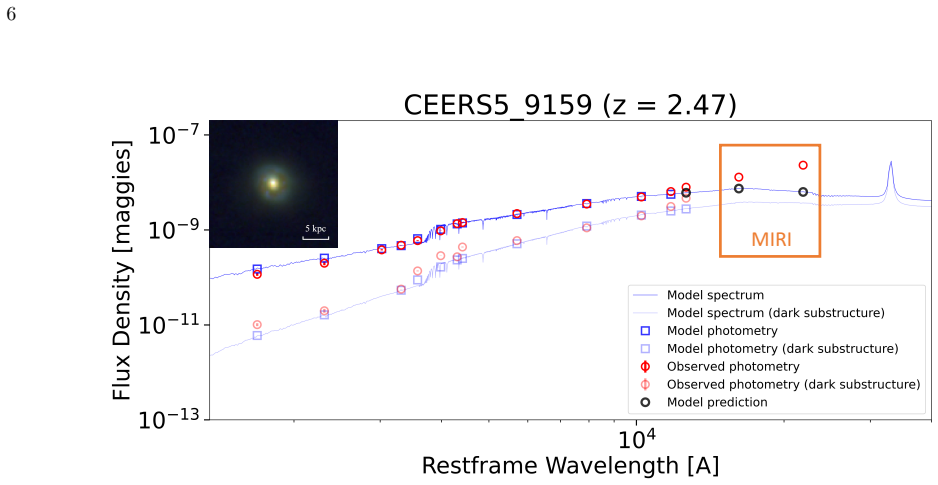
For those candidate galaxies, the authors subtracted the model image from the observed image to locate the dusty patches, then fit the light of each patch separately. They estimate that these patches contain about 10-20% of the stars and star formation in these galaxies, and that the obscured fraction does not depend strongly on galaxy mass or star formation rate. The patches are often off-center and irregular, and galaxies with a recent burst of star formation in the last 100 million years tend to have more hidden light. The main caveat is that the conversion from extra red light to hidden mass assumes the hidden regions emit like the rest of the galaxy, and any contribution from black holes (AGN) is ignored, so the true numbers could be lower or higher.
Extended reading notes
Core claim
Around one-third of the massive galaxies at z~3 show evidence of optically thick dust obscuration, which segregates on average ~10-20% of the stellar mass and SFR, i.e. they are invisible to UV/optical observations (Section 7). If correct, standard SED-based mass and SFR estimates for massive galaxies at cosmic noon are systematically low by this amount in a third of the population.
Load-bearing premise
The assumption, stated in Section 2 and used in Section 5.1, that the intrinsic spectral shapes of the optically thin and optically thick components are identical. Under this assumption, the F444W excess directly maps to obscured stellar mass and SFR using the same mass-to-light ratio as the rest of the galaxy. If the hidden regions are actually younger (as the burstiness correlation suggests) or contain AGN light, the mass-to-light ratio differs and the quoted 10-20% obscured fractions shift. The paper acknowledges this and calls its estimates lower limits.
Editorial analysis
A structured set of objections, weighed in public.
Assumptions & free parameters
free parameters (2)
- Candidate selection threshold in F444W excess =
15 sigma
- SFH binning and continuity prior =
7 lookback bins, reduced to 5 for substructures
assumptions (5)
- ad hoc to paper Intrinsic spectral shapes of optically thin and optically thick components are identical
- ad hoc to paper The F444W excess is entirely attributed to dust-obscured star formation, not AGN
- domain assumption Calzetti et al. (2000) attenuation law applies to all galaxies and substructures
- domain assumption F444W-band dust optical depth is less than unity for the searched regions
- domain assumption Parent sample selection via EAZY photo-z and stellar mass is accurate enough
Cite this review
Pith. "Pith review of Unveiling the Dark Side of UV/Optical Bright Galaxies: Optically Thick Dust Absorption." pith.science (2026). https://pith.science/paper/TPQ3QKM5
@misc{pith2026241108100,
  author       = {Pith},
  title        = {Pith review of: Unveiling the Dark Side of UV/Optical Bright Galaxies: Optically Thick Dust Absorption},
  year         = {2026},
  howpublished = {\url{https://pith.science/paper/TPQ3QKM5}},
  note         = {Machine review of arXiv:2411.08100}
}
read the original abstract
Over the past decades, a population of galaxies invisible in optical/near-infrared, but bright at longer wavelengths, have been identified through color selections. These so-called optically faint/dark galaxies are considered to be massive quiescent galaxies or highly dust-attenuated galaxies. Having the entire galaxy obscured by dust, however, is likely an extreme case of the much more common occurrence of optically thin and thick absorption coexisting in the same system. With the power of JWST imaging, we are able to spatially resolve massive galaxies at z~3, accurately model their spectral energy distributions, and identify candidate optically thick substructures. We target galaxies with log(M*/Msun)>10.3 and 2.5<z<3.5, and get 486 galaxies in CEERS and PRIMER fields. Based on excess NIR luminosity, we identify 162 galaxies (~33\% of the parent sample) as candidate hosts of optically thick substructures. We then carry out spatially resolved SED modeling to explore the physical properties of those dark substructures and estimate the amount of optically thick obscuration. We find that optically thick dust is ubiquitous in normal massive galaxies with a wide variety of SFR and morphology. 10-20\% of the stellar mass/SFR are unaccounted for in our selected galaxies, and the fraction is insensitive to stellar mass or SFR. The dark substructures are generally dustier than the rest of the galaxies and are irregularly distributed, arguing against an obscured AGN as the source of the NIR excess. A correlation between the obscured luminosity and the presence of a recent starburst in the past <100 Myr is also observed.
Figures


Figures from the paper (15 more)


Forward citations
Cited by 1 Pith paper
-
The Cosmic Evolution Early Release Science Survey (CEERS)
The CEERS survey overview shows that coordinated parallel JWST observations in the EGS field work as designed and have generated a public legacy dataset that enabled extensive early-universe science.
Reference graph
Works this paper leans on
-
[1]
, " * write output.state after.block = add.period write newline
ENTRY address archivePrefix author booktitle chapter doi edition editor eprint howpublished institution journal key month number organization pages publisher school series title misctitle type volume year version url label extra.label sort.label short.list INTEGERS output.state before.all mid.sentence after.sentence after.block FUNCTION init.state.consts ...
-
[2]
write newline
" write newline "" before.all 'output.state := FUNCTION format.url url empty "" new.block "" url * "" * if FUNCTION format.eprint eprint empty "" archivePrefix empty "" archivePrefix "arXiv" = new.block " " eprint * " " * new.block " " eprint * " " * if if if FUNCTION format.doi doi empty "" " " doi * " " * if FUNCTION format.pid doi empty eprint empty ur...
-
[3]
- [1] #1 = = ^ ^ ^ .\!\!^ d .\!\!^ h .\!\!^ m .\!\!^ s .\!\!^ @mss
thebibliography [1] 20pt to REFERENCES 6pt =0pt -12pt 10pt plus 3pt =0pt =0pt =1pt plus 1pt =0pt =0pt -12pt =13pt plus 1pt =20pt =13pt plus 1pt \@M =10000 =-1.0em =0pt =0pt 0pt =0pt =1.0em @enumiv\@empty 10000 10000 `\.\@m \@noitemerr \@latex@warning Empty `thebibliography' environment \@ifnextchar \@reference \@latexerr Missing key on reference command E...
2021
-
[4]
Alcalde Pampliega , B., P \'e rez-Gonz \'a lez , P. G., Barro , G., et al. 2019, , 876, 135, 10.3847/1538-4357/ab14f2
-
[5]
Algera , H. S. B., Inami , H., Oesch , P. A., et al. 2023, , 518, 6142, 10.1093/mnras/stac3195
-
[6]
Bagley , M. B., Finkelstein , S. L., Koekemoer , A. M., et al. 2023, , 946, L12, 10.3847/2041-8213/acbb08
-
[7]
Barrufet , L., Oesch , P. A., Weibel , A., et al. 2023, , 522, 449, 10.1093/mnras/stad947
-
[8]
2024, arXiv e-prints, arXiv:2404.08052, 10.48550/arXiv.2404.08052
Barrufet , L., Oesch , P., Marques-Chaves , R., et al. 2024, arXiv e-prints, arXiv:2404.08052, 10.48550/arXiv.2404.08052
Show all 91 references
-
[9]
1996, , 117, 393, 10.1051/aas:1996164
Bertin , E., & Arnouts , S. 1996, , 117, 393, 10.1051/aas:1996164
1996 doi
-
[10]
Bowler , R. A. A., Cullen , F., McLure , R. J., Dunlop , J. S., & Avison , A. 2022, , 510, 5088, 10.1093/mnras/stab3744
2022 doi
-
[11]
J., Conroy , C., & Johnson , B
Byler , N., Dalcanton , J. J., Conroy , C., & Johnson , B. D. 2017, , 840, 44, 10.3847/1538-4357/aa6c66
2017 doi
-
[12]
C., et al
Calzetti , D., Armus , L., Bohlin , R. C., et al. 2000, , 533, 682, 10.1086/308692
2000 doi
-
[13]
T., McQuaid , T., et al
Calzetti , D., Linden , S. T., McQuaid , T., et al. 2023, , 946, 1, 10.3847/1538-4357/acbeac
2023 doi
-
[14]
2018, , 478, 1170, 10.1093/mnras/sty1088
Carniani , S., Maiolino , R., Amorin , R., et al. 2018, , 478, 1170, 10.1093/mnras/sty1088
2018 doi
-
[15]
M., Zavala , J
Casey , C. M., Zavala , J. A., Manning , S. M., et al. 2021, , 923, 215, 10.3847/1538-4357/ac2eb4
2021 doi
- [16]
-
[17]
K., Angl \'e s-Alc \'a zar , D., Cullen , F., & Hayward , C
Cochrane , R. K., Angl \'e s-Alc \'a zar , D., Cullen , F., & Hayward , C. C. 2024, , 961, 37, 10.3847/1538-4357/ad02f8
2024 doi
-
[18]
E., & White , M
Conroy , C., Gunn , J. E., & White , M. 2009, , 699, 486, 10.1088/0004-637X/699/1/486
2009 doi
-
[19]
E., Whitaker , K
Cutler , S. E., Whitaker , K. E., Weaver , J. R., et al. 2024, , 967, L23, 10.3847/2041-8213/ad464c
2024 doi
-
[20]
P., et al
Davis , M., Guhathakurta , P., Konidaris , N. P., et al. 2007, , 660, L1, 10.1086/517931
2007 doi
-
[21]
Draine , B. T. 2003, , 41, 241, 10.1146/annurev.astro.41.011802.094840
2003 arXiv
-
[22]
2018, , 616, A110, 10.1051/0004-6361/201732370
Elbaz , D., Leiton , R., Nagar , N., et al. 2018, , 616, A110, 10.1051/0004-6361/201732370
2018 doi
-
[23]
L., Bagley , M
Finkelstein , S. L., Bagley , M. B., Ferguson , H. C., et al. 2023, , 946, L13, 10.3847/2041-8213/acade4
2023 doi
-
[24]
2018, , 620, A152, 10.1051/0004-6361/201832928
Franco , M., Elbaz , D., B \'e thermin , M., et al. 2018, , 620, A152, 10.1051/0004-6361/201832928
2018 doi
-
[25]
J., et al
Freundlich , J., Combes , F., Tacconi , L. J., et al. 2019, , 622, A105, 10.1051/0004-6361/201732223
2019 doi
-
[26]
2018, , 479, 3563, 10.1093/mnras/sty1664
Friedmann , M., & Maoz , D. 2018, , 479, 3563, 10.1093/mnras/sty1664
2018 doi
-
[27]
A., Magnelli , B., et al
Fudamoto , Y., Oesch , P. A., Magnelli , B., et al. 2020, , 491, 4724, 10.1093/mnras/stz3248
2020 doi
-
[28]
P., Mather , J
Gardner , J. P., Mather , J. C., Clampin , M., et al. 2006, , 123, 485, 10.1007/s11214-006-8315-7
2006 doi
-
[29]
P., Mather , J
Gardner , J. P., Mather , J. C., Abbott , R., et al. 2023, , 135, 068001, 10.1088/1538-3873/acd1b5
2023 doi
-
[30]
2024, , 962, 26, 10.3847/1538-4357/ad1519
Gentile , F., Talia , M., Behiri , M., et al. 2024, , 962, 26, 10.3847/1538-4357/ad1519
2024 doi
-
[31]
A., Brammer , G
Gim \'e nez-Arteaga , C., Oesch , P. A., Brammer , G. B., et al. 2023, , 948, 126, 10.3847/1538-4357/acc5ea
2023 doi
-
[32]
2023, , 677, A34, 10.1051/0004-6361/202346673
G \'o mez-Guijarro , C., Magnelli , B., Elbaz , D., et al. 2023, , 677, A34, 10.1051/0004-6361/202346673
2023 doi
-
[33]
2024, , 527, 12065, 10.1093/mnras/stad3964
Greenwell , C., Gandhi , P., Stern , D., et al. 2024, , 527, 12065, 10.1093/mnras/stad3964
2024 doi
-
[34]
A., Kocevski , D
Grogin , N. A., Kocevski , D. D., Faber , S. M., et al. 2011, , 197, 35, 10.1088/0067-0049/197/2/35
2011 doi
- [35]
-
[36]
A., Swinbank , A
Hodge , J. A., Swinbank , A. M., Simpson , J. M., et al. 2016, , 833, 103, 10.3847/1538-4357/833/1/103
2016 doi
-
[37]
W., Gonzalez , R
Holwerda , B. W., Gonzalez , R. A., Allen , R. J., & van der Kruit , P. C. 2005, , 129, 1396, 10.1086/427716
2005 doi
-
[38]
S., Zheng , X
Huang , J. S., Zheng , X. Z., Rigopoulou , D., et al. 2011, , 742, L13, 10.1088/2041-8205/742/1/L13
2011 doi
-
[39]
Hubble , E. P. 1926, , 64, 321, 10.1086/143018
1926 doi
-
[40]
J., Cowley , W
Ikarashi , S., Ivison , R. J., Cowley , W. I., & Kohno , K. 2022, , 659, A154, 10.1051/0004-6361/202141196
2022 doi
-
[41]
2022, , 935, 120, 10.3847/1538-4357/ac7f43
Ji , Z., & Giavalisco , M. 2022, , 935, 120, 10.3847/1538-4357/ac7f43
2022 doi
-
[42]
D., Leja , J., Conroy , C., & Speagle , J
Johnson , B. D., Leja , J., Conroy , C., & Speagle , J. S. 2021, , 254, 22, 10.3847/1538-4365/abef67
2021 doi
- [43]
- [44]
-
[45]
M., Faber , S
Koekemoer , A. M., Faber , S. M., Ferguson , H. C., et al. 2011, , 197, 36, 10.1088/0067-0049/197/2/36
2011 doi
-
[46]
2022, , 263, 38, 10.3847/1538-4365/ac9909
Kokorev , V., Brammer , G., Fujimoto , S., et al. 2022, , 263, 38, 10.3847/1538-4365/ac9909
2022 doi
-
[47]
2023, , 677, A172, 10.1051/0004-6361/202346937
Kokorev , V., Jin , S., G \'o mez-Guijarro , C., et al. 2023, , 677, A172, 10.1051/0004-6361/202346937
2023 doi
-
[48]
J., Almaini , O., et al
Lawrence , A., Warren , S. J., Almaini , O., et al. 2007, , 379, 1599, 10.1111/j.1365-2966.2007.12040.x
2007
-
[49]
C., Johnson , B
Leja , J., Carnall , A. C., Johnson , B. D., Conroy , C., & Speagle , J. S. 2019, , 876, 3, 10.3847/1538-4357/ab133c
2019 doi
-
[50]
M., Primack , J., & Madau , P
Lotz , J. M., Primack , J., & Madau , P. 2004, , 128, 163, 10.1086/421849
2004 doi
-
[51]
M., Casey , C
Manning , S. M., Casey , C. M., Zavala , J. A., et al. 2022, , 925, 23, 10.3847/1538-4357/ac366a
2022 doi
-
[52]
A., et al
Matthee , J., Sobral , D., Boogaard , L. A., et al. 2019, , 881, 124, 10.3847/1538-4357/ab2f81
2019 doi
-
[53]
A., Barrufet , L., Boogaard , L
Meyer , R. A., Barrufet , L., Boogaard , L. A., et al. 2024, , 681, L3, 10.1051/0004-6361/202348306
2024 doi
-
[54]
D., Lacey , C
Mitchell , P. D., Lacey , C. G., Baugh , C. M., & Cole , S. 2013, , 435, 87, 10.1093/mnras/stt1280
2013 doi
-
[55]
L., & Edmunds , M
Morgan , H. L., & Edmunds , M. G. 2003, , 343, 427, 10.1046/j.1365-8711.2003.06681.x
2003
- [56]
-
[57]
2024, , 962, 59, 10.3847/1538-4357/ad17c8
Osborne , C., & Salim , S. 2024, , 962, 59, 10.3847/1538-4357/ad17c8
2024 doi
-
[58]
Y., Ho , L
Peng , C. Y., Ho , L. C., Impey , C. D., & Rix , H.-W. 2002, , 124, 266, 10.1086/340952
2002 doi
-
[59]
G., Barro , G., Annunziatella , M., et al
P \'e rez-Gonz \'a lez , P. G., Barro , G., Annunziatella , M., et al. 2023, , 946, L16, 10.3847/2041-8213/acb3a5
2023 doi
-
[60]
G., Barro , G., Rieke , G
P \'e rez-Gonz \'a lez , P. G., Barro , G., Rieke , G. H., et al. 2024 a , , 968, 4, 10.3847/1538-4357/ad38bb
2024 doi
-
[61]
G., Rinaldi , P., Caputi , K
P \'e rez-Gonz \'a lez , P. G., Rinaldi , P., Caputi , K. I., et al. 2024 b , , 969, L10, 10.3847/2041-8213/ad517b
2024 doi
-
[62]
2016, , 594, A54, 10.1051/0004-6361/201628925
Petrushevska , T., Amanullah , R., Goobar , A., et al. 2016, , 594, A54, 10.1051/0004-6361/201628925
2016 doi
-
[63]
C., Tuffs , R
Popescu , C. C., Tuffs , R. J., Dopita , M. A., et al. 2011, , 527, A109, 10.1051/0004-6361/201015217
2011 doi
-
[64]
A., Hodge , J
Riechers , D. A., Hodge , J. A., Pavesi , R., et al. 2020, , 895, 81, 10.3847/1538-4357/ab8c48
2020 doi
-
[65]
2023, , 518, L19, 10.1093/mnrasl/slac115
Rodighiero , G., Bisigello , L., Iani , E., et al. 2023, , 518, L19, 10.1093/mnrasl/slac115
2023 doi
-
[66]
F., Lotz , J
Rodriguez-Gomez , V., Snyder , G. F., Lotz , J. M., et al. 2019, , 483, 4140, 10.1093/mnras/sty3345
2019 doi
- [67]
-
[68]
C., Daddi , E., et al
Rujopakarn , W., Williams , C. C., Daddi , E., et al. 2023, , 948, L8, 10.3847/2041-8213/accc82
2023 doi
-
[69]
2007, , 172, 1, 10.1086/516585
Scoville , N., Aussel , H., Brusa , M., et al. 2007, , 172, 1, 10.1086/516585
2007 doi
-
[70]
M., Buat , V., Haddad , W., et al
Seill \'e , L. M., Buat , V., Haddad , W., et al. 2022, , 665, A137, 10.1051/0004-6361/202243702
2022 doi
-
[71]
2022, , 926, 155, 10.3847/1538-4357/ac3de5
Shu , X., Yang , L., Liu , D., et al. 2022, , 926, 155, 10.3847/1538-4357/ac3de5
2022 doi
-
[72]
Smith , J. D. T., Draine , B. T., Dale , D. A., et al. 2007, , 656, 770, 10.1086/510549
2007 doi
-
[73]
Speagle , J. S. 2020, , 493, 3132, 10.1093/mnras/staa278
2020 doi
-
[74]
G., et al
Sun , F., Egami , E., P \'e rez-Gonz \'a lez , P. G., et al. 2021, , 922, 114, 10.3847/1538-4357/ac2578
2021 doi
- [75]
-
[76]
J., Genzel , R., & Sternberg , A
Tacconi , L. J., Genzel , R., & Sternberg , A. 2020, , 58, 157, 10.1146/annurev-astro-082812-141034
2020 doi
-
[77]
2021, , 909, 23, 10.3847/1538-4357/abd6e3
Talia , M., Cimatti , A., Giulietti , M., et al. 2021, , 909, 23, 10.3847/1538-4357/abd6e3
2021 doi
-
[78]
F., Bouwens , R
van Leeuwen , I. F., Bouwens , R. J., van der Werf , P. P., et al. 2024, , 534, 2062, 10.1093/mnras/stae2171
2024 doi
-
[79]
2016, , 816, 84, 10.3847/0004-637X/816/2/84
Wang , T., Elbaz , D., Schreiber , C., et al. 2016, , 816, 84, 10.3847/0004-637X/816/2/84
2016 doi
-
[80]
R., Cutler , S
Weaver , J. R., Cutler , S. E., Pan , R., et al. 2024, , 270, 7, 10.3847/1538-4365/ad07e0
2024 doi
-
[81]
E., Pope , A., Cybulski , R., et al
Whitaker , K. E., Pope , A., Cybulski , R., et al. 2017, , 850, 208, 10.3847/1538-4357/aa94ce
2017 doi
-
[82]
E., Labb \'e , I., van Dokkum , P
Whitaker , K. E., Labb \'e , I., van Dokkum , P. G., et al. 2011, , 735, 86, 10.1088/0004-637X/735/2/86
2011 doi
-
[83]
E., Franx , M., Leja , J., et al
Whitaker , K. E., Franx , M., Leja , J., et al. 2014, , 795, 104, 10.1088/0004-637X/795/2/104
2014 doi
-
[84]
C., Labbe , I., Spilker , J., et al
Williams , C. C., Labbe , I., Spilker , J., et al. 2019, , 884, 154, 10.3847/1538-4357/ab44aa
2019 doi
- [85]
- [86]
- [87]
-
[88]
Y., Elbaz , D., G \'o mez-Guijarro , C., et al
Xiao , M. Y., Elbaz , D., G \'o mez-Guijarro , C., et al. 2023 b , , 672, A18, 10.1051/0004-6361/202245100
2023 doi
-
[89]
2019, , 878, 73, 10.3847/1538-4357/ab0d22
Yamaguchi , Y., Kohno , K., Hatsukade , B., et al. 2019, , 878, 73, 10.3847/1538-4357/ab0d22
2019 doi
-
[90]
B., et al
Yang , G., Papovich , C., Bagley , M. B., et al. 2023, , 956, L12, 10.3847/2041-8213/acfaa0
2023 doi
-
[91]
2020, , 642, A155, 10.1051/0004-6361/202038059
Zhou , L., Elbaz , D., Franco , M., et al. 2020, , 642, A155, 10.1051/0004-6361/202038059
2020 doi
Reviewed August 12, 2026 · model on record in the stance chip above.
Discussion (0). Continue with ORCID to comment.