REVIEW 2 major objections 6 minor 36 references
Spatially Resolved Galaxy-Dust Modeling with Coupled Data-Driven Priors
T0 review · 2 major / 6 minor · reviewed 2026-08-12 · deepseek-v4-flash
Pith's one-line read A pair of score-based neural priors lets multi-band galaxy images be decomposed into intrinsic starlight and a resolved dust map, recovering host and dust properties for dust covering fractions below about 90 percent.
desk verdict A genuinely new conditional dust prior and a promising joint modeling scheme, but the headline simulation result is contaminated by training/test overlap and needs a held-out retest. read the letter →
The pith
A machine-rendered reading of the paper's core claim, the machinery that carries it, and where it could break.
The reading
What carries the argument
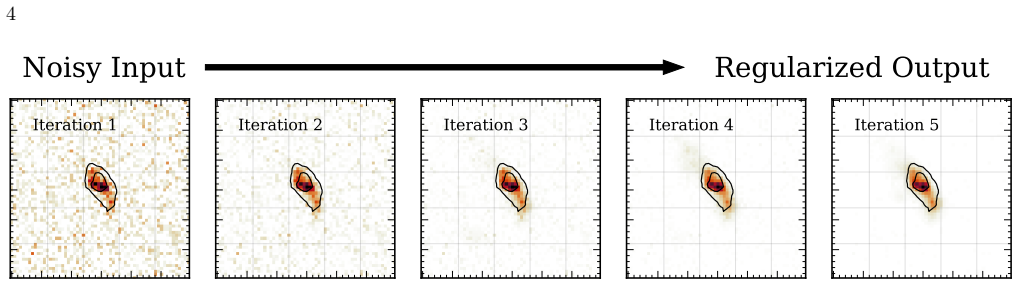
The load-bearing object is the score-matching neural-network prior, a network that outputs the gradient of the log-probability of a morphology, $\nabla \log p_{\mathrm{data}}(x)$, for the host image and, in a conditional U-Net variant, for the dust image given the host image $p(D\mid S)$. The conditional dust prior is what makes the non-parametric decomposition work: it is flat where the likelihood is flat, strongly penalizes uncorrelated pixel-scale color noise, and encodes the observed tendency for dust to track stellar light, so the optimizer can move dust where it is unconstrained by data without inventing arbitrary geometries. These score gradients are added to the likelihood gradient during gradient-descent optimization, and the fitted quantities are the host spectrum $F$, host morphology $S$, dust morphology $D$, and attenuation slope $\delta$. A supporting mechanism is the initialization scheme, which starts near zero dust and, when no red filter is available, builds a crude dust map from the bluest pixels so the regularization can refine it into a coherent dust morphology.
What would settle it
Run the method on images of galaxies that have independent spatially resolved attenuation measurements, for example Balmer-decrement maps from integral-field spectroscopy or far-infrared dust maps, and compare the inferred $A_V$ images pixel by pixel; if the residuals correlate with inclination, morphological type, or dust covering fraction in the claimed $f<90\%$ regime, the simulation-based prior is not transferring.
Extended reading notes
Core claim
The central claim is that the joint model $Y = (F^{T}S) \odot 10^{-0.4A}$, where $F$ is a one-dimensional host spectrum, $S$ is a non-parametric monochrome stellar morphology, and $A = K^{T}[-2.5\log_{10}D]$ is the dust attenuation cube with a spatially uniform slope parameter $\delta$, becomes identifiable in multi-band images once two score-based priors supply the missing regularization. The stellar prior $p(S)$ suppresses pixel noise and keeps the host morphology on the manifold of real galaxy shapes, while the conditional dust prior $p(D\mid S)$ encodes the correlation between starlight and dust location learned from radiative-transfer simulations, preventing the likelihood from interpreting every red pixel or noise fluctuation as dust. Maximum-a-posteriori optimization with these priors recovers accurate attenuation maps and unreddened spectra across a wide range of attenuation amplitudes and geometries, with the known exception of the thin-screen limit in which every line of sight is covered and the attenuation level is degenerate with an intrinsically redder spectrum. The same behavior holds when the fit is initialized only from optical bands, where the starting dust map is noisy and the priors are primarily responsible for steering it to a plausible morphology.
Load-bearing premise
The load-bearing premise is that the dust morphologies appearing in the radiative-transfer simulations used to train the conditional prior are representative of real galaxy-dust geometry, and that the same simulation set can stand in for real galaxies as a test bed.
Editorial extensions
If this is right
- Dust attenuation maps and dereddened host SEDs become obtainable for ordinary survey imaging, without requiring IFU observations, far-infrared data, or parametric galaxy models.
- Because nonuniform attenuation currently biases stellar-population mass and redshift estimates, recovering the dust map first should reduce those biases for the bulk of survey galaxies.
- The documented thin-screen failure defines a concrete development path: adding a stellar-population-synthesis prior on the host spectrum or external tracers such as the Balmer decrement and far-infrared emission should extend the method to fully covered, heavily obscured galaxies.
- Survey-scale resolved dust maps would transform studies of dust production, transport, and destruction from a few hundred galaxies to statistically powerful samples.
Reading between the lines
- The accuracy reported on simulations is probably optimistic because the same radiative-transfer catalog both trains the conditional dust prior and serves as the test set without a train/test split; performance on real galaxies outside that distribution is the open question.
- A natural extension the authors do not develop is to distill the fitted host models into a fast feed-forward network that maps images directly to dust maps, removing the need for per-object optimization at survey scale.
- The conditional prior could be recalibrated on real galaxies by cross-checking inferred $A_V$ maps against Balmer-decrement maps from integral-field surveys, turning the simulation-only prior into a genuinely data-driven one and probing whether dust geometries in nature match those in simulations.
Signed reviews
Editorial analysis
A structured set of objections, weighed in public.
Referee Report
Summary. The paper presents a joint forward model for spatially resolved galaxy and dust decomposition from multi-band optical/NIR images. The host galaxy is described by a non-parametric morphology and a single positive spectrum, while dust attenuation is described by a spatial dust map and a fitted attenuation-curve slope. Two score-based neural priors regularize the inversion: a host morphology prior trained on HSC images and a conditional dust prior p(D|S) trained on NIHAO-SKIRT radiative-transfer simulations. MAP fits are obtained with gradient descent. The method is validated on simulated griz observations of 65 NIHAO-SKIRT galaxies under red-start and blue-start initialization, and applied to three SDSS galaxies. The headline claim is accurate recovery of dust amplitude and morphology for covering fractions f < 90%, with a known thin-screen degeneracy at higher covering fractions.
Significance. If the validation is sound, the method is a meaningful step toward spatially resolved dust attenuation maps and dereddened galaxy SEDs from ordinary multi-band images, which would be valuable for the large imaging surveys now coming online. The paper has several concrete strengths: the conditional dust prior is a principled way to regularize a severely ill-posed inverse problem; the host prior is independently trained on a large sample of real HSC galaxy images; the thin-screen degeneracy is acknowledged explicitly rather than hidden; and the authors point to public catalogs and code for the host prior and the simulation library. The main qualification is that the quantitative claim in Section 3.1 is currently based on a simulated test set whose independence from the dust-prior training set is not established. If that independence is demonstrated, the paper would be a solid methods contribution.
major comments (2)
- [§2.2, §3.1] The central simulated validation is not independent of the dust prior. Section 2.2 trains the dust score model on the 65 NIHAO-SKIRT galaxies from Faucher et al. (2023), and Section 3.1 tests on "65 simulated galaxies from Faucher et al. (2023)" with three orientation angles each; no train/test split is stated anywhere in the paper. Because the public catalog contains ten viewing angles per galaxy, the reader cannot rule out that the tested orientations are drawn from the same set of images used in training. In that case, the Figure 4 residuals largely measure the dust prior's ability to recall the training distribution rather than its ability to generalize to unseen galaxy-dust geometries. This matters most in the blue-start and low-S/N regimes, where Section 2.3 states that the model "relies on our data-driven priors" and where the likelihood is too weak to correct an unrepresentative prior. Please provide a held-out validation: train the dust prior on a subset of the catalog and test on the remaining galaxies (or use leave-one-out cross-validation), and report the same recovery metrics for the held-out set. If a split was already used, state it explicitly and give the details.
- [§2.1, Eqs. (3)–(5), §3.2] The forward model as written does not include PSF convolution or a pixel response function, and the simulated validation in Section 3.1 appears to use PSF-free images. Real SDSS images are seeing-limited; even for the large galaxies considered here, the PSF is non-negligible after downsampling to 64×64 pixels, and it will mix attenuated and unattenuated light across pixel boundaries. If scarlet2 includes a PSF that is simply not shown in Eqs. (3)–(5), this should be stated explicitly and the PSF should be included in the simulated validation. If it is not included, the "realistic simulations" claim in the abstract is overstated, and the SDSS application needs to be tested with PSF-convolved images before the recovered dust maps can be interpreted at the claimed spatial resolution.
minor comments (6)
- [§3.2] The phrase "bright (mg > 16 mag)" appears to have the inequality sign reversed; all three galaxies are bright objects with apparent magnitudes below 16.
- [§3.1] The text alternates between "isochromatic" and "monochromatic" galaxies in the same paragraph; please use one term consistently.
- [§2.3] The blue-start initialization would benefit from a precise definition of the color used to rank pixels (e.g., g−i) and a description of how the bluest N% of pixels are selected within the galaxy footprint.
- [§2.2, §5] No trained weights or code are provided for the dust prior network; a data/code availability statement would improve reproducibility, especially because the host prior and the NIHAO-SKIRT catalog are already public.
- [Eq. (1) and Eq. (3)] The symbol F is used both for the spectral flux density in Eq. (1) and for the vectorized filter-integrated spectrum in Eq. (3); this overloaded notation is confusing and should be disambiguated.
- [§3.2] The residual panels in Figure 5 are only described qualitatively; reporting the RMS residual with and without the dust component would make the improvement concrete and easier to compare across S/N levels.
Circularity Check
Dust prior is trained and evaluated on the same 65 NIHAO-SKIRT galaxies, so the headline f<90% recovery is partly an in-sample check; no algebraic circularity in the model derivation.
-
fitted input called prediction
[Section 2.2 (dust prior training) and Section 3.1 (simulated-galaxy tests, Figure 4)]
"We train the network with simulated galaxies from Faucher et al. (2023). ... We begin by considering 65 simulated galaxies from Faucher et al. (2023). ... we consider all 65 galaxies from Faucher et al. (2023) and three orientation angles for each. ... We therefore rely on our data-driven priors to transform our noisy initializations into plausible galaxies."
The conditional dust prior p(D|S) is learned from the Faucher et al. (2023) NIHAO-SKIRT catalog, and the headline quantitative test (Figure 4, Section 3.1) evaluates recovery on exactly that catalog (65 galaxies, three orientations), with no stated train/test split. Because a score-model prior trained on these galaxy-dust pairs assigns high density to the true dust maps of the same galaxies, the MAP solutions in Figure 4 are attracted toward ground truth even where the image likelihood is weak; in the blue-start and low-S/N regimes the paper explicitly says the fit 'relies on our data-driven priors.' The reported f<90% accuracy is therefore an in-sample measure that partly reflects prior memorization rather than an independent prediction.
full rationale
The paper's forward model (Eqs. 1-5) and MAP optimization are not circular: the dust attenuation law, the separable SED/morphology parameterization, and the score-matching training objective are standard and do not presuppose the results. The host morphology prior is taken from Sampson et al. (2024), a public network trained on 600,000 HSC images; although that paper shares an author, the prior is independently trained and code-reproduced, so the self-citation is not load-bearing circularity. The one substantive circularity is in the evaluation design: the conditional dust prior is trained on the Faucher et al. (2023) NIHAO-SKIRT galaxies, and Section 3.1 then reports recovery of dust amplitude and morphology on those same 65 galaxies (three orientations each) without any stated train/test split. Since the prior encodes the joint distribution of the training dust/host pairs, the MAP solutions are pulled toward the very dust maps used to train the prior, particularly in the blue-start and low-S/N regimes where the paper states the fit relies on the data-driven priors. Thus the headline f<90% accuracy is an in-sample statistic, not an independent prediction. This warrants a moderate circularity score (5): the derivation itself is not equivalent to its inputs, but the central quantitative claim lacks an independent test set. The SDSS galaxy applications and the isochromatic control are external or semi-external, which prevents a higher score.
Assumptions & free parameters
free parameters (4)
- attenuation curve slope delta =
per galaxy, uniform prior in [-1, 0.5]
- score-model noise scale for host prior =
0.02
- score-model noise scale for dust prior =
0.1
- blue-start percentile N =
50%
assumptions (5)
- domain assumption Dust attenuation follows the modified Calzetti law with a single spatially uniform slope parameter delta across the galaxy (Eqs. 1 and 2).
- domain assumption Spatial and spectral variations separate: Y = F^T S and A = K^T (-2.5 log10 D) (Eqs. 3 to 5).
- domain assumption Dust morphology prior factorizes as p(S,D) = p(S) p(D|S) (Eq. 6), and the conditional relation is learned from NIHAO-SKIRT radiative-transfer simulations.
- standard math Score-matching networks trained with Gaussian noise at sigma = 0.02 or 0.1 provide an adequate approximation to the true log-density gradient at zero noise.
- domain assumption The u-band is omitted because the attenuation curve is steep in the near-UV, and the remaining griz bands sufficiently constrain the attenuation law.
Cite this review
Pith. "Pith review of Spatially Resolved Galaxy-Dust Modeling with Coupled Data-Driven Priors." pith.science (2026). https://pith.science/paper/NRTXA4KN
@misc{pith2026241108111,
  author       = {Pith},
  title        = {Pith review of: Spatially Resolved Galaxy-Dust Modeling with Coupled Data-Driven Priors},
  year         = {2026},
  howpublished = {\url{https://pith.science/paper/NRTXA4KN}},
  note         = {Machine review of arXiv:2411.08111}
}
read the original abstract
A notorious problem in astronomy is the recovery of the true shape and spectral energy distribution (SED) of a galaxy despite attenuation by interstellar dust embedded in the same galaxy. This problem has been solved for a few hundred nearby galaxies with exquisite data coverage, but these techniques are not scalable to the billions of galaxies soon to be observed by large wide-field surveys like LSST, Euclid, and Roman. We present a method for jointly modeling the spatially resolved stellar and dust properties of galaxies from multi-band images. To capture the diverse geometries of galaxies, we consider non-parametric morphologies, stabilized by two neural networks that act as data-driven priors: the first informs our inference of the galaxy's underlying morphology, the second constrains the galaxy's dust morphology conditioned on our current estimate of the galaxy morphology. We demonstrate with realistic simulations that we can recover galaxy host and dust properties over a wide range of attenuation levels and geometries. We successfully apply our joint galaxy-dust model to three local galaxies observed by SDSS. In addition to improving estimates of unattenuated galaxy SEDs, our inferred dust maps will facilitate the study of dust production, transport, and destruction.
Figures


Figures from the paper (2 more)


Reference graph
Works this paper leans on
-
[1]
1966, ApJS, 14, 1, doi: 10.1086/190147
Arp, H. 1966, ApJS, 14, 1, doi: 10.1086/190147
doi:10.1086/190147 1966
-
[2]
Bernstein, R. A., Freedman, W. L., & Madore, B. F. 2002, ApJ, 571, 56, doi: 10.1086/339422
doi:10.1086/339422 2002
-
[3]
2018, PASJ, 70, S5, doi: 10.1093/pasj/psx080
Bosch, J., Armstrong, R., Bickerton, S., et al. 2018, PASJ, 70, S5, doi: 10.1093/pasj/psx080
-
[4]
2018, JAX: composable transformations of Python+NumPy programs, 0.3.13
Bradbury, J., Frostig, R., Hawkins, P., et al. 2018, JAX: composable transformations of Python+NumPy programs, 0.3.13. http://github.com/google/jax
2018
-
[5]
Bundy, K., Bershady, M. A., Law, D. R., et al. 2015, ApJ, 798, 7, doi: 10.1088/0004-637X/798/1/7
-
[6]
Calzetti, D., Armus, L., Bohlin, R. C., et al. 2000, ApJ, 533, 682, doi: 10.1086/308692
doi:10.1086/308692 2000
-
[7]
2020, Astronomy and Computing, 31, 100381, doi: 10.1016/j.ascom.2020.100381
Camps, P., & Baes, M. 2020, Astronomy and Computing, 31, 100381, doi: 10.1016/j.ascom.2020.100381
arXiv 2020
-
[8]
2003, MNRAS, 342, 345, doi: 10.1046/j.1365-8711.2003.06541.x
Cappellari, M., & Copin, Y. 2003, MNRAS, 342, 345, doi: 10.1046/j.1365-8711.2003.06541.x
arXiv 2003
Show all 36 references
-
[9]
P., Bianchi, S., et al
Casasola, V., Cassar` a, L. P., Bianchi, S., et al. 2017, A&A, 605, A18, doi: 10.1051/0004-6361/201731020
2017 doi
-
[10]
2013, ARA&A, 51, 393, doi: 10.1146/annurev-astro-082812-141017
Conroy, C. 2013, ARA&A, 51, 393, doi: 10.1146/annurev-astro-082812-141017
2013 doi
-
[11]
I., Baes, M., Bianchi, S., et al
Davies, J. I., Baes, M., Bianchi, S., et al. 2017, PASP, 129, 044102, doi: 10.1088/1538-3873/129/974/044102
2017 doi
-
[12]
Draine, B. T. 2003, ARA&A, 41, 241, doi: 10.1146/annurev.astro.41.011802.094840
2003 arXiv
-
[13]
R., & Macci` o, A
Faucher, N., Blanton, M. R., & Macci` o, A. V. 2023, ApJ, 957, 7, doi: 10.3847/1538-4357/acf9f0
2023 doi
-
[14]
J., Arag´ on-Salamanca, A., Merrifield, M
Greener, M. J., Arag´ on-Salamanca, A., Merrifield, M. R., et al. 2020, MNRAS, 495, 2305, doi: 10.1093/mnras/staa1300
2020 doi
-
[15]
R., Vieira, J
Greve, T. R., Vieira, J. D., Weiß, A., et al. 2012, ApJ, 756, 101, doi: 10.1088/0004-637X/756/1/101 G¨ uver, T., &¨Ozel, F. 2009, MNRAS, 400, 2050, doi: 10.1111/j.1365-2966.2009.15598.x
2012
- [16]
-
[17]
2002, MNRAS, 337, 921, doi: 10.1046/j.1365-8711.2002.05968.x
Hirashita, H., & Ferrara, A. 2002, MNRAS, 337, 921, doi: 10.1046/j.1365-8711.2002.05968.x
2002
-
[18]
2021, Differentiable Programming workshop at Neural Information Processing Systems 2021
Kidger, P., & Garcia, C. 2021, Differentiable Programming workshop at Neural Information Processing Systems 2021
2021
-
[19]
P., & Ba, J
Kingma, D. P., & Ba, J. 2015, in 3rd International Conference on Learning Representations, ICLR 2015, San
2015
-
[20]
http://arxiv.org/abs/1412.6980
Diego, CA, USA, May 7-9, 2015, Conference Track Proceedings. http://arxiv.org/abs/1412.6980
2015 arXiv
-
[21]
2013, The Astrophysical Journal Letters, 775, L16, doi: 10.1088/2041-8205/775/1/L16
Kriek, M., & Conroy, C. 2013, The Astrophysical Journal Letters, 775, L16, doi: 10.1088/2041-8205/775/1/L16
2013 doi
-
[22]
2011, arXiv e-prints, arXiv:1110.3193, doi: 10.48550/arXiv.1110.3193 LSST Science Collaboration, Abell, P
Laureijs, R., Amiaux, J., Arduini, S., et al. 2011, arXiv e-prints, arXiv:1110.3193, doi: 10.48550/arXiv.1110.3193 LSST Science Collaboration, Abell, P. A., Allison, J., et al. 2009, arXiv e-prints, arXiv:0912.0201, doi: 10.48550/arXiv.0912.0201
-
[23]
2018, Astronomy and Computing, 24, 129, doi: 10.1016/j.ascom.2018.07.001
Melchior, P., Moolekamp, F., Jerdee, M., et al. 2018, Astronomy and Computing, 24, 129, doi: 10.1016/j.ascom.2018.07.001
2018 doi
-
[24]
2009, Astronomy and astrophysics, 499, 69, doi: 10.1051/0004-6361/200811526
Noll, S., Pierini, D., Cimatti, A., et al. 2009, Astronomy and astrophysics, 499, 69, doi: 10.1051/0004-6361/200811526
2009 doi
- [25]
-
[26]
2020, ARA&A, 58, 529, doi: 10.1146/annurev-astro-032620-021933
Salim, S., & Narayanan, D. 2020, ARA&A, 58, 529, doi: 10.1146/annurev-astro-032620-021933
2020 doi
- [27]
-
[28]
2010, MNRAS, 407, 1581, doi: 10.1111/j.1365-2966.2010.17047.x Galaxy Dust Maps 11
Shen, S., Wadsley, J., & Stinson, G. 2010, MNRAS, 407, 1581, doi: 10.1111/j.1365-2966.2010.17047.x Galaxy Dust Maps 11
2010
-
[29]
2019, in Advances in Neural Information Processing Systems, ed
Song, Y., & Ermon, S. 2019, in Advances in Neural Information Processing Systems, ed. H. Wallach, H. Larochelle, A. Beygelzimer, F. d 'Alch´ e-Buc, E. Fox, & R. Garnett, Vol. 32 (Curran Associates, Inc.). https://proceedings.neurips.cc/paper files/paper/2019/ file/3001ef257407...
2019
-
[30]
2020, in Advances in Neural Information Processing Systems, ed
Song, Y., & Ermon, S. 2020, in Advances in Neural Information Processing Systems, ed. H. Larochelle, M. Ranzato, R. Hadsell, M. Balcan, & H. Lin, Vol. 33 (Curran Associates, Inc.), 12438–12448. https://proceedings.neurips.cc/paper files/paper/2020/ file/92c3b916311a5517d929057...
2020
- [31]
-
[32]
S., Brook, C., Macci` o, A
Stinson, G. S., Brook, C., Macci` o, A. V., et al. 2013, MNRAS, 428, 129, doi: 10.1093/mnras/sts028
2013 doi
-
[33]
A., Kriek, M., Price, S
Suess, K. A., Kriek, M., Price, S. H., & Barro, G. 2019, ApJ, 877, 103, doi: 10.3847/1538-4357/ab1bda van den Oord, A., Kalchbrenner, N., Vinyals, O., et al. 2016, arXiv [cs.CV]. https://arxiv.org/abs/1606.05328
2019 arXiv
-
[34]
A., Stinson, G
Wang, L., Dutton, A. A., Stinson, G. S., et al. 2015, MNRAS, 454, 83, doi: 10.1093/mnras/stv1937
2015 doi
-
[35]
M., Genzel, R., et al
Wuyts, S., F¨ orster Schreiber, N. M., Genzel, R., et al. 2012, ApJ, 753, 114, doi: 10.1088/0004-637X/753/2/114
2012 doi
-
[36]
G., Adelman, J., Anderson, John E., J., et al
York, D. G., Adelman, J., Anderson, John E., J., et al. 2000, AJ, 120, 1579, doi: 10.1086/301513
2000 doi
Reviewed August 12, 2026 · model on record in the stance chip above.
Discussion (0). Continue with ORCID to comment.