A cat qubit stabilization scheme using a voltage biased Josephson junction
Pith reviewed 2026-05-23 17:00 UTC · model grok-4.3
The pith
A DC-voltage-biased Josephson junction stabilizes cat qubits with a stronger two-to-one photon exchange rate than parametric pumps while averaging out Kerr terms.
A machine-rendered reading of the paper's core claim, the machinery that carries it, and where it could break.
Core claim
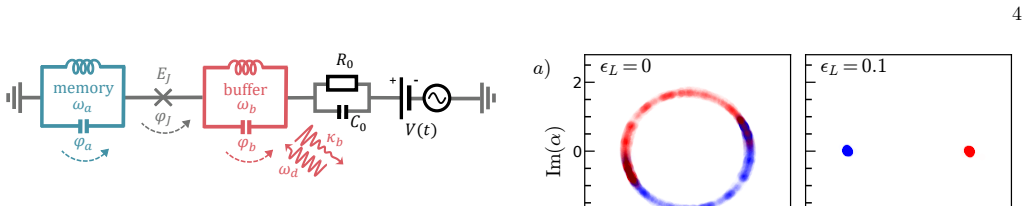
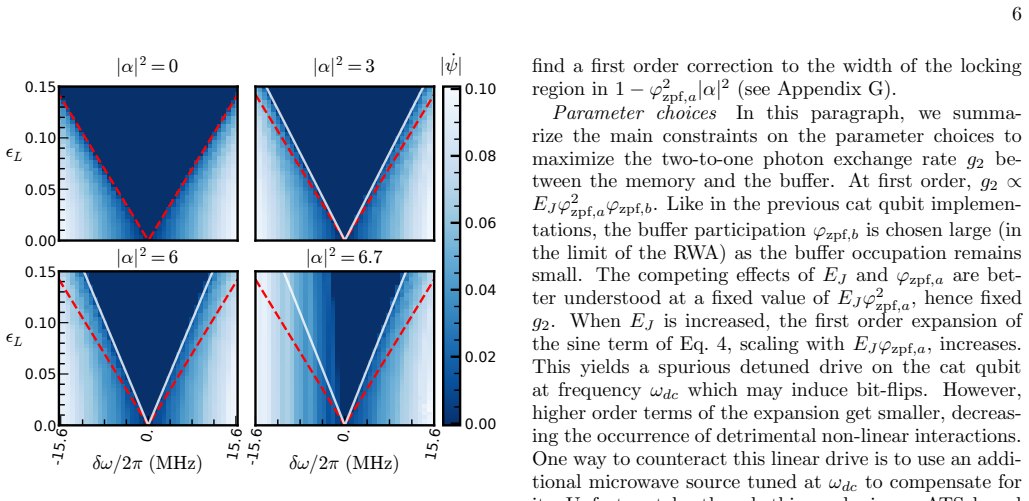
A simple circuit employing a DC-voltage-biased Josephson junction produces a two-to-one photon exchange rate larger than that obtained with parametric pumps, while the bias dynamically averages typically resonant parasitic terms such as Kerr and cross-Kerr; injection locking with a frequency filter is proposed to suppress long-term angle drifts from voltage noise, and the entire scheme is simulated without rotating-wave approximations to expose oscillatory effects.
What carries the argument
The DC-voltage-biased Josephson junction that supplies the two-to-one photon exchange interaction and dynamically averages parasitic Kerr terms.
If this is right
- The two-to-one photon exchange rate exceeds the value achieved by parametric-pump implementations.
- Kerr and cross-Kerr terms are dynamically averaged by the bias without extra circuit elements.
- Injection locking prevents long-term drifts of the cat-qubit angle caused by DC voltage fluctuations.
- Simulations without rotating-wave approximations quantify oscillatory effects present in the stabilization.
- The design provides concrete groundwork for experimental realization of the circuit.
Where Pith is reading between the lines
- Successful implementation could translate the larger interaction strength into lower overhead for quantum error correction with cat qubits.
- The same voltage-bias technique may be adapted to other Hamiltonian-engineering tasks that currently rely on parametric drives.
- Direct side-by-side experiments could quantify how much the rate improvement and Kerr suppression actually reduce bit-flip error rates.
- The frequency-filter parameters needed for stable locking could be optimized by measuring residual phase diffusion under realistic voltage noise.
Load-bearing premise
Injection locking through a cat-qubit-adapted frequency filter can suppress long-term angle drifts from DC voltage noise without adding new decoherence channels or demanding unattainable voltage stability.
What would settle it
An experiment that measures the two-to-one photon exchange rate in the proposed circuit, compares it directly to a parametric-pump implementation, and checks whether Kerr terms remain suppressed under the DC bias.
Figures




read the original abstract
DC-voltage-biased Josephson junctions have been recently employed in superconducting circuits for Hamiltonian engineering, demonstrating microwave amplification, single photon sources and entangled photon generation. Compared to more conventional approaches based on parametric pumps, this solution typically enables larger interaction strengths. In the context of quantum information, a two-to-one photon interaction can stabilize cat qubits, where bit-flip errors are exponentially suppressed, promising significant resource savings for quantum error correction. This work investigates how the DC bias approach to Hamiltonian engineering can benefit cat qubits. We find a simple circuit design that is predicted to showcase a two-to-one photon exchange rate larger than that of the parametric pump-based implementation while dynamically averaging typically resonant parasitic terms such as Kerr and cross Kerr. In addition to addressing qubit stabilization, we propose to use injection locking with a cat-qubit adapted frequency filter to prevent long-term drifts of the cat qubit angle associated to DC voltage noise. The whole scheme is simulated without rotating-wave approximations, highlighting for the first time the amplitude of related oscillatory effects in cat-qubit stabilization schemes. This study lays the groundwork for the experimental realization of such a circuit.
Editorial analysis
A structured set of objections, weighed in public.
Referee Report
Summary. The manuscript proposes a simple circuit using a DC-voltage-biased Josephson junction to engineer a two-to-one photon interaction for cat-qubit stabilization. It claims this yields a larger interaction rate than parametric-pump implementations while dynamically averaging resonant parasitic terms (Kerr, cross-Kerr). The scheme is simulated without rotating-wave approximation; an additional proposal uses injection locking through a cat-qubit-adapted frequency filter to suppress long-term angle drifts from DC voltage noise.
Significance. If the larger interaction rate and dynamic averaging hold under realistic conditions, the approach could improve cat-qubit bit-flip suppression and resource efficiency in quantum error correction. The explicit simulation without rotating-wave approximation is a strength, as it quantifies oscillatory effects that are typically neglected.
major comments (1)
- [Abstract] Abstract (final paragraph): the injection-locking scheme with a cat-qubit-adapted frequency filter is presented as an 'in addition' proposal to suppress DC-voltage-induced angle drifts, yet it is neither derived from the circuit Hamiltonian nor included in the numerical simulation; because the central claim requires both the larger rate/averaging and a practical stabilization method, this unvalidated assumption is load-bearing for the viability of the full scheme.
minor comments (1)
- [Abstract] The abstract states that the two-to-one rate is 'larger' but supplies neither the numerical value, comparison baseline, nor error bars from the simulation; adding these would make the central prediction more concrete.
Simulated Author's Rebuttal
We thank the referee for their detailed review and constructive criticism. We address the single major comment below, agreeing where the observation is accurate and outlining the planned revision.
read point-by-point responses
-
Referee: [Abstract] Abstract (final paragraph): the injection-locking scheme with a cat-qubit-adapted frequency filter is presented as an 'in addition' proposal to suppress DC-voltage-induced angle drifts, yet it is neither derived from the circuit Hamiltonian nor included in the numerical simulation; because the central claim requires both the larger rate/averaging and a practical stabilization method, this unvalidated assumption is load-bearing for the viability of the full scheme.
Authors: We agree with the referee that the injection-locking scheme is presented as an additional proposal, is not derived from the circuit Hamiltonian, and is not included in the numerical simulations. The central results of the manuscript concern the DC-voltage-biased Josephson junction circuit itself, which is shown (via RWA-free simulations) to deliver a larger two-to-one photon exchange rate while dynamically averaging resonant Kerr and cross-Kerr terms. The injection-locking idea is offered separately as one possible route to suppress long-term angle drifts arising from DC-voltage fluctuations, an issue that would appear in any cat-qubit stabilization scheme using a DC bias. Because this proposal is indeed unvalidated within the present work, we will revise the abstract (and the corresponding paragraph in the main text) to make explicit that the injection-locking scheme is a conceptual suggestion for future experimental implementation rather than a fully developed component of the current study. This change will be incorporated in the revised manuscript. revision: yes
Circularity Check
No circularity: rates from direct Hamiltonian simulation, stabilization proposal stated separately
full rationale
The paper derives its central claim of a larger two-to-one photon exchange rate with dynamic averaging of Kerr terms from a proposed circuit Hamiltonian simulated without RWA; these quantities are not obtained by fitting parameters to data within the paper and then relabeling the fit as a prediction. The injection-locking stabilization is introduced explicitly as an additional proposal in the abstract and is not asserted to follow from the circuit equations or to have been validated inside the same simulation. No self-citations are used to import uniqueness theorems or ansatzes that would close the derivation on itself. The work is therefore self-contained against external benchmarks and receives the default non-circularity finding.
Axiom & Free-Parameter Ledger
axioms (1)
- domain assumption Standard superconducting circuit quantization and Josephson junction Hamiltonian apply without additional loss mechanisms from the DC bias line.
Reference graph
Works this paper leans on
-
[1]
R. Acharya, I. Aleiner, R. Allen, T. I. Andersen, M. Ans- mann, F. Arute, K. Arya, A. Asfaw, J. Atalaya, R. Bab- bush, D. Bacon, J. C. Bardin, J. Basso, A. Bengtsson, S. Boixo, G. Bortoli, A. Bourassa, J. Bovaird, L. Brill, M. Broughton, B. B. Buckley, D. A. Buell, T. Burger, B. Burkett, N. Bushnell, Y. Chen, Z. Chen, B. Chiaro, J. Cogan, R. Collins, P. C...
work page 2023
-
[2]
M. Mirrahimi, Z. Leghtas, V. V. Albert, S. Touzard, R. J. Schoelkopf, L. Jiang, and M. H. Devoret, New Journal of Physics 16, 045014 (2014)
work page 2014
-
[3]
S. Puri, S. Boutin, and A. Blais, npj Quantum Informa- tion 3, 10.1038/s41534-017-0019-1 (2017)
- [4]
-
[5]
Z. Leghtas, S. Touzard, I. M. Pop, A. Kou, B. Vlastakis, A. Petrenko, K. M. Sliwa, A. Narla, S. Shankar, M. J. Ha- tridge, M. Reagor, L. Frunzio, R. J. Schoelkopf, M. Mir- rahimi, and M. H. Devoret, Science 347, 853 (2015)
work page 2015
-
[6]
R. Gautier, M. Mirrahimi, and A. Sarlette, PRX Quan- tum 4, 10.1103/prxquantum.4.040316 (2023)
- [7]
-
[8]
S. Touzard, A. Grimm, Z. Leghtas, S. O. Mundhada, P. Reinhold, C. Axline, M. Reagor, K. Chou, J. Blumoff, K. M. Sliwa, S. Shankar, L. Frunzio, R. J. Schoelkopf, M. Mirrahimi, and M. H. Devoret, Phys. Rev. X 8, 021005 (2018)
work page 2018
-
[9]
C. Berdou, A. Murani, U. R´ eglade, W. Smith, M. Villiers, J. Palomo, M. Rosticher, A. Denis, P. Morfin, M. Del- becq, T. Kontos, N. Pankratova, F. Rautschke, T. Per- onnin, L.-A. Sellem, P. Rouchon, A. Sarlette, M. Mir- rahimi, P. Campagne-Ibarcq, S. Jezouin, R. Lescanne, and Z. Leghtas, PRX Quantum 4, 020350 (2023)
work page 2023
-
[10]
U. R´ eglade, A. Bocquet, R. Gautier, J. Cohen, A. Marquet, E. Albertinale, N. Pankratova, M. Hall´ en, F. Rautschke, L.-A. Sellem, P. Rouchon, A. Sarlette, M. Mirrahimi, P. Campagne-Ibarcq, R. Lescanne, S. Je- zouin, and Z. Leghtas, Nature 629, 778
-
[11]
H. Putterman, K. Noh, R. N. Patel, G. A. Peairs, G. S. MacCabe, M. Lee, S. Aghaeimeibodi, C. T. Hann, I. Jar- rige, G. Marcaud, Y. He, H. Moradinejad, J. C. Owens, T. Scaffidi, P. Arrangoiz-Arriola, J. Iverson, H. Levine, F. G. S. L. Brand˜ ao, M. H. Matheny, and O. Painter, Pre- serving phase coherence and linearity in cat qubits with exponential bit-fli...
-
[12]
A. Marquet, A. Essig, J. Cohen, N. Cottet, A. Murani, E. Albertinale, S. Dupouy, A. Bienfait, T. Peronnin, S. Jezouin, R. Lescanne, and B. Huard, Phys. Rev. X 14, 021019 (2024)
work page 2024
-
[13]
A. Marquet, S. Dupouy, U. R´ eglade, A. Essig, J. Co- hen, E. Abertinale, A. Bienfait, T. Peronnin, S. Jezouin, R. Lescanne, and B. Huard, arXiv:2403.07744 [quant-ph] (2024), arXiv:2403.07744
- [14]
-
[15]
M. Hofheinz, F. Portier, Q. Baudouin, P. Joyez, D. Vion, P. Bertet, P. Roche, and D. Esteve, Physical Review Let- ters 106, 10.1103/physrevlett.106.217005 (2011)
-
[16]
M. C. Cassidy, A. Bruno, S. Rubbert, M. Irfan, J. Kammhuber, R. N. Schouten, A. R. Akhmerov, and L. P. Kouwenhoven, Science 355, 939–942 (2017)
work page 2017
- [17]
-
[19]
A. Peugeot, G. M´ enard, S. Dambach, M. Wes- tig, B. Kubala, Y. Mukharsky, C. Altimiras, P. Joyez, D. Vion, P. Roche, D. Esteve, P. Mil- man, J. Lepp¨ akangas, G. Johansson, M. Hofheinz, J. Ankerhold, and F. Portier, Physical Review X 11, 10.1103/physrevx.11.031008 (2021)
-
[20]
G. C. M´ enard, A. Peugeot, C. Padurariu, C. Rolland, B. Kubala, Y. Mukharsky, Z. Iftikhar, C. Altimiras, P. Roche, H. le Sueur, P. Joyez, D. Vion, D. Esteve, J. Ankerhold, and F. Portier, Physical Review X 12, 10.1103/physrevx.12.021006 (2022)
- [21]
-
[22]
A. Balanov, N. Janson, D. Postnovand, and O. Sosnovt- seva, Synchronization From Simple to Complex (Springer Berlin Heidelberg, 2009)
work page 2009
-
[23]
A. Pikovsky, M. Rosenblum, and J. Kurths, Synchroniza- tion: A Universal Concept in Nonlinear Sciences (Cam- bridge University Press, 2001)
work page 2001
-
[24]
A. Bengtsson, P. Krantz, M. Simoen, I.-M. Svensson, B. Schneider, V. Shumeiko, P. Delsing, and J. Bylan- der, Physical Review B 97, 10.1103/physrevb.97.144502 (2018)
-
[25]
D. Markovi´ c, J. Pillet, E. Flurin, N. Roch, and B. Huard, Physical Review Applied 12, 10.1103/phys- revapplied.12.024034 (2019)
-
[26]
L. Danner, C. Padurariu, J. Ankerhold, and B. Kubala, Physical Review B 104, 10.1103/physrevb.104.054517 (2021)
-
[27]
G. Lakshmi Bhai, H. Mukai, and J.-S. Tsai, Applied Physics Letters 122, 10.1063/5.0134702 (2023)
-
[28]
S. Meister, M. Mecklenburg, V. Gramich, J. T. Stock- burger, J. Ankerhold, and B. Kubala, Physical Review B 92, 10.1103/physrevb.92.174532 (2015)
-
[29]
C. Chamberland, K. Noh, P. Arrangoiz-Arriola, E. T. Campbell, C. T. Hann, J. Iverson, H. Putterman, T. C. Bohdanowicz, S. T. Flammia, A. Keller, G. Refael, J. Preskill, L. Jiang, A. H. Safavi-Naeini, O. Painter, and F. G. Brand˜ ao, PRX Quantum3, 010329 (2022)
work page 2022
-
[30]
C. Hamilton, C. Burroughs, and S. Benz, IEEE Transac- tions on Appiled Superconductivity 7, 3756–3761 (1997)
work page 1997
- [31]
- [32]
-
[33]
A. Vrajitoarea, Z. Huang, P. Groszkowski, J. Koch, and A. A. Houck, Nature Physics 16, 211–217 (2019)
work page 2019
-
[34]
D. Ruiz, J. Guillaud, A. Leverrier, M. Mirrahimi, and C. Vuillot, arXiv 10.48550/ARXIV.2401.09541 (2024)
-
[35]
D. S. Schlegel, F. Minganti, and V. Savona, Physical Re- view A 106, 10.1103/physreva.106.022431 (2022)
-
[36]
Q. Xu, G. Zheng, Y.-X. Wang, P. Zoller, A. A. Clerk, and L. Jiang, npj Quantum Information 9, 10.1038/s41534- 023-00746-0 (2023)
-
[37]
T. Hillmann and F. Quijandr´ ıa, Physical Review A107, 10.1103/physreva.107.032423 (2023)
-
[38]
E. A. Sete, J. M. Martinis, and A. N. Korotkov, Phys. Rev. A 92, 012325 (2015)
work page 2015
-
[39]
J. A. Sanders, F. Verhulst, and J. Murdock, Averag- ing methods in nonlinear dynamical systems , Vol. 59 (Springer, 2007)
work page 2007
-
[40]
Indeed, these would make ˜fk much larger than ∂ ∂t ˜fk, to a point that ϵk with ϵ ≪ 1 could not compensate
-
[41]
P. Rouchon and M. Mirrahimi, Lecture notes (2015). 9 APPENDIX We here give more details about the results of the main text. Appendix A recalls the approximations involved in obtaining the (quantum) two-photon exchange Hamilto- nian as a dominant contribution of our setup. Appendix B gives details on quantum simulation, with frequency-filtered dissipation....
work page 2015
-
[42]
The photon parity, which corresponds to the unprotected degree of freedom of the bosonic cat-qubit code (phase flips), remains unaffected. The strict validity of this analysis relies on the limit φzpf,aα , φ zpf,b ≪ 1, which we push rather boldly with the values taken in the main paper simulations. Nevertheless, those full-system simulations, using the fa...
-
[43]
Analyzing the dynamics with higher-order RWA (averaging theory) Injection locking is a long-term stabilization phenomenon in a fast oscillating system, thus featuring a timescale separation ε ≪ 1. As such, locking can usually be highlighted by performing a time-dependent change of frame, approximately following the dominant oscillations, in order to push ...
-
[44]
the system motion itself is much slower than the characteristic oscillation frequency
The starting point is a dynamical system in standard form: ˙x = f(x, t) where f(·, t) oscillates at frequencies ω larger than some characteristic frequency ωc, and ∥f ∥ / ωc = ε ≪ 1 i.e. the system motion itself is much slower than the characteristic oscillation frequency. We assume all functions to be smooth, in particular with derivatives in x being O(1...
-
[45]
The first-order average dynamics is obtained by just taking the time-average off(x, t) assuming x fixed. In other words, we define ˙x = ¯f(x) + ∂ ∂t ˜f(x, t) (E8) where ¯f has no explicit time-dependence and ∂ ∂t ˜f(·, t) has zero time-average; at first order, ˙x ≃ ¯f(x) . Usually, the locking phenomenon does not appear yet at this first order. Writing ∂ ...
-
[46]
To push the oscillating vector field to the next order , we perform the change of variable x1 = x − ˜f(x, t) , (E9) which is close to identity and hence well-defined, since ∥ ˜f ∥ = O(ε). Replacing this in (E8), we get: ˙x1 = ¯f(x) − ∇x ˜f(x, t) · ¯f(x) + ∂ ∂t ˜f(x, t) = ¯f(x1) + ∇x1 ¯f · ˜f(x1, t) − ∇x1 ˜f · ¯f(x1) + ∂ ∂t ˜f(x1, t) + O(ε3) , where in the...
-
[47]
The last point is to analyze the second-order dynamics, where locking is expected to appear. If an exponentially stable behavior is found at this order, then (for sufficiently small ε) it will dominate and persist in the full dynamics. • The general linear circuit can be partly discussed on the basis of its frequency content. - A stationary component is n...
-
[48]
Including noise in the model Echoing the analysis of Appendix C, we can write a stochastic model including white noise and analyze its behavior in presence of the injection locking dynamics. From the analysis just made, we can reduce this to the simple model : dφ(t) J,1 = ϵLν0 2 sin(φ(t) J,1) dt + 2√κϕ dWt ≃ −ϵLν0 2 φ(t) J,1 dt + 2√κϕ dWt , (E12) 23 assum...
discussion (0)
Sign in with ORCID, Apple, or X to comment. Anyone can read and Pith papers without signing in.